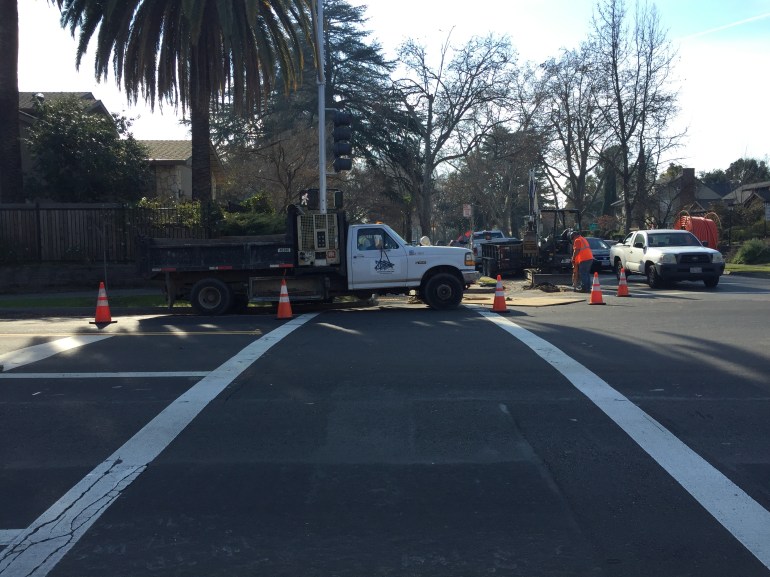
Sacramento City continues its practice of approving construction projects that do not consider the needs of walkers and bicyclists. Here is the latest I ran across, on Folsom Blvd between Santa Ynez Way and 39th St. The construction on the south side appears to be installing cable or fiber. At the west end, there is a sudden ‘sidewalk closed’ sign. There is no prior warning, there is no ramp or marked crosswalk for crossing Folsom to the north side (it requires crossing an offset intersection diagonally to go from one ramp to another, an exceptionally long distance), and there is no indication about how long the detour is.
At the other end, there is the same sort of signing without any prior warning or information provided.
At this location, 39th St, there is a marked crosswalk with traffic signal which could allow people to cross Folsom, but just to make sure the message that pedestrians are unwelcome here is clearly received, a construction truck was parked across the crosswalk. When I asked the construction crew to move the truck, they refused. I reported it to parking enforcement but am not sure of the outcome.
Of course there is a bicycle lane along this section of Folsom Blvd, which is also blocked by the construction. That may be justifiable, but you would think that forcing bicyclists to share the general purpose traffic lane would justify a reduction of the speed limit from 35 mph to 25 mph, but no, that that would inconvenience drivers and in the city, that is not to be considered.
This kind of bias against walkers and bicyclists should be unacceptable in the city. And it would be if the staff of Construction Services were not biased against walkers and bicyclists. Time to replace that staff with people who care about all modes of travel.
In my neighborhood, about half the trees have lost all their leaves for the year, and the other half are still hanging on. If I listen closely, I can hear the tick of leaves hitting the ground.
So, how have the bike lanes been doing during leaf season? At least for the parts of the central city and east Sacramento that I ride in, acceptably OK. People are putting their leaf piles in the bike lanes much less often than in previous years. I’m not sure why. I haven’t noticed any city effort to educate about this, other than a vague “When possible, avoid placing piles in bike lanes.” on their Leaf Season page. But I really do believe there are less piles in the bike lanes. Maybe people are beginning to clue in. If only there were a similar improvement in trash cans in bike lanes.
A big concern was how the new separated bikeways (‘protected bike lanes’, ‘cycletracks’) on P and Q and 10th (and now 9th) would do. The city has not yet purchased a device for sweeping these bike facilities. Apparently the ‘the claw’, the loader that collects the leaf piles and moves them into dump trucks, can negotiate the bikeways, and this is how they have been kept clear. This is working pretty well, all except for one block, pictured below. This section of P Street between 15th and 14th has a large accumulation of leaves, and the leaves have developed into leaf slime, with is an incredibly slippery mush of decayed leaves. I am not sure what is different about this block, but it certainly is different. It needs to be cleaned now, and cleaned more frequently.
4. Sacramento, California The J Street Safety Project was designed to calm traffic, improve pedestrian crossings, provide parking-protected bikeways, and make the street more inviting for travel. They chose to add a parking-protected lane to allow people of all ages and levels to bike the grid, separated from moving traffic. Travel lanes were reduced from 3 to 2, encouraging slower vehicle speeds, decreasing pedestrian crossing lengths, and improving corridor safety. The project came out of the Central City Transportation Plan (Grid 3.0) in 2016, and is a marriage of street maintenance funding and transportation planning. They found that there was a need to calm traffic and improve pedestrian crossings, which was identified by the local businesses and residential community. The project improves pedestrian visibility by moving parking back from the intersection. It also benefits local businesses along the corridor by slowing traffic and increasing ease of crossing the corridor. So far they’ve built over 25 blocks of parking-protected bikeways this year, and have funding for another 22 blocks.
California Vehicle Code 21950, failure to yield to pedestrians, is in my opinion the most important violation as it applies to implementing Vision Zero in Sacramento. The Vision Zero Sacramento Action Plan (draft) says “Launch high-visibility enforcement campaigns against speeding, failure to yield to pedestrians, distracted driving, and impaired driving. Campaigns will focus on HIN corridors.” The state code says:
21950. (a) The driver of a vehicle shall yield the right-of-way to a pedestrian crossing the roadway within any marked crosswalk or within any unmarked crosswalk at an intersection, except as otherwise provided in this chapter. (b) This section does not relieve a pedestrian from the duty of using due care for his or her safety. No pedestrian may suddenly leave a curb or other place of safety and walk or run into the path of a vehicle that is so close as to constitute an immediate hazard. No pedestrian may unnecessarily stop or delay traffic while in a marked or unmarked crosswalk. (c) The driver of a vehicle approaching a pedestrian within any marked or unmarked crosswalk shall exercise all due care and shall reduce the speed of the vehicle or take any other action relating to the operation of the vehicle as necessary to safeguard the safety of the pedestrian. (d) Subdivision (b) does not relieve a driver of a vehicle from the duty of exercising due care for the safety of any pedestrian within any marked crosswalk or within any unmarked crosswalk at an intersection.
VEHICLE CODE – VEH, DIVISION 11. RULES OF THE ROAD,CHAPTER 5. Pedestrians’ Rights and Duties; http://leginfo.legislature.ca.gov/faces/codes_displaySection.xhtml?lawCode=VEH§ionNum=21950; retrieved 2018-12-15
So, how is the Sacramento Police Department doing on enforcing this code against drivers who fail to yield to pedestrians in the crosswalk? Well, from the ‘Sacramento Police Vehicle Stop Data’ (http://data.cityofsacramento.org/datasets/sacramento-police-vehicle-stop-data) of the last two years, there were 101 violations of 21950 recorded, out of 61,151 violations. This is 0.17 percent, or, other violations were 582 times more common.
Anyone spending more than 10 minutes standing on the corner of any busy pedestrian intersection could count a hundred violations of this law. I know this because I do it. It is part of my job and it is also part of my advocacy. In two years the police only wrote 105 citations? I will also add that I have seen Sacramento Police Department officers in motor vehicles violating this very code hundreds of times, on myself and on others. Even the bicycle mounted officers are frequent violators. I will say that officers have yielded to me in the crosswalk, but it is much more common that they don’t. I’m not saying that they are trying to run me down, rather than they don’t wish to be slowed or inconvenienced, and so will cross through the crosswalk when I’m in it. They are, in this sense, just like other drivers.
So what is this disconnect between what is important and what officers do? I’m going to be blunt here. The police not partners in achieving Vision Zero, in fact they are the main impediment to Vision Zero. If they persist in their windshield perspective that pedestrians are the problems and drivers don’t mean to cause harm, pedestrians will continue to die, and drivers will continue to not face consequences for their violations, for their assaults, for their murders.
If you wish to reply that we all need to work together, and consider perspectives, well, please present evidence that this has worked in the part, or some construct that says it will work in the future. I’m not seeing it. In case you think I am picking on Sac PD, things are actually worse in other jurisdictions, but since this is where I live and observe the issue every day, it is the place I focus on.
By the way, thank you Don Kostelec @KostelecPlan for getting me fired up about all the ways in which our entire system is biased against pedestrians, and that those people whose job it is to consider and act on safety are mostly only concerned about drivers and traffic flow. I encourage you to follow his ‘The Twelve Days of Safety Myths‘ series.
Jibe (formerly North Natomas TMA) is hosting two Smart Cycling (Traffic Skills 101) courses, in December and January, and a League Cycling Instructor (LCI) Seminar in February. If you are interested in working with youth for Jibe and other regional programs, or being a bicycling instructor, check the flier and position announcement, and sign up now! Yours truly is a LCI who leads the bicyclist education program in San Juan Unified School District, and cannot speak more highly of this opportunity. Go for it!
Jibe (formerly North Natomas TMA) and partners are offering two Traffic Skills 101 workshops, in December and January. Though the workshops are schedule to train new instructors for the Jibe Project Ride Smart program that teaches bicycling skills and safety in schools, they are open to others. Traffic Skills is a League of American Bicyclists course that qualifies people to go on to take the League Cycling Instructor Seminar.
The first workshop is Thursday, December 6, evening, and Saturday, December 8, daytime.
I learned from a JUMP field staff how to deal with U-bars that won’t insert. Just move the rear wheel a bit, and it will go in. The U-bar is hitting the spokes, so rotating the rear wheel removes the block. This happens particularly with the charging rack, since with the front wheel locked into the rack, the rear wheel doesn’t move as much.
JUMP just changed their return to hub policy. Users will get a 25 cent credit for returning a bike to any hub, on that trip, and a dollar credit for returning to any charging hub. The email (graphics below) doesn’t make it clear if this applies to any drop zone hub, or only the charging hubs, but my experience yesterday and today is that it is for any drop zone hub (the green icon with lightning bolt). The credit I got for drop zone hubs was $1.25, both credits together. This could change. It could also vary depending on your membership type. I hope that this will encourage people to return bikes to hubs at the end of their trip. I often see bikes parked less than a half block from hub. Will 25 cents make a difference? Probably not, but it is a start. How about 50 cents, JUMP? In some other cities, there is a charge of $2 for leaving a bike outside a hub, in addition to the trip charge. I hope that we don’t need to go there in Sacramento.
I now have a student membership in JUMP Sac since I’m a student at American River College. At $30 a year, it is a great deal for anyone who uses JUMP regularly. You get 60 free minutes a day. Almost makes it worth being a student! An oddity is that taking a bike to a drop zone hub for credit counts against my daily minutes, until the daily minutes are used up, then the ride time is no longer charged. So it seems I get partial credit while I still have minutes, and full credit after I don’t have minutes remaining. I’m not sure I understand this structure, and I’m not sure it is consistent.
I, and everyone else, had hoped that bike parking would improve over time as people got used to the system, but parking seems to be getting worse rather than better. I’m not talking about parking in the buffer zone or to the side on wide sidewalks, which while technically illegal is practical where there are no bike racks, but parking in the sidewalk. This morning there were six bikes parked on and blocking the sidewalk on S Street. I don’t know why users would do this, as there was a sidewalk buffer immediately adjacent with plenty of space for bike parking (though nothing to lock to). Get it together people! There is no excuse for this kind of parking. It is both rude and hazardous for people walking, particularly if they have mobility issues and can’t go around. I moved the bikes. Yes, they are heavy.
I have been finding a lot of dead GPS bikes, with no display and no lights on the GPS unit. I’m not sure if this is common, or I’m just adept at finding them. If you find a bike like this, that does not wake up when buttons are pressed, please report it to support@jumpbikes.com. Sometimes they have lost track of these bikes, and sometimes they know the last location before the unit went dead, but it doesn’t hurt to report it.
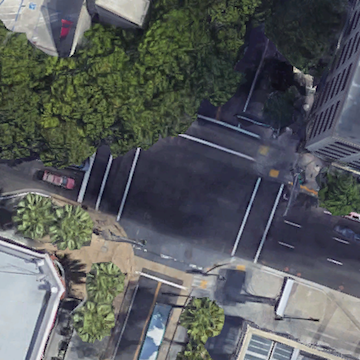
The signal at J Street and 13th Street in downtown Sacramento (shown at right) does not work well for pedestrians. The signal cycle is long, even compared to other signals on J Street, so the wait for pedestrians is quite long. I have seen the signal cycle skip both pedestrian crossings and vehicle crossings a number of times, which means that the wait is doubly long. Most walkers respond to this long wait by simply crossing the street against the pedestrian signal, and I don’t blame them at all.
A second issue is that the signal is set so that the east crosswalk walk mode occurs at the same time as the left turn from 13th Street southbound to J Street eastbound, meaning there is always a conflict between pedestrians and drivers at this point, and this conflict has been created by the signal setup. Many drivers cut directly behind or in front of people walking, as they know if they wait until the crosswalk is clear, as the law requires, they won’t make the signal.
This signal should be reconfigured so that it gives priority to pedestrians, without making them wait an unreasonable period of time, and does not create unnecessary conflict between turning drivers and people walking. The east crosswalk at a minimum needs a longer leading pedestrian interval (LPI).
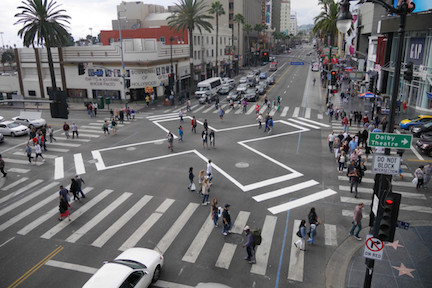
Even better would be to make this a pedestrian scramble intersection, with an all-direction crossing phase during which all vehicle turning movement are prohibited. The intersection can be marked with diagonal crosswalks, and additional diagonal pedestrian signal head added, however, simply changing the signal timing is sufficient as an initial step. This is a busy crosswalk intersection, with the convention center on one corner, the Sheraton Grand on another, and the parking garage for the Sheraton and others on the third corner. It is alway busy, and the people crossing here are commonly tourists, who are likely used to more advanced ‘world class’ cities where pedestrians are not second class citizens after car drivers.
Note: There are a number of busy pedestrian crossing intersection in the Sacramento central city that deserve an upgrade, but this is the one that most irritates me, whether walking or bicycling.
JUMP Bikes representative Alex Hagelin made a presentation at the September 19 meeting of the Sacramento Active Transportation Commission (SacATC). Below are my notes from the presentation, and you can view it online at http://sacramento.granicus.com/MediaPlayer.php?clip_id=4254.
JUMP Bike Share Update at SacATC 2018-09-26, agenda item 5
Alex Hagelin, Sacramento General Manger
Launched in May
900 bikes by October
Metrics
80% month to month growth
350,000 miles
> 300,00 Lbs CO2 saved
13,000,000 calories burned
Parking complaints about 0.3% of trips
(no stats on trips per bike)
Parking
> 600 bike racks within city, 300 racks pending review for placement
Gathered community input on locations 11,000 votes
Charging
10 plus with SacRT light rail stations, additional locations at private businesses (due to electrical drop requirements)
Bike parking behavior change
2-3 times more use of JUMP as compared to GoBike in San Francisco
Considering photo requirement that users would have to take a photo of their parking job
Education, carrots, sticks, response time
Community
Drafting equity plan, available soon
Boost membership, $5 per year for low income; Pay Near Me to allow cash addition to account
Participating in local events
Looking forward
Community outreach
Responsible and responsive vendor
Growth: new bikes, expanded service area
Questions/answers
Bike clubs complaining about rider skills
JUMP seeing people on bikes who are not regular riders
City talking to JUMP about what education will look like
Raised issues about where bikes are located, neighborhood equity
Asked about service area, north to American River, and south a ways, will need new hubs in these areas
Charging stations SacState, city college, SacRT, private property
Sacramento central city is booming with construction, which I consider to be a wonderful thing. Mixed use buildings, single lot apartments andhomes, state office buildings. But the construction is having a serious impact on walkability, and often bikeability. (Note: this post is not about road construction or about temporary closures, which also need to be addressed, but not today.)
Two examples, both of state developments, but with principles applicable to private developments, will illustrate the issues. For the new California Natural Resources Agency building between O and P, and 8th and 7th, the sidewalk, parking and one travel lane on the south side (P St) were removed from service. These are not being used in any way for the project. Perhaps they will be eventually, but in the meanwhile, presumably for the entire life of the construction project, they are just sitting empty and unused. For the new O Street office building at O and 12th, the sidewalk and parking were removed from the east side of 12th between the N-O alley and the O-P alley. The section to the north, where the building is being constructed, needs closure, as the underground level is being dug and the sidewalk will be replaced. But on the section to the south, which is being used for storing construction materials, do not need to be closed. There is plenty of space on this former parking lot.
12th Street construction closure
For some of the private construction going on, of which there are many examples, some closures are no doubt necessary. But the closures seem to be occurring from the very first day of construction to the very last day of construction, even though it is needed for only part of the time.
Construction companies are doing this because they can, out of convenience or laziness. And the city is allowing them to. Each construction project requires a traffic control plan, and the permit specifies allowable areas and time frames.
When I questioned the closure on the southern section of 12th Street, Matt from Construction Services in Public Works argued that since parking was removed, it was only fair that the sidewalk access be removed. His thinking was that fairness required making everyone lose something, and that the loss of parking was equivalent to the loss of sidewalk access.
This of course is a ridiculous argument. Parking is in no way equivalent to access. And priority must be given on all roadways to the most vulnerable users, which are in order of importance, pedestrians, bicyclists, and motor vehicle drivers.
At the recent Sacramento Active Transportation Commission meeting, Jennifer said that she though there might be guidance on access restrictions, but wasn’t sure, and would look into it.
In the meanwhile, let me propose:
For any roadway with more than one lane in a direction, space will be taken from a general purpose travel lane:
If a sidewalk or informal walking path is present, pedestrian access will be preserved by the creation of a temporary sidewalk protected by delineators or barriers.
If a bike lane or separated bikeway is present, access will be preserved by the creation of a temporary bike lane protected by delineators or barriers.
For any roadway with a single lane in a direction, space will be taken by closing the general purpose lane in one direction, with appropriate detours for motor vehicles:
If a sidewalk or informal walking path is present, pedestrian access will be preserved by the creation of a temporary sidewalk protected by delineators or barriers.
If a bike lane or separated bikeway is present, access will be preserved by the creation of a temporary bike lane protected by delineators or barriers.