Here is another antique post that was not posted, but more recent, from 2021. As an update, this is slightly less of a problem today than it was. The city has enforced the requirement that only permit holder Lime (bikes and scooters) can deploy to the racks that were installed by JUMP for the JUMP Bike program. The photo below shows one of those racks. There are also many more scooter and bike parking areas (outlined in white, with symbols, but without racks). With this, I’ve cleaned out my drafts folder.
Rentable scooters, called shared rideables by the city, are thick as flies in Sacramento central city. They are being deployed to bike rack areas, completely filling the racks and leaving no space for bikes. The photo shows a rack with each space occupied by a scooter, no spaces available. It also illustrates a JUMP rack at which other companies are deploying their scooters. These JUMP racks, and the trapezoidal racks, were purchased for the original SoBi and later JUMP systems, and so ‘belong’ to the JUMP/Lime system.
Individuals are free to part their own bike or scooter, or any bike scooter they rent, at these racks, but the other companies are prohibited from deploying to them.
And there are simply too many scooters in some areas, particularly Old Sacramento and R Street. Lime, Bird, Spin, and Razor, are deploying more scooters to high demand areas than can possibly be rented in a day. I assume that they are trying to drive each other out of business so they can dominate and raise prices, which is the business model for all app-based companies. In some ways, a fallout would be good, but in the meanwhile, the huge number of scooters is occupying public space, the sidewalks, and reducing livability.
Where two previous posts come together (Reset for SacATC and don’t forget the little things) is suggested policies for the City of Sacramento that support walking for many reasons: to protect vulnerable users from drivers, to reduce vehicle miles traveled (VMT) and thereby greenhouse gas emissions (GHG), to create a walking-first city where everyone feels safe to walk, and to support infill housing that is the next most important action to reduce GHGs. I’ll make a brief suggestion for a policy that would implement each walking idea.
These are the policies that the Sacramento Active Transportation Commission (SacATC) should be addressing, and then making recommendations to the city council. I’ll be blunt: if SacATC is not addressing these issues, then why does it exist?
The ideas presented are, not in any priority order (numbers for reference only):
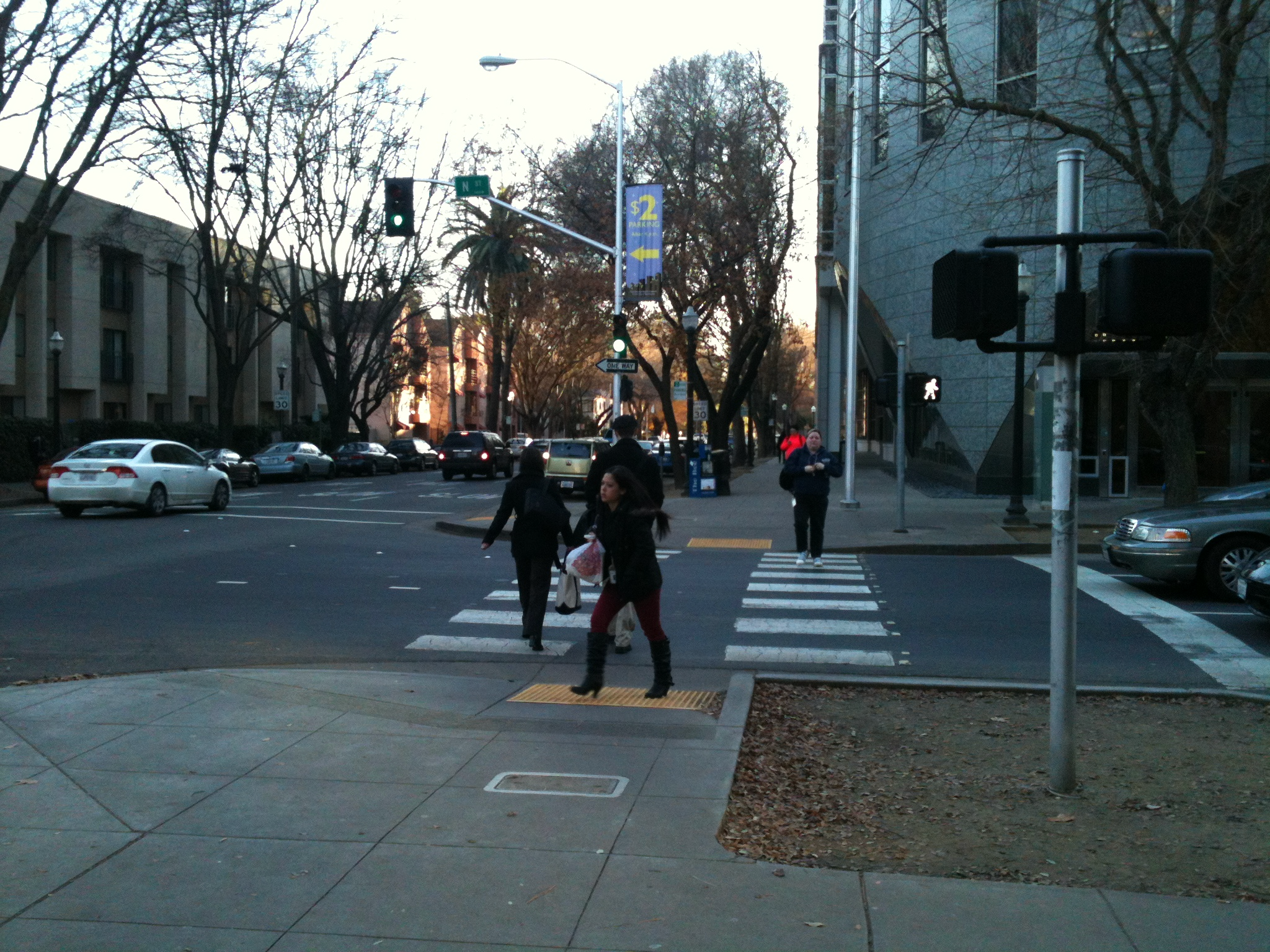
1. Mark crosswalks at every intersection. Except in purely residential neighborhoods, these should be zebra design. Policy: The city will mark (paint) every crosswalk in the city. The standard will be zebra or continental markings (the solid bars), but parallel lines are acceptable at purely residential intersections. Implementation within one year. Considerations: Yes, this will be expensive to install and to maintain. But the safety benefit makes this a great investment. Since the DMV fails to ensure that drivers understand that every intersection has crosswalks whether marked or not, it is incumbent on the city to mark crosswalks.
2. Daylight intersections by removing parking from within 15 feet of every crosswalk, at least on the near side (far side is a lesser safety benefit) Policy: Marked parking spots will be removed from within 20 feet of an intersection on the near side. Unmarked parking will be converted to no parking with red curb offsets of 20 feet. The resulting area may be used for shared rideables parking. Where a curb extension is present, parking need not be removed. Implementation within two years. Considerations: This increases visibility at every intersection by making walkers more visible to motorists (and bicyclists), and making vehicles more visible to people walking. Near side means the first crosswalk at every intersection in the direction of travel. Removal of parking on the far side confers little safety benefit.
3. Re-program traffic signals to create leading pedestrian intervals, everywhere. Policy: Every traffic signal with a pedestrian signal head will be programmed to offer a leading pedestrian interval (LPI) of at least three seconds. Implementation within one year. Considerations: The greatest risk walkers face at intersections is right-turning drivers who do not yield to people in the crosswalk. The LPI gives walkers a head start so that they are visible to drivers while the traffic light is still red. State law will soon be changed to allow bicyclists to also use the LPI.
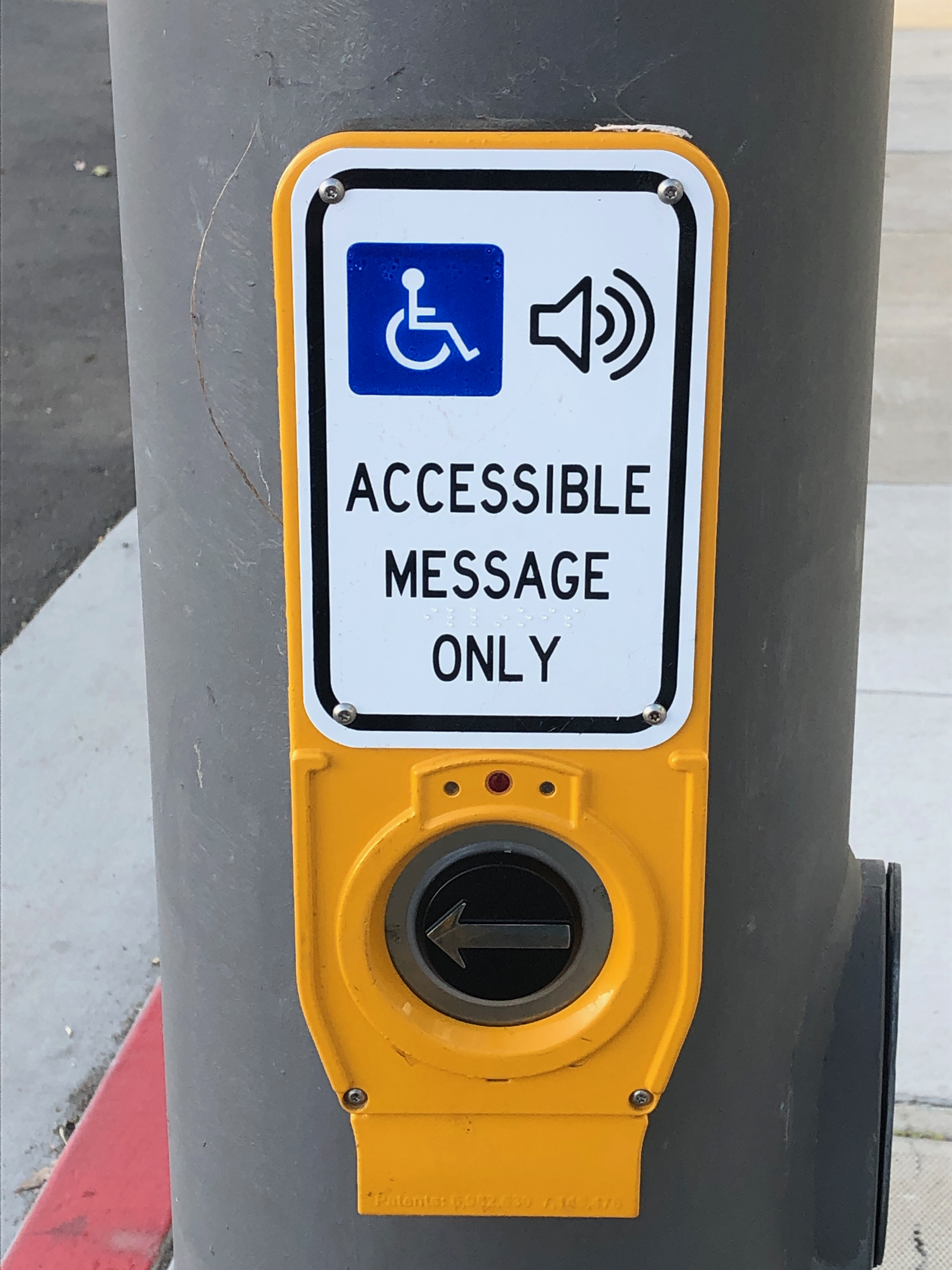
4. Remove or properly label every pedestrian push button. Don’t make walkers play the guessing game. Except at very low use intersections, pedestrian signals should be on auto-recall. Policy: Every pedestrian push button will either be removed or labeled with its function. Implementation within one year. Considerations: The presence of push buttons without indication of whether they are necessary to push is a case of clear discrimination against people walking. The city has refused to change signage to indicate whether the push button activates a signal change, triggers an audible warning only, or does nothing at all. In the long run, all pedestrian signals everywhere should be on auto-recall, meaning no push is needed, but this correctly labeling the button is the first step.
5. Remove pedestrian prohibitions which serve traffic flow rather than safety of walkers. This is the majority of them. Policy: The city will study every instance of a pedestrian prohibition to determine if the prohibition is necessary to ensure safety for people walking. Traffic flow will not be used to justify a prohibition. Each location where the study determines there is no safety benefit for walkers will be removed, crosswalks marked, and appropriate pedestrian signal heads installed. Implementation within three years. Considerations: Most, though not all, of these pedestrian prohibitions were installed to promote the flow of traffic, not to protect walkers. Studies will result in the removal of most.
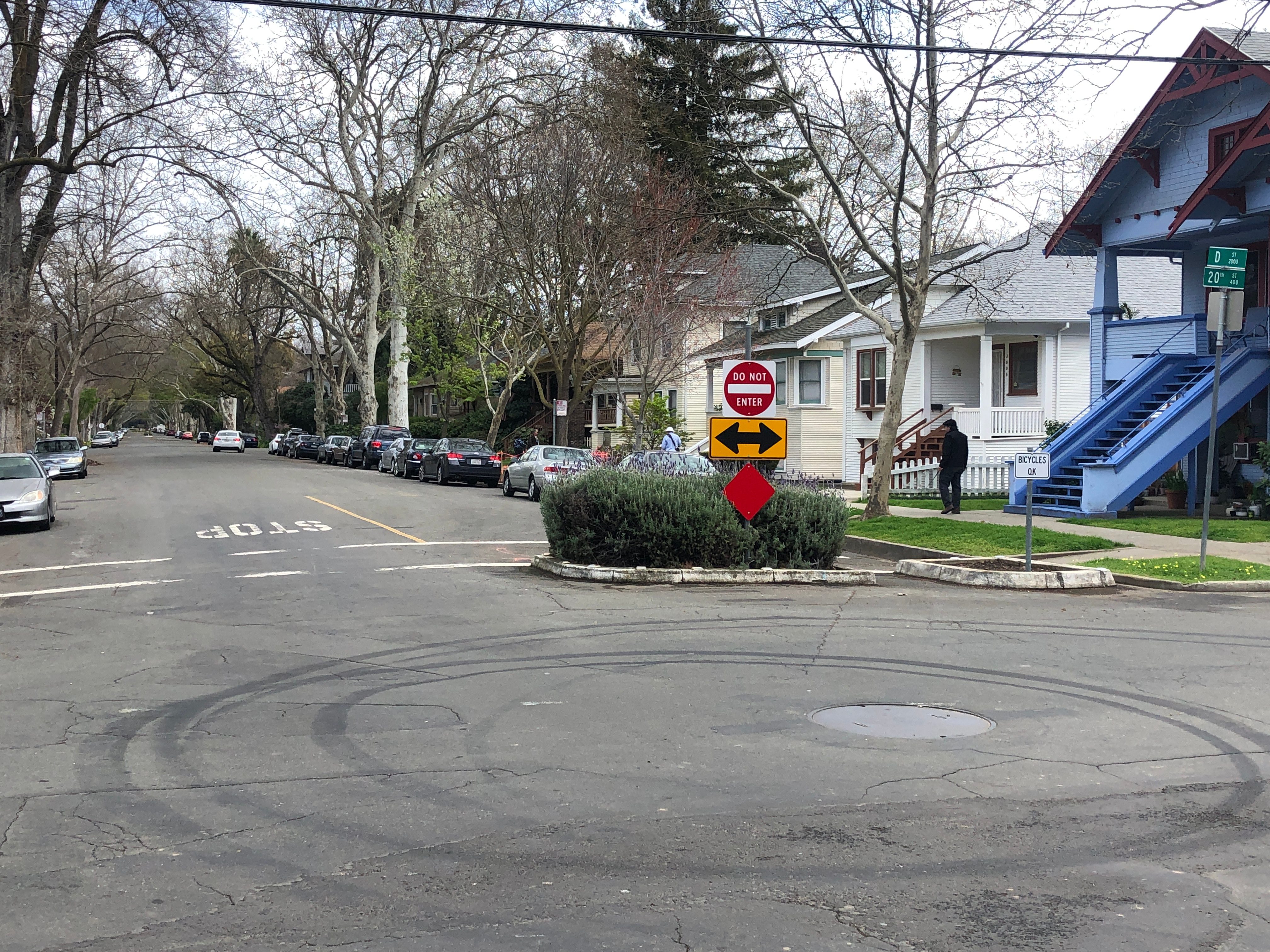
6. Install traffic diverters (modal filters) on about one-quarter of all streets, at no less than 1/8 mile intervals. This discourages through-traffic on most streets, and discourages longer driving trips, while being permeable to bicyclists and walkers. Policy: At every location in the city where a grid street system or alternate travel streets are available, the city will install traffic diverters (modal filters) which require motor vehicles to turn off current street. The interval should be no less than 1/8 mile. This will not apply to designated collector or arterial streets. Implementation within for years. Considerations: Diverters discourage drivers from traveling long distances on streets which should be low traffic, and they also slow traffic. Diverters are the most effective traffic calming device available. Despite the clear effectiveness of the existing diverters, the city has decided not to install any more. This policy would reverse that unofficial policy. Where a grid street system exists, diverters are completely appropriate. Unfortunately the winding streets and lack of connectivity in the sprawling parts of the city make these impractical.
7. Charge for all street parking, everywhere, even in residential neighborhoods. Policy: End all free street parking. Charge residents a reasonable fee for a parking permit that covers the cost of maintaining the portion of the street that contains the parking. Set fees for paid parking in such a way that there is always at least one open parking spot on every block. Implement within one year. Considerations: The city has done much better at managing paid parking, raising rates to more closely reflect (though not fully cover) the actual costs to the city. But outside of paid parking areas, drivers are getting a free ride, which encourages ownership and use of vehicles, contributing to VMT. In residential areas, it is not unusual for a single residence to own multiple vehicles, some of which are rarely used and just take up space that could better be used for other purposes.
8. Reduce speed limits to 20 mph, citywide and all at once, on every street that is not an arterial or collector street. Policy: The speed limit on all streets that are not collectors or arterials will be reduced to 20 mph. Implementation within six months. Considerations: The benefits to walkers and bicyclists (and drivers) of lower speeds are well known, reducing the severity of crashes and reducing the likelihood of crashes due to more reaction time. The ’20 is plenty’ movement is becoming widespread. Some argue that changing speed limits without changing roadway design is pointless, but my philosophy is “Yes, and…” – we should be redesigning roadways, but while that work is in progress, we can save lives now by reducing speed limits. It will take some while to change speed limit signs, so simply blocking out the existing 25 number would be acceptable in the interim.
9. Ensure that every construction project that reconstructs sidewalks also installs curb extensions (bulb-outs) where there is a parking lane present. This is not uniformly happening. Policy: Curb extensions will be required on every corner which is reconstructed for any purpose. Street faces on corners where a bicycle lane is present but parking lane is not present will be excepted. Curb extensions will be designed so as to not interfere with bicycle lanes, and existing or planned separated bikeways. Implementation immediately. Considerations: Curb extensions, also called bulb-outs, significantly increase safety by shortening crossing distances and by increasing visibility between walkers and drivers. The entity making the change to the sidewalk/corner would be responsible to the extension, though where drainage issues exist, the city might help with partial funding to move or enhance drainage. There are many instances in the city where curb extensions should be installed as part of construction projects, but are not being.
10. Create interim curb extensions with paint and flexible posts. Policy: At any intersection where a pedestrian fatality or severe injury has occurred within the last ten years, temporary curb extensions created with paint and vertical delineators will be installed. Implementation within one year. Temporary curb extensions will be replaced by permanent concrete curb extensions within ten years. Considerations: This policy would allow the ‘quick fix’ of curb extensions at relatively low cost, but eventually create curb extensions at all hazardous intersections, city-wide.
11. Take on responsibility for maintaining sidewalks, since they are an integral part of the transportation network. Policy: The city accepts maintenance responsibility for all sidewalks that are within the public right-of-way. The city will develop a plan for bringing all sidewalks to a state of good repair, with implementation first in low-income neighborhoods. Considerations: State law allows the city to shirk its responsibility for maintaining sidewalks by shifting the burden unfairly onto adjacent property owners. The result is poorly maintained sidewalks that do not serve the needs of anyone waking or rolling, but particularly discriminate against people with mobility limitations. Some sidewalks are not within the public right-of-way, but this is uncommon.
12. Buy every employee of Public Works and Community Development a copy of Walkable City Rules (Jeff Speck), and hold sessions to develop a new city mission that prioritizes walkers (and bicyclists and transit riders) over private vehicles. Policy: Buy the books! Implementation immediately. Hold sessions within six months. Develop new mission within one year. Considerations: Every city employee should be responsible for doing their part to make the city a walkable place where people are safe and welcomed on every street. City employees and politicians have in the past created a car-dominated city where it is unsafe to walk and bicycle, and now is the time to set a new vision and way forward. Note that this does not address the issue that people don’t feel safe walking in some locations, and this is a critically important issue that the city should also address.
The City of Sacramento is going to consider some big, transformative projects Tuesday evening. That’s great. But let’s not forget all the small things they could be doing, but aren’t:
Mark crosswalks at every intersection. Except in purely residential neighborhoods, these should be zebra design.
Daylight intersections by removing parking from within 15 feet of every crosswalk, at least on the near side (far side is a lesser safety benefit)
Re-program traffic signals to create leading pedestrian intervals, everywhere.
Remove or properly label every pedestrian push button. Don’t make walkers play the guessing game. Except at very low use intersections, pedestrian signals should be on auto-recall.
Remove pedestrian prohibitions which serve traffic flow rather than safety of walkers. This is the majority of them.
Install traffic diverters (modal filters) on about one-quarter of all streets, at no less than 1/8 mile intervals. This discourages through-traffic on most streets, and discourages longer driving trips, while being permeable to bicyclists and walkers.
Charge for all street parking, everywhere, even in residential neighborhoods.
Reduce speed limits to 20 mph, citywide and all at once, on every street that is not an arterial or collector street.
Ensure that every construction project that reconstructs sidewalks also installs curb extensions (bulb-outs) where there is a parking lane present. This is not uniformly happening.
Create interim curb extensions with paint and flexible posts.
Take on responsibility for maintaining sidewalks, since they are an integral part of the transportation network.
Buy every employee of Public Works and Community Development a copy of Walkable City Rules (Jeff Speck), and hold sessions to develop a new city mission that prioritizes walkers (and bicyclists and transit riders) over private vehicles.
The City of Sacramento is holding a city council workshop on Tuesday, February 8, 5:00PM. The purpose of the workshop is to gather input to help the city realign its transportation policies and project with its climate change objectives (they are far, far from in alignment now).
Sacramento Area Bicycle Advocates (SABA) with partners has created a petition you can sign to support a more effective and equitable transportation system. The petition and background information are at https://sites.google.com/sacbike.org/cleansac/home.
In its final report, the Mayors’ Commission on Climate Change recommended that to achieve its climate goals, Sacramento must prioritize the use of active transportation, public transit, and shared mobility services, and then electrify remaining vehicles. Reducing vehicle miles traveled by prioritizing walking, biking, rolling, and transit is the most effective way to reduce emissions in Sacramento.

We are asking the Sacramento City Council to:

1. Build a Comprehensive Active Transportation Network.
Commit to and take action to build a seamless, low-stress network of active transportation corridors, for the central city and connections into and out of the city. An infrastructure that supports safe walking, biking and rolling should include the following elements: separated bikeways, secure bicycle parking, adequate lighting, widened sidewalks, traffic calming, and other speed reduction measures.

2. Commit Funding.
Prioritize and set aside funding within the city budget for an active transportation program. Set aside the necessary matching funds to qualify for the federal and state infrastructure programs this year and in future years. Deliberately seek additional funding and financing through grants, state and federal programs, and other revenue sources.

3. Adopt Policy Guidance to Reduce Vehicle Miles Traveled.
All land use decisions should require consideration of reducing vehicle miles traveled when new projects and modifications to existing projects are evaluated by staff and reviewed and approved by City Commissions and Council.

4. Focus on Equity.
Prioritize a consistent focus on equity for project timing and funding.

5. Engage the Community.
Engage the community and regional experts in developing an active transportation program that works for everyone.

6. Ensure Adequate Staffing.
Ensure adequate staffing and resources to develop and administer the program, including the funding/financing aspect.
I’ll comment first on the petition. It is good, but does not go far enough in my opinion. Two improvements I would make:
1. Build a Comprehensive Active Transportation Network. Add short-term bicycle parking everywhere, and secure long-term bicycle parking at all retail and job centers. Recognize bike share as an integral part of the transportation system, including funding it in low-income neighborhoods.
2. Commit Funding. The city should pursue grants and other funding sources, but must also invest significant budget resources to transportation. The city provides the required match for grants, but almost no other funding. The result is that city funds are spent as a match on large projects, and small projects that could otherwise use the funding and have an immediate impact on safety and equity, are neglected. It is rare for cities to rely almost entirely on grant funding, as the Sacramento does for it active transportation and complete streets projects. Sacramento is an outlier.
One of the major programs being proposed to council is a network of bikeway superhighways, shown on the map below. The concept of bicycle superhighways comes recently from Milan, though other European cities have long had such facilities.
The bikeway superhighways part of the proposal seems to be the flagship of the program, so I’ll make a few comments on that.
In the north, the Niños Parkway must be extended over Interstate 80 into the commercial centers to the north. Otherwise, it fails to connect residents to jobs, and falls short at mitigating the major barrier to travel represented by the freeway.
In the south, the 24th St and MLK corridors must be extended south at least to Florin Rd, if not further. Otherwise the residential areas north and south of Florin Rd are isolated from the job opportunities to the north.
Within the bikeways superhighways portion of the city page, there is a statement: 6. Complete the existing bikeway network within 4 miles of the Central City by closing gaps in the network and calming traffic. I do not deny that this might have the greatest impact in reducing VMT (vehicle miles traveled), and since I live in the central city, I’d be a beneficiary. However, this conflicts with the equity goals stated on this page, and throughout city policy. This is the area that has always received the greatest city investment, in infrastructure and in maintenance. The rest of the city to the north and south has largely been neglected. In my view, it is time to turn this on its head. Only projects and investments in low-income areas, or which demonstrably serve to connect low-income neighborhoods to jobs and regional amenities, should be funded. Period. We have a century of disinvestment in low-income areas, greatly accelerated by the urban renewal fiasco of the 1950-1970s. Now is the time to start undoing that damage.
The term ‘congestion relief’ should be removed from the city page, and city documents. Congestion relief is always taken to mean making it easier to drive. Congestion in fact is always a natural check on overuse of motor vehicles, and by reducing traffic speeds, makes it safer for bicyclists. And probably walkers as well, but the research on that is not as clear.
I hope you’ll get involved. SacMoves, the coalition of transportation and air quality advocacy groups, will be discussing the city proposal in depth, and there may be more information to share before the city workshop.
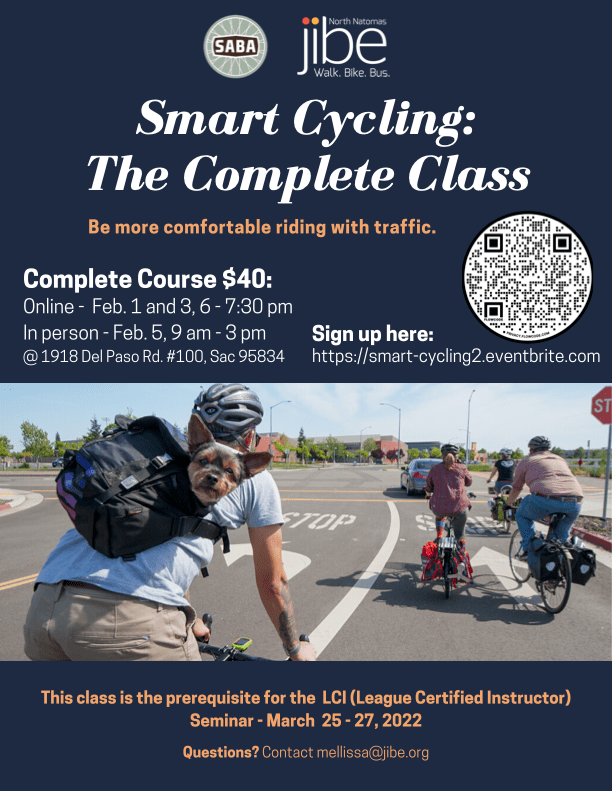
North Natomas Jibe, Sacramento Area Bicycle Advocates (SABA) and other partners are offering a Smart Cycling class in the Sacramento area on February 1 and 3, evening ‘classroom’ presentations through Zoom, and an in-person field day on Saturday, February 5, for parking lot skills and road skills.
This class is oriented towards people who would like to go on to the League Cycling Instructor (LCI) Seminar which will be offered March 27-29, for which passing scores on the skills and test are a prerequisite, but it is open to anyone who is interested. North Natomas Jibe’s Project Ride Smart, San Juan Unified’s Bicyclist Education Program, and several other programs in the Sacramento region use LCI’s as instructors for in-school and out-of-school youth programs.
When you sign up for the class (use the QR code in the graphic above), you will receive a Zoom link to the ‘classroom’ presentation, held Tuesday, February 1 and Thursday, February 3, 6:00 to 7:30PM. There will be a chance to ask questions.
The class includes Saturday, February 5 field day, 9:00AM to 3:00PM. It will include parking lot skills for bike handling and hazard avoidance, and a road ride in traffic in the area of the Jibe office, followed by a debrief and multiple choice exam for people who want a certificate and/or are going on to the LCI Seminar. Lunch will be provided, but you can bring your own. Bring snacks as well, if you get hungry.
For the field day, you need a bike in good working order (ABC Quick Check), a bicycle helmet (required for our insurance), clothing appropriate for the forecasted weather, and a water bottle if you wish. The class will take place in most weather, except heavy rain and high winds. If you are borrowing a bike, please ride it beforehand so you are familiar with how it handles. If your bike needs repairs or adjustments, we can suggest a bike shop in your area to get it ‘up to speed’ before the class.
There has been a tremendous amount of infill building, much of it housing, in midtown Sacramento and even downtown. This is a wonderful thing. As part of the construction projects, sidewalks and curbs are often torn up and replaced. In some instances, the replacement is done the right way, with wider sidewalks, directional curb ramps (two to a corner, not diagonal), and curb extensions. But in at least half the replacements, but curb extensions are missing.
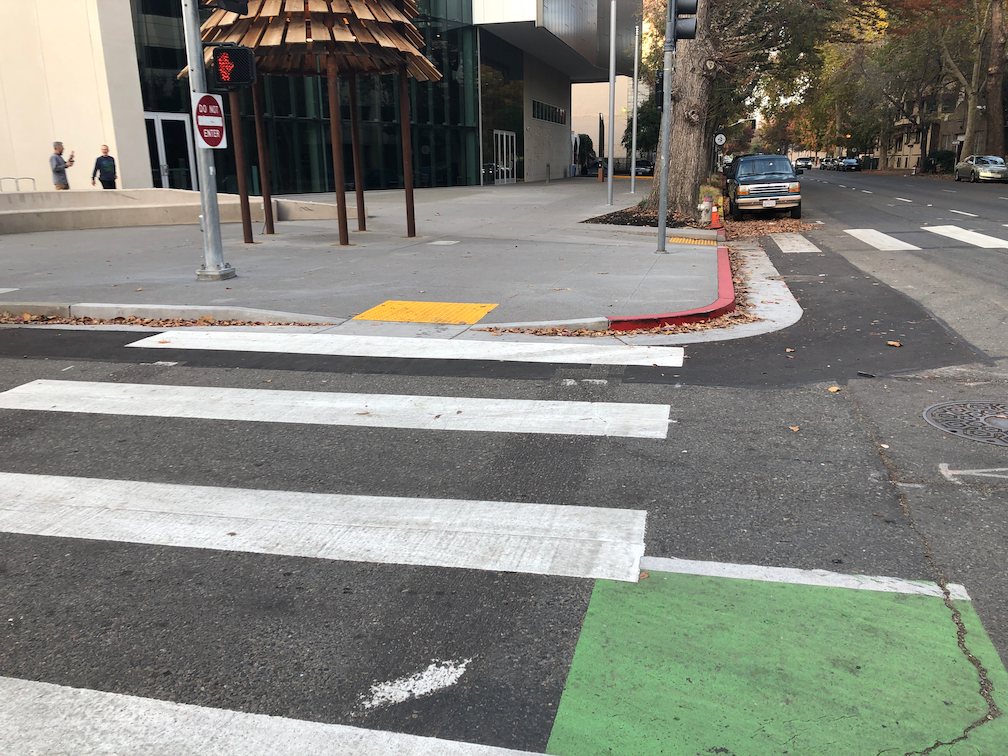
15th Street at K Street, missing curb extension, Sacramento
The photo above shows the new sidewalks and curb ramps at the southeast corner of the SAFE Convention Center, at 15th Street and K Street. That much is good, and a big improvement over what was there before.
However, the curb extension on 15th Street is missing. The purpose of curb extension is to slow traffic speeds, to shorten the crossing distance, and to increase visibility between drivers and walkers. But it is missing here. Once the convention center really opens, this will be a very busy crossing for pedestrians, and is already receiving increased use from the performing arts center.
What gives, Sacramento? Every reconstructed corner should have curb extensions. Yes, they must be designed appropriately so they only block the parking lane and not a bike lane, but in this case, there is no bike lane.
“In the year I’ve been in office, I’ve heard from thousands of people regarding their concerns and ideas about needed improvements in their neighborhoods. When I bring these community concerns to staff, I hear a lot of support and empathy for the issues raised, but it is often followed by a somber realization: there isn’t a sufficient budget to provide these services.
While I understand the limitations of the City budget, I also believe there are basic services any City should provide:
Streetlights, particularly in older neighborhoods that lack sufficient lighting to promote safety for all road users.
Sidewalk repair, the costs for which we put onto property owners during the 2008 recession. Sidewalks are a public good everyone uses and should be maintained by the City.
Public Restrooms to serve everyone in our city, particularly at parks. This should also include porta potties near large encampments.
Road and traffic safety improvements, particularly targeting streets and intersections where there are repeated collisions or injuries.
Public garbage cans and collection to help mitigate litter.
These needs aren’t unique to District 4, but are issues I’ve also observed citywide. As we approach the midyear and future budgets, I urge you to join me in asking that we consider the quality-of-life improvements the community is asking for and appropriate funds for these purposes.”
These five items are all transportation issues to some degree or another.
Streetlights: Many people will not walk at night when there is insufficient lighting. They feel unsafe. Many intersections are poorly lit for people walking, providing light for drivers but not for people in crosswalks.
Sidewalk repair: The lower the income level of a neighborhood, which is strongly but not complete correlated with people of color, the poorer the sidewalks. This is an ongoing problem in north Sacramento and south Sacramento, but exists other places. When the city claims it has not responsibility for maintaining sidewalks, but does maintain roadways, it is sending a clear message that drivers are more important than walkers. This must change. The first step is not to start fixing sidewalks, but to change city code so that the city is responsible for maintaining sidewalks, not adjacent property owners. There may be situations in which a tree on private property damages a public sidewalk, but most of the damage from trees occurs by city owned trees in the sidewalk buffer area. In fact, the worst sidewalks are often adjacent to city-owned property, where the ordinance requiring property owner repair apparently doesn’t apply. (In the interests of transparency, if one wishes to see truly horrible sidewalks, visit the City of Los Angeles. Makes Sacramento look like a walking paradise.)
broken sidewalk on V Street, Sacramento
Public restrooms: Any person who is walking is likely to be making a slower trip than a driver, and more likely to need to use a restroom during their trip. Walkers are also more likely to chain destinations, and therefore need a restroom during a longer trip, while drivers often make shorter individual trips to single destinations. The city has resisted making public restrooms available, partially in an effort to make unhoused people unwelcome. One new restroom was built in Cesar Chavez Plaza, and some parks have restrooms available for some hours, but many park restrooms remain locked. For example, the one in Fremont Park has been locked up for two years now.
Traffic safety improvements: This one is obvious. What is not obvious is that the city has an unwritten policy that it will only make major street changes with federal, state, and regional grants, not out of the general budget. A few things are done as part of routine maintenance, when a street is repaved and re-striped, but this is a tiny fraction of what is needed. Improvements to high-injury intersections and corridors should be a funded part of the city budget, not dependent upon grants from outside.
Public garbage cans: Again, people walking are likely to generate things that need to be trashed or recycled. For example, walk to your local coffee shop and then continue on your journey, you end up with an empty cup to dispose of. People driving simply throw it on the floor, or out the window in many cases. And if they throw it on the floor, it is likely to be thrown on the ground the next time the vehicle is parked. I know this because this is the pattern for people who commute in from the suburbs and park in the central city. I’ve observed it hundreds of times. It is true that in areas with active business improvement districts, there are more public garbage cans, but that leaves many areas of the city out, which are just as deserving of the service.
The city discriminates against people walking (and bicycling). These budget items would be a first step towards redressing that.
I will say that the greatest need for these improvements is not in District 4, which has often received more attention from the city than any district other than District 1. Sacramento has had and continues to have a serious equity failing, spending more money on repair and improvements in higher income areas.
This morning I was nearly hit and then assaulted by the driver of an SUV in Sacramento. I was crossing 14th St at the south side of P St at about 7:30AM. The driver had stopped before the crosswalk, so I proceeded across, but the driver lurched forward and nearly hit me. I had to jump back to avoid being hit, and slapped the side of his vehicle to get his attention. I proceeded across the crosswalk and onto the sidewalk. The driver leapt out of this vehicle and came after me, screaming that if I ever touched his car again, he would hurt me. I don’t remember the exact words, but they were violent words. He kept saying “I didn’t see you”, not in an apologetic manner, but in a way that implied it was my fault that he didn’t see me. After yelling a number of more threats, he shoved me. This is assault.
A bystander took photos of the driver and his vehicle, seen below. The bystander used the same term that I often used, ‘entitled drivers’. She was more than happy to provide the photos to me, and expressed hope that I would file charges. I have submitted an incident report to Sacramento PD.
the vehicle: GMC Yukon, grey, license M546BOthe driver, on left, white middle aged male
I notice when walkers and bicyclist post photo of vehicles driven by offending drivers, they often blank out the license number. I’m not sure why. Maybe it is fear of retaliation, worse violence from the driver. But here you go: the license plate was CA M546BO. It is a strange license number.
Back to the entitled. Many drivers feel that they own the road, and it is the responsibility of others to get out of their way. This applies particularly to walkers and bicyclists, but it even applies to other drivers. The excuse often offered is “I didn’t see them”. I think this is often fabricated after the fact to justify what would otherwise not be justifiable, which is an intention or willingness to harm others. But in some case it is true. They didn’t see because they didn’t look. Many drivers are looking at their phones or their large in-dash information displays. In this case, the driver was looking only to the right to see traffic on one-way P Street. He probably never looked left at all. But it is the legal responsibility of drivers to look and to see. If they are not willing to do that, as is true of this driver, they should not hold a license to drive. This driver, in part because he has a large, expensive vehicle, felt entitled to be driving on the street without paying attention, particularly at a crosswalk where walkers have the right of way.
This is the people we share the streets with. And the people about whom traffic ‘safety’ agencies such as National Highway Traffic Safety Administration (NHTSA) and California Office of Traffic Safety (OTS) continue to claim that road safety is a shared responsibility. Bullshit. Drivers kill people, walkers and bicyclists (with extremely rare exceptions) do not.
This is also a street design issue. One way streets are safer to cross for walkers because you only need to look in one direction, left or right. However, for people on cross streets, they are much more dangerous because many (most?) drivers never look the other direction for people in the crosswalk or bicycling.
North Natomas Jibe, Sacramento Area Bicycle Advocates (SABA) and other partners are offering a Smart Cycling class in the Sacramento area on November 2 & 4, evening ‘classroom’ presentations through Zoom, and an in-person field day on Saturday, November 6, for parking lot skills and road skills.
This class is oriented towards people who would like to go on to the League Cycling Instructor (LCI) Seminar which will be offered in the spring, for which passing scores on the skills and test are a prerequisite, but it is open to anyone who is interested. North Natomas Jibe’s Project Ride Smart, San Juan Unified’s Bicyclist Education Program, and several other programs in the Sacramento region use LCI’s as instructors for in-school and out-of-school youth programs.
When you sign up for the class (use the QR code in the graphic above), you will receive a Zoom link to the ‘classroom’ presentation, held Tuesday, November 2 and Thursday, November 4, 6:00 to 7:30PM. There will be a chance to ask questions.
The class includes Saturday, November 6 field day, 9:00AM to 3:00PM. It will include parking lot skills for bike handling and hazard avoidance, and a road ride in traffic in the area of the Jibe office, followed by a debrief and multiple choice exam for people who want a certificate and/or are going on to the LCI Seminar. Lunch will be provided, but you can bring your own. Bring snacks as well, if you get hungry.
For the field day, you need a bike in good working order (ABC Quick Check), a bicycle helmet (required for our insurance), clothing appropriate for the forecasted weather, and a water bottle if you wish. The class will take place in most weather, except heavy rain and high winds. If you are borrowing a bike, please ride it beforehand so you are familiar with how it handles. If your bike needs repairs or adjustments, we can suggest a bike shop in your area to get it ‘up to speed’ before the class.
It has become popular these days to claim that the only real solution to traffic violence is re-design of roadways to prevent bad driver behavior, and to eliminate traffic enforcement as a solution to bad driver behavior. I’m not in disagreement with this. Re-design does prevent a lot of bad driver behavior. Traffic enforcement is very often a tool of oppression by law enforcement on people of color. All true.
But… There is also a blind spot. Roadway re-design does not force drivers to yield to walkers in the crosswalk. Sure, if traffic is going slower, it is less likely that collisions will be fatal to the walker, and perhaps slightly less likely to result in a collision at all, with more reaction time. But a driver that won’t yield at 35 mph is a driver that won’t yield at 25 mph. Failure to yield to someone in the crosswalk is sociopathic behavior, in that it intimidates people against walking, and it is psychopathic behavior in that it prioritizes driver convenience over the lives of others. These people are mentally ill, and they should be removed from our roadways. Not just ticketed, but their drivers license pulled and their vehicle confiscated.
No technology that I’m aware of will automatically enforce yielding behavior, or ticket failure to yield. Red light running cameras are legal in California, but are installed on only a tiny fraction of signalized intersections, and are not even used in many localities. Speed cameras are illegal in California (to protect the guilty). I have never heard of cameras focused on failure to yield.
Law enforcement has essentially stopped enforcing failure to yield. I’ve never seen someone stopped for this violation, and the traffic stop statistics say that it almost never happens. Law enforcement doesn’t care. It sees walkers as second class citizens. After all, they are often lower income and sometimes homeless, people that law enforcement feels obligated to oppress, not to serve. I myself have experienced law enforcement officers failing to yield to me in the crosswalk a number of times. CHP is the worst offender, but all the agencies are guilty.
What provoked this post? I was bicycling home along P Street from the store. A woman was crossing. The driver in the left hand land stopped for her, as did I. The driver in the right hand lane not only did not slow to see why, but blew through the crosswalk, very nearly hitting the woman. I caught up with the vehicle, and saw that both the driver and passenger were high-income, white, and young. When I tried to talk to them about their violation and nearly hitting the woman, they blew me off and implied that I was crazy for even caring about this. This is the drivers we share the road with.
Yes, let’s re-design the roadways. But in the meanwhile, lets enforce failure to yield with serious consequences. The lives of people walking are too valuable to sacrifice to drivers, for even one day. I realize there are equity implications of traffic enforcement, but my anecdotal observation says that the worse drivers are high-income white males. Hardly the oppressed class.