Transit projects in Sacramento region

SacTransitActionPlanScenarioC-map-onlyReconnecting America, a transportation advocacy organization, just published Transit Space Race 2013. To see the Sacramento area projects, click on the < 3 million tab, and then sort by state. The eleven projects will be at the top of the list. The transit agency link in the right-most column links back to a page or website about the project.

Though the south corridor extension is shown as engineering in the status column, construction is underway on parts of the extension, the two bridges, and will start soon on other parts, with the help of a recent federal grant as well as regional funds. The airport extension and streetcar projects also have their own webpages.

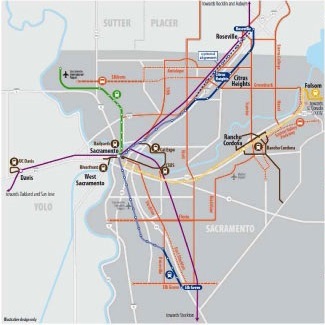
Most of the other projects link to the Sacramento TransitAction Plan, which show all possible projects in Scenario C (map at right, more detail in the plan starting on page 50). This plan does not give much detail on each project, but the name of the project gives you an idea.

News summary January 21

DUI woman hits pedestrian in Midtown’s entertainment district (Sacramento Press 2013-01-21)

Stuart Leavenworth: Will county be duped by college bait? (SacBee 2013-01-20)

Citrus Heights boy hit by suspected impaired driver dies 3 months later (SacBee 2013-01-17)

Sacramento’s Township Nine starts with 180 apartments, light rail station (SacBee 2012-01-17); Township Nine project in downtown Sacramento finally launches (SacBee 2013-01-16)

Editorial: Region needs more options for transit to airport (SacBee 2013-01-14); Letter: Where are free hotel shuttles to airport?; Letter: Where are free hotel shuttles to the airport?; Letter: Include bus pass with every airplane ticket; Letter: Lack of transit options to the airport is due to parking revenue

Bike capacity on light rail

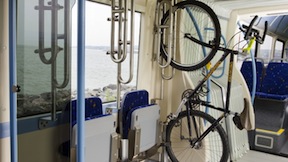
Sportworks Interlock transit bike rack

The other item I want to talk about at the Unmet Transit Needs meeting today is bicycle capacity on SacRT’s light rail system. I’ve written about bikes on light rail previously, and won’t repeat that detailed post here, except to say again that SacRT is not meeting the needs of transit users with bicycles on the light rail system.

Sportworks makes two types of transit bicycle racks that could be used on SacRT light rail, the SwingLock and the Interlock. The SwingLock is basically an improvement to the bike rack hooks installed on the 200 series light rail cars, while the Interlock is a more complicated, more expensive, and more effective rack. I spoke to a Sportworks employee at ProWalk/ProBike last year, and he said they also design custom racks for transit systems where off-the-shelf solutions won’t work. I have family in Las Vegas, and when I’m visiting, I use the RTC-Southern Nevada transit system which has the Interlock installed in many of its newer articulated buses. The racks work great!

SACOG Unmet Transit Needs Hearing

I attended the SACOG final hearing on unmet transit needs. Apparently the process is repeated every year, so this is just the last one for this fiscal year. I spoke, as planned, on the unmet needs of bicyclists on light rail and level boarding with low floor light rail cars. Board member Steve Cohn welcomed me to attend the regular SacRT board meeting to talk about these concerns. He said that SacRT is working on these very issues, but since they haven’t publicized anything yet, I’m not sure what they are thinking and where in the process they are.

Only one other person spoke, mostly about disability access and connectivity between the many transit systems in the region.

I’m not sure whether the lack of testimony indicates that people think all the issues were addressed in the earlier hearings, or whether people didn’t know of the opportunity, or if there is a lack of interest. Though SacRT has clearly improved since the low point of 2010 when the system and service were decimated, there is a long ways to go to get back to base level and then to improve on it.

Level boarding with low floor light rail cars

SacRT light rail steep steps for bicyclist

Today in Sacramento will be the last of SACOG’s Unmet Transit Needs meetings. It will start at 9:30AM in the SACOG board room at 1415 L St, Ste 300, in downtown Sacramento, near the northeast corner of Capitol Park. In preparation for that meeting, I’m thinking about the things I’d like to talk about, particularly issues that I’m not sure that others will bring up. Those two are bicycles on light rail, and level boarding for light rail. I’ve said a bit about level boarding in my Portland post, but there is plenty more to say.

The SacRT light rail system has high floor cars. Both the older 100 series cars by Siemens Transportation Systems and the newer 200 series cars by Construcciones y Auxiliar de Ferrocarriles (CAF) have high floors. People must navigate steep stairs from the ground to the car. Disabled people are accommodated by a high boarding platform, but with only one platform at each station (and none for southbound blue line at 12th & I station), those needing level boarding are restricted to one end of the lead car, and all other doors and cars exclude them. Many people who use the train don’t consider themselves disabled enough to use the high boarding platforms, yet struggle with getting up and down the steps. Many bicyclists also struggle with these steps. The handrails which are provided in the middle of the stairs to assist people with the steep steps are themselves part of the problem, as they block people who are carrying items such as strollers, groceries, luggage and bicycles.Read More »

News summary January 13

High-speed train is a Field of Dreams (SacBee 2012-01-12; this was on the Opinion page, but doesn’t seem to have made it to the website; I’d ignore it but there is a delicious irony in use of “field of dreams” – did McCarthy and Denham not watch the movie, or did they take some strange message from it that no one else did?)

Man accused in fatal DUI in Carmichael pleads not guilty (SacBee 2013-01-11)

Viewpoints: Proposed college in Cordova Hills shows valid vision for the future (SacBee 2013-01-11)

Letter: Elk Grove needs light rail (SacBee 2013-01-09)

City considers approving I-5 interchange (Sacramento Business Journal 2013-01-08)

Sacramento light rail expands with a lift from FTA (Fast Lane blog 2013-01-07)

$135 million federal grant keeps Sacramento region’s rail expansion rolling (SacBee 2013-01-08)

Letter: Cordova Hills development is much needed (SacBee 2013-01-04); letter: Cordova Hills is not needed (SacBee 2013-01-09); Letter: Cordova Hills is needed (SacBee 2013-01-09)

News summary January 6, 2013

Feds to announce Sacramento light rail expansion funding grant (SacBee 2012-01-04)

Bicycles: hey, wait, is that legal? (SacBee 2013-01-04)

CHP seeks vehicle involved in fatal Christmas Eve hit and run (SacBee 2012-01-02)

Where did the downtown population go? (Sacramento Press 2013-01-02)

Update: Boy, 3, dies after hit by car in Citrus Heights (SacBee 2012-12-31); Youngster killed in Citrus Heights traffic accident identified by coroner (SacBee 2013-01-01)

Five new driving rules take effect for 2013 in California (SacBee 2013-01-01)

Silicon Valley’s light rail among the least efficient (SacBee 2012-12-31)

Walkable City – live chat

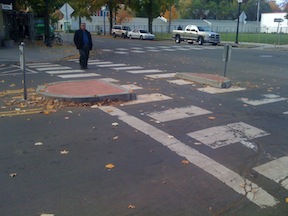
Pedestrian Refuge Median

I participated in the Walkable City live chat sponsored by Sacramento Press today, which featured Jeff Speck, author of Walkable City: How Downtown Can Save America, One Step at a Time, William Burg, and host Jared Goyette, which I advertised yesterday. I enjoyed hearing from both Speck and Burg. Burg is sort of the historian laureate of Sacramento, and his local perspective really added a lot.

You can review the recorded live chat by following the link from the live chat link above, and I highly recommend that you do. My take-aways from the conversation are:

  1. Jeff Speck reiterated his “General Theory of Walkability” which defines a favored walk as including the elements of useful, safe, comfortable and interesting.
  2. Speck said that in order to be walkable, a place must have “good bones”, short blocks in a grid pattern, with squares. Nearly always, these are pre-war neighborhoods. Burg pointed out that Sacramento downtown and midtown does have this, though our blocks are longer than many highly walkable cities, but our grid has been broken severely by the freeways and to some degree by the downtown mall and the convention center.
  3. Speck said that many cities that have a great reputation for walkability started with just one great street, or even one great block, such as LoDo (lower downtown) in Denver. The one great place increased the draw for young creatives, which led to more widespread changes.Read More »

Walkable City

Sacramento Press is sponsoring a live chat with Jeff Speck, the author of Walkable City: How Downtown Can Save America One Step At A Time. The live chat is tomorrow, January 3, at 12:30PM. The offline chat is already going on, if you want to check it out. I am currently reading the book, in the Kindle version, but am only part way through.

Many of the online comments so far have focused on creating a livable city, and it is wonderful to see so many positive ideas and accurate identification of challenges. Intelligent conversation like this is rare in the Sacramento news blogs. I’ll make some comments specifically on the walkability safety aspects. I’ve written about this before, but it is worth writing about again and again, because the problems still exist.

Traffic sewers: Multiple lane and one way streets are traffic sewers. This epithet is used to describe streets designed to flush traffic in and out of employment centers (and to homes in the suburbs) twice a day. They serve no other reasonable purpose, and they make a place very much less walkable. Three (or more) lane roadways are incompatible with walkability. They encourage high speed traffic, and provide too long a crossing distance to pedestrians to be comfortable with. They don’t meet the “8-80” criteria, of being safe and comfortable for people of all ages.Solutions:

  1. Therefore, I think that all three-lane roadways in Sacramento must be narrowed to two lanes. If a true refuge median is provided between two directions of travel, at least three feet wide, so that a person can cross each direction of traffic separately, then roadways with a total of four lanes are acceptable. If not, then only a total of two lanes. Six lane or more roadways, common in the northern and southern suburbs of the City of Sacramento, are not acceptable.
  2. One way streets also encourage high speed travel. I think that all of our one way streets should be converted to two way streets. This can be done over time as streets are repaved, it is not as high a priority as the narrowing of streets, above.

Read More »
News summary 2012-12-30

Sprawl delay (Sacramento News & Review 2012-12-27)

Bicycle thefts up on grid, bait bike remains underused (Sacramento Press 2012-12-28)

Fatal wrecks decline across Sacramento region (SacBee 2012-12-28)

Red-light cameras to go ‘live’ Saturday in Rancho Cordova (SacBee 2012-12-27)

Nearly 3,000 drivers caught in cell phone crackdown (SacBee 2012-12-26)

Sacramento police seek suspect in fatal Valley Hi hit-and-run (SacBee 2012-12-26); Coroner identifies man killed in Valley Hi hit-and-run (SacBee 2012-12-27)

Live chat on walkability with author Jeff Speck: Jan 3 at 12:30 p.m. (Sacramento Press 2012-12-26)

Pedestrian killed in Highway 50 onramp hit-and-run (SacBee 2012-12-26)

Focusing on infrastructure to make development more compact (Sacramento Business Journal 2012-12-26)

Capital SouthEast Connector will create 5,400 jobs: report (Sacramento Business Journal 2012-12-24); just more sprawl boosterism, how many jobs could be created with $456 million spent on lasting job creation? – highways are among the lowest job generators per dollar spent

Book of Dreams: Cole rides again with the help of his special-needs bike (SacBee 2012-12-24)