SacATC 2025-08-21

The Sacramento Active Transportation Commission (SacATC) will meet Thursday, August 21, 2025, at 5:30 PM. The meeting will be at Sacramento City Hall, council chambers. The meeting is livestreamed from the Upcoming Meetings Materials page at the time of the meeting. Comments may be made in-person, or via eComment on the Upcoming Meetings Materials page up to the time of the meeting, but should be submitted well ahead of time if you wish the commission members to see the comment before the meeting. No comments are taken online.

This is a big meeting! I hope you can attend and comment, or use eComment. I have not yet reviewed the documents, but may add additions to this post if appropriate.


Agenda (pdf)

Open Session

  • Roll Call
  • Land Acknowledgement
  • Pledge of Allegiance

Consent Calendar

  1. Approval of Active Transportation Commission Meeting Minutes
  2. Active Transportation Commission Log

Discussion Calendar

  1. Streets for People Active Transportation Plan: part 1, part 2
  2. Connecting Howe Avenue: Safety and Mobility Plan Proposed Alternatives: staff report, presentation
  3. The Norwood Mobility Project Proposed Alternatives: staff report, presentation
  4. Active Transportation Commission 2025 Annual Report: staff report, Annual Report, presentation
  • Commission Staff Report
  • Commissioner Comments – Ideas and Questions
  • Public Comments-Matters Not on the Agenda
  • Adjournment

SacATC 2025-03-20

The Sacramento Active Transportation Commission will meet this Thursday, March 20, 2025, at 5:30 PM. Comments may be made in person during the meeting, or beforehand via the eComment capability on the Upcoming Meetings page. Though the meeting is live-streamed on that same page, comments may not be made in that way.


The core agenda is:

Consent Calendar

  1. Approval of Active Transportation Commission Meeting Minutes
  2. Active Transportation Commission Log

Discussion Calendar

  1. Airport South Industrial Annexation – Amendments to the City Bicycle Master Plan
  2. Streets for People Draft Plan and Phase III Community Engagement Approach (staff report, Streets for People Draft Plan; note: the plan is a large document, and does not include appendices, which can be downloaded from the Streets for People webpage)

In the webinar today, a comment was made that the information in the plan and in the webinar is very complex and hard to get a handle on. I agree. Even as a transportation nerd, it is very hard to digest. I’d suggest the city come up with a simple presention, even simpler than the Executive Summary, that speaks to people who just want better and safer transportation for walking and bicycling, but know little about transportation planning and infrastructure. Some people will want to focus on the streets in their neighborhood where they live, or the routes they travel. Others will want to focus on the policy and approach of the plan. It is probably not possible to look at and understand both.

As I’ve said, I hope to post more detailed information and comments on the plan, but haven’t gotten to that yet.

SacCity Streets for People draft plan

for Matt

Additional posts on the Streets for People Plan will be under category: Streets for People – Active Transportation Network. I encourage you to take a look at Strong SacTown’s series of posts on Street Design Standards. And all of the NACTO Design Guides. And Jeff Speck’s Walkable City and Walkable City Rules. But your own lived experience is just as valuable as the words of the experts, so please join in to support and improve the plan.

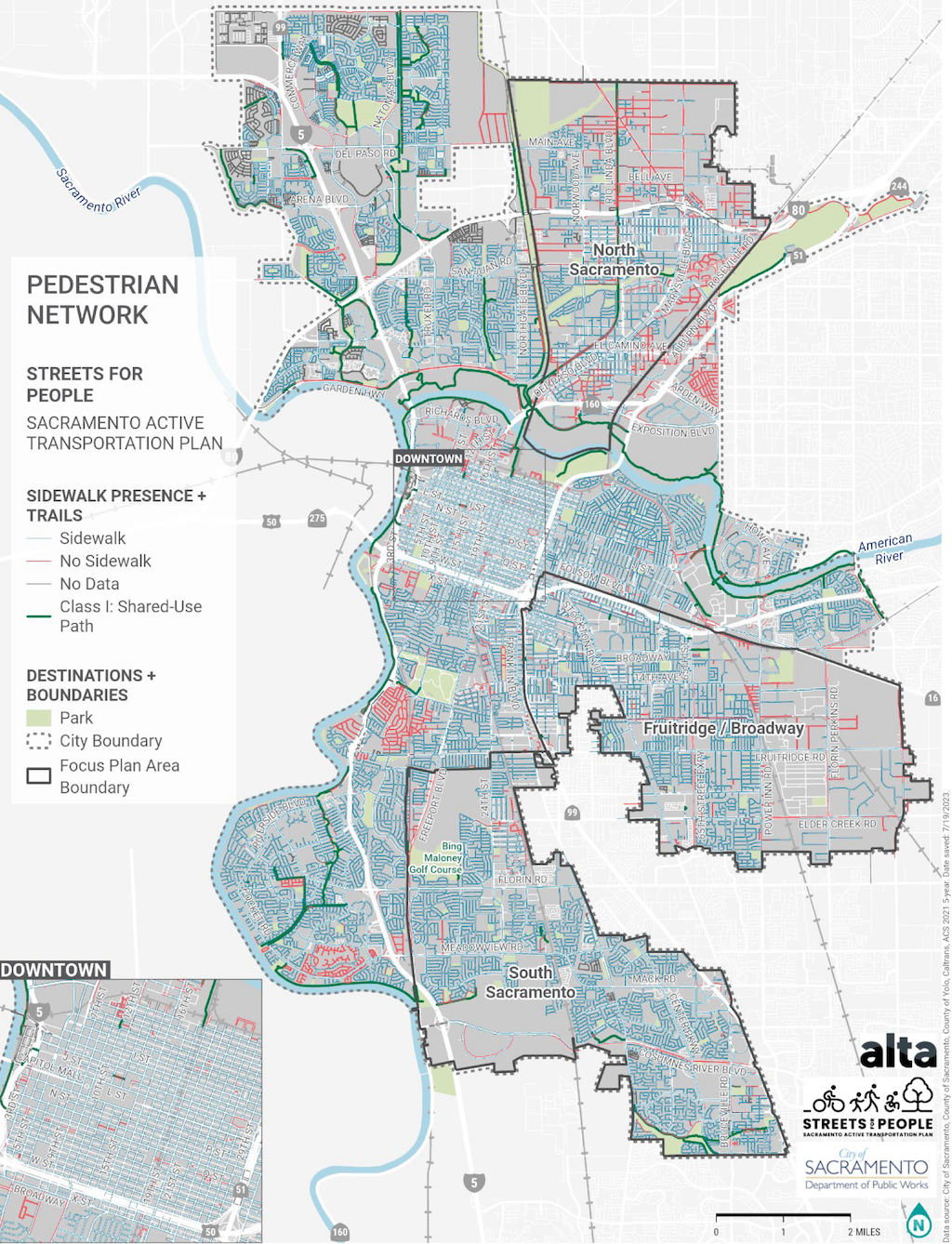
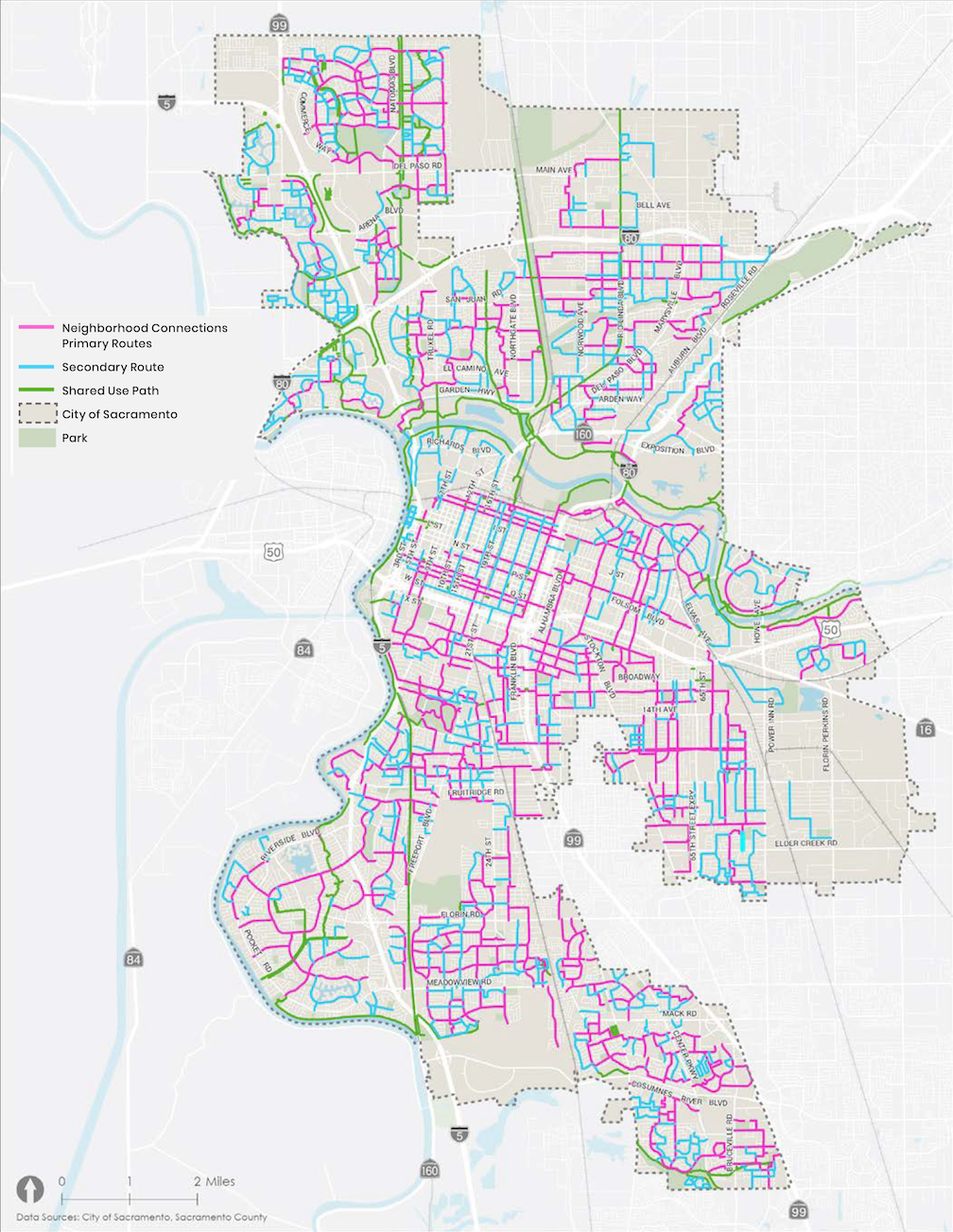
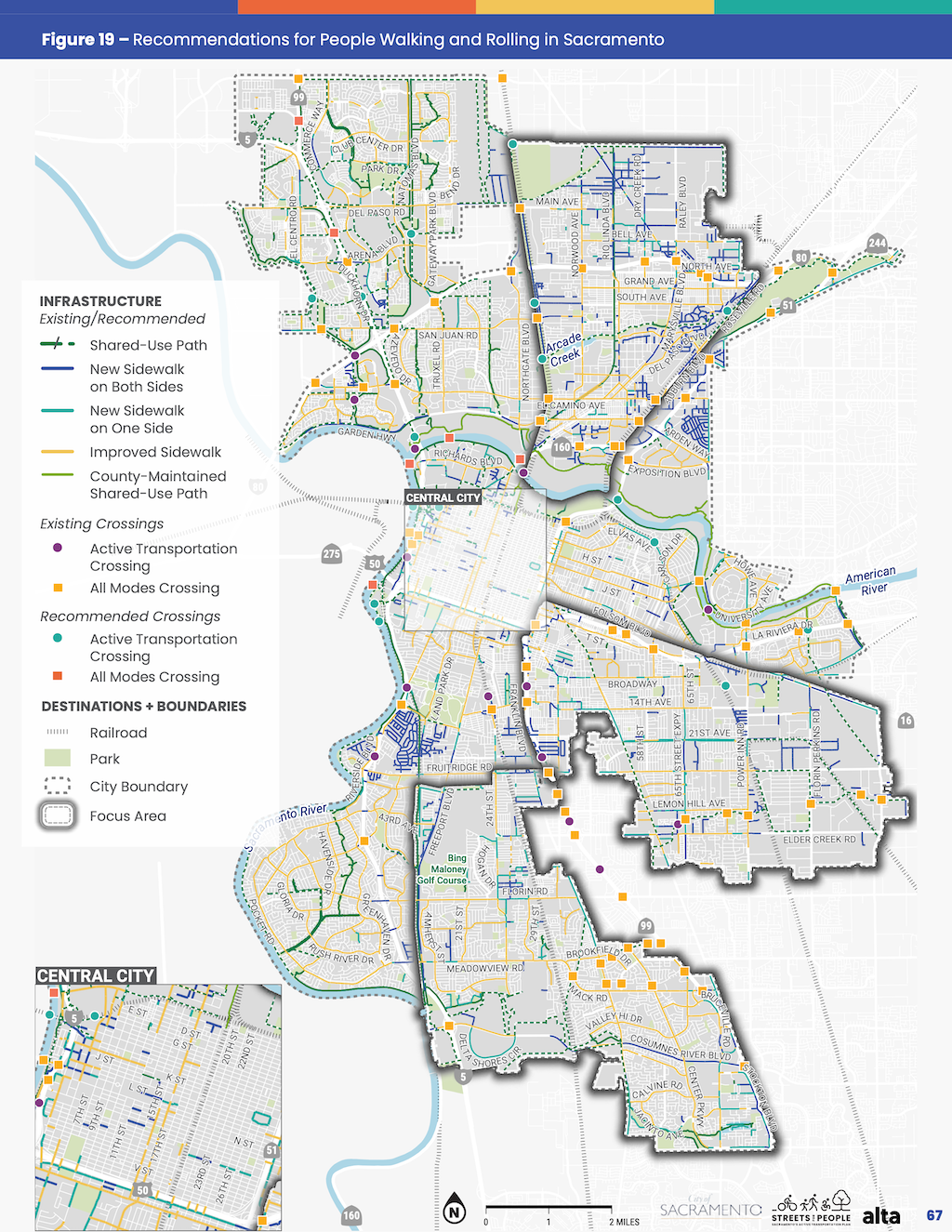
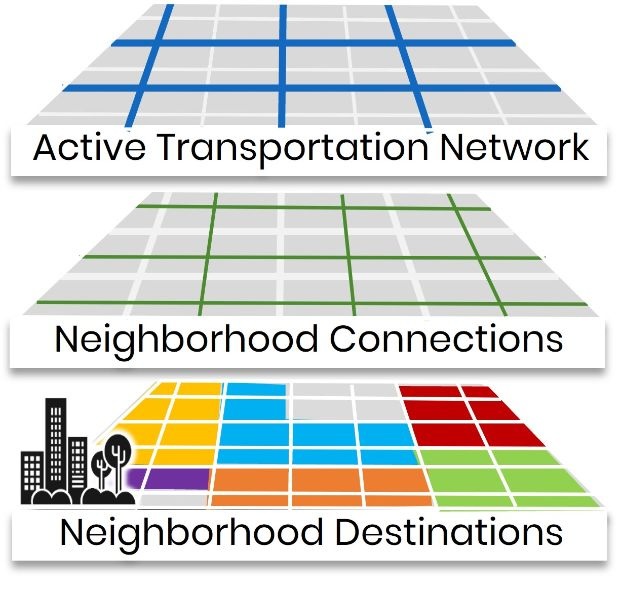
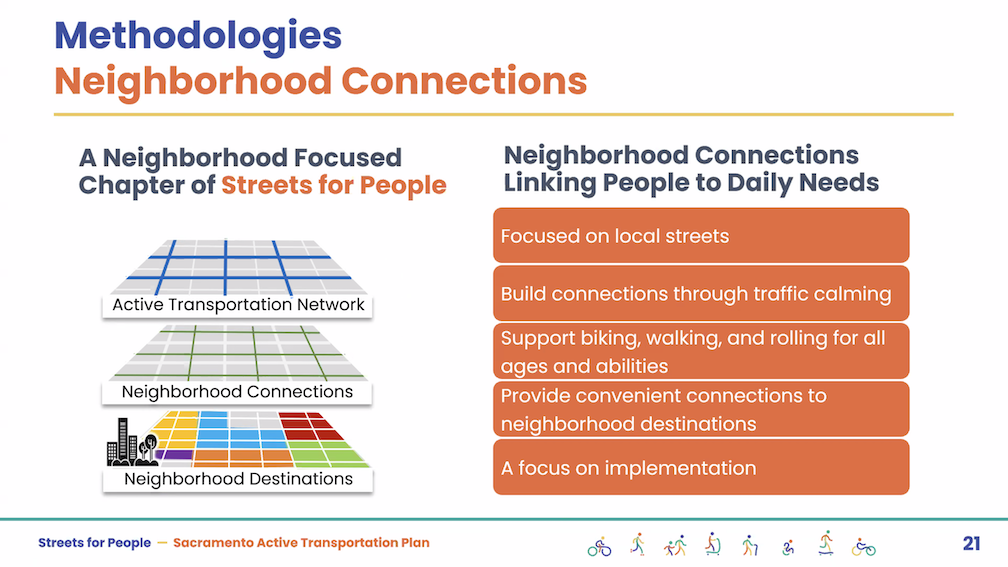
The City of Sacramento Streets for People draft plan has been released. The Streets for People / Active Transportation Plan webpage has more detail. The body of the plan is a little difficult to download there, so it is also available here (57MB pdf). The appendices and related documents are easy to download there (I don’t know why Appendix 5 is missing). A comment about terminology: ‘Streets for People’ refers both to the overall Active Transportation Plan, and to this specific section of the overall plan. The Streets for People: Sacramento’s Active Transportation Plan public draft 2025-03 is the section that covers arterial and major collector streets. Local streets are covered in the Neighborhood Connections Plan (2025-01), which has now be adopted by the city and will be incorporated into the overall plan later this year. The diagram below shows the relationship, with the green neighborhood connections, and the blue ‘active transportation network’ which is the topic of the draft plan.

I have only skimmed the plan, so don’t have comments yet, but since it is out there, I hope that many people will take a look and comment. To the city, mainly, but you can also comment on this blog post. Comments are accepted through April 6. Though the map for gathering geographically related comments is closed, it is still available for viewing. You can submit comments through a form, probably best for general comments that apply to the process or the overall document. You can email city staff directly at StreetsForPeople@cityofsacramento.org. The preferred method for comments is to make comments directly on the pdf, available at https://streetsforpeopledraftplan.altago.cloud/#/, probably best for specific comments on text or graphics. You can also sign up to receive email updates.

The Neighborhood Connections Plan is great and provides a solid basis for improving both safety comfort level for people walking and bicycling in their neighborhood. However, local streets are not where the majority of crashes occur, certainly not the fatality and severe injury crashes. These occur on arterial and major collector streets, the ones that were designed for motor vehicle movement and convenience. These roadways are too wide, and too fast. Yet many walking and particularly bicycling trips must cross or travel along these dangerous streets. Until these streets are redesigned to not only accommodate but encourage walking and bicycling, most people won’t leave their immediate neighborhood, and will continue to make most trips, even short trips, but motor vehicle. And that is the subject of this draft plan, and why it is so important.


Table of Contents

  • 1 About This Plan
    • What Is Streets for People?
    • Need for a Focused Approach
    • What’s in the Plan?
    • Plan Goals
    • Recent Achievements
  • 2 Walking, Biking, and Rolling in Sacramento Today
    • Building on the Past
    • What the Data Shows
    • Equity
    • Walking and Rolling
    • Biking
    • Safety
    • Comfort
    • Access
    • Sustainability
  • 3 Community Engagement
    • Leading with Equity
    • Community Planning Team
    • Engagement Events
    • What We Heard
  • 4 Recommendations 52
    • Network Recommendations
    • Intersection Recommendations
    • Recommended Policies and Programs
    • Maintenance Considerations
  • 5 Implementation
    • Costs
    • Funding
    • Monitoring and Review
    • Next Steps
  • A Appendices (which are in separate documents, available on the webpage)

SacCity Neighborhood Connections workshops

The City of Sacramento is holding two online workshops on the Neighborhood Connections portion of the Streets For All Active Transportation Plan, on Wednesday, November 13 at 6:00 PM, and Wednesday, November 20 at 12:00 noon. Registration is available on the Streets for People webpage. The Neighborhood Connections Public Draft Plan will be available on November 4 on the Streets for People webpage.

The Neighborhood Connections Story Board is the most valuable document to come out of the project so far, well worth a look. I’ve written about traffic calming features in Neighborhood Connections before, as well as other topics in Streets for People and Street Design Standards. There is a great deal of overlap, and should be, between the Streets for People Active Transportation Plan and the Street Design Standards Amendment.

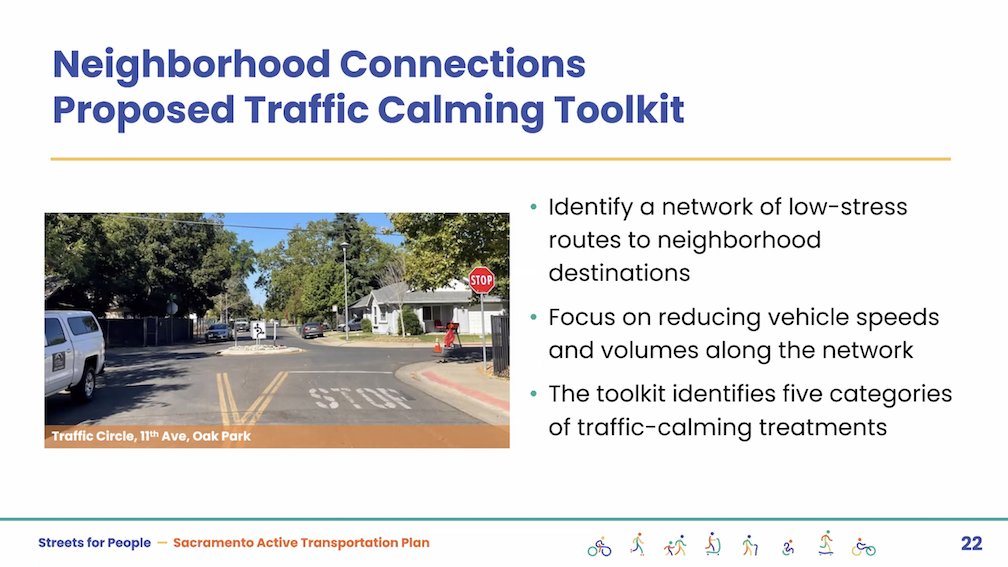
“The Neighborhood Connections Network is made up of residential streets and minor collectors that connect to neighborhood destinations, such as parks and retail. The network includes proposed traffic-calming treatments to reduce vehicle speeds and volumes to support people walking, biking, and rolling.”

diagram Streets for People Active Transportation Network, Neighborhood Connections, Neighborhood Destinations
graphic Neighborhood Connections workshops

traffic calming measures

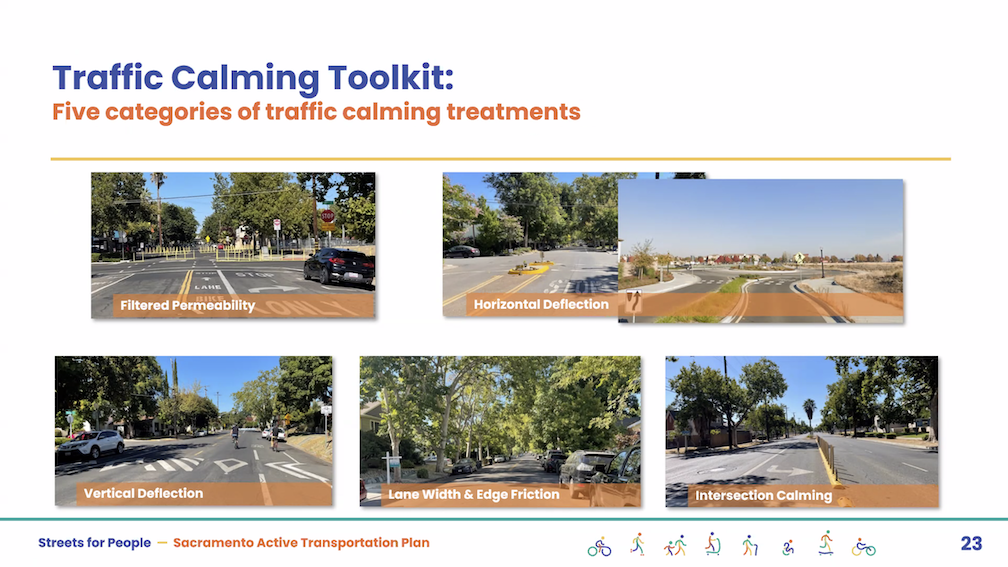
The Strong SacTown Street Design Standards Team has posted on Modal Filters, which are probably the most effective tool we have for calming and slowing traffic. But there are a number of others than can be used, sometimes more effective depending on the context of the street being redesigned. The traffic calming features below are listed in approximate order of effectiveness, following modal filters of course, but each street to be redesigned for traffic calming is unique, so the best solutions will vary.

The city has a parallel project, the Streets for People Active Transportation Plan. The Neighborhood Connections storymap Traffic Calming tab (scroll the menu bar right if you don’t see this tab) has great examples of many of the traffic calming features. I am using some of those in the recommendations below.

Note: A recently release study of traffic speed reductions engendered by complete streets elements in Minnesota identified roundabouts as the most effective as slowing drivers. Crossroads: Measuring the Effects of Road Features on Driving Speeds, 2024-09-11.

Marked Crosswalks

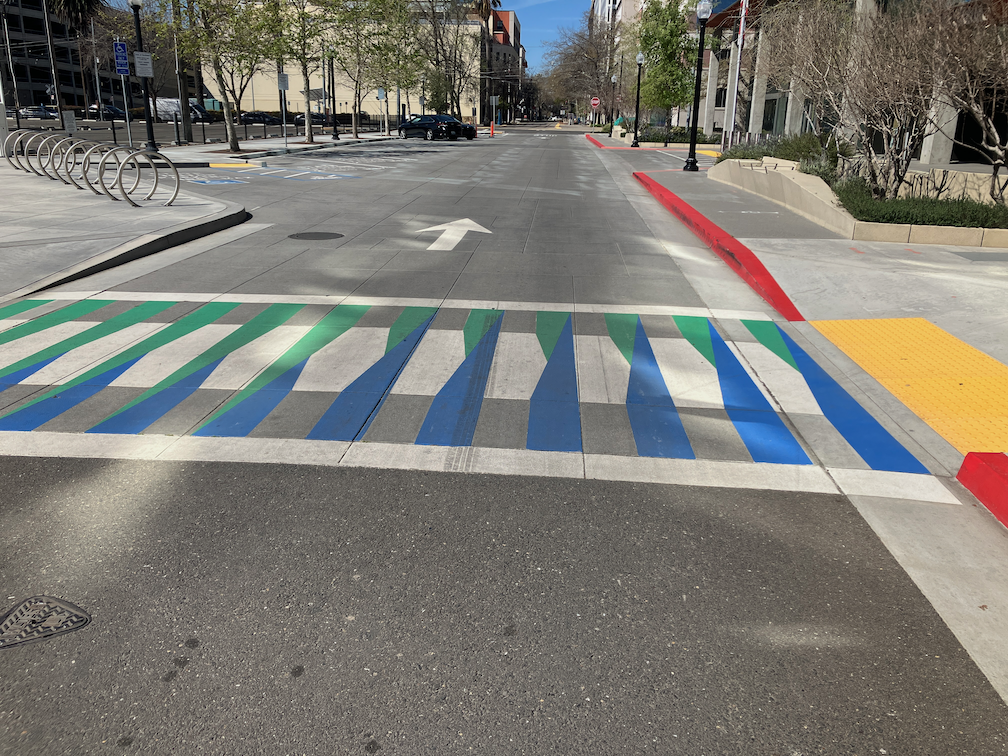
Though state law recognizes that there is a legal crosswalk on every side of every intersection, unless signed against, many drivers do not understand that they must yield to walkers crossing, whether the crosswalk is marked (painted) or not. The crosswalk at every side of every intersection should be painted, though low volume low speed streets may not require marked crosswalks. Decorative designs within the crosswalk further increase visibility.

photo of decorative crosswalk, O Street in Sacramento
decorative crosswalk, O Street in Sacramento
Read More »

Streets for People interactive map

Additional posts on Streets for People Active Transportation Plan are at category: Active Transportation Plan.

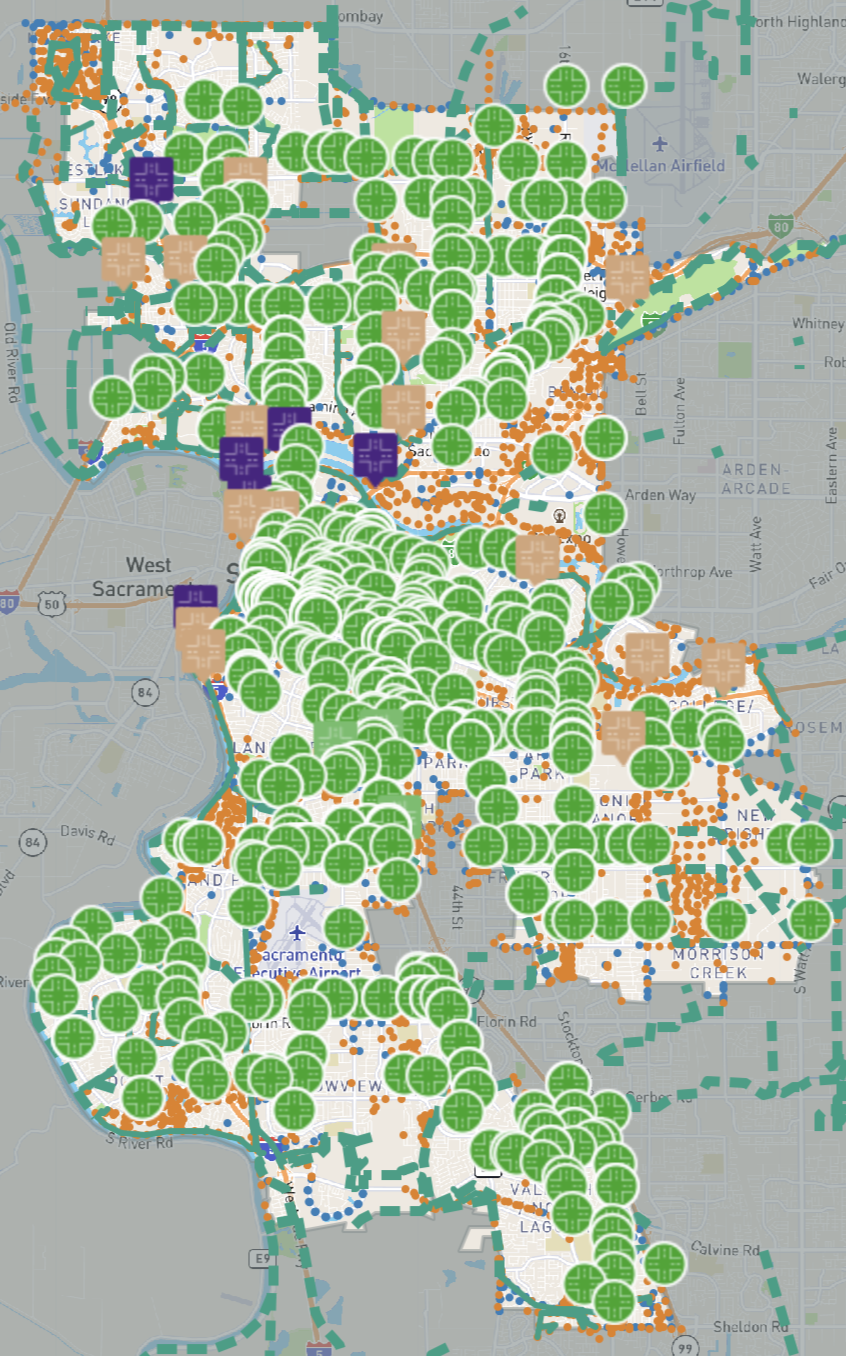
The interactive map developed for the Streets for People Active Transportation Plan is available for public input through August 11. The ‘add a route’ and ‘add a point’ options have a free-form entry box, so you can enter anything you would like, but using terms that the city uses, in the visual glossaries (below) or the traffic calming features (below) are more likely to be understood and accepted.

You can comment on the city’s recommendations: “Clicking on a draft network recommendation will launch a pop-up that will provide more information about the recommendation. You can leave a comment, like, or dislike on any recommendation.”

Or you can add your own: “Are there roads or intersections that don’t have a recommendation, but you think should? Use the “Add a route” and “Add a point” buttons below to mark these locations on the map.”

The interactive map offers visual glossaries for pedestrian infrastructure and classes of bikeways. Since you can’t have these glossaries open at the same time as the map, they are offered as blog posts and pdf documents by Getting Around Sacramento.

Traffic Calming Features

The City of Sacramento has added the Neighborhood Connections Story Board to the Streets for People Active Transportation Plan webpage. The traffic calming tab has 13 features, with photos, brief descriptions, and relative costs. These traffic calming features are meant for local and minor collector streets, not for major collector and arterials streets. See Streets for People traffic calming for the 13 features.

The crowd-sourced entries on the map are concentrated in the central city and north Land Park. We hope that people who walk and bicycle in other parts of the city, particularly the disinvested areas of South Sacramento and North Sacramento, will make suggestions on the map.

Neither the glossaries nor traffic calming features offer fully signalized intersections as a recommendation. Traffic signals regulate motor vehicle flow to some degree, but do not significantly slow traffic nor make streets safer for walkers and bicyclists. Safety is best achieved by slowing the motor vehicles through street redesign.

The ‘bicycle routes’ / sharrows option in the Visual Glossary of Classes of Bikeways has been misused by Sacramento and many other cities/counties/Caltrans by placing them on high volume and high speed roadways, in lieu of creating safer bicycle facilities. Their use should be strictly limited, and most existing locations should be converted to higher quality bicycle facilities.

Streets for People virtual slides

Additional posts on Streets for People Active Transportation Plan are at category: Active Transportation Plan.

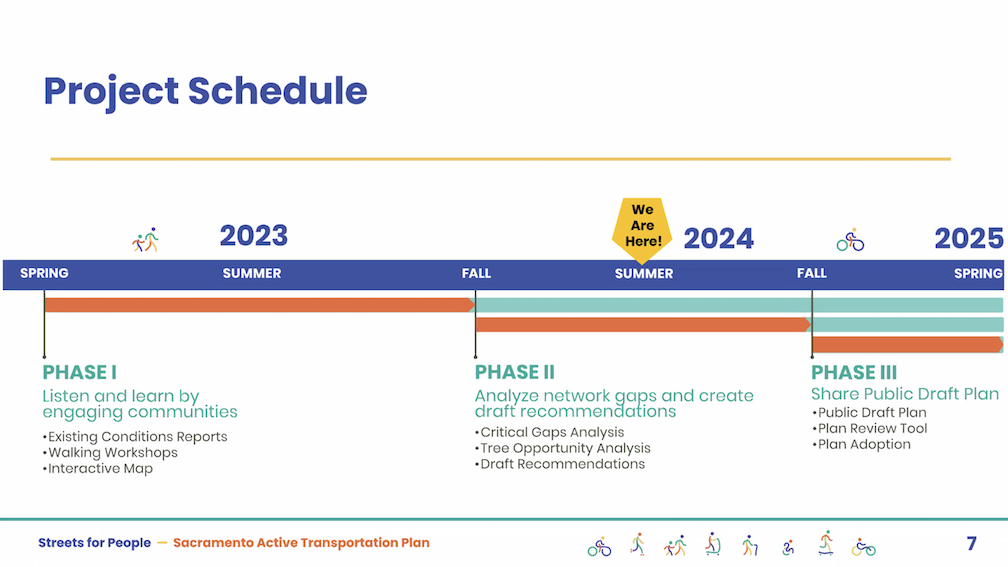
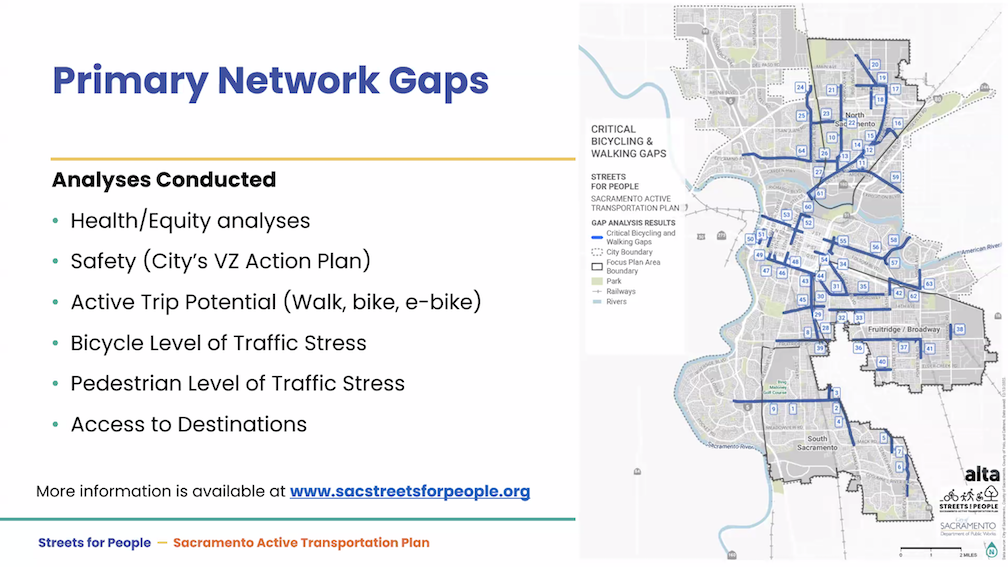
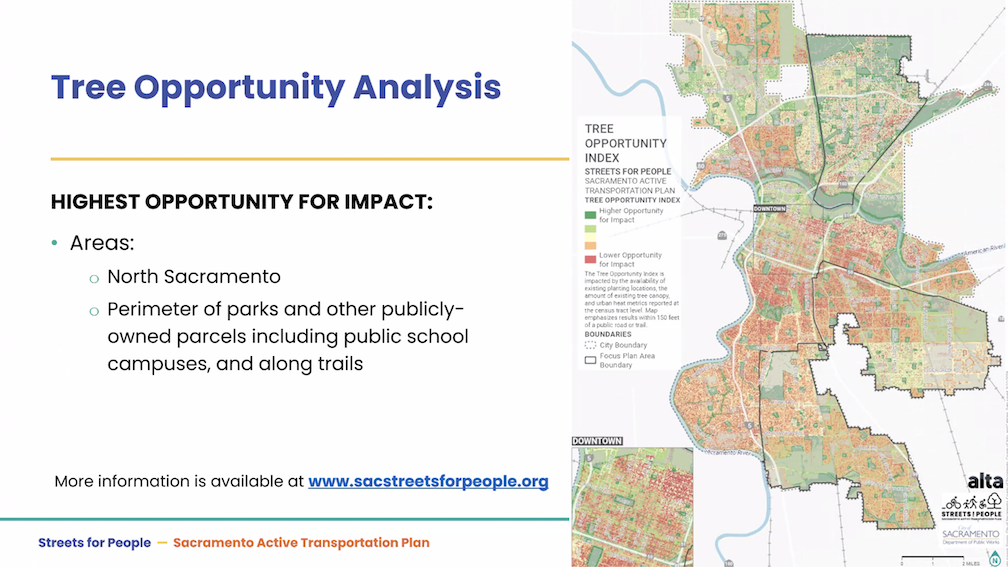
The City of Sacramento held the Streets for People Citywide Virtual Workshop #1 yesterday. Though the city may eventually post the slideshow, it is not on the program page Streets for People Active Transportation Plan yet, so I’m posting them here. These are low-ish resolution screen captures, so you won’t be able to see detail in them, but I hope they are still useful to you. I did not capture every single slide, but I hope the ones of interest are here. Of course the slides do not capture the presenter comments that went with each slide, which are important.

The next workshop, Streets for People Citywide Virtual Workshop #2, will be tomorrow, July 11. Please see the program web page for registration link. I assume the presentation will be the same.

The first workshop was poorly attended. I don’t know how many people, but the presenters mentioned several times how few people were on the webinar. My question/comment is that the Traffic Calming tab of the Neighborhood Connections storymap has the best examples of traffic calming measures, with many of the photos local, whereas the visual glossary pedestrian and visual gallery bikeways examples provided as part of the interactive map are of poorer quality, not local, and in a few cases should not be recommended at all. These two sources should use the same examples, where they overlap.

The second workshop will be followed by a series of focus groups for particular neighborhoods or areas of the city, and walk audits in those same areas. I hope that people will participate in one or more of them.

Streets for People Interactive Map visual gallery – pedestrian

Streets for People Active Transportation Plan has posted an interactive map on which people may make comments on proposed projects, or add their own points or lines. There are visual galleries for pedestrian infrastructure and bicycle classes, but they overlay the map so can’t be viewed while viewing the map. The visual galleries have been captured and made available here. This post is the pedestrian infrastructure gallery, next will be the bicycle classes gallery.

These elements are not exhaustive. There are several elements in the Streets for People Neighborhood Connections storymap traffic calming tab which can be used on the interactive map as well. And you may add your own.

Note: Photos are not from Sacramento. These galleries and the elements they contain are re-used from projects in other cities.

Visual Glossary of Pedestrian Infrastructure

Note: Also available as a pdf.

Sidewalks

Provide an area for people walking to travel separated from vehicle traffic. Typically constructed out of concrete and separated from the roadway by a curb or gutter and sometimes a landscaped buffer. 

Read More »

Streets for People Interactive Map visual gallery – bikeway classes

Streets for People Active Transportation Plan has posted an interactive map on which people may make comments on proposed projects, or add their own points or lines. There are visual galleries for pedestrian infrastructure and bicycle classes, but they overlay the map so can’t be viewed while viewing the map. The visual galleries have been captured and made available here. This post is the classes of bikeways gallery.

These elements are not exhaustive. There are several elements in the Streets for People Neighborhood Connections storymap traffic calming tab which can be used on the interactive map as well. And you may add your own.

Note: Photos are not from Sacramento. These galleries and the elements they contain are re-used from projects in other cities.

Visual Glossary of Classes of Bikeways

Also available as a pdf.

Shared-Use Paths 

Paths shared by people walking and biking completely separated from motor vehicle traffic. These facilities tend to be comfortable for people of all ages and abilities. 

Read More »

SacATC 2024-06-20 on Streets for People

The City of Sacramento Active Transportation Commission (SacATC) will meet today, June 20, 2024, 5:30PM in city council chambers, 915 I Street. 

The main agenda item is: 

  1. Streets for People Active Transportation Plan

This is a discussion and feedback item, not for decision.

The attachments to the staff report are available separately on the Streets for People webpage. Hopefully this will solve issues with the very large and likely corrupted combined document.

You can comment via eComment at the city’s meeting page, http://sacramento.granicus.com/ViewPublisher.php?view_id=21, before the meeting starts, or in person. Of course in-person is more powerful, but eComments are valuable and the only method many people can use. eComments submitted well ahead of time can be viewed by commissioners, while last-minute ones will go into the record but not be viewed before the meeting.

If you are frustrated by my posting the meeting on the day of the meeting, please view or subscribe to the calendar hosted by STAR, at https://star-transit.org/events/, which has this event and many others of interest to transportation advocates.