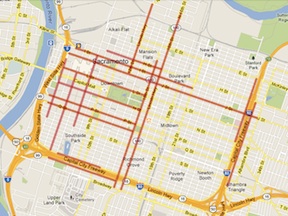
At right is the second map of downtown/midtown Sacramento, showing the 1-way streets. This map was created using Google maps and memory, and has not yet been field checked.
These streets total about 32.6 miles.
The map graphic links to the map data in Google Maps, from which you can zoom in on areas and turn on or off satellite view. The reason that this is not a map view graphic is that the online browser version of Google Maps starts paging after about 18 entries, so it is not possible to view all of the segments at the same time. This image is instead from Google Earth, via KML export and import.
The map provides background for an upcoming post about transforming transportation and livability in downtown/midtown.
At right is a map of the 3-lane (or more) streets in the downtown/midtown section of Sacramento. All of these streets are also one-way streets. Many people call this the grid, but others define the grid as a larger area including areas east of Alhambra Blvd and south of Broadway. This map was created using Google maps and memory, and has not yet been field checked.
These streets total about 25.4 miles.
The map graphic links to the map data in Google Maps, from which you can zoom in on areas and turn on or off satellite view.
The map provides background for an upcoming post about transforming transportation and livability in downtown/midtown.
Sacramento Area Bicycle Advocates (SABA) posted a question on Facebook, “Where shall we hold one in Sacramento?” about the Sunday Streets event this past Sunday on the Embarcadero in San Francisco. This echoes a conversation Alexis and I had while we were attending. She liked the Embarcadero Sunday Streets because it was a long distance and showed how streets can be used for transportation in a different way than we usually use them. For Sacramento, that would argue for a long distance closure that connects together destinations.
Though I certainly enjoyed this Sunday Street, I really like the two that I’ve been to in the Mission neighborhood of San Francisco, which close stretches of Valencia St and 24th St. This route is in a neighborhood, there are people living along the streets and in the neighborhood, as well as those who come from other places to enjoy. There are a multitude of locally-owned businesses to appreciate and engage, with nary a chain in sight. The special events such as play areas, climbing walls, hula hoops, dance demonstrations and others feel more concentrated rather than scattered out along a long route. For Sacramento, this argues for a midtown location, which is the only area where there is a sufficient concentration of residents and locally owned businesses. The Mission event is about community, and more like a street fair.
Embarcadero is more about transportation, and Mission is more about community. Sacramento, of course, could do both.
For more information about the flavors and locations of open streets events, see Open Streets Project. Check out the website for background information including “models”, and then go to one! Of course San Francisco is the easiest for us here in the Sacramento region, but Berkeley will also be having one or more this year, and as you’ll see, they are becoming common on the west coast, throughout the United States, and the world.
The next San Francisco event is on April 14, and is in the Mission neighborhood which I’ve referred to above, on Valencia St and 24th St. Don’t miss it! And bring back your thoughts and commitment to making it happen in Sacramento.
Alexis and I volunteered at the event as intersection monitors. Once you’ve been to an event, you can consider volunteering, which provides a different perspective. Though I was initially assigned to an quiet intersection where there was nothing much to do, I got moved to a lively intersection, The Embarcadero and North Point, where the F streetcar line crosses The Embarcadero at an angle, and there was a lot to do, stopping the walking-biking-rolling crowd as the streetcar came through, keeping people out of the dedicated streetcar lane, and talking to people about how to safely cross tracks.
The Sacramento Bee today had an article titled Fatal wrecks decline across Sacramento region. I was curious about where the data came from, and asked the author, Phillip Reese. He pointed me to the FARS (Fatality Analysis Reporting System) database. With reluctance, I finally dove in to this database which I’ve long been curious about but afraid of. It is quite hard to use, and it does not allow retrieval of multiple years at once. I compiled a data table of fatalities in the Sacramento region for the last ten years, and the table and graph are below. I used the SACOG region, which includes the six counties of El Dorado, Placer, Sacramento, Sutter, Yolo, and Yuba, so my numbers do not exactly match the four county region used by the Sacramento Bee for the map and 170 number.
The chart shows that there is in fact a downward trend in fatalities in the region, though it is not a consistent decline. Part of the reason 2011 looks good is that 2010 was bad.
Let me say, as I’ve said before, that fatality counts are a mis-measure of roadway safety. The best measure is the rate per vehicle mile traveled (VMT). Injuries are just as important as fatalities because they indicate trends in driver behavior, while fatalities reflect the internal safety of motor vehicles for occupants, and the effectiveness of the emergency medical system in responding to crashes. I will look more at the data, including looking specifically at pedestrians and bicyclists, and the rate for all modes. In meanwhile, here is the data and chart, to be taken with a grain of salt.
The City of Sacramento will include on the November ballot a repeal of Measure A, from 1977, which prohibits the city from requiring green waste bins. If passed, the city has already established a policy that “the claw” would only be used during three months, November through January, and during other months, green waste bins would be required for everyone.
Why is this a transportation issue? The yard waste ends up most commonly in the bike lanes. Piles of leaves can be challenging, but branches end up in the piles as well, an almost certain guarantee of a bicycle crash. At night the dark piles don’t stand out, and I’ve hit a number of them. Once the pile is there on the street, it accumulates all sorts of other trash as well. Some jerks seem to take it as an open invitation to add household trash, and couches, and … The piles could be placed in the parking lane, but almost never are. On streets without bike lanes, the piles constitute a mine field for the bicyclist who rides close to the right. Of course one can avoid the piles by taking the travel lane, as I and many others do, but at least as many bicyclists won’t place themselves there and end up swerving back and forth to avoid the piles.
If the measure passes, we will still have three months of piles, but there should be fewer of them as many people use the green waste bins year round. In my experience, the fall is the most challenging time of year, as the abundant leaves are hit by the fall rains and decay into a slimy slippery mess. I love that Sacramento has so many trees, and therefore so many leaves, but it is still a challenge.
We’ve all experienced waste bins in the bike lanes as well, trash, recycling, and green waste. But this seems a more manageable issue to me, as the owners can be cited and the bins moved by cyclists. In my opinion, bins belong in the parking lane where one is present, and where not, in the owner’s driveway or yard. Unfortunately, law does not seem clear on this point.
Bins do not ever belong on the sidewalk. As much as I am inconvenienced by bins in the bike lane, I never want to see them on the sidewalk, where they completely block access by disabled people and make walking less pleasant for everyone. When I’m walking, I always move bins off the sidewalk and back into people’s yards or driveways. Fortunately this is not a major problem in the city of Sacramento, but is common practice in the suburbs and other cities of the region.
The Streetsblog family of blogs (NYC, LA, SF, and Capitol Hill) has Daily News posts, and for the NYC, The Weekly Carnage. I find these useful for picking up interesting information I’d otherwise miss. Though I probably only average one click per list, it is still useful. Maybe this would be useful for Sacramento. Please let me know if it is useful, and please pass along articles that you think I might miss. The only news sources that I regularly follow are the Sacramento Bee and The Sacramento News & Review, but even there I sometimes miss things.