Sacramento City Express newsletter of March 4 includes an item about improvements to four intersections with a grant from the federal HSIP (Highway Safety Improvement Program) program. The article is below.
This is not part of the city’s new quick build program, rather it is from a grant submitted some time ago. Though( the city is not planning for or applying for new RRFB (Rapid Rectangular Flashing Beacon) installations, they were specified in this grant application and will be installed.
Safety upgrades coming to four high-injury intersections across Sacramento
Pedestrians crossing some of Sacramento’s busiest corridors will soon see brighter warning beacons, clearer markings and improved accessibility features designed to make walking safer and more accessible.
All four intersections are located on arterial roadways identified on the City’s High Injury Network in the Vision Zero Action Plan, which focuses on reducing traffic fatalities and serious injuries on City streets.
The project includes installation of Rectangular Rapid Flashing Beacon systems at each location, upgraded curb ramps with detectable warning surfaces, new signage, flexible posts and refreshed striping and pavement markings to improve driver awareness and pedestrian accessibility. Rectangular Rapid Flashing Beacons are pedestrian-activated flashing yellow lights that alert drivers someone is crossing the street.
“These intersections are on our High Injury Network, and additional visibility and warning features are designed to improve driver awareness to yield to pedestrians,” said James Kragh, associate engineer with the Department of Public Works. “Installing rapid flashing beacons and upgrading curb ramps will enhance conspicuity and accessibility for people using these crossings.”
The City applied for and received $193,600 in HSIP Cycle 10 construction funding to help deliver the project.
Construction is expected to begin later this month and be completed this summer.
Once complete, the upgraded crossings will provide stronger visual cues to drivers and safer, more accessible routes for people walking and rolling along some of Sacramento’s most heavily traveled corridors.
The Sacramento Active Transportation Commission (SacATC) will meet Thursday, Aprll 17, 2025, at 5:30 PM. The meetings are held in city council chambers at 915 I St, Sacramento, CA 95814. The meeting can be viewed online via the link provided on the city Upcoming Meeting Materials page at the time of the meeting, but comments may only be made in person, or via eComment ahead of time.
I have concerns about the use of RRFBs (Rectangular Rapid Flashing Beacons) at unsignalized crosswalks. They may be better than crosswalks without, however, they may provide a false sende of security for walkers. I have noticed (anecdotal evidence only) that the rate of driver compliance with RRFBs is poor, only about 40%, which is not much better than unprotected crosswalks, and it has not improved at drivers have gotten used to the RRFB as they are installed in more locations. I would suggest that before the city install any additional RRFBs, there a literature survey to see if there are recent indications of driver non-compliance increasing hazard for people walking, and on-the-ground observation of at least two existing locations in the city. I know that compliance with the RRFB on J Street at 17th Street is poor. I have almost been hit in both the west and east crosswalks, both of which have RRFBs. I kinow not to trust drivers to yield, but what about people walking who do not know to not trust drivers. The other enhancements proposed seem good.
In Audible Signals Phase 1, a number of locations in the central city where pedestrian signals were on auto-recall were converted, or downgraded, to locations requiring the push of a button. These are called beg-buttons) because the pedestrian indicator will never come on unless the button is pushed, though with many of the locations, the pedestrian signal is set to auto-recall even though the button says it must be pressed. This is an unofficial city policy, that people walking will NOT be informed of the operation of the pedestrian signal, left to guess whether it is auto-recall or requiring a push. The recently installed ‘push or wave to cross’ signals do not overcome this issue. The staff report claims that all of the new locations already have push buttons, though it does not say whether any are on auto-recall.
The city is claiming as support for the past and proposed audible signals project that citizens are requesting beg buttons. They are not. What they are requesting is audible signals that communicate effective crossing information to visually impaired walkers (or rollers), to comply with current ProWAG requirements. The city is conflating audible signals with push buttons, but they do not need to go together. Audible signals can be installed at auto-recall intersections.
This is the eighth post (I think) on the Broadway Complete Streets project. Additional posts on Broadway Complete Streets are available at category ‘Broadway Complete Streets‘.
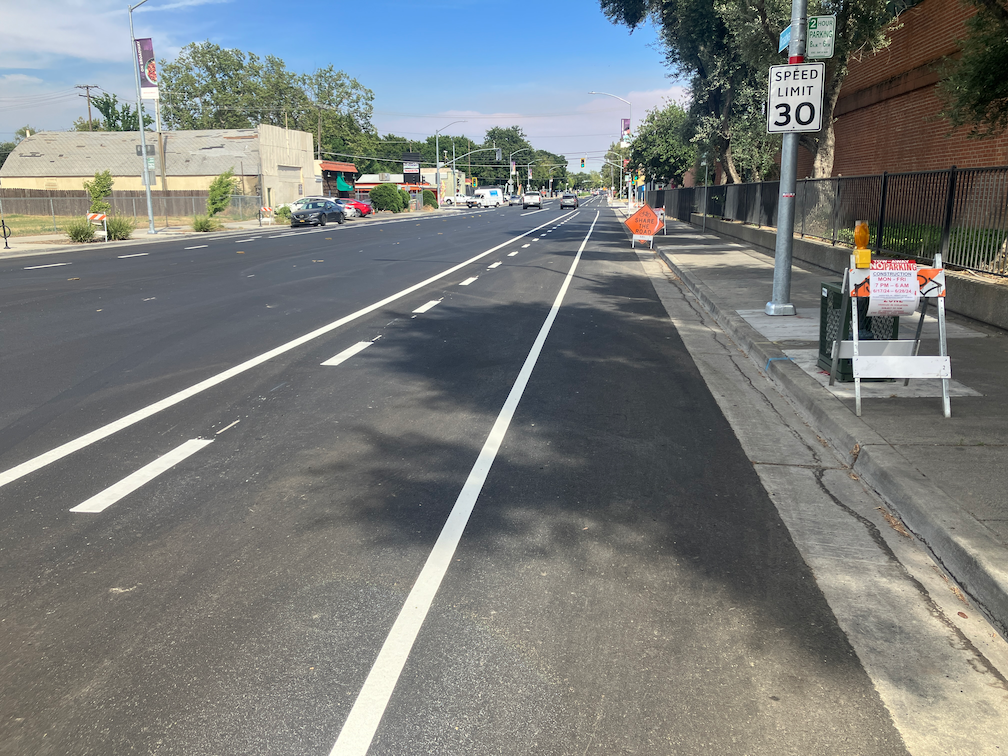
The long-line striping on Broadway is essentially complete, with the addition of yellow lines for center dividers and the center turn lane. There is still no green paint for bicycle facilities, and the shared transit/bike areas. None of the crosswalks have been installed. This lack of attention to crosswalks is typical of the entire project, motor vehicles first, sidewalks last and walkers crossing last.
Broadway at 3rd St striping
The short curb-separated bikeway eastbound between 15th Street and 16th Street was closed yesterday, though I had used it a few days earlier. I noticed a bicycle signal on Broadway at 16th Street / Land Park Drive, which may have not been there before or may not have been activated and so I didn’t notice it. In a short while of observing, it did not change to green, so perhaps it is awaiting completion of the curb-separated bikeway.
Broadway at 16th St / Land Park Dr, eastbound, bicycle signal
I continue to have concerns about the RRFBs (rectangular rapid flashing beacon) used for several crosswalks along Broadway. The one in the photo below seemed to be stuck on, for unknown reasons. The rate of driver yielding to people crossing is very low. An observer pointed out that because RRFBs are not common in Sacramento, drivers may not know how to deal with them, and that this would be a perfect time for a city educational effort to bring drivers up to speed (so to speak). The particular location shown below, Broadway at 22nd, has a median island in the center, preventing drivers from passing stopped motor vehicles by using the center turn lane. Other locations do not have this protection, and I observed at least one instance of a driver passing a stopped vehicle by using the center turn lane at Broadway and 18th Street. Reduced general purpose lanes, from two per direction to one per direction, do significantly reduce the multi-lane threat, where one vehicle stops and others do not, but the center turn lane allows drivers to continue to threaten walkers, and to violate the law.
Broadway at 22nd Str, RRFB and walker
As recently as the Broadway Fact Sheet in 2019, conversion of 16th Street between Broadway and X Street from one-way to two-way was part of the project. I’ve seen no evidence of work on that part, so it may have been delayed or may have been dropped. Also, work on Broadway between 19th Street and 21st Street has been delayed to another phase due to prolonged negotiation with Union Pacific over whether there will be one or two traffic lanes per direction approaching the railroad tracks between 19th Street and 20th Street.
I’ll post again when green paint has been installed, and the crosswalks completed.
Additional posts on Broadway Complete Streets are available at category ‘Broadway Complete Streets‘.
Striping is finally occurring on Broadway, more than two weeks after marking for the striping was completed. Crosswalks have not been striped, though if I were in charge, they would be the first thing striped. Striping is incomplete from 3rd Street to 11th Street, and there is minor striping east of there. There is no green paint yet.
partial striping on Broadway at 3rd St
RRFBs (rectangular rapid flashing beacon) signals have been installed at three locations. These are mounted on poles and mast arms. Some observation has indicated they are being widely ignored by drivers. A person who has watched the RRFB at 18th Street says that only about 5% of the drivers were yielding to walkers who had triggered the lights. I will do more observation and talk to more people about their observations, but so far, the concerns I expressed in RRFBs are being ignored are true on Broadway.
I was a strong supporter of RRFBs (rectangular rapid flashing beacon), where a safer crossing of the street is intended mid-block. I worked with transportation agencies in a number of locations to get them installed, and was very happy to see them go in.
They are used where multi-use trails cross roadways, and at intersections where additional traffic calming and safety are needed, but where the transportation agency does not want to add stop signs, or is unwilling or financially unable to install a traffic signal. The cost savings of an RRFB over a traffic signal are significant, about $25K for a RRFB, and upwards of $1M for a full traffic signal.
But…
Driver behavior has rendered RRFBs untenable for protecting people walking. I have observed a number of RRFB locations over the last few months. All of them are failing. Between 25% and 50% of drivers are failing to yield to people using these crossings, bicyclists or walkers. I have seen several people almost get hit by car drivers. Some drivers are slowing but failing to stop, or yield, and some drivers are not even slowing. Apparently the attitude of many drivers is that the RRFBs are only advisory and do not require yield to people in the street. Of course the law requires yielding to people crossing the street in a crosswalk, whether there is any type of signing or signaling, or not. But drivers don’t see it that way.
So, I find myself having to withdraw support for RRFBs. I will not support them as freestanding safety improvements, not as part of project. It is sad that driver behavior has erased the benefit of a safety enhancement, but it is a fact, and driver behavior gets continuously worse, never better.
The monthly meeting of the Sacramento Active Transportation Commission (SacATC) will be this Thursday, April 18, 2024, starting at 5:30 PM in the city council chambers. You can comment on these items, or on topics not on the agenda, ahead of time via eComment, or in person at the meeting. I encourage people to attend these commission meetings. There are usually very few members of the public in attendance, which means that your voice is important. Though eComments are valuable, in-person comments carry a lot more weight. The city’s planning staff is usually progressive and innovative, but Public Works in general is not, so it is important the citizens show up to push for progressive and innovative projects and policies. With some new appointments to the commission, and support of the public, the commission itself has been much more progressive than in past years.
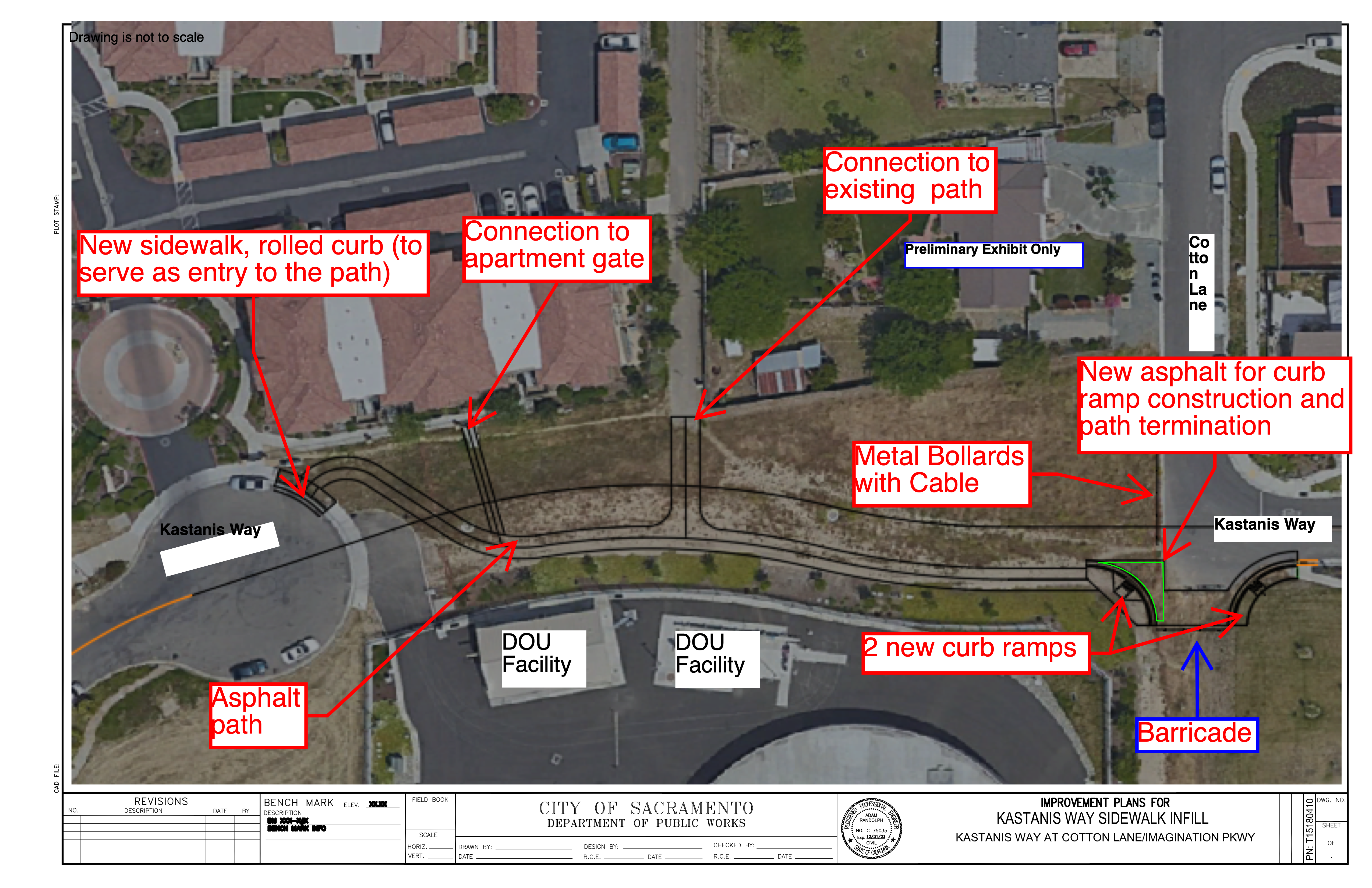
Kastanis Way Shared Use Path looks like a great project, connecting two dead-end streets for walkers and bicyclists, but not motor vehicles. These are the kinds of projects that should be implemented everywhere the opportunity exists.
Kastanis Way shared use path
Grand Avenue Sidewalk Infill also looks good, providing improvements to the crossing Grand Avenue by the Sacramento Northern multi-use path.
Grand Avenue Sidewalk Infill project
The Traffic Signal Safety project is questionable. There are nine locations:
16th Street at D Street (Traffic Signal)
Franklin Boulevard at 36th Avenue (Traffic Signal)
Freeport Boulevard at Kitchner Road (Traffic Signal)
Fruitridge Road at 60th Street (Pedestrian Signal)
Rio Linda Boulevard at Harris Avenue (Rectangular Rapid Flashing Beacon)
Stockton Boulevard at 11th Avenue (Pedestrian Signal)
24th Street at 25th Street (Pedestrian Signal)
Munroe Street at Latham Drive (Traffic Signal)
Rio Linda Boulevard at Roanoke Avenue (Rectangular Rapid Flashing Beacon)
I haven’t had a chance to look at each of these proposals, though I will note that the city traffic engineers love to install traffic signals. At $100K to $500K per intersection, these are major investments. Many of the new signals the city has installed, for example on 5th Street and S Street, are unneeded, and waste of money. They have also converted a number of pedestrian signals from auto-recall (the pedestrian signal comes on at every signal cycle) to beg buttons (the person walking or rolling must activate the sensor, or the pedestrians signal will never come on). The city has a number of unnecessary signals, 60 in the central city alone. Maybe a one-for-one program is called for, install a new signal, take out an existing signal.
I don’t trust city traffic engineers. They label projects as safety projects for walkers and bicyclist, when they are really motor vehicle infrastructure projects. So-called pedestrian and bicyclist safety projects are often motor vehicle enhancements in disguise.
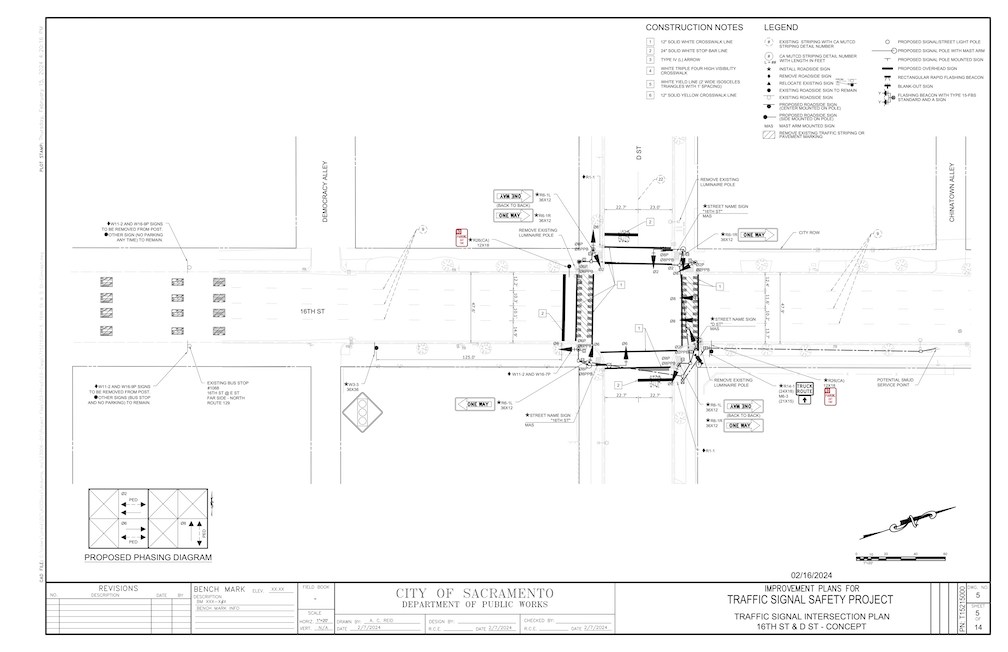
I cross 16th Street at D Street several times a week on bicycle, and occasionally walking, most often to access the American River bike trail via Sacramento Northern path over the river. Yes, I have to wait for a gap in traffic on 16th Street, which sometimes takes a while. But rarely longer than I would have to wait for a traffic signal, given that the arterial street (16th Street) always has a long green and the cross street (D Street) has a short green. I think that funds would be better spent slowing motor vehicle traffic on 16th Street, or adding bike facilities to 16th Street, or reducing the travel lanes on 16th Street, which is a four-lane traffic sewer. Traffic signals do not calm traffic. They irritate drivers, and cause them to quickly accelerate out of the signal to make up for time lost at the signal. They may allow for safer pedestrian crossing, or at least would if red light running were not an epidemic in Sacramento. The fact is, many drivers do not stop for red lights, and certainly don’t stop for people walking in crosswalks. Measures other than traffic signals are necessary to solve the issue.
traffic signal at 16th St & D St
The proposal for an RRFB (Rectangular Rapid Flashing Beacon) for Rio Linda Blvd at Roanoke Avenue is inappropriate. The posted speed limit in this section of Rio Linda Blvd is 40 mph, meaning that actual speeds are more like 50 mph. This is too fast for an RRFB to have any effect on drivers. Even at slower speeds drivers often ignore RRFBs. If there is to be a safe crossing at Roanoke, there must be a HAWK signal, or a full traffic signal. Again, funds would be better expended slowing traffic on Rio Linda. At this time, there is no connection between Roanoke Avenue and the Sacramento Northern Bike Trail, so it isn’t clear why this location has been picked for a signal.
RRFB for Rio Linda Blvd & Roanoke Ave
I will leave it to others to examine the other seven locations. Are signals needed? Are they the right kind of signal for the context, particularly the speed and volume of motor vehicle traffic? Are there projects that would improve safety for walkers and bicyclists more than expensive traffic signals? Are these the best locations, the ones that best serve routes of travel for walkers and bicyclists? I have doubts that these questions were considered.
Note: Readers Sean Rogers has suggested a better, and less expensive, solution for Monroe and Latham, in comments. The solution may be calming traffic, not just installing a signal.
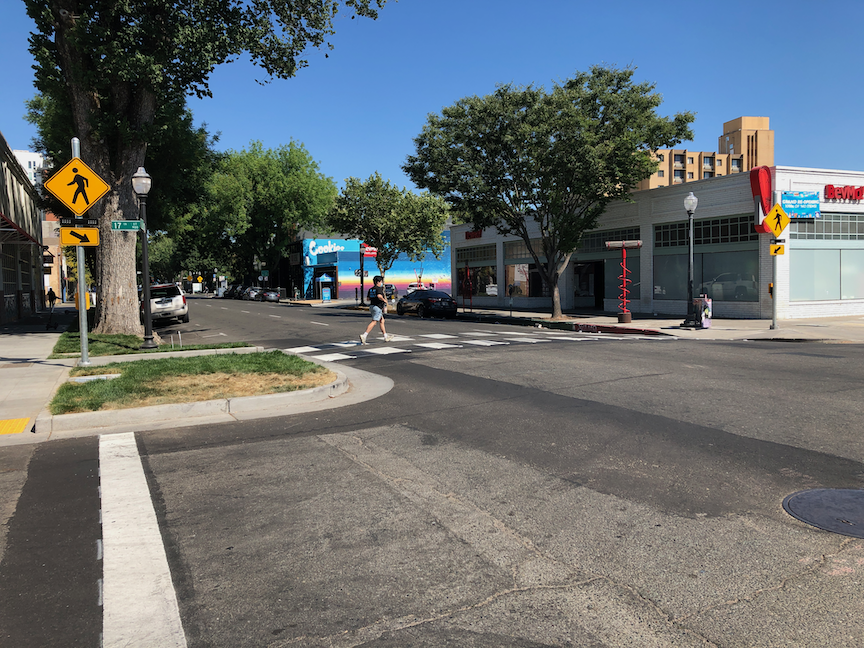
Last week I walked over to the new Target store at J Street & 17th Street in midtown Sacramento. On my way there, I was thinking to myself that with the additional people walking to the store, the crosswalk over J Street was going to need some sort of additional protection, since I knew from experience that most car drivers don’t yield to people walking at that location.
Lo and behold, a RRFB (rectangular rapid flashing beacon) was installed!
RRFB on J St at 17th St
The person walking presses a button which triggers flashing lights mounted on the pedestrian crossing signs. A curb extension on the north side of the crosswalk was installed when the sidewalks around the Target store were installed, so the crossing distance has been shortened somewhat, which also helps.
There are signs with the buttons, below. These are not MUTCD compliant signs, which is ironic, because the city had refused at the beginning of the pandemic to install pedestrian crossing signs that indicated the actual effect of the button, whether it was necessary to press it, because there is no MUTCD sign that does that. Maybe the city is reconsidering it’s signing – unlikely.
RRFB button
A word of warning to anyone who thinks signs and flashing light make it safe to cross. What they do is make is safer than it would be without, but not safe. J Street is a three-lane traffic sewer, on which drivers seldom yield to people walking, whether there is a marked crosswalk or not. Anytime a roadway has multiple lanes in a direction, the multi-lane threat exists, that one driver will stop and others will not. I see this routinely on all the streets in Sacramento that are multi-lane. So, cross with caution no matter what. What I do is step into the street to remind drivers that I have the right-of-way, but walk very slowly until the drivers in all lanes have come to a complete stop. Of course that frustrates the driver who originally stopped, that I am crossing so slowly, but my job is to keep myself safe, not to please drivers.





 Getting Around Sacramento