SacATC April 18 notes

These are my notes from the April 18 meeting of the Sacramento Active Transportation Commission (SacATC). The official minutes are not available until the agenda for the next meeting is released, about three days before the meeting.

City staff announced that due to hiring a consultant and the project timeline, the updated Vision Zero Action Plan would not be available until sometime in 2025, not this year.

Agenda 4: Kastanis Shared Use Path. This is a wonderful project, connecting two ends of a dead-end street for walkers and bicyclists. It received my support and the full commission. Commissioners asked about lighting and trees, but as a sidewalk infill project from a very limited program, those could not be included.

Agenda 5: Grand Avenue Sidewalk Infill. Another wonderful project, adding sidewalks on Grand Aveue adjacent to the Sacramento Northern Trail for better neighborhood access included ADA ramps on all corners. A SacRT bus stop location will also be improved. Again, my support and the full commission. Commissioner Harris, who represents District 2, spoke about the lack of sidewalks throughout much of the district, and the benefit of any infill projects.

I spoke on items ‘not on the agenda’, asking that the slide presentations be made available before the commission meeting whenever possible. There is often information in the presentations not available in the staff report, which can make a project look better, or worse. I also suggested that the commission ask for a presentation on how the city views its responsibility for bus stops, since this came up many times in discussion of the Grand Avenue project.

I hope that more people will attend the SacATC meetings and comment on projects (on online via eComment). This is the only real chance for public input on projects, other than going to your council member. Most Public Works projects are a black box without public input, so when there is the chance, it is time to speak up for safer and innovative solutions.

And now on to the more complex project, which took up the majority of the meeting time.

Agenda 3: Traffic Signal Safety Program. There was a staff presentation with a slide deck that was not available to the public (this is an ongoing problem, see below). Though the diagrams in the presentation were much more detailed than the ones in the staff report, they still left out a lot about the context of the intersection. What is it close to? Are there already a lot of walkers? How far is it to the next safe crossing? Is a traffic signal the best solution? It was clear from answers to commissioner questions that a lot of information was missing. Apparently this project is the result of a SACOG grant made to the city in 2017. Presumably there was a resulting document on the project, but that was not made available. The staff person said site selection was based on traffic warrants, but then exhibited a lack of knowledge about warrants. The question came up about whether the city could install a signal of any type that didn’t meet designs in the CA-MUTCD (California version of the federal Manual for Uniform Traffic Control Devices). The initial answer was no, but this was revised to yes, however a grant would be unlikely to be obtained that included non-MUTCD designs.

Overall, the entire traffic signal project is disappointing. The traffic engineering section of Public Works seems to have a very simple view of the world, to wit, a street with an unsafe design > a traffic signal. Changing the street design? Nah. Calming traffic to make the crossing safer? Nah. Shortening the crossing distance? Nah.

Traffic signals are expensive! Though no budget detail was provided, it is reasonable to assume from the overall $7.9M budget, which includes four full traffic signals, three pedestrian signals, and two RRFB (rectangular rapid flashing beacon) that full traffic signals cost about $1M each. That kind of money could fund a lot of traffic calming with lane reductions and curb extensions. Please take a look at my agenda post, and a comment from Sean Rogers that provides a much lower cost alternative for the Monroe Street and Latham Drive intersection.

Traffic signals do not necessarily create safer streets. Certainly, they don’t promote safety in between signals, as drivers accelerate to previous, often egregious, speeds as soon as the light turns green. With rampant red-light running, stop signs are probably much safer than signals. Though drivers also run stop signs, they do so at much slower speeds, whereas drivers running red lights often accelerate into the red light, ensuring the death of anyone in their path. If there are no gaps in traffic on a roadway, then it is necessary to create gaps with some sort of control, but a traffic signal is often the dumbest and most expensive way of doing that.

California has two years from the adoption of the federal MUTCD, which was December 2023, to either submit its own version, or the federal version will be the version for California.

The federal MUTCD (2023) has some interesting text (Section 4B.03 Alternatives to Traffic Control Signals): “Since road user delay and the frequency of some types of crashes are sometimes higher under traffic signal control than under STOP sign control, consideration should be given to providing alternatives to traffic control signals even if one or more of the signal warrants (see Chapter 4C) has been satisfied”, followed by 14 alternatives to traffic signals.

Section 4C.01 Studies and Factors for Justifying Traffic Control Signals provides a list of nine possible warrants to justify a traffic signal:

Warrant 1, Eight-Hour Vehicular Volume
Warrant 2, Four-Hour Vehicular Volume
Warrant 3, Peak Hour
Warrant 4, Pedestrian Volume
Warrant 5, School Crossing
Warrant 6, Coordinated Signal System
Warrant 7, Crash Experience
Warrant 8, Roadway Network
Warrant 9, Intersection Near a Grade Crossing

It is unknown which of, or any of, these were used to justify the signal locations. There are very detailed (and hard to understand) explanations of each of these warrant types.

My comments on the project, which I did not quite finish (two minutes is a short time), included:

  • Signals are not necessarily a safety feature for people walking, unless there are no gaps in traffic, the more important issue is to calm traffic on the approaching streets
  • We already have a lot of unneeded signals, where the traffic volume and context of the intersection does not justify a full traffic signal, perhaps 60 of them just in the central city
  • 16th & D: traffic on 16th St needs to be calmed, signal will probably not shorten wait time for crossing
  • Rio Linda at Roanoke: lacks a connection to Sacramento Northern Trail, which would make it a great deal more useful, posted speed 40 mph is too high for an RRFB
  • Monroe and Latham: traffic calming through lane reduction and curb extensions would be as effective as a signal (Sean Rogers comment)
  • At about $1M for a full traffic signal, there are much less expensive alternatives, and much better ways of spending limited funds

MUTCD released

The 11th edition of the Manual for Uniform Traffic Control Devices (MUTCD) was released in December by FHWA (Federal Highway Administration), so is the 2023 version. The update included solicited comments from the public for the first time, as previously it had been solely the work of traffic engineer insiders. As a result, it is better than the previous version, but still has many unsafe practices included. Though it is supposed to be only about signs and pavement markings, it grades into roadway design, with an emphasis on high speed freeways. Much of it should be limited to highways, but it is regularly applied, or mis-applied, to local streets.

I have been focused on Part 6: Temporary Traffic Control, because it relates to the City of Sacramento work zone policy update. The diagrams are much easier to digest than the text, but the text is also critical. Most of the text and diagrams relate to freeways and expressways, where sidewalks and bike facilities are absent, but it does have some information that affects walking and bicycling. The document uses the phrase ‘shall’ to indicate that a practice must be followed, however, the entire document is prefaced with allowance and encouragement to use engineering judgement. Other terms such as guidance and support are used, for ‘good ideas’ but not requirements. It is very unlikely that I will ever read the entire document; it is 1,150 pages!

NACTO (National Association of City Traffic Officials, a much more progressive organization than FHWA) has done a preliminary review of the new MUTCD: NACTO Statement on the Release of the 11th Edition of the MUTCD, Which Governs How Nearly Every Street in the U.S. Is Designed. NACTO has promised a more though review.

California has in the past adopted its own version of the federal MUTCD, the CA-MUTCD. The current California version is 2014, and it took the state five years to develop this version and get it approved. Hopefully it will take far less time this go-round. The California version deletes some text and diagrams from the federal, adds some diagrams, and adds quite a bit of text. In most case, the California version specifies clearer or safer information, but not always. In some cases the California version has been included in the new federal version, so does not need to vary. I have not seen any announcement from Caltrans about a state update.

traffic engineering ‘profession’

This post is provoked by two articles on the Strong Towns blog: Strong Towns Will Defend Engineers’ Right to Free Speech From the Minnesota Licensing Board, and We Are Holding Engineers Accountable for Dangerous Road Designs. The Engineering Powers That Be Want Us To Shut Up. However, I’m going to go far beyond anything Strong Towns would say. Strong Towns would say that traffic engineers are good people, just working from a flawed set of assumptions and a flawed understanding of what streets are for. I’m not so sure.

Our transportation system, which largely does not work for walkers and bicyclists, and doesn’t work very well for transit users, was designed by traffic engineers. Our transportation system kills 43,000 people a year in the US, and injures far, far more. Not to mention climate change, which in California is largely the result of our transportation system (57% of GHGs). Not to mention the asthma and other health problems of the kids who live near freeways and arterial roadways. Not to mention… well, you get the idea. The list could be very, very long. Not all of this is the fault of traffic engineers, but I’m saying most of it is. What other profession gets away with killing so many people, and harming far more, and shirks responsibility for it? A little education and a little enforcement will solve the problem? Bullshit.

I have long questioned the use of ‘traffic engineer’ and ‘professional’ in the same phase. Traffic engineering is more akin to quackery. Give us all your money, and we’ll design and build something that will make you happy! Oh, it didn’t, well, give us the rest of your money and we’ll fix the thing that didn’t work. Yeh, we know that what we design doesn’t really work to ease congestion or make your life better or safer, but give us some more money, and it will eventually (one more lane lane will fix it). Snake oil!

Traffic engineers fall back on two things in an effort to absolve themselves of responsibility:

  • The MUTCD made me do it. This is akin to that old expression ‘the devil made me do it’. The MUTCD (Manual of Uniform Traffic Control Devices) was written largely by traffic engineers, and it could be changed by traffic engineers. But when the revision process started, traffic engineers whined loudly about any change that would reduce traffic flow, or increase safety for other users of the roadways. It’s the two-year-old response: if you don’t let me have my way, I’m going to take my ball and go home, and give me your lunch money while you’re at it (sorry, real two-year-olds, to align you with traffic engineers, that’s mean). The MUTCD is full of ‘facts’ that are largely made up by the engineering ‘profession’. There is almost no research to back up what is claimed in the MUTCD. And even if it were a valid document, it doesn’t require that it be followed, it just says, if you are designing something, here is the the best practice that we’ve documented. In California, the Highway Design Manual also makes up ‘facts’ to fit the desires of traffic engineers, and prohibits many safety features because someone imagined that they were unsafe (or slowed traffic).
  • It was the politician’s decision, not ours. But the fact is that politicians almost always follow the recommendations of the traffic engineers. Most politicians don’t have the expertise to question what the engineers suggest, nor do they usually listen to the concerns of the people who will be harmed by projects (unless those harmed are big campaign donors). After all, ribbon cuttings are a path to reelection. If the traffic engineers propose bad solutions, those are almost always what gets implemented.

So, traffic engineers: If you are not working today and every day to fix the problems your profession has created, you are not only part of the problem, you are the problem. If you spend any time working on roadway capacity expansion projects, I ask that you not go into work, that you find a job where your values don’t harm so many people, while sucking the public budget dry and incurring maintenance liabilities that will be with us for the foreseeable future.

Traffic engineers have embraced a concept called ‘complete streets’ to a degree that surprised everyone. Not me. How else to fund traffic signals and lighting and new curbs and utilities, except by capturing funds meant for active transportation? As though the other roadway projects didn’t provide enough money, here is another source we can capture.

My attitude towards traffic engineers has been simmering for a long while, and it has boiled over. Why do citizens who just want to travel safely by foot, bicycle, and transit have to fight the designs and desires of traffic engineers? Why do we have to fight for walkable sidewalks? Why do we have to fight for bikeable streets? Why do we have to fight for the money and priorities to run an effective transit system? Why are the roads continuing to deteriorate, while roadway capacity expansion projects receive the bulk of funding? Why? The answer is, largely, the traffic engineering ‘profession’.

MUTCD sidewalk construction signs

A follow-on to my previous post MUTCD revision comments, and of relevance to all my construction zone posts.

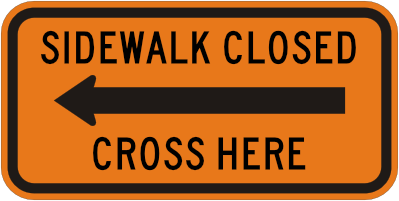
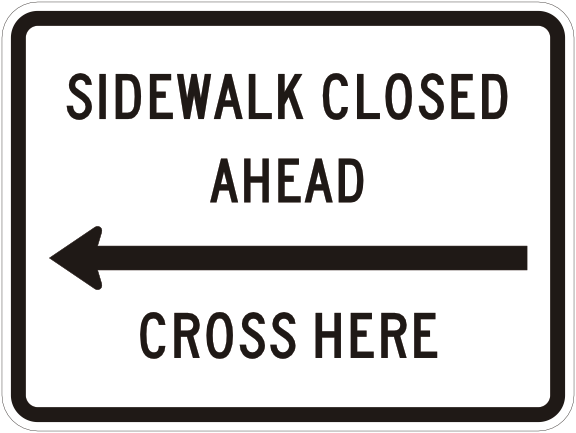
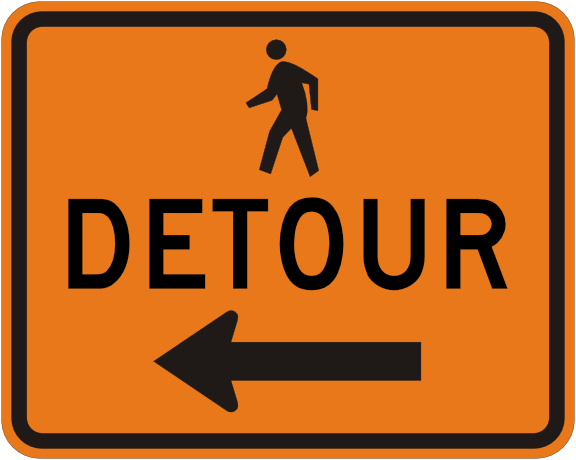
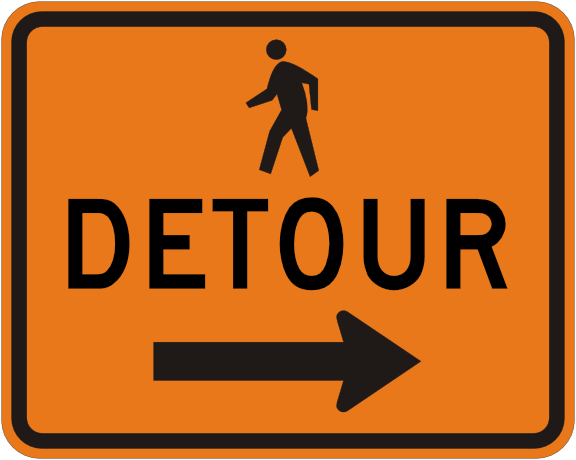
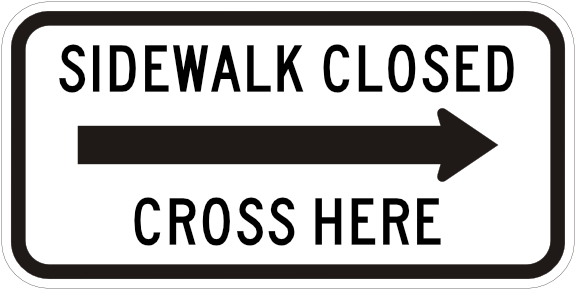
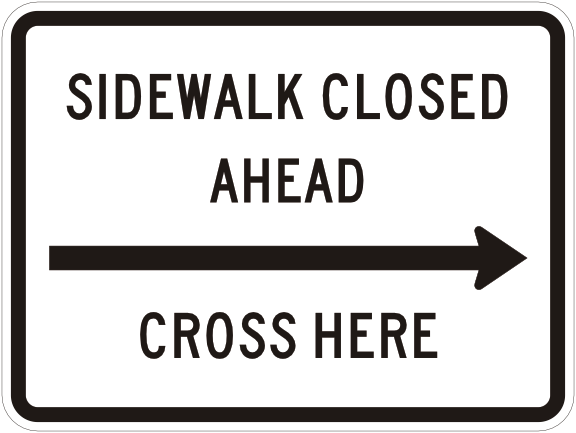
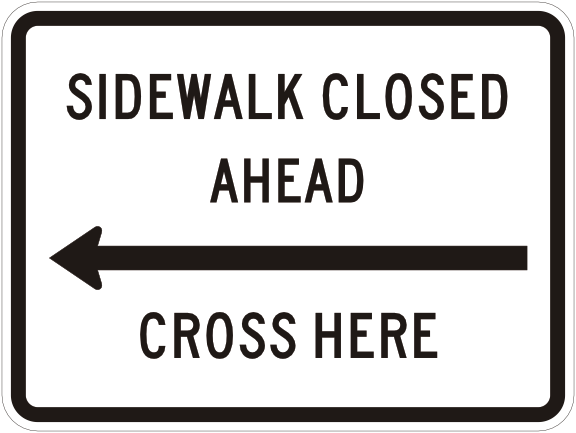
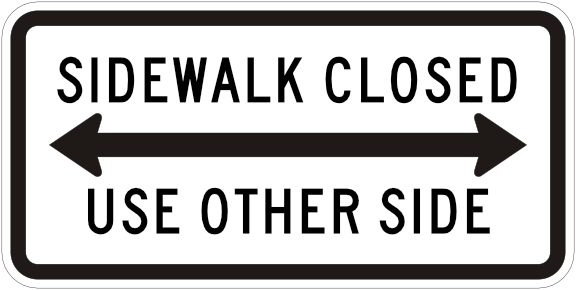
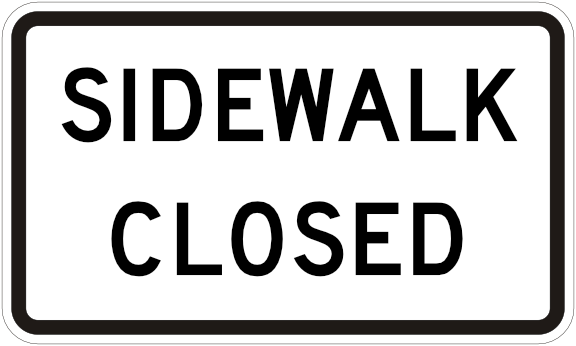
The MUTCD (Manual for Uniform Traffic Control Devices) is a bit confused (and a lot lacking) when it comes to signs for temporary traffic control devices. Orange is supposed to be the color for temporary traffic control devices, yet the manual uses regulatory (white) signs for sidewalks in construction zones. A white sign indicates permanence, an orange sign indicates temporary. That subtlety seems beyond the comprehension of the people who write the MUTCD, but I’m here to help them. Below are the pairs of signs for sidewalk closure in construction zones. On the left is the existing MUTCD sign, on the right is the sign as it should be.

R9-9 regulatory version
R9-9 TTC version
R9-11a regulatory version
R9-11a TTC version
R9-11 regulatory version
R9-11 TTC version

There might be situations in which the permanent, white regulatory sign might be appropriate, though the number of such situations is and should be rare. Sidewalks should be continuous, not broken, not closed.

Note that I did not include the R9-10 sign with arrows pointing both ways, since I can’t think of a context in which that would be the appropriate sign. Unless someone can, it should be removed from the MUTCD.

I have also suggested that all TTC signs be given a unique code, not M, not R, not W, but perhaps T.

MUTCD revision comments

The Federal Highway Administration (FHWA) is revising the Manual on Uniform Traffic Control Devices (MUTCD) and is seeking public comment. You can view the revised document at https://www.federalregister.gov/documents/2020/12/14/2020-26789/national-standards-for-traffic-control-devices-the-manual-on-uniform-traffic-control-devices-for (scroll down until you see Supporting/Related Materials in the green box, and you may make comments on this same page (Submit a Formal Comment is a big green button).

The MUTCD is an incredibly complex document, with cross-references everywhere that require you to jump around through the document, terms used but never defined (though 287 terms are defined), incredible detail on some topics while pretty much ignoring other topics (like bicyclists and walkers). The document is intended to cover signs and markings (the paint on roadways) but does not address roadway design except in a very minor way. That is deferred to private organizations such as Association Association of State Highway and Transportation Officials (AASHTO). Many people have suggested that the main reason FHWA is updating MUTCD is to add the section on automated vehicles, and the other changes are an afterthought.

One could devote their life to reading and understanding the MUTCD, and probably would not, in fact I’m not sure that anyone in FHWA has ever read the entire document. The reason it is so important, however, is that it is the document to which transportation engineers constantly refer to as the reason they can’t do the right thing, or must do the wrong thing.

My comments so far are below.


The MUTCD should be separated into two documents, one for highways and another for streets. Local engineers continually refer to items that should only apply to highways in designing or refusing to design facilities for streets.

Section 1C.02
Definitions of Words and Phrases Used in this Manual

106. Intersection—intersection is defined as follows: (b) The junction of an alley, or driveway, or side roadway with a public roadway or highway shall not constitute an intersection, unless the public roadway or highway at said junction is controlled by a traffic control device.

The definition uses the term ‘side roadway’ but this term is not otherwise defined. If used, it must be defined.

2B.59 Traffic Signal Pedestrian and Bicycle Actuation Signs (R10-1 through R10-4, and R10-24 through R10-26)
Figure 2B-26. Pedestrian Signs and Plaques of the signs document

The activation signs in 2B-59 should be greatly simplified. There should be a sign for signal heads that count down, a sign for symbols only, a sign to activate audible message, and a sign to extend crossing time. Having 18 signs does not help pedestrians in any way. Signs reflecting old pedestrian signal heads should be phased out in five years, along with changing all pedestrian signal heads to reflect the current standard.

4I.05 Pedestrian Detectors
Push button pedestrian detectors which are not required (the signal is on auto-recall) SHALL be removed, or converted to accessible pedestrian detectors, within five years of the date of publication. Accessible push button detectors will have associated signing which clearly indicates the purpose of the button, and that a button press is not required to cross. The existence of push buttons which serve no purpose is confusing to pedestrians and indicates a bias against people who walk.

Figure 4I-4 
Pedestrian Intervals In the Relationship to associated vehicular phase intervals: diagram, the third option (Part of Yellow Change Interval + Red Clearance Interval = Buffer Interval) and the fourth option (Red Clearance Interval = Buffer Interval) should be removed. These two options may significantly reduce safety for pedestrians while having only minor impact on traffic throughput. These types of signal setups discourage people from crossing streets.

Part 6: Temporary Traffic Control

The entire Part 6 Temporary Traffic Control is extremely weak in the accommodation and protection of pedestrians and bicyclists.

Bicycles

Figure 6P-48. Bicycle Lane Closure with on-Road Detour (TA-48)
Whenever construction signs are placed in a bike lane, as they often are, the ‘bike lane closed ahead’ sign should precede the ‘road work ahead’ sign, since bicyclists will be forced into the roadway by the sign and motor vehicle drivers need the warning of bicyclists before they need the warning of road work.

W11-1/W16-1P assembly is shown on the figure, but the sign is not in associated sign document. The ‘bike lane closed ahead’ sign is not in the associated sign document, nor does it seem to exist anywhere in the current MUTCD.

The ‘bikes may use full lane’ (R4-11) and the ‘share the road’ assembly are shown as optional. They should not be optional, since the detour roadway does not have a bike lane, whereas the construction roadway did.

Figure 6P-47. Bicycle Lane Closure without Detour (TA-47)
Again makes the ‘bikes may use full lane’ and ‘share the road’ assembly optional. It should not be. Signing in this situation must communicate to both the bicyclist and the motor vehicle driver. The ‘bikes merge’ sign is not in the TTC signs document, nor anywhere else in the MUTCD.

There is no diagram that shows signing and marking for a temporary separated bicycle pathway placed in the roadway. There must be a diagram for this situation.

Pedestrians

Almost nowhere in the TTC sign diagrams are sidewalks shown nor the appropriate treatment of temporary closures, whether through detour or added pathways. The implication is that pedestrians don’t exist and need not be accommodated.

Figure 6K-2. Pedestrian Channelizing Device shows how a channelization should be constructed, but says nothing about where that channelization might occur.

Figure 6P-29. Crosswalk Closures and Pedestrian Detours (TA-29) shows sidewalk closures, with a mid block temporary crosswalk, but it does not show the barriers themselves, nor are these sidewalk barriers shown anywhere in the MUTCD so far as I can determine. Transportation agencies routinely use inconsistent signing and barriers for sidewalk closures, which is just as much of a hazard as inconsistent roadway signing, so this must be addressed in the MUTCD.

A diagram should be added that shows a pedestrian channelization placed in the roadway to provide safe and direct travel for pedestrians, in addition to the detour situation.

beg button signs

The Manual for Uniform Traffic Control Devices (MUTCD), and the California equivalent, are standards for the design and placement of traffic control signs. They have the force of law for any federal or state funded roadways, but there is no enforcement mechanism, so signs that do not meet these standards can certainly be found, both in places that just decide they know better, and in places where the public right-of-way and use is evolving rapidly and the glacial pace approval of new signs is not keeping up.

The MUTCD has 14 signs related to the use of beg buttons to cross the street, in the R10-1 through R10-4 series. One of these is shown below, the most complicated one, R10-3e. Of the 14, none offer any information about whether the beg button is required or not. This is not an oversight; it is a direct expression of traffic engineer’s disdain for pedestrians. California could, of course, add other signs with better information, after approval by FHWA, but it has not seen fit to do so.

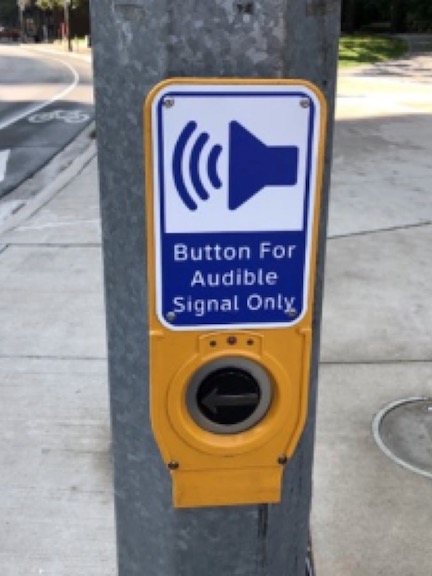
Noting the lack of good signs that actually address real-world situations, some entities have designed their own. One example is below, which came via Don Kostelec, of whom I’ll have more to say shortly. (original source not known)

Why is the distinction between these two types of signs important? Buttons can be used by limited vision or blind people to trigger the pedestrian signal, and the auditory and sometimes vibratory message that goes with it. When the conversation started about removing beg buttons, many disability advocates were up in arms, understandably. If there is no button, there is no message.

Except, of course, for automatic detection of pedestrians, and even pedestrians types, that many other countries and a very few places in the US are installing. Traffic engineers routinely resist automatic detection as “too expensive and not practical” despite spending much larger sums on vehicle detection. Which in the case of bicyclists, often doesn’t work anyway.

Traffic engineers also frequently place buttons in places where people with disabilities, as well as everyone, can’t find them and/or can’t reach them.

So, is there a way to preserve the function of buttons needed by disabled people, while not discriminating against all pedestrians? You bet. Just label the button for its function. And put it in an accessible location.

So, Don Kostelec. He is one of my heroes, as he has done a better job than anyone I know of documenting the failures of transportation agencies to install safe and usable pedestrian facilities. Sidewalks too narrow, or that end where you really need them; ADA ramps to nowhere; crosswalks that can’t be safely used; and on and on. I highly encourage you to check out his blog (http://www.kostelecplanning.com/blog/) and Twitter feed (@KostelecPlan). He does not hesitate to call out road and traffic engineers for their failure to think, and for their failure to follow their professional code of ethics. Though he didn’t originate it, I think he is responsible for popularizing the expression “Hold my beer!” in the transportation world, implying that only an engineer drinking beer, and momentarily designing a roadway or facility before going back to drinking, could have done something that stupid.

And on this topic of beg buttons, I particularly encourage you to read his recent post, Push buttons: The good, the beg, and the ugly.

There has also been a lot of discussion about whether it is hard to change the buttons from required to not required, which is called auto recall, or just recall. A number of cities have changed hundreds of buttons in very short order because they prioritized it. Newer signal control boxes allow changes to be made remotely, changing the function and timing of pedestrian signals. Older control boxes may require that someone go out and physically change them. The older boxes are sometimes derisively called squirrel cages because they had large physical clocks with rotating dial, with pegs to change the signal on or off, as it came around. They made noises like a squirrel or hamster cage. A few idiots have been saying that pedestrian signals should not be changed remotely because of security issues. That is the whole point of modern signal controllers, part of Integrated Traffic Systems (ITS), that they can be can sense and respond to actual traffic, and can be adjusted remotely to respond to changing conditions and for changing flow when crashes occur.

There is also the issue that many transportation agencies don’t know what is at the intersection. Does it have pedestrian signals or not? Does it have pedestrian countdown or not? What is the timing of the pedestrian phase, in terms of countdown? Is the beg button required or not? They simply don’t know. Locally, Sacramento County is the worst on this issue.

Previous post on beg buttons: Don’t touch that button! Then, there are locations where pedestrian crossing is simply prohibited, for reasons having everything to do with speeding traffic and nothing to do with pedestrian safety: and crossing prohibitions, and no-ped-crossing in the grid.

signs and diagrams for construction zones

Coming up, some suggested solutions for construction zone accommodation for walkers and bicyclists, but first, the relevant signs and markings. These are MUTCD (Manual for Uniform Traffic Control Devices) compliant signs, which are always what should be used, not the hand-made and/or non-compliant signs that are sometimes used.

Note: I have modified the presentation of signs here, using two slideshows: Temporary Traffic Control (TTC) signs M (orange), and regulatory signs R (white). MUTCD R9-10 is not a favored sign because it gives no indication about what the most direct route for a walker is.

  • MUTCD M4-9a left sign
  • MUTCD M4-9c left sign
  • MUTCD M4-9c right sign
  • MUTCD R9-10 sign
  • MUTCD R9-9 sign

The no pedestrians sign, MUTCD R9-3a, is intended for permanent closures of crosswalks, not temporary closures of sidewalks, and so should not be used for construction zones.

MUTCD R9-3a sign: no pedestrian crossing

In the MUTCD, 154 pages are dedicated to Temporary Traffic Control Devices, almost all of which treat roadways as though walkers and bicyclists did not exist, but there are four pages and two diagrams which do show accommodation. For those unfamiliar with the MUTCD, the word shall means there is no choice, it must be done. So every construction zone that does not follow these is a violation of the law. The most important text is below, and the two diagrams follow.

“Standard:

  1. When crosswalks or other pedestrian facilities are closed or relocated, temporary facilities shall be detectable and shall include accessibility features consistent with the features present in the existing pedestrian facility.

Standard:

  1. When crosswalks or other pedestrian facilities are closed or relocated, temporary facilities shall be detectable and shall include accessibility features consistent with the features present in the existing pedestrian facility.
  2. Curb parking shall be prohibited for at least 50 feet in advance of the midblock crosswalk.”
MUTCD Figure 6H-29: sidewalk detour or diversion
MUTCD 6H-29: crosswalk closures and pedestrian detours

More Sac county nonsense

MUTCD-2012_Figure9C-7The Bicycle Detector Pavement Marking (CA-MUTCD Figure 9C-7, shown at right) is placed to show a bicyclist where to stop so that they can trigger a traffic signal. When installed properly, they prevent the all-too-common scenario where bicyclists cannot trigger signals and must either cross against the red light when a safe gap is available, or wait until a motor vehicle arrives. They are also a clear signal to motorists that there is a reason why the bicyclist is positioned where they are. Of course “bicycles may use full lane” is true approaching any intersection where right turns are permitted, however, most motorists do not know or remember this law unless there is a sign there to remind them. The sharrow serves a similar purpose. However, these markings are often not installed in properly.

Mission southbound at Marconi, bike detector placement

Here is another fresh Sacramento County mistake, where the marking was not placed properly. On Mission Ave southbound, approaching Marconi Ave, there is a Bicycle Detector Pavement Marking in the bike lane, but not in the regular through/right turn lane. This marking is on new pavement placed in a complete streets project along Marconi from Mission westward to Fulton, and was installed within the last two years. If a bicyclist is to trigger the signal, they have to stay in the right hand edge bicycle lane, where they are at risk of getting right hooked. If they adopt a merge position between the two lanes, where they should be in order to make clear to motor vehicle drivers to either get in front or fall in behind, not beside, then the signal won’t trigger.

The solution is to place a marker in the regular lane, and adjust loop sensitivity if necessary, so that the bicyclist can choose which lane position to use.

Sac County just doesn’t get it

The photo below shows Garfield Ave southbound approaching Marconi Ave, in the Carmichael community of Sacramento County. This roadway was repaved within the last year, and this is the bicycle facility that was painted by the county. The bike lane veers to the right and then ends, running into the dedicated right hand turn lane, and another bike lane continues to the left of the right hand turn lane. These pavement marking clearly give priority to motor vehicles making a right hand turn, and ask bicyclists to yield to those vehicles, as second-class users of the roadways.

Garfield-sb-Marconi_bike-lane-shift

And this is what it could look like.Read More »