A rather disappointing board meeting (SacRT Board 2026-09-28). Again, staff is underprepared to answer board member questions, and many board members are asleep at the wheel, not asking any questions, or in some cases, not really paying attention.
I spoke on three issues, and my comments are below, in italic. These were written ahead of time, so my actual testimony may have dropped some points or added others. If you want to hear what I said, or other transit advocates said, or board members said, or staff said, you can listen to/watch the YouTube post of the meeting at https://www.youtube.com/watch?v=-0gEKiVZ_3Q&list=PLAfWRxJkwPon701gc9cUsUqqBDlmiWJnt&index=4.
3.1 ‘Customer Service Response to Feedback and Comments’
Yet again, the staff report and presentation have not been made available to the public along with the rest of the agenda. With one exception since July 2025, these documents have always been late, even showing up in several cases during the board meeting. I can no longer see this as an oversight, or unintentional. I believe this is an effort on the part of staff to hide this information for as long as possible so that the public and advocates cannot review the documents and develop a response. This is unacceptable.
This item was presented by Lisa Hinz (VP of safety, security, and customer satisfaction).
Board asked about delay of 3.1 documents, Tabitha Smith (board secretary) said it was a website uploading error. Henry Li (general manager) promised it would not happen again. It is a fact that the customer service documents are almost always finished well after other board documents, often after the agenda has been posted. So this is not just a document posting issue, it is a failure to complete important documents in a timely manner.
No policy was shared on fare enforcement, strollers, shopping carts or bicycles. Existing policy was restated, slide below.
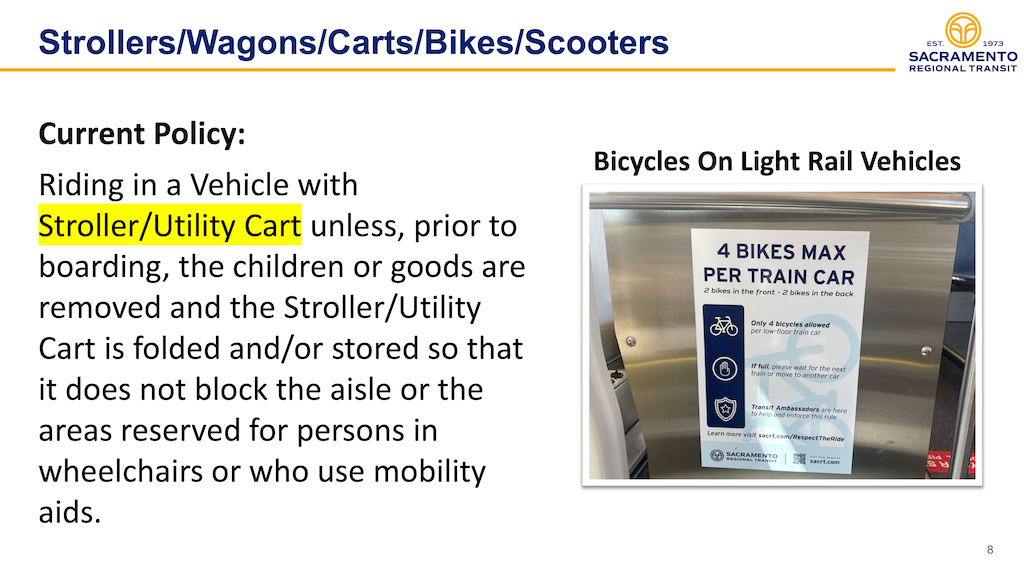
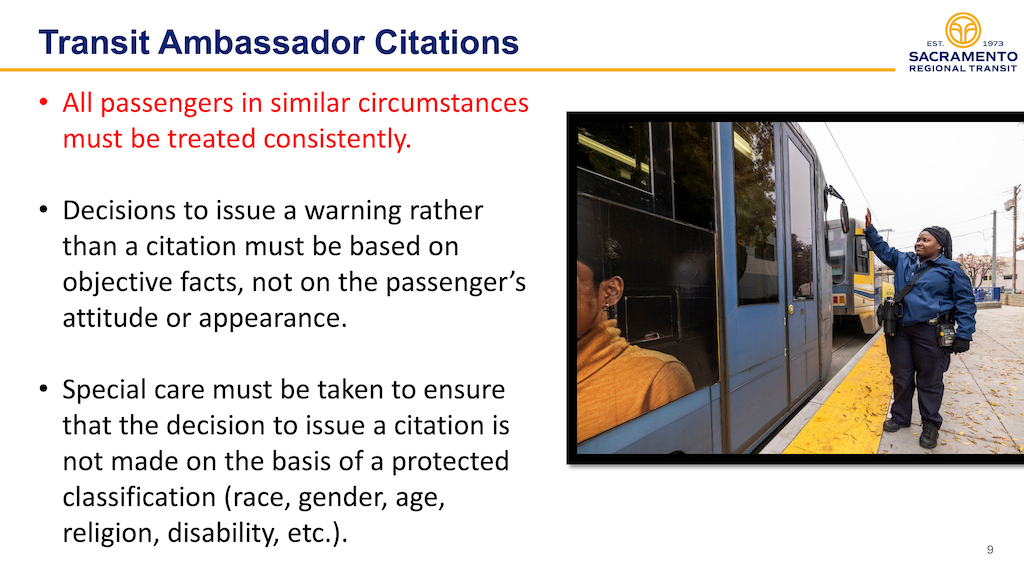
Lisa Hinz gave a vociferous defense of the idea of zero-tolerance, slide below. She said that anything less than zero-tolerance would lead to unequal treatment of passengers, followed by lawsuits against SacRT. It is clear to me that Lisa does not consider riders to be people, then are just names on citations. Her level of empathy for people is zero. Lisa’s attitude is a typical law enforcement one which believes that people are just an inconvenience to the real mission of law enforcement. Guilty until proven innocent. This face that SacRT presents to the public is horrible, and it has resulted in a significant loss of reputation for SacRT, as well, as apparently, a loss of riders.
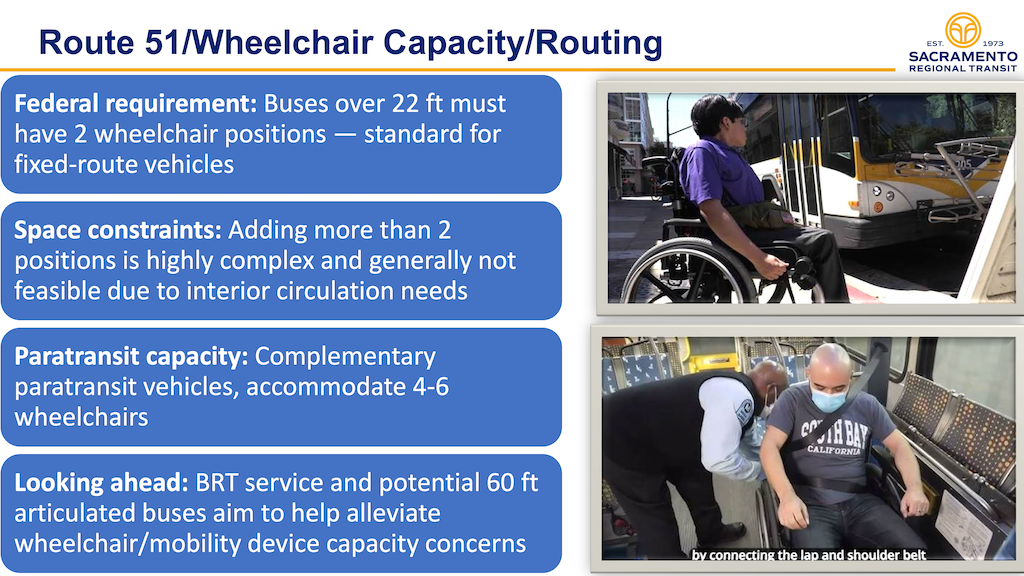
One of the slides indicated that accommodating more than two wheelchairs was impossible for the Stockton BRT, slide below. I added to my comments that AC Transit’s new buses have three to five wheelchair positions. SacRT has chosen to purchase buses that meet the FTA minimums, and not to provide additional capacity. Another advocate reminded that buses not infrequently have to leave wheelchair users behind when the two spaces are already full.
It appears that policy will go to MAC first, and then back to the board. ‘Proposed Policy for Cart and Wagon use on SacRT vehicles (Priscilla Vargas, ADA Compliance Officer)’ was on the August MAC agenda, but was tabled. It was also on the September agenda, but minutes not available yet, and I have not had time to review the YouTube recording, so I don’t know if it was addressed. (Update: There was some discussion at the September MAC. The policy is that wagons will be banned. Shopping carts will have a size limit, and apparently riders will have to make a ‘reasonable modification’ (The correct term is ‘reasonable accommodation’, but Priscilla Vargas apparently does not know the correct term.) request to the accessibility department (?). Other riders without that permission will have to remove contents and fold their carts. Lisa Hinz contradicted this interpretation. Who’s on first? It was admitted that the public has not been provided information on these policies. Ack! Strollers and bicycles were not addressed.)
3.2 ‘Information: Green Line to the Airport – Right-of-Way Retention and Corridor Implementation Strategy’
This presentation is immensely complicated. It was reviewed by a number of transit advocates, including some who work in transit, and most could not make sense of it. There is too much detail and not enough clarity. The presentation violates the basic writing technique of ‘tell them what you are going to tell them, then tell them, then tell them what you told them’. It may be that some people are interested in all this detail most people want to know ‘what’s the upshot’. That is nowhere to be found.
Though it is hard to parse the information, it appears that the $1.2 billion estimate does not include the $500 American River bridge. So the project is really $1.7 billion. To assume that the city will, under its current and ongoing budget crises, and difficulty winning grants for major projects, be able to come up with a half million is questionable.
I noted several board member nodding their heads on my comment, that they thought the presentation was needlessly complicated.
Serna commented that there must not be sunk costs for conversion to light rail. He asked about a flyover for CA 99 that could be used for both buses and light rail. Hume also commented on sunk costs, and suggested considering alternative modes including autonomous vehicles. He said surface routes may not be good even if dedicated lanes, though I’m unsure what this has to do with the project. Dickinson said the traditional rail is best and questioned why the route (similar to Route 11) goes back to Natomas rather than staying on I-5. Said if people want local service, give them local service; if they want the airport, give them the airport.
It keeps getting claimed by board members and staff that Green Line to the Airport light rail is the top project for the public, but that is not what the ‘Transit Idea Exchange’ listening sessions indicated. The public was uninterested in these very expensive moon-shot projects, and primarily wanted better bus service.
4. Matters not on the agenda
The public relations debacle that resulted from SacRT’s sudden implementation of a zero-tolerance policy on fare collection, strollers, shopping carts, and bicycles, was without any discussion or decision by the board. This indicates to me that ‘customer satisfaction’ must be moved out of the organizational structure of ‘Security, Safety, and Customer Satisfaction’. The law enforcement orientation of this division cannot provide the necessary attitude and attention to the mission-critical function of customer satisfaction.
The placement of the Transit Ambassador program within this division may also be problematic. SacRT has never clearly defined the function of the TAs. If their primary function is law enforcement, leave the program here. If their primary function is customer service, then move them elsewhere in the organization structure. If SacRT does not know what their primary function is, which appears likely, then the program needs to be revisited and revised.
There were several other advocates who spoke on items not on the agenda. Crystal Lee McGee, head of ATU 256 (Amalgamated Transit Union Local 256), introduced Ms. Johnson, who spoke about being harassed by her supervisor as a new mother, and not provided a private lactation area. The SacRT Go supervisor’s name was mentioned but I did not catch it. It is rare for ATU to go to the board with personnel issues, so it is clearly one of critical importance. This may be another instance of SacRT’s anti-family orientation, along with the anti-family stroller policy.
7.1 ‘General Managers Report’
The General Managers Report presentation often includes slides that were not in the posted document. These slides are not made available after the fact.
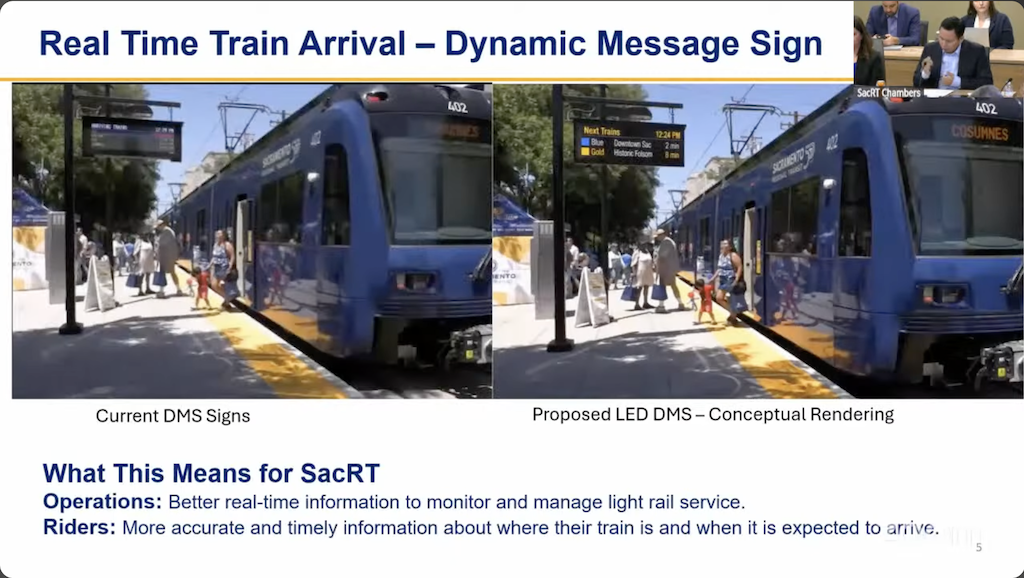
One such slide on was on modern information signs for light rail. Henry said that implementation of new signs is was intentionally delayed so that it could be integrated with the Light Rail Modernization program. This was the first the public had heard about this. Several of the existing signs are non-functional, and have been for some while. Other signs have display issues, making them hard or impossible to read. Even when the signs work, they rarely have useful information for riders. A common message is that light rail trains are running 15 minutes late, which is nonsensical since the frequency during weekday days is 15 minutes. Riders have no way of knowing whether the arriving train is on time or delayed, they just want the train to come. Part of the reason that SacRT can’t provide accurate information about light rail delays is that they did not implement high quality GPS and real-time GTFS for the new light rail cars, so they don’t know where those trains are without asking the operators for location. I did not capture that slide, unfortunately. (Update: I reviewed the YouTube video [1:44:30], and captured the slide below. The new system will be from Clever Devices/Hitachi. Their website shows internal displays but not these external station displays.)
In the September MAC meeting, it was announced that 45 new Siemens S700 cars have been or will shortly be on hand, but the next set of cars, 46 to 65, will not start arriving until February of 2029. New cars will gradually replace legacy cars on the Blue Line as they become available. That may mean that the new light rail information signs might not be installed until many years from now. Yow!
The GM report mentioned the following on the Transit Connect program physical cards: “This next phase also includes important updates for Connect Card pass holders. While Connect Card users should continue using their cards for now, the transition to Transit Connect will begin later in 2026. Much like the ZipPass retirement earlier this summer, Connect Card customers will receive a window of time to use any stored value on their cards before switching to the new system. Riders will have the option of moving to the Transit Connect app or obtaining a new Transit Connect smart card if they prefer a physical alternative.” I will re-state that the physical or Smart Card was not part of SacRT initial planning for Transit Connect and Tap2Ride integration. It was added after members of the transit advocacy community including state workers questioned what would replace the Connect Transit Card. It has still not been defined for the public how the physical cards will relate to the app, nor how services will be provided to unbanked people. Critical details of Transit Connect have not been shared with the public. Nothing SacRT does happens on time, so it is likely that Phase 2 will occur sometime next year, not this fall.
To be honest, I have a hard time following the GM report. It is at the end of the meeting, when everyone is tired. Henry spends a lot of time announcing events, which are already on the website and in the Next Stop News, and talking about light rail disruptions, which if reported at all, should be in a separate agenda item.
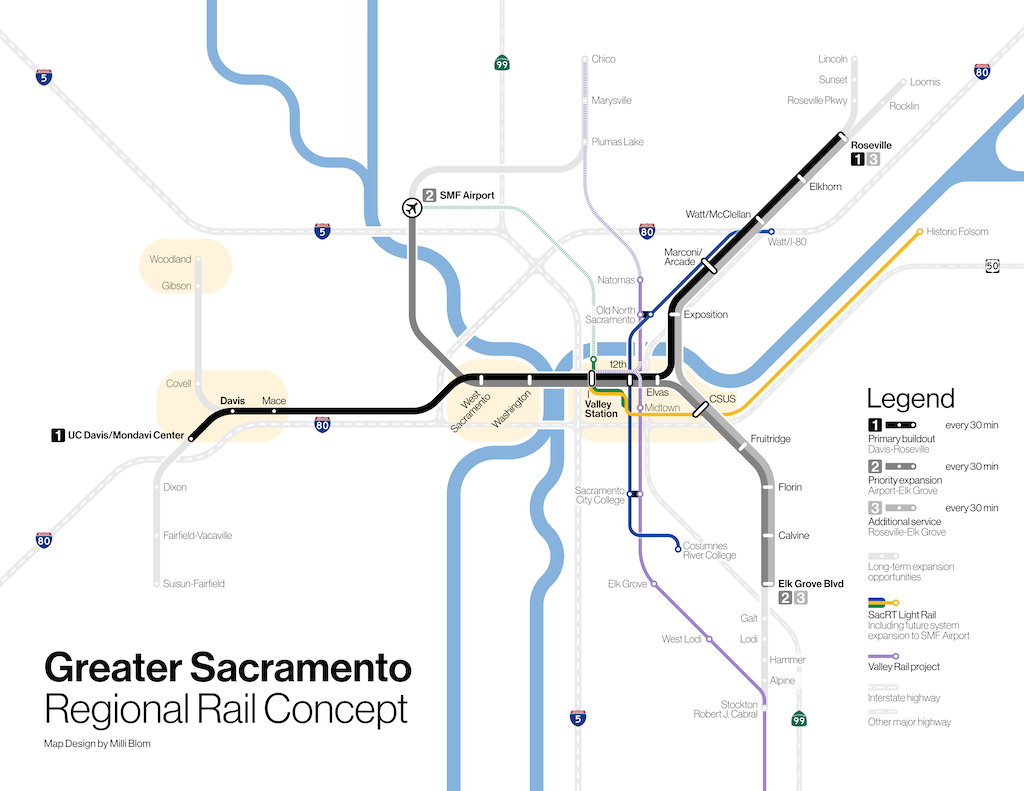


 SacRT is holding community open houses on the Green Line to the Airport in early December. December 1 in North Natomas, December 2 in Sacramento, and December 3 in South Natomas. Details are at
