Continuing construction woes

Construction projects all over the city of Sacramento continue to bias motor vehicle travel over walkers and bicyclists. This has been going on for a long time, and it has not gotten any better. A few construction projects handle it appropriately, most do not.

One issue that I ran into yesterday is particularly galling because of the long detour it takes to bypass the construction site at the corner of J Street and 4th Street, at the California Fruit Building (not sure if it will have the same name after reconstruction). From the southeast corner of J Street & 3rd Street to the southeast corner of J Street & 4th Street is 380 feet, along a sidewalk which has been closed by construction. The detour is 785 feet, but the important issue is not the distance but the time. The detour requires pressing five beg buttons and using five crosswalks, a walk of 7.25 minutes, most of that time waiting for the pedestrian signal to change. A direct route would be just over a minute.

J Street south side, eastbound past 3rd

This map (Google) shows the detour.

What are the alternatives? One is that a travel lane could be removed from J Street. Both a pedestrian walkway and a bicycle lane could be temporarily installed in this section past the construction. Another is to install a crosswalk on the east leg of the J Street & 3rd Street intersection. Pedestrian crossing is currently prohibited (by signing and guard rail) at this location, but the prohibition is solely for the flow of motor vehicle traffic and the convenience of drivers, it has nothing to do with pedestrian safety. The crosswalk need not be temporary, it could be a permanent installation. Of course this crosswalk would require two crossings, but two is better than five.

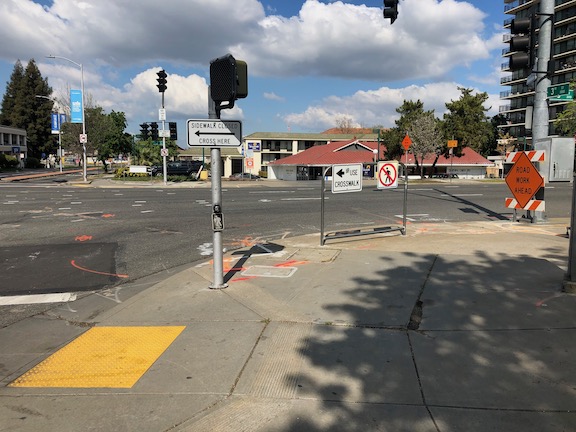
Short of these two real fixes, the signing could be better. In the photo below, there is an unobvious sign indicating a detour to the west, but it doesn’t say which sidewalk. I did not understand what it meant until I had walked down to the construction fence. On the sidewalk that is closed, there is no indication until reaching the construction fence that the sidewalk is closed. There should be some indication of how long, or how many crossings, for the detour. A person might decide to turn around and head south to L Street, or to the access points to K Street, if they had more information. This photo also shows the pedestrian prohibition established for traffic flow rather than pedestrians safety.
In the westbound direction, there is even less information. The sign says sidewalk closed, and there is a vandalised construction arrow, which might or might not indicate the detour route.
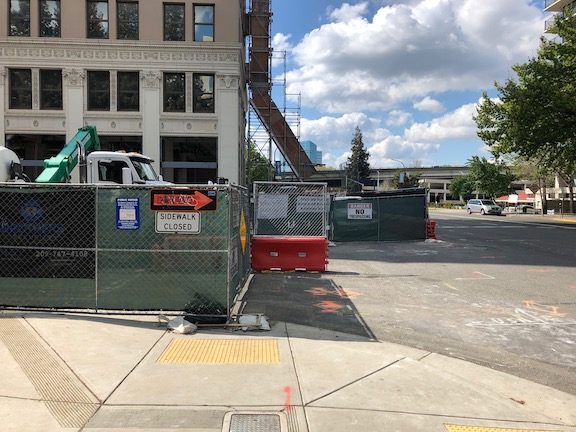
J Street south side, westbound at 4th

I don’t blame most of this type of issue on the construction companies. The construction company has to get a permit from the city, which includes a traffic plan. The city is accepting, and in some cases encouraging, traffic plans with no, or insufficient, accommodation for pedestrians and bicyclists, and insufficient signing. Of course the construction company wishes to minimize the work and the signing, but it should be the city’s responsibility to ensure good traffic plans. It rarely does. I will remind readers again that the city employee who supervises this permitting process said that pedestrians and bicyclists would be accommodated if it did not interfere with traffic flow.

Since I have time on my hands, I’ve been walking a lot more in downtown/midtown, with social distancing of course, so I hope to add additional posts on this topic.

bike/scooter share enforcement

From the City of Sacramento City Express blog: https://sacramentocityexpress.com/2019/11/18/traffic-and-parking-enforcement-begins-for-shared-e-scooters-e-bikes-on-nov-19/.

The city will be enforcing both parking and traffic for the electric assist bike share JUMP, and the JUMP and Lime electric scooters. Many people are still riding the scooters on sidewalks, so I would expect citations for that. Under state law, not Sacramento law, scooters must be ridden on the street. The amount of parking that endangers or impedes walkers has fallen off over time, so there should be much less of that, but it will be interesting to see how exactly that will be enforced. The city still does not have sufficient bike parking, particularly in neighborhoods but even in commercial and mixed areas, and though it has installed a few bicycle and scooter corrals, they are far from enough.

unacceptable accommodation

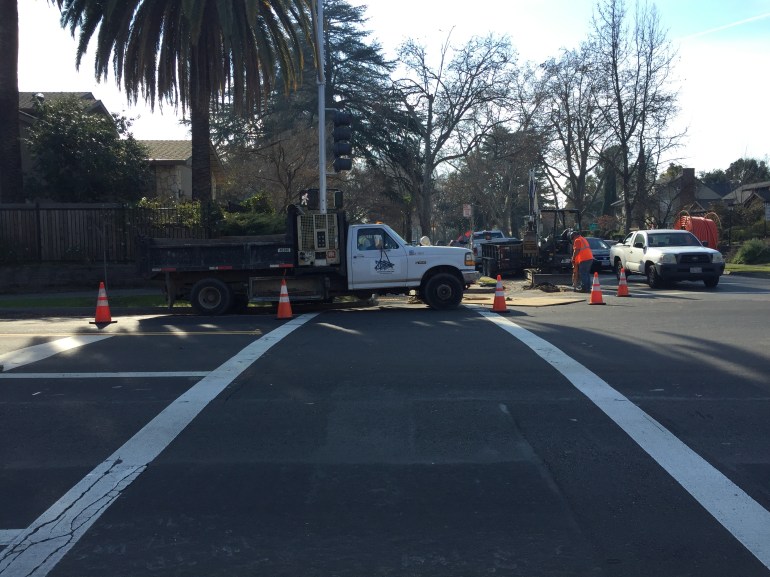
Sacramento City continues its practice of approving construction projects that do not consider the needs of walkers and bicyclists. Here is the latest I ran across, on Folsom Blvd between Santa Ynez Way and 39th St. The construction on the south side appears to be installing cable or fiber. At the west end, there is a sudden ‘sidewalk closed’ sign. There is no prior warning, there is no ramp or marked crosswalk for crossing Folsom to the north side (it requires crossing an offset intersection diagonally to go from one ramp to another, an exceptionally long distance), and there is no indication about how long the detour is.

At the other end, there is the same sort of signing without any prior warning or information provided.

At this location, 39th St, there is a marked crosswalk with traffic signal which could allow people to cross Folsom, but just to make sure the message that pedestrians are unwelcome here is clearly received, a construction truck was parked across the crosswalk. When I asked the construction crew to move the truck, they refused. I reported it to parking enforcement but am not sure of the outcome.

Of course there is a bicycle lane along this section of Folsom Blvd, which is also blocked by the construction. That may be justifiable, but you would think that forcing bicyclists to share the general purpose traffic lane would justify a reduction of the speed limit from 35 mph to 25 mph, but no, that that would inconvenience drivers and in the city, that is not to be considered.

This kind of bias against walkers and bicyclists should be unacceptable in the city. And it would be if the staff of Construction Services were not biased against walkers and bicyclists. Time to replace that staff with people who care about all modes of travel.

Sacramento Vision Zero Top 5 outreach

This information from the City of Sacramento via email.

Vision Zero Top 5 Corridors Banner

We have added and updated upcoming outreach events for the Vision Zero Top 5 Corridors.

Join us to learn more about the Vision Zero Top 5 Corridors Study and share your experience biking, walking and driving along these streets at one of the following events:


Date and Time Event Location Corridor of Interest
Monday, November 5th

5:00-7:00 p.m.

Community Workshop Peter Burnett Elementary School

6032 36th Ave.

South Stockton Blvd.
Wednesday, November 7th

Noon-2:00 p.m.

Pop-up Event Transit stop at Broadway and Stockton near Food Source (4401 Broadway) Broadway/Stockton Blvd.
Saturday, November 10th

9:30-10:15 a.m.

Old North Sacramento/Dixieanne Community Association GraceCity

701 Dixieanne Ave.

El Camino Ave.
Thursday, November 15th

5:00-7:00 p.m.

Community Workshop Luther Burbank High School

3500 Florin Rd.

Florin Rd.
Thursday, November 15th

6:30-8:00 p.m.

Gardenland/Northgate Neighborhood Association Stanford Settlement Conference Room

450 W. El Camino Ave.

El Camino Ave.
Friday, November 16th

4:00pm-6:00 p.m.

Pop-up Event Grocery Outlet

2308 Del Paso Blvd.

El Camino Ave.
Wednesday, December 5th

6:00-8:00 p.m.

Hagginwood Community Association William J. Kinney Police Facility

3550 Marysville Blvd.

Marysville Blvd.


About the Study


In 2017, the City of Sacramento identified the five corridors in Sacramento with the highest numbers of fatal and serious crashes involving pedestrians, bicyclists, and motorists.

The Vision Zero Top Five Corridor Study will analyze the factors that contribute to these corridors’ high crash rates.  Based on technical analysis, community input, and best practices in roadway safety and design, the study will identify improvements for each of these corridors that can be implemented in the near-term.

More information about the project is available at http://visionzerosac.org

Crosswalk removal and CVC

At the community meeting, Ryan Moore kept saying “we followed the law” in removing crosswalks. Though he was not specific, the law he may have been referring to is the section of California Vehicle Code (CVC) below. It remains to be seen if this law was followed, but it may have been since the requirements are minimal. Residents in the neighborhood were uniform in saying that they had not seen any notice, but that does not prove it did not occur. There are additional legal requirements on the city that will be addressed in future posts.

CVC 21950.5. (a) An existing marked crosswalk may not be removed unless notice and opportunity to be heard is provided to the public not less than 30 days prior to the scheduled date of removal. In addition to any other public notice requirements, the notice of proposed removal shall be posted at the crosswalk identified for removal.

(b) The notice required by subdivision (a) shall include, but is not limited to, notification to the public of both of the following:

(1) That the public may provide input relating to the scheduled removal.

(2) The form and method of providing the input authorized by paragraph (1).

Leading Pedestrian Interval (LPI) signals

Questions about using Leading Pedestrian Interval (LPI) signals at the community meeting on crosswalks reminded me that I had information on these in the city for some while, but hadn’t shared it. A LPI signal gives the pedestrian a 3-second (or more, but the Sacramento ones are all 3 seconds) head start, with the walk sign coming on before the light turns green, so that pedestrians will already be in the crosswalk and more visible before vehicles start to move. These address the common issue of both right-turning and left-turning vehicles failing to yield to pedestrians in the crosswalk. They are one of the pedestrian safety countermeasures identified by the Federal Highway Administration (FHWA), with a crash reduction factor of 60%. If you search for ‘leading pedestrian interval’ on the Internet, you’ll see a great number of useful links. The NACTO page is especially worthwhile.

My purpose in sharing the specific locations is so you can go out and experience LPI for yourself. How does it work for you?

A LPI does slow traffic very slightly since there is an additional 3 seconds per direction during which most vehicles are not moving.

Lastly, this is not a solution that could have been used at the Freeport-Oregon intersection, which is not a signalized intersection. However, it is a solution for the signalized intersections along Freeport. Ryan Moore claimed that these can’t be used at low pedestrian locations, but the response to all such reactionary claims is: “You can’t judge the need for a bridge by the number of people swimming the river.” If crossings are not safe, then fewer people are walking than otherwise could be. The demand is there, but not the facility. LPIs are one solution.

Lead Pedestrian Interval (LPI) locations in City of Sacramento (as of 2015-08-28):

  • 9th Street and I Street
  • 9th Street and P Street
  • 10th Street and I Street
  • 10th Street and J Street
  • 15th Street and K Street
  • 29th Street and K Street
  • 30th Street and K Street
  • 9th Street and Q Street
  • 13th Street and I Street
  • 8th Street and P Street
  • 8th Street and Q Street

Community meeting on crosswalks – 2

Part one, Community meeting on crosswalks, prior posts:  removal of crosswalksDon’t use the ‘A’ word. Next related post will be about Zegeer.

Question and answer session of the meeting:

  • The city is doing a speed study on Freeport from Sutterville Rd to Meadowview Rd, and will include part of Sutterville (not clear what part)
  • There are no red light cameras on Freeport; the city piggybacks on country red light program
  • There are no lead pedestrian interval signals on Freeport, or even is south Sacramento (all are in the central city); Ryan Moore said these should not be used in low pedestrian areas (which is false)
  • Resident commented on Fruitridge Rd, 24th to Freeport, a lot of red light running and few safe crossings
  • Resident who lives on Oregon suggested changing the speed limit on Freeport
  • Steve Hansen says that the city would like to change Freeport, but to do so, the community (residents, businesses, neighborhood associations) will need to come together to decide how; people will have to give up some time for better safety; he also mentioned narrow sidewalks with obstructions
  • Several people asked about or commented on specific sections and intersections; Matt mentioned catching egregious speeders
  • South Land Park Neighborhood Association (Ryan?) asked what public notice there was before crosswalk removal and said they were not notified; not clear if the other two were notified
  • Ryan Moore said that each removal was analyzed, he says they followed the law of CA MUTCD; said most of the removals were result of complaints; said neighborhood input makes no difference; mentioned FHWA info on crosswalks, referring to Zegeer report though not by name (more info about Zegeer in a future post)
  • Neighbor said that any process that removes crosswalks is flawed; mentioned no still phase on signals (time between red one direction and green the other); going out of the way is not reasonable to ask; can’t have data on people walking because people are scared to walk
  • Steve Hansen and Jay Schenirer want to review pedestrian guidelines, not sure what document this is; said we need to talk about equity because the top corridors of Vision Zero concern are not necessarily located in disadvantaged communities
  • Neighbor said speed display signs don’t seem to have any effect on behavior; asks for immediate action and not years out
  • Ryan Moore continually says “we’d like to but we can’t” but offers no proof; continues to say that crosswalks at this volume and speed are not safe
  • Neighbor said there are bus stops close to Oregon which is true and which might make removal a violation of Title 6
  • Issue of sidewalk maintenance responsibility has come up several times; city continues to insist that it is the responsibility of the property owner (even though most sidewalks are part of the public right-of-way and all are part of the transportation network)
  • Many people pointed out that improvements could have been made at the Freeport-Oregon intesection, such as bulb-outs, refuge median, lighting; there is a median already but it is too narrow to provide refuge
  • Participant asked for a pedestrian commission, Jennifer Donlon Wyant said the the city Active Transportation Commission would be seated in April or May
  • Jay Schenirer wrapped, mentioned that McClatchy students drove the changes to Freeport north of Sutterville Rd

My overall take on the community meeting is that the city council members and the public, both residents of the neighborhood and others, want proactive changes to increase pedestrian safety and walkability. They don’t want excuses. Ryan Moore, the Interim City Traffic Engineer, seem prepared only to offer excuses.

Of all the people on stage, Ryan Moore seemed the least sympathetic to the person killed, or the issues that it raises. He said much the same thing he’d said to the SacBee: “Instead, traffic engineers hope that by removing some crosswalks, pedestrians will instinctively choose to cross at a safer, nearby intersection,” Moore said. He kept referring to federal and state standards that were being followed, though a number of people in the audience who know a great deal about traffic engineering noticed that he was mis-stating and mis-using standards and research to defend his actions and opinions.

Community meeting on crosswalks

I had promised I’d report on the community meeting to address the crosswalk removal over Freeport at Oregon and related issues, but it has taken me a while. Previous posts: removal of crosswalksDon’t use the ‘A’ word. For background, see the SacBee article: Why Sacramento erased 23 crosswalks, including one where a grandmother died after removal.

The meeting was hosted by City of Sacramento council members Jay Schenirer and Steve Hansen, and school board president Jessie Ryan, and held March 8 at Hollywood Park Elementary which is east of the intersection where the fatality occurred.

Steve talked about the concept of a stroad, a street/road hybrid that doesn’t do either well, though he did not use the term. Freeport is a stroad. He introduced vision zero, talked about changing both infrastructure and behavior, mentioned that the traffic motor officers are gradually being built up but are far below what they should be, and said “we should enjoy the public space and not be afraid.”

Ryan Moore, Interim Traffic Safety Engineer, and the person responsible for the removal of crosswalks, repeatedly mentioned a ‘Systematic Safety Analysis Report’ but is was not clear what this is, and the city website has no mention of it. He also said that he was following all the federal and state rules, as well as research, by removing the crosswalks.

Jennifer Donlon-Wyant, the Active Transportation Specialist, gave a Vision Zero presentation similar to what many people have seen before, but highlights are that Sacramento is the second worst in the state for pedestrian fatalities per capita. She went over the ten profiles that are the core of the draft Vision Zero Action Plan, of which three are related to speed, and one related to transit stops, which all play a role in this incident. One that does NOT apply is ‘Pedestrian Crossing Outside of an Intersection or Crosswalk.’ Though the city had erased the marked crosswalk, it was and is still a valid legal crosswalk. Freeport Blvd is not one of the top five fatality and injury corridors in the city.

Matt Armstrong, Sergeant of the Motor Team (officers on motorcycles) said he has 7 officers on at a time, maximum, for the entire city. They respond to complaints, but otherwise focus on schools and high volume corridors. He said top concerns are red light running, distracted driving, and speed. He mentioned something I had not heard before, that this was a multi-lane threat crash. A multi-lane threat crash occurs on streets with more than one lane in the same direction (Freeport has two lanes in each direction), when one driver stops for a pedestrian and other drivers does not. This is a violation of CVC 21951 “Whenever any vehicle has stopped at a marked crosswalk or at any unmarked crosswalk at an intersection to permit a pedestrian to cross the roadway the driver of any other vehicle approaching from the rear shall not overtake and pass the stopped vehicle.”

Jessie Ryan said the district recognized that their policies were insufficient and were going to adopt the California School Boards Assocation Safe Routes to School policy (which is very weak), that they were creating heat maps to prioritize unsafe routes, is committed to using and reviewing data, and welcomes public input. The district, prior to this, has shown little interest in Safe Routes to School and has implemented only some minor projects.

Kirin Kumar of WALKSacramento and Jim Brown of Sacramento Area Bicycle Advocates (SABA) spoke briefly about the need for culture change in the community and in the city bureaucracy.

Next post I’ll discuss some of the public comments and questions, and the answers provided.

Serve on SacRT board

From our friends SacTRU and also noticed by Ridership for the Masses.

Mayor Steinberg is appointing a member of the private sector to the SacRT Board. This seat will replace one of the Sacramento City Council seats currently filled by Councilman Rick Jennings and will serve until the end of 2018. The member of the private sector would have full voting rights as a board member representing the city of sacramento.

Position: Seat A – A member of the private sector with an understanding of the importance of regional transit and public transportation.

Deadline to Apply: March 30, 2018 at 5:00pm

The requirements and selection process are vague, but all are encouraged to apply. We hope many qualified members of the community will apply and represent the needs of riders, and that this seat is not simply filled by an interested member of the business community.

Apply at: http://www.cityofsacramento.org/Clerk/Legislative-Bodies/Boards-and-Commissions. Scroll down to Sacramento Regional Transit Board; no direct link is available.

It has been suggested that the best candidate is a woman of color. There is only one woman serving on the board currently, Linda Budge. There are two people of color, Rick Jennings and Phil Serna, but it is Rick Jennings seat that is being offered (see board list). STAR believes it is important to have someone who is a regular user of the transit system, since the current members range from low transit use to no transit use. Finding that ideal candidate that increases the diversity of the board and better represents riders will be a challenge. If you know that person or those people, please let them know and ask them to serve.

At the same time, STAR encourages everyone to apply. This can be a transformative moment for SacRT, and a strong interest in the position may encourage the other entities, county and cities, to appoint citizens. The board suffers from having politicians as members who are already very busy with their other boards and commissions, and other interests, and don’t pay enough attention to transit. We need someone whose passion is transit that works for everyone.

Don’t use the ‘A’ word

I attended the community meeting hosted last evening by Jay Schenirer, Steve Hansen, and the school district, called as the result of the recent fatality and severe life-threatening injury on Freeport Blvd. I’ll write more soon about the meeting itself, but for today, a comment about use of the ‘A’ word, accident. Every public official that evening, with the exception of Jennifer Donlon Wyant, used the word accident. Some of them repeatedly, with Ryan Moore, the Interim City Traffic Engineer, being the worst offender. Many of these uses were made while standing in front of the Vision Zero slide that states “Vision Zero ~ a traffic safety philosophy that rejects the notion that traffic crashes are simply “accidents,” but are preventable incidents that can and must be systematically addressed.” Oh, the irony.

Not the time to go into a detailed explanation of the harm that using this word causes, but you can check out http://droptheaword.blogspot.com, or #CrashNotAccident on Twitter. Basically, the common understanding of the word in traffic violence conversations is to excuse motor vehicle drivers (and engineers) of responsibility for their actions, implying that nothing could have been done, when in fact many things could have been done.

So, a modest proposal. Every time a public official uses the ‘A’ word, they make a contribution of $20 to a local transportation advocacy organization. Eventually, people will cure themselves of using the word, but in the meanwhile it will be an important source of income for nonprofits working to overcome the bias inherent in use of the word, and the underlying windshield perspective that accepts traffic violence as inevitable.