- Volunteers build bikes for underserved children (SacBee 2016-12-09)
- Sacramento asks developers to open wallets to keep city streets from clogging (SacBee 2016-12-08)
- Are cheaper fares, more airlines headed Sacramento’s way? (SacBee 2016-12-07); I hope not: more flights = more carbon = faster climate change
- How Sacramento can rethink transportation, Chris Morfas (SacBee 2016-12-06)
- Back-Seat Driver: ‘Left-lane loons’ and other Sacramento freeway agitators (SacBee 2016-12-05); left lane loons who drive well over the speed limit and endanger themselves and others are “self-appointed visionaries who have decided what’s good for everyone.” What an idiot you are, Morris Erickson.
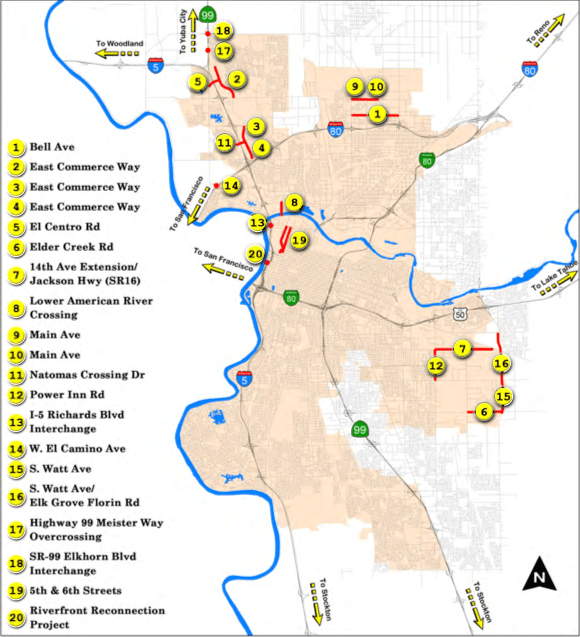
transportation development impact fee
The City of Sacramento is working on a Transportation Development Impact Fee (TDIF) for the entire city, and with somewhat different requirements for subareas including downtown, river district, and North Natomas. The Sacramento Bee clued me into the proposal with Sacramento asks developers to open wallets to keep city streets from clogging (SacBee 2016-12-08). My initial guess was that this is in response to the failure of Measure B, but this proposal has been worked on since at least August, so that is not the case. The city has a webpage on development impact fees, with two documents specifically about the transportation DIF. I have not had the time to delve into the details, nor do I have any expertise in this area, so these are my initial thoughts.
Missing the message on Measure B
This is a letter I sent to my representative on the Sacramento Transportation Authority (SacTA) board of directors.
I read the Measure B report from Executive Director Jeffrey Spencer, item 12 on Thursday’s agenda, and I have to say I’m rather disturbed by it. (here, or page 41 of the SacTA agenda packet)
In paragraph one, he is completely incorrect about the voter turnout. It was 74.5%, similar to past elections, both on-year and off-year.
In paragraph three, he claims $35K spent by Measure B opposition, and though he doesn’t provide any reference for this, I will give him the benefit of the doubt that he did an FPPC records request and used that info. However, he does not mention political spending by the pro-B group, as well as “educational” spending by SacTA, SacRT, Sacramento County, and the cities such as the glossy mailers that clogged my mailbox. His implication is that pro-B got outspent, but that simply cannot be true.
In paragraph three, he also stated “These news releases and reports are not always factual and can rely on conjecture. Although providing untrue statements, the general public cannot decipher the facts and may rely on this group’s opinions.” That is a pretty amazing statement coming from a public official. Is he really accusing anti-B of lying? He fails to mention that the pro-B glossy mailers had a number of factual errors, mis-statement, straw-men, and questionable implications.
In paragraph four, he says “Discussions with voters after the election…” What voters, whose discussion? I would think there would be documentation here. Though I’m certainly not claiming anything but anecdotal evidence, I heard two things from voters after the election: 1) anti-tax sentiment, and 2) opposition to a measure that spent so much on roadway expansion and so little on transit. Voters got that there was a focus on fixing roadways, and the pro vote was probably in large part due to that, but they also recognized that there was unnecessary roadway expansion larded onto the measure.
You can’t solve a problem if you misidentify what that problem is, and in my opinion, Mr. Spencer has failed to admit failure, has mis-identified the reasons for that failure, and therefore, cannot solve the problem.
If SacTA is to have any chance of moving forward WITH the community to address transportation issues, they need to a) listen to the public, and b) come up with innovative solutions rather than the 1970s thinking represented by the failed Measure B.
News Summary 2016-12-04
- Man hit with stun gun in scuffle with light-rail police is released from jail (SacBee 2016-12-02)
- See where in Sacramento officers issue the most parking tickets for expired meters (SacBee 2016-12-01)
- Editorials: Caltrans has over-the-top delay on a vital freeway project (SacBee 2016-11-30); the SacBee finally admits in print that new freeway lanes just fill up
- Sacramento’s most annoying freeway project is (almost) over – five years later (SacBee 2016-11-29)
- Which freeway has the most aggressive drivers? (SacBee 2016-11-28)
News summary 2016-11-27
- With the wave of this card, you can soon board any area bus (SacBee 2016-11-26)
- What’s next for Sacramento roads and transit after Measure B defeat? (SacBee 2016-11-23)
- Mysterious groups sue to prevent taller buildings on commercial Sacramento corridor (SacBee 2016-11-21)
- Sacramento RT’s latest dilemma: Imbibe or abstain? (SacBee 2016-11-21)
News summary 2016-11-20
- From chaos, a bicycle- and pedestrian-friendly Freeport Boulevard is born (SacBee 2016-11-20)
- Sacramento transit agency has second thoughts about advertising alcohol on buses (2016-11-16); Transit agency considers allowing beer, wine ads on Sacramento buses and trains. What about pot? (SacBee 2016-11-14)
News summary 2016-11-13
- Soccer stadium and huge railyard project get green light from Sac City Council (SacBee 2016-11-11)
- Sacramento doesn’t feel congestion pain like LA or SF … yet (SacBee 2016-11-09)
- Sacramento and Placer transportation taxes fail to pass (SacBee 2016-11-08)
- Is Measure B worth it for Regional Transit riders? (SacBee 2016-11-07)
- Back-Seat Driver: Downtown Sacramento: ‘Nobody goes there anymore. It’s too crowded’ (SacBee 2016-11-07)
- SABA Supports Measure B (SABA 2016-11-?)
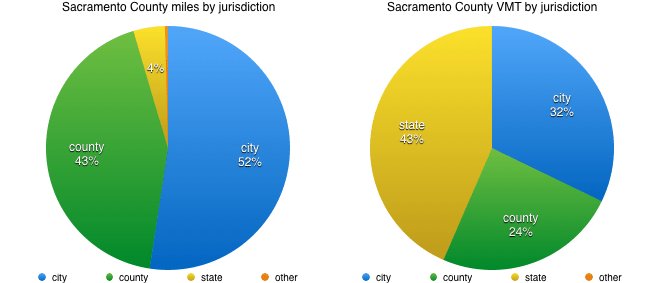
roads in California and Sacramento County
In preparation for some exploration of funding sources for roads, it helps to see what the situation is with the jurisdictions and types of roads, for mileage and VMT.
Jurisdiction means the level of government responsible for the road. This is not always clear from simply looking at a road. If there is a federal or state highway sign, it is pretty clear, but there are roads that are part of the state highway system that are not signed as such.
The types of roads, here, means functional classification, which is a federal designation of Interstate, Principal Arterial – Other Freeways and Expressways, Principal Arterial – Other, Minor Arterial, Major Collector, Minor Collector, and Local. Again, it is not always easy to distinguish classification, but as a generality, freeways fall into the first two, major roads such as Folsom Blvd and Watt Ave fall into the third, busy wide streets are the next three, and residential streets are the last. Another useful classification is that the first six categories are roads, meant to move motor vehicle traffic, and the last is a street, meant to provide access to residences and small businesses. Unfortunately, we build far too many of the road variety and then put business on them so they no longer function well to move cars. See Strong Towns for a more detailed explanation of roads, streets, and stroads.
News summary 2016-11-06
- Essay: Measure B’s ticket to ride (Sacramento News & Review 2016-11-03)
- Who else is buying light-rail cars from Siemens Sacramento? Look south (SacBee 2016-11-01)
- Dixon depot for rent, and a strange use for Sacramento bicycle lockers (SacBee 2016-10-31)
- Why Measure B is good for commuters (SacBee 2016-10-31)
- Why Measure B is a bad deal for Sacramento taxpayers (SacBee 2016-10-31)
News summary 2016-10-30
- What more can we do to stop teens from dying in car crashes? (SacBee 2016-10-29); Foon misses the elephant in the room, which is that providing teens with alternatives to driving, such as frequent transit service and walkable and bikeable neighborhoods, would probably do more to reduce teen deaths than any training or graduated licensing; it is the driving addiction that kills
- Sacramento could be among first to test fleet of self-driving vehicles (SacBee 2016-10-27)
- Sacramento firm Siemens nabs another big light rail deal (SacBee 2016-10-27)
- Planning Commission endorses ambitious downtown railyard plan (SacBee 2016-10-25)
- Sacramento transportation sales tax mailers stir questions (SacBee 2016-10-24)
- Raley’s shopping center on Freeport Boulevard gets planning commission’s approval (SacBee 2016-10-24); no drive-thru restaurants, bicyclist and pedestrian accommodation, less parking, all are a move towards a less suburban-sprawl design

