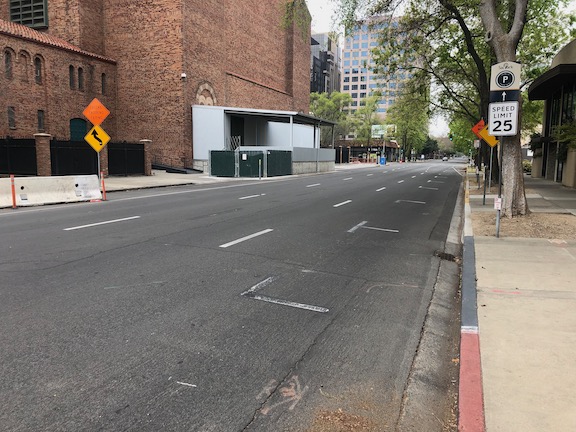
prudent drivers as traffic calming

Now, on to why I brought up the topic of prudent drivers. A prudent driver on a two lane (one lane in each direction) roadway largely controls the behavior of irresponsible drivers. On wider roads, with two lanes or more in a direction, whether a one-way or two-way, the irresponsible driver can do as they wish, violating laws and endangering others. On the narrower roadway, the irresponsible drivers get irritated, and honk and cuss, but there isn’t much they can do about it. This difference in large part explains why fatality and severe injury crashes are rare on residential streets within neighborhoods, and are common on arterial streets with multiple lanes. It also explains why rural roads have such high crash rates, because the prudent driver there can’t really control other drivers. On two lane streets, prudent drivers set the tone; on multiple lane streets, irresponsible drivers set the tone.

We have proven, over the history of motor vehicle use in the US, that is is not possible to significantly change the behavior of drivers. Education doesn’t do it, enforcement (even when that used to be more common) doesn’t do it. Nearly all of the improvement in roadway deaths has been due to safer cars, not to safer drivers or safer roads, and now that improvement is reversing itself as more and more walkers and bicyclists are killed by irresponsible drivers.

I am not against education, if it is directed at the most dangerous behaviors, which it is not, and I am not against enforcement, if it is done in an unbiased manner, which it is not. Each state has an agency, usually called the Office of Traffic Safety (OTS), whose mission is to obscure the real causes of crashes and to blame walkers and bicyclist for their death and injury, and at the federal level, the National Highway Traffic Safety Administration (NHTSA) fulfills this function admirably. In this, they are often aided and abetted by the law enforcement agencies. The reason CHP is California is so opposed to automatic speed enforcement is because it would remove the mis-focus and bias that they otherwise rely upon.

Driver behavior must be controlled by roadway design. That is why I strongly believe that all multiple lane roads must be reduced. Two lane one-way streets must be converted to two-ways streets with only one lane in each direction (and any other lanes converted to pedestrian, bicyclist or transit use). Two-way roadways with two or more lanes in the same direction must be reallocated to other uses. Again, excess capacity would be converted to pedestrian, bicyclist, or transit use, or even to development as overly wide streets shrink to fit the real need.

I have no illusions about the huge change in traffic flow. Those drivers who have gotten used to having plenty of space for themselves (their cars) would have to figure out how to use less: fewer trips, shorter trips, slower trips. People would make different decisions about where they live, where they work, where they shop and recreate. As far as I am concerned, this is all to the good.

Our freeways are designed by the ‘best and brightest’ engineers to be as safe as possible, allowing errant vehicles extra space, protecting hard objects with guard rails and impact attenuators (crash barriers), and using ridiculously wide travel lanes, yet still have very high crash rates. Spending more money apparently doesn’t make freeways safer, and the explanation for this is risk compensation, the proven effect that irresponsible drivers will increase their unsafe behavior to maintain the same level of risk. Think about the daily news items about crashes that close freeways for significant periods of time, and how often they happen. None of these need to happen, and I’d argue that an irresponsible drivers is the primary cause of each and every one of them. This post is about local streets, not freeways, but it is worth remembering that irresponsible drivers are everywhere.

I don’t believe that one single death or severe injury for a walker or bicyclist is worth any amount of convenience for motor vehicle drivers. Not one.

So, I ask every transportation agency in the Sacramento region to:

  • cease widening roads, forever
  • analyze all one-way roads with three or more lanes to determine the most dangerous ones, and convert these within two years
  • analyze all two-way streets with more than one lane per direction for the most dangerous ones, and convert these within five years
  • analyze the remaining roads that are not one lane per direction, for the most dangerous ones, and convert these within ten years
  • complete conversion of all roads within twenty years
  • stop victim blaming

prudent vs. irresponsible drivers

The previous post was about prudent drivers. The table below shows how I think of prudent drivers, and irresponsible drivers. It is so hard to not be snarky about driver behavior, but I have toned it down quite a bit. If you think I am exaggerating, then you don’t spend much time on the roads walking and bicycling. I spend a lot of time doing both, probably averaging three hours per day, all of it closely observing driver behavior and the roadway built environment, because it is both my job and my advocacy. The irresponsible behavior is something I see every day, from a significant percentage of drivers. Notice that I did not use the term negligent driver, as is the legal term in my prior post on a prudent driver, because only some of this is negligent; much of it is just sociopathic.

Prudent Driver Irresponsible Driver
yields to pedestrians in crosswalks and waiting to cross never yields to pedestrians
takes turn at stop sign intersections goes out of turn at stop sign intersections
obeys speed limits, within 5 mph drives as fast as possible in all situations
on multi-lane roads, always slows or stops if a vehicle in another lane is stopped on multi-lane roads, pulls around other vehicles that are stopped, honks, and proceeds at full speed
rarely uses their car horn, and only to prevent a crash often uses their car horn to make those other idiots pay attention and get out of the way
is aware of what is going on around them is focused on other things than the road
doesn’t use their smart phone while driving, other than wayfinding holds ongoing conversation on smart phone; texts when they think they can get away with it
passes bicyclists with a safe distance, even when it means waiting yells at, honks at, and close-passes bicyclists, because they don’t belong on the road
believes all people have a right to share the public space on the roadway believes that right to the roadway is determined by the value of their vehicle and social status
will do anything to avoid a crash revels in crashes when they know they are right
knows the the cost of building and maintaining roads is subsidized by everyone is certain that gas tax monies are being illegally diverted to other uses
knows that parking is never ‘free’ and someone, or all of us, are paying believes that the right to free parking is guaranteed in the constitution, and that the parking space in front of their house belongs to them
could be a male or female (or non-binary) is almost always a male

a prudent driver

700. Basic Standard of Care: A person must use reasonable care in driving a vehicle. Drivers must keep a lookout for pedestrians, obstacles, and other vehicles. They must also control the speed and movement of their vehicles. The failure to use reasonable care in driving a vehicle is negligence.

Judicial Council of California Civil Jury Instructions, 2019

The term ‘prudent driver’ does not exist in law or case law for California, though it does for some other states. The concept is useful enough that I’d like to explore it here. The term is closely related to other concepts such as a ‘reasonable person’, ‘prudent man‘, ‘prudent person’, ‘duty of care’, and ‘standard of care’. The Judicial Council of California Civil Jury Instructions (CACI) document, excerpted above, is often referred to a ‘case law’, instructions for how to interpret legal codes, based on court findings. Many terms in California Vehicle Code are left intentionally fuzzy, but case law removes much of, but not all of, this fuzziness. In civil law, which is what this document covers, the three criteria for establishing liability are negligence, causation, and harm, meaning that the person acted in a negligent way, and harm was caused by the negligence.

Of the two issues most relevant to people walking, speeding and failure to yield are the most significant.

706. Basic Speed Law (Veh. Code, § 22350): A person must drive at a reasonable speed. Whether a particular speed is reasonable depends on the circumstances such as traffic, weather, visibility, and road conditions. Drivers must not drive so fast that they create a danger to people or property.

Judicial Council of California Civil Jury Instructions, 2019

Section 706: Basic Speed Law (and sections 707 and 708), presents the idea that violation of the speed limit is not, per se, evidence of negligence on the part of the driver, but that the test is whether the speed was reasonable. In most European countries, violation of speed limits is negligence, but unfortunately that is not the case in the US. But the document does lay out pretty clearly that the driver is responsible for controlling their vehicle and anticipating the presence of other users on the roadway.

710. Duties of Care for Pedestrians and Drivers in Crosswalk (Veh. Code, § 21950): A driver of a vehicle must yield the right-of-way to a pedestrian who is crossing the roadway within any marked crosswalk or within any unmarked crosswalk at an intersection. When approaching a pedestrian who is within any marked or unmarked crosswalk, a driver must use reasonable care and must reduce his or her speed or take any other action necessary to ensure the safety of the pedestrian.

A pedestrian must also use reasonable care for his or her own safety. A pedestrian may not suddenly leave a curb or other place of safety and walk or run into the path of a vehicle that is so close as to constitute an immediate hazard. A pedestrian also must not unnecessarily stop or delay traffic while in a marked or unmarked crosswalk.

The failure of a pedestrian to exercise reasonable care does not relieve a driver of a vehicle from the duty of exercising reasonable care for the safety of any pedestrian within any marked crosswalk or within any unmarked crosswalk at an intersection.

Judicial Council of California Civil Jury Instructions, 2019

Section 710 covers the failure to yield to pedestrians violation, CVC 21950. The case law does have some interesting quotes:

“While it is the duty of both the driver of a motor vehicle and a pedestrian, using a public roadway, to exercise ordinary care, that duty does not require necessarily the same amount of caution from each. The driver of a motor vehicle, when ordinarily careful, will be alertly conscious of the fact that he is in charge of a machine capable of projecting into serious consequences any negligence of his own. […]”

“It is undisputed that defendant did not yield the right of way to plaintiff. Such failure constitutes a violation of the statute and negligence as a matter of law in the absence of reasonable explanation for defendant’s conduct.”

To summarize, my interpretation of the judicial guidance is:

  1. Drivers must control the speed of their vehicle, no matter what the posted speed limit, in recognition that they must always be aware of other users of the roadway and take all reasonable precautions to ensure that crashes do not occur.
  2. Drivers must yield to pedestrians who are exercising reasonable care in crossing the street, and the pedestrian has a presumption of right-of-way in the absence of other evidence.

So, a prudent driver would not be negligent, and a negligent driver would not be prudent.

Next post, more about how a prudent driver behaves.

the city could do this now

Some things the City of Sacramento could do today, and this week, to improve transportation and safety now and in the future:

  • Paint red curb offsets for all marked and unmarked crosswalks. These are upstream offsets, which have a strong safety value of increasing the visibility of drivers and walkers to each other. Downstream offsets, beyond the crosswalk, are much less important. Paint is cheap! Yes, maintenance of paint is more expensive, but this is important enough to make the investment.
  • Set all pedestrian signals to auto-recall, city-wide. Later we can have a discussion about whether to leave them this way, and how this interacts with the audible signals for limited vision people. I’m NOT saying disconnect the buttons, they would work if you pressed them, rather, that you no longer need to press them.
  • Convert the southbound light rail lane on 12th Street from a shared general purpose travel lane to a transit lane, from C Street to K Street. Having drivers interfere with light rail should never be OK. Consider doing the same for the portions of 7th Street and 8th Street where there is excess vehicle capacity.
  • Enforce, with a vengeance, speeding and failure to yield to pedestrian laws. Impound the cars and revoke the licenses of anyone who has more than one of these violations in a week. Our streets have been taken over by lawless joy-riders, and we need to take them back, for the safety of walkers, bicyclists, and other people in vehicles, and yes, people in adjacent buildings. Yes, these situations will end up in court, about whether the city has the power to do this, but in the meanwhile, we get these people off the street. This is an emergency, after all, and this seems a reasonable use of police emergency powers.
  • Close at least one street of at least a eighth mile length in every census tract. Since census tracts vary by population size, in a very rough way, this distributes the closed streets in the fairest manner. It provides people safe walking space in their neighborhoods, to ensure physical distancing.
  • Close the extra lanes on any street that has more than two lanes per direction, and re-allocate that space to either pedestrians or bicyclists, as demand seems to indicate.

There is construction going on right now on N Street adjacent to Capitol Park. The street has been narrowed from three lanes to one lane, and it is working just fine. The prudent driver, the one following speed limits, or at least in the range, now sets the speed of the roadway, and the egregious violators have to live with it. Which is, I think, why I’m not seeing problems on N Street right now, and am still seeing it on other wide roadways.

What else would you recommend, actions that could take place almost immediately and would not cost much?

I & 12th crashes

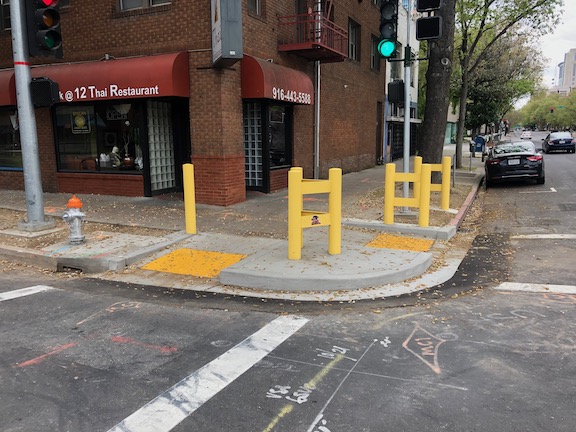
The city has installed substantial bollards on the southwest corner of I Street and 12th Street in an effort to protect the Bangkok@12 Thai Restaurant there.

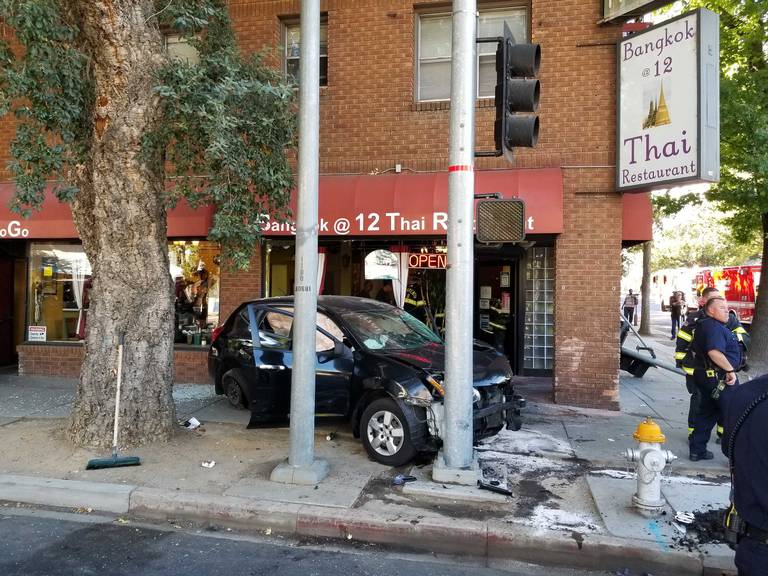
There were at least two major injury crashes into the restaurant in 2019, and the location has a history of crashes (see https://www.sacbee.com/article235349392.html for one example). There were 26 collisions at this intersection in the five year period 2015-2019. This is the most for any intersection in the central city, with the next closest being 19th Street and X Street, at 17.

2019-09-20 crash (photo from SacBee)

Why? Well, the primary reason is that this is the intersection of two 3-lane, one-way arterials, both of which are known to have a history of speeding. The city installed a speed display sign on 12th Street approaching I Street, but has not done so for I Street approaching 12th Street. I had not noticed this sign before yesterday, so I don’t know how long it has been there. Even a brief watch of it indicated that many drivers are exceeding the speed limit, some egregiously so, at more than 10 mph over the speed limit. And then, of course, there are the bollards pictured above. These are not solutions.

The city has identified the section of I Street east of 12th for a reduction in travel lanes from three to two, and that will help. But to the west, no reduction, so drivers will likely be speeding up through the intersection to spread out into the increased capacity. For 12th Street, a reduction from four (!) to three lanes will occur north of H Street, which may reduce speeds approaching here, but in the section between H Street and J Street, it will remain three lanes.

I strongly feel that all roadways of three or more lanes must be reduced to two lanes. Drivers simply cannot be trusted to behave properly on 3-lane roads. It doesn’t matter how much signing we add, or bollards we add, drivers will still speed and will endanger walkers, pedestrians, people in other vehicles, and people sitting down to eat a meal at restaurants.

Solution? The reduction in lanes on I Street must continue westward at least to 10th Street (I would continue it all the way to the freeway, but that is another issue). 12th Street must be reduced from three lanes to two lanes in the section between H Street and J Street (I would reduce it from C Street south). Most of the traffic on 12th Street turns left onto J Street, only a portion continuing south, so having one through lane and one left turn lane would not significantly reduce capacity, but would make things a great deal safer. A bonus would be that the left hand travel lane can be allocated to the exclusive use of the southbound light rail tracks. Currently, the southbound lane is shared between motor vehicles and light rail, and the light rail train is often delayed by congestion and by left turning vehicles. Two birds with one stone, as the saying goes.

The city’s Vision Zero effort focuses on corridors, stretches of street with a high crash rate, and this is not a bad focus, given that most of these corridors are in disadvantaged/disinvested communities. It does not focus on intersections, not even on very high crash rate intersections. San Francisco’s Vision Zero program, one of the leading in the country, identifies the top five corridors, AND the top five intersections. There has been significant though not necessarily complete infrastructure work on each of these. I would like to see the I Street and 12th Street intersection be prioritized for Sacramento.

Who is out there driving?

There has been a lot of discussion Twitter the last week about drivers speeding on roads, just because they can, with the streets mostly empty. Agreement has come in from a wide variety of places, but there are also doubters, who say this is not happening. So, I decided to pay more attention to what is going on. These observations are from Sacramento central city, east Sacramento, and south of Broadway to Fruitridge Road, but mostly central city.

On three lane one-way streets, egregiously poor driver behavior is rampant. It is less common on two lane one-way streets, but still noticeable. It is pretty much absent on two-way streets.

I took some time to observe drivers on two three lane one-way streets in the central city, J Street, and 12th Street, both of which I know to have speeding problems when they are not congested. Both locations had signals every block. I suspect driver behavior would be much worse on sections without signals every block, but have not done observations yet.

On J Street, 38% of the drivers were doing something significantly unsafe or obnoxious. On 12th Street, it was 45%. This was Sunday afternoon. What, specifically, was I seeing?

  • drivers going more than 10 mph over the speed limit (limit is 25 mph on these two streets), sometimes well over
  • muscle cars revving up to high speed between signals and then braking hard for the signal (usually, sometimes they just blew the red light); what I mean by muscle cars is vehicles with a horsepower rating far more that would ever be needed in a city
  • vehicles with exhaust systems modified to be very loud, and which were being driven in a way so as to generate that noise
  • drivers making right or left hand turns, against red signals, without really slowing down

I do not have a radar gun, though it would probably be a good investment. But I have spent many hours at speed display signs calibrating my perceptions of vehicle speed to the what the sign says. There is a speed display sign on 12th Street between H Street and I Street. Though most drivers (the ones not mentioned above) were going no more than 25 mph, some were going up to 35 mph, accelerating in just that one block, and several drivers pegged the display, which means it blanks out the speed and displays a message such as ‘too fast’, which on this sign I think means over 35 mph. How fast would they have been going if the signals were not here?

You might have some hope that the police would enforce against this. Sorry to dash your hopes, but every single Sacramento Police Department vehicle I saw today was going well over the speed limit. Not just a little, and not responding to calls (no siren, no lights), but well over.

Of course the long-term solution to this is not enforcement, but reconfiguring roadways to eliminate ALL three lane (or more roads), and to convert most one-way roads to two-way. The city is working on some of that, but at a snail’s pace, as streets are being resurfaced. We need to accelerate this change, to keep all of us safe, today, during the pandemic, and beyond. Yes, I am even including drivers and their passengers in the ‘us’, as they are as much in danger from this behavior as walkers and bicyclists.

I know that there are also people out there driving for valid reasons, going to essential jobs, to medical care, to buy groceries (though a lot of them could be bicycling). The best thing we can do for those people is to remove the others.

JUMP charging hubs

Someone asked me recently about the locations of JUMP bike charging hubs in Sacramento. There are 18 on the map below, and one new on on 19th Street just north of Q Street, at the Q19 Apartments development. I captured this map from the JUMP bikes website, which took a little doing.

JUMP bike charging hubs in Sacramento

I recently took photos of all the hubs I could find, and they are part of the Sac bike-share album at https://www.flickr.com/photos/allisondan/albums/72157713653167982. I was able to locate only one of the three hubs shown for Sacramento City College. It may be: 1) I just couldn’t find the other two (they are much harder to see at this time since they don’t have any bright red bikes in them), or 2) they are not charging hubs but regular bike racks, or 3) they are located where construction is going on and are inaccessible or removed. All the rest of them have at least one photo in the album.

So far as I know, there are no charging hubs in Davis, nor in West Sacramento (which shown on the map as part of Sacramento).

When you actually rent a bike, the app shows the location of these hubs, but with no bikes to rent (the system is currently shut down, in case you had not heard), I can’t see what the live map shows. But other than the one new one, I think this map is accurate. Let me know if you know otherwise.

16th & E construction problems

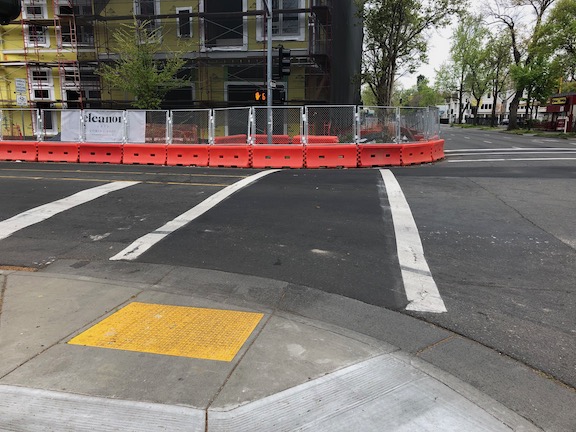
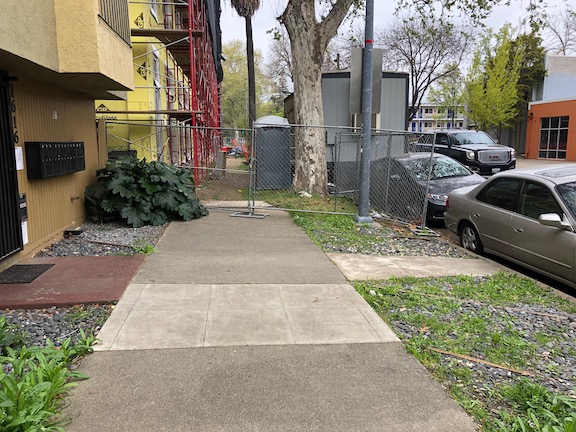
An new housing development at 16th Street and E Street (remember, I’m not against housing developments) has significant problems. At the southeast corner of 16th and E, the corner has been completely blocked by construction barriers and fencing, so there is no safe wait space for people using the crosswalk, and therefore both crosswalks should be closed. There should be a barrier and signing on the east side crosswalk over E Street, and there should be a barrier and signing for the south side crosswalk over 16th Street. Neither are there.

16th Street & E Street, no crosswalk barrier

The project also has problems on 16th Street approaching from the south, where the sidewalk end, but a small sidewalk closed sign is not visible because it is on a canted fence, and there is no advance warning at F Street.

16th Street northbound, no visible signing

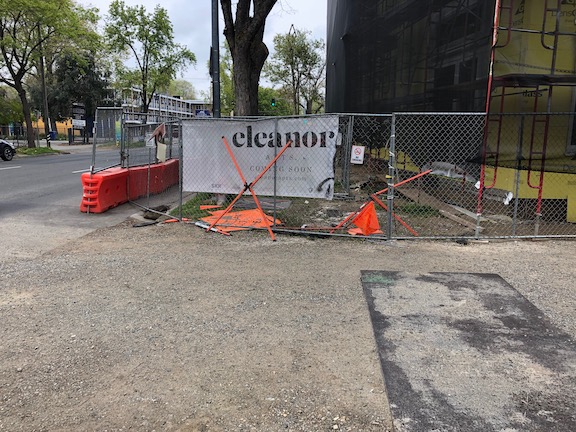
On E Street westbound, there is a construction fence with no sidewalk closed signing, nor is there any advanced signing at the last safe crossing at 17th Street.

E Street westbound, no signing

This property and development is apparently owned by SKK Development, Sotiris Kolokotronis, and is called Eleanor Apartments.

closed sidewalk & dead project at 700 16th

The apparently dead redevelopment project at 700 16th Street, the old Clarion Hotel, which occupies the block between 16th and 15th, and H Street and Government Alley, has closed sidewalks for a long period of time, even though nothing is happening there. The sidewalks closed are on H Street, the entire block, and 15th Street, the half block. As seen in the first photo below, there is enough pedestrian traffic on 15th Street to have worn a path in the sidewalk buffer. The solution here is to require the developer to remove this fence. If fencing is needed, which is doubtful on this side of the building, it should be on the property and not in the buffer. Re-opening this piece of sidewalk until such time as there is active development is the right thing to do.

15th Street use path, north of H Street, old Clarion Hotel

On the northwest corner of 15th Street and H Street, the corner could have been left open so that the two crosswalks could be safely used, but it was not. Instead, a sloppy fencing job leaves a sidewalk too narrow for ADA use.

15th Street & H Street, northeast corner, no ADA access for crosswalks

The sidewalk closure on H Street might need to remain because there is building access on this side, but it should be properly signed approaching from the east, which is is not.

H Street & 16th Street no signing

Lastly, on 15th Street southbound at Government Alley, there is a fence but no signing, and there is no advance warning at G Street that the sidewalk is closed ahead.

15th Street at Government Alley, no signing

This property is apparently owned by SKK Development, Sotiris Kolokotronis, and is called The Bernice. This failure to accommodate walkers is both the fault of the owner/developer, for the poor job of fencing and signing, and of the city for failing to monitor the situation (and perhaps for allowing it to exist in the first place). This also points out that there must be bonds for construction zone fencing and signing so that if a owner/developer fails to proceed with development, the city can go in and partially or fully restore access at the developer’s expense.

Sac permanently closes sidewalk

Note: updated 2020-03-28 to correct lane descriptions and add a photo of the lane shift.

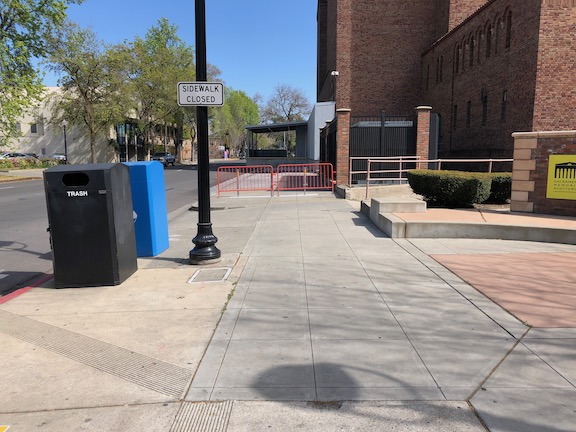
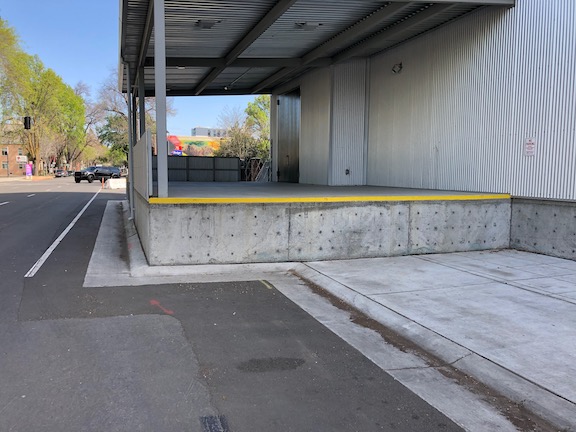
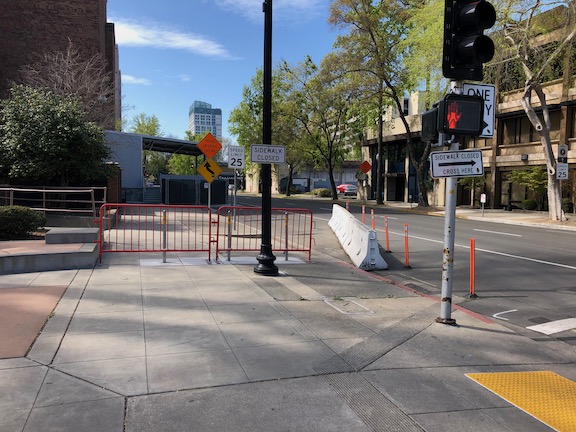
On the south side of I Street, between 15th Street and 16th Street, the city has permanently closed the sidewalk. This was to construct a loading dock for Memorial Auditorium. I had noticed the construction going on there, the first phase of the city’s project for the convention center and community center theater, and just assumed things would be returned to normal when construction was complete. How wrong I was. I was flabbergasted when I saw this. The loading dock sticks quite a ways into what used to be the public right of way, erasing the sidewalk and two parking lanes (the general purpose lanes were shifted to the right). The loading dock is concrete, intended to be there forever. See the photos below.

If the loading area was really than important, and could not be provided anywhere else, the city could have set things up for easy temporary closure of some of the street so as to allow loading when needed. They did not, they made it permanent.

I have walked by here, on the sidewalk, when events were going on at the Memorial Auditorium and there were a lot of walkers using this sidewalk. I imagine for a lot of other uses as well.

Also note that the ‘ bike lane’ stripe does not meet standards for a bike lane because it is immediately adjacent to a hard barrier and fence, so requires shy distance not provided. So that means when there are eventually bike lanes on I Street, this will be a gap, permanently.

What the fuck were you thinking, City of Sacramento?

photo: I Street, south side, east of 15th Street
I Street, south side, east of 15th Street
photo: I Street, south side, east of 15th Street
I Street, south side, east of 15th Street
photo: I Street, south side, west of 16th Street
I Street, south side, west of 16th Street
photo: I Street, south side, west of 16th Street
I Street, south side, west of 16th Street
I Street westbound, lanes shifted right