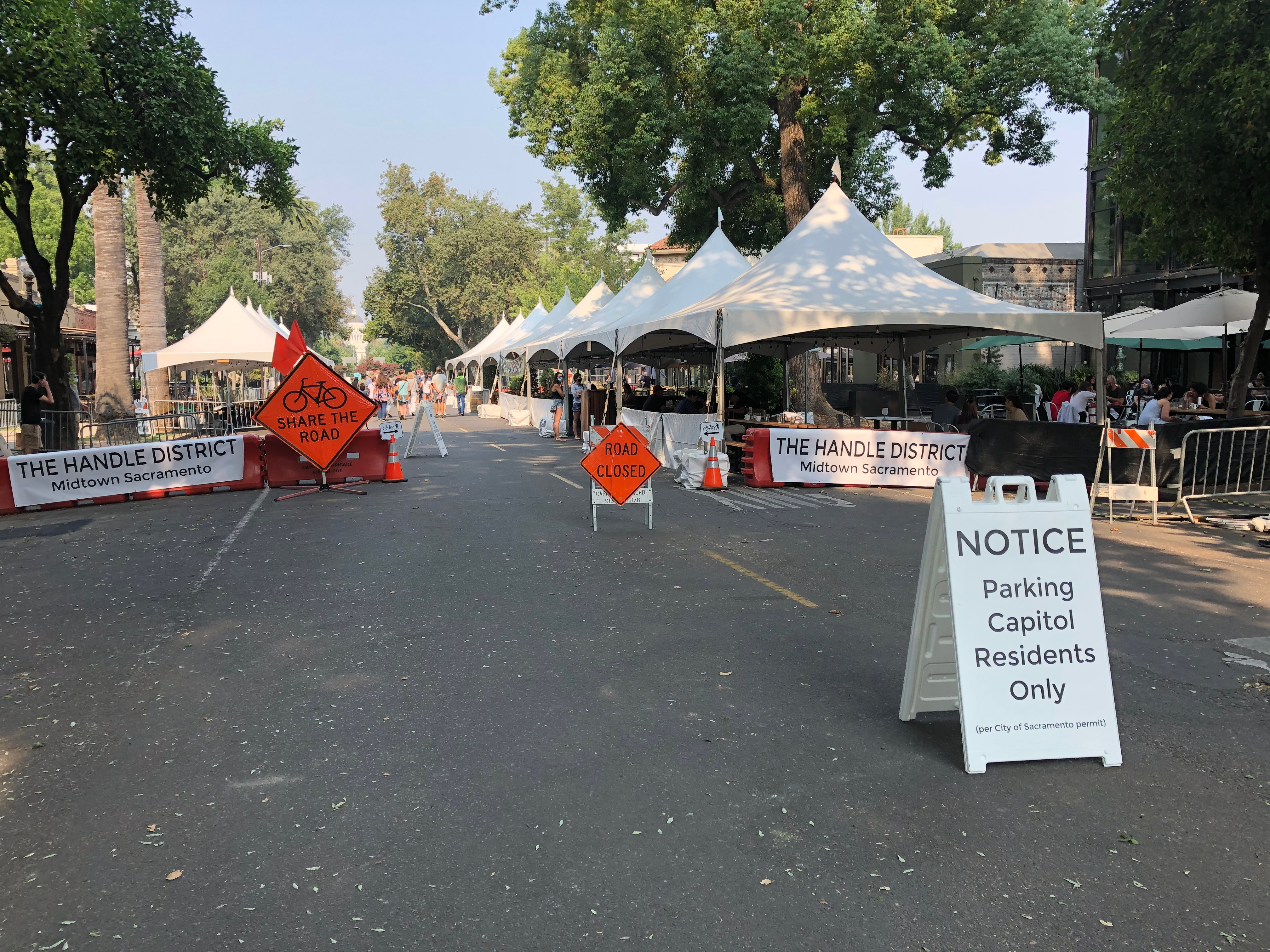
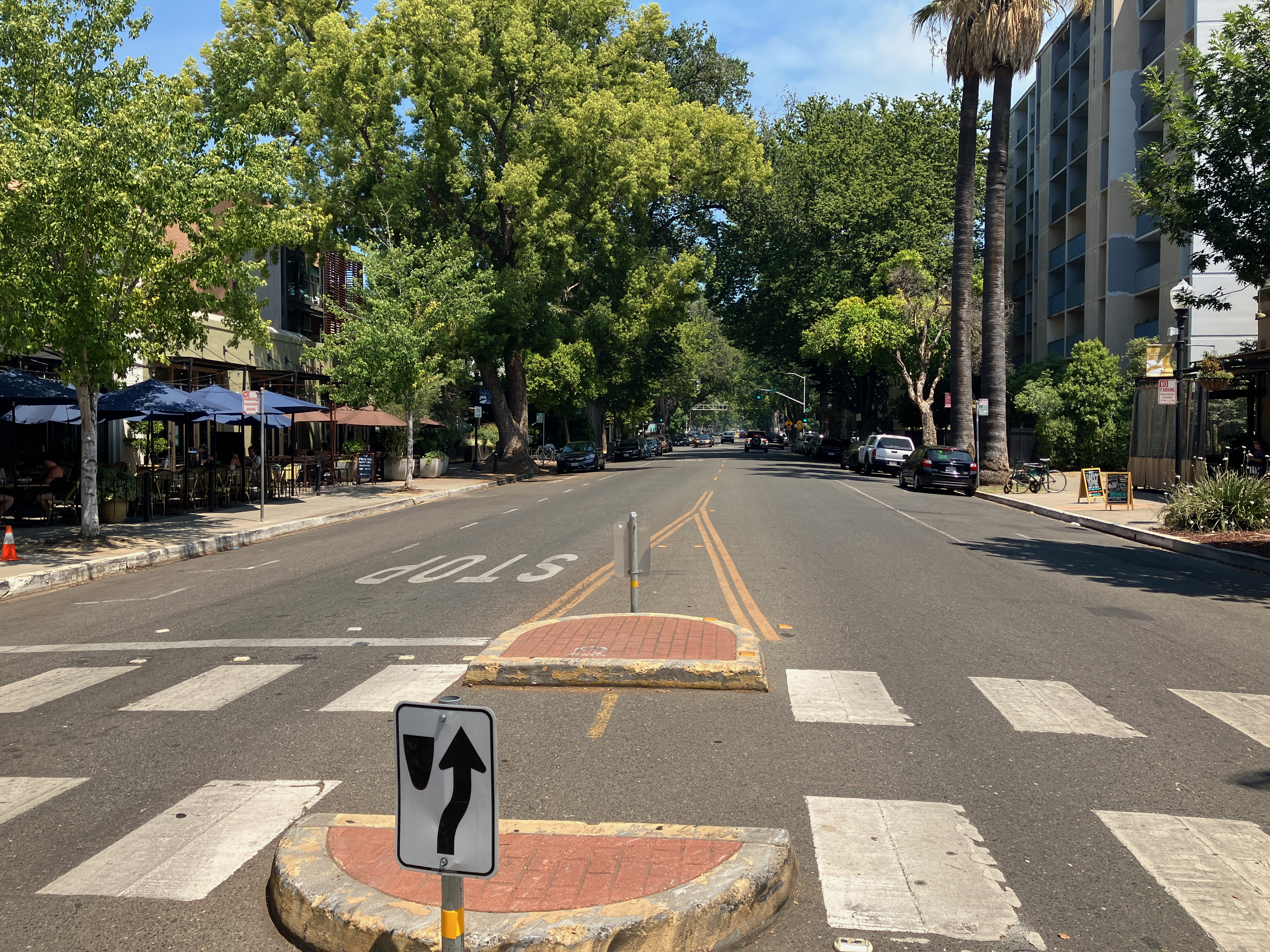
Sac one-way to two-way

The City of Sacramento Downtown Mobility Project includes the conversion of two one-way street segments to two-way. Specifically, I Street from 15th St to 21st St, and 5th Street from I St to X St. The time frame for these changes was projected to be 2021.

Note that 5th Street is already two-way from L St to J St, and from I St to Railyards Blvd. One-way 5th Street significantly handicaps access from the south to and from Sacramento Valley Station.

Downtown Mobility Plan

The 2040 Sacramento General Plan mobility element Proposed Roadway Changes map (10MB; this is from the City Council agenda item 15 for January 19, 2021, I’ve not found it on the city website) indicates additional one-way to two-way conversions in the central city. On the clip of the city-wide map showing the central city, below in pinkish, these are small sections of 3rd St, sections of 7th St and 8th St, one block of 16th St, small sections of 19th St and 21st St, sections of G St and H St, some additional sections of I St, a long section of N St, and small sections of L St and P St under the Business 80/Capital City freeway. There is no indication of sequencing of these conversions in documents available so far, but since the plan is a 20 year plan, I would hope that these conversion are prioritized for the next five years.

2040 Sacramento General Plan, Proposed Roadway Changes, excerpt

I’ve written a number of times about the safety hazards of one-way streets and recommendations for converting them in Sacramento: One-way streets, again; 5th Street mess at Sac Valley Station; more on conversion to two-way streets; street changes. When these additional conversions are implemented, the central city will be closer to my ideal of no one-way streets except when there is a separated (protected) bikeway on the street. An even this is questionable, as it increases safety for bicyclists but does little to increase safety for walkers.

Someone recently asked when the streets in the central city were converted to one-way, and I don’t know. Anyone out there have information?

Reform NHTSA? Hmm…

Congratulations to Californian Steven Cliff on his appointment as interim administrator the National Highway Traffic Safety Administration (NHTSA). See StreetsblogCal post Steven Cliff, from California Air Resources Board, Appointed Acting Head of National Highway and Traffic Safety for more information.

The agency has many areas of responsibility including vehicle safety and education. The agency mission is: “The National Highway Traffic Safety Administration is responsible for keeping people safe on America’s roadways.” The agency has for years (long predating Trump) seen its mission as making it safe for people inside vehicles, and has ignored any issues of safety for people outside vehicles. People have repeatedly asked that the agency address vehicle design that would make it safer for people outside, making it less likely that they would be hit by a driver, and more likely to survive if they were hit. Its education programs are rife with victim blaming and bias against walkers and bicyclists. Nearly everyone who is active in the walker and bicyclist safety profession rejects out of hand their educational materials as being so biased as to be unusable. Even though they have officially stopped using the discredited claim that driver behavior is responsible for 94% of crashes, they are still relaying and cheering on this garbage when other agencies and organizations use it.

NHTSA has promoted the ‘shared responsibility’ mythology, that all users of the road are equally responsible for safety, frequently seen along with the message that walkers and bicyclist must wear high visibility clothing, must carry lights, must never use cell phones, must be aware at all times of the hazard presented by motor vehicles and are responsible for avoiding those hazards. This is bullshit. Drivers of vehicles which are designed to be unsafe for people outside them, who think they own the road and that pedestrians and bicyclists should be somewhere else, should be responsible. These drivers are traveling along roadways that were designed to be unsafe for walkers and bicyclists by transportation agency engineers, who also should be responsible.

NHTSA does not have responsibility for roadway design, that lies with the Federal Highway Administration (FHWA). However, NHTSA has made no effort to work with FHWA to bring together concerns about the safety of vehicle design with the safety of roadway design. The agency view seems to be ‘not our problem’.

I encourage you to read Don Kostelec, who has been one of strongest voices highlighting the victim-blaming of agencies like NHTSA and the mis-design of roadways by engineers. He does a better job of this than I ever could.

20% of roadway fatalities in 2019 were what NHTSA calls ‘nonoccupant fatalities’, meaning people walking and bicycling. Or eating in cafes, or sleeping in their beds, or shopping in stores, or any number of other ways in which drivers kill people when departing the roadway. During the pandemic there has been a huge increase in poor (criminal) driver behavior, and after the pandemic there will be a large increase in vehicle miles traveled (VMT). In some places, vehicles miles traveled (VMT) has already increased nearly back to where it was before the pandemic, even though many people are taking few or no trips. Those who are taking trips have increased their motor vehicle use. This does not bode well. NHTSA does not directly contribute to this problem, but it has had a central role in absolving drivers of responsibility for crashes that kill and maim walkers and bicyclists, and for that, I hold them responsible.

7,338 walkers and bicyclist died on the roadways in 2019. The numbers will probably be similar in 2020, though some cities have seen huge increases. Ironically, the percentage of total fatalities may decrease since there has been such a huge increase, of about 1.5 times, in single vehicle crashes, mostly due to speeding. (https://crashstats.nhtsa.dot.gov/Api/Public/Publication/813054)

I don’t think that NHTSA can be reformed. The culture of windshield perspective and victim blaming is so deeply ingrained in the agency that, short of casting off all the administrators, department heads, and much of the employee base, no reform is possible. While other agencies and organizations at all government levels have shifted away from victim blaming and windshield bias, many kicking and screaming, NHTSA has not shifted. It is still stuck in the 1970s mindset that plagues transportation agencies, that the purpose of roadways is to move the maximum number of motor vehicles at the maximum possible speed.

So, Steven, I wish you the best of luck and professional success in this position, but I’m not holding my breath. The anti-safety culture is just too deeply embedded in NHTSA. Of that 7,338 people who died in 2019, I would guess that half of them would be alive today if NHTSA actually took its stated mission of roadway safety seriously.

pavement condition in Sac City, part 2

I started wondering about other variables that might affect pavement condition index (PCI) in the council districts, so here is a little more exploration. See the previous post: pavement condition in Sac City.

First, the council district map, for those who may not be familiar with boundaries.

I wondered about the relationship between population density (people per square mile) and PCI. There isn’t any correlation, though again, the district 1 and 8 outliers may be interesting. I did not realize that district 8 has the highest population density of the districts.

I wondered about the relationship between lanes miles and PCI. There is a weak correlation.

And finally, here is my current data table, in case you want to play with data or suggest insights. Note that the population of each district is roughly the same, as it should be. The unfunded column is the amount (millions of dollars) of backlog, to bring roadways up to PCI 75, but it does not include the ongoing yearly expense of maintaining them at that level.

pavement condition in Sac City

In the search for other information, I came across the City of Sacramento Pavement Condition Report, dated March 2020, and it has some interesting things to ponder. The city has 3000 lane miles of streets. The county reports road miles instead of lane miles, so I can’t directly compare the city and county, but the city does say it has the fifth largest roadways network in California.

The report has maps for each council district, showing the PCI for each (PCI = pavement condition index, a measure of how well the roadway has been maintained, higher is better). I wondered whether the PCI correlated with income, as many things do, so I plotted 2020 median household income of each district against PCI, table and chart below.

There is not a strong correlation between income and PCI, R = .42, but district 1 and 2 are clear outliers, with 1 being the highest income and highest PCI, and 2 being the lowest income and lowest PCI. The city report says that the reason district 1 has a high PCI is that the roads there are newer, but I’m a little doubtful this explains it all, since many of the roads in that area are now old enough to need maintenance.

The target score for ‘roads in good condition’ is at least PCI 75, so Sacramento is falling far short of that because it is not spending enough on roadway maintenance. Part of the reason for this is that money is spent on building new roadways and widening roadways instead of maintaining roadways. But the underlying reason is that the city has allowed to be constructed, and then taken on maintenance responsibility for, roadways which it does not have the income to maintain. In new developments, construction of internal roadways is paid by the developer, but arterials and collectors, which often must be upgraded to handle increased traffic, and the interchanges with freeways, are largely paid by the city, or grants, and are maintained by the city. But low density development, of which the city was formerly very fond and still has some attachment to, cannot ever generate enough income in property or sales taxes to maintain the roadways. This is one of the great suburban subsidies that so hurts our cities and counties.

The report lays out three funding level scenarios:

  1. current funding levels: The PCI will deteriorate over 10 years to 42, which is rated ‘poor’, and if ever corrected, would cost about ten times as much to correct as it would to maintain. I doubt that most people in the city would find this in any way acceptable.
  2. maintain current conditions: To keep the PCI level at 60, the city would need to spend $35.7 million per year, but it is currently only spending $9.7 million per year. This is 3.7 times current expenditures. Though the PCI would be stable, there would be a continuous increasing backlog of maintenance because the PCI would not be improved to the desired 75.
  3. improve conditions to state of good repair: To bring PCI to 75 would cost $58.5 million per year. This is 6.0 times current expenditures.

What to do? I’m sure if the city knew, it might never have gotten into this bind. This is a pattern with nearly all cities, that they cannot under any reasonable current taxation scheme hope to maintain their infrastructure. This post is about roadways, but the same is true of water supply and sewer and electric and gas. And services such as fire and police, for that matter. And it doesn’t even touch on the need for sidewalk maintenance, which is only addressed in terms of adding ADA structures at intersections. For much greater insight on the problem and possible solutions, I refer you to Strong Towns and the book Strong Towns: A Bottom-Up Revolution to Rebuild American Prosperity (from your local bookstore or library).

But I will suggest some things:

  • a moratorium on accepting any new roadways into the city, until the city has identified a mechanism for maintaining them, which would probably entail the developer paying into a trust fund for maintenance
  • paving of parking lanes to a lower level of maintenance than travel lanes; adjacent areas do not need the load bearing capacity of travel lanes nor receive as much wear and tear; the city has already done this in a few locations
  • reducing excess travel lanes; for most roadways in the city, three travel lanes per direction are excess capacity, rarely needed except for brief periods of time or in uncommon circumstances; though re-allocation to bike lanes, separated bikeways, or sidewalks (or in a few cases, parking) should be the ultimate fate of these excess areas, in the meanwhile they can just be blocked off from use and therefore remove the need for maintenance; in many cases two lanes per direction are also excess
  • evaluate whether a lower PCI than 75 might be just fine for residential streets and collector streets; after all, poor pavement does have a traffic calming effect, and we need traffic calming everywhere, so maybe PCI 60 is OK for many roadways

I believe that funding to maintain local streets, most of which are residential streets, and probably collector streets, should come from the city or county level, not from the state or federal government. The closer to the roadway the funding is, the more likely the city or county is to make rational and sustainable decisions about roadway maintenance responsibilities and funding. I think an argument could be made that arterial maintenance should be funded by the state since these roadways serve traffic beyond the city and county boundaries.

As a car-free person, you might assume that I don’t care much about pavement condition, but buses and bikes operate on the same streets as private motor vehicles and commercial vehicles, so acceptable pavement condition is important to me as well.

value capture for transit funding

Common Ground California has produced a white paper Transit Value Capture for California, by Derek Sagehorn and Joshua Hawn. In my previous posts about funding transit and transportation (how to fund transit in Sac county, transportation funding ideas, no Measure A in 2020, Against Measure A, etc.), I had not really looked at this option because I didn’t understand it very well. But the white paper and additional research has given me a better understanding.

“Regressive consumption taxes instituted by local and state governments to fund public transit investment are approaching legal and political limits.”

Transit Value Capture for California, December 2020, Derek Sagehorn & Joshua Hawn, Common Ground California

The first of the tax options is a Land Gain Tax, basically a capital gains tax on sales of property, applied through the capital gains section of California’s personal income tax. The paper presents some models, based on the distance from rail stations and major bus hubs, with Transit Value Capture Districts, and the type of property (commercial or owner-occupied). This tax would be implemented at the state rather than local level, because it is an income tax which counties and cities in California are not permitted to levy, so the funds would be redistributed to the transit agencies. This option would require some legislation, but not anything on the level of a constitutional amendment.

The second option is a Regional Real Estate Transfer Tax, a tax on the transactions like a county or city level tax, but intended to fund large infrastructure projects of regional significance. For the Sacramento region, that might be enhancements to Capitol Corridor and San Joaquins train service, and bringing high speed rail to Sacramento. This option would also require some legislation.

…windfall gains due to increased development potential to affected landowners.

Transit Value Capture for California, December 2020, Derek Sagehorn & Joshua Hawn, Common Ground California

Several other options are mentioned in the paper. Regular real estate transfer tax (RETT), implemented at the county or city level in some but not all locations (City of Sacramento is one), though the percentages are generally low except in a few cases. But counties can set their levels, and could allocate the increase to transit. It is not clear to me whether any transit agencies have the authority to levy this tax, but of course funds could still be used for transit. The state documentary transfer tax is an insignificant source of income, and it appears to go into the general fund.

2020 Proposition 15 would have removed the Proposition 13 property tax reductions for commercial property, resulting in $billions of dollars in state income, much of which would have gone to education but some to other uses such as transit. It did not pass, but it will be back on the ballot in the future.

Mello Roos community facilities taxation districts can be established around specific projects, as was attempted for the Sacramento Riverfront Streetcar. I don’t know enough about these to say whether they are useful or appropriate.

The other major mechanism the paper presents is development value capture, where the transit agency is directly involved in development, the profits of which can go to transit capital and operations. Since in the Sacramento region almost all transit agency owned property is associated with SacRT’s light rail system, the use of existing properties would be limited to those properties that are excess or are currently used for underutilized parking lots. SacRT has preferred to sell off properties, which has a one-time income impact, but can’t lead to ongoing income. They have been encouraged to become involved as leads or partners in development, but have so far resisted. The transit agency most involved in development in California has been BART in the bay area. Legislation has allowed them more flexibility and types of involvement than most transit agencies have, though even they have some unfortunate restrictions. To be effective, additional legislation would be required.

Of these options, the one over which people at the local level have significant control is the Real Estate Transfer Tax. But having transit agencies, cities and counties getting behind legislation necessary to ease or implement the other value capture ideas would be very worthwhile.

As with all my posts on transit and transportation funding, I am not presenting myself as an expert. If you have corrections to fact or implication, please let me know.

BikeLink in Sacramento

The City of Sacramento has installed some BikeLink bike storage lockers in parking garages. These are the first city-sponsored lockers, though Sacramento Valley Station (Capitol Corridor) has an extensive locker installation, Folsom has had lockers at the three light rail stations for several years, and Roseville has a few locations.

The new city locations are mostly parking garages: Memorial Garage, 805 14th St, City Hall Garage, 1000 I St, Capitol Garage, 1126 11th St, and Tower Bridge Garage, 135 Neasham Cir, with one additional location in the K St pedestrian tunnel to Old Town Sacramento/Sacramento Riverfront. I’m not overly fond of parking garage locations, as they are out of sight and not a place most bicyclists would think of to seek out bike parking, but they are certainly better than nothing, and people will eventually discover and use them.

BikeLink lockers in Sacramento Memorial Garage

I hope that the next set of BikeLink lockers in Sacramento are located centrally and visibly at high bicyclist traffic areas, for example DoCo, and the new convention center and community center. They are particularly important where bicycles will be parked for longer time periods, such as attending events, and where parking is needed at night. For short-term, day-time parking, regular bike racks will serve most users. However, employees who bike to work often do not have safe storage, I see a lot of bikes parked out behind buildings, locked to whatever can be found, and I suspect most of these are low-income employees of service businesses, who deserve better security for their bikes. So high retail locations like restaurant areas and malls should also have them, for the use of employees if not others.

I wrote about BikeLink in earlier posts: BikeLink, on-demand bike lockers at Sacramento Valley Station, and bike storage at light rail (note that the Folsom Pedal Stop is no longer there, but there are still 8 lockers at the Historic Folsom light rail station adjacent).

El Santo blocks sidewalk

The City of Sacramento’s Farm to Fork Al Fresco program, which has provided space for outdoor dining during the pandemic by using sidewalk, sidewalk buffer, parking lane, and/or street areas, has been in my opinion a great success. Though I’m COVID cautious and not partaking, I know that this program has been critical to keeping many restaurants in business. I hope that the program continues, to some degree, even after the pandemic. Even when dining inside is permitted again, I think these outdoor spaces are a strong addition to the livability of Sacramento, and in almost all cases is a better use of street space than parking. I strongly support the permanent closure of some street segments, particularly R Street between 14th and 15th, and 20th Street between J and K. I also support widening of sidewalks or buffer space so that more restaurants can permanently offer outside dining space.

In the initial rollout, there were a number of problems. Some of the sidewalk diversions were not posted properly, and the ramps provided did not meet ADA. In a few cases sidewalks were completely blocked, without providing an alternate route. But these problems seemed to be quickly resolved, through the work of the city, business owners, and business associations. I talked with a number of restaurant owners and managers, making suggestions of improvements, and they almost always made them. Though I recognize some people don’t think there should be dining or drinking outside at all during the pandemic, this program really has a good vibe, in my mind. The businesses have been positive, the people have been positive.

Except El Santo. El Santo, a restaurant/night club at K Street and 10th Street, put up a barrier and shelter that completely blocks the sidewalk on the south side of K. For a while, the sidewalk to the east was blocked by an active utility construction zone, but that construction is long since over. People walking or rolling (wheelchair) are forced out onto the detectable warning stripe (very uncomfortable to travel along) or the light rail tracks (dangerous). See the photo below.

El Santo, K St & 10th St, blocking sidewalk

I reported this issue to the city on September 23, 2020. I don’t know when the blockage was installed, since this was my backpacking season and I may well have missed it. It is not clear to me whether the city gave issued a faulty encroachment permit or whether the business violated the permit, but the effect is the same, a sidewalk that can’t be used. I followed up with a phone call January 6, 2021. Nothing has been done to correct the issue. The business does not care, the city does not care. It is problems like this one, allowed to fester, that will darken public perception of the Al Fresco program.

Sac community air protection

A group of partners led by Valley Vision is undertaking a project to identify location for new air quality monitors in low-income, high-pollution areas of Sacramento, specifically Old North Sacramento and Oak Park. For more on the project, which will install 20 Clarity Node-S monitors for particulate matter 2.5 and nitrogen dioxide, see the Valley Vision webpage at https://www.valleyvision.org/projects/community-air-protection/.

The issue is that these two communities are subject to significant negative air quality impacts from a variety of sources but primarily freeways which slice through both communities, and high-traffic arterials. But no one really knows what the problem is, because there are no air quality monitors in those neighborhoods. Below, a map of existing Clarity monitors. The concentration in South Sacramento is due to a similar earlier project, funded by AB 617, but there are none in Old North Sacramento, and one at the edge of Oak Park.

Clarity locations

PurpleAir, a citizen-led network of air quality monitors, has a better distribution, but still only one in Old North Sacramento and a few in Oak Park. These are particulate matter monitors, and gained great popularity with the wildfire smoke incidents of the last few years.

PurpleAir locations

What about the official air quality monitors, the ones used to set air quality alerts for the county? Here they are (little red dots). You might think, surely some must be missing. Nope. These stations mesure air quality for the entire county. Update: I replaced the map graphic with one showing all Sacramento County locations, created a pdf map, and added a table of locations.

EPA AQS locations

Sacramento County is a nonattainment area for ozone 8-hr (2015 standard), PM2.5 24-hr (2006 standard), and PM10 (1987 standard).

The project, of course, is not just about monitoring air quality, but about identifying solutions to improve air quality. Community Project Advisory Committees will be formed in both neighborhoods to guide deployment, data collection, and actions and ongoing collaboration for solutions.

I participated in the first listening sessions, for Oak Park, on January 13. Participants had a lot of suggestions for locations, particularly ones where there are high volumes of traffic, as well as places such as schools where the pollution is most harmful. There was also a lot of talk about solutions, with reducing vehicle miles traveled (VMT) by increasing walkability and providing better transit service being the most commonly mentioned.

There are three more sessions to come, January 20, 26, and 28. Please see the project webpage for details and to register: https://www.valleyvision.org/projects/community-air-protection/ (scroll down to just below the map).

If you live in these two neighborhoods, or work or shop or recreate there, I strongly encourage you to participate in some way and make your voice heard. Even for others, it would be good to track and support the project. I strongly believe that our lack of monitoring capacity allows us to think that air quality in the county is better than it really is, and allows the public to overlook that it is mostly low-income, high-minority neighborhoods that bear the brunt of air pollution from our cars-first development pattern and long distance commuter freeways.

Added two graphics showing the community areas in more detail.

Oak Park
Old North Sacramento/Norwood

Sac general plan and housing

The City of Sacramento is updating its general plan, and as part of that process considering modification of zoning and development restrictions, with the intent of allowing the creation of more housing. A recent SacBee article, Sacramento has a plan to address its housing crisis. Some neighborhoods are fighting it, covered some of the changes being proposed by city staff, and some opposition to those ideas. The opposition is coming from neighborhood associations in East Sacramento, Elmhurst, and Land Park, at least so far. Though neighborhood associations usually represent only some of the richer and more powerful residents, they are nonetheless very politically powerful, particularly East Sacramento and Land Park, so the views of these will hold some sway with city council. I will address some of the misconceptions represented in the neighborhood association viewpoints.

These neighborhoods, along with Oak Park, were originally streetcar suburbs, developed by and for the profit of the streetcar companies and their associated development interests (greedy developers, no doubt). I recommend Bill Burg’s Sacramento’s Streetcars book (and any writing by Bill), and you can view part of the content at http://sacramentohistory.blogspot.com/2007/08/sacramentos-streetcar-suburbs.html. As such, the development pattern is a relic of times past, which met the needs of that time but do not necessarily meet the needs of this time. East Sacramento and Elmhurst had more businesses than they do now, so they are less livable neighborhoods than once they were. Not sure about Land Park. Yes, most of the housing was single family and duplexes, but there were multi-family homes as well.

The neighborhood associations want to fix their neighborhoods in time, so that they never change. That is not possible. Neighborhoods either change or decline over time. Midtown is a continual example of that, as buildings that no longer serve are either converted or replaced. The reason these three neighborhoods have only experienced some decline is that rich people live in these neighborhoods and have been able to forestall decline by an infusion of money that they’ve made in other parts of the city and region.

Fixing a neighborhood in time, if it is in good condition, will inevitably lead to inflation of home values, which I consider unearned income. Maintaining and updating houses is not what I mean, I mean that the value just goes up and up regardless of any action on the part of the owner. Many of these homes are now unaffordable for middle class people, even though that is primarily who they were built for (with the fabulous 40s and homes right on Land Park park being exceptions). Intentional scarcity makes anything more expensive, and the neighborhood associations like intentional scarcity.

So what do middle class people do? They move out to the sprawling suburbs in an attempt to find affordable housing. Of course this is partly an illusion because the cost of car ownership and the time lost to commuting subtract most or all of that cheaper housing benefit. I attribute the explosion of the sprawling suburbs in large part to the fact that the inner ring suburbs refused to allow intensification of housing to accommodate more people. Many of the people in these old neighborhoods consider themselves to be progressive, yet their resistance to change produced vast sprawl, high speed arterials and the pollution, climate change, death, and un-livability that goes with these outer suburbs, and exurbs. A phrase that has been used by many to highlight this is pretty accurate, “I’ve got mine, screw you”.

Another impact is that in an effort to prevent all change, they actually induce undesirable change. From the article: “Their fear is that investors will tear down single-family homes and replace them with poorly-maintained rental properties, charging high rents to Bay Area transplants to turn a big profit.” What instead happens is that even richer people buy small houses, tear them down, and build large McMansions on the same lot. In many cases these McMansions violate current zoning, but that is no problem is you have enough money or political power. Yes, I know that the neighborhood associations hate that too, but it is in part a result of their resistance to change. Apparently a McMansion is better than multi-family? Not in my worldview.

Bill Burg (@oldcityguardian) recently posted a photo of midtown variety of housing types, below, and a diagram of various floor area ratio scenarios, indicating the FAR of 1.0 for much of Sacramento is probably too low, and the FAR of 2.0 for the central city is too low.

variety of housing forms, midtown Sac (Bill Burg photo)
Floor Area Ratio (FAR) diagram (source unknown, via Bill Burg)

Lastly, I find the frequent assumption by homeowners that renters are somehow less community involved as ridiculous. I have been a renter every day since I left my parent’s house (I’m 68, so that is a lot of years), and I know only a very few homeowners (also friends) that have been more involved in their community.

9th St blocked by construction

Thank you, Ali Doerr Westbrook, for flagging the latest violation of walker and bicyclist accommodation on a construction project in Sacramento.

The east side of 9th St between L St and the alley is blocked by a construction project. Both the sidewalk and bike lane are blocked. There is no advance signing at 9th and K for southbound walkers and bicyclists, as required by ADA. There is no signing on the construction fencing, as required by ADA. Construction fencing is not an acceptable detectable warning, as required by ADA. Note that this construction project, the conversion of Capitol Park Hotel into supportive housing, is a city project, so not only is the city responsible for a traffic plan that accommodates walkers and bicyclists, but field checking that the plan is being followed, and enforcing it when it is not.

9th St at K St, no advance warning of closure ahead for walkers or bicyclists

This blockage would in itself be bad, but it is made worse by the blockage of the sidewalk on the west side of 9th St, between K and the alley. This private project is also not properly signed and barricaded. Between these two projects, there is NO walker access on 9th St between K St and L St. None. None. None. Of course one could cross at the alley between one side and the other, but then the city conveniently has a walker-hostile code that crossing streets at alleys is illegal. Got the bases covered, Sacramento!

Though the most egregious, this incident is just the latest in a series of offences in the central city. I have posted on some of these here (tag: construction zone), and on Twitter. I’ve also reported a large number of them to the city’s 311 app. Of these 311 reports, about half are closed without anything being done. Making the same report multiple times increases the likelihood, but doesn’t guarantee it.

The worst of the violations are on city projects. The renewal of Memorial Auditorium had issues. Though now finished, it resulted in the permanent closure of the sidewalk on the south side of I Street. The next worse offense is the ongoing city project called 3C, the convention center and community auditorium construction project. Though some of the issues have been resolved here, several remain, particularly on the 15th St side. And this Capitol Park Hotel project is also a city project. There have been other city project problems, but I don’t have time today to go back through my records and photos to identify all of them.

In response to the concerns from myself and many others, the city had said that it would come up with a construction accommodation policy. After a year, nothing has happened. The city, at least the part of the city responsible for construction zone traffic plans, just does not care. Walkers and bicyclists are routinely ignored or actively discriminated against, in favor of motor vehicle drivers. The city is in violation of its ADA consent decree in allowing these issues to occur and to continue.