non-essential driving

The last month has brought an awareness to many people about what essential is. I doubt if you asked people in January who the essential workers are, you would have gotten an answer that matched who turned out to be essential. I probably would have missed most of them. It is not the rich, or the techies, or the entertainers, or the politicians. It is the lower paid workers, the people who pick, harvest and prepare food, the people who staff grocery stores and pharmacies, teachers, and of course the medical profession. I am not in any of those categories, and the fact that I am not, and am still working and getting paid, means our society has been valuing the wrong people for the wrong reasons.

With our new understanding of essential, I am wondering how we apply this to driving. What is essential driving? Streetlight VMT Monitor indicates that driving in Sacramento County is down 66% (2020-04-14). What were those trips that were formerly being made? Well, some of them were commuting to work trips, but those would account for no more than 2 one-way trips per day, for some people. Nationally, commute trips are down below 25% of total trips. So that can’t explain a 66% decline, even if no one were going to work, which we know is not true. I suspect people who are doing what could be considered essential trips – to essential jobs, and to the grocery store and medical services – are about the same rate as before, so that doesn’t account for the decline either. The only conclusion I can come to is that a significant portion of those trips not now being made were non-essential.

I know that when I am out walking and bicycling for physical activity, I see a lot of people who are probably just driving for pleasure. Obviously those speeding egregiously, which is at least 20%, are driving for the pleasure of doing what they want on the mostly empty roads, other people be damned. And a lot of the other people do not seem to be heading towards or away from work, or the grocery store. A lot of people are just out driving around. If we eliminated these non-essential trips, I suspect VMT would be down at least 80%.

Even the grocery store is problematic. I see people coming out of grocery stores with a small purchase, an amount that could easily be carried on a bike, or even walking. Of course I don’t know how far these people are going, and what their specific situation is. It true that many, many people have chosen to live in places where the distance to a grocery store is not walkable or bikeable, the sprawling suburbs. Conversely, some people don’t have much choice about where they live, and end up in food deserts, because they can’t afford to live in places with grocery stores. And there are a few people whose only reasonable transportation mode is a car, due to physical disability, but those are very few in number. I am going to say that many trips to the grocery store also fall into the non-essential driving category. (Note: this was going on long before the pandemic, with Trader Joe’s being the poster child for people who drive to the store and leave with small amounts of groceries not requiring a multi-ton motorized vehicle to transport.)

Let me say up front that I have no data to back up what I’m going to say. But it does fit the data about VMT reduction, and what we know about travel modes, and what I observe on the street.

At least half the car trips formerly being made were non-essential. Probably much more.

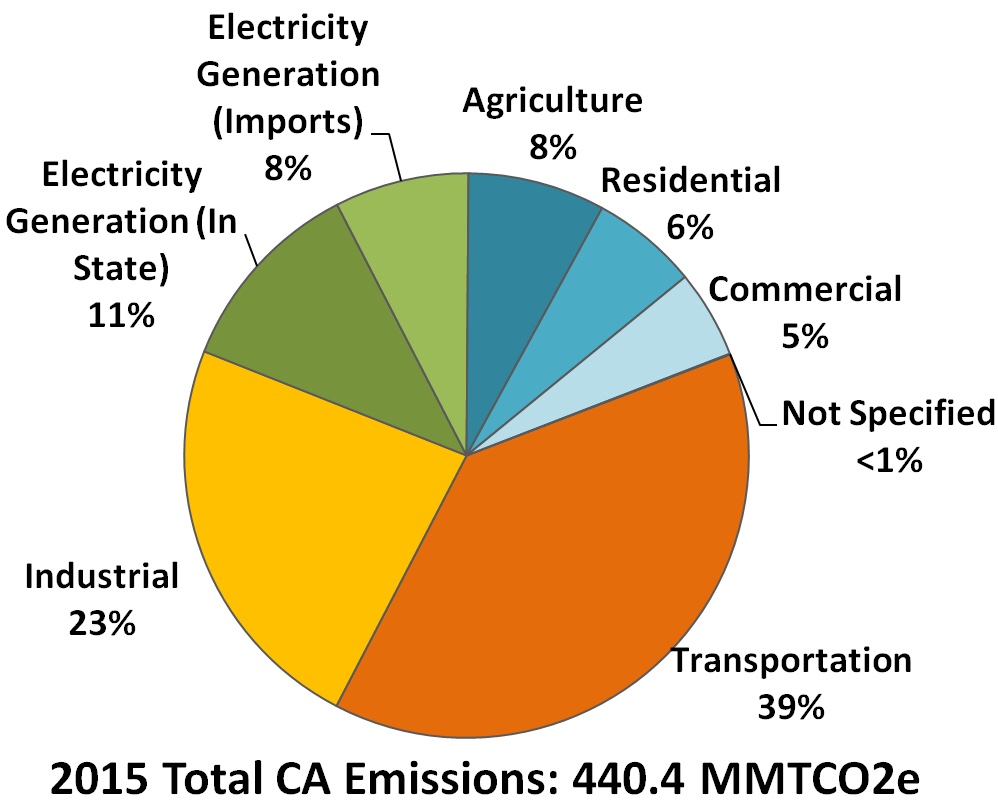
So what? Well, we know, unless we are ideologically opposed to knowing, that motor vehicle travel is 40% of all carbon emissions in California, and it is the portion of our emissions that we have made no progress in reducing. So, every non-essential car trip is a crime against the climate, a crime against people’s health, a crime against livability of cities.

I am not sure how to best eliminate all these non-essential trips. Pricing fuel, or travel, or parking, is part of the solution. This is often called congestion pricing, but the point is not to reduce congestion but to eliminate unnecessary travel. We need to stop subsidizing non-essential travel, we need to make it hard for people to make this choice. Obviously the controls cannot be primarily economic, as that would hurt the people the most, who have the least choice. But it must be in part economic, because middle and upper income people make choices based on money.

Some suggestions:

  • Convert areas of the city that are and look urban (downtown, primarily, but other areas as well) into superblock areas, a la Barcelona, where many of the streets become car-free or car-light. This is easiest to do where there is a grid street network, harder but not impossible to do other places.
  • Reduce street parking significantly, starting with streets where the right-of-way is needed for other purposes, such as sidewalks, sidewalk buffers, and bicycle facilities. I am not against street parking, as it does serve somewhat to slow traffic, but where the space has a higher use, it should be eliminated and reallocated. At the same time, we should never build another structured parking deck (parking garage). These structures NEVER pay for themselves in parking revenue, and so they are a subsidy from everyone to drivers (whether they are public or private, makes no difference, they are an inefficient use of capital). I would suggest we eliminate 10% of all parking in the central city, within one year, and then evaluate the impact on non-essential travel. If it has not decreased significantly, then eliminate another 10%, and on until non-essential travel becomes rare.
  • Charge the real cost of parking, on street and decks. The city only charges enough, roughly, to cover the cost of the program, meaning enforcement and administration. The land used by parking comes free, as a subsidy to those parking. The cost of repaving the parking lane (which we should not be doing anyway) comes free, another subsidy. The difficulty the city has in converting parking space to other uses, such as bike corrals, parklets, delivery zones, and drop-off/pick-up areas, which are often higher uses than parking, is another give-away to drivers, and residents and businesses who think they own the parking spaces.
  • Shift transportation expenditures away from private vehicle transportation, in favor of necessary freight, transit, walking and bicycling. That means #NoNewRoads and #NoNewLaneMiles. We maintain what we have but we don’t build any more. We stop paving parking lanes to the same standards as streets, and let them deteriorate. And we let low-traffic streets that serve very few people (cul-de-sacs, primarily, though some semi-rural roads, as well) go back to a natural surface, unless the users of that street want to pay the full, unsubsidized, cost of paving.

There are a lot of reforms that must happen at the state and federal level, and I’m not addressing those here. These are ideas that can be implemented locally, at the city and county level.
We can’t go back

sorry, could not find a photo for Sacramento,, but if someone provides it, I will replace this one of Los Angeles (via Business Insider)

We can’t go back to the way things were before! To the car-dominated world where walkers and bicyclists were considered second-class citizens, worthy of consideration only when it did not inconvenience the privileged drivers of cars. The streets are largely empty (except for some essential drivers and too many joy-riders). The air is clean. The city is quiet. It is (other than the above-mentioned joy riders) safe to cross the street, to bicycle on the street, even in some places, to walk in the street. I don’t intend to ever go back, and will work to make sure we do not go back.

Here is a list, with brief notes, of areas in which I think we should not and cannot go back. No priority order. I think that over time my ideas can be refined and added to. Let me acknowledge the many people on Twitter, my main social platform, for giving me a lot of good ideas and food for thought.

  • Right to Move: I believe that, as humans, we have a right to move, to freedom of movement (though I also believe that reduction or even suspension of this right for public health during a pandemic is acceptable, though traumatic). However, this right is expressed through walking (or mobility devices for those not able to walk). It is not expressed through bicycles, or scooters, or even transit, and it is absolutely not expressed through privately owned vehicles. I am not saying that bicycles and scooters and transit are not good methods of movement for transportation, but walking must always be the most important and the most guaranteed, our most basic right, with other modes coming later, if at all (in the case of cars). I am tired of myself and others being terrorized by private vehicle drivers, who are all too happy to inflict their traffic violence on innocent people. Walking FIRST!
  • Transportation
    • all pedestrian signals should be set on recall; they should be labeled with their function; and if there a locations where traffic engineers claim such a low rate of pedestrian use, I’d ask for an analysis of why is there no pedestrian use; if it is an urbanized area, why aren’t there pedestrians, and if it is a rural area, why is there a signal?
    • failure to yield to pedestrians (CA CVC 21950) should be considered a sociopathic offense, similar to drunk driving and smoking in buildings, and strictly enforced; I am not just concerned about the number of pedestrians who are killed and severely injured by drivers, but about all the people who could walk, but don’t, because they are rightfully afraid of car drivers; drivers who repeatedly violate this should have their driving privileges revoked (drivers license suspended and vehicle impounded), and those who still violate should be jailed
    • #NoNewLaneMiles (a more specific version of #NoNewRoads); we have all the roads we will ever need, we just need to use them more efficiently by increasing the density of homes, jobs, and services; because there are no new roads, there will be no greenfield developments, as we have plenty of infill/redevelopment land to work with, and we have an excess of single family homes
    • expenditures on roadways will only go to maintenance, and once a level of good repair is achieved, then to true complete streets projects which reallocate roadway space and increase safe crossings
    • all roadways that are more than two lanes per direction must be reduced to no more than two lanes. Drivers have proven themselves, again and again, incapable of responsibly using wide roadways, and so these wide roadways must end. Temporarily, we can put up barricades or delineators to reduce the lanes, and in the long run, determine and then implement ways of re-allocating this space to best serve the community; some land might be available for housing development
    • freeways will be designed and sized for freight movement, not for commuting; interstate commerce is the primary legally and morally justifiable use for our Interstate system; the idea of continuously expanding freeways so that a continuously expanding number of people can choose to commute continuously expanding distances is not socially or economically rational or feasible; where there are more than two lanes on a freeway, one or more of them should be designated (and enforced) as a freight-only lane so that freight is not slowed by commuting traffic
    • private and commercial fossil-fueled vehicles must be strictly controlled on all spare-the-air days; if the air quality particulates (winter) or ozone (summer) exceeds the ‘healthy’ level, then we start shutting down vehicles; this would be much easier to do if we implemented a pricing scheme (congestion management) all the time, but if we are still working on that, we can in the meanwhile reduce traffic; I’m thinking the easiest way to do that is to control on-ramps and off-ramps, since most long distance commuters, and much commercial traffic, is using the freeways; some on-ramps already meter vehicles, and we could just slow this down so fewer vehicles are allowed to enter; we would have to add off-ramp metering; there are a lot of ways of managing traffic, some of the best controlling the amount of underpriced or free parking, but this is definitely one to explore
    • vehicles must be speed limited, so that drivers cannot exceed safe speed limits; this is one of the easiest to accomplish because all modern vehicles could be speed limited with minor software modification, but I realize that it is politically the least feasible; nevertheless, we need to be talking about it and advocating for it
  • Work from home: I fully understand that not every job is amenable to working from home, and interestingly, it turns out that almost all of the truly essential jobs are not, but nevertheless, many jobs are; employers should be required to analyze each job position to determine whether a particular job could be done from home, either all the time, or some days of the week, and then to implement work from home policies that allow the least in-person work required
  • Schools: I am part of the educational system. I like the idea of school choice, and I think it has a number of benefits. However, I also see the cost of it. A huge amount of driving, taking students to and from school. The idling of cars outside the school has a measurable and negative impact on air quality in the classrooms. Much of this driving is unnecessary, and trips could be done walking or bicyclist, but is driven for the convenience of the parents (not the students). The greatest danger students walking and bicycling face is the drivers taking their own child to school, and in addition to the direct danger, there is the intimidation that makes people less willing to walk and bike. Students are getting significantly less physical activity. Students and families feel less connected to the neighborhood they live in, and the school feels less connected to its neighborhood as well. So:
    • for any school located on an arterial with more than two lanes of traffic in a direction, lanes will be immediately closed in order to increase the safety of students walking and bicycling, and to create a less polluted and hectic environment
    • private vehicles will be prohibited on campuses, except where the parent has submitted a statement to the school detailing why a particular student must be transported directly to the school (meaning, a disability of some sort), and received a pass; schools are there to educate students, not to accommodate drivers
    • for schools located on local streets, the block on which the school is located will be closed to through traffic for the duration of arrival and dismissal (or longer); of course this means that students and families using mobility devices must be guaranteed high quality sidewalks and crosswalks, with ADA ramps, at least 6 feet in width, and in good repair
    • school districts should have a conversation with families and the public about the ways in which a non-neighborhood school supports and does not support academic learning and the needs of its community
  • Housing: Part of the reason we have a housing crisis is that single family homeowners have been able to suppress the building of homes, for some types of people (read: minorities) and for some kinds of housing (read: multi-family), for a long period of our history. We all suffer from this: un-housed people, high rents, separation of jobs and housing, climate change, air pollution, most of our transportation dollars going to long distance commuters while we have potholes in our local streets, underinvestment in transit and rail, etc. The most egregious, though largely hidden from view, aspect of this is that single family housing has bankrupted our cities, and counties, and state. Single family housing can never generate enough sales tax or property tax or user fees to pay for the maintenance required to sustain all these spread out houses and roads and utilities and law enforcement, and fire, and, and and. I think it is becoming clearer by the day how financially on edge our governments were. They have huge bond debt, huge deferred maintenance and well as current maintenance obligations, and far too much reliance on new development just to keep the old going (which is called the development ponzi scheme – see Strong Towns). Sprawl is the primary though not the only driver (pun intended) of this. So:
    • immediately remove all residential zoning classifications, so that there is only one residential zone, and no limit on the types of housing that can be constructed on a piece of land; until such time as we can analyze what we need in terms of zoning and development standards, I’d leave the rest be, but this is a step we can and should take immediately
    • no developments (even infill) larger than a certain size should be allowed to deed road and utility improvements to cities and counties, unless they pay a fee to a maintenance endowment sufficient to maintain that infrastructure for all time; I am not talking about development fees, which of course are used to maintain past infrastructure and to keep the doors open, but never retained for the future, rather, these are banked funds to meet the needs of the future
    • recognize a right to housing for all people; this is obviously a huge undertaking, for which governments may not have the money (because of the sprawl subsidy and bankruptcy detailed above), though there is certainly a lot of shifting of resources that could get us a significant way there, but we need to start working toward that goal now, and with much of our societal focus on how to solve the issue as quickly and equitably as possible

Thank you if you stuck with this long list to the end. As I said, it is preliminary, and your constructive comments here or on Twitter are welcomed.

I admit that I thought we had a decent world, many issues to work on, but sort of OK. Probably some others felt this way. But the bottom has dropped out, for those in poor health (much of that poor health due to all the actions above that we did not take), people of color, low income people, un-housed people, people dependent on employer-provided health insurance, people in essential jobs. I am very lucky! (yes, the luck of privilege).

I hope that we reflect deeply on the clean air and streets available for people (outside cars) to live, and all join together to make sure we do not go back to the old, unenlightened times, but to work hard towards a better future.

I am quite aware that I have not mentioned, or have lightly touched on, a lot of other issues that are critical to so many people. Climate change is one of the biggies for me. Please don’t think that those other issues are unimportant to me, but transportation is my expertise and advocacy, and it needs strong voices, now and always.

the problem with maps

Maps have suddenly become the preferred method for presenting information, which is a good thing. But I see so many maps that don’t present what they are claiming to present, or supporting the story being told in the text. Ack!

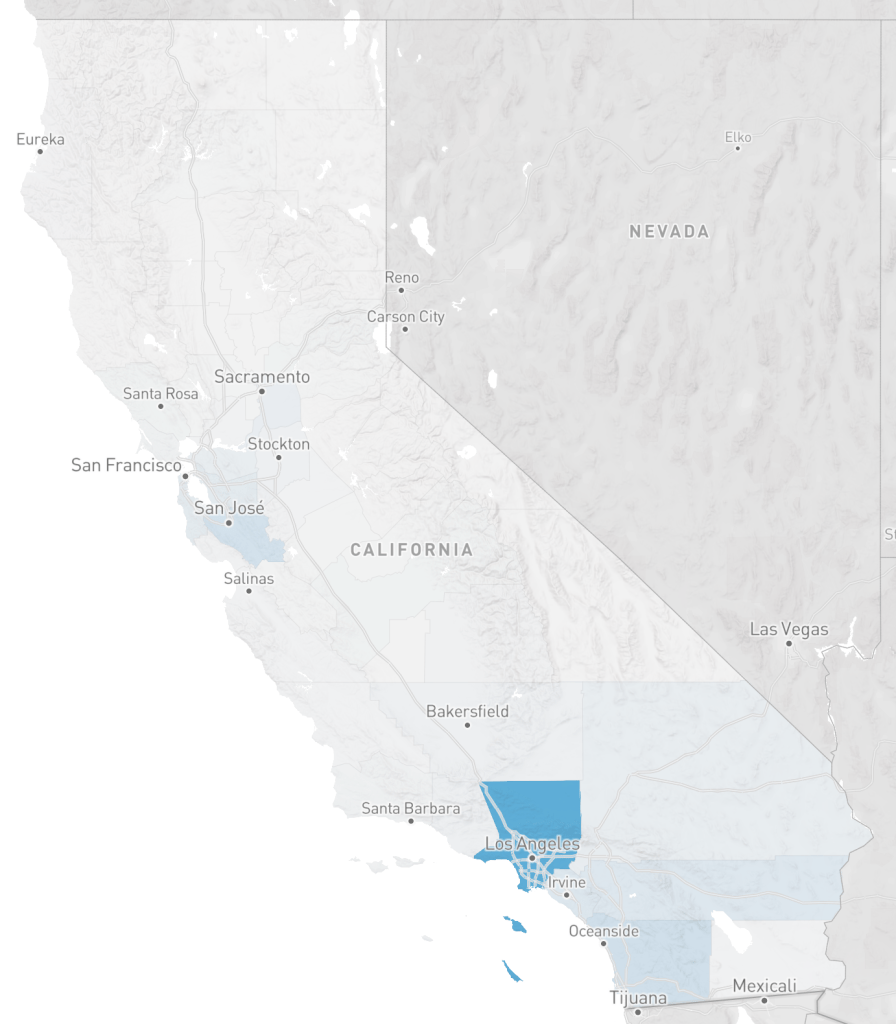
Since coronavirus maps are the rage, I’ve selected two to show. These are from the UCSF Health Atlas, which just added COVID-19 data by county. Take a look for yourself, a fascinating website, that I was not aware of until today. The first map is of COVID-19 cases. It shows Los Angeles county as having the most, followed by San Diego county and then Santa Clara county. The second map is of COVID-19 cases per 100,000 people. It shows Mono county as having the highest rate, followed by San Mateo county.

COVID-19 cases, source UCSF Health Atlas
COVID-19 map, cases per 100,000 people

Remarkably different maps, eh! Why?

Numbers don’t tell a story of any use to responding to the pandemic, or of any other planning effort. The important quantity is rate, and in this case the rate is per 100,000 people. The table below shows a selection of counties and their statistics. If one looked at just the numbers, Los Angeles county would look like a horrible place to be. Yet the rate is below a number of other counties in California. Los Angeles county contains over one-quarter of the people in California. In fact, Mono county is the worst place to be right now, with a rate far above any place else in the state.

CountyCV numberCV ratedensitypopulation
Los Angeles595559507610,098,052
San Diego13264027283,302,833
Santa Clara12076331861,922,200
San Francisco5686611,413870,044
Mono191351714,174
Inyo116012618,085
San Mateo555733237765,935
Marin141542294260,295
selected county statistics

The second major issue that number maps lie about is the importance of density. It is currently popular, especially among NIMBYs (not in my backyard), but even some in the medical profession, to claim that density is a problem, that density has fueled spread of the virus. And that once the pandemic is over, the prominence of cities will be over, that everyone will realize that the suburbs were the best and safest place all along, and go back to their long distance commutes. Bullshit! If density were the problem, San Francisco city/county would have the highest rate, but its rate is fairly average for California. And largely rural counties like Mono would have very low rates, but its rate is the highest. Before you ask, no, I don’t have similar data for New York, nor I am sure what it would show.

All of this comes with the standard disclaimer that COVID-19 cases are dependent upon testing, but testing has been widely variable in different counties. I have not seen any statistics on testing at the county level, but that is another data set that could be used to normalize cases in the similar way that population is used to normalize cases. And as the pandemic progresses and the curve declines (someday), the data may look very different. But in the meanwhile, the best we have and the best we can do for planning is to use rates.

So how does this relate to transportation, the topic of this blog? Transportation agencies, both road builders and so-called safety agencies (OTS and NHTSA) almost always report numbers and not rates, and make claims about what is important based on those numbers. They are reluctant to report rates, or anything, though if you read to the end of their reports, or search in their data tables, the rates are usually there, just not obvious. They agencies are also very reluctant to compile pedestrian counts or bicyclist counts, claiming it is too expensive, but really what they are saying is that pedestrians and bicyclists are not important enough to count. They wouldn’t like the statistics that result from data normalized by trips numbers or trip length for pedestrians and bicyclists, because such data would probably force them to select different projects and have different priorities than the ones they have.

The Health Atlas also has data on Street Connectivity, which I hope to explore since it relates so strongly with walkability and bikeability.

prudent drivers as traffic calming

Now, on to why I brought up the topic of prudent drivers. A prudent driver on a two lane (one lane in each direction) roadway largely controls the behavior of irresponsible drivers. On wider roads, with two lanes or more in a direction, whether a one-way or two-way, the irresponsible driver can do as they wish, violating laws and endangering others. On the narrower roadway, the irresponsible drivers get irritated, and honk and cuss, but there isn’t much they can do about it. This difference in large part explains why fatality and severe injury crashes are rare on residential streets within neighborhoods, and are common on arterial streets with multiple lanes. It also explains why rural roads have such high crash rates, because the prudent driver there can’t really control other drivers. On two lane streets, prudent drivers set the tone; on multiple lane streets, irresponsible drivers set the tone.

We have proven, over the history of motor vehicle use in the US, that is is not possible to significantly change the behavior of drivers. Education doesn’t do it, enforcement (even when that used to be more common) doesn’t do it. Nearly all of the improvement in roadway deaths has been due to safer cars, not to safer drivers or safer roads, and now that improvement is reversing itself as more and more walkers and bicyclists are killed by irresponsible drivers.

I am not against education, if it is directed at the most dangerous behaviors, which it is not, and I am not against enforcement, if it is done in an unbiased manner, which it is not. Each state has an agency, usually called the Office of Traffic Safety (OTS), whose mission is to obscure the real causes of crashes and to blame walkers and bicyclist for their death and injury, and at the federal level, the National Highway Traffic Safety Administration (NHTSA) fulfills this function admirably. In this, they are often aided and abetted by the law enforcement agencies. The reason CHP is California is so opposed to automatic speed enforcement is because it would remove the mis-focus and bias that they otherwise rely upon.

Driver behavior must be controlled by roadway design. That is why I strongly believe that all multiple lane roads must be reduced. Two lane one-way streets must be converted to two-ways streets with only one lane in each direction (and any other lanes converted to pedestrian, bicyclist or transit use). Two-way roadways with two or more lanes in the same direction must be reallocated to other uses. Again, excess capacity would be converted to pedestrian, bicyclist, or transit use, or even to development as overly wide streets shrink to fit the real need.

I have no illusions about the huge change in traffic flow. Those drivers who have gotten used to having plenty of space for themselves (their cars) would have to figure out how to use less: fewer trips, shorter trips, slower trips. People would make different decisions about where they live, where they work, where they shop and recreate. As far as I am concerned, this is all to the good.

Our freeways are designed by the ‘best and brightest’ engineers to be as safe as possible, allowing errant vehicles extra space, protecting hard objects with guard rails and impact attenuators (crash barriers), and using ridiculously wide travel lanes, yet still have very high crash rates. Spending more money apparently doesn’t make freeways safer, and the explanation for this is risk compensation, the proven effect that irresponsible drivers will increase their unsafe behavior to maintain the same level of risk. Think about the daily news items about crashes that close freeways for significant periods of time, and how often they happen. None of these need to happen, and I’d argue that an irresponsible drivers is the primary cause of each and every one of them. This post is about local streets, not freeways, but it is worth remembering that irresponsible drivers are everywhere.

I don’t believe that one single death or severe injury for a walker or bicyclist is worth any amount of convenience for motor vehicle drivers. Not one.

So, I ask every transportation agency in the Sacramento region to:

  • cease widening roads, forever
  • analyze all one-way roads with three or more lanes to determine the most dangerous ones, and convert these within two years
  • analyze all two-way streets with more than one lane per direction for the most dangerous ones, and convert these within five years
  • analyze the remaining roads that are not one lane per direction, for the most dangerous ones, and convert these within ten years
  • complete conversion of all roads within twenty years
  • stop victim blaming

Who is out there driving?

There has been a lot of discussion Twitter the last week about drivers speeding on roads, just because they can, with the streets mostly empty. Agreement has come in from a wide variety of places, but there are also doubters, who say this is not happening. So, I decided to pay more attention to what is going on. These observations are from Sacramento central city, east Sacramento, and south of Broadway to Fruitridge Road, but mostly central city.

On three lane one-way streets, egregiously poor driver behavior is rampant. It is less common on two lane one-way streets, but still noticeable. It is pretty much absent on two-way streets.

I took some time to observe drivers on two three lane one-way streets in the central city, J Street, and 12th Street, both of which I know to have speeding problems when they are not congested. Both locations had signals every block. I suspect driver behavior would be much worse on sections without signals every block, but have not done observations yet.

On J Street, 38% of the drivers were doing something significantly unsafe or obnoxious. On 12th Street, it was 45%. This was Sunday afternoon. What, specifically, was I seeing?

  • drivers going more than 10 mph over the speed limit (limit is 25 mph on these two streets), sometimes well over
  • muscle cars revving up to high speed between signals and then braking hard for the signal (usually, sometimes they just blew the red light); what I mean by muscle cars is vehicles with a horsepower rating far more that would ever be needed in a city
  • vehicles with exhaust systems modified to be very loud, and which were being driven in a way so as to generate that noise
  • drivers making right or left hand turns, against red signals, without really slowing down

I do not have a radar gun, though it would probably be a good investment. But I have spent many hours at speed display signs calibrating my perceptions of vehicle speed to the what the sign says. There is a speed display sign on 12th Street between H Street and I Street. Though most drivers (the ones not mentioned above) were going no more than 25 mph, some were going up to 35 mph, accelerating in just that one block, and several drivers pegged the display, which means it blanks out the speed and displays a message such as ‘too fast’, which on this sign I think means over 35 mph. How fast would they have been going if the signals were not here?

You might have some hope that the police would enforce against this. Sorry to dash your hopes, but every single Sacramento Police Department vehicle I saw today was going well over the speed limit. Not just a little, and not responding to calls (no siren, no lights), but well over.

Of course the long-term solution to this is not enforcement, but reconfiguring roadways to eliminate ALL three lane (or more roads), and to convert most one-way roads to two-way. The city is working on some of that, but at a snail’s pace, as streets are being resurfaced. We need to accelerate this change, to keep all of us safe, today, during the pandemic, and beyond. Yes, I am even including drivers and their passengers in the ‘us’, as they are as much in danger from this behavior as walkers and bicyclists.

I know that there are also people out there driving for valid reasons, going to essential jobs, to medical care, to buy groceries (though a lot of them could be bicycling). The best thing we can do for those people is to remove the others.

Parking thoughts

Applicable to the City of Sacramento, but also to any urbanized area:

  • Any block on which parking capacity regularly fills on any day of the week and any time of day should charge parking fees.
  • The price of parking should be managed so as to always have at least one free space per block (the Shoup criteria)
  • Any block with mixed use should have one spot per block for bike racks and scooter parking, and one spot for ride-hailing and delivery use. These spots could be in the space daylighted by red curbs for crosswalk visibility.
  • The fees paid for by residents for parking permits should be sharply increased so that they more closely reflect the cost to the city of providing car storage space for car-owning residents.
  • The income from all new parking fee areas should go into a fund to be spent on the neighborhood that generated it, to enhance livability. It should not go into the general fund, and not be used to bond against. (again, the Shoup criteria)

Free and underpriced parking is one of the largest subsidies the city provides to car owners, but everyone who doesn’t own a car or has on-property parking pays for the subsidy. Which is not fair, and which encourages car ownership and car use.

I’m not suggested we get rid of on-street parking, it is a good use for some of the space we’ve set aside for it, but we do need to manage it more intentionally for the benefit of everyone and all modes of transportation, and charge for what it really costs.

Much more could be said, but that is enough for today.

Roundabouts and traffic circles

It is common for people to use the terms roundabout and traffic circle interchangeably, as though there is no difference between the two. Sadly, Streetsblog San Francisco, whose mission is to educate the public, claims that there is no significant difference and that it is OK to use the terms interchangeably (SFMTA Launches “Muni Backwards” Program). That is not true.

A roundabout has two very significant features:

  1. significant horizontal deflection which slows traffic
  2. yield signs at all approaches

Traffic circles do not usually have these features.

Sac_7th-St_roundabout
roundabout, Sacramento

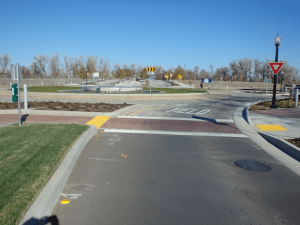
The photo at right shows a roundabout in the River District/Township 9 in Sacramento. It is quite a bit bigger than a roundabout needs to be, and was installed in a new development, not at an existing intersection, but you can see the deflection and yield signs.

Significant horizontal deflection means that vehicles must change significantly from a straight line of travel, which requires that they slow significantly. This slowing reduces the number of crashes somewhat, and almost eliminates the number of severe crashes and fatalities (about 80% reduction). They are safer because they greatly reduce the number of conflict points in an intersection.

R6-5_288Yield signs on all approaches means that vehicles only have to stop for other vehicles already in the roundabout. Otherwise, they proceed at their reduced speed and never have to stop. This yield approach benefits motor vehicles and bicyclists who ride in the travel lane. It does not, and is not really intended to, benefit bicyclists in bike lanes or pedestrians, but at the same time, if does not hurt them. There is one standard MUTCD sign used at roundabouts, shown at right, but you will also see many other signs at both roundabouts and traffic circles.

traffic circle, Sacramento

Traffic circles vary widely in size, and therefore the amount of deflection. At least in California, they almost always have stop signs on two of the approaches, so that one street does not stop and the other does. The photo at right shows a traffic circle in downtown Sacramento. It has some deflection, but not enough to really slow traffic, and with the stop sign, does not ease the flow of traffic. These traffic circles also squeeze bicyclists who do not know they need to take the lane to safety navigate the intersection. The traffic circle sign is not a federal or state standard sign, but does communicate.

There are a a number of traffic circles in Sacramento central city, most of which were put in years ago, but a few newer ones also exist. Depending on the size of the circle, they have varying traffic calming benefits. The reason traffic circles are used instead of roundabouts is that you can’t just plop a roundabout into the footprint of an existing urban intersection. They require more space.

There are a lot more features of roundabouts than just the two that I mentioned. If you want to become a traffic nerd on roundabouts, I recommend the FHWA roundabout page, particularly the publication Roundabouts: An Informational Guide, Second Edition. For an international best practices perspective that focuses on bicyclist benefits, check Explaining the Dutch roundabout abroad.

Multi-lane roundabouts probably do not have significant safety outcomes over regular intersections. Many Sacramento people have experienced multi-lane roundabouts in Roseville and in Truckee at the Interstate 80 – Hwy 89 interchange. It makes me nervous to even watch these, and I always label these as multi-lane roundabouts to distinguish them from single-lane roundabouts or just roundabouts, which do have very significant safety outcomes.

SF_new-traffic-circle-McAllister-LyonLastly, the type of traffic circle that engendered the discussion in San Francisco is at right. It has several non-standard features, even given the variability of traffic circles.
CEQA hearing

This is a follow-on to my Wednesday post on the CEQA Guidelines update/reform: CEQA VMT reform has a fatal flaw.

Four organizations spoke at the hearing:

  • Climate Resolve (Ella): spoke against exemption, spoke about equity and displacement, mentioned request to Caltrans to use VMT instead of LOS
  • City of San Jose: spoke against transportation exemption, apparently submitted letter signed by other cities but I didn’t catch which ones; San Jose recently adopted VMT as their measure for transportation and development (Streetsblog Cal: San Jose Becomes Fourth California City to Adopt VMT as Metric for Traffic Impacts)
  • Coalition for Clean Air: spoke to reducing VMT as the best path to reducing emissions
  • California Bicycle Coalition (Linda): spoke about equity and displacement issues, on need to monitor and determine consistency, spoke against exemption

And I spoke, the sole citizen speaker:

  • I reject the language in 15064.3, Subdivision (b)(2), which exempts transportation from any requirement to use VMT rather than LOS.
  • Overall, the changes will affect development in a positive way, encouraging infill and discouraging greenfield development, however, transportation drives greenfield development drives rather than greenfield development driving transportation, so the overall benefit will be much lessened by the transportation exemption.
  • Transportation is the largest single contributor to greenhouse gas emissions in California (about 39%), but this language does little to address transportation
  • The draft guidelines specifically say “this provision does not prohibit capacity expansion.” But capacity expansion is the largest single contributor to exist and future emissions. This is exactly the issue that most needs to be solved
  • In the Sacramento region, nearly every county and city will continue to use LOS rather than VMT, with the possible exception of Sacramento city and Davis. Even the discussion of a possible change had most transportation ‘professionals’ and politicians up in arms.
  • Though it did not talk about it, the draft clearly contravenes the intent of the legislature in SB 743, which was to kill LOS.

I hope that there is enough opposition on the transportation issue that the agencies will come back with a better proposal, but if not, the legislature will have to come back to the issue again. If this exemption stands, the state cannot possibly meet its greenhouse gas reduction targets.

CEQA VMT reform has a fatal flaw

If you are not otherwise occupied on Thursday afternoon, you may want to attend the California Natural Resources Agency hearing on CEQA reform. The hearing is Thursday, March 15, 1:30 to 4:30, at California Energy Commission, Rosenfeld Hearing Room, 1516 9th St, Sacramento, CA 95814. One of the great things about living in Sacramento is the opportunity to influence state policy and legislation in a way that people in other parts of the state cannot. We can be their proxies.

As a result of a multi-year planning process, the Office of Planning and Research (OPR) developed recommendations to improve CEQA to address some shortcomings, particularly that it has been used to stop good development, infill and mixed use, while encouraging greenfield development. The recommendations are now being passed along to the California Natural Resources Agency for adoption, since that is the agency that administers CEQA.

While there are great improvements contained in the proposal, there is what I consider to be a fatal flaw. From the OPR document (15064.3, Subdivision (b)(2): Transportation Projects): “Subdivision (b)(2) clarifies that projects that reduce VMT, such as pedestrian, bicycle and transit projects, should be presumed to have a less than significant impact. This subdivision further provides that lead agencies have discretion in which measure to use to evaluate roadway, including highway, capacity projects, provided that any such analysis is consistent with the requirements of CEQA and any other applicable requirements (e.g., local planning rules). Importantly, this provision does not prohibit capacity expansion.”

What this means is that transportation agencies can continue to use outmoded and harmful Level of Service (LOS) instead of using Vehicle Miles Traveled (VMT). To my mind, the main point of CEQA reform was to eliminate LOS, the insidious concept that has led to our unsustainable transportation system. It does so for land use, but does not do so for transportation projects. This is a fatal flaw.

A coalition of environmental and transportation advocacy organizations developed a letter to Resources that addresses the flaw, but seems to give up any hope of making it right, instead hoping that Caltrans will adopt VMT. They might, but I can assure you that many agencies never will unless forced to. Sacramento County, for one, lives in a 1970s mindset that congestion is the great evil that can be met only through roadway expansion, now and forever. [“Apply a VMT-based approach to all projects, including road capacity projects. We are sorely disappointed that the proposed Section 15064.3(b) exempts roadway capacity projects from using a VMT-based measure of transportation-related environmental impacts. With the proposed rulemaking, the State has determined that the best approach to measuring transportationn-related environment impacts is vehicle miles traveled; yet, at the same time, the State has exempted projects with arguably the greatest impact on the environment from using that metric. To close this loophole that threatens California’s environment and public health, we will be recommending that Caltrans commit to applying the VMT metric when they are the responsible agency.”]

If this exemption of transportation projects is not deleted, the exercise will be one of futility because transportation projects have such a huge impact on greenhouse gas emissions, both directly from vehicle emissions, and secondarily by encouraging sprawl which itself has a huge impact on emissions.

To be honest, it took me a while and help from several people to find this flaw, and there may be others I’ve missed, but I do still think that the remainder of the proposal is good.

OPR Current CEQA Guidelines Update page: http://opr.ca.gov/ceqa/updates/guidelines/

NRA CEQA page: http://resources.ca.gov/ceqa/

NRDC: California Gets It Right on Transportation—Almost

Streetsblog California: Update: Last Chance to Comment on Statewide Changes to CEQA

Would it be easier to speed-limit vehicles?

In my previous post, Yes, and lower speed limits, and many others, I’ve written about speed and and need to reduce vehicle speeds. This can be done in a number of ways, most effectively by redesigning streets. But street redesign is a multi-billion dollar undertaking just in our region, and that is a conservative estimate.

Thinking outside the box, what if we speed-limited vehicles instead? What if all vehicles were limited to the posted speed limit? Many newer vehicles already have most of the technology needed: cruise control and location awareness through GPS. They would need some modification to use the cruise control to limit the speed, not to what the driver sets it at, but what the speed limit is. Shouldn’t cost much money for the conversion. Old vehicles, of course, don’t have this technology, and would need a fairly expensive update. How expensive, I don’t know. I’m not a technology person, and can only express surprise that either researchers are not researching this, or that if they are, it isn’t making it into the media.

During the transition period, I can see two actions that would encourage conversion. One is similar to emission inspections, where once your car becomes unable to pass inspection, and it would cost more to fix it that it’s value, it is retired. Of course in California, that means the car is shipped to another state to keep polluting, and that is not a good solution. The other is that there would be a penalty for not installing the conversion. The penalty would gradually increase over time. There are very obvious equity issues about this proposal. Maybe a cash-for-speeders program to buy and retire vehicles without speed-limiters. And it is not as though our current system is without equity implications. People of color and low income are much more likely to be the victims of crashes as are others, and we certainly know that speed enforcement can and is used to oppress people of color and low income.

Speed-limited vehicles would be a huge investment, for the updates required of newer vehicles, and the addition of the technology to older vehicles. I strongly suspect that it would be much less than the investment of fixing all our streets. Of course, we eventually still want to fix our streets in locations that are not triaged out, to make them livable and economically vibrant places, but with speed-limiting, we would have more time to work on that.

I would exempt two-lane rural roads from speed-limiting. Though a lot of crashes do occur on these roads, the valid need to be able to pass slow moving vehicles remains, and the scheme would just not work here. All other roads, yes. It might even be possible to increase speeds on freeways, where variability in speed is as much of a problem as speed itself.

Of course cars-first people would scream that this attacks their god-given and constitutionally-guaranteed right to drive as fast as they can. But these are the car nuts, just like gun nuts, that claim a right to do what they want to do without any consideration of the effect on others. It is time we grow up and recognize that vehicles are deadly weapons that must be limited to reduce mayhem.

Will autonomous vehicles solve this problem? Perhaps. These vehicles will certainly have full awareness of the posted speed limits on every street (part of the reason they are bandwidth intensive). I suspect that most autonomous vehicles will be part of commercial fleets (buses, delivery vehicles, ride hailing). Given the legal liability of allowing these vehicles to exceed the speed limit, I don’t think companies will. Of course there will be private owners who hack their autonomous vehicles to exceed the speed limit, but in a world of speed-limited vehicles these will stand out and be dealt with. The real issue, though, is that there will be a very long period of transition in which most vehicles on the road are not autonomous.

I welcome comments from anyone more technologically savvy than I, who can help me better understand the technological issues and solutions.