CEQA VMT reform has a fatal flaw

If you are not otherwise occupied on Thursday afternoon, you may want to attend the California Natural Resources Agency hearing on CEQA reform. The hearing is Thursday, March 15, 1:30 to 4:30, at California Energy Commission, Rosenfeld Hearing Room, 1516 9th St, Sacramento, CA 95814. One of the great things about living in Sacramento is the opportunity to influence state policy and legislation in a way that people in other parts of the state cannot. We can be their proxies.

As a result of a multi-year planning process, the Office of Planning and Research (OPR) developed recommendations to improve CEQA to address some shortcomings, particularly that it has been used to stop good development, infill and mixed use, while encouraging greenfield development. The recommendations are now being passed along to the California Natural Resources Agency for adoption, since that is the agency that administers CEQA.

While there are great improvements contained in the proposal, there is what I consider to be a fatal flaw. From the OPR document (15064.3, Subdivision (b)(2): Transportation Projects): “Subdivision (b)(2) clarifies that projects that reduce VMT, such as pedestrian, bicycle and transit projects, should be presumed to have a less than significant impact. This subdivision further provides that lead agencies have discretion in which measure to use to evaluate roadway, including highway, capacity projects, provided that any such analysis is consistent with the requirements of CEQA and any other applicable requirements (e.g., local planning rules). Importantly, this provision does not prohibit capacity expansion.”

What this means is that transportation agencies can continue to use outmoded and harmful Level of Service (LOS) instead of using Vehicle Miles Traveled (VMT). To my mind, the main point of CEQA reform was to eliminate LOS, the insidious concept that has led to our unsustainable transportation system. It does so for land use, but does not do so for transportation projects. This is a fatal flaw.

A coalition of environmental and transportation advocacy organizations developed a letter to Resources that addresses the flaw, but seems to give up any hope of making it right, instead hoping that Caltrans will adopt VMT. They might, but I can assure you that many agencies never will unless forced to. Sacramento County, for one, lives in a 1970s mindset that congestion is the great evil that can be met only through roadway expansion, now and forever. [“Apply a VMT-based approach to all projects, including road capacity projects. We are sorely disappointed that the proposed Section 15064.3(b) exempts roadway capacity projects from using a VMT-based measure of transportation-related environmental impacts. With the proposed rulemaking, the State has determined that the best approach to measuring transportationn-related environment impacts is vehicle miles traveled; yet, at the same time, the State has exempted projects with arguably the greatest impact on the environment from using that metric. To close this loophole that threatens California’s environment and public health, we will be recommending that Caltrans commit to applying the VMT metric when they are the responsible agency.”]

If this exemption of transportation projects is not deleted, the exercise will be one of futility because transportation projects have such a huge impact on greenhouse gas emissions, both directly from vehicle emissions, and secondarily by encouraging sprawl which itself has a huge impact on emissions.

To be honest, it took me a while and help from several people to find this flaw, and there may be others I’ve missed, but I do still think that the remainder of the proposal is good.

OPR Current CEQA Guidelines Update page: http://opr.ca.gov/ceqa/updates/guidelines/

NRA CEQA page: http://resources.ca.gov/ceqa/

NRDC: California Gets It Right on Transportation—Almost

Streetsblog California: Update: Last Chance to Comment on Statewide Changes to CEQA

Would it be easier to speed-limit vehicles?

In my previous post, Yes, and lower speed limits, and many others, I’ve written about speed and and need to reduce vehicle speeds. This can be done in a number of ways, most effectively by redesigning streets. But street redesign is a multi-billion dollar undertaking just in our region, and that is a conservative estimate.

Thinking outside the box, what if we speed-limited vehicles instead? What if all vehicles were limited to the posted speed limit? Many newer vehicles already have most of the technology needed: cruise control and location awareness through GPS. They would need some modification to use the cruise control to limit the speed, not to what the driver sets it at, but what the speed limit is. Shouldn’t cost much money for the conversion. Old vehicles, of course, don’t have this technology, and would need a fairly expensive update. How expensive, I don’t know. I’m not a technology person, and can only express surprise that either researchers are not researching this, or that if they are, it isn’t making it into the media.

During the transition period, I can see two actions that would encourage conversion. One is similar to emission inspections, where once your car becomes unable to pass inspection, and it would cost more to fix it that it’s value, it is retired. Of course in California, that means the car is shipped to another state to keep polluting, and that is not a good solution. The other is that there would be a penalty for not installing the conversion. The penalty would gradually increase over time. There are very obvious equity issues about this proposal. Maybe a cash-for-speeders program to buy and retire vehicles without speed-limiters. And it is not as though our current system is without equity implications. People of color and low income are much more likely to be the victims of crashes as are others, and we certainly know that speed enforcement can and is used to oppress people of color and low income.

Speed-limited vehicles would be a huge investment, for the updates required of newer vehicles, and the addition of the technology to older vehicles. I strongly suspect that it would be much less than the investment of fixing all our streets. Of course, we eventually still want to fix our streets in locations that are not triaged out, to make them livable and economically vibrant places, but with speed-limiting, we would have more time to work on that.

I would exempt two-lane rural roads from speed-limiting. Though a lot of crashes do occur on these roads, the valid need to be able to pass slow moving vehicles remains, and the scheme would just not work here. All other roads, yes. It might even be possible to increase speeds on freeways, where variability in speed is as much of a problem as speed itself.

Of course cars-first people would scream that this attacks their god-given and constitutionally-guaranteed right to drive as fast as they can. But these are the car nuts, just like gun nuts, that claim a right to do what they want to do without any consideration of the effect on others. It is time we grow up and recognize that vehicles are deadly weapons that must be limited to reduce mayhem.

Will autonomous vehicles solve this problem? Perhaps. These vehicles will certainly have full awareness of the posted speed limits on every street (part of the reason they are bandwidth intensive). I suspect that most autonomous vehicles will be part of commercial fleets (buses, delivery vehicles, ride hailing). Given the legal liability of allowing these vehicles to exceed the speed limit, I don’t think companies will. Of course there will be private owners who hack their autonomous vehicles to exceed the speed limit, but in a world of speed-limited vehicles these will stand out and be dealt with. The real issue, though, is that there will be a very long period of transition in which most vehicles on the road are not autonomous.

I welcome comments from anyone more technologically savvy than I, who can help me better understand the technological issues and solutions.

Yes, and lower speed limits

I believe that stroads should be turned back into Streets, and roads preserved for their transportation function. I’m a Strong Towns member, and fully support the argument that the best solution to stroads is to reconstruct them into streets. #SlowTheCars is the right approach. Key to that approach is that changing speed limits doesn’t do much to slow cars, and that ticketing people for going the design speed instead of the posted speed is often just a pretext for profiling and oppression.

BUT. It will be a long while and trillions of dollars to accomplish that. Undoing the damage of the past is not easy, because the money it would take to fix everything has long since gone into the pockets of those who profited from unsustainable (socially, economically, environmentally) development. We will have to triage, changing the most dangerous places first, and those places with the best chance of becoming walkable, livable, and vibrant second. We may never, and perhaps should never, get to those places that are the model of the suburban experiment. Many suburban places will fail and go back to agriculture. Others will not. But spending a lot of money to fix a suburban stroad, adding sidewalks and bike lanes and street furniture, will be good money after bad because these places won’t ever be dense enough or successful enough to pay back the investment.

Back to speed. It will be a long while before we can lower the design speed of stroads and streets back to the correct speed. In most cases, that design speed should be 20 mph. Occasionally higher or lower, but mostly 20. In the interim, I think that we should reduce the speed of all urban streets, that are not arterials and collectors, to 20 mph. I am not suggested that this limit be tightly enforced, as the point is not enforcement but education and commitment. A community willing to lower the speed limit to 20 is a community willing to think about safety and livability, and to accept that the way we have done thing in the past is absolutely not what we need in the present or future. Setting speed limits to 20 is a message to pay attention and think about consequences. Portland and Seattle have recently reduced some speed limits to 20.

Read More »

Driving a stake through LOS

The Governor’s Office of Planning and Research has completed the first step in replacing level of service (LOS) with vehicle miles traveled (VMT) as the primary measurement for determining the CEQA impact of development on roadways by drafting the replacement language. This process was specified in In the second step, the Natural Resources Agency is holding a public process to implement the changes, and you can participate. Two meetings have been scheduled:

Sacramento
Date: March 15, 2018
Time: 1:30-4:30pm
Location: California Energy Commission, Rosenfeld Hearing Room
1516 9th Street, Sacramento, CA 95814

Los Angeles
Date: March 14, 2018
Time: 1:30-4:30pm
Location: California Science Center, Annenberg Building, Muses Room
700 Exposition Park Dr, Los Angeles, CA 90037

You can also comment by email at CEQA.Guidelines@resources.ca.gov.

I hope that you will support the changes either in person or by email. The use of LOS has caused incalculable damage to roadways and to livability throughout California. CEQA, originally intended to protect the environment, as been used instead as a weapon to harm the environment and encourage sprawl. Urban infill could rarely meet the requirements of LOS in CEQA, but suburban development almost always could, so what we got is square miles of suburban and exurban sprawl, and very little infill. This change to VMT will at least level the playing field, and may make sprawl more difficult. I don’t know how much opposition there will be, but there are several interests that would like thing to stay just the way they are: engineers who want to build highways instead of transportation systems, greenfield developers who make huge profits while shifting costs to society, and cities and counties (you, Sacramento county, and others) who want to preserve their ability to encourage and subsidize far-flung development. If you like cities, if you like livability, if you like infill, this is one of the most important things that can happen.

Of course, this is only the second step in driving a stake through the heart of LOS. The third step is to ensure that all cities, counties, and regional agencies remove LOS as a tool in planning development and transportation. The legislation and these regulations will prevent exclusive use of LOS by any entity, but it does not preclude use of LOS as a additional criteria. LOS must be eliminated completely. The most important question in transportation and development is what kind of world we want to live in, and though VMT is only a tool for achieving that, it is far far better than the tools we currently use.

For all the details of the Natural Resources Agency process and regulation, see the CEQA page and the notice of rulemaking.

HOV lanes solution

So, given that new HOV lanes do not reduce congestion, and in fact induce demand and increase vehicle miles traveled (VMT), what is the solution? I suggest the following policy:

HOV lanes will not be added to any freeway by the construction of new lanes. If, in the judgement of Caltrans or other agencies, a HOV lane is desirable, an existing general travel lane(s) may be converted to some sort of HOV or tolled status. This only applies to freeways with three or more lanes existing. Existing general purpose lanes may also be converted to transit-only lanes or dedicated to rail use. It is well known that additional lanes of any sort will induce additional traffic, which is directly contrary to state goals to reduce carbon emissions and vehicle miles traveled (VMT).

This could be implemented as a 10-year moritorium rather than a permanent policy, as I think that within 10 years the folly of adding lanes to freeways will be clear to everyone, even Caltrans. 

#NoNewLanes

Note: when I wrote the preceding post and this one, I was aware that ECOS (Environmental Council of Sacramento) was working on a lawsuit against Caltrans over the project to add carpool lanes, as additional newly constructed lanes, to Highway 50. That suit has now been been filed.

HOV lanes

HOV (high occupancy vehicle) lanes have been in the news over the last few years, and will be so more and more often. They are the preferred option by Caltrans and other transportation agencies (which often have to fund these largely on their own dime) for increasing highway capacity. Notice that I said increasing capacity rather than reducing congestion. Caltrans claims that they reduce congestion (see Caltrans HOV page), but there is no evidence to support that, and much to controvert it. Though Caltrans officially acknowledges the concept of induced demand, it is not used in their highway planning. The mid-level engineers in Caltrans, who largely determine the actual projects selected and the design of those projects, don’t believe in induced demand. They say so regularly. But induced demand is a proven effect, and any project planned without that in mind is going to be mis-designed. 

Communities have grown increasingly resistant to the expansion of freeways, which largely or entirely benefit long distance commuters and provide almost no benefit, and often strong negatives, to the neighborhood, and little benefit to productive freight traffic. The era of the freeway is over, and many exiting freeways will be torn down eventually, but Caltrans is still on a building jag. Knowing the resistance, however, Caltrans rarely proposes new general purpose lanes (lanes which any one can drive in, without restriction), instead proposing HOV lanes. Somehow, these seem to get a pass from communities and environmentalists, figuring that a HOV lane expansion is better than a general purpose lane expansion. Well, yes, but the question is, should there be any expansion at all?

If some high capacity vehicles are diverted out of general purpose lanes, that provides a more open lane, and that more open lane will be filled with additional traffic. The HOV lane itself, being more open than adjacent lanes, will create additional traffic. Drivers respond to their perception of crowding and delay. If they see more space, they will drive more. Induced demand, simple as that. So a HOV lane increases overall traffic. Cost is an issue, as most of our transportation dollars at the state and regional level go to these projects, instead of projects that would actually reduce private vehicle use and vehicle miles traveled. Environmental and social impacts increase. And the lanes fill up, creating a demand for yet more lanes in a never-ending cycle. 

A $133M project called 80 Across the Top has been completed, which added HOV lanes to Interstate 80 from the river to Watt Ave. Note that cost does not include loss of productivity during construction, which if the news media is to be believed, was considerable, nor the elevated crash rate during the project. Now Caltrans is well underway with a $187M project to add HOV lanes to Hwy 50, and is out selling the idea of adding HOV lanes to Business 80 (Capital City Freeway). Meanwhile, a number of people have proposed tearing down the Capital City Freeway, including this blog. The river bridge would not be torn down, but the transportation facility north and south of the bridge would be a surface roadway rather than elevated freeway, and capacity on the bridge could be made available for other modes. Or maybe the bridge should be torn down and replaced with an appropriately scaled neighborhood bridge (similar to what is being talked about for the Broadway extension bridge over the Sacramento River). 

Next up: the solution for HOV

principles for transportation investment

As part of my work with transportation advocates, and my personal passions toward a transformed transportation system, here is my Principles for Transportation Investment. It applies to all government levels, but in particularly was developed as an alternative paradigm for Measure B and “Son of Measure B.” Text below, and also a pdf (Principles for Transportation Investment). This is long, but I hope you will take the time to read and reflect. And comment.


Principles for Transportation Investment

The overarching goals for investments in transportation are:

  • creation and support of livable, walkable communities that are economically vibrant for all citizens
  • reduction of distance between housing, jobs and amenities
  • reduction of vehicle miles traveled (VMT) per capita in order to reduce greenhouse gas emissions
  • reduction and eventual elimination of crash fatalities and severe injuries
  • maintenance of our transportation system in a state of good repair

Our transportation system is out of balance, emphasizing private motor vehicles over transit, walking and bicycling. A ten-year moratorium on new roadways and roadway widening, through 2028, will jump-start the process of bringing modes back into balance.

In the past and present, communities of low-income and color have been under-invested, and often dis-invested through lack of maintenance. Future investments must therefore work to return these communities to parity. Specifically,

  • communities of low-income and color must be present at the table for all major transportation decisions, and funding will be allocated to support that inclusion in all planning processes
  • 50% of transportation investments will be in or directly benefiting communities that meet the established ATP/GGRF grant criteria for disadvantaged communities, for at least 15 years or until significant parity is achieved

Transportation investments must meet the goal of reduction and eventual elimination of fatalities and severe injuries. Specifically,

  • the top intersections and corridors with fatalities and severe injuries will be identified and will be used as the primary though not sole criteria for project selection
  • projects which may increase crash rates for minor injuries and property damage while reducing or eliminating fatalities and severe injury, such as roundabouts and mid-block crossings, will be considered for funding without prejudice
  • sidewalks will be considered an integral part of the transportation system, therefore sidewalk installation and maintenance will be completed as a normal part of transportation investment
  • bicyclist and pedestrian fatality and severe injury rates are high and increasing; therefore 25% of transportation investments will be devoted to bringing fatality and injury rates back to parity with mode share

Transportation investment must depend upon a variety of income sources including user fees, property taxes, income taxes, and sales taxes. User fees should be the primary source, while sales taxes should be used in moderation because they are inherently regressive. Specifically,

  • at a state, regional, county and city level, sales tax measures must be complemented by actions to implement user fees, property taxes and income taxes to support transportation

Housing and transportation cannot be addressed in isolation and must be integrated through planning and investment. The economic impact on housing affordability and individual mobility is not just housing costs or transportation costs, but housing + transportation costs. Specifically,

  • no investment in rail transit should be made in areas where there are not existing plans or reasonable expectation of affordable housing development, and no new bus routes created where there are not existing plans or reasonable expectation of affordable housing development
  • governments must invest in affordable and “missing-middle” housing at a rate comparable to or exceeding investments in transportation

A successful transportation system must be integrated with wise land use. Specifically,

  • no transportation investments should be made which promote rapid densification and displacement
  • and conversely, no transportation investments should be made in communities or areas which are unwilling to allow a natural increment of density
  • greenfield development must pay the entire cost of transportation, including long-term maintenance, related increases in transportation capacity for roads, transit, walking and bicycling throughout the region which are engendered by the development, and transportation demand management

Transportation investments at all government levels will support the SACOG Sustainable Communities Strategy. Specifically,

  • since achievement of greenhouse gas reduction targets can only be achieved through a strong investment in transit, walking and bicycling, transportation investments will reflect those goals
  • no project will be funded which would induce increased VMT

Congestion relief in the absence of other measures has and will induce more traffic and therefore additional congestion. Therefore, all projects which are intended to relieve roadway congestion will implement controls to prevent induced demand, including congestion pricing, or will mitigate induced demand through corresponding investments in transit, walking and bicycling.

All transportation projects must address maintenance of the infrastructure in a state of good repair for all time, including eventual replacement cost. Specifically,

  • user fees must support a significant portion of ongoing roadway maintenance
  • fix-it-first must be a continuing commitment at all levels of government until the entire transportation system is in a state of good repair (SOGR), and then state of good repair must be continued
  • all agencies will have and implement a complete streets policy before receiving funding; all roadway repaving projects must consider re-allocation of roadway width to sidewalks, bike lanes, and transit lanes
  • governments will no longer take on responsibility for the cost of maintaining transportation infrastructure which serves greenfield development; therefore the development must allocate a long-term reserve to the maintenance of internal transportation facilities and any highway interchange which primarily serves greenfield development

Fiscal solvency at all government levels must be a guaranteed outcome of major transportation investments. Therefore, all major projects will include a transparent and accountable analysis of the ways in which the project will increase user fees, property taxes, income taxes, and sales taxes which meet or exceed the cost of construction and maintenance.

All transportation investments must support improvement and maintenance of public health. Specifically,

  • investment must reduce air pollution, however, the traditional assumption that congestion relief reduces air pollution must be justified by actual data
  • investment must encourage daily physical activity in all parts of society
  • transportation modes which generate air pollution (roadways and diesel rail) will not be located or expanded near schools and parks
  • transportation planning must consider the removal or reduction of existing roadway capacity such as freeways and/or conversion of diesel rail to electric rail

Education of youth in transit, walking and bicycling will reduce future demand for private motor vehicle travel, and increase demand for livable, walkable communities. Specifically,

  • elementary students will receive pedestrian and bicyclist education
  • middle and high school students will receive transit education
  • 1% of all transportation funds will be devoted to youth education
  • transportation agencies will work with California Department of Education, school districts, private schools and law enforcement to develop and fund model education programs

time to get off the infrastructure treadmill

Hwy 50 slide, @kellyinmedia

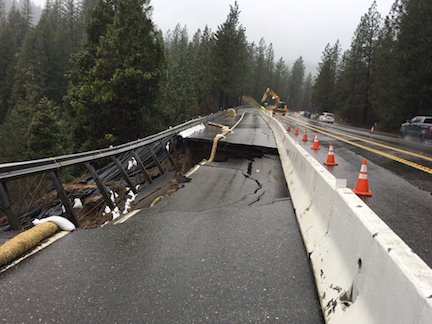
With the recent storm damage to roadways, as well as some transit and rail lines, the governor has proposed about $600M in quick fixes. This adds on to $59B deferred maintenance on state highways, and $78B on local roads (the actual local roads number is likely much, much higher). Pretty soon, we’re talking real money.

I am not opposed to fixing storm damage, or to keeping roads in a state of good repair, abbreviated SOGR and often called “fix-it-first.” However, if it isn’t obvious by now, let me clearly state that we already have more infrastructure than we can ever afford to maintain. Even without climate change, we probably could not keep up, and with climate change, we don’t have a chance.

We have a transportation system built on the idea that someday there will be enough money, our kids will be richer, the economy will be better, the federal government will offer an infrastructure windfall, a fairy godmother will wave her wand. It’s not going to happen. The bills are already coming due, and there will be far greater bills coming due in the near future. Politicians, and the voters who support them, have been running a growth ponzi scheme (see https://www.strongtowns.org/journal/2009/2/3/the-small-town-ponzi-scheme.html and other Strong Towns references), gathering the political and economic benefits today while putting the costs off to the future.

So, what to do? Well, first, stop digging the hole. We don’t need any new roads or highways, or additional lane miles. We do need to make the ones we have more efficient (defined as the number of people moved per hour per dollar, NOT the number of vehicles moved per hour per dollar), and on the whole, we do need to keep them repaired.

But we also need to realize that we have already overbuilt, and we are going to need to let go of some of it. Return rural roads and residential-only streets to gravel (bicyclists, get your mountain bikes). Stop paving parking lanes to the same high standards we use for the travel lanes, and in many cases, let them return to gravel as well. Or just remove some of them – we don’t need as many cars, either. Where sidewalks are needed and don’t exist, don’t take them out of people’s property, but out of the existing roadway. Where roads have been built wider than will ever be needed, take the extra width out and sell it off, with adjacent property owners getting first right of refusal. If there is no market, then give it away to the adjacent property owner. In suburban Sacramento county, there are streets that go from narrow two lane to four lane to extra-wide four lane and then back down again. These are safety hazards and maintenance nightmares. Let’s put this wasted road space back to productive use.

Katy Freeway (I-10) Texas; By Socrate76 - Own work, CC BY-SA 3.0, https://commons.wikimedia.org/w/index.php?curid=7444029
Katy Freeway (I-10) Texas; By Socrate76 – Own work, CC BY-SA 3.0, https://commons.wikimedia.org/w/index.php?curid=7444029

Freeways are the next big thing to reduce. The major Interstates are economically critical for freight movement and to a lesser degree people movement (though quality rail can take much of the pressure off). But they’ve gone from two lanes per direction to four to six to eight to ten, with Texas holding the record, I believe, at thirteen lanes per direction (in the U.S. at least). What are all the extra lanes for? Mostly commuters, and for about two hours a day. People who have been allowed and encouraged to live a long way from where they work, just to save on housing costs. But the bill has been paid by all of us, private car commuters or not, and we have only just begun to pay this bill. It may be larger than our entire economy. So, let’s shrink the Interstates back down, in most cases to two lanes per direction. The other freeways? Most of them are not needed at all and can be removed in favor of surface streets with a restored street grid. People will adjust over time, make different decisions, and it will take long enough to accomplish that it won’t be a sudden shock.

There is no better time than a crisis to re-think our transportation system. If we don’t think now, we will go back to sleep and assume that it is all going to work out, somehow, someday, some fairy godmother.

Each of these ideas deserves exploration, and I will do that as I can.

we don’t need transportation “balance”

A recent post on Streetsblog, Brent Toderian: Don’t “Balance” Modes — Prioritize Walking, Biking, and Transit, is from a visit and keynote in Denver, but applies perfectly to Sacramento, and I encourage you to read and reflect.

His main point is that those calling for balancing spending on all the modes really mean “lets just keep doing what we were doing.” We have spent, in this region, trillions of dollars in support of one mode, the privately owned motor vehicle. We have spent a little on transit, and almost nothing on walking and bicycling. If we simply increase the share for transit, walking and bicycling a bit, we have not really done anything. There is a deficit in transit, walking, and bicycling that can only be overcome but shifting our spending to these modes. Every dollar spent on expanding or widening roadways and freeways for privately owned vehicles directly harms transit, walking and bicycling because it encourages and subsidizes privately owned vehicles. It encourages people to live further away from jobs and services. It induces traffic, which congests our roadways so that transit can’t work as well. It encourages inappropriate speeds that endanger walkers and bicyclists.

nonewroadsBefore we can start doing right, creating system that truly serves people’s desires for access in livable communities, we have to stop doing what we were doing. It think we can keep doing the wrong stuff and just add in the right stuff, we are wrong. We need to stop expanding and widening roads. Now, and for ever. #NoNewRoads

#NoMoreUber

I have always been leery of Uber. They have seemed from the beginning like a bunch of spoiled tech brats, whose only values are innovation and profits. Their business model is to exploit the grey areas of law, and to exploit the black and white areas of law by making huge profits in the time gap between recognition and enforcement. They are really not providing a service so much as running a scam. They are scamming their drivers. They are scamming their riders. They are scamming their investors. They are scamming society as a whole by proposing that shady dealings are the future of transportation. They have been found in a number of states to be violating employment/contractor and wage laws, but they continue as though they can. And if we let them, they can indeed. The instances of discrimination against people of color and the disabled are legion. The instances of intimidation and violence against patrons by drivers who have not been sufficiently background checked are legion.

What has brought me to this point of anger, however, is their arrogant attitude about operating semi-autonomous vehicles in San Francisco. Their vehicles have been observed violating the law and endangering pedestrians and bicyclists, and the company’s response has been that things will get solved eventually, with a little engineering. They have thumbed their nose at both the state of California and the city of San Francisco, refusing to cease vehicle testing, though they have not acquired permits to do so. All the other companies have.

I’m a frequent visitor to San Francisco, and what I’ve observed when walking, bicycling and using transit is: Uber drivers making high speed right turns, failing to yield to pedestrians in crosswalks (marked or unmarked), cutting in and out of lanes and disrupting traffic flow, greatly exceeding the speed limit, pushing bicyclists out of traffic by using their vehicles as weapons of intimidation, blocking bike lanes to pick up and drop off (legal for taxis when the client’s disability requires that, not so for Uber), blocking transit only lanes (the bus + taxis designation does not apply to Uber), circling the block waiting for rides which increases congestion and air pollution. I could go on. I’ll say that I’ve also experienced some very polite and safe Uber drivers, but they are the exception.

It is well documented that Uber is losing money. So what is their plan? Their plan is to drive the competition out of business. One of their competitors is taxi cabs (which are licensed and regulated), and in some locations their have nearly succeeded. I’m not defending taxis, whose service was poor for years, but driving your competition out of business by violating the law is not the way things are supposed to work in a country of laws. Competition by offering a better service? Sure, but not by violating the law.

Another effect of even more concern to me is that they are harming public transit. Many transit systems are just hanging on, with declining ridership and declining fare recovery. Some might go under due to the actions of Uber. Of course it is likely that Uber will go under as well, and so the marketplace should work, but what of the damage they cause on their way down? Uber has encouraged the idea that ride hailing is the future and transit is the past. And if we let it be so, it will be.

None of this is to suggest that ride-hailing/car-“sharing”/transportation network companies (TNC’s, the official name of such services) can’t be part of our overall transportation services, complementing other modes. But I will state right here that Uber is not part of that solution, they are the problem.

So, what to do. I ask you, dear readers, to stop using Uber. If they lose riders, they will fail all the sooner, and do less damage on their way down. There are other ways to get around, please use them.

Until a few months ago, I’d have said that companies that bully everyone cannot succeed, but then a bully was elected as a president (or not, depending on your view of the electoral college and popular vote). Perhaps all bets are off. Maybe Uber is the future, the model of business so well refined by Donald Trump.

You bet I’m angry.

#NoMoreUber