how do we get more red light cameras?

I live close to Fremont Park in Sacramento’s central city. I walk through the park every day I’m in town, often multiple times. That means I’m crossing through the bounding intersections of P Street & 15th Street, Q Street & 15th Street, Q Street & 16th Street, and P Street and 16th Street, multiple times a day. I also spend a lot of time at Naked Lounge on the southeast corner of Q Street and 15th Street, and some time at Karma Brew on the northwest corner of P Street and 16th Street. That gives me a front row seat to watching the behavior of drivers at these intersections. On nearly every signal cycle, I seem a driver running the red light at each of these intersections. This is not a the exception, it is the rule. By running the red light, I don’t mean entering the intersection on yellow and finishing on red, I mean entering the intersection on red. I mean drivers that are intentionally endangering themselves, other drivers, bicyclists, and walkers. Every signal cycle.

Though I’m an able-bodied and aware walker, Fremont Park is also used by a lot of homeless individuals, families using the playground, people sitting on the benches and reading, people lying on the grass and enjoying the sun (finally) and enjoying the shade (now), people participating in a number of organized recreation activities such as yoga, and of course the festivals such as Chalk It Up. This is a place that should be safe to get to for everyone. It is not currently.

I wrote about a crash at P Street and 15th Street. I’ve written multiple times about red light cameras, pandemic of red light running, red-light-running bullies, and SacCity red light cameras and crashes.

Let me state up front that I am NOT in favor of the enforcement of traffic laws by armed police officers. I have seen first-hand the way in which traffic stops are used to harass and oppress people of color and low income. I have read and seen innumerable accounts of officers murdering the people they stop on pretext. Armed law enforcement is the problem, not the solution. On the other hand, I am strongly in favor of automated enforcement. It is my theory that most serious traffic violations are by a small number of egregious drivers. Automated enforcement can ticket these drivers, which will change the behavior of some of them, but not of many of them who are high income drivers of high end vehicles. It does, however, allow law enforcement to identify repeat offenders and hold them accountable with vehicle confiscation and drivers license suspension.

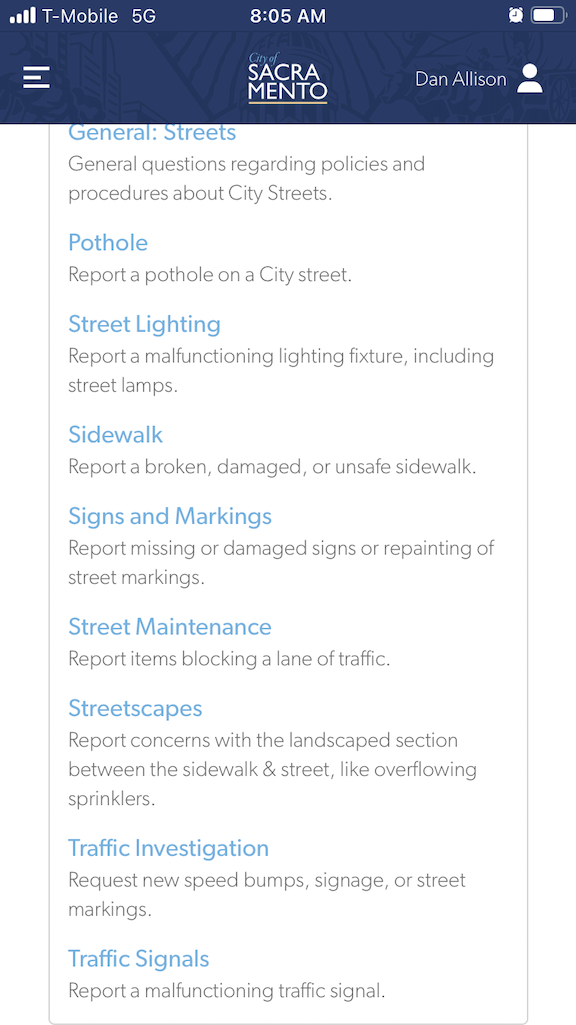
I want there to be red light enforcement cameras installed on at least one of the four intersections at Fremont Park. My observations indicate that the intersection of Q Street and 15th Street is the worst. I looked on the city’s Red Light Running Program page to see if there was a mechanism for submitting requests. No. I looked at the city’s 311 app to see if there was a place to submit a request. Not really. The closest I could find was to select Streets > Traffic Investigation, and then Signals (see screenshots below). I’ll update this when I get a response (though these days most 311 reports get no response at all).

The other way of request that might be effective is to directly contact city council members.

Parking fees by size and weight

As the perfect follow-on to my post yesterday about Parking reform for Sacramento, an post today on Streetsblog USA: Here’s a Big Idea: The Larger the Car, the More You Pay to Park the Damn Thing, about a neighborhood in Montreal charging for residential parking permits by the weight and and fuel source of the vehicles. The program is intended to not just get people into small vehicles, or cleaner vehicles, or no vehicles, but to get people to think about the impact on climate and safety of their choice of vehicle. So, I’ve added that idea to my list.

The graphic below actually does not really show the huge difference between older light trucks, or SUVs, but it is a good graphic to start with.

Source: Will Chase/Axios; https://www.axios.com/2023/01/23/pickup-trucks-f150-size-weight-safety

Parking reform for Sacramento

Note: Added item to Parking fees below, in italic, based on an idea from an article in Streetsblog USA.

Following on to the discussion group topic this week of Walkable City this week, Part 3: Get the Parking Right, here is a list of my thoughts about parking reform in the City of Sacramento. Almost all applies to parking anywhere. I think nearly every one of these has been mentioned in previous posts, but I’ve not brought them together in a single place.

The City of Sacramento has a Parking Services website. Parking Services is part of Public Works.

  • Parking management:
    • Parking must be managed under a city-wide parking management plan, and the plan must be consistent with city and state policy for reducing motor vehicle use and vehicle miles traveled (VMT). The city does not have a parking management plan, so far as is known.
    • Parking mandates must be removed city-wide, not just for the central city and transit oriented locations.
    • The city should foreswear any new structure parking (parking garages or parking decks). Though the city does not have any active plans for new parking, it has had recently, and they may come back.
    • Require all new housing or mixed use developments to unbundle parking, meaning that no free parking is provided for residents, and all parking is available to any person who wants to rent the space. Unbundling should be phased in over five years for all existing parking.
    • Prohibit commercial parking lots adjacent to sidewalks, meaning the buildings must face sidewalks and not parking lots.
    • Property assessment of surface parking lots will be at the same value as the productive land use that existed there before, to discourage building removal and and to keeping of land in less productive or unproductive uses; this requires cooperation from the county
  • Parking fees:
    • A base rate for all parking will be set such that it covers installation, maintenance, and management of all public parking; this rate might vary by whether parking is metered or not, or might be uniform throughout the city.
    • Charge at least the base rate for all street parking, everywhere in the city, via meters or permits, that recovers base rate; NO FREE PARKING!
    • Set variable rates for residential parking permits based on the size, weight, and fuel source of the vehicle
    • Formally implement variable pricing of street and structured parking to achieve Shoup’s 85% utilization
    • Charge for handicapped spaces (this eliminates the motivation for non-handicapped drivers to illegally use handicapped spots)
    • Eliminate all holiday or promotional free parking; research indicates that free parking actually reduces business customers by reducing parking turnover
    • Pilot ideas for charging for delivery use of street parking
  • Parking revenue:
    • Parking revenue will not go into the general fund or to pay off bonds not related to parking, but be used for specific purposes related to parking and neighborhood improvement
    • 50% of parking revenue (above base rate) will be spent on neighborhood improvements on the same streets or within parking districts
    • 50% of revenue (above base rate) will be allocated to transit operations and transit amenities
  • Parking conversion to higher uses:
    • Add trees in the parking lane on all streets without sidewalk buffers; many of the lower income neighborhoods in the city lack sidewalk buffers and private trees, making walking unpleasant and hazardous
    • Do not charge for conversion of street parking to dining space, and minimize permit costs for street dining
    • Provide one or more short-term (20 minutes or less) parking spaces on every block with retail
    • Provide one or more delivery spaces per block with any retail, and enforce against double-parking for delivery where delivery spaces are available
    • Replace parallel parking with diagonal parking on overly wide streets, to slow traffic; most streets in the city are overly wide
    • Where sidewalk or sidewalk buffer space is not available for micro-mobility (bike share, scooter share) parking, street parking will be converted in sufficient quantity
    • Modify development standards to allow only one-side parking in new residential developments
    • Allow conversion of parking to bike facilities where a reduction of travel lanes is not practical (on streets 30 mph or higher)

I strongly believe that the single city action most responsible for the renewal of midtown Sacramento, all the infill development and successful business, is the removal of parking minimums (mandates) from the central city in 2012. Since that time, the city has removed parking mandates from land near major transit stops, and in 2022, the state prohibited cities from establishing mandates near major transit stops (the definition of a major transit stop is fuzzy, however).

The city has proposed, in its draft 2040 General Plan, to remove parking mandates city-wide. It remains to be seen whether pressure from politicians and suburban protectors of ‘their’ street parking spot will subvert this recommendation. 2040 General Plan draft, Chapter 8 Mobility, Goals and Policies M-2.17 Parking Management Strategy, page 8-18.

Other resources:

PRN parking lot map for Sacramento

The Parking Reform Network (PRN) website on parking minimums (also called mandates) and minimums has been recently updated and enhanced. Take a look!

I have in the past worked to compile information about parking in the central city, but it turned out to be more complex that I had realized and I never completed it. It is fairly easy to map surface parking lots, that lowest common denominator of land use, but mapping parking garages is more complicated because many of them have commercial at street level, so are not all parking, and many developments have either underground or parking in the middle of the building. All of these are much harder to document and map. So I am glad that PRN, with partner Strong Towns, is mapping.

You can see the primary map at Parking Lot Map. Use the city pulldown if you don’t go directly to Sacramento. Note that this map covers just most of downtown, it does not cover the entire central city, nor any of the rest of the city. Be sure to click on the ‘View More’ button, which provide detail that is difficult to find elsewhere, including on the city’s own website.

PRN parking lot map of 'central city' Sacramento
PRN parking lot map of ‘central city’ Sacramento

The city’s 2021 Housing Element includes policy H-1.4: Facilitate Infill Housing Development. The City shall facilitate infill housing along commercial corridors, near employment centers, near high-frequency transit areas, and in all zones that allow residential development as a way to revitalize commercial corridors, promote walkability and increased transit ridership, and provide increased housing options . (page 23)

The implementation chapter of the housing element includes Program H8. Revisions to Parking Requirements (page 46) that is included in the PRN website. The general plan update for 2040, which would implement this program, has been delayed beyond 2022. The city has not provided a target date, so far as I know.

SacCity red light cameras and crashes

A follow on to red-light-running bullies. I’ve created a map that shows the eleven right light camera (automated enforcement) locations under the City of Sacramento’s Red Light Running Program. The city has 907 signalized intersections. These locations are (listed alphabetically by the intersection entry in the Traffic Signals GIS layer):

  • 16th Street & W Street X
  • 21st Street  & Broadway X
  • 5th Street & I Street X
  • Alhambra Boulevard & J Street
  • Arden Way & Challenge Way X
  • Arden & Exposition Boulevard & Ethan Way X
  • El Camino Avenue & Evergreen Street X
  • Fair Oaks Boulevard & Howe Avenue X
  • Folsom Boulevard & Howe Avenue/Power Inn Road X
  • Mack Road & Center Parkway X
  • Mack Road & La Mancha Way/Valley Hi Drive X

The map (pdf) shows each location, with the red signal icon, and a heat map of the crash severity for crashes occurring at intersections. Yellow means high collision severity, with severity being a weighting of the individual types [1 – Fatal; 2 – Injury (Severe); 3 – Injury (Other Visible); 4 – Injury (Complaint of Pain)]. But it does show the pattern, and you can clearly see the intersections along arterial roadways, where most crashes occur. The crashes are not necessarily red light running crashes. There is a PCF Violation category (VIOLCAT) 12 – Traffic Signals and Signs, and another Intersection (INTERSECT_), but that would not distinguish red light running from stop sign running. It might take looking at individual incident reports, but that is beyond my capacity.

There are certainly high crash severity locations in the city that are beyond the map coverage area, and there are plenty of locations without cameras.

It would be interesting to know if these red light camera locations have a lower rate of red light running crashes that comparable intersections without cameras, but that will require quite a bit more thinking an analysis.

Read More »

red-light-running bullies

If you go stand at any busy intersection in Sacramento, you will see drivers running red lights on almost every single signal cycle. Of course this problem is not unique to Sacramento, but it is where I live and walk and bicycle, and I see it every day, at every signalized intersection. I am not talking about drivers entering the intersection on the yellow light, and not making it through before it turns red. I am talking about drivers entering the intersection when the light is already red. And quite often, they accelerate into the red light, making sure they can get through.

I call this bullying behavior. It says that I (the driver) is more important than anyone else. Me (the driver) making this light is more important than anything else in the world, which translates to my (the driver’s) convenience is more important than anyone else’s life. I (the driver) know that this is dangerous behavior, but I (the driver) don’t care.

My preferred word for this is actually terrorism. Terrorism, however, implies actions by individuals against states, or more often by states against individuals (state-sponsored terrorism). This is not that. But the intent is the same, to change other people’s behavior by the threat of violence, or actual violence. This is traffic violence perpetrated by entitled drivers against everyone else on the road. Terrorism may not be technically correct, but it sure sounds right.

Most drivers have adjusted to this by not starting into the intersection on the green, but waiting until the run light running driver has cleared. Same for people bicycling and walking. Most walkers know it is not safe to enter the crosswalk until all the cars have stopped, because usually they will not stop. But not all drivers, walkers or bicyclists know, and these are the people being killed or seriously injured at intersections.

Red light running has always been a problem, but it has gotten much worse. It accelerated, I think, during the pandemic, when there was less traffic, and drivers started to gamble with running red lights. Now that the traffic is mostly back, they are still doing it. In my observation, it gets worse by the month.

Many people think that the solution to traffic violence is to change road designs so as to prevent dangerous driver behavior. I’m of course in favor of this. But in this instance, re-design does not prevent this bullying behavior.

Having near-side traffic signals, as many advanced countries do, would help a little because a driver who chose not to stop loses information about how late on the red they are and therefore is less likely to run the red light. See Near Side Signals: Thinking Outside the Pedestrian Box for more info on near side signals. But this alone would not solve the problem.

Slowing speeds would help, as the red light running driver would be a little less likely to kill the walker, bicyclist, or other driver and passengers than at higher speeds. But the red light runners are in my observation the same people who are driving well over the speed limit, adjusting their risk tolerance for to the highest possible level that won’t get them killed. Of course, these are not drivers who are much concerned about killing other people.

The City of Sacramento has a Red Light Running Program. The page says there are 11 cameras in the city. Out of 4000 plus intersections. This is not a serious response to a serious problem. It is in fact the typical city response to any transportation issue, to do the absolute minimum possible to avoid being called out for doing nothing.

I believe from extensive observation (I walk a LOT), though I have no data to prove it, that red light running is done by a fraction of drivers, and those drivers do it again and again and again. They’ve gotten away with it, so far, and will continue. At least 3/4 are drivers of expensive cars, high income, entitled people. If that is so, it would not take much to greatly reduce this behavior. Ticket them again and again and again, whether directly by law enforcement officers or by automated cameras, and their behavior would gradually change. Of course if we set ticket fines based on the value of the vehicle rather than flat rates, and impounded and/or confiscated vehicles upon repeated infractions, it would change even quicker.

Law enforcement is complicit in this red light running. I have never seen a driver stopped for running a red light. Ever. And in fact, law enforcement drivers are just as likely to run red lights as any other. Law enforcement doesn’t like automated enforcement, because it reduces the opportunity for them to do pretextual stops. It also is seen as reducing the need for officers, though since they don’t do this enforcement anyway, I can’t see how it actually reduces the need.

Many people have called on the city to install more leading pedestrian interval (LPI) lights in the city, where the pedestrian indicator turns to walk 3 seconds or more before the parallel traffic signal turns green. These of course help, but even where they already exist, the interval is now taken up by the time a walker must wait for the red light running drivers to clear the intersection before proceeding. Much less effective at promoting walking and safety than it could be.

Solutions:

  • The city could recognize that this is a serious traffic violence issue, and respond forcefully, with more enforcement and more automated cameras. The city’s Vision Zero policy obligates them to take traffic violence seriously, but they do not.
  • The CA-MUTCD could be changed to require near side traffic signals instead of far side traffic signals.
  • The state legislature and judicial council could change fines for violation of California Vehicle Code (CVC) to be based on the value of the vehicle. People often talk about basing fines on income, as some first world countries do, but income is not easily available to the law enforcement officer or processor of the red light camera mailed ticket, whereas the value of vehicles is available in the DMV database. If you run a red light in your $1000 clunker, the fine would be $1, and if you run a red light in your $200,000 trophy car, it would be $2000. To start.
  • Along with higher fines for drivers of fancy cars, the vehicles of these drivers should be impounded for the third violation of the same CVC within a year. Impound means you get the vehicle back after a certain period of time, maybe three months. And for those drivers that doesn’t control, then the vehicle should be confiscated, meaning you don’t get it back and the agency sells it. Maybe for more than six violations of the same CVC within a year, or ten within three years.
  • Walkers and bicyclists could equip themselves with paint ball guns so as to mark the vehicles of these bully drivers, so at least other people could see them coming. And perhaps other drivers would them start enforcing social pressure on them. It worked for smoking, when people who smoked in buildings and on transit were publicly shamed.
  • And of course, in the long run, we do need to re-design streets to that red light running is less likely, and less likely fatal due to lower speeds.
does Sacramento enforce illegal parking?

As a person who walks a lot in the central city, and some in other areas, I often see and report illegal parking to the city through the 311 app. I’m not talking about parking too long, or not paying, but about blocking driveways, sidewalks, and crosswalks. 90% of the time, the response that I get was that a parking officer was dispatched and the vehicle was no longer there, so no citation was issued. I provide the license number, vehicle description, and a photo, but the city will not use that information to ticket once a vehicle has moved. But, the real issue it that they often ignore the violation completely.

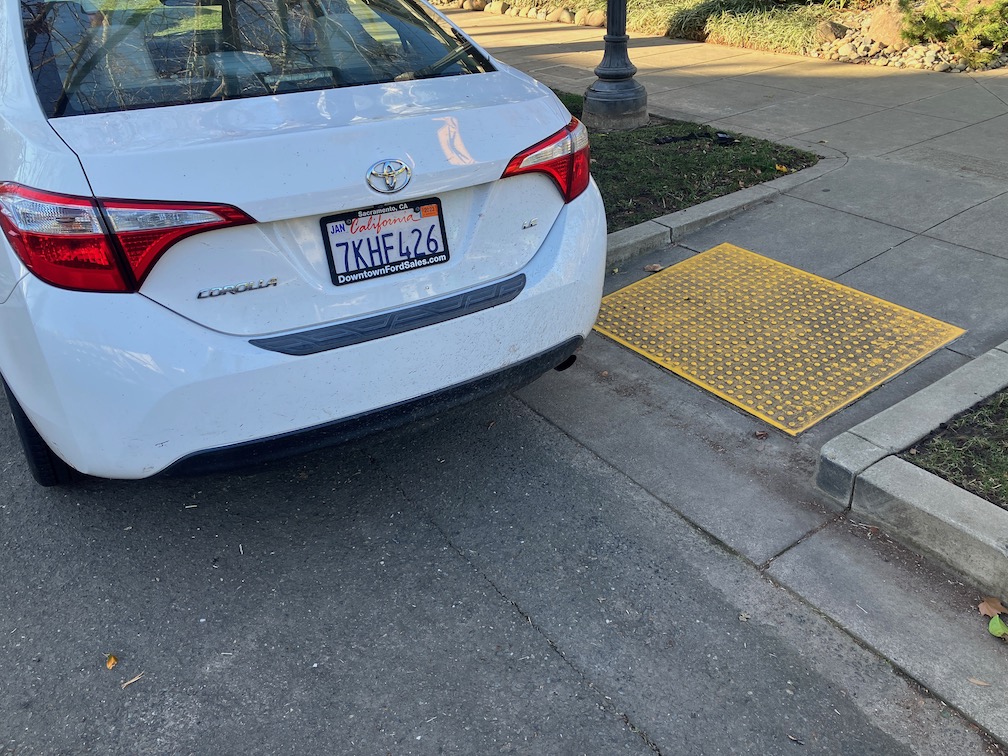
An example. I reported this illegally parked vehicle at 9:17AM. It was blocking the crosswalk over 13th St, and the ADA ramp. The remaining ramp area was not wide enough to allow a wheelchair to pass. At 11:09AM I received an email reply from the city, stating: “A Parking Enforcement Officer arrived at P ST & 13TH ST, SACRAMENTO, 95814 to find that the vehicle(s) reported were no longer on the scene.” At 7:30PM, the vehicle was still in exactly the same place. The officer was lying. The vehicle was still there. Either the officer never visited the location, or decided not to cite the vehicle.

illegally parking vehicle blocking crosswalk and ADA ramp
illegally parked vehicle, 13th St, not cited

This is the sort of attitude the city has toward people who walk, or roll. They are always less important than people who drive.

the blindness of bikes vs parking people

I am getting so, so tired of people on Twitter, bicycling advocates, who see bikes and bikes only as the solution to everything.

These are people who believe that it is always best to remove on-street parking in favor of bike lanes, whether regular or separated bikeways. In fact, they are always looking for roads on which to install bike facilities and remove parking, because they get off on the idea of removing all parking. A lot of advocates want bike lanes on every street.

Well, I disagree.

If there is a situation where existing or future bicycling use should be accommodated, and the only way of doing do it is to remove parking, then I’m in agreement. But that is often not the case. On any street with more than two lanes, it is almost always better to remove a travel lane (called general purpose lanes) than to remove parking.

Parking does (at least) two things:

  1. Calms traffic by creating perceived friction, which slows drivers down. It is moving vehicles, quite often moving well over the posted speed limit, that are a hazard to bicyclists, and everyone else. It is not parked cars (not ignoring the issue of door-zone bike lanes).
  2. Provides places for customers to park who so far have not shifted to walking and bicycling, or who are in that rare situation of needing a car for disability reasons or items being picked up/dropped off.

Sure, we need less parking than we have, but no parking is not the solution. If there is no on-street parking, then it increases the demand for surface parking lots, which are the worst possible land use in cities, or for structured parking (parking decks) which are the most expensive type of parking to build, and almost always require taxpayer subsidy. Both of these also produce almost zero property tax and sales tax.

I’m also in favor of managed parking, so that it is never free, and costs enough so that there will always be some empty spaces available, and that drivers are paying market value for parking, and for the cost of the pavement and maintenance they are using. I’m also in favor of designated passenger drop-off/pick-up curbs and unloading/loading curbs for commercial use. We do have too much parking, and way too much free parking. We should have less.

For those who I haven’t convinced, or have made angry (no doubt), please read The High Cost of Free Parking by Donald Shoup, and Walkable City by Jeff Speck. Both recommend retaining parking, but managing it better, in most situations. And removing it when there is really a good justification. Donald Shoup has conducted more research on parking than anyone, and Jeff Speck has designed more projects to improve walkability and livability than most.

Lastly, let me say I hate cars and hate most car drivers. The world would be a better place if we had about 5% of the cars we have now. The world would be a better place if almost all people walked or bicycled for almost all trips, and used transit for the few others. But I think it is dangerous to just remove all parking without looking at the situation on the ground, which includes all modes and everything that is adjacent to the street, including businesses.

traffic engineering ‘profession’

This post is provoked by two articles on the Strong Towns blog: Strong Towns Will Defend Engineers’ Right to Free Speech From the Minnesota Licensing Board, and We Are Holding Engineers Accountable for Dangerous Road Designs. The Engineering Powers That Be Want Us To Shut Up. However, I’m going to go far beyond anything Strong Towns would say. Strong Towns would say that traffic engineers are good people, just working from a flawed set of assumptions and a flawed understanding of what streets are for. I’m not so sure.

Our transportation system, which largely does not work for walkers and bicyclists, and doesn’t work very well for transit users, was designed by traffic engineers. Our transportation system kills 43,000 people a year in the US, and injures far, far more. Not to mention climate change, which in California is largely the result of our transportation system (57% of GHGs). Not to mention the asthma and other health problems of the kids who live near freeways and arterial roadways. Not to mention… well, you get the idea. The list could be very, very long. Not all of this is the fault of traffic engineers, but I’m saying most of it is. What other profession gets away with killing so many people, and harming far more, and shirks responsibility for it? A little education and a little enforcement will solve the problem? Bullshit.

I have long questioned the use of ‘traffic engineer’ and ‘professional’ in the same phase. Traffic engineering is more akin to quackery. Give us all your money, and we’ll design and build something that will make you happy! Oh, it didn’t, well, give us the rest of your money and we’ll fix the thing that didn’t work. Yeh, we know that what we design doesn’t really work to ease congestion or make your life better or safer, but give us some more money, and it will eventually (one more lane lane will fix it). Snake oil!

Traffic engineers fall back on two things in an effort to absolve themselves of responsibility:

  • The MUTCD made me do it. This is akin to that old expression ‘the devil made me do it’. The MUTCD (Manual of Uniform Traffic Control Devices) was written largely by traffic engineers, and it could be changed by traffic engineers. But when the revision process started, traffic engineers whined loudly about any change that would reduce traffic flow, or increase safety for other users of the roadways. It’s the two-year-old response: if you don’t let me have my way, I’m going to take my ball and go home, and give me your lunch money while you’re at it (sorry, real two-year-olds, to align you with traffic engineers, that’s mean). The MUTCD is full of ‘facts’ that are largely made up by the engineering ‘profession’. There is almost no research to back up what is claimed in the MUTCD. And even if it were a valid document, it doesn’t require that it be followed, it just says, if you are designing something, here is the the best practice that we’ve documented. In California, the Highway Design Manual also makes up ‘facts’ to fit the desires of traffic engineers, and prohibits many safety features because someone imagined that they were unsafe (or slowed traffic).
  • It was the politician’s decision, not ours. But the fact is that politicians almost always follow the recommendations of the traffic engineers. Most politicians don’t have the expertise to question what the engineers suggest, nor do they usually listen to the concerns of the people who will be harmed by projects (unless those harmed are big campaign donors). After all, ribbon cuttings are a path to reelection. If the traffic engineers propose bad solutions, those are almost always what gets implemented.

So, traffic engineers: If you are not working today and every day to fix the problems your profession has created, you are not only part of the problem, you are the problem. If you spend any time working on roadway capacity expansion projects, I ask that you not go into work, that you find a job where your values don’t harm so many people, while sucking the public budget dry and incurring maintenance liabilities that will be with us for the foreseeable future.

Traffic engineers have embraced a concept called ‘complete streets’ to a degree that surprised everyone. Not me. How else to fund traffic signals and lighting and new curbs and utilities, except by capturing funds meant for active transportation? As though the other roadway projects didn’t provide enough money, here is another source we can capture.

My attitude towards traffic engineers has been simmering for a long while, and it has boiled over. Why do citizens who just want to travel safely by foot, bicycle, and transit have to fight the designs and desires of traffic engineers? Why do we have to fight for walkable sidewalks? Why do we have to fight for bikeable streets? Why do we have to fight for the money and priorities to run an effective transit system? Why are the roads continuing to deteriorate, while roadway capacity expansion projects receive the bulk of funding? Why? The answer is, largely, the traffic engineering ‘profession’.

speed limiting NOW!

If you read the news at all, you will already know why motor vehicles needs to be speed limited. The carnage grows every day, and egregious speeders and drunk/high drivers slaughter innocent people on the streets, on the sidewalks, and inside buildings.

So, I’m going to ask that Secretary of Transportation Pete Buttiegeg and National Highway Traffic Safety Administration (NHTSA) Administrator Steven Cliff immediately start the process of rulemaking to require always-on speed limiting devices on all new motor vehicles, and retroactive activation on all vehicles that were built with that capability, and implementation for all motor vehicles within 10 years. I hope that Congress passes legislation mandating this before NHTSA finishes its rulemaking process, because we can’t really wait for that process.

So, Pete and Steven. Will you do what is necessary, right NOW, or will you kowtow to the car-dominance industry and let things go on, let the slaughter continue apace? Now is the time for y0u to show leadership.