how do we get more red light cameras?

I live close to Fremont Park in Sacramento’s central city. I walk through the park every day I’m in town, often multiple times. That means I’m crossing through the bounding intersections of P Street & 15th Street, Q Street & 15th Street, Q Street & 16th Street, and P Street and 16th Street, multiple times a day. I also spend a lot of time at Naked Lounge on the southeast corner of Q Street and 15th Street, and some time at Karma Brew on the northwest corner of P Street and 16th Street. That gives me a front row seat to watching the behavior of drivers at these intersections. On nearly every signal cycle, I seem a driver running the red light at each of these intersections. This is not a the exception, it is the rule. By running the red light, I don’t mean entering the intersection on yellow and finishing on red, I mean entering the intersection on red. I mean drivers that are intentionally endangering themselves, other drivers, bicyclists, and walkers. Every signal cycle.

Though I’m an able-bodied and aware walker, Fremont Park is also used by a lot of homeless individuals, families using the playground, people sitting on the benches and reading, people lying on the grass and enjoying the sun (finally) and enjoying the shade (now), people participating in a number of organized recreation activities such as yoga, and of course the festivals such as Chalk It Up. This is a place that should be safe to get to for everyone. It is not currently.

I wrote about a crash at P Street and 15th Street. I’ve written multiple times about red light cameras, pandemic of red light running, red-light-running bullies, and SacCity red light cameras and crashes.

Let me state up front that I am NOT in favor of the enforcement of traffic laws by armed police officers. I have seen first-hand the way in which traffic stops are used to harass and oppress people of color and low income. I have read and seen innumerable accounts of officers murdering the people they stop on pretext. Armed law enforcement is the problem, not the solution. On the other hand, I am strongly in favor of automated enforcement. It is my theory that most serious traffic violations are by a small number of egregious drivers. Automated enforcement can ticket these drivers, which will change the behavior of some of them, but not of many of them who are high income drivers of high end vehicles. It does, however, allow law enforcement to identify repeat offenders and hold them accountable with vehicle confiscation and drivers license suspension.

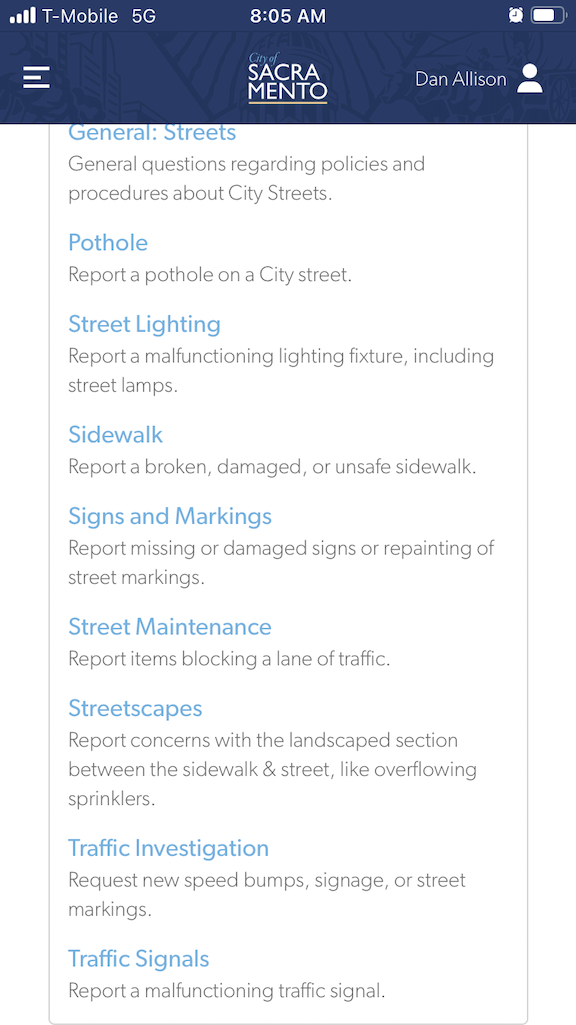
I want there to be red light enforcement cameras installed on at least one of the four intersections at Fremont Park. My observations indicate that the intersection of Q Street and 15th Street is the worst. I looked on the city’s Red Light Running Program page to see if there was a mechanism for submitting requests. No. I looked at the city’s 311 app to see if there was a place to submit a request. Not really. The closest I could find was to select Streets > Traffic Investigation, and then Signals (see screenshots below). I’ll update this when I get a response (though these days most 311 reports get no response at all).

The other way of request that might be effective is to directly contact city council members.

SacCity red light cameras and crashes

A follow on to red-light-running bullies. I’ve created a map that shows the eleven right light camera (automated enforcement) locations under the City of Sacramento’s Red Light Running Program. The city has 907 signalized intersections. These locations are (listed alphabetically by the intersection entry in the Traffic Signals GIS layer):

  • 16th Street & W Street X
  • 21st Street  & Broadway X
  • 5th Street & I Street X
  • Alhambra Boulevard & J Street
  • Arden Way & Challenge Way X
  • Arden & Exposition Boulevard & Ethan Way X
  • El Camino Avenue & Evergreen Street X
  • Fair Oaks Boulevard & Howe Avenue X
  • Folsom Boulevard & Howe Avenue/Power Inn Road X
  • Mack Road & Center Parkway X
  • Mack Road & La Mancha Way/Valley Hi Drive X

The map (pdf) shows each location, with the red signal icon, and a heat map of the crash severity for crashes occurring at intersections. Yellow means high collision severity, with severity being a weighting of the individual types [1 – Fatal; 2 – Injury (Severe); 3 – Injury (Other Visible); 4 – Injury (Complaint of Pain)]. But it does show the pattern, and you can clearly see the intersections along arterial roadways, where most crashes occur. The crashes are not necessarily red light running crashes. There is a PCF Violation category (VIOLCAT) 12 – Traffic Signals and Signs, and another Intersection (INTERSECT_), but that would not distinguish red light running from stop sign running. It might take looking at individual incident reports, but that is beyond my capacity.

There are certainly high crash severity locations in the city that are beyond the map coverage area, and there are plenty of locations without cameras.

It would be interesting to know if these red light camera locations have a lower rate of red light running crashes that comparable intersections without cameras, but that will require quite a bit more thinking an analysis.

Read More »

red-light-running bullies

If you go stand at any busy intersection in Sacramento, you will see drivers running red lights on almost every single signal cycle. Of course this problem is not unique to Sacramento, but it is where I live and walk and bicycle, and I see it every day, at every signalized intersection. I am not talking about drivers entering the intersection on the yellow light, and not making it through before it turns red. I am talking about drivers entering the intersection when the light is already red. And quite often, they accelerate into the red light, making sure they can get through.

I call this bullying behavior. It says that I (the driver) is more important than anyone else. Me (the driver) making this light is more important than anything else in the world, which translates to my (the driver’s) convenience is more important than anyone else’s life. I (the driver) know that this is dangerous behavior, but I (the driver) don’t care.

My preferred word for this is actually terrorism. Terrorism, however, implies actions by individuals against states, or more often by states against individuals (state-sponsored terrorism). This is not that. But the intent is the same, to change other people’s behavior by the threat of violence, or actual violence. This is traffic violence perpetrated by entitled drivers against everyone else on the road. Terrorism may not be technically correct, but it sure sounds right.

Most drivers have adjusted to this by not starting into the intersection on the green, but waiting until the run light running driver has cleared. Same for people bicycling and walking. Most walkers know it is not safe to enter the crosswalk until all the cars have stopped, because usually they will not stop. But not all drivers, walkers or bicyclists know, and these are the people being killed or seriously injured at intersections.

Red light running has always been a problem, but it has gotten much worse. It accelerated, I think, during the pandemic, when there was less traffic, and drivers started to gamble with running red lights. Now that the traffic is mostly back, they are still doing it. In my observation, it gets worse by the month.

Many people think that the solution to traffic violence is to change road designs so as to prevent dangerous driver behavior. I’m of course in favor of this. But in this instance, re-design does not prevent this bullying behavior.

Having near-side traffic signals, as many advanced countries do, would help a little because a driver who chose not to stop loses information about how late on the red they are and therefore is less likely to run the red light. See Near Side Signals: Thinking Outside the Pedestrian Box for more info on near side signals. But this alone would not solve the problem.

Slowing speeds would help, as the red light running driver would be a little less likely to kill the walker, bicyclist, or other driver and passengers than at higher speeds. But the red light runners are in my observation the same people who are driving well over the speed limit, adjusting their risk tolerance for to the highest possible level that won’t get them killed. Of course, these are not drivers who are much concerned about killing other people.

The City of Sacramento has a Red Light Running Program. The page says there are 11 cameras in the city. Out of 4000 plus intersections. This is not a serious response to a serious problem. It is in fact the typical city response to any transportation issue, to do the absolute minimum possible to avoid being called out for doing nothing.

I believe from extensive observation (I walk a LOT), though I have no data to prove it, that red light running is done by a fraction of drivers, and those drivers do it again and again and again. They’ve gotten away with it, so far, and will continue. At least 3/4 are drivers of expensive cars, high income, entitled people. If that is so, it would not take much to greatly reduce this behavior. Ticket them again and again and again, whether directly by law enforcement officers or by automated cameras, and their behavior would gradually change. Of course if we set ticket fines based on the value of the vehicle rather than flat rates, and impounded and/or confiscated vehicles upon repeated infractions, it would change even quicker.

Law enforcement is complicit in this red light running. I have never seen a driver stopped for running a red light. Ever. And in fact, law enforcement drivers are just as likely to run red lights as any other. Law enforcement doesn’t like automated enforcement, because it reduces the opportunity for them to do pretextual stops. It also is seen as reducing the need for officers, though since they don’t do this enforcement anyway, I can’t see how it actually reduces the need.

Many people have called on the city to install more leading pedestrian interval (LPI) lights in the city, where the pedestrian indicator turns to walk 3 seconds or more before the parallel traffic signal turns green. These of course help, but even where they already exist, the interval is now taken up by the time a walker must wait for the red light running drivers to clear the intersection before proceeding. Much less effective at promoting walking and safety than it could be.

Solutions:

  • The city could recognize that this is a serious traffic violence issue, and respond forcefully, with more enforcement and more automated cameras. The city’s Vision Zero policy obligates them to take traffic violence seriously, but they do not.
  • The CA-MUTCD could be changed to require near side traffic signals instead of far side traffic signals.
  • The state legislature and judicial council could change fines for violation of California Vehicle Code (CVC) to be based on the value of the vehicle. People often talk about basing fines on income, as some first world countries do, but income is not easily available to the law enforcement officer or processor of the red light camera mailed ticket, whereas the value of vehicles is available in the DMV database. If you run a red light in your $1000 clunker, the fine would be $1, and if you run a red light in your $200,000 trophy car, it would be $2000. To start.
  • Along with higher fines for drivers of fancy cars, the vehicles of these drivers should be impounded for the third violation of the same CVC within a year. Impound means you get the vehicle back after a certain period of time, maybe three months. And for those drivers that doesn’t control, then the vehicle should be confiscated, meaning you don’t get it back and the agency sells it. Maybe for more than six violations of the same CVC within a year, or ten within three years.
  • Walkers and bicyclists could equip themselves with paint ball guns so as to mark the vehicles of these bully drivers, so at least other people could see them coming. And perhaps other drivers would them start enforcing social pressure on them. It worked for smoking, when people who smoked in buildings and on transit were publicly shamed.
  • And of course, in the long run, we do need to re-design streets to that red light running is less likely, and less likely fatal due to lower speeds.
traffic engineering ‘profession’

This post is provoked by two articles on the Strong Towns blog: Strong Towns Will Defend Engineers’ Right to Free Speech From the Minnesota Licensing Board, and We Are Holding Engineers Accountable for Dangerous Road Designs. The Engineering Powers That Be Want Us To Shut Up. However, I’m going to go far beyond anything Strong Towns would say. Strong Towns would say that traffic engineers are good people, just working from a flawed set of assumptions and a flawed understanding of what streets are for. I’m not so sure.

Our transportation system, which largely does not work for walkers and bicyclists, and doesn’t work very well for transit users, was designed by traffic engineers. Our transportation system kills 43,000 people a year in the US, and injures far, far more. Not to mention climate change, which in California is largely the result of our transportation system (57% of GHGs). Not to mention the asthma and other health problems of the kids who live near freeways and arterial roadways. Not to mention… well, you get the idea. The list could be very, very long. Not all of this is the fault of traffic engineers, but I’m saying most of it is. What other profession gets away with killing so many people, and harming far more, and shirks responsibility for it? A little education and a little enforcement will solve the problem? Bullshit.

I have long questioned the use of ‘traffic engineer’ and ‘professional’ in the same phase. Traffic engineering is more akin to quackery. Give us all your money, and we’ll design and build something that will make you happy! Oh, it didn’t, well, give us the rest of your money and we’ll fix the thing that didn’t work. Yeh, we know that what we design doesn’t really work to ease congestion or make your life better or safer, but give us some more money, and it will eventually (one more lane lane will fix it). Snake oil!

Traffic engineers fall back on two things in an effort to absolve themselves of responsibility:

  • The MUTCD made me do it. This is akin to that old expression ‘the devil made me do it’. The MUTCD (Manual of Uniform Traffic Control Devices) was written largely by traffic engineers, and it could be changed by traffic engineers. But when the revision process started, traffic engineers whined loudly about any change that would reduce traffic flow, or increase safety for other users of the roadways. It’s the two-year-old response: if you don’t let me have my way, I’m going to take my ball and go home, and give me your lunch money while you’re at it (sorry, real two-year-olds, to align you with traffic engineers, that’s mean). The MUTCD is full of ‘facts’ that are largely made up by the engineering ‘profession’. There is almost no research to back up what is claimed in the MUTCD. And even if it were a valid document, it doesn’t require that it be followed, it just says, if you are designing something, here is the the best practice that we’ve documented. In California, the Highway Design Manual also makes up ‘facts’ to fit the desires of traffic engineers, and prohibits many safety features because someone imagined that they were unsafe (or slowed traffic).
  • It was the politician’s decision, not ours. But the fact is that politicians almost always follow the recommendations of the traffic engineers. Most politicians don’t have the expertise to question what the engineers suggest, nor do they usually listen to the concerns of the people who will be harmed by projects (unless those harmed are big campaign donors). After all, ribbon cuttings are a path to reelection. If the traffic engineers propose bad solutions, those are almost always what gets implemented.

So, traffic engineers: If you are not working today and every day to fix the problems your profession has created, you are not only part of the problem, you are the problem. If you spend any time working on roadway capacity expansion projects, I ask that you not go into work, that you find a job where your values don’t harm so many people, while sucking the public budget dry and incurring maintenance liabilities that will be with us for the foreseeable future.

Traffic engineers have embraced a concept called ‘complete streets’ to a degree that surprised everyone. Not me. How else to fund traffic signals and lighting and new curbs and utilities, except by capturing funds meant for active transportation? As though the other roadway projects didn’t provide enough money, here is another source we can capture.

My attitude towards traffic engineers has been simmering for a long while, and it has boiled over. Why do citizens who just want to travel safely by foot, bicycle, and transit have to fight the designs and desires of traffic engineers? Why do we have to fight for walkable sidewalks? Why do we have to fight for bikeable streets? Why do we have to fight for the money and priorities to run an effective transit system? Why are the roads continuing to deteriorate, while roadway capacity expansion projects receive the bulk of funding? Why? The answer is, largely, the traffic engineering ‘profession’.

speed limiting NOW!

If you read the news at all, you will already know why motor vehicles needs to be speed limited. The carnage grows every day, and egregious speeders and drunk/high drivers slaughter innocent people on the streets, on the sidewalks, and inside buildings.

So, I’m going to ask that Secretary of Transportation Pete Buttiegeg and National Highway Traffic Safety Administration (NHTSA) Administrator Steven Cliff immediately start the process of rulemaking to require always-on speed limiting devices on all new motor vehicles, and retroactive activation on all vehicles that were built with that capability, and implementation for all motor vehicles within 10 years. I hope that Congress passes legislation mandating this before NHTSA finishes its rulemaking process, because we can’t really wait for that process.

So, Pete and Steven. Will you do what is necessary, right NOW, or will you kowtow to the car-dominance industry and let things go on, let the slaughter continue apace? Now is the time for y0u to show leadership.

keep Sacramento N St narrowed

Note: As is not unusual, I had forgotten that I’d written about N St before: N Street bike route to cycle track, 2015. Seven years have passed, the city has taken no action.

The construction for the Capitol annex project has narrowed N St to two lanes eastbound, from 10th St to 14th St, and parking has been removed from the south side to shift the lanes over. Now is the time for the City of Sacramento to implement its long-delayed (if not deep-sixed) plans for re-allocating space on N St. There have been ongoing utility projects over the last few years that have narrowed N St to two or even just one lane. At no time did that create significant congestion, during the pandemic or before the pandemic. I live two blocks from N St, and both travel along it and cross it frequently. I’ve never seen more than momentary congestion, in 11 years. What that means is that N St, in its three-lane configuration, has grossly excess capacity for motor vehicles.

While the street has been narrowed is the time to redesign the street so that it has no more than two general purpose lanes, and has a curb-protected or parking-protected bikeway. Probably on the left. This is in fact the perfect setting for a separated bikeway, five blocks from 10th St to 15th St with no intersecting streets from the north side, which is Capitol Park.

It is true that the sidewalk on the north side of N St is a designated bikeway, so bicyclists may use the sidewalk to avoid riding in the street. But bicyclists on the sidewalk are often in conflict with people walking on the sidewalk. The sidewalk has pretty continuous use by walkers, particularly during the lunch time – walk time for state workers, but a lot of people also include a circuit of the Capitol Park on their runs and walks. This conflict is easy to solve: create a safe, welcoming, protected (separated) bikeway on the street. And do it now!

On N St eastbound, the leftmost lane is a designated left turn lane at 10th St, which is what makes possible the two-lane configuration beyond 10th St. As a temporary measure, this works well, and forcing turns off three lane streets is a good solution for so many overbuilt arterials roads in Sacramento, but here it is only temporary, and would be obviated by the conversion of all of N St from 3rd St to 15th St. N St becomes a two-lane street at 15th St, and then becomes a two-way street at 21st St. N St from 15th St to 21 St would probably be a good candidate for a separated bikeway as well, but with paint bike lanes existing, would be a lower priority.

Below is a StreetMix sketch of what N St might look like. Note that the width of the street and the elements are estimated, not measured. I don’t believe parking is needed on both sides, but the diagram shows it for people who think it is necessary. Left side is north, Capitol Park in this case, and right side is south, mostly state buildings.

N St Sacramento between 3rd St and 15th St

As a reminder, I feel strongly, and it is backed up by evidence:

  1. Three-lane streets are significantly less safe than two-lane streets, primarily for the muli-lane threat (one vehicle stops for walkers and the others do not). They are also a clear sign of poor land use planning, which puts residents and the things they need to reach (jobs, stores, recreation and entertainment, medical, etc.) far away. Narrowing all such roadways in the city from three to two, or less, would increase safety, increase livability, and encourage people to make different choices about where they live and visit. Maps of collisions (vehicle vs. vehicle, vehicle vs. walker, vehicle vs. bicyclist) align almost perfectly with overbuilt arterials.
  2. One-way streets are significantly less safe than two-way streets, for the same multi-lane threat, and because there isn’t any friction to slow drivers. However, I think that the only valid argument for one-way streets is to accommodate separated bikeways, bus lanes, or rail transit. That may be true of N St.

And, sorry, can’t resist, get rid of the worthless palm trees while they are at it. We need shade trees, not poles.

Freeport Boulevard Transportation Plan Emerging Design Concepts

City of Sacramento staff (Drew Hart) presented to the Sacramento Active Transportation Commission last Thursday on the Freeport Boulevard Emerging Design Concepts. The presentation slides are here. The city’s Freeport webpage has a lot of background material. A link to the virtual open house on April 28 (tomorrow!) is available. This project and the Northgate project are being supported by the same consultant, so you will notice similarities in the process and graphics.

The northern section, between Sutterville Road to the east and Sutterville Road to the west, should look exactly like the traffic-calmed, complete street to the north. This project on Freeport was successful. There is no reason for five lanes in this section. One lane northbound, one lane southbound, and one left turn lane southbound is all it needs. If traffic backs up at the Freeport and Sutterville Road to the east intersection, then shorten the signal cycle.

The emerging design document skips over the issue of whether four general purpose lanes are even needed. A concept should be presented that reduces general purpose lanes to two, and reallocates roadway width to other modes.

Dedicated right hand turn lanes should be removed everywhere. Dedicated left hand turn lanes should be provided only where traffic studies have shown a clear need, and should never reduce the roadway width for other uses.

Green lanes are shown behind protection for separated bikeways. Since the protection does or should prevent vehicle incursion, the paint is not needed.

Dedicated transit lanes should be considered. Though SacRT has not identified this as a high frequency route in the High Capacity Bus Service Study (Route 62 is 30-minute frequency), reconstruction of the roadway must consider the possibility of dedicated transit lanes and transit supporting infrastructure. Appendix A, available on the project webpage, provides a lot of detail about existing transit stops, which are mostly quite poor.

Some businesses along Freeport have multiple driveways, more than are justified by the amount of vehicle traffic access. Closure and narrowing of driveways should be considered. Since almost every business has parking fronting the street, no on-street parking is needed anywhere. This is poor urban design, but it is the nature of the corridor and could not be corrected without wholesale reconstruction of the corridor.

While separated bikeways are often a good solution, the frequency of driveways might make for poor quality infrastructure. Unless driveways can be closed or reconfigured, separated bikeways may not be the best solution.

Posted speed AND design speed should be considered for reduction. Posted speed is 30 mph from Sutterville Rd (to the east) to Arica Way, 35 mph from Arica Way to Fruitridge Rd, and 40 mph from Fruitridge Rd to Blair Ave. The section from Sutterville Rd (to the east) to Fruitridge Rd should be posted and designed for 25 mph, in recognition of the density of businesses and driveways. The section from Fruitridge to Blair Ave should be posted and designed for 30 mph, as it has a lower density of businesses and driveways, and is adjacent to the airport for a significant distance.

Prioritization of the modes for Sutterville (to the east) and Fruitridge Rd should be:

  • walking
  • bicycling
  • transit
  • motor vehicle

Prioritization of the modes for Fruitridge Rd to Blair Ave should be:

  • bicycling
  • transit
  • walking
  • motor vehicle

Crash/collision map of the Northgate Blvd corridor for pedestrians (walkers) and bicyclists. Data is from SWITRS for the years 2015-2019. (pdf)

map of Freeport Blvd Emphasis with pedestrian and bicyclist crashes

Northgate Boulevard Emerging Design Concepts

Update: Added a crash/collision map at the bottom. Though prevention of pedestrian and bicyclist killed and severe injury is always a top priority, this is not a high risk corridor as compared to many arterials in the city.

City of Sacramento staff (Leslie Mancebo) presented to the Sacramento Active Transportation Commission last Thursday on the Northgate Boulevard Emerging Design Concepts. The presentation slides are here. The city’s Northgate webpage has a lot of background material. A link to the virtual open house on May 11 is available.

I rode Northgate Blvd yesterday to refresh my memory about the street, as I’d not gone that way in a while. So, some comments:

The section of Northgate from Rio Tierra to I-80 is a standard suburban arterial, with low quality development and a completely uninteresting place to be. Changes to the roadway may make it safer, but won’t make it any more interesting or economically successful. The city should not focus on this area. It is unpleasant, and not particularly safe, but leave it be.

The section of Northgate from Rio Tierra to Garden Hwy has serious issues, but I see it as a place that could be transformed into an interesting, welcoming, and vibrant place. The number of small businesses, each with a driveway, is a challenge, but also an opportunity. At least half of the businesses are locally owned. This is not the home of big box and chain stores like much of the suburbs. It IS a place where people could walk if provided a safe and encouraging environment, and there are multiple destinations used by local residents.

I think that this entire segment should have buffered and wide sidewalks. The bike facilities could provide some buffer, but the sidewalk buffer is critical because it allows street trees. This section desperately needs street trees! Of course to be successful, the buffer/planting strip needs to be at least six feet, and the sidewalk at least six feet, but eight-ten foot buffer and eight foot sidewalk would be better. I think that the walking mode should take precedence over all other modes, even bicycling and transit, so whatever right-of-way the buffer and sidewalk needs, it should get. Don’t compromise this away.

I realize this project is at the gathering community input stage. However, diagrams will be used, and I’d like to see the diagrams include significant improvement to the pedestrian environment, wide sidewalks buffered from other modes, with trees in the buffer.

The presentation resulted in a number of questions from commission members about bicycle facilities. One of the ideas that got support is a two-way separated bikeway (or cycletrack) to provide a connection between the Ninos multiple use trail and the American River Parkway multiple use trail (the ‘special section’ in the presentation). There was less agreement about bicycle facilities north of there. One of the ideas is separated bikeways (protected bike lanes). Though of course separated bikeways are the best solution overall, I’m not sure they make sense for the east side of the street. Separated bikeways work best when there are few or no driveways, but there is a huge numbers of driveways here. The west side of the street has far fewer driveways.

There are some opportunities on the corridor for reducing driveways, and certainly some of the driveways can be narrowed to reduce entry and exit speeds. But short of a wholesale revision of the area, most driveways will remain, so the street design must accommodate this fact.

Transit on the part of the corridor between Arden Way and San Juan Road is provided by SacRT Route 13 Natomas/Arden, with a 45 minute frequency on weekdays. The route has a fairly low ridership, but it is a long route of which the Northgate section is a small part.


Crash/collision map of the Northgate Blvd corridor for pedestrians (walkers) and bicyclists. Data is from SWITRS for the years 2015-2019. (pdf)

Take the information about fault below with a huge grain of salt. It is well known that law enforcement officers assume walkers and bicyclists to be at fault, without any serious investigation, and often on the sole word of the driver involved.

Pedestrian (walker):

  • Northgate near Rosin Ct: killed, 60 yo male, unknown detail, no fault, no alcohol
  • Northgate near Ozark Cir: severe injury, 74 yo female, crossing, at fault, alcohol
  • Northgate at Wisconsin: severe injury, 36 yo female with two children, crossing, driver fault
  • Northgate at Peralta: severe injury, 48 yo, crossing Peralta, at fault (very unlikely)

Bicyclist:

  • Northgate near Winter Garden: severe injury, 49 yo male, left turn, at fault
  • Northgate at Bridgeford: killed, 47 yo male, crossing, at fault, alcohol or drug
  • Northgate at Harding: killed, 31 yo female, left turn, at fault
  • Northgate at Garden Hwy: severe injury, 40-44 yo male, broadside, at fault CVC 21453

The intersections of Northgate and San Juan Rd, West El Camino, and Garden Hwy/Jefferson Ave are particularly problematic because they are flared out to accommodate turning lanes, thereby lengthening crossing distances for walkers and creating a walker-hostile environment. Fixing these intersections would probably do more to improve the safety and feeling of this corridor than changes along the corridor.

excess car capacity!

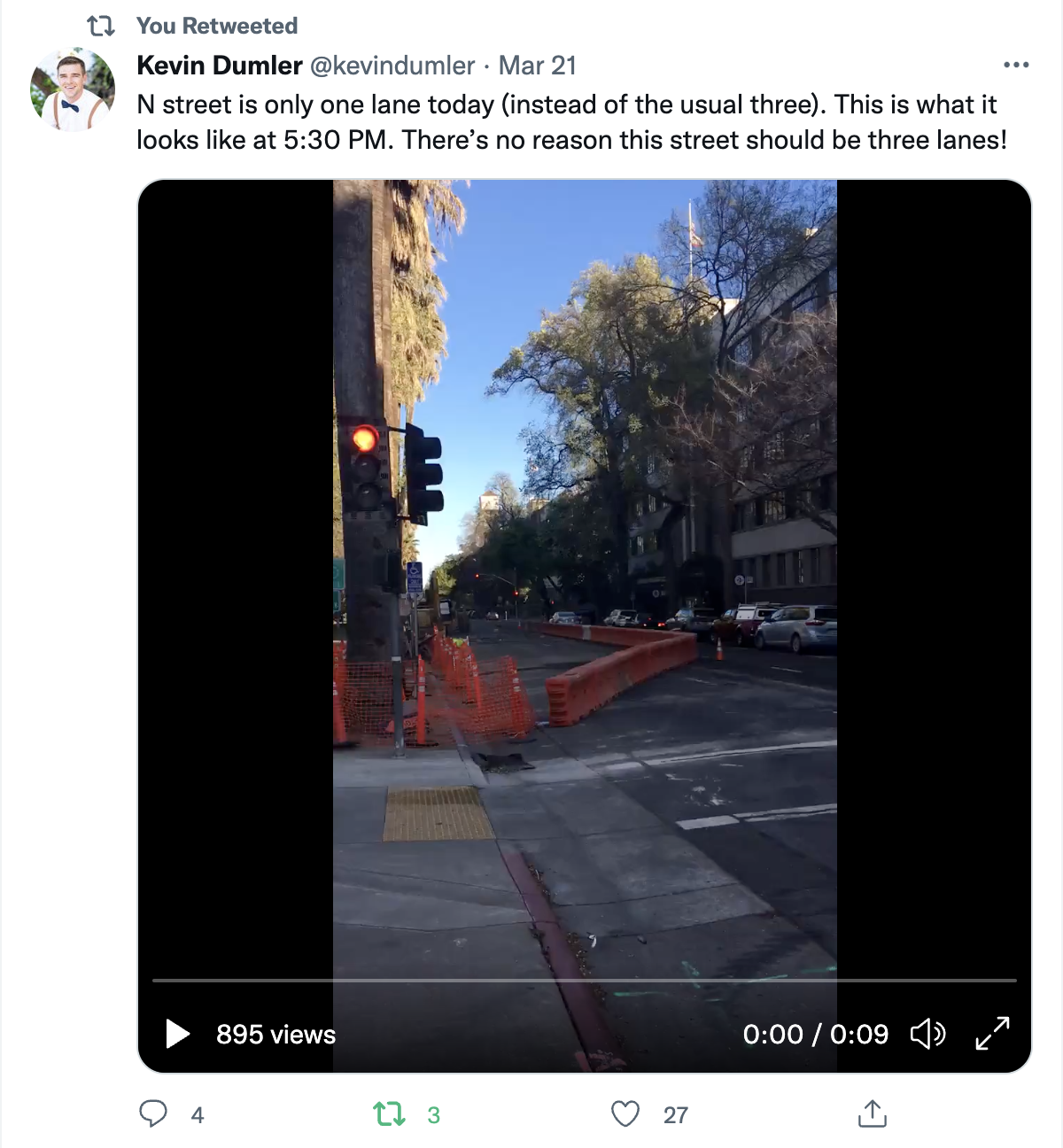
Kevin Dumler posted this to Twitter, and it caused me to pay more attention to all the utility and construction projects going on in the central city that have reduced general purpose travel lanes (car lanes). What follows are some photos of other locations.

10th St past P St, lane reduction two to one
I St past 10th St, lane reduction three to two
J St past 10th St, lane reduction three to two, also parking and bike lane closure
N St past 10th St, lane reduction from three to one (same location as Kevin tweeted)
L St past 12th St, lane reduction from three to one

It is only in this last example, on J Street between 12th and 10th, where there was some congestion. However, no vehicles were being stuck at signals, nor failing to make it through the signal at 11th Street, so this is very minor congestion.

The point, well made by Kevin, is that we have excess capacity for motor vehicles on many of our roadways, particularly three lane roadways, that could better be used for other things, like bike facilities, wider sidewalks, planter strips or wider planter strips. Or even narrowing the street for housing!

(in)complete streets

Note: This is a follow-on to streets – stroads – roads. It will make more sense if you read that one first.

The complete streets concept says that all modes of travel (walking, bicycling, motor vehicles, and transit when appropriate) should be accommodated on streets. The accommodation is accomplished by providing separate spaces for each: sidewalks for people walking, bike lanes for people bicycling, general purpose lanes for people driving.

The concept was and is promoted by the National Complete Street Coalition, now part of Smart Growth America, since 2004. The traffic planning and engineering professions strongly resisted the concept for years, but it now receives at least voice support from most planners and engineers. In California, chances of getting a transportation infrastructure grant are low if it does not at least claim to meet complete streets concepts.

The two biggest weaknesses of the complete streets concept are:

  • No guidelines for the frequency of safe crossings are built into the complete streets concept. It could be, but it is not. So travel along corridors is better, but crossing that corridor may not be any better than it was before.
  • Speed limits are rarely reduced on a reconstructed complete streets. Traffic lanes are often narrowed, and sometimes reduced, in an effort to slow traffic. However, a design that actually enforces a lower speed, and therefore allows a lower speed limit is rarely considered.

FHWA (Federal Highway Administration) recent released a Complete Streets Report to Congress and related webpage. I have not had a chance to look at this in detail, so I don’t know if the federal concept overcomes the weaknesses of the previous complete streets concept. The graphic below was the leading one in the new effort, and was justifiably criticised as presenting an unattractive if sort-of compliant complete street, but some people who have read the document say it is better than this. Streetsblog USA: USDOT Tackles Overlooked Barriers to ‘Complete Streets’ — And Sparks Debate.

FHWA complete streets graphic

Caltrans has a recently adopted Complete Streets Policy. The City of Sacramento has a complete streets policy. Citrus Heights, Elk Grove, Folsom, Rancho Cordova, and the county express support for complete streets concepts in their general plans, and have complete streets projects, but apparently do not have specific policies.

There have been a number of complete streets project already in the Sacramento region, and more are on the way. The proposed Measure 2022 transportation sales tax flags complete streets for much of investment, so it is important to understand what a complete street is and is not. Let me say that a complete street is almost always better than what was there before. A lot of our streets were constructed without sidewalks, or with narrow sidewalks interrupted with utility poles and other obstructions, and lacking curb ramps. Complete streets usually have continuous sidewalks of six feet or more, with fewer (but not no) obstructions, and curb ramps at corners. Almost all of our streets were constructed without any place for bicyclists, so a complete street with bike lanes may be an improvement (though many traffic engineers continue to think that painted bike lanes work on higher speed streets).

I was working partly in the City of Citrus Heights when the Auburn Blvd Complete Streets Phase 1 project was designed and implemented. Indeed, travel along the corridor was much improved, and the road was more welcoming to all modes of travel. But there were no more safe crossings of Auburn Blvd than there were before. The crosswalks were still way to far apart for people to conveniently access the businesses, homes, and schools along the corridor. The speed limit was unchanged, though my perception was that actual speeds were a bit slower.

Nearly all streets that have become, or are proposed to become, complete streets are stroads. Think of a major roadway in the county, and you are picturing a stroad. Making a stroad a complete street does not make it not a stroad. Complete streets projects often forget to answer the most basic questions: what is the purpose of this roadway, and how can we construct it so that it fulfills that purpose? A stroad with sidewalks and bike lanes is still a stroad if the primary function is to move people along the corridor, rather than allow them to be in the corridor.

If the purpose of a roadway is to move a high volume of motor vehicles quickly, a road, then sidewalks and bike lanes probably aren’t appropriate, and those modes should be provided for on parallel routes. If the purpose of a roadway is to provide a place for people and building wealth, a street, then sidewalks and SLOW or no motor vehicle traffic is the only appropriate design. This is often expressed as a place where ‘cars are guests’ and bicyclists mix in with other street users rather than needing an exclusive space.

Yes, I am talking about an ideal here. Almost all of our roadways were designed and function inappropriately. We have a long ways to go, but we at least have to get started by stopping what we are doing wrong, and starting to do it right. The proposed Measure 2022 transportation sales tax largely commits to continue doing it wrong, for 40 years. That is the next post.