Is sales tax for transportation the wrong approach?

There are three ideas for transportation funding floating around, for the 2026 ballot, though none have been formalized. All rely on sales tax.

  • Sacramento Transportation Authority (SacTA) may create a ballot measure to fund transportation. It would be in addition to the existing Measure A, and might fund transportation infrastructure for infill housing, which has not been done before. As an agency-sponsored measure, it would require 2/3 vote to pass.
  • Sacramento Metro Rail and Transit Advocates (SMART) and Mayor Darrell Steinberg have drafted measure that would fund active transportation, transit, and housing. It would probably be for the county, but could be just for the City of Sacramento. As a citizen initiative, it would require only 50% + 1 to pass, a much more achievable vote.
  • SacRT it considering a measure for transit and related active transportation that might cover only a part of Sacramento County, the more transit-supportive part, probably the cities of Sacramento and Elk Grove. As an agency-sponsored measure, it would require 2/3 vote to pass.

Sales taxes are regressive, meaning that low-income people pay a much larger percentage of their income to sales tax versus high-income people. Most organizations which lead with equity are opposed to further sales tax increases, feeling that enough is enough.

In Sacramento County, with a strong anti-tax voice in the low density unincorporated county, it is difficult though not impossible to reach the 2/3 threshold. The 2016 transportation sales tax fell short of 2/3. Measures to fund schools districts are more likely to pass. A complicating issue is that Elk Grove recently passed a sales tax measure to fund many purposes, one of which is transportation. Folsom and Rancho Cordova have sales taxes for which it isn’t clear to me whether any goes to transportation.

General purpose sales tax measures, which may list uses but are not required to follow those lists, only require 50% + 1 to pass. That flexibility is both a feature and a danger, since a government may shift sales tax income from what they said it would be spent on to other purposes.

Though I have not heard parcel taxes being discussed, they are another source of funding, though they are also regressive because they are a flat rate per parcel, not based on the value of the parcel.

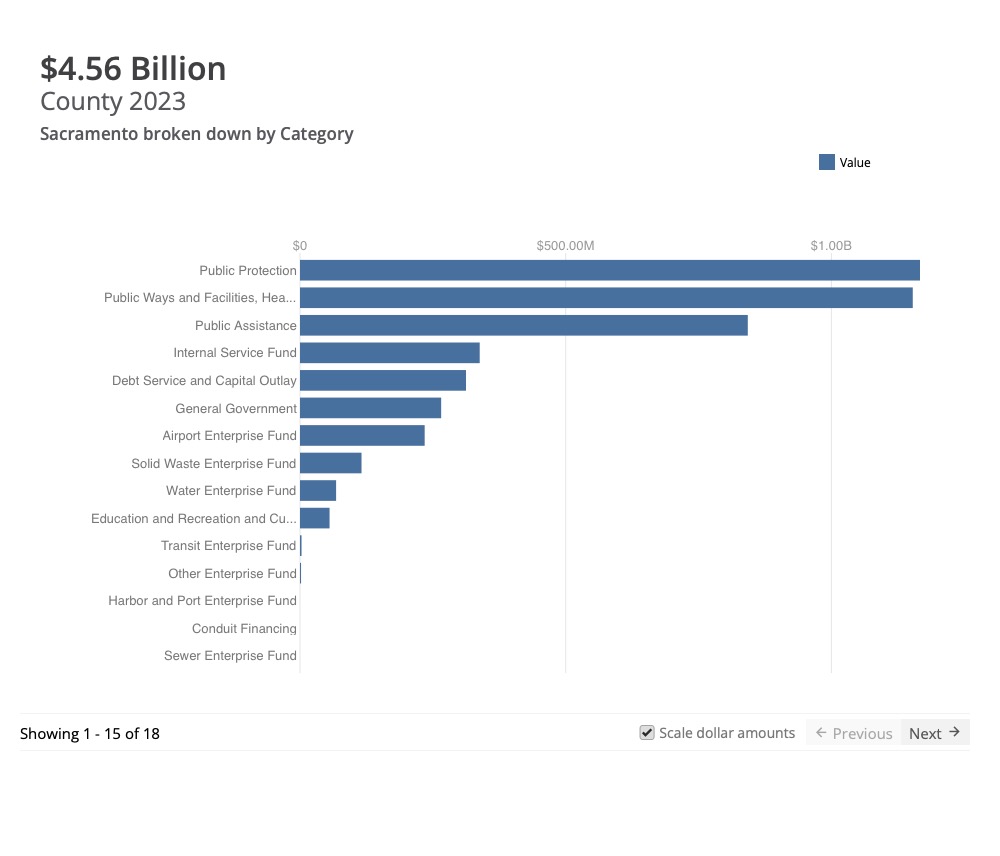
Two other types of tax which are progressive, meaning that high-income people pay a higher percentage of income than low-income people, are income tax and property tax. Income tax does fund transportation at the state level, but income taxes are not available to cities, counties, and special districts. Property tax can fund transportation, though due to Prop 13 which limits property tax, it mostly goes to schools and public safety. For Sacramento County in 2023, the chart below shows allocations. The ‘Public Ways and Facilities, Health, and Sanitation’ category goes mostly to Health, with Public Ways and Facilities being less than 20% of that category. This chart does not include school districts within the county, which also rely on property tax.
Transfer taxes, which are based on the value of a property when it is sold, are progressive. These have been discussed in a number of places in California, though not locally so far as I have heard. I am not aware of any existing transfer taxes that fund transportation, though they do fund a number of other government functions. The state levies a transfer tax throughout the state, and that income goes into the general fund.

Any county, city or special district can bond against property tax, meaning that they can expend money now and pay it back over time from future property tax income. Again, Prop 13 limits the usefulness of this by suppressing property tax income, but does not preclude it. If Prop 5 on the 2024 ballot passes, cities, counties, and special districts will be able pass bond measures with a 55% vote rather than 2/3 vote, though the proposition raises the bar on transparency and types of expenditures. Though Prop 5 is intended primarily to fund housing, it could fund transportation, and there is a logical nexus with transportation that supports housing.

For other posts on transportation funding, see category Transportation Funding.

what’s going on? (other)

There are so many actions and possibilities for improving the efficient, equity, and safety of our transportation system that I can’t keep up with it all, and even nonprofits that have staff are unable to keep up. So, what’s going on? The list below is not in any priority order, but may give you ideas about what you would like to get involved in. It takes a village!

Items specific to City of Sacramento were in a previous post, while these items are about other locations, and/or applicable to all the cities and counties in the region.

Transportation funding in Sacramento County: Transportation sales tax measures in 2016 and 2022 failed, and a 2020 measure was withdrawn. Each measure was weak on active transportation and transit (and the sprawl developer sponsored ‘citizens initiative’ in 2022 was horrible), and also suffered from anti-tax sentiment in the county. There are three efforts to place a funding measure on the 2026 ballot, Sacramento Transit Authority (SacTA) new Measure A, SMART/Steinberg citizen measure for housing, active transportation, and roadway maintenance, and SacRT transit measure for City of Sacramento and Elk Grove. All of these are in early stages, not yet formalized. Sales taxes are regressive, making low-income people pay a much higher percentage of their income on these taxes, so efforts to identify other mechanisms are critically important.

City of Rancho Cordova Active Transportation Plan: The city is starting the process of community engagement towards developing a plan for walking, rolling and bicycling.

Other active transportation plans: Sacramento County updated its plan in 2022. Folsom updated its plan in 2022. It isn’t clear what the status of Elk Grove’s Bicycle, Pedestrian, And Trails Master Plan is. West Sacramento’s Bicycle, Pedestrian, and Trails Master Plan, from 2018, received minor updates in 2024. Roseville is undertaking a Transportation 360 effort to include walking, bicycling and transit. Davis does not seem to have an active transportation plan.

Sacramento County Climate Action Plan: The county has delayed a climate action plan by years, going through a series of revisions that aren’t much better than the previous. Sacramento Climate Coalition and 350Sacramento have been the most active on this issue. It will take citizen pressure on staff and on the Board of Supervisors to ensure an effective plan.

Other climate action plans: Every city and county is required to come up with a climate action plan. I don’t know the status of plans other than City of Sacramento and Sacramento County.

SACOG 2025 Blueprint: SACOG is developing a new version of the MTP/SCS called Blueprint ‘Linking land use and transportation in the Sacramento region’. There is a constant tension between the desires of cities, in particular Sacramento, West Sacramento, and Davis, and the smaller cities and rural counties of the six county SACOG region, over what kinds of transportation investment to make. SACOG is required to come up with a plan that would reduce greenhouse gas emissions (GHG) by 19%, and the transportation policies and projects selected will make all the difference in whether the region has a chance for achieving that goal. Citizen pressure for infill and livable communities is required to counteract the small city and rural voices that just want money to continue doing what they’ve always done, which is encourage low density sprawl development with a motor-vehicle focused transportation network.

Caltrans District 3: While other entities are beginning to meet the public demand and legal requirements to reduce greenhouse gas emissions (GHG) by reducing vehicle miles traveled (VMT), and improve roadway safety, Caltrans District 3 is continuing to expand highway capacity, inducing travel demand and increasing GHG/VMT, and making it very hard for cities and counties to make their roadways that are state highways or that cross state highways (underpasses and overpasses) to improve safety. Caltrans headquarters has been unable to rein in District 3.

This list no doubt misses some important topics. Please suggest them in the comments.

Rancho Cordova Active Transportation Plan graphic

Prop 5 bonding for transportation?

Proposition 5

A Yes on 5 website offers details in support of the proposition. The arguments against, on the voter information guide, are just the standard anti-tax voice, so isn’t useful to this post, but you can read your guide if you are interested. Prop 5 was placed on the ballot by the legislature, as a result of two legislative resolutions. The proposition is entitled “Proposition 5: Allows Local Bonds for Affordable Housing and Public Infrastructure with 55% Voter Approval.

The proposition would change the voting threshold from two-thirds, 67%, to 55%, for ballot measures by cities, counties and special districts (does this include SacRT?) that bond against property taxes for the purposes of affordable housing and public infrastructure. The proposition does not directly raise property taxes, nor would local bonding measures directly raise taxes, though since the bonds have to be repaid with interest, property taxes could eventually go up within the limits sets by other legislation. This has nothing to do with sales tax, which remains at two-thirds for govenment proposed sales taxes, and 50%+1 for citizen proposed measures.

The history of the proposal development indicates that it is more about affordable housing than public infrastructure, but infrastructure is definitely allowed, and could easily be justified when that infrastructure supports affordable housing. It can also apply to transportation infrastructure. The specific language in the ballot measure related to infrastructure is “construction, reconstruction, rehabilitation, or replacement of public infrastructure”, which is pretty open-ended. More specifically, the proposition lists the following infrastructure uses:

(I) Facilities or infrastructure for the delivery of public services, including education, police, fire protection, parks, recreation, open space, emergency medical, public health, libraries, flood protection, streets or highways, seaports, public transit, railroad, airports, and
(II) Utility, common carrier or other similar projects, including energy-related, communication-related, water-related, and wastewater-related facilities or infrastructure.
(III) Projects identified by the State or local government for recovery from natural disasters.
(IV) Equipment related to fire suppression, emergency response equipment, or interoperable communications equipment for direct and exclusive use by fire, emergency response, police, or sheriff personnel.
(V) Projects that provide protection of property from sea level rise.
(VI) Projects that provide public broadband internet access service expansion in underserved areas.
(VII) Private uses incidental to, or necessary for, the public infrastructure.
(VIII) Grants to homeowners for the purposes of structure hardening of homes and structures, as defined in state law.

The reason for raising this issue is that taxes based on property are progressive, meaning that people with higher incomes and therefore higher value property, pay more in taxes. Sales taxes are regressive, meaning that low-income people pay a higher percentage of their income on taxes than do higher income people. Proposals to increase the sales tax in Sacramento County have been resisted by many who think we have runs out that option and need to turn to options that are not regressive, like property tax.

I prefer pay-as-you go expenditures from most transportation projects, except for a few which are very expensive and of clear benefit to everyone. There are few transportation projects that would or should quality for this. The transportation projects we most need going forward are many small fixes, not the mega-projects done in the past which tend to be motor vehicle projects. But some transit projects could be or should be bonded. The problem with bonding is that interest payments raise the cost to about 1-1/2 times the project cost, depending on the bond length and bone rates, and that money goes to wall street investors, not to the project.

I am in favor of the proposition. It gives local governments, and therefore citizens, control over how they spend their property tax, rather than being constrained by statewide controls that were implemented by anti-tax interests.

If the proposition passes, would it be the solution, or a solution, to funding affordable housing and transportation infrastructure instead of or in addition to sales tax or other taxes and fees? I don’t know, but I do think it is worth exploring. Though the proposition applies to local measures on the same ballot, there are no transportation measures of any sort on the 2024 ballot in Sacramento Couny. There may be in 2026, as a Sacramento Transportation Authority new Measure A transportation sales tax, or a SacRT sales tax for transit with a limited geography, a citizen measure sales tax for housing, transportation, and active transportation (the SMART/Steinberg proposal), or other ideas that have not yet come forward. A property transfer tax has been discussed, which is another progressive tax. The state has a property transfer tax, as do other entities. It isn’t clear to me whether Sacramento County or any of the cities within the county have transfer taxes.

Yuba City sales tax for transportation+

SacBee: Yuba City voters will decide on an unorthodox sales tax. How will it work, what does it pay for?

Yuba City will be placing on the November ballot Measure D sales tax that includes ‘Roads – tackling the $150 million in deferred maintenance on our local roads’. It is a general purpose sales tax measure, so the city can change how funds are allocated after it passes (as happened with some of the City of Sacramento Measure U funds), but it is interesting that a small city in the Sacramento region is taking the initiative to fix its roads, when others are not.

Elk Grove passed Measure E, a one-cent sales tax measure, also a general measure, which includes ‘Maintaining Streets and Improving Traffic’. Rancho Cordova passed Measures R and H to ‘to improve city streets’ among other general purposes. There may be others. Sacramento County has been unable to pass a sales tax measure for transportation since 2009’s Measure A, which is in effect through 2039, though there may be a ballot measure in 2026. The City of Sacramento has not passed a sales tax measure for transportation. Measure U did not include a call-out for transportation, though as a general measure, funds could be used for transportation.

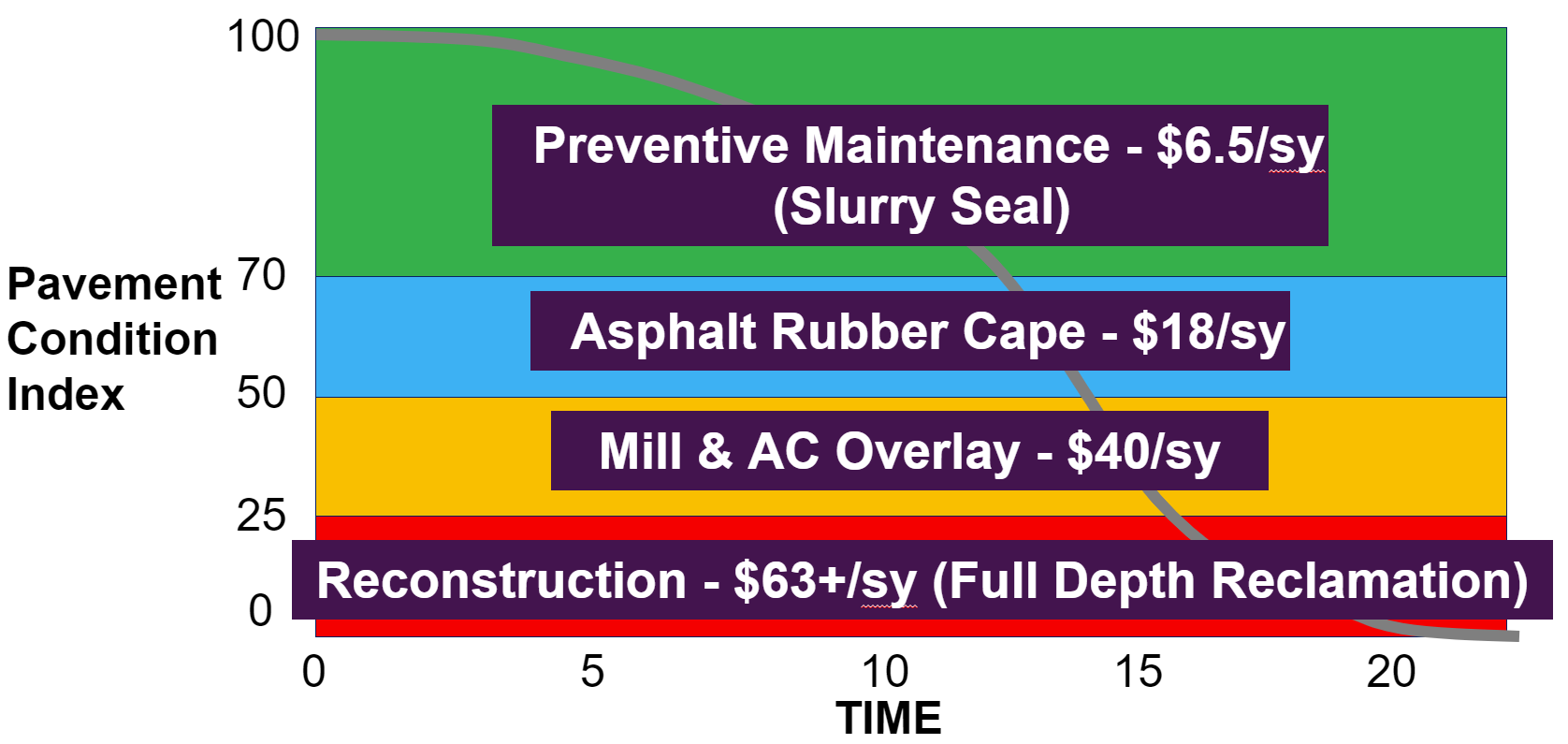
Yuba City chart on the increasing cots of deferred roadway maintenance
Yuba City chart on the increasing costs of deferred roadway maintenance

a tax JUST to fix roads?

While attending the Sacramento Transportation Authority meeting last Thursday, and hearing the long painful discussion about how there isn’t, and never will be, enough money to fix our roads to the level that the public desires, a thought occurred to me. Keeping roads in good shape is often called ‘fix-it-first’ or ‘state of good repair’.

What about a sales tax of a quarter cent, JUST for maintaining roads? It would have a short term, perhaps 10 years, with language included that it could not be extended. It would only be for fixing pavement. It would not includes complete streets or sidewalks. It could include the addition of regular bike lanes as the street is re-striped after paving, but would not include high quality bike facilities. It would include language to ensure that it is not used to expand roadway capacity or to build new roads.

I know that many of my transportation advocacy friends are cringing. What about all the other things that need to be fixed? What about missing sidewalks? What about complete streets? What about traffic calming? Yes, all of those are important, and must be funded in some way. But useable streets are the base of everything else we do for mobility and access. Sacramento area streets are certainly not the worst in California. I know that Los Angeles, and San Francisco, and parts of Oakland, are much worse.

There would also be a tremendous question of fairness. The tax would be collected from all citizens of the county, but most of it would be spent in unincorporated Sacramento County. The county has a long, long history of underinvesting in its roads, building new but not maintaining. That keeps taxes lower, which is in part why there are so many anti-tax people in unincorporated county, but it does not create useable roads. Should the rest of the county be responsible for fixing the county’s underinvestment? Its a fair question.

photo of potholes on Sacramento County road, credit SacBee
potholes on Sacramento County road, credit SacBee

Communities Over Highways Campaign

America Walks has created a Communities Over Highways Campaign. The campaign asks for a moratorium on highways, and instead invest in:

  • fix-it-first
  • safety over speed
  • make transit work
  • reconnect communities

STAR and SABA have already signed on to the campaign, and individuals are encouraged to send letters to their elected representatives. For me, living in Sacramento, the letter goes to Governor Gavin Newsom, State Senator Angelique Ashby, Assemblymember Kevin McCarty, Representative Doris Matsui, Senator Alex Padilla, and Senator Laphonza Butler.

CalBike People-First Mobility Budget

I had mentioned CalBike’s initial response to the governor’s budget, in the a modest proposal to fix the budget deficit post, referring to Stop Fueling Climate Change: Coalition Challenges Governor to Shift Transportation Spending. CalBike now has a more specific proposal, which they are calling the 2024 People-First Mobility Budget for California. This is part of CalBike’s Invest/Divest program. You can sign a petition on both the program and the budget pages, and I encourage you to do so. I did, and I also contributed to the program.

The CalBike People-First Mobility Budget shifts significant funds from the standard Caltrans budget, which is focused on build more, but don’t maintain what we have, to a state of good repair. The typical Caltrans budget, which the governor’s proposed budget continues, is what has gotten us into our horrible transportation mess. Time for a new paradigm! Thank you, CalBike.

CalBike People-First Mobility Budget graphic

I, of course, would go further. I’d spend 100% of Federal Trust Fund and the California State Highway Account (SHA) on VMT reduction, and I’d fund Active Transportation Program at $1B. I completely support the 50% to historically marginalized areas. These are the places that have been intentionally isolated, divided, and polluted by our current highway system. Nevertheless, I recognize the CalBike proposal as a very practical one, and hope that legislators will integrate all these ideas into the state budget.

CalBike Invest/Divest logo

a modest proposal to fix the budget deficit

I woke up this morning with thoughts about how Governor Newsom could largely solve the budget deficit. And shortly thereafter ran across the CalBike-led letter, co-signed by 25 organizations, to the governor about shifting budget priorities: Stop Fueling Climate Change: Coalition Challenges Governor to Shift Transportation Spending. In the Governor’s initial budget proposal, there is no reduction in highway building whatsoever. It is as though this is the sacred mission of the state, to fund and build highways at the level desired by Caltrans, and the asphalt lobby, no matter what else is going on in the state, with budget or climate. This is called the ‘Infrastructure Cult’ by Strong Towns.

The letter’s four asks are:

  1. Consider any proposed reductions in General Fund spending on transportation infrastructure in the context of our climate and equity goals
  2. Backfill any General Fund cuts by leveraging the existing statutory flexibility of federal highway formula funds as well as funding from the State Highway Account.
  3. Suspend California state investment in new highway capacity
  4. Develop a multi-year funding commitment that ensures at least 50% of the State Highway Account (SHA) funds go to VMT-reducing projects while prioritizing investments in California’s most burdened communities.

I support all of these ideas, but of course would go further:

  • Suspend SHOPP funding, the funding which is supposed to maintain and improve (but not expand) our highway system until an audit of the SHOPP program is complete. This would take at least a year, maybe more. SHOPP is the biggest part of the Caltrans budget, so the savings for this year would be considerable.
  • Suspend all STIP funding, the funding which is used to build new infrastructure, indefinitely, except for the TIRCP (rail and transit) and ATP (walking and bicycling) programs. This is much the same as the letter’s third action.
  • Propose to the legislature a bill that would convert all HOV (high occupancy vehicle) lanes (which are worthless in practice because so routinely violated), to tolled lanes, statewide, within five years. This effort would include state funding to accelerate creation of tolling authorities where they don’t exist, and to study merging of tolling authorities into regional entities.
  • Propose to the legislature a bill that would not only allow but encourage and/or require the conversion of general purpose lanes to toll lanes. For the time being, this would preserve two general purpose lanes on highways with more than two lanes per direction, but ultimately, all lanes would be tolled. Highways are incredibly expensive to build and maintain, and general funds should never be spent on highways because they are not used by a significant portion of the population. And if all users are tolled in all lanes, the tolls would be reasonable and equitable.
  • Propose a bill to the legislature that assigns CalSTA (California State Transportation Agency) a study of the charter and organization of Caltrans. Caltrans is an outmoded legacy agency which should be reoriented towards meeting the needs of citizen access and climate action, and most specifically maintaining what we have and not continuing to build new.

Four boards meeting

On November 9, 2023, the boards of four agencies met together for the first time: SACOG (Sacramento Area Council of Governments), SacRT (Sacramento Regional Transit District), SMAQMD (Sacramento Metropolitan Air Quality Management District), and SMUD (Sacramento Municipal Utilities District). This is probably the largest gathering of elected officials in one room in Sacramento history. Of course the number was not as great as you might think, because many officials serve on multiple boards. The SMUD board is independently elected, while the other three boards are composed of elected officials appointed to the boards by their own boards or councils.

The agenda for this meeting and the resolution that was passed are available here. The reason for the meeting was to advance collaboration among the boards to further mutual objectives, and to pass a resolution stating that. The staff of these agencies already collaborate to some degree, but also don’t on some important issues.

There was a long discussion period before passing of the resolution. No surprise, many of the smaller cities dominated the discussion, as is the case with SACOG board meetings. Several electeds used the time to promote commercial concerns that they benefit from, which is a really sad statement on the quality of our elected officials. Probably 90% of the discussion was devoted to electric vehicles, and in fact it looks as though seeking grant funding for more electric vehicle infrastructure was the real reason for the meeting. Grant applications with multiple agencies on board are more likely to receive funding. There was also discussion of managing forest lands for carbon sequestration and need to manage forests to reduce severe wildfire carbon release. And a few other topics. Active transportation was not one of them.

The boards tried to cut off public comment, but this caused an uproar and several citizens were allowed to speak (if they had been prevented, it would have invalidated the whole meeting under the Brown Act). Of course I spoke, and made the following points:

  • Where is Sacramento Transportation Authority? SacTA probably has more effect on carbon emissions that any other agency in the region, but was not represented. I later learned they were not invited.
  • The discussion and collaboration is about money, money, money, but should be about policy, policy, policy. What are the policies that the agencies can agree on? Money should follow policy, not control it.
  • The strong focus on motor vehicle electrification is techno-glitter, and results in deemphasizing:
    • safe walking: no mention was made of the needs of walkers for safety from motor vehicles
    • bike share: no mention was made of bike share, or scooter share for that matter
    • electric bikes: no mention was made of electric bikes during the discussion; bikes are the most important solution to the climate crisis, but one that the agencies seem particularly disinterested in
    • reducing VMT: the discussion was mostly about electrification, with very little about reducing VMT (vehicle miles traveled), though all reputable sources indicate that it will be necessary to reduce VMT along with electrification
    • land use: no mention was made of land use; though none of these agencies have direct control over land use, their expenditures affect land use and are affected by land use; the climate crisis cannot be solved without changing our land use patterns, but all of the smaller cities, and the counties, want and hope to ignore this fact

I finished up by talking about my experience with bike parking at the venue, which was the Sacramento State Alumni Center. When I rode up, there was no bike rack on the north side of the building, so I locked up to a parking sign. Exploring around I noticed a wave rack on the south side of the building. Wave racks received a ‘not recommended’ status from the Association for Pedestrian and Bicycling Professionals, which is the national standard, about ten years ago. Yet that is all the university provides. There are acres of car parking north of the building, and acres of parking south of the building. The university does have two dedicated bike parking compounds, but neither are close to the alumni center. The pathway along the south side of College Town Drive is nice, though substandard, but it ends at the intersection with Stadium Drive, where the alumni center is located. This is what we get when we focus on the needs of motor vehicle drivers, and place them above other users of the public space. This is what got us into the climate crisis, and we will not get out of it until we change that focus.

followup on SacTA hears voter survey

I attended the Sacramento Transportation Authority (SacTA) last Thursday (2023-09-14). Though I really wanted to complain about the continuing funding of the climate arson Capital Southeast Connector, I held my tongue, to concentrate on the voter survey presentation. The presentation was a brief version of the whole document (see SacTA hears voter survey), highlighting the most critical parts. The jist of the presentation is that a measure on the 2024 ballot would probably fail at about 55%, well below the 67% necessary for passage of an agency-sponsored measure.

The SacTA board members accepted the bad news, and were discouraged, but seemed fairly fatalistic about it. There was a recognition for some board members and a staff person that the failed 2022 Measure A (‘citizens measure’ sponsored by developers) had lessened the chances for future transportation measures even though this one was not sponsored by SacTA. A board member expressed hope that maybe a new and true citizen measure might come up, and other board members nodded. There was general agreement that another ‘same old, same old’ measure was never going to pass. There was also voiced resistance from at least two board members against any taxes, though that is not the consensus of the board. The item was up for presentation and discussion, not for decision.

I encouraged, and several board members supported, looking in more detail at Mayor Steinberg’s proposal once there is enough detail to clearly understand.

My statement to the board was (not word for word):

  • Transit needs more funding in order to meet air quality and GHG reduction targets in MTP/SCS, so doing nothing is not a good answer. SacRT is the lowest funded transit agency in California for a city of its size.
  • Low public support is due in part to the horrible 2022 Measure A, which the public recognized was designed as a gift to greenfield developers and freeway builders, and did not address the transportation needs of the county
  • The public has never seen a measure or proposed measure that was designed to establish and meet goals for transportation investment, so they are leery of any new measure
  • Mayor Steinberg’s proposed housing and transportation measure is something different, it addresses real needs in the county, with 1/3 to affordable housing, 1/3 to transit, and 1/3 to active transportation and safe streets
  • If the public were aware of an innovative and progressive measure, I believe voters would be much more supportive
  • Though no organizations have formally come out in favor of the mayor’s, it is likely that support would be present. At the same time, if another business as usual measure is proposed by SacTA, it will be opposed. The transportation advocacy community knows how to kill bad measures, and will again.