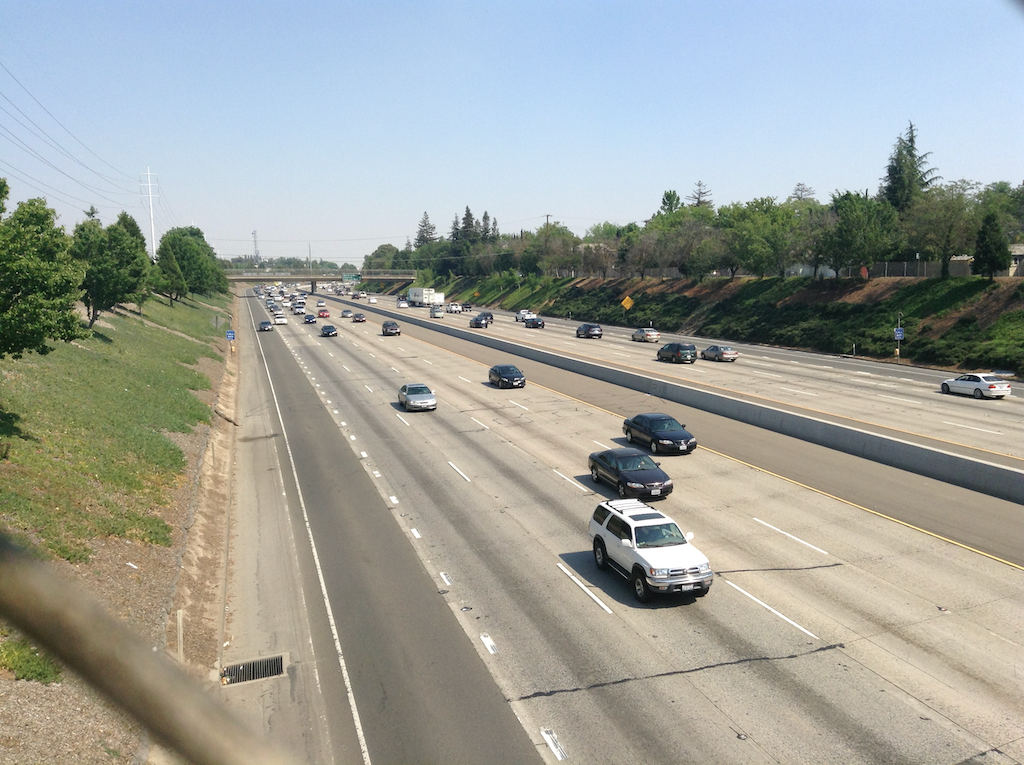
What’s next: transit

Part four of what’s next, part three being What’s next: squeeze roadways, part two being What’s Next: parking, and part one being What’s next: freeways. Radical ideas for what to do now that the road safety and transit initiative SaferSacStreets did not make the November ballot.

The SaferSacStreets citizens initiative would have provided about half of the funds to transit, mostly SacRT. SacRT is a seriously underfunded transit agency, surviving on about 1/6 of a cent sales tax, which is far less than any other city transit system. What is does get is about a 1/3 part of the Sacramento County Measure A transportation sales tax, 1/3 of 1/2 equals 1/6. Of course SacRT gets some other funds from state and federal sources, but these are mostly for infrastructure, and it also obtains grants from time to time, which help, but again, are for infrastructure and not operations. Infrastructure is important, as it maintains and replaces buses, and maintains and replaces light rail vehicles, as well as other needs including expansion. If you have seen or ridden the old light rail cars, which are far, far past their expected lifespan, you will know what neglect of maintenance and replacement looks like. Fortunately, SacRT has replaced part of its fleet with new Siemens S700 light rail cars, now used on the Gold Line, and to be used throughout once enough new cars are purchased.

The other significant issue for SacRT is that they have been using money designated for infrastructure to pay for operations, for several years now. The state encouraged this, and federal government allowed it with some funds, but the state funds are running out, and under this administration federal funds are uncertain, so a crisis is coming when there won’t be these extra funds for operations. Without a new revenue source, cutbacks will be necessary. The new sales tax in City of Sacramento would have allowed SacRT to shift funds back to maintenance, and to at least some expansion of service. SacRT is in a planning process, SacRT 2025, which identified what an additional 1/4 cent or 1/2 cent of sales tax would do. The 1/4 cent summary and map is below. Note that this planning is for the entire system, basically Sacramento County. The City of Sacramento would have generated about 1/3 of this amount (in very rough terms, 1/3 of the population and 1/3 of the sales tax income is from the city), and would have been spent on enhancing transit in the city, though of course expenditures in the city would have beneficial impact throughout the system.
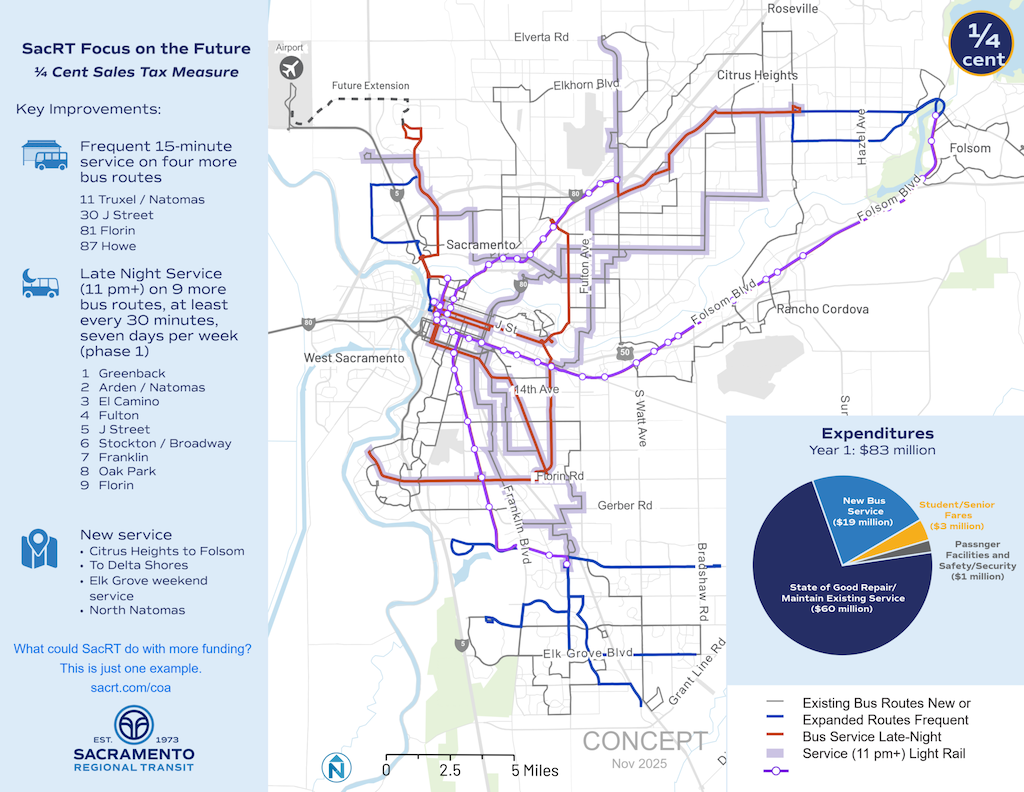
diagram of SacRT summary and map of 1/4 cent options
SacRT summary and map of 1/4 cent options

So, no new income. What can be done to maintain service, and to mitigate the cutbacks that will be needed? I have more uncertainty and fewer ideas than I did with the three previous posts that focused on the roads portion of the initiative. But here are some:

Third lanes become transit lanes: I recommended that the third lane of roadways be closed to reduce motor vehicle capacity. Instead of closure, these can be converted to full time transit-only lanes. Most arterials with three lanes per direction are also bus routes, so there is overlap in the benefit. Transit-only lanes would require some paint and signing, so probably somewhat more expensive than closure, but on the other hand, no concrete barriers, and vertical delineators only in some locations. Probably just as important is making light rail tracks exclusive to transit use, for example on 12th Street where motor vehicle traffic interferes with light rail trains. But the locations where transit-only lanes for buses and trains are few enough that this is not going to make huge difference for the system. Eventually, there should be transit-only lanes on smaller streets, but that requires planning that will take time, and money.

Rebalance frequency vs coverage: It is time for a quick system revision process, similar to the SacRT Forward process in 2019. There won’t be the money to do a comprehensive cut, so this would be rougher. My preference is to eliminate low ridership routes, or reduce span of service to higher ridership times. I realize this would leave people in lower density areas with poorer service, or without any service, but something must be cut, and I’m less sympathetic to people who have chosen to live in lower density areas where efficient bus service is just not possible. When there was extra money, lower density areas were served by SmartRide, but those funds are long gone, and the current on-demand Flex program only serves seniors, disabled and low-income riders. There won’t be money for in-depth planning and public engagement process, so staff’s best guesses will have to do.

Drop light rail extension ideas: Green Line light rail to the airport, and Blue Line light rail to Elk Grove projects continue to receive support from politicians, SacRT board members, and some SacRT staff. Under current funding and reasonable likelihood of funding, these project will never happen. There are other longer term light rail extension projects that are still on the table but not current focus. I think SacRT should drop planning, and discussion, for all of these extensions. Someday, once society shifts interest and funding away from private motor vehicles and towards transit, these projects might come back, but by that time, current planning would be so out of date as to be largely useless. Let it go!

Evaluate staff: It is characteristic of SacRT that staff decisions often turn out to be wrong. Sometimes they are reversed or modified after public feedback, and sometimes they aren’t. These poor decisions are, I think, the result of significant incompetence with some staff. Not all staff, not even most staff, but staff in key decision making positions. Repeated mistakes are not held to account, but are glossed over. This must end. Under constrained funding, every decision should be the best that can be made with current knowledge and experience. Some current staff is just not capable of that. They should be held to account or let go.

That’s it for my radical proposals, for now. I look forward to hearing from other individuals and organizations about their ideas. One the standards answers is ‘do more with less’, but we were already doing more with less. At least for the time being, less is what it is. I have doubts about future funding, from sales tax or other sources, and I’ll write about that eventually.

What do you think?
Slow Down Sacramento’s response to the initiative failure

As I previously posted (SaferSacStreets doesn’t make the ballot), the citizen initiative in the City of Sacramento to fund roadway safety and transit did not gather enough valid signatures for the November 2026 ballot.

Slow Down Sacramento/Isaac Gonzalez sent an email yesterday on the question of ‘Where do we go from here?’. I want to acknowledge that Slow Down often writes more clearly about transportation safety for walkers and bicyclists than anyone else in the Sacramento region. Including me! So I really encourage you to read the email, which I’ve linked: https://mailchi.mp/d31f8ff7a298/thank-you-for-being-a-change-maker-14211892?e=295546f14d. Of course you should be a supporter of Slow Down, and getting the email directly to your inbox. I am a supporter, and have been since the organization launched in 2023, three years ago.

I agree with everything in this email, including the list of ten priorities, and that is why I’m strongly encouraging you to read it. It isn’t short, but it is well written and covers the topic very well.

Tomorrow I’ll post some of my more radical ideas about ‘what now’, but please read Slow Down Sacramento first.

SaferSacStreets doesn’t make the ballot

The County of Sacramento determined that there were insufficient valid signatures for the SaferSacStreets initiative to be on the November 2026 ballot.

Below is an email sent to supporters.

This leaves the City of Sacramento efforts to make streets safer for all users without the funding needed, since the city allocates very little general fund money to street safety. It leaves SacRT without funding needed to enhance existing bus service, particularly increasing frequency and span of service on high ridership routes.


We are saddened today to report very disappointing news. The Sacramento County Registrar of Voters has determined that the Sacramento Safe Streets and Affordable Transit Measure of 2026 did not have enough valid signatures of registered City voters to qualify for the November ballot. 

As we reported a few weeks ago, the campaign delivered over 32,000 signatures to the City Clerk on June 30, 2026. By submitting 10% more than the statutory minimum, the measure qualified for a random sample count. A full count would have taken three months and would not have allowed the measure enough time to qualify for the November ballot.

We are currently inspecting the petitions and the County’s random sample count verification process to determine if there were any possible errors or other factors that could lead to the measure qualifying for an election in 2028. However, it is clear that the measure will not be on the November 2026 ballot.

This result is heartbreaking for all of us who have invested so much time, expense, and energy into bringing this measure forward. We always knew it was a long shot to mount a citizens initiative that was so short on time and money, despite the tremendous support and enthusiasm from all of our volunteers and supporters. We will update you as soon as we can, including future options. You can also check our website for updates at http://www.safersacstreets.com

Thanks for your support.

Steve Cohn, Deb Banks, and Sam Rice

Safer Sac Streets Co-chairs

CTC = the highway lobby

California OKs a lot of new freeway lanes during climate change-fueled heat wave (SacBee, Ariane Lange, 2026-03-21)

The California Transportation Commission (CaTC; CTC is Commission on Teacher Credentialing) has approved yet more of your tax dollars to serve a small segment of the population, those who commute long distances. Freeways will be expanded all over the state. Why is more highway capacity needed? Because more lanes equals more driving, equals more gas tax, equals more money for highways. It is a circular loop, also known as a growth ponzi scheme.

The CTC has long been in the pocket of the highway lobby, which is composed of the asphalt and concrete providers and construction companies, the fossil fuel companies, and the politicians who love ribbon cuttings over actually doing something to benefit their voters (of course, as we all know, most politicians first consider their campaign contributors, and only if it doesn’t conflict, citizens).

But because CTC continually funds highway expansion, basically giving Caltrans everything that asks for, so long as it is capacity expansion, and refuses to give serious discussion or attention to climate change and the evolved transportation environment, it has really become the highway lobby.

Because nearly all transportation funding (otherwise known as your tax dollars) goes to highway expansion, there is little left at the state level for maintaining highways. And little at the regional (SACOG) level. And almost nothing at the county and city level. Your street is likely falling apart, because the money is going elsewhere.

Caltrans has built a transportation system based almost solely on the needs of commuters and freight, though because of congestion induced by commuters, it no longer serves freight very well. Active transportation was not just an afterthought, but was actively planned against. The most dangerous roadway locations in the state are highway onramps and off ramps, which were designed for the highest possible motor vehicle speed, and usually have minimal or no accommodation for people walking and bicycling. As if the ramps were not bad enough, Caltrans retains control of overpasses and underpasses, though they spend none of their money on improving those, forcing local entities to spend their own limited funds to fix Caltrans mistakes. And there are plenty of Caltrans mistakes to be fixed. Billions of dollars worth. Instead of fixing things, Caltrans builds more. More problems to solve, more infrastructure to maintain, but without asking for very much for that maintenance.

Nine of the eleven members of the CTC are appointed by the governor. So our windshield governor owns the misallocation of taxpayer dollars. Of these members, only two could be considered advocates for active transportation, transit, and rail: Adonia Lugo and Darnell Grisby. A few others are not opposed to these, but not very supportive. Some are actively opposed to spending state money on anything but highways.

Strong Towns has addressed this travesty by documenting how the era of Interstate Highway expansion is and should be at an end:

Of course Caltrans and its enabler CTC is not just expanding the Interstate system, which they are, but the entire state highway system.

CTC is broken. Can it be reformed? It seems to me unlikely. Since CTC largely serves to give Caltrans whatever it wants, maybe it would be better to just give the budget directly to Caltrans. Nothing would improve, but at least active transportation, transit, and rail advocates would only have to monitor one agency instead of Caltrans and CTC.

Safer Sac Streets

The website for Safer Sac Streets (Sacramento Safe Streets and Affordable Transit Measure of 2026) is now up. The website includes the full text of the measure. It has links to donate, get involved, and endorse.

The measure is a citizen measure, developed by a variety of walking, bicycling and transit advocacy organizations and others, unlike the fake ‘citizen’ measure of 2022 which was a Trojan horse for sprawl developer interests, and failed spectacularly. As a citizen measure, it requires only 50% + 1 to pass. It is also limited to the City of Sacramento, which has been strongly supportive of transportation and transit funding in past measures.

Signature gathering will start as soon as the city clerk signs off and assigns a letter, very soon. The measure will require about 31,000 signatures. Though some funds are available to signature gathering, most will be done by advocates, which is good since they will know more about the measure and local needs and perspectives, unlike the signature gatherers at grocery stores and farmers markets who often know nothing about the measures and propositions they are gathering signatures for.

The campaign kickoff will occur Sunday, March 15 at 1:00 PM, New Helvetia Brewing Company, 1730 Broadway, Sacramento.

Getting Around Sacramento will have more posts about the measure.

regional block grants for transportation

This week’s podcast Talking Headways Podcast: Localities Subsidize the State DOT, Talking Headways, Jeff Wood, was an interview with Adie Tomer of Brookings Institution about a research paper recommending that some federal transportation funding go directly to regional government, MPOs (Metropolitan Planning Organizations) and COGs (Council of Governments), rather than through state departments of transportation. The paper points out that in most cases local governments are subsidizing the state DOT, giving more money to the state than they are getting. The solution suggested is regional block grants (Regional block grants: A new approach to funding transformative infrastructure projects, Brookings Institution, 2025-05-08).

“Regions are the economic hubs of the nation, with metropolitan areas alone producing 90% of gross domestic product in 2023.”

“Regional infrastructure needs are complex, outpacing existing federal funding mechanisms. Formula funds primarily flow to states, while regional actors struggle to qualify for many competitive grants.”

“A new federal model should empower regions and their localities directly. Regional block grants can equip regions with predictable, flexible funding to deliver transformative infrastructure.”

I love the idea! Caltrans gets state funding, and gets a portion of SACOG funding, and a portion of Sacramento Transportation Authority funding. That allows Caltrans to continue to widen freeways and build interchanges, while local roads are pocked with potholes. We have ever fancier freeways with ever expanding lanes. Why? We don’t need that, it contributes nothing to solving our transportation needs, but just induces more driving and more congestion and more pollution and more crashes.

There is a constant tension at the SACOG Board when Caltrans demands funds that come from the state and other sources, for their pet projects. Same at SacTA, when Caltrans demands funds that come from local sales tax. Time to end this!

I encourage you to listen to the podcast, available on any podcast reader, and check the Brookings research paper.

alternatives to transportation sales tax

Sales taxes are regressive, in that lower income people pay a higher percentage of their income in sales tax than do higher income people. In Sacramento area, a new transportation sales tax measure is being talked about, whether for transportation in general, or for transit specifically. No proposals have been made, but there are certainly many discussions in many arenas.

The San Francisco Bay Area is also having the same discussions. There is legislation to authorize a transportation sales tax measure in up to five Bay Area counties. A recent KQED article (Proposed Transit Tax Should Be Paid by Businesses, Not People, Progressive Group Says) talks about discussions, and an alternative proposal to use a business gross receipts tax instead of sales tax. It is true that any tax ultimately comes out of the pockets of citizens, but a gross receipts tax is better distributed and not as regressive.

I have a concern that politicians again and again go to the default of sales taxes because it seems easier to sell. But sales tax rates are already very high, and there is increasing evidence that voters will not go for a higher sales tax rate, no matter what the topic or the benefit.

I’ll write more about funding options in the future. Past posts include Is sales tax for transportation the wrong approach?, transportation funding ideas, and many, many others under the category: transportation funding. I was amazed, looking back, at how many times I’ve posted about transportation funding and tax measures.

AB 1223 for wider SacTA authority

AB 1223: Local Transportation Authority and Improvement Act: Sacramento Transportation Authority (Nguyen/Krell) has been introduced in this legislative session. As of April 2, it is still in the Assembly Local Government Committee.

“The bill would provide that the allowable expenditure categories for revenues from a tax imposed by STA include the construction, modernization, and improvement of infrastructure, as defined, that supports infill or transit-oriented development and would reduce vehicle miles traveled.” It would also allow Sacramento Transportation Authority (SacTA) to develop and operate toll facilities, and to impose taxes on areas of less than the entire county.

SacTA is currently operating under general state legislation, and the Measure A code that established the authority. The authority now wishes to make clear that expenditures which broaden the mission to more transportation and infrastructure projects that support transportation are within the purview of the authority.

It isn’t clear to me how the toll facilities ability would mesh with the Capitol Area Regional Tolling Authority (CARTA) which is intended to cover the SACOG region.

The less than-full-county voting area is similar to that implemented for SacRT, but does not require that two or more cities be adjacent, as does the SacRT legislation. The idea is the same, that some areas of the county will be opposed to any sales tax measure, no matter what it contains, so creating a measure that targets supporting areas makes sense.