more on Steinberg’s transportation and housing proposal

My previous post on Mayor Darrell Steinberg’s transportation measure proposal was based on the August 25 press conference and panel discussion which included Elk Grove Mayor Bobbie Singh-Allen, Steve Cohn of SMART (Sacramento Metro Advocates for Rail and Transit), Cathy Creswell, Chair of Sacramento Housing Alliance, Luke Wood, President of Sacramento State, and Gabby Trejo of Sacramento Area Congregations Together (SacACT).

A ten page summary of the proposal offers more detail on ‘The Climate, Clean Transportation, and Affordable Housing Act of 2024‘. The proposal offers three major program areas, each of which would receive about one-third of the revenue generated.

  1. Affordable housing and displacement prevention
  2. Investing in public transportation
  3. Safe streets and active transportation

For affordable housing, there are three sub-programs:

  • Creation of new affordable housing on vacant or underused infill sites and along existing commercial corridors and/or transit lines: infill housing rather than greenfield development (which can never be affordable because lower housing costs are more than counterbalanced by higher transportation costs)
  • Preventing displacement and homelessness: keeping people in their homes so they don’t become homeless
  • Green Means Go: enhancing infrastructure needed to support affordable infill housing

For public transportation, it would fund high priority public transit improvements, with four elements:

  • Bus rapid transit countywide. This element was important enough to Steinberg that he highlighted it on his webpage, table below. Note that light rail extension is a possible future enhancement to BRT to Elk Grove and the airport, but it does lock in these extensions are other proposals have.
  • Expanding service & frequency on existing transit lines
  • Light rail fleet replacement and station renewal
  • Regional (Intercounty) Transit Network/ express bus services
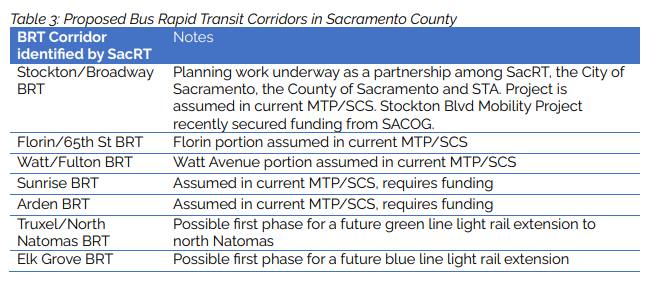
table of Proposed Bus Rapid Transit Corridors

For safe streets and active transportation, there are two sub-programs:

  • Fixing the roads and active transportation
  • Innovative mobility: unfortunately, the focus is on motor vehicle electrification, and not e-bikes and shared mobility devices

Note that though the documents calls for a half-cent sales tax, Steinberg said he is open to other funding ideas including property tax. He also implied that if the rest of the county is not on board with an innovative investment strategy or tries to water it down with the traditional road building and widening methods, the city would go its own way.

Certainly we need more detail, but I support the vision that Steinberg’s proposal puts forth. Almost of all of our transportation expenditures in the past have disinvested in, or active harmed, communities of low income and people of color. They have continuously widened and extended roadways, mostly for the benefit of high income suburban commuters. They have built and over-built transportation infrastructure that we will never have enough money to maintain, and insisted on building more rather than taking care of what we have. They have actively discriminated against people who walk and bicycle. They have ignored the established fact that adding roadway capacity induces more travel, so that ‘congestion relief’ is always out of reach.

It is time for a new approach, and I believe that Steinberg’s proposal is an important step along the way to a better future.
SacTA hears voter survey

This afternoon (2023-09-14, 1:30PM), the Sacramento Transportation Authority (SacTA) will hear from consultants about a survey of likely voters and attitudes toward a transportation sales tax measure. Agenda item 13 is available (the entire agenda packet is so long that it is hard to find this item; this is a low resolution version).

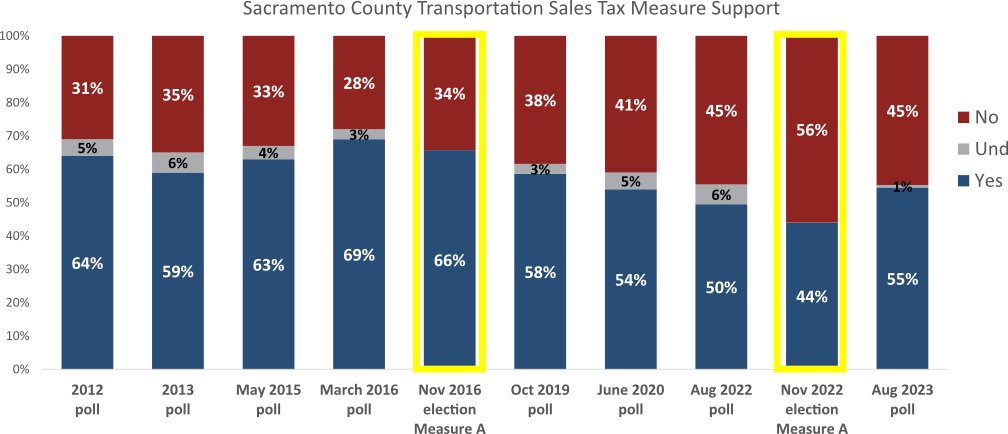
The survey indicates that only 54% would vote yes, which is less than the 67% required for passage, assuming that the measure is sponsored by SacTA, and not a citizen initiative.

There are a lot of interesting bar charts, in the presentation. Below is just one, showing the level of support in various surveys and actual elections over time. I recommend you take a look at the whole document to see what jumps out for you.

bar chart showing Sales Tax Measure Support over time
Sales Tax Measure Support over time

The presentation does not really address what I think is a key factor, which is the cynicism developed by voters over time when the same failed policies get presented again and again. The 2016 Measure A, the withdrawn 2020 Measure A, and the landslide failure of 2022 Measure A presented transportation investments that are more of the same: more highways, more interchanges, more roadway capacity, more air pollution, more greenhouse gas emissions. The voters have never been offered an alternative that does not represent the interests of traffic engineers who always want more: more cars, more concrete, more ribbon cuttings, more money. Particularly after the 2022 developer-sponsored ‘citizen initiative’, voters don’t trust that sales taxes will be spent on what they actually need for livability and economic vibrancy. 2022 Measure A was just more money in the pockets of greenfield developers and highway builders. Money out of the voters pockets.

But there is now an alternative, Mayor Darrell Steinberg’s proposal. I wonder if that were presented to the public, what the level of support would be. More about that in the next post.

$5 billion, or reduce cars

The number of $5 billion (or more) has been bandied about recently as the amount of money we need to fix all the poorly designed and dangerous roads in the City of Sacramento. The number seems reasonable, and I myself have estimated that sidewalk repair alone is $1.5 billion. This is just the city, let alone the county or region. The county and region are in most cases much worse off than the city. I support more funding for this work, some via sales taxes, but more via property taxes. After all, it is property that requires our transportation infrastructure and benefits from a good system.

But what if there is a better way? A less expensive way?

I encourage you to watch the latest (August 24) episode of Not Just Bikes (by Jason Slaughter), titled ‘Even Small Towns are Great Here (5 Years in the Netherlands)‘. He has collected video clips from visits to small towns across the Netherlands. He has two main points about small towns: almost all of them are served by good rail service, and many of the small towns and suburbs don’t need extensive bike structure because there are so few motor vehicles that it is safe and comfortable to ride on any street. My favorite quote from the video is:

“To make a place friendly for cycling, it was more important to restrict cars than it was to build a bunch of expensive bicycle infrastructure. After all, protected bike lanes are just an extension of car infrastructure, right. You don’t need bike paths if you don’t have a lot of cars.”

Not Just Bikes (Jason Slaughter)

A related quote, that I will have to paraphrase, since I can’t find the original source is: We have plenty of space for bikes on our streets, its just that it is currently occupied by cars.

The point, for me, is that we could make much more effective investments if we greatly reduced the number of cars on the road rather than trying to make all our roads safe for bicycling and walking. We need to make car drivers pay the true cost of their transportation choice: fossil fuel extraction, climate change, air pollution, expensive highways, foreign wars and fossil fuel subsidies, and a long list of others. Yes, and making it necessary to build protective infrastructure for walkers and bicyclist to protect them from those drivers. We need to make is more expensive and less convenient to drive, so that people will make other choices.

If we actively and directly reduce car dominance, we might only need $1 billion to fix everything. Still a lot of money, but not out of reach.

Jason moved to the Netherlands from Canada, but the car dominated ‘no places’ that he left are the same car dominated ‘no places’ of the United States, and of Sacramento. In fact, Canada tried to imitate the US, and left themselves impoverished, both economically and mobility wise.

Imagine for a moment, someone saying “Carmichel, where there are so few cars that it is safe to bicycle and walk on any street, and the are great transit connections to all the regional destinations.” They would be laughed out of the room. Yet Carmichael, and unincorporated town in Sacramento County, is about the same size as many of the small cities called out in the Not Just Bikes video. We have designed a horrible world in service of the idea that we can and should drive everywhere. We if we flip that and make it hard and expensive to drive everywhere, places will begin to heal. Even Carmichael.

Steinberg’s proposal for 2024 county ballot measure

Mayor Darrell Steinberg used his third State of the City address on Friday to introduce his concept of a housing and transportation measure for the 2024 ballot, called the ‘Climate, Clean Transportation and Affordable Housing Measure’. The half cent sales tax would generate about $8-9 billion over the 40 years, and the transportation aspects would be administered by Sacramento Transportation Authority (SacTA) which administers the current Measure A. More detail is available on the Mayor’s Community Engagement website https://engagesac.org/blog-civic-engagement/2023/8/25/a-new-vision-to-fund-affordable-housing-and-transportation.

One-third would go to a countywide housing trust fund, to provide affordable housing, permanent supportive housing, and other types. One-quarter of the one-third would be devoted to keeping people in their housing so they don’t become homeless to begin with.

Another one-third would go for public transportation. Specifically, initiate bus rapid transit routes, increase bus frequencies on all routes, buy new fleet, and create express buses across the region.

The other one-third would be for safe streets and active transportation. Implement vision zero, build sidewalks and protected bike lanes, multipurpose trails, car and bike share, and repair roads, all with an equity lens.

All of these investments would help the city and county reach the agreed-upon greenhouse gas (GHG) reduction target of 19% for the region.

Steinberg acknowledged that there will be opposition from the old guard, who want to keep doing the same things that don’t work and have never worked for most citizens of the city and county.

He pointed out that transit cannot be effective unless we achieve a density of housing and destinations that allows transit to work.

The mayor said that he would prefer a countywide measure, but would go for a city measure if the other partners (county and the four cities) are not interested. He emphasized several times that climate change compels us to change directions and invest more wisely.

Panel

A panel was composed of Elk Grove Mayor Bobbie Singh-Allen, Steve Cohn of SMART (Sacramento Metro Advocates for Rail and Transit), Cathy Creswell, Chair of Sacramento Housing Alliance, Luke Wood, President of Sacramento State, and Gabby Trejo of Sacramento Area Congregations Together (SacACT).

I won’t detail the panel questions and answers, except to say that there was a recognition among all that housing and transportation are inextricably linked. If you watch the video of the session, note that the first ten minutes is dead air space, and the quality of the video is poor. But still worth watching.

As I say, “You can’t have affordable housing without effective transit, and you can’t have effective transit without a density of housing and services”.

Sac City is transportation bankrupt

There is an insightful admission hiding in the City of Sacramento General Plan 2040 update. In the Mobility Element, A Multimodal System section, Maintenance and Funding subsection (page 8-8), “A key challenge for Sacramento is that existing revenue streams do not fully cover operations and maintenance costs, and this same funding is also used to support implementation of improvements for safety and mobility throughout the city.”

Revenue does not cover expenses. Liabilities exceed assets. The city is bankrupt, just as you would be in this situation. Some asset of yours, like your house if you own one, or your business if you own one, is deteriorating, and you do not have the income to fix it. In the case of the city, it has incurred debt in order to build a transportation network that it cannot possibly maintain under the current taxation regime. And it never will. Never. If the city raised taxes, of whatever type, to the point they would pay for debt service and maintenance of the existing system, people would revolt. And that does not even include the new transportation infrastructure that some people would want. The city’s transportation system is bankrupt. It always will be. The core of the reason is that the city asked developers to pay for transportation infrastructure within a development, but then the city takes on liability for maintenance of that infrastructure. It all looks good for about 30 years, until things start to fall apart. The streets need repaving. The sidewalks are cracked. Painted lines and crosswalks have long since faded to invisibility. Not to mention what lies beneath (water and sewer), which is even more expensive to fix. For an in-depth explanation of how cities and counties and states got into this situation, I can recommend Confessions of a Recovering Traffic Engineer: Transportation for a Strong Town, and Strong Towns: A Bottom-up Revolution to Rebuild American Prosperity, both by Charles Marohn of Strong Towns. In fact, just in time for my post, an article today on Strong Towns: Why Cities are Flying Blind When It Comes to Their Own Debt.

So, what to do?

  1. Don’t bond anything again. We don’t need more roadways, or wider roadways, or interchanges. We don’t need big projects. Pay for maintenance of what we have, out of current income. This also means that we would never again bond against future income for current funding, as the city has done with parking revenue.
  2. Figure out what we can’t afford to maintain, and have that discussion with the public. I’d suggest that we can’t afford to maintain parking areas, whether on street, surface lots, or structured parking. Parking has never paid for itself and never will, and if we have to triage our transportation spending, it should be the first to go. Next would be cut-de-sacs and intentionally dead-end streets.
  3. Change accounting and budgeting so that transportation infrastructure shows up as a liability in accounting and budget, because it must be maintained forever, rather than as an asset.
  4. Cease accepting responsibility for new roadways built by developers. If a developer wants infrastructure, they can pay for it, and maintain it, forever, by setting aside reserves to cover the necessary maintenance. This would result in gated communities, which I definitely do not like, but a gated community is better than fiscal bankruptcy. It would also result in far, far fewer greenfield developments, since the financial model for these is that society will take on maintenance responsibility, and will build the surrounding infrastructure of arterial roads and highways that the development must have to pencil out. That is all to the good.
  5. Wean the city off of federal, state, and regional grants. Not all at once, but decrease the percentage of transportation projects that depend on outside money. This would mean even less money for transportation in the city, but it would force the city and citizens to look at what is really important, to individuals and society, and spend on the things that are really important. I hope that safety comes out at the top, and that we spend on transforming out transportation system from the current one that kills and maims people to one that protects vulnerable users first and foremost.

Note that the city is bankrupt in many ways, not just transportation. But transportation is my thing, so that is what I focus on.

Capital Southeast Connector sneaks another one in

Please see the Streetsblog California post today on transportation projects which increase VMT (vehicle miles traveled): California Will Continue Funding Projects that Induce Driving, Despite State Policy. The post in particularly calls out the Capital Southeast Connector highway project in Sacramento County as inducing VMT (not to mention greenfield developing), in direct violation of the principles of California’s Climate Action Plan for Transportation Investments (CAPTI).

When CTC (California Tranportation Commission) member Darnell Grisby raised questions about the project, the project representative tried to gaslight Grisby and the commission by saying the JPA did not have land use authority and the development to be induced is not their problem. But the JPA does, indirectly, because highway projects promote sprawl and directly reduce the effectiveness of walking, bicycling, and transit projects.

Having been shot down in the recent Measure A sales tax, which failed in large part because it included controversial Capital Southeast Connector projects, the JPA (joint powers authority) is trying other back-door methods. The ultimate outcome desired by the JPA is a full freeway from El Dorado Hills and Highway 50 to Elk Grove and Interstate 5. The public has rejected this idea, so the JPA is working to sneak the project through in segments, by nickel and dime-ing the taxpayers until it is ultimately finished. In case you aren’t aware of the Capital Southeast Connector, I have written about it many times: Measure 2022: Southeast Connector exceptionalism, No to the southeast connector, Measure 2022: greenfield developer sponsors, and many others on the failed Measure A 2022.

SACOG has repeatedly refused to put the project as a whole into the regional MTP/SCS (metropolitan transportation plan / sustainable communities strategy) updates and specifically said it will not be in the upcoming Blueprint.

The Capital Southeast Connector JPA is a rogue agency. It serves the needs of greenfield developers and politicians who see the future as even more motor vehicle dominated than the present. The JPA should be disbanded. This probably wouldn’t completely kill off the project, since the county and cities might continue to waste taxpayer dollars on inducing sprawl and travel, in order to gain campaign contributions, but it would certainly help.

No Capital Southeast Connector highway, now or ever, in pieces or as a whole!

SACOG ATP awards

Ten projects were awarded ATP (Active Transportation Program) funding in the SACOG region for 2023-2027. Brief descriptions follow. All are full funding of the grant request, unless otherwise noted.

  • Citrus Heights – Arcade Cripple Creek Extension. Construct a 0.5 mile Class I multi-use trail following the Arcade Creek alignment between Sayonara Drive and Mariposa Avenue. $7,155,000
  • El Dorado County – El Dorado Trail / Missouri Flat Road Bicycle/Pedestrian Overcrossing. Construct a Class I multi-use grade-separated crossing over Missouri Flat Rd, closing a gap in the El Dorado Trail. $3,271,000
  • Elk Grove – Laguna Creek Inter-Regional Trail Crossing at State Route 99. Construct Class I Bikeway across State Route 99 and adjacent class I trail gap closure. $6,874,000
  • Folsom – Folsom-Placerville Rail Trail Gap Closure Project. Install curb ramps, sidewalk connections, curb extensions, pedestrian refuge islands, curb & gutter, raised medians, pavement markings, signage, striping, and asphalt overlay. $1,700,000
  • Roseville – Dry Creek Greenway East Trail, Phase 2. Construct a Class I multi-use trail and Class II buffered bike lanes. $6,063,000
  • Sacramento County DOT – Bell Street Safe Routes to School. Construct new sidewalks and curb ramps. Relocate signal poles and straighten sidewalks. Install pedestrian signal, RRFB, new signs, bike lanes and bike detectors. $8,808,000
  • Sacramento County Regional Parks – Dry Creek Parkway Trail. Construct a paved Class1 multi-use trail, including dg shoulder, plus two bridges and roadway crossing evaluation. $7,704,000
  • Sacramento – 9th Street Separated Bikeway Project. Construct a Class IV bikeway and a Class II bikeway. [This would extend the Central City Mobility Project from Q St to Broadway, which is not part of the current project.] $2,564,000
  • West Sacramento – North 5th Street Complete Streets & Connectivity Project. Project will install bike lanes, intersection enhancements, and new sidewalks, and an ADA ramp connection from 5th Street/A Street to Riverwalk Trail. $3,131,000 (partial funding)
  • West Sacramento – West Capitol Avenue Regional Connection Bicyclist and Pedestrian Safety Improvements. Construct vertical delineators to create separated bike lanes, Class II bike lanes , intersections improvements, and improve Westacre Rd underpass. $735,000

I am particularly pleased about Bell Street Safe Routes to School and Arcade Cripple Creek Extension, as these were projects that I promoted when I was Safe Routes to School Coordinator for San Juan Unified School District. Bell Street is used by many students attending Howe Avenue Elementary, Encina Preparatory High, and Greer Elementary, as well as several private schools in the area. The Arcade-Cripple Creek trail project serves both students at a number of schools and promotes active transportation for the entire community.

Capitol Corridor gets more TIRCP funds

Capitol Corridor has received more funds from the TIRCP (Transit and Intercity Rail Capital Program) for some projects in the Sacramento region. It includes full funding of the Sacramento Valley Station transit hub, additional funds for the Sacramento-Roseville third track project, and contactless readers for Thruway buses (presumable the same readers that have been installed on the trains, which will allow direct payment for trips once the Tap2Ride pilot is complete).

https://www.capitolcorridor.org/blogs/get_on_board/capitol-corridor-awarded-42-million-from-california-state-transportation-agency

What’s Next? – SacMoves Coalition

An earlier post covered the Mayor’s Environmental Advocates Roundtable.

SacMoves is a coalition of transportation advocacy organizations and environmental and climate advocacy organizations, primarily, though it does include some other interests such as housing. There are also a number of interested individuals who participate in the meetings. I am not speaking for the coalition. I represent one organizational member of the coalition, Sacramento Transit Advocates and Riders (STAR), and serve on the Process Committee of the coalition, but otherwise don’t have position or authorization to speak for the coalition. I am relaying information that I think will be of interest to others.

SacMoves decided not take a position on the Measure A transportation sales tax. Most organizational members were opposed to the measure, some very strongly, and there were a few members that did not want the coalition to take a position. As a result, several individuals and some organizations formed the MeasureANotOK group, assisted by Climate Plan, and were primarily responsible for defeat of the measure (though there is of course always an anti-tax contingent). And it was a resounding defeat!

SacMoves Coalition held a special meeting on March 9 to discuss What’s Next?, and more specifically whether SacMoves would take a key role in formulating future transportation funding, or would wait and respond to what others proposed. The group meeting that day confirmed that the coalition would take a key role, and the next regular meeting confirmed that. A one-page summary of the special meeting is here: https://gettingaroundsac.blog/wp-content/uploads/2023/03/sacmoves_2023-03-16_planning-summary.pdf.

The regular meeting on March 17 formed three working groups to start developing background information towards providing a model for transportation goals and funding, which are policy, funding, and communications. The coalition also decided to work more closely with housing and particularly affordable housing interests to see how each can contribute to the best solutions. Transportation and housing cannot stand in siloes, or they both fail.

The coalition does not see itself as the only group working on transportation funding. Organizational members and individuals are following and participating the other efforts, including the Mayor’s roundtable. Perhaps eventually the efforts will coalesce behind a single proposal which will move forward through the efforts of all the interested organizations and individuals.

Unfortunately, SacMoves does not have a website, so I can’t direct you there for more information or contacts, but if you contact me, I will pass you along to the right people.

What’s next? – Mayor’s Environmental Roundtable

After the failure of Measure A transportation sales tax measure, everyone who was for it, and everyone who was against it, asked ‘What’s next?’ It is clear there is a need to fund at least some types of transportation infrastructure, including transit, active transportation, and repairing the potholes. It is also clear to me, at least, there there is absolutely no need to fund roadway capacity expansion. We have all of the roadways we will ever need – we need less capacity, not more. But that is not clear to everyone. A lot of people initially were saying things like “we just need to improve the measure a bit, perhaps by removing the Capital Southeast Connector, and then it will pass in 2024. Fortunately, that view has faded. We need something much better than the failed Measure A, and it is not obvious that more transportation sales tax is the right solution. So, What’s next?

One of the groups working on that question is the Mayor’s Environmental Advocacy Roundtable (the mayor being Mayor Darrell Steinberg). A premise of the group is that there might be a role for the city in defining how to fund transportation, and perhaps creating a sales tax or other measure focused on the city. This group has met four times. I was able to attend the last meeting on March 22, and have a brief report. Please keep in mind that these are my notes about what I found interesting, not minutes of the meeting. First, two documents were available, shared here, the agenda, and the overview. Jennifer Donlon Wyant gave a presentation on the city’s transportation planning and funding, which I do not have available. The remainder of the meeting was discussion. So, my notes:

Read More »