red light cameras and law enforcement

Earlier posts on red light running and automated enforcement are available at category: automated enforcement.

The City of Sacramento has a crisis in biased law enforcement against people of color and low income, and also has a crisis of red light running.

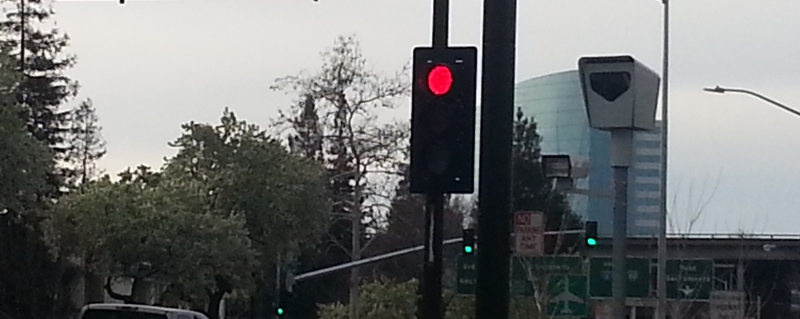
The city had red light cameras at eleven locations, part of a program managed by Sacramento County Sheriff’s Office. The county dropped the program in early 2024, and all cameras were removed. The county claimed that the fines from red light running were not paying the cost of the program, and of the contractor. The City of Sacramento therefore dropped its program and has made no effort to restart it. At the dollar value of human life being $10M or more, it is hard to understand how the county saw this program as too costly. City of Sacramento paid $27M in traffic crash lawsuits over five years. The county information does not seem to be available, but it would likely be larger due to higher population, more road miles, and more poorly designed roadways and intersections.

The nature of red light running is that a motor vehicle driver T-bones someone, impacting other motor vehicles, walkers and bicyclists at a perpendicular angle at high speeds, frequently resulting in a fatality. This is not the leading cause of fatalities, but it is significant.

There are reasonable objections to any law enforcement of traffic laws. Traffic stops are often pre-textual, intended to discover illegal activity or warrants that have nothing to do with traffic law, and to oppress people of color and low income. Law enforcement officers not infrequently escalate interactions, resulting in intimidation, unlawful arrest, and death. Law enforcement often focuses on communities with people of color and low income, both because of the pre-textual nature of stops and intended intimidation of people in those communities. Even when justified, tickets for traffic violations have an outsized impact on lower income people because fines are a flat amount no matter the income of the violator, so are strongly regressive. Court fees add a great deal to the cost of a ticket, often sending low-income people in a downward economic and legal spiral. 

Automated enforcement of traffic law removes some of these concerns, but not others. By removing the interaction with officers, law enforcement intimidation and violence is eliminated. But the issue of outsized economic impact remains.

If a red light camera program were to be restarted in the City of Sacramento, it would have to have these characteristics:

  1. The program would be operated by Public Works as part of their transportation management responsibilities, not by the Police Department.
  2. Camera locations would be selected based on traffic crash location hot-spots, but adjusted so that low-income communities do not have a higher number of cameras per-capita than other areas 
  3. For camera locations with a history of traffic crashes resulting in fatalities and severe injuries, and with a higher than average number of citations issued, the city would commit to making changes to that intersection to reduce the incidence of red light running and crashes.
  4. The fines for red light running would be reduced for low-income people. The reduction could be a) across the board for income levels below a certain set percentage of the median household income, or b) based on the value of the vehicle driven by the violator. Alternatives to fines could also be implemented. Though income based fines are often mentioned, and are used in other countries, concerns about privacy and availability of the data make this impractical. The value of a vehicle is easily available, and does track to some degree with the income of the owner. It is not certain whether these options could be implemented by the city now, or if changes in state law would be required, but the city should commit to exploring options and committing to a solution.

Two other types of automated law enforcement have been discussed. Automated speed cameras are legal under a pilot program for several cities, but Sacramento is not one of them. It is unlikely that other cities would be added, or statewide implementation would occur before the pilot is completed. It is possible that active intelligent speed assistance will become law in California, and obviate the need for automated speed enforcement, at least in urban areas.

Automated enforcement of ‘failure to yield’ to walkers (pedestrians) law would be very useful. Failure to yield sometimes results in fatalities and severe injuries, but it always results in intimidation of people walking by people driving, reducing the frequency and comfort of walking trips. The technology for detection of ‘failure to yield’ is not well developed, but has been implemented in some cities and is practical. ‘Failure to yield’ is another crisis on our roadways.

This recommendation to restart the red light camera program in the city does not indicate that it is the primary solution to the traffic violence crisis. It is one among many tools. Changes to the roadway, temporary (quick-build) or permanent, are by far the most effective solution and should be the lead action by the city.

SacCity pedestrian safety emergency: enforcement

The draft City of Sacramento emergency declaration on pedestrian safety: ‘Declaring a state of emergency regarding pedestrian safety in the City of Sacramento and calling for immediate action to address pedestrian injuries and fatalities’ is available (pdf of text, 2 pages, 68KB) (pdf of attachments, 28 pages, 26MB).

This post focuses on the enforcement item.

3. “The City Manager is further directed to work with the Sacramento Police Department to ramp up enforcement of traffic laws that protect pedestrians, including speed limit enforcement, crosswalk violations, and distracted driving. The City shall prioritize enforcement in high-injury corridors and areas with frequent pedestrian activity.”

Three advocacy organizations specifically commented about the draft that it must focus on ‘equity and mobility justice’, as did most of the people who spoke at the city council meeting.

I’ll be blunt. There is a deep and well justified mistrust of Sacramento Police Department (SacPD) among people of color and low-income, particularly among, but not limited to, blacks. SacPD has a history of oppressing black people, and has often used traffic stops as a pretext to harass people. Many of these have escalated into arrest, beatings, and even death. I have seen no real evidence that SacPD has changed their stripes. They are not people that I want interacting with the public about traffic law. And, apparently, they don’t want to either. SacPD has reduced its traffic officer group to almost nothing, and does little traffic enforcement by traffic officers or any officers. It is time to move past the idea that law enforcement has much to contribute to reducing traffic violence.

At the same time, no enforcement of any sort is not the answer. People are dying when drivers violate traffic law, and these deaths are unacceptable. Speed is a contributing factor to all traffic crashes, and is sometimes the primary factor. Driving too fast for conditions, and these conditions include walkers and bicyclists on and close to the roadway, is always wrong, even though road design encourages it.

Automated enforcement is a partial answer. It avoids the pretextual stops, avoids harassment of people of color and low-income by police, at least over traffic law, avoid the escalation that police engage in, and is much less expensive than police officers.

The three main traffic violence issues to be addressed, at least at this time, are:

red light running: Red light cameras and automatic ticket issue to the owner of the vehicle are a partial solution to red light running. Of course some drivers will always run red lights, will always endanger others, and will not be deterred by tickets. But most drivers will notice that tickets are being issued, and will change their behavior. Red light running does have infrastructure solutions, including changing from far-side signals to near-side signals, and raised crosswalks and raised intersections. But there are not easy or inexpensive fixes, so automated enforcement is a good interim solution. When the county ended its red light program, which operated the red light camera in the City of Sacramento, the city made no effort to replace that program, and at least some city staff celebrated it (the red light runners?). The city should create a red light camera program of its own. It should be administered by Public Works, not by SacPD. There are equity issues, since the wide, high speed arterials that most encourage red light running are in low-income communities. Two solutions are to distribute cameras across the city in locations where red light running might occur, and not just those locations with a history. The egregious violators, which are who we really want to target, will be receive tickets eventually. The second is to adjust violation fees (and court costs) to a factor related to income. It would be awkward and perhaps invasive to base it on income, but it could easily be based on vehicle value.

failure to yield to walkers: Drivers have been trained by roadway mis-design to not yield to people in crosswalks. The recent SacPD, OTS funded, sting on J Street demonstrated how common this is. But again, as drivers have been trained to do this, they can be untrained. There are options for automated enforcement of failure to yield, but it requires more complicated and less widely used technology. The city should be experimenting with this technology (they are not), but in the meanwhile, this may be one situation in which in-person enforcement, on a limit basis and with close attention to equity concerns, may be justified. Any in-person enforcement by SacPD raises issues of police violence and over-reaction, including high-speed chases of violators. One solution is to ban high-speed chases. With technology such as helicopters (which the police love) and drones, there is no reason to endanger the lives of violations, bystanders, or officers themselves with high speed chases. Too many cops have watched too many movies with the thrill of high-speed chases. The practice must end.

speeding: There is available and highly reliable technology for automated enforcement of speeding. There is a state-authorized pilot program of speed camera enforcement in six cities and part of Pacific Coast Highway. Sacramento is not among them. To its credit, City of Sacramento asked to be part of this pilot but was not included. The city should strongly lobby the next legislative session for inclusion, and should have a program designed and ready to go when authorized. Speeding is the most common concern of the public, and it is true that speed is a factor in every crash, I’m doubtful that it is the biggest concern. I’d rather see a focus on red light running and failure to yield.

I believe that item 3 should be deleted for its likely failure on equity and mobility justice.

I have not yet written about the other six items, and don’t know when I’ll be able to get to it. However, I will say now, in case you were wondering, that by far the most effective city response is temporary (quick build or tactical urbanism) and permanent changes to roadway design. And what it will take to accomplish those changes is funding, from the city general fund. The seeking of grants, and waiting years or decades for the funding to address traffic violence, is only part of the solution. If this is truly an emergency, and it is, the city must spend significant funding to act on it, and act now.

street design and land use

Street design and land use are intimately connected. Street design should support surrounding land use (not land use somewhere else), and land use should take advantage of the best characteristics of streets. But in most of Sacramento, street design and land use do not support each other.

At the regional level, SACOG (Sacramento Area Council of Governments) has transportation authority but does not have land use authority. They must rely on encouragement of local governments to implement better land use, and is able to use transportation investments to a small degree to support better land use. But the City of Sacramento does have both transportation and land use authority, and could and should be planning the two in unison to accomplish a more sustainable and livable built environment.

Many of our streets are designed to allow people to pass through at high speed, not to stop for living. In some cases, this is an historical artifact because some of our major streets were at one time state highways. But other streets were designed in the same way in more recent times. The city has allowed and encouraged business development along these former highways, with more driveways, more parking, more intersections, more congestion that reduces transit effectiveness, and fewer safe crossings. At the same time, the city has widened roads and widened lanes, creating or maintaining high speed limits which are completely incompatible with the function of streets as places, or as Strong Towns puts it, places for building wealth.

The roadways which try to combine the functions of high speed and throughput with local productivity are called ‘stroads’, a street/road combination. These roadways fail at both. They must be healed by conversion to either streets or roads.

Stroad to Road

In order to bring street design and land use into alignment, the city must either redesign these stroads (a street/road hybrid) toward road function by:

  • Greatly reduce driveways and eliminate on-roadway parking
  • Eliminate signals that serve shopping centers, and replace major signalized intersections with roundabouts
  • Provide on-demand safe crossing at moderately frequent intervals for walkers and bicyclists
  • Discourage homes and businesses along these roadways

Stroad to Street

Or, redesign these stroads toward street function by:

  • Change roadway design to enforce motor vehicle speeds of 20 mph or less
  • Encourage homes and small businesses along streets
  • Create space for living in the public right-of-way by temporary or permanent closure of some streets, and street or sidewalk dining areas (with ADA-compliant routes).

In most cases it is more cost effective to change a stroad to a street, but both transformations are possible and necessary. We need fewer roads and more streets in our transportation system.

Land Use

An effective land use pattern offers the opportunities of daily life (jobs, businesses, dining, entertainment, groceries and shopping) within walking or bicycling distance of home. In Sacramento, the midtown section of the central city already offers this type of land use, because it was developed before the primitive concept of zoning pushed all uses further away. A few other places in Sacramento offer widely scattered examples of such land use.

Relatively few trips outside the neighborhood would be necessary if we had this type of mixed use and diverse land use. Though both land use and streets in midtown could be even better, it is an example which other neighborhoods could emulate. Of course streets must support this land use, with slow speeds which do not endanger people walking and bicycling, and where parking is sufficient but not in excess.

The city should support small businesses in every reasonable way. It need not prohibit larger businesses, but let them succeed or not on their own, without promotion or subsidy from the city.

Small parcels, often called fine-grained development, best support a diversity of housing types and businesses. The city should preserve small parcels, prohibiting consolidation except under compelling public interest, and where large parcels exist, consider purchase, division into small parcels, and sale to small scale infill developers.

Street and Land Use Supporting Each Other

Below is a photo of K Street in midtown Sacramento. The street design, one lane each way, low volume and low speed, temporary curb extensions to calm traffic, painted crosswalks, some on-street parking but reduced to increase walker safety. Of course it could be even better. The land use, a mix of storefront retail and housing, in turn supports good road design. This is a street. This is a place where people want to spend time, and spend money, and feel welcome.

photo of street design and land use that support each other, K St, midtown Sacramento
street design and land use that support each other, K St, midtown Sacramento

Street and Land Use Working Against Each Other

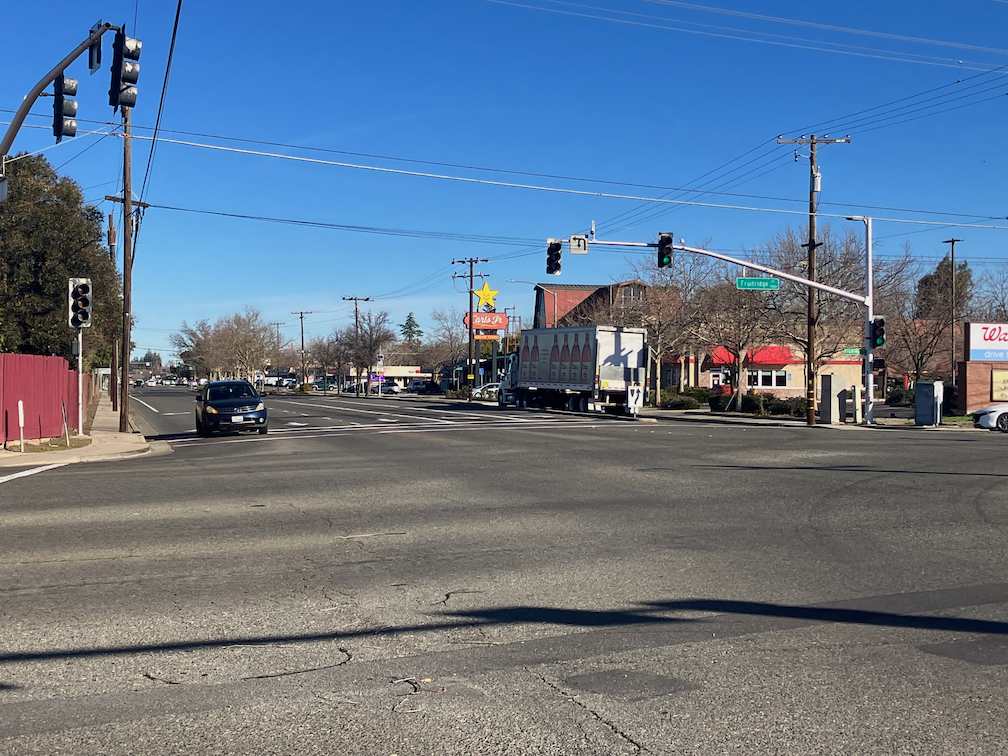
Below is a photo of Freeport Blvd at the intersection with Fruitridge Rd in south Sacramento. The street is designed for high speed travel, accommodating high volumes of motor vehicles. Bike lanes are present in some places, but dropped when necessary to promote motor vehicle flow. Dual left turn lanes endanger everyone on the road, and right turn lanes present a hazard to bicyclists. The crosswalk has faded to near invisibility. And the land use reflects those problems. Fast food businesses oriented to drivers and excluding walkers and bicyclists. A blank fence to try to isolate residences from the roadway, but of course it does not reduce exposure to noise and air pollution. Parking lots facing the street rather than storefronts. This is not a place where people feel welcome.

Freeport is NOT the worst stroad in town, by any means, but it is typical. Does the roadway encourage poor land use? Yes. Does the land use encourage the poorly designed roadway? Yes.

Intersection Control

Intersection control means the devices used at intersections to control the actions and behavior of motor vehicle drivers and others including walkers. The types of controls are:

  • none
  • 2-way yield
  • 2-way stop (or minor approach stop, MAS)
  • 4-way stop (or all-way stop, AWS)
  • roundabouts without signals
  • partial traffic control signals, such as flashing red or flashing yellow, and HAWK or RRFB
  • complete traffic control signals, with a cycle of green-yellow-red

It is often assumed, by traffic engineers and by the public, that safety increases moving down the list of intersection controls. However, there is research both supporting and contradicting this assumption.

Intersections may have features designed for people crossing, such as pedestrian crossing signals, with or without a countdown, and accessible pedestrian signals, compliant with PROWAG (Public Right-of-Way Accessibility Guidelines). Pedestrian signals may require user activation (the beg button) or may use automated pedestrian detection. Exclusive pedestrian phases allow people to cross when no motor vehicles are moving, thereby reducing the chance for crashes to near zero.

Other features may increase or decrease safety. Examples that may increase safety if properly designed and implemented, are curb extensions, refuge islands, automated red light cameras, near-side traffic signal placement, raised crosswalks or raised intersections, and roadway design that slows vehicles approaching the intersection. Examples that may decrease safety, particularly for walkers and bicyclists, are dedicated turn lanes, faded or non-existent crosswalks, pedestrian crossing prohibitions, and roadway designs that encourage speeding approaching the intersection.

Traffic Signals

Traffic engineers often try to solve known safety issues by adding new traffic signals. Little attention is paid to alternative solutions such as adding traffic calming features, or removing hazardous features. New or enhanced traffic signals are VERY expensive, ranging up to $1,000,000 per intersection. The addition of new signals ensures that money will not be available for traffic calming solutions that would be less expensive and more effective.

Traffic signals do not decrease the speed of motor vehicles in between intersections. Drivers immediately accelerate to the speed they had before stopping at the signal (if in fact they do stop). But signals do delay drivers, leading to frustration and increased violation of motor vehicle codes, particularly in yielding to walkers in the crosswalk. Red light running has become epidemic in the Sacramento region, perhaps worse than other regions, so it is not safe for anyone to proceed on a green signal or a pedestrian walk signal. This indicates a failure of traffic signals to control driver behavior, and that they may no longer be effective for safety.

The fact is, traffic signals are largely intended to smooth and ease traffic flow, and are often not safety features at all. Safety is used to justify new or upgraded signals, often without evidence.

Traffic signals are a classic example of ‘orderly but dumb’. Intersections should be ‘chaotic but smart’. (Strong Towns concept and Carlson’s Law)

Traffic engineers often claim that existing traffic signals were installed based on meeting warrants defined in the Manual for Uniform Traffic Control Devices (MUTCD, and the California version CA-MUTCD), but generally can’t produce those warrant documents. Many signals were installed based on politician requests and were not and are not justified by intersection characteristics. The warrant process emphasizes traffic flow and de-emphasizes safety for walkers and bicyclists.

All existing traffic signal locations should be analyzed every ten years, and signals which did not meet, or no longer meet, warrants, shall be removed. As roadways are modified or rebuilt with traffic calming features, far fewer traffic signals will be necessary.

When are traffic signals justified?

  1. At the intersection of two major roadways.
  2. Where the flow of traffic on one roadway does not provide gaps in traffic for crossing that roadway.
  3. At offset or skewed intersections where visibility or understanding may be difficult.

Most existing and proposed traffic signals do not meet any of these criteria. Major roadways, almost always designed as stroads, which are roadways designed for higher speed but with land use or design features that require slower speed, including driveways and turning movements, should be uncommon in urban areas.

Signals should never be installed to serve driveways, including shopping centers.

For any new traffic signal installed, it must include:

  • Signal cycles no longer than 90 seconds. Longer cycles are biased against walkers, and encourage walkers to cross against the signal.
  • Leading pedestrian interval (LPI) which provides the walk sign three or more seconds before the green light for drivers. Leading pedestrian interval (LPI) should be installed at ALL traffic signals in the city within five years. Bicyclists may proceed on the walk signal.
  • Elimination of slip lanes, dedicated right-hand turn lanes, and dedicated left-hand turn lanes more than one. Turning movements constitute the greatest danger to all roadway users.
  • No right (or left, for one-way roads) turn on red. No right on red should be installed at ALL traffic signals in the city within ten years.
  • Automated pedestrian detection to eliminate the need for beg buttons while achieving compliance with PROWAG. No person walking or rolling shall be required to manually actuate a pedestrian signal.
  • Implementation of exclusive pedestrian phases at any intersection with significant pedestrian flow. This phase may be achieved with turn prohibitions during pedestrian movement, or by all-way pedestrian crossing, called pedestrian scrambles.
  • Demand-responsive operation so that the signal cycle responds to demand by drivers, walkers and bicyclists, rather than set to an unchanging cycle.

Existing signals should meet the same criteria when upgraded.

HAWK and RRFB signals

HAWK (High intensity Activated crossWalK) and RRFB (Rectangular Rapid Flashing Beacon) are partial signals installed to allow walkers to cross roadways which would be difficult or unsafe to cross. However, HAWK signals are violated by some drivers, and RRFB signals are violated by many drivers. These signals are often justified by traffic engineers as ‘safer than nothing’, but it only takes one violating driver to kill a walker. RRFBs should not be used on roadways with a posted speed limit over 30 mph, and HAWKs over 35 mph.

Other Intersection Control

Intersections without signals can have stop signs, yield signs, or no signs at all.

The intersection of two low-speed (20 mph or less), low volume streets do not need any sign. They can be left uncontrolled, with drivers and bicyclists negotiating right of way at intersections, based on the universal first-come/first-served principal.

Intersections of moderate-speed (up to 30 mph), moderate volume streets may justify some signing. In order of increasing regulation, these are:

  • Two-way yield
  • Two-way stop
  • Four-way stop

The lowest level of signing that can provide safety for the intersection is the right level of signing. Stop signs should not be installed based on neighborhood or politician request, but rather based on observation of user behavior and the intersection, and crash history. The objective should not be to eliminate all possibility of crashes but to eliminate any possibility of fatal crashes.

With roadways designed for safety and placemaking rather than motor vehicle speed and throughput, intersection control can be the minimum necessary rather than the maximum control and expense.

Roundabouts

A roundabout is a circulatory intersection in which motor vehicles and bicyclists yield to others already in the roundabout, but otherwise do not need to stop. By eliminating traffic signals and stop signs, they ease traffic flow (and therefore driver frustration) and reduce crashes, particularly fatal and severe injury crashes. Other than low speed, low volume local streets that require no traffic control but do require user negotiation, roundabouts are the safest sort of intersection. Multi-lane roundabouts should really not be called roundabouts at all, and are generally no safer than signalized intersections.

References

Previous Getting Around Sacramento posts

lawsuits against Yolo 80

For earlier posts on Yolo 80 and managed lanes, see category ‘managed lanes‘.

Two lawsuits have been filed against Caltrans over the Yolo 80 freeway widening project.

Sierra Club and ECOS: Sierra Club, ECOS file lawsuit against Caltrans over I-80 project; Sierra Club and ECOS Sue Caltrans over Yolo I-80 Freeway Widening Project

“Caltrans’ Environmental Impact Report (EIR) grossly underestimates increased vehicular travel, which would emit far larger quantities of greenhouse gases (GHG) and air pollutants than claimed. The EIR fails to consider viable alternatives, such as increased public transit or alternate tolling strategies. Therefore, the project neither adequately manages demand nor produces adequate revenue to fund needed transit alternatives. Also, Caltrans’ proposed mitigation is woefully inadequate to offset the resulting increased GHG and air pollutant emissions.” – Sierra Club/ECOS Press Release

NRDC (Natural Resources Defense Council)/Planning and Conservation League/Center for Biological Diversity: Environmental Groups File Suit Against I-80 Highway Expansion; Environmental Groups Challenge Highway Expansion Project in Court

“First, Caltrans improperly chopped this project into two pieces to use funding in illegitimate ways and obscure environmental impacts, as documented by a Caltrans whistleblower. The first project, already underway, is using maintenance-only transportation dollars to strengthen the shoulders of the highway so they can accommodate heavy vehicle travel. The second project would restripe the road to accommodate the additional lane of traffic in each direction.” – NRDC

I tend to be cynical about the chances of stopping this widening project. However, the lawsuits can have several beneficial impacts:

  • requiring Caltans to supplement or revise its Environmental Impact Report, because it failed to consider several impacts, and failed to address induced demand
  • requiring Caltrans to allocate more funding to environmental and GHG mitigation; the existing project only partially mitigates impacts, and depends on income from a single tolled lane, which may fall short of projections
  • highlighting the failure of the California Transportation Commission, and in particular Chair Carl Guardino, to provide legally required oversight of Caltrans

I am in favor of tolling freeway lanes in order to recovered construction and maintenance costs, and to fund mitigation measures, not just for GHG but for other environmental impacts. A tolling authority (CARTA) has been set up to administer the added toll lane, but there are great uncertainties about how much will be raised, and the fee structure (vehicles and time of day) has not been developed.

“The EIR does not consider tolling existing lanes, which could be based on income, with funds used to provide clean public transit and bike and pedestrian options along the corridor, facilitating affordable infill development.” – Ralph Propper, ECOS Climate Committee Chair, from the press release

Strong SacTown quick-build street safety

Strong SacTown has created a great visual introduction to quick-build fixes for street safety, posted to Instagram. I encourage you to take a look. The series includes curb extensions and modal filters (traffic diverters), both quick build with temporary materials, and permanent installations. Of course temporary materials should eventually be replaced with permanence, but it is better to get something on the ground now rather than waiting for the planning and money it takes for permanent installations. We are experiencing an epidemic of traffic violence, and even small actions can reduce fatalities and injuries. These installations are also called tactical urbanism, though the definition of quick-build and tactical urbanism is not identical.

Some additional ideas that are not always thought of as traffic calming.

Street Design

We can design better streets to begin with so that the need for traffic calming is reduced. Example one is the wide medians in Boulevard Park, which reduces turning movements to the intersections while providing a pleasant environment. Example two is wide sidewalk buffers in the Poverty Ridge area, where narrow streets reduce vehicle speeds, and the sidewalk buffers provide a pleasant environment. I have watched motor vehicle drivers passing each other on these narrow streets in the Poverty Ridge area. They are slowing to about 5 mph to pass. This is a traffic violence reduction design in action!

wide street median, 22nd St at C St in Boulevard Park
photo of narrow street with wide sidewalk buffers, V St at 21st St
narrow street with wide sidewalk buffers, V St at 21st St in Poverty Ridge
Read More »

the end of red light enforcement

A SacBee article today notes the end of the red light camera program in City of Sacramento, which was part of Sacramento County’s program: Sacramento’s red light camera program has been shut down by the Sheriff’s Office. Here’s why. (sorry about the firewall)

This is very sad news, given the epidemic of red light running in the City of Sacramento (and elsewhere). I’ve written about this before: how do we get more red light cameras?, red light running consequences, SacCity red light cameras and crashes, Sac Vision Zero intersections & red light cameras, red-light-running bullies, and pandemic of red light running. It has only gotten worse over time, and will continue to get worse unless the city takes action to reduce it.

A quote from the Sacramento County Sheriff’s Office is particularly galling: “Gandhi said the Sheriff’s Office wants to focus on its mission of suppressing violent crime and other criminal activity.” Apparently, in the view of law enforcement, traffic violence is not a violent crime. Apparently, the fact that red-light runners kill and injure walkers, bicyclists, passengers, and other drivers is of little concern. Sadly, this is a very common law enforcement attitude.

If cost-cutting were an appropriate response to criminal activity, it would be reasonable to just eliminate law enforcement. Law enforcement responds to criminal activity; it does little to nothing to prevent criminal activity. Automated red light enforcement is an effective response to criminal activity, and it does reduce future criminal activity. Why is the Sheriff’s Office and the City of Sacramento not interested?

If you think that direct law enforcement of red light running is a good replacement, you would be wrong, for two reasons. One, almost no enforcement of motor vehicle violations occurs anymore, other than some enforcement of speeding. Two, the law enforcement practice of pretextual stops, stopping people of color for traffic violations to search for other violations, and to intimidate people of color, results in law enforcement violence against drivers of color.

One of the useful things the city was doing to reduce traffic violence is no longer. Don’t you feel safer now? You can visit the city’s Red Light Running Program page, in case you wish to leave condolences, remembrances, or flowers.

photo of red light camera, from City of Sacramento
red light camera, from City of Sacramento

convert HOV lanes to Express Lanes

With the establishment of the regional tolling authority, Capitol Area Regional Tolling Authority (CARTA), a joint powers authority (JPA), the opportunity exists for existing HOV (high occupancy vehicle) lanes to tolled lanes, specifically Express Lanes. HOV lanes had their time, but that time is past. HOV lanes are routinely violated. If you stand on an overpass and look down at vehicles in the HOV lane, you will see that many of them are single occupant vehicles, not high occupancy. You could also do the same while driving, but I’d rather you kept your eye on the road. The HOV 2+, used in the Sacramento region, which requires two occupants, is a pretty low bar, but even that is not achieved by many drivers. HOV lanes, being free, also generate no funds to maintain the lanes.

The SACOG region current has about 144 lane-miles of HOV lanes. It has no HOT (high occupancy toll) lanes, and no Express Lanes (all vehicles tolled, though toll may vary with occupancy or time of day). The map below (pdf) shows the existing HOV lanes (blue), and the HOV lane now being constructed as part of the Fix50 project. I have seen a SACOG map of the intended Managed Lane Network, but am unable to find it at the moment.

While the Yolo 80 project initiated the current tolling effort, SACOG in the 2020 MTP/SCS, identified managed lanes as a key component of both managing traffic and paying for maintenance of the system.

The MTP/SCS identifies these policies directly related to tolling:

  • POLICY 11: Initiate a leadership role in testing and piloting roadway pricing mechanisms, such as facility-based tolling and mileage-based fees, in partnership with the state, federal, and local agencies and private sector organizations.
  • POLICY 12: Take steps to implement tolling or pricing of specific lanes on major facilities, such as freeways, to improve traffic management, reliability, and operations of those facilities and to help raise funding for the cost of building and maintaining large capital investments.
  • POLICY 13: All new major expansion projects on the region’s freeways and expressways should be planned for eventual deployment of pricing options to both manage demand and provide a financing mechanism for capital costs. Any pricing strategy pursued should be sensitive to changes in roadway demand during different parts of the day (peak/off-peak) with the objective of managing demand and providing travel choice.
  • POLICY 14: Revenues generated from facility-based pricing should be used to build and maintain a regional network of paid express lanes and, where surplus revenue is available, on strategic transit services (e.g., express buses) or other mobility solutions that can reduce vehicle miles traveled and provide multiple travel options along priced corridors.

SACOG also has Managed Lane Network webpage, which includes Frequently Asked Questions.

I propose that all HOV lanes in the Sacramento region be converted to Express Lanes within a five year period, and that tolling be managed by CARTA. The reason for five years is that it will take about that long to do the public hearings required by law, to purchase and install the tolling infrastructure, and to determine the amount of tolls and any discounts offered for occupancy or time of day.

There are now so may types of vehicles that might lay claim to discounts that it would be better to charge the same for every vehicle. The road mileage charge, which is being considered by the state, could vary by type of vehicle, particularly to charge by weight which directly corresponds to wear and tear on the roadway, as well as the amount of tire and brake dust generated.

Converting HOV lanes to Express Lanes is the first step. The second step is to convert any lanes in excess of two per direction to Express Lanes (the basic two would remain free, for a period of time), and eventually to toll all lanes on all freeways and bridges. Freeways and bridges are incredibly expensive infrastructure to build and maintain, and users of the freeways and bridges should be paying for this, not the general taxpayer, many of whom never drive (though they do derive some benefit from freight traffic).

For additional posts on managed lanes, see category ‘managed lanes‘.

the long awaited death of ‘share the road’

The ‘share the road’ sign, which has been very popular with traffic engineers, is NOT in the 2023 MUTCD. So this sign is dead, and a well deserved death. The ‘share the road’ sign was often interpreted by drivers to mean, bicyclists must share the road with motor vehicles, or in less polite terms, “get out of my way, the sign says so”. The share the road diamond shaped sign was never a legal MUTCD sign, though they were and are quite common.

W16-1P sign, which used to say ‘share the road’ now says ‘in road’, as in, bicycles in roadway. The left sign is common, the middle sign can be used, and the right sign is for temporary traffic control (TTC). Since this new sign content replaces the old with the same sign designation, I take it to mean that the old sign may no longer be used at all, and must be replaced by the new sign.

The plaque is not used by itself, but with the W11-1 bicycle sign, below. Though the yellow version of the W11-1/W16-1P assembly is permitted, this sign would more likely be used at TTC in a construction zone.

MUTCD W11-1/W16-1P assembly sign 'bicycles in road'
MUTCD W11-1/W16-1P assembly sign ‘bicycles in road’

Outside of construction zones, the preferable sign would be MUTCD R9-20 ‘bikes allowed use of full lane’, below, and this sign can also be used in construction zones. This sign is similar to the old MUTCD R4-11 sign, which is no longer in the MUTCD.

MUTCD R9-20 'bicycles allowed use of full lane'
MUTCD R9-20 ‘bicycles allowed use of full lane’

Only in a few cases does the MUTCD require replacement of existing signs, but does require that the current sign be used in any new installation.

The new MUTCD recognizes the green painted bicycle lanes and green dotted bicycle lanes (often called skip marking) through conflict areas such as merges and intersections. Unfortunately, it did not drop recognition of the ‘sharrow’ shared lane marking. Though the sharrow can be legitimately used to show a bicyclist path in confusing locations, it has generally been used to bias roadways against bicyclists and to encourage motorists to fail to yield to bicyclists in the roadway. Maybe next time!

The MUTCD now has an entire chapter devoted to bicycles, Part 9: Traffic Control for Bicycle Facilities. This is progress, even if less than desired.