SacCity pedestrian safety emergency: enforcement

The draft City of Sacramento emergency declaration on pedestrian safety: ‘Declaring a state of emergency regarding pedestrian safety in the City of Sacramento and calling for immediate action to address pedestrian injuries and fatalities’ is available (pdf of text, 2 pages, 68KB) (pdf of attachments, 28 pages, 26MB).

This post focuses on the enforcement item.

3. “The City Manager is further directed to work with the Sacramento Police Department to ramp up enforcement of traffic laws that protect pedestrians, including speed limit enforcement, crosswalk violations, and distracted driving. The City shall prioritize enforcement in high-injury corridors and areas with frequent pedestrian activity.”

Three advocacy organizations specifically commented about the draft that it must focus on ‘equity and mobility justice’, as did most of the people who spoke at the city council meeting.

I’ll be blunt. There is a deep and well justified mistrust of Sacramento Police Department (SacPD) among people of color and low-income, particularly among, but not limited to, blacks. SacPD has a history of oppressing black people, and has often used traffic stops as a pretext to harass people. Many of these have escalated into arrest, beatings, and even death. I have seen no real evidence that SacPD has changed their stripes. They are not people that I want interacting with the public about traffic law. And, apparently, they don’t want to either. SacPD has reduced its traffic officer group to almost nothing, and does little traffic enforcement by traffic officers or any officers. It is time to move past the idea that law enforcement has much to contribute to reducing traffic violence.

At the same time, no enforcement of any sort is not the answer. People are dying when drivers violate traffic law, and these deaths are unacceptable. Speed is a contributing factor to all traffic crashes, and is sometimes the primary factor. Driving too fast for conditions, and these conditions include walkers and bicyclists on and close to the roadway, is always wrong, even though road design encourages it.

Automated enforcement is a partial answer. It avoids the pretextual stops, avoids harassment of people of color and low-income by police, at least over traffic law, avoid the escalation that police engage in, and is much less expensive than police officers.

The three main traffic violence issues to be addressed, at least at this time, are:

red light running: Red light cameras and automatic ticket issue to the owner of the vehicle are a partial solution to red light running. Of course some drivers will always run red lights, will always endanger others, and will not be deterred by tickets. But most drivers will notice that tickets are being issued, and will change their behavior. Red light running does have infrastructure solutions, including changing from far-side signals to near-side signals, and raised crosswalks and raised intersections. But there are not easy or inexpensive fixes, so automated enforcement is a good interim solution. When the county ended its red light program, which operated the red light camera in the City of Sacramento, the city made no effort to replace that program, and at least some city staff celebrated it (the red light runners?). The city should create a red light camera program of its own. It should be administered by Public Works, not by SacPD. There are equity issues, since the wide, high speed arterials that most encourage red light running are in low-income communities. Two solutions are to distribute cameras across the city in locations where red light running might occur, and not just those locations with a history. The egregious violators, which are who we really want to target, will be receive tickets eventually. The second is to adjust violation fees (and court costs) to a factor related to income. It would be awkward and perhaps invasive to base it on income, but it could easily be based on vehicle value.

failure to yield to walkers: Drivers have been trained by roadway mis-design to not yield to people in crosswalks. The recent SacPD, OTS funded, sting on J Street demonstrated how common this is. But again, as drivers have been trained to do this, they can be untrained. There are options for automated enforcement of failure to yield, but it requires more complicated and less widely used technology. The city should be experimenting with this technology (they are not), but in the meanwhile, this may be one situation in which in-person enforcement, on a limit basis and with close attention to equity concerns, may be justified. Any in-person enforcement by SacPD raises issues of police violence and over-reaction, including high-speed chases of violators. One solution is to ban high-speed chases. With technology such as helicopters (which the police love) and drones, there is no reason to endanger the lives of violations, bystanders, or officers themselves with high speed chases. Too many cops have watched too many movies with the thrill of high-speed chases. The practice must end.

speeding: There is available and highly reliable technology for automated enforcement of speeding. There is a state-authorized pilot program of speed camera enforcement in six cities and part of Pacific Coast Highway. Sacramento is not among them. To its credit, City of Sacramento asked to be part of this pilot but was not included. The city should strongly lobby the next legislative session for inclusion, and should have a program designed and ready to go when authorized. Speeding is the most common concern of the public, and it is true that speed is a factor in every crash, I’m doubtful that it is the biggest concern. I’d rather see a focus on red light running and failure to yield.

I believe that item 3 should be deleted for its likely failure on equity and mobility justice.

I have not yet written about the other six items, and don’t know when I’ll be able to get to it. However, I will say now, in case you were wondering, that by far the most effective city response is temporary (quick build or tactical urbanism) and permanent changes to roadway design. And what it will take to accomplish those changes is funding, from the city general fund. The seeking of grants, and waiting years or decades for the funding to address traffic violence, is only part of the solution. If this is truly an emergency, and it is, the city must spend significant funding to act on it, and act now.
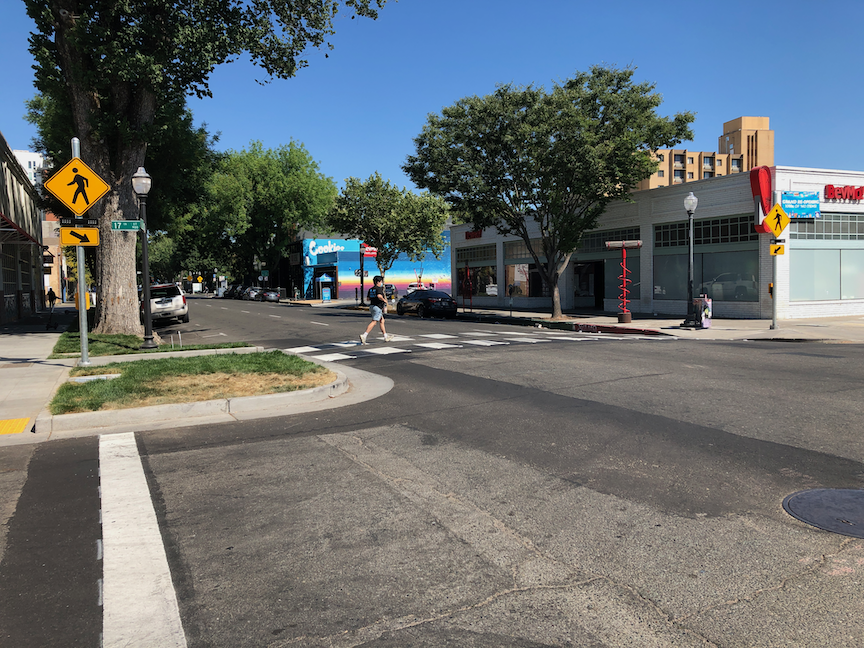
traffic violence emergency at Sac City Council

It is likely that council member Caity Maple, along with Mayor Darryl Steinberg and council member Karina Talamantes, will introduce an emergency declaration on traffic safety at the city council meeting tonight, starting at 5:00 PM. The item is not on the agenda, so I presume it will be introduced during the ‘Council Comments-Ideas, Questions’ part of the agenda, after all the numbered agenda items. Council members get their ‘matters not on the agenda’ time, just like the public does. None of the advocates I have asked have a clear picture of how emergency declarations work. I presume the idea will come back to council one to many times in the near future, but tonight is your first chance to hear what the council has to say and comment on the ideas.

Caity Maple has posted about the recent injury (now fatality) and the emergency response she wants the city to take:


I’m devastated to see yet another person critically injured after being struck by a vehicle on Sacramento’s roads. Even beyond our City’s commitments to eliminate traffic deaths through Vision Zero, we need to take immediate and urgent action. This coming Tuesday, alongside my colleagues Mayor Darrell Steinberg and Mayor Pro Tem Karina Talamantes, I will be introducing a proposal that:

  • Declares a state of emergency for the City of Sacramento regarding the road safety crisis
  • Directs the City Manager to identify funding for a public education campaign focused on driver education, pedestrian/ bicyclist awareness, and traffic safety
  • Directs the City Manager to work with SacPD to ramp up enforcement of traffic laws that protect pedestrians, including speed limit enforcement, crosswalk violations, and distracted driving, especially in high-injury corridors
  • Reaffirms our commitment to Vision Zero and directs staff to expedite safety projects

Read More »

SacCity fails to act on traffic violence

At the June 11 city council meeting at which the 2024-2025 budget was adopted, seven of the council members spoke strongly about the need to address safety on the city’s streets, acknowledging that the city leads California as the most deadly for roadway users. But no modification was made to the budget to reflect that priority, and the city manager refused to make any changes to the budget to fund street safety.

In the two months since that council meeting, nothing has shown up on the council agenda to move forward on street safety, nothing has shown up to allocate funds, except some minor grant applications.

The city has long had a policy that it does not fund street safety projects, except for the required grant matches. Other than grant matches, no city general funds are expended to make our streets safer. The city certainly has been successful in getting some grants, but also has not been competitive on many others.

The Sacramento Active Transportation Commission (SacATC) made a recommendation in their annual report to allocate $10M to safety projects. Council members spoke in support of the idea, but no action was taken to fund those ideas.

We have an epidemic of traffic violence in the city. Yet the city is doing almost nothing to address that. Walkers, bicyclists, drivers and passengers are all dying in horrible numbers. What is the city doing in response? Submitting grant applications and hoping for the best. This is unacceptable.

The council must take this public health crisis seriously, and allocate funds to start solving it. It must also stand up to the city manager, who does not believe in spending money on street safety. The city manager runs the city according to his own whims, and rarely follows the direction of council on anything. The council must either stand up to, or fire, the city manager. So long as he is in the position, the city will not move forward on saving the lives of vulnerable roadway users.

SacBee: quit parroting CHP misinformation

An article in the SacBee today reports that a bicyclist died when he/she swerved into the path of a motor vehicle. The article parrots the CHP spokesman, that the bicyclist swerved. No doubt the uninjured driver would say that. The bicyclist is dead and has nothing to say, so the CHP takes the word of the driver.

Note that no crash investigation has been conducted by CHP. Crash investigations take weeks, and require gathering of detailed information about the point of collision, and the direction of movement of the bicyclist and driver at the time of collision, and more information about the victim and perpetrator. But without the results of an investigation, the CHP just assumes that the bicyclist is at fault and the driver is innocent. This is victim blaming of the first order. Of course this is standard procedure for CHP, where almost every officer thinks that every bicyclist crash is the fault of the bicyclist, without evidence to support that assumption. CHP is not a safety-oriented agency, they are a victim-blaming agency. No surprise.

What is a surprise is that the SacBee would parrot the CHP’s misinformation about the crash. News media does not exist to reprint agency press releases. It should exist to question what agencies say, particularly when the agency expresses certainty about a crash that has not received an incident investigation. Please do better, SacBee. Report the facts that are known, not CHP speculation.

what is public safety?

This post is a response to the Sacramento City Council meeting last Tuesday on the FY 2024-2025 budget adoption.

A number of people spoke on the budget, the majority of them downtown power brokers who were adamant that the police department budget not be reduced. They painted a picture of lawlessness in the central city that could only be reversed by not only not reducing, but increasing the police budget. Most of the problem was blamed on unhoused people, who were presented as violent drug addicts and criminals (never mind the white collar crime going on inside the buildings). Mayor Steinberg right off the bat said that the police budget was being increased, not reduced, but that did not prevent the speakers from claiming that it was being reduced. Several speakers used the term ‘defund the police’, which was originally an effort to reduce police budgets to force the police to be more accountable to the people, but has now been weaponized by pro-police people to suggest that every effort to hold police accountable is an effort to defund the police. One speaker attacked Councilmember Valenzuela, suggesting that she was personally responsible for all the problems in the central city.

To say the least, I was very disturbed by these messages. These are people of great privilege, asking that the city elevate their privilege over other citizens.

Not one of these central city people spoke about the epidemic of traffic violence that is harming people more than traditional crime. Several city council members did speak about this, but none of the downtown power brokers.

None of the power brokers even mentioned other parts of the city. Were they concerned about crime elsewhere? Apparently not.

Only one of the people who spoke in favor of the police budget appeared to be a person of color. He was not from the central city, and expressed ambivalence about police, acknowledging that he was concerned about crime related to his business, but also that many people were uncomfortable about the police.

Not one person from the low-income parts of the city spoke in favor of the police, or the police budget. There is a deep, and well deserved, distrust of the police in large parts of the city. Police have served as oppressors and killers in many, many incidents. Take a moment to think about all the incidents where the police escalated the situation, and then started shooting. Think about the incidents where they showed up and started shooting before they even knew what was going on, and killed innocent people. Think about the incidents where an unarmed person was running away ‘resisting arrest’ and the police shot them in the back. This is a reality that low-income people of color live with and are traumatized by.

In my view, police do not keep us safe. They respond to incidents involving bullets and knives. They often don’t respond to other incidents, or respond very slowly. And it is always response, never prevention.

What does this have to do with traffic violence and safe streets?

The police budget takes a large and growing part of the city budget. These are dollars that could be spent on solving problems, making the city a safer place, but instead they go to the police, who have only one solution, themselves. Councilmember Valenzuela made an effort to keep personal in internal affairs, the police who investigate police malfeasance and crime, but was rebuffed by Police Chief Kathy Lester who doesn’t believe internal affairs is important. Several times the issue came up, as it has many times before, about transferring a small part of the police budget to efforts that actually make a difference, such as Department of Community Response, but no action was taken.

The number of deaths in the city from traffic violence is larger than the number from homicide. Yet the city has only eight traffic enforcement officers. Eight, out of nearly 700 sworn officers (there are others who work for the department but are not officers). This understaffing is a choice that the police department makes, it was not forced on them by anyone else. It reflects their attitude that people who die by guns and knives are worth notice, but people who die by traffic violence are not. It also reflects their attitude that it is better to respond to violence than prevent violence.

I am not in favor of direct traffic enforcement by police. Of the few stops that occur, they are almost all pretextual, meaning that the police officer has stopped the person for a traffic violation, but really is seeking other violations. Most stops are of people of color, as documented by the police’s own data. These stops not infrequently escalate, escalation as often on the part of the officer as the person stopped. Some of these stops result in death.

Automated enforcement is the answer to most traffic enforcement. The city had a red light camera program, but when the county dropped it, so did the city. The police made no request to continue to program. Though the city has encouraged the legislature to pass and the governor to sign automated speed enforcement, the police have been silent. Again, an attitude that only an officer can enforce the law, technology cannot.

I have watched police officers routinely ignore traffic violations, just sitting around waiting for something ‘important’ to happen.

So what is public safety? Public safety is when:

  • resources are spent equally on protecting all citizens, not just the privileged
  • police and the city as a whole focuses on reparation, reinvestment, and dialog to heal the trauma created by police oppression
  • police allocate their officers and other resources based on actual threats to the public safety, not on outmoded perceptions
  • the city reallocates budget to those programs that are making a positive difference in people’s lives, not just increasing the budget of the loudest voices

I know I’ll lose some readers with this post. I know that some people concerned about traffic violence and safe streets are also supporters of the police and of direct traffic enforcement. Sorry to see you go. But I can no longer be silent when I see police and pro-police people claiming the right to use the term ‘public safety’ for their own benefit, to the detriment of others.

RRFBs are being ignored

I was a strong supporter of RRFBs (rectangular rapid flashing beacon), where a safer crossing of the street is intended mid-block. I worked with transportation agencies in a number of locations to get them installed, and was very happy to see them go in.

They are used where multi-use trails cross roadways, and at intersections where additional traffic calming and safety are needed, but where the transportation agency does not want to add stop signs, or is unwilling or financially unable to install a traffic signal. The cost savings of an RRFB over a traffic signal are significant, about $25K for a RRFB, and upwards of $1M for a full traffic signal.

But…

Driver behavior has rendered RRFBs untenable for protecting people walking. I have observed a number of RRFB locations over the last few months. All of them are failing. Between 25% and 50% of drivers are failing to yield to people using these crossings, bicyclists or walkers. I have seen several people almost get hit by car drivers. Some drivers are slowing but failing to stop, or yield, and some drivers are not even slowing. Apparently the attitude of many drivers is that the RRFBs are only advisory and do not require yield to people in the street. Of course the law requires yielding to people crossing the street in a crosswalk, whether there is any type of signing or signaling, or not. But drivers don’t see it that way.

So, I find myself having to withdraw support for RRFBs. I will not support them as freestanding safety improvements, not as part of project. It is sad that driver behavior has erased the benefit of a safety enhancement, but it is a fact, and driver behavior gets continuously worse, never better.

Drivers are terrorists.

photo of RRFB on J St at 17th St, Sacramento
RRFB on J St at 17th St, Sacramento

San Juan Rd at Airport Rd kills another person

I posted to Instagram about this, but it deserves amplification. “The Sacramento Bee had an article today that provided in-depth information about the death of a person crossing San Juan Rd in North Natomas. It included information about the dangerous roadway and lack of crosswalks and about the individual and family of the person killed. This is the kind of crash reporting we need to raise awareness and get the city to allocate resources to save lives.”

Apple Maps capture of intersection of San Juan Rd and Airport Rd in North Natomas, Sacramento
intersection of San Juan Rd and Airport Rd in North Natomas, Sacramento

I have worked off and on doing bicyclist education in North Natomas, and therefore crossed through this intersection many times, mostly bicycling but occasionally walking. It is not a safe intersection, for anyone.

Walking

The lack of crosswalks is obvious. The posted speed limit is 40 mph, but common practice and the design of the road sets that as a minimum rather than maximum. Knowing that this is a dangerous situation, the city has cross-hatched out the area from Azevado Drive to Airport Road on the north side, narrowing the roadway to one lane, but drivers routinely use this area for both travel and turning. Westbound drivers coming down off the overpass over I-80 accelerate to 60 mph. People walk across San Juan here. The city has decided to leave them to fate, and in this case the fate was death. A crosswalk without any additional protection would not be appropriate given the high speed traffic. It would require, at the least, a RRFB (rectangular rapid flashing beacon), which is a sign with flashing lights activated by the person wanting to cross. But given actual speed, it probably would need additional protection. Fixing poorly designed roadways is expensive, but so are lives.

There is a crosswalk over Airport Road, but given the wide-open design of the intersection, it is meaningless. Drivers turning from San Juan Road are unlikely to notice it. Drivers southbound on Airport Road generally stop over or beyond the crosswalk, because they need the visibility, and as much head start on the dangerous turn as possible. I know this from extensive observation.

Bicycling

Some people would say “but it has bike lanes”. Not really. Eastbound, motor vehicles turning onto Airport Road cross over the bike lanes at many points, regardless of any paint on the ground. If a person stayed in the bike lane, they would be exposing themselves to high speed traffic for along distance. Hug the curb to be further from motor vehicles, or use the bike lane so that you are more visible? It is a devils choice, forced by road design. West of Airport Road, the bike lane is missing for a distance, implying to drivers that they have the right-of-way over bicyclists. Eastbound, the bike lane is mostly continuous, except for the intersection itself (why?), but it is full of debris from construction traffic and car parts. To my knowledge, the city has never swept this bike lane.

It is difficult many times of the day to turn east from Airport Road to San Juan Road. High speed traffic, high volume at certain times, does not slow in the least in this area, and there is no signing to indicate they should.

Regular Class 2 bike lanes should be illegal on roadways posted over 35 mph. This road was mis-designed from the beginning. I don’t know whether the city later added bike lanes, though it is probably so given all the striping on San Juan to the east. The bike lanes did not make it safer for bicyclists.

Journalism

News media in general does a very poor job of reporting on traffic crashes, particularly when the victim is a walker or bicyclist. The initial news item parrots the law enforcement statement. Unless waiting for ‘notification of family’, the victim’s name is given, but the driver’s name never is. This is a strange inversion of ‘innocent until proven guilty’, making the driver innocent and the victim guilty. As I have stated many times before, law enforcement personnel have no training in analyzing the ways in which roadway design contributes, if not causes, traffic crashes. But they have a lot of ideas, not based in any research or training, that they are too happy to relay. One that will ring home with bicyclists is the repeated phrase ‘they weren’t wearing a helmet’, as though wearing a helmet protects against being hit by a driver traveling over the speed limit (they almost all are) or well over the speed limit, as is likely in this case.

A good summary of the issue is by SafeTREC, Media Narratives of Pedestrian and Bicyclist-Involved Crashes. If you want more, simply search the Internet for ‘poor journalism on traffic crashes’ or similar terms. Angie Schmitt wrote an entire book, Right-of-Way, about this issue and others. What about the next reporting? There usually isn’t any. The incident is never mentioned again. Law enforcement contributes to this by making sure that the incident report is delayed for weeks or months after the crash. In California, there is the common practice of law enforcement claiming that incident reports can never be released to anyone but immediate family. This is no backed up by state law, but it is common practice. So even when the incident report is completed, the public is unlikely to ever know the facts of the crash. All the public ever knows is the untrained, biased speculation of the law enforcement officer on the scene. The cynic in me can only see this as an intention on the part of law enforcement to protect drives and keep the public in the dark about traffic violence.

So, it was a wonderful breath of fresh air to read the Sacramento Bee article by Ariane Lange: A father died crossing a dangerous Sacramento road. His 13-year-old son was watching. The article went into depth about the person who was killed, and his family. It looked at the dangerous design of the road, and the fact that the city rarely fixes dangerous roads except with state or federal grants, not its own money. It talked about Vision Zero and the high injury network, of which San Juan Road is one, though in part due to problems further east. It talks about the statistics for death at various vehicle speeds, including 50% death at 40 mph (though it is very unlikely the driver was going that slow).

Traffic violence is pervasive in Sacramento, with the highest rate of fatal crashes in the state. The usual media reporting glosses over this, basically selling the story that if it wasn’t someone you know, it wasn’t that important. But it is always important, and sooner or later it will be someone you know, or you. These are real people with real lives, and real families and friends, and their death leaves a huge hole, whether they are homeless or not.

Thank you, Ariane, for telling the real story behind the death.

Rapid Response Program for SacCity

Note: This is a major revision of a post from 2024-01-31. The OakDOT Rapid Response Program is now in a separate post.

When a fatality or severe injury occurs for walkers and bicyclists, people often ask, what can we do right now to prevent or reduce the severity of the next crash? This topic has come up a number of times at the Sacramento Active Transportation Commission (SacATC), and communication from Slow Down Sacramento and the Safety ForumCivic ThreadSABA, Strong SacTown and other organizations.

Based on the successful program from Oakland, I am proposing that the City of Sacramento develop a similar rapid response program.

The City of Sacramento would establish a pilot Rapid Response Program with an initial budget of $100K. The pilot program would address only fatal crashes. The budget will likely be insufficient, as Sacramento has a state-leading level of fatal crashes, but the pilot would allow the city to develop expertise and program structure, and formulate a future budget. The city might respond only to fatal crashes on the high injury network, in order to extend the budget.

A Rapid Response Team will include a city planner and city traffic engineer, and may include responding law enforcement officer and walking or bicycling advocate (Civic Thread for walking and SABA for bicycling, paid for their time). I intentionally say the law enforcement officer who responded to the crash. Other law enforcement officers would likely offer only uninformed opinions and victim blaming, though the experience could be useful for educating officers about street design.

The team will review existing documents and data, and then visit the fatal crash site within two work days of the crash, or the death of a person resulting from an earlier crash.

The team will make a report within five working days which identifies and proposes quick-build features (countermeasures) to reduce or eliminate infrastructure hazards, with prioritization based on effectiveness.

The quick-build features (countermeasures) may include:

  • Refreshed crosswalk
  • Refreshed pavement markings
  • Temporary curb extension with flex posts
  • Temporary modal filter (traffic diverter) with flex posts
  • Temporary traffic circle with flex posts
  • New marked crosswalk
  • Changed or added signing
  • Temporary new stop sign; permanent stop sign would require additional analysis
  • Changed signal timing

At least one quick-build feature (countermeasure) will be installed within 10 work days of the site visit. Additional temporary features will be designed and scheduled.

I had previously mentioned mapping of crashes and related data by the city, because the state SWITRS system is always too far behind. I had previously mentioned a dashboard on crashes. However, these would probably best be implemented after the pilot year.

OakDOT Rapid Response Program

The City of Oakland Department of Transportation (OakDOT) Safe Streets Division has developed a Rapid Response Program to immediately address street infrastructure that contributes to fatal crashes.

The City of Oakland Department of Transportation (OakDOT) seems to have the best program I could find on the Internet. This is not surprising – since being formed in 2016, OakDOT has led on developing programs for safer streets that are informed by equity. Unfortunately, no single document on the program is available from OakDOT, but several presentations, case studies, and examples serve. Safe Oakland Streets (SOS) is Oakland’s version of Vision Zero.

Rapid Response Projects: OakDOT seeks to eliminate traffic fatalities and severe injuries while promoting safe, healthy, equitable mobility for all. OakDOT’s efforts to make streets safe include rapid responses to fatal and severe crashes involving the most vulnerable users of Oakland’s roadways. A Rapid Response is a coordinated effort in the days and weeks following a traffic tragedy that may include investigations, targeted maintenance, near-term improvements, and the identification and prioritization of longer-term capital needs.”

The two elements most relevant to rapid response are:

  1. Maintenance Treatment: If the crash location has a maintenance issue that may be related to traffic safety e.g., pavement defect, faded striping, missing sign), the maintenance issue will be rectified by field staff.
  2. Quick-Build Improvement: If there are design treatments that could be implemented quickly at low cost, engineering staff will prepare the design and issue a work order for field staff to construct.

A presentation to Oakland BPAC summarizes the program well and provides some examples.

Two examples are below, Harrison Street and the streets surrounding Garfield Elementary School.

OakDOT photo Harrison St & 23rd St showing quick build improvements resulting from Rapid Response
OakDOT graphic of safety improvements at Garfield Elementary School

OakDOT has a Crash Prevention Toolkit with photos of solutions, most of which are inexpensive and quick to implement.

OakDOT Crash Prevention Toolkit excerpt

OakDOT offers a map with locations of fatality crashes and relevant features such as high injury network and equity, Traffic Fatalities, City of Oakland. A chart, below, also shows yearly data for modes of travel. A Crash Analysis Infographic also communicates data visually.

OakDOT chart of traffic fatalities by mode over time

no turn on red for Sacramento?

Update: I was incorrect that a ban citywide would not require signing. See below for more information. Thank you, Matt, for the heads up.

Many places throughout the United States are considering banning turns on red signals. Permitting turns on red was a fuel-saving practice implemented in the 1970s, though there is little evidence it actually saved fuel. There is considerable evidence that it decreases safety for walkers and bicyclists, and perhaps motor vehicle drivers and passengers. Though turns on red signals are not the greatest danger walkers and bicyclists face, banning the practice would have safety benefits. It is a partial protection against oversized SUVs and trucks, which have large blind zones that contribute to striking walkers and bicyclists. Though people think of this as no-right-turn-on-red, in Sacramento central city with its overabundance of one-way streets, it may also be no-left-turn-on red.

San Francisco is considering an expansion of its no-turn-on red zones from the Tenderloin, where it has increased safety and calming traffic, to more of the downtown area. Washington DC has banned turn-on-red, though it doesn’t take effect until next year. Chicago and Seattle have considered bans.

The signs used to indicate no turn on red are:

How should the City of Sacramento, and the rest of the counties and cities in the region respond? The options are:

  • ban citywide: Turns on red would be illegal throughout the city (or county). The advantage is that no signing would be needed since it would apply to all signalized intersections. However, this may not have as great a safety benefit as a more targeted approach.
  • ban at locations of crashes involving turning vehicles: This is a no-brainer. Turn on red should be banned at any intersection where there is a history of crashes caused by vehicles turning on red. This should be city policy, to install signs at any location where SWITRS indicates there is an issue, or immediately after any crash.
  • ban at intersections with a high walker count: This is probably the most beneficial for safety. The problem is that the city does not collect data on the number of walkers using crosswalks (marked or unmarked), so it would not know where to start. The lack of data collection is a failure on the part of the city, but it is nevertheless a fact.
  • ban at separated bikeway locations: A ban at the intersections with separated bikeways (also called protected bike lanes, parking-protected bikeways, or cycletracks) would protect bicyclists and give them a head start over motor vehicles. Leading pedestrian intervals (LPIs), which bicyclists can also use, can offer even better protection.

I have resisted turn-on-red bans in the past because I thought they had a lower safety benefit than many other measures that could be taken, but traffic violence has become such an issue that any action to reduce death and injury for walkers and bicyclists may be worth taking, and taking now.

As an alternative to bans, yield-to-pedestrians (and bicyclists) signs can also be installed. Two versions are shown below, on the left, the approved MUTCD R10-15R sign, and on the right, the bicyclist and pedestrian version with interim approval in California, and in use in many locations. My observation is that these signs are widely ignored by drivers, but of course, they do help those drivers who are willing to follow the law.


California Vehicle Code (CVC) 21453

CVC 21453: 
(a) A driver facing a steady circular red signal alone shall stop at a marked limit line, but if none, before entering the crosswalk on the near side of the intersection or, if none, then before entering the intersection, and shall remain stopped until an indication to proceed is shown, except as provided in subdivision (b).
(b) Except when a sign is in place prohibiting a turn, a driver, after stopping as required by subdivision (a), facing a steady circular red signal, may turn right, or turn left from a one-way street onto a one-way street. A driver making that turn shall yield the right-of-way to pedestrians lawfully within an adjacent crosswalk and to any vehicle that has approached or is approaching so closely as to constitute an immediate hazard to the driver, and shall continue to yield the right-of-way to that vehicle until the driver can proceed with reasonable safety.
(c) A driver facing a steady red arrow signal shall not enter the intersection to make the movement indicated by the arrow and, unless entering the intersection to make a movement permitted by another signal, shall stop at a clearly marked limit line, but if none, before entering the crosswalk on the near side of the intersection, or if none, then before entering the intersection, and shall remain stopped until an indication permitting movement is shown.

https://leginfo.legislature.ca.gov/faces/codes_displaySection.xhtml?lawCode=VEH&sectionNum=21453.

Under section (b), signs are required, even if the ban is citywide. Section (c) does allow use of red arrows, but the red arrow signal would be more expensive than a sign, so only used in a few situations. The blank-out sign, shown above in the set of three, is probably the most effective, but again, more expensive that a regular sign.