Protected bikeways, also called separated bike lanes or cycle tracks, are all the rage these days. The NACTO Urban Bikeway Design Guide codified cycle tracks, but they were already showing up in several cities, and are now being implementing in a great number more. I’ve ridden on cycle tracks in Long Beach, San Francisco (just yesterday, in fact) and other cities, and yes, they are a pleasure to ride on compared to riding in traffic or traditional bike lanes. Many people have declared the era of vehicular cycling dead, and the era of protected bikeways upon us.
The Sacramento midtown farmers market at J and 20th has been going for two Saturdays now. The market is somewhat different from the main Sacramento Farmers Market I usually attend because it has more prepared food, though it still has a good complement of fresh and dried food. The market is only 8 blocks from my house, though the main one under the freeway on Sundays at 8th and W is only 16 blocks, Chavez Plaza on Wednesdays is 11 blocks, Fremont Park on Tuesdays is 1 block, Capitol Park and Capitol Mall on Thursdays are 3 blocks and 12 blocks respectively. Clearly I’m blessed to be in the middle of so many farmers markets. This density of urban amenities is why I love living in midtown. I’ve heard great things about the Saturday Oak Park farmers market, and will visit as soon as I can.
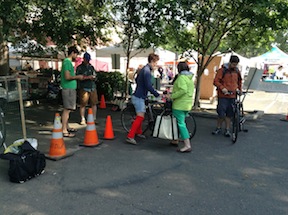
bike valet at Midtown Farmers Market
The more unique character of the Midtown Farmers Market Sacramento, however, is that it encourages shopping by bike. Sacramento Area Bicycle Advocates (SABA) is providing bike valet service for the market, and a lot of people are coming by bike. There have never been less than two cargo bikes, and sometimes many more, and the large bike valet corral has at times filled up with bikes. Impressive!
3876 Noriega St (from San Francisco Planning Department)
SABA (Sacramento Area Bicycle Advocates) and Sacramento Metropolitan Air Quality Management District are partnering to create demonstration parklets in Sacramento. This is exciting! SABA has a couple of posts on their Facebook page, and I’m sure there will be a lot more discussion.
A parklet is a small space serving as an extension of the sidewalk to provide amenities and green space for people using the street (Wikipedia). They can remove the tension between street furniture and sidewalk life on the one hand, and sidewalks as a transportation route. Though Sacramento has wide sidewalks in some areas, it also has narrow sidewalks in a number of areas that are highly popular. As an example, 16th Street between P Street and O Street, right next to where I live, has a narrow zip-zag sidewalk, fenced cafe seating for restaurants, and a lot of people and a lot of bikes. There is a tension here, between cafe seating, bike parking, and the sidewalk’s function. A parklet would allow more street life without taking away from any of the other functions.
Parklets are often sponsored by the adjacent business, but since they are in the public right of way, they are open to all users at all times. Cafe seating is different in that the business has a permit for the exclusive use of that area, so it is often open only to customers and only when the business is open. Cafe seating and parklets are actually a great complement to each other, creating vibrant street life that neither alone could.
San Francisco has an official Pavement to Parks parklet page, with details about the spectacularly popular program and a series of photos. The photo with this post is one of my favorites. San Francisco Great Streets Project has a series of pages on parklets, with before and after photos, though it is not up to date.
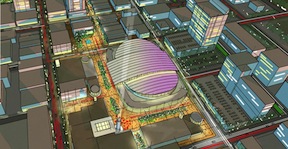
Whether the arena is built or not, I care little, and whether the Kings stay or not, I care not at all. But what I find interesting is that no one any longer talks about a public asset like this being located in the suburbs. When it was in the railyards, it was a downtown arena. As it is now proposed on the footprint of the mall, it is the downtown arena. It is the same in Seattle, where the arena location is not so central but is still part of downtown.
Sacramento has grown up! It realizes that downtown is the place for public assets. Downtown has a high density of public transit, walkable and bikeable areas, a grid street pattern, established businesses that can serve patrons of an events center, and yes, even freeways.
The ARCO/Power Balance/Sleep Train facility squats in the middle of acres of parking, a 12,000 parking space wasteland. It is far from light rail, is poorly served by bus (you can get there, but you can’t get home, for evening events, and not at all on Sunday, transit score 24, minimal), is in an un-walkable and un-bikeable area (all high speed arterial roads, walk score 48, car dependent), where almost no streets go through (the classic suburban street system of cul-de-sacs and streets that wind interminably). Why anyone ever thought an arena in Natomas was a good idea, I don’t know, but at least no one any longer thinks it is. And that is progress!
Downtown Plaza, the currently proposed location, has a walk score of 94, walker’s paradise, and a transit score of 67, good transit.
Sacramento Area Bicycle Advocates (SABA) posted a question on Facebook, “Where shall we hold one in Sacramento?” about the Sunday Streets event this past Sunday on the Embarcadero in San Francisco. This echoes a conversation Alexis and I had while we were attending. She liked the Embarcadero Sunday Streets because it was a long distance and showed how streets can be used for transportation in a different way than we usually use them. For Sacramento, that would argue for a long distance closure that connects together destinations.
Though I certainly enjoyed this Sunday Street, I really like the two that I’ve been to in the Mission neighborhood of San Francisco, which close stretches of Valencia St and 24th St. This route is in a neighborhood, there are people living along the streets and in the neighborhood, as well as those who come from other places to enjoy. There are a multitude of locally-owned businesses to appreciate and engage, with nary a chain in sight. The special events such as play areas, climbing walls, hula hoops, dance demonstrations and others feel more concentrated rather than scattered out along a long route. For Sacramento, this argues for a midtown location, which is the only area where there is a sufficient concentration of residents and locally owned businesses. The Mission event is about community, and more like a street fair.
Embarcadero is more about transportation, and Mission is more about community. Sacramento, of course, could do both.
For more information about the flavors and locations of open streets events, see Open Streets Project. Check out the website for background information including “models”, and then go to one! Of course San Francisco is the easiest for us here in the Sacramento region, but Berkeley will also be having one or more this year, and as you’ll see, they are becoming common on the west coast, throughout the United States, and the world.
The next San Francisco event is on April 14, and is in the Mission neighborhood which I’ve referred to above, on Valencia St and 24th St. Don’t miss it! And bring back your thoughts and commitment to making it happen in Sacramento.
Alexis and I volunteered at the event as intersection monitors. Once you’ve been to an event, you can consider volunteering, which provides a different perspective. Though I was initially assigned to an quiet intersection where there was nothing much to do, I got moved to a lively intersection, The Embarcadero and North Point, where the F streetcar line crosses The Embarcadero at an angle, and there was a lot to do, stopping the walking-biking-rolling crowd as the streetcar came through, keeping people out of the dedicated streetcar lane, and talking to people about how to safely cross tracks.
On Monday evening, I observed an altercation over a parking spot in front of my apartment on O Street in Sacramento. There are several restaurants on 16th Street that are popular and generate a desire for parking, and there is already a lot of local resident parking, so spots are hard to find at times. I had noticed that cars were backed up on the street as people were waiting for others to leave, but was not paying close attention until I heard yelling. A driver of a car stopped in the middle of the street was yelling at two people who had parked and were walking towards 16th Street, claiming that they had “stolen” his parking spot and demanding that they move. He escalated into threats against their car (breaking out all the windows) and against their persons (“I’m going to take you down”). The angry driver pursued the other two, and ended up shoving and slapping the male of the couple. He also made threats against the female. He continued the confrontation even when the others were trying to end it, and he taunted the male with “I slapped you in front of your girlfriend and you were too much of a wussy to do anything about it.”
My point is not to document the assault and battery, and given that it did not show up on the SacPD daily activity log, I presume the police, when they eventually responded, did not think it important. My point, rather, is to talk about the sickness of someone threatening to harm another over a parking spot. Over a parking spot! The perpetrator was completely prepared to do harm to the other two just because he felt unjustly deprived of his parking spot. Whether he was unjustly deprived or not, I can’t say, because I didn’t observe the taking of the parking spot.
What kind of world view leads one to think that it is justified to harm others over a parking spot? Only an angry sociopath would view things that way.
As I have said before, driving causes brain damage. But let me be more specific now. Driving not only encourages and brings out sociopathic behavior, it IS sociopathic behavior. Driving is sociopathic behavior. There, I’ve said it.
The Sacramento City USD Board voted to close seven schools, including Washington Elementary. This is a sad day for students and their communities. There is a good chance that the decision will be overturned in the courts, as the district proudly refused to consider the effects of the closure on low income and high minority communities, but nevertheless, this will take up yet more community energy and time, energy and time that could have been devoted to improving schools. What kind of feeling does this leave the communities with, when the district and the board work against the interests of the community?
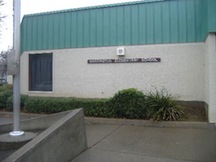
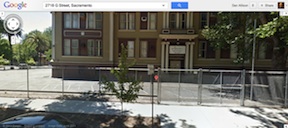
The meeting on the closure of Washington Elementary School in midtown Sacramento is this evening (Wednesday, February 13) from 6:00 to 9:00PM, at the school. Though all of the eleven schools proposed to be closed are important, I’m highlighting this one because it is my neighborhood school – I live in midtown. If this school closes, there will be no schools left in midtown.
The district’s website has information on closures. While I believe the district’s approach of basing closure solely on “economic criteria” – meaning excess capacity – is seriously flawed, nevertheless, here is the capacity report on Washington. If the portable classrooms (X, Y, Z) with a capacity of 132 were removed, the overall capacity would then be 574 rather than 706. The school would then be 39% of capacity rather than the district’s number of 31%. Still very low. I suspect that a similar analysis of the other schools to be closed would show a similar bias against schools where the district added portables and is now counting these against the school, no matter what condition or life expectancy they have.
Sacramento City Unified School District (SCUSD) is considering the closure of 10 elementary schools which are well below capacity due to declining enrollment, in order to save money on facilities and staff. While I certainly sympathize with the need to reduce costs in the face of declining enrollment, I think that SCUSD is failing to consider several factors in making this decision. Let me say that many school districts are facing the same challenge; SCUSD is just the current example, and I am not trying to pick on them. I live within SCUSD but work in another school district; I do not have children, but have been an education professional for much of the last 39 years.
There have been a number of articles in the local media about the closures, but the SacBee article on Sunday, January 27 provides a level of detail and addresses several of the challenges.
Why is this a transportation issue? Closure of these schools will eliminate 10 neighborhood schools, which children can by and large now walk or bicycle to. True, many of the students don’t, but they could. In most cases they will not be able to walk and bike to their new school, due to increased distance and the need to cross busy arterial streets. The change will therefore greatly increase the rate of parents driving their children to school at the remaining schools. More congestion and air pollution, and less safety for the students who do walk and bike. I will clearly state two premises:
Right-sized neighborhood schools have a strong social value that must be weighed along with other considerations.
All children should be able to walk and bike to school, at least at the elementary level.


 Getting Around Sacramento