Getting around… with a knee scooter

I fractured a bone in my right foot on July 7 while backpacking along the Pacific Crest Trail in the Granite Chief Wilderness. I initially thought it was a tendon problem, because I’d had some discomfort with the tendon before, however, in stepping on the outside edge of my foot on a rock, the pain level increased manifold. I walked out on it. On Friday, I went into the doctor, got an x-ray, and now have a lower leg cast. What does this have to do with transportation? Well, I’m now getting around with a knee scooter, rather than walking or bicycling.

It has been interesting, and here is my take on it so far. The knee scooter has small wheels, about eight inches, so it is less stable than a bicycle, or a wheelchair. Because it is somewhat unstable, I use a lot of energy maintaining balance. Though I’ve noticed, now that I’m paying more attention to people using wheelchairs, that the unpowered ones are not all that stable either. But it does move along quickly, faster than walking though not as fast as bicycling.

Read More »

Sacramento has stalled

Jim Brown wrote recently in the Sacramento Bee about underfunding for the city’s contractor to develop a new bike plan, and the plateauing of progress on bike mode share in the city. Please read! However, the issues go well beyond bicycling. Sacramento has stalled, period. We are no longer making forward progress towards livability.

There are three additional major issues, as I see them:

  1. Our public transportation system (SacRT) is woefully underfunded, and despite a lot of discussions recently about how to improve the system, not one of our political leaders seems to have the courage to state the obvious, that we cannot have a successful and efficient system unless we devote more tax revenue to it. Putting bandaids on the system will not make a significant difference. Sacramento needs to fund SacRT at a level comparable to other cities of our size, which means tripling our tax base.
  2. Sacramento is not becoming more pedestrian friendly, in fact it seems to me to be becoming less so. There is an almost universal failure among drivers to recognize the rights of pedestrians to cross the roadway (CVC 21950). I find that almost no drivers yield to me when I am walking. Apparently the Sacramento Police Department accepts this situation, because so far as I know they make no effort to enforce the law. I have never seen someone pulled over for failing to yield to a pedestrian, and in fact I’ve had several SacPD officers fail to yield to me. Pedestrians, not bicyclists, are the indicator species for our city, and until we treat people walking as the highest form of transportation, we will never be anything but a sad city. [As an addendum to this, Chris Morfas reminded me that the conversion of one-ways streets to two-way streets has also stalled. The city made a decision to start these conversions years ago, and then lost courage. Nothing has happened on this critical change in years.]
  3. The city is going to focus much of its attention on Natomas, now that the building moratorium has been removed. I think that no effort and no money should be spent there until the city develops a new vision for Natomas. The sprawl suburbs are a dead end, and we should not be spending any money on them until we have a plan for how to make them financial viable and livable. Meanwhile, the two truly needy parts of the city, South Sacramento and North Sacramento/South Natomas, are neglected. These are the areas where the most people are walking, bicycling, and using public transit, but yet the city continues to throw money at the “rich” areas that it hopes will provide sales tax and property tax revenue to save the city from its debt problem. The fact is, however, that it always costs more in infrastructure to support new developments than they ever generate in sales and property taxes. It is the small businesses in South and North Sacramento that actually support this city.

There is also much to celebrate in Sacramento. I live in midtown, and I am so impressed with the new development happening, with the richness of opportunity here, and even impressed with the improvements to bicycle facilities that have happened. But most of this is driven by economics, and will happen with or without the help of the city. What won’t happen without the help of the city is livability in South and North Sacramento. Indeed, to say something controversial, I think the city needs to pay way less attention to downtown/midtown, and much more to the neglected areas north and south. I am not saying that every area of the city can be saved – we will have to prioritize and triage – but to keep acting as though downtown/midtown are the whole of Sacramento indicates a complete lack of leadership on the part of the city council.

West Sacramento gets affordable housing grant

The City of West Sacramento received a grant in the first round of the Affordable Housing and Sustainable Communities (AHSC) program. This is the housing leg of the cap-and-trade program, announced yesterday by the Strategic Growth Council, complementing the transportation leg that got SacRT a grant for light rail car refurbishment.

  • Project Name: Delta Lane Affordable Housing and Grand Gateway Transportation Infrastructure Project
  • Project Sponsor: City of West Sacramento
  • Project Type: ICP; Disadvantaged Community? YES
  • Total Award: $6,730,888
  • Project Description: The Delta Lane Affordable Housing Project is a mixed-use development including 77 residential units and retail. The project will also provide transportation improvements in the Grand Gateway and Washington transit-oriented development/infill development districts. The project will greatly improve walkability and bikeability opportunities that are currently lacking and offer connectivity to the two surrounding disadvantaged communities. The project will also be connected to the nearby city transit hub and the major employment centers of CalSTRS, the California Department of General Services, and downtown Sacramento.

downtown/midtown infill projects

Two articles from yesterday, CADA gets go-ahead for more housing (SacBee 2015-05-04) and Small is beautiful: Mini-developments popping up in Sacramento’s central city (Sacramento Business Journal 2015-05-04) talked about several locations where infill development has or will occur. The SacBee mentions Warehouse Artist Lofts, Legado de Ravel, 16 Powerhouse and Eviva Midtown. WAL and Legado de Ravel are complete though not all retail spaces are yet occupied. 16 Powerhouse is nearly complete, and Eviva is just getting going again, with foundation work underway. Also mentioned are Enterprise Rent-A-Car at the corner of 16th and N streets; the entire block bounded by 12th, 13th, N and O streets (this is incorrect, the block is actually 12th/13th/O/P, which is largely a parking lot but contains several older apartment buildings); and the southwest corner of 14th and N (a parking lot). The Sacramento Business Journal mentions Capitol Avenue near 18th Street (1809 Capitol Ave, where constructing is going on right now), an empty lot at 1523 E St, the southeast corner of 17th and Q Streets (a parking lot), 2215 Q St, and four single-unit townhomes on four lots at 2117 20th St (I think this may be an incorrect number on 20th, as there are some new townhouse that are part of the Tapestri Square area).

I was curious to look at these locations, some of which I’d not noticed before, so visited and took photos of each, presented in the slideshow below.

Let me say that I’m opposed to demolishing still usable buildings in order to build new developments. Not because we don’t need new large developments, but because there are plenty of other properties where they can take place. This would apply to the 12th/13th/O/P locations, on which sit several apartment buildings.

There are hundreds, perhaps thousands, of properties throughout downtown/midtown which could be redeveloped. They are empty, or parking lots, or occupied by abandoned buildings which cannot reasonably be reconstructed, or buildings which have been vacant for number of years.

This slideshow requires JavaScript.

tomorrow on Broadway Corridor

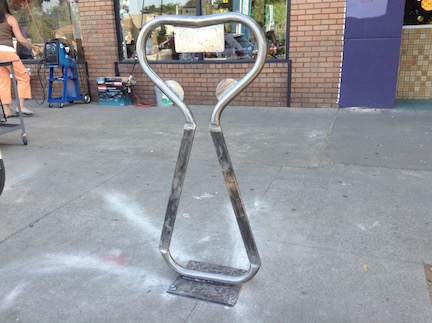
art bike rack at New Helvetia Brewing

The City of Sacramento is soliciting input on changes to be made on the Broadway Corridor to accommodate pedestrian and bicyclist use.

Broadway, as currently designed, is definitely a motor vehicle world, where pedestrians cross at considerable risk and bicyclists riding in traffic are routinely honked at (or worse). Some years ago an attempt was made to calm traffic by installing bulb-outs or curb extensions at some pedestrian crossings. But these did little to slow traffic and much to make bicycling more difficult. As one of the main business streets of Sacramento, and one that is considerably more diverse than many, the corridor, and the businesses along it, and the people who use it, deserve better. Please be a part of making that change happen.

“Broadway has many exciting destinations, but as an auto dominated arterial it is an unfriendly place to walk or ride a bike,” explained Sparky Harris, City of Sacramento Project Manager. “The goal of this project is to better connect sidewalks and bike lanes, enhance pedestrian crossings, and make the corridor an inviting destination for anyone attempting to travel without a car.” (from City Express)

Tomorrow, Wednesday, April 19 there are several mobile workshops along the corridor where people can find out more about the proposals and provide input. Check the City Express post City looking at improvements for Broadway Corridor for times and locations.

Sacramento Area Bicycle Advocates (SABA) is hosting a bike ride from Capitol Park that will end at the mobile workshop at New Helvetia Brewing on Broadway at 18th. The event is on Facebook: https://www.facebook.com/events/934340296639140/.

Walking to the pub

I’d like to expand on a tweet I posted last night:

“On St Patricks day, when everyone is reminding you to drive sober, let me remind you to live close enough to your pub that you can walk.”

As I was walking around early evening yesterday, I went by a number of bars that were catering to some degree to the St. Patrick’s Day celebrations. I was looking for a place with Irish music, of which there were as many yesterday as the entire rest of the year (sadly, Celtic/Irish music has faded from Sacramento). Some were pretty empty, some were so full there were long lines just to get in. The most popular in my part of town, De Vere’s, didn’t seem to be offering music at all. And I won’t set foot in a place that serves green beer. I settled on Shady Lady as the place I’d return to in the later evening. But this isn’t a post about favorite bars, it is about transportation.

Shady Lady is four blocks from my apartment. An easy walk at any time, and an easy walk if I’ve had enough to drink that it would affect my walking. I actually don’t drink much, and had only two strong beers last night. But the point is, I could have walked home if I’d had ten, or more. Or I could have done what many others were doing, jump in their car and head home, endangering themselves and their passengers, endangering other drivers and passengers, endangering pedestrians, endangering bicyclists. Everyone spends time talking about not driving drunk, about having designated drivers, but despite years of this kind of talk, and some effective shaming by Mothers Against Drunk Driving, people still do it. The talk is especially prominent around holidays, St. Patrick’s Day among many. But there are still drunks on the road, and they still cause a disproportionate percentage of crashes. We’ve made some difference, but only a small part of the difference we need to make, and I have the feeling that effectiveness has plateaued. When I read the newspaper, most crashes involve alcohol, or speed, or alcohol-fueled speed. We can never reach Vision Zero if anyone, ANYONE, is driving home from a bar with significant alcohol in their system.

So, what to do? Well, live close enough to a pub/bar that you can walk.

I think we would do well to return to the old concept of a pub, the public house, the gathering and drinking place where the town or the neighborhood went to on a regular basis. There was a time people did not jump in their cars to go drinking. I understand that pub culture has faded even in the United Kingdom, but given this celebration of St. Patrick’s Day and Irish culture, I’d like to see us turn back towards that model. Get drunk at the pub, stumble home. That was the tradition, and it could be again.

There are some issues:

  1. There are vast areas in the suburbs that have no bars, or at least no bars that the average person would feel safe walking into. Just like there are food deserts, there are good bar deserts.
  2. There is a strong social desire to go to the latest, greatest, most popular, most “cool” bar, so those places are packed with people who have driven in from somewhere else.
  3. Most people chose the place where they live based on other criteria, such as a nice house, or an affordable house, or good schools for the kids, or a quiet neighborhood. All of those are useful, but when that choice leads to killing yourself and others by driving drunk, it is a bad choice for everyone. And a real possibility is that you will end up killing your own kids or someone else’ kids.

So, do you drink enough that it affects your ability to get around? If you answer yes, then I’m asking that you commit to yourself, and to me and everyone else, that you will only do that at a place you can walk home from. No exceptions, no excuses. Will fulfilling that commitment cause you to have to move? Probably. Do it anyway. Don’t kill yourself, and don’t kills others, based on a broken concept that the decision about where we choose to live is without consequence to others.

For some more perspective on the issue, see Strong Towns “Mothers Against Drunk Driving Should Also Be Against Zoning.” Though I strongly disagree with the post title, and the post only provides arguments against dumb zoning, it is an interesting read.
Sacramento does well on economic segregation

A recent report Segregated City: The Geography of Economic Segregation in America’s Metros indicates that Sacramento is better than most cities in economic segregation. Unfortunately the full data set has not been released, and Sacramento shows up in only two of the tables and one text location. The paper is highlighted in a CityLab post America’s Most Economically Segregated Cities.

“Interestingly, the large metros where the wealthy are least segregated (Exhibit 2.3) are mainly on the East and West Coasts and include some of America’s leading high-tech knowledge centers, which have some of the highest income levels in the nation. San Jose is the metro where the wealthy are the least segregated from other segments of the population, followed by nearby San Francisco, Washington, D.C., Seattle, Hartford, Boston, Providence, Portland, Oregon, Minneapolis-St. Paul, and Sacramento. The relatively high wages that knowledge and professional workers receive enable them to share some neighborhoods with the super-wealthy, even though the gap between rich and poor may be substantial in these places.” (page 17)

In Exhibit 2.3: Large Metros where the Wealthy are Least Segregated (page 17), Sacramento (Sacramento-Arden-Arcade-Roseville, CA) is ranked number 10. In Exhibit 3.3: Large Metros with the Lowest Levels of Income Segregation (page 24), Sacramento is ranked number 6.

Fresno county is sinking, so punches holes in the ship

“You have no conceivable way of raising the money you need to build the new facilities to enhance your existing operations, much less provide for the growth.” – Mike Prandini, president of the Building Industry Association of Fresno and Madera counties (Fresno County supervisors suspend — but don’t eliminate — building fees charged to developers Fresno Bee 2015-02-10)

What he meant, I think, is that since no amount of developer fees could possibly pay for the expense to the county of greenfield development, that the county might as well just continue the practice of subsidizing greenfield development with taxpayer general funds, so as to not make the beneficiaries of new development, the developers and home buyers, pay anything at all. This is insanity.

When the ship is sinking, might as well deep-six it. Full speed ahead with development, though the iceberg looms dead ahead.

Thanks to Strong Towns for the reference.

State school bonds are a subsidy to sprawl

typical greenfield school, Elliott Ranch ES, Elk Grove

Californians for Quality Schools, led by the development community, is proposing a new statewide school bond issue for the November 2016 election. Many people would assume this is a good thing: schools are good, schools are needed, so a bond issue is needed. The last school bond issue from 2006 is nearly exhausted. See two local articles about the school bond effort: California school builders, others to gather signatures for November 2016 bond measure (SacBee 2015-01-13) and Builders to gather signatures for $9 billion school bond (Sacramento Business Journal 2015-01-13).

I think that the school bond issue is a transportation issue, and is a huge mistake. Though I’m part of the educational system, I am opposed to this bond. Why?

Statewide bond issues largely pay for new schools in developing areas. They could be used to pay for reconstructing existing schools (modernization), or for building new schools to replace old ones in urban areas (new construction), but they generally are not. They could be used to level the playing field between low-income or disadvantaged communities (partially the critically overcrowded schools program), but they generally are not. Local school districts are expected to largely pay for reconstruction and replacement from their own school bonds and developer impact fees.

Though it is difficult to track down the allocation of funds to new construction versus modernization, one six-month allocation totaling $337.2 million had only $2.8 million for modernization. There have been a large number of criticisms of the current funding formulas that seem to allocate much more to high income school suburban districts rather than to students who need higher quality classrooms.

So where are these new classrooms that are being paid for? Nearly all are in greenfield developments in the suburbs and exurbs. As such, they are a huge subsidy by state taxpayers (who have to repay the bond issues and interest) to development interests. It is yet another taxpayer subsidy to suburban sprawl. It is no surprise that the leading advocates for the new bond are corporations that build schools (through Coalition for Adequate School Housing) and corporations that build greenfield developments (through California Building Industry Association). An interesting acronym, CASH for Coalition for Adequate School Housing, which sees the taxpayers as a cash cow for lucrative contracts.

We do need a solution, given that greenfield development is still happening. The best solution is that development impact fees pay for 100% of new schools: land, buildings and contents, and that new development pay into a school district reserve account that will fund normal maintenance on the school for a period of ten years. This of course would be strongly opposed by proponents of the bond issue. They don’t want to pay their own way. But full funding from impact fees and a maintenance reserve would ensure that existing students and residents are not harmed by new development. And it would greatly reduce the financial incentive for greenfield development, which is my primary purpose after all because greenfield development to the greatest block to rational transportation planning.

If we pass the bond, we will perpetuate sprawl. Please do not sign the petitions to place the bond issue on the ballot, and if the issue does make it to the ballot, please do not vote for it. Of course additional reform is needed so that state monies do go to solving specific problems, particularly in underserved communities, but at least stopping the bond issue will stop the gravy train and allow us to focus on reform.


One-way streets, again

I’m glad to see the idea of converting one-way streets to two-way streets to improve livability and safety is back in the news: More than one way (Sacramento News & Review 2014-11-27).

The reasons given, by Chris Morfas, William Burg, Jim Brown, Dave Saalsaa, and Emily Baime Michaels are all good, strong reasons for conversion.

The comments by Sparky Harris are a little disingenuous. The city already has a plan to convert one-way to two-way, documented in the 2006 Central City Two-Way Conversion Study Final Environmental Impact Statement (no long available on the city’s website, but I have a copy of this large document if you want it). It is interesting that it is not longer on the website. Eight years ago the changes in driving and living habit were starting to become obvious, and even at that time, it was clear that there were considerable benefits from conversion. Except for a very few streets that were converted when they were resurfaced, nothing has been done. Now another study? I’d rather see more action and less study. Yes, some conversions will not have benefits that are as strong, and some will be controversial, but converting many of the streets is “low-hanging” fruit, something that should already be underway and not awaiting more study.

I’ve written about this idea in several posts: