what’s going on? (SacCity version)

In compiling this list, I realized that it was becoming very long, so I’m splitting it into two lists, the second on non-City of Sacramento to be posted shortly.

There are so many actions and possibilities for improving the efficient, equity, and safety of our transportation system that I can’t keep up with it all, and even nonprofits that have staff are unable to keep up. So, what’s going on? The list below is not in any priority order, but may give you ideas about what you would like to get involved in. It takes a village!

City of Sacramento

  • Street Design Standards Amendment: This is ongoing. The organization most involved is Strong SacTown, and of course, Getting Around Sacramento
  • Streets for All Active Transportation Plan: This is ongoing. The neighborhood connections part of the plan, perhaps the most important element, will open a public input process in November, with two online workshops.
  • Work Zone and Event Detour Policy: This is ongoing, however, opposition in Public Works has delayed this policy by many months, and it will take public pressure to free it up.
  • Active Transportation Commission (SacATC): Though it has been pretty ineffective since founding in 2018, the addition of strong leaders to the commission and the notice of supportive city council members has opened the opportunity for real progress.
  • Vision Zero: Though the city committed to Vision Zero in 2017, the rate of traffic fatalities and severe injuries has increased every year since, because of the city’s unwillingness to take dramatic action, and the very very slow process of depending on grant funding to improve streets. The focus on corridors and inattention to intersections is also a flaw. The Vision Zero plan is being updated, but so far there has been no public involvement.
  • Speed limits: The city reduced speed limits in many school zones several years ago, on a few streets recently, and is working towards additional reductions under AB 43.
  • Emergency Declaration on Roadway Safety: Vice Mayor Caity Maple, Mayor Darrell Steinberg, and council member Karina Talamantes are sponsoring an emergency declaration on roadway safety, to address the epidemic (pandemic?) of traffic violence in the city. The initial proposal focused on ineffective traditional responses, but they seem open to more innovative and effective approaches.
  • Climate Action and Adaptation Plan: This plan, now part of the 2040 General Plan, set targets for walking, bicycling, and transit mode share, that were less ambitious than proposed in the Mayors Climate Action Plan, but nevertheless significant. Reaching these targets will require proactive changes to transportation funding allocation, street redesign, and implementation of quick-build projects.
  • Transportation Priorities Plan (TPP): This plan was adopted in 2022, to guide city investment and grant seeking based on objective criteria, rather than the whims of traffic engineers. Though the priorities could have been better weighted towards equity, active transportation, and climate action, it is nevertheless an immense improvement. Citizens will have to monitor the city’s decisions to ensure that the plan is followed, and improved over time.
  • Shared Mobility/Shared Rideables: The city has a shared rideables program which has resulted in a plethora of electric scooters in some parts of the city, and almost none in others, and almost no bike share at all, though we once had the second most successful bike share in the US. The city has chosen to let the market decide, the commercial companies, and has refused to consider city subsidy or a city program to ensure more widespread and equitable availability.
  • Quick-build: The active transportation community has requested that the city implement a quick-build program, with funding, that can respond quickly to crashes and traffic safety issues. Leadership has primarily been by Slow Down Sacramento. Though the city has discussed a program, they have so far refused to implement or fund a program.
  • Red light camera enforcement (no link because the city removed its page): The city participated in the county’s red light camera program, but when the county dropped the program, the city did as well, and so far as is known, has no plans to develop their own program. Red light running is epidemic (pandemic?) in Sacramento, and elsewhere, and there must be an automated enforcement program, with equity guardrails, to address this traffic violence issue.
  • Daylighting: State law (AB 413) prohibits parking with 20 feet of intersections, in order to increase visibility between drivers and people walking. The city has not said whether it will enforce this law, nor whether it will add signing or red curbs to communicate it to drivers. So of the benefits of daylighting can also be achieved through temporary (quick-build) or permanent curb extensions.
  • Speed camera enforcement: The city is not part of the speed camera enforcement pilot program (though to its credit, it asked to be). The city should continue to ask to be part of the pilot program, and to fully participate when the program becomes permanent.
  • The 2040 General Plan: The plan sets a new vision for mode priority in the city (graphic below). This is a seismic shift in priorities, and will be resisted by many city staff, so it will take citizen pressure to ensure that it is followed.
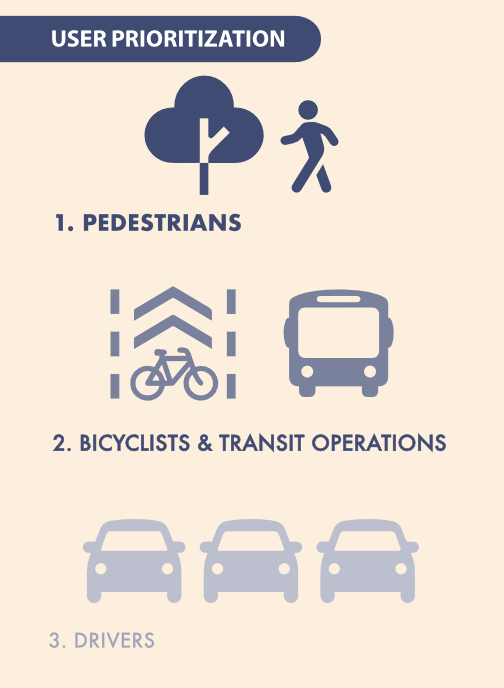
graphic of User Prioritization from City of Sacramento 2040 General Plan
User Prioritization from City of Sacramento 2040 General Plan

This list no doubt misses some important topics. Please suggest them in the comments. The next post will include some actions that are applicable to City of Sacramento, but also to other cities, the county, and the region.
SacATC 2024-10-17

The City of Sacramento Active Transportation Commission (SacATC) will meet this Thursday, October 17, 2024, starting at 5:30 PM. The meeting is held at city council chambers, 915 I Street, and can be viewed online via the link available when the meeting starts, on the city’s Upcoming Meetings page. People may comment in person (preferred) or make an eComment on the city’s Upcoming Meetings page. Though all eComments become part of the public record, only those submitted before noon of the meeting date will be seen by the commissioners. The agenda includes three discussion items, below, and is available as pdf.

  1. Fiscal Year (FY) 2025/26 Caltrans Sustainable Transportation Planning Grant
  2. Assembly Bill (AB) 43 Project (speed limits)
  3. Active Transportation Commission 2024 Draft Annual Report

At the last meeting, the commission decided to reduce the list of recommendations to those directly impacting street safety. In the updated draft annual report, these six are:

  1. Increase Funding for Active Transportation Infrastructure Projects
  2. Expand Speed Management Programs
  3. Create a Sacramento Quick- Build Bikeways Program
  4. Re-Establish Slow & Active Streets
  5. Develop a Citywide Safe Routes to School Program
  6. Finalize the Construction Detour Policy

They are listed in inverse order of funding. with #1 requesting the highest level of funding, $3M per year.

It is important for the community to support the annual report with its focus on priority safety actions, to support the report when it goes to city council, and to support the city prioritizing these funds in the mid-year budget revision and in next year’s budget.

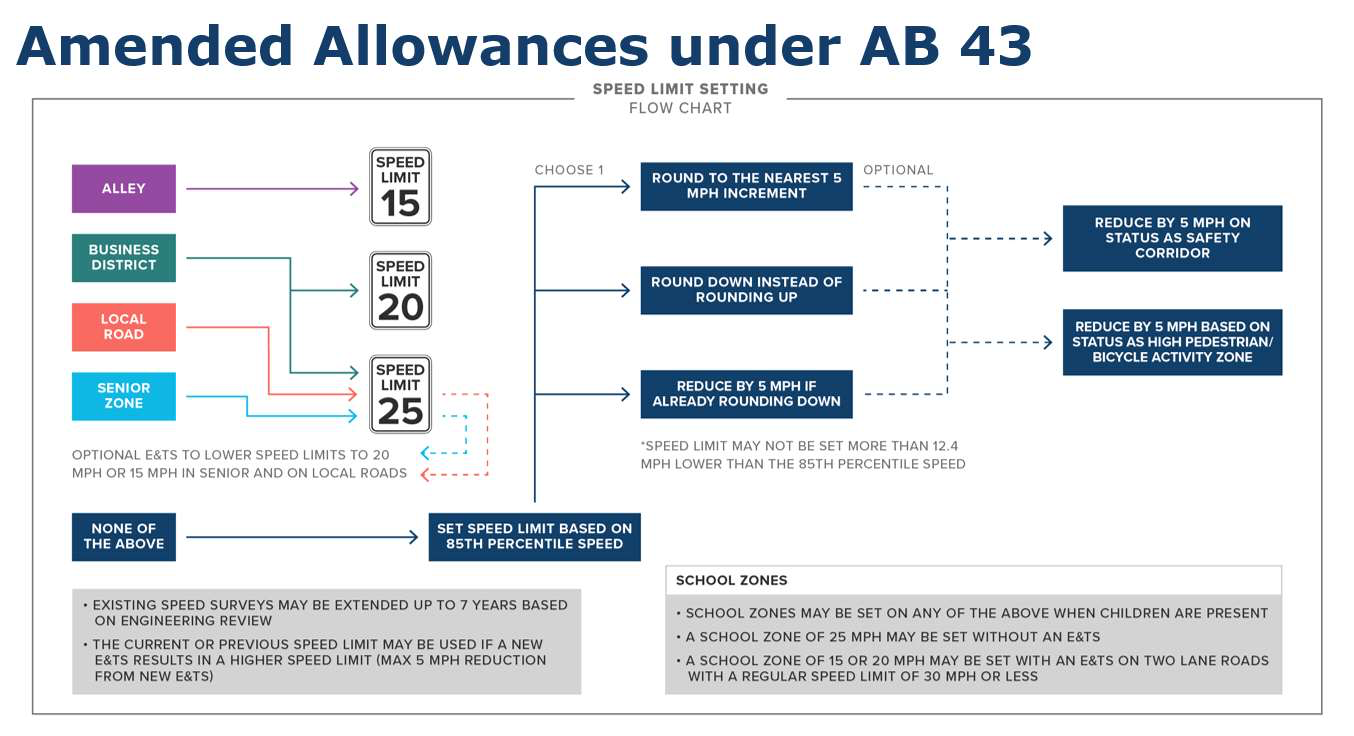
The city reduced speed limits in many school zones several years ago, and recently reduced speed limits on a few streets, and is gradually working to reduce speed limits on more streets, including alleys, business districts, local roads, and senior zones. The graphic below shows the approach. The presentation will bring the commission up to date on the project.

graphic of speed limit setting flow chart

City staff is asking the commission to recommend two grant applications under Caltran’s Sustainable Communities Planning Grants for Transit Needs in Sacramento to meet Climate, Equity and Mobility Goals; and the Walking, Bicycling and Transit Access Wayfinding Project.

The city’s Department of Public Works Transportation Planning Newsletter has more information on these topics and others. I recommend you sign up if you aren’t already getting the email newsletter, which comes out once a month.

more on Broadway-Land Park bike signal

I have written before about the problematic bike signal for Broadway eastbound at Land Park Drive (dangerous bike signal on Broadway, Broadway bicyclist press the button). Now some more detail, from a full hour of observation on the signal and driver behavior.

I had hoped to observe bicyclists reacting to the signal, but unfortunately there were no bicyclists. Despite the city devoting much of the street right-of-way to bike lanes (not protected, on only sometimes buffered), it appears that no one is riding their bicycle on Broadway. I’m not surprised. Broadway continue to be an unpleasant place for bicyclists and walkers, and regular bike lanes are unlikely to change that.

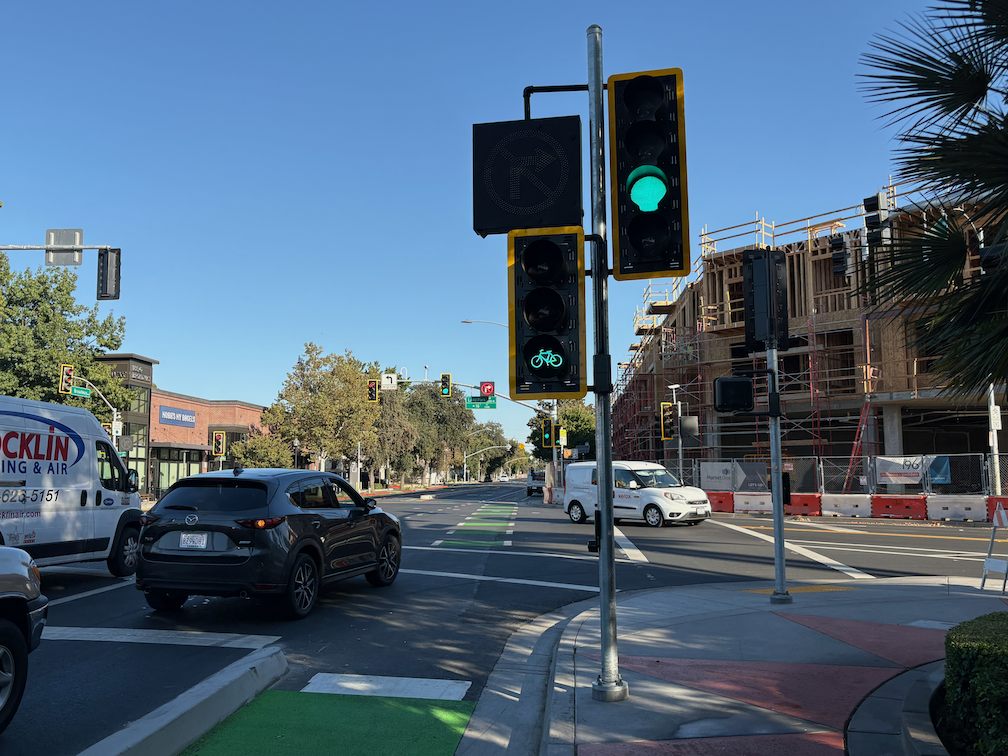
The last post I had noted that there was a required beg button for bicyclists to trigger the bike signal, but had failed to look up and notice that there was a complete set of regular signal, bike signal, and blank-out no-right-turn sign on the same post. It looks like:

photo of Broadway eastbound at Land Park Dr, signal, bike signal, blank-out no right turn
Broadway eastbound at Land Park Dr, signal, bike signal, blank-out no right turn

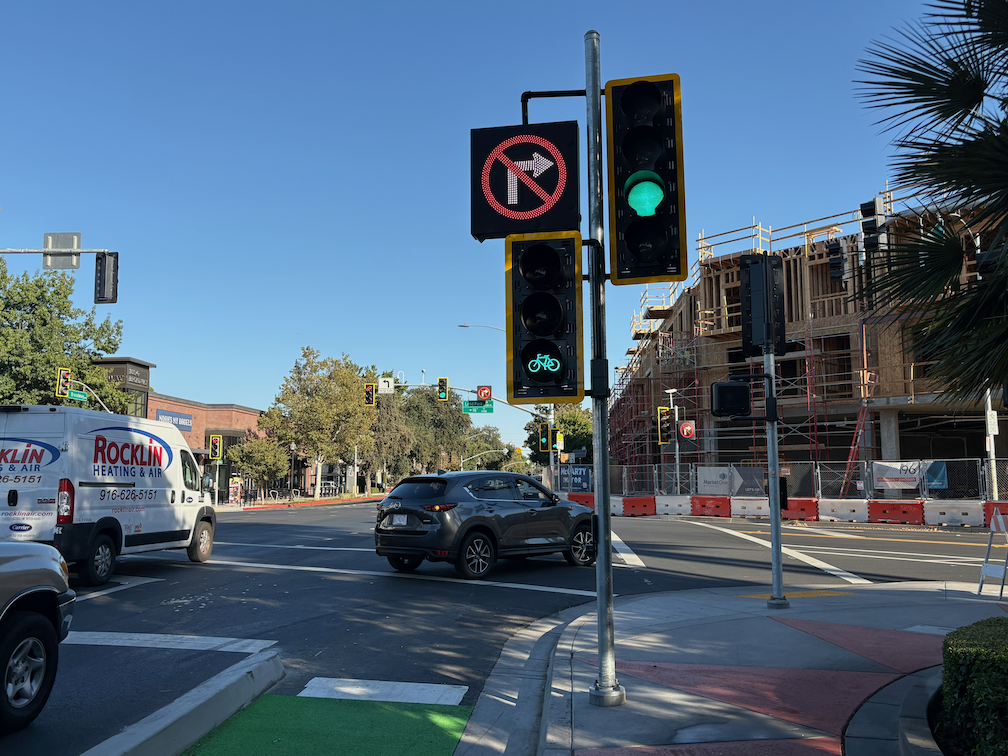
For those unfamiliar with the blank-out signs, which are relatively uncommon in the city, it illuminates when turns are prohibited, and is blank when not prohibited. See photo below for the blank-out phase.

This signal array is definitely mis-communicating to drivers. When the bicycle signal is on, the no-right-turn sign should be on, and the regular signal red. This is mounted close to the right hand turn lane, and drivers see it as applying to that lane.

Most of the time, it is necessary to press the pedestrian beg button to trigger the bike signal. But then sometimes it is triggered without any press, and not due to the presence of bicyclists, as there were no bicyclists. Most signal cycles the bike signal remains red.

When the bike signal is on, there is a period of time when the no-right-turn sign is not on (blanked out), as below.

photo of Broadway eastbound at Land Park Dr, signal, bike signal, blanked-out no-right-turn
Broadway eastbound at Land Park Dr, signal, bike signal, blanked-out no-right-turn

Do drivers follow the no-right-turn sign? In an hour of observation, I did not see one driver follow the sign. Every driver turned across the no-right-turn sign and across the green bike signal. Every. Though I did not observe it at this time, I have experienced drivers yelling at me, and other bicyclists have reported being yelled at, by drivers who think they have the right of way and wonder why bicyclists are proceeding and interfering with cars. The photo below shows just one of about 70 drivers who turned against the no-right-turn sign.

photo of Broadway eastbound at Land Park Dr, driver turning against no-right-turn sign
Broadway eastbound at Land Park Dr, driver turning against no-right-turn sign

Solutions

  1. The regular signal should remain red while the bike signal is green. The placement of this signal is interpreted by drivers as applying to the right hand turn lane, so it must be red.
  2. The bike signal must have an exclusive phase where all other vehicle movements are prohibited. A properly designed intersection with a properly designed signal system probably would not need an exclusive phase, but this is NOT a properly designed intersection and NOT a properly designed signal system.
  3. The pedestrian beg button should be removed from the bike lane, and automatic detection of bicyclists installed. The city knows how to do this, and has done it at a few other intersections, but chose not to here.

Bicyclists will be fatally or severely injured here, and the cause of the crash will be mis-designed roadways, for which city engineers are directly responsible. Drivers are just responding to a mis-designed roadway, the guilty party is the traffic engineers.

The design document for Broadway Complete Streets, and as built, has a through lane, a dedicated left hand turn lane, and a dedicated right hand turn lane. This right hand turn lane is the source of the conflict, the source of the danger. The roadway as built prioritizes motor vehicle throughput over safety.

Stockton Blvd Plan to Planning and Design

The City of Sacramento Planning and Design Commission is holding a hearing on the Stockton Blvd Plan this Thursday, October 10, 5:30 PM. It is item 3 on the overall agenda.

The Stockton Blvd Plan is largely about development and necessary utility infrastructure along the corridor between Alhambra Blvd and 65th Street. I am making documents available here. Note that two of these are huge. I’ve downsampled them a bit, but if something you wish to see is fuzzy, you will have to go back to the original documents on the city website, Upcoming Meeting Materials.

I do not have time to look at these documents, but I’m posting them in the hopes that someone will. Though I use Stockton Blvd a few times a year, I don’t spend enough time there to have useful comments from a community perspective.

The Stockton Blvd Plan is NOT about transportation, which is addressed by a separate Stockton Blvd Corridor Plan. In fact, the Stockton Blvd Plan EIR refers all transportation related comments to this document. This plan was a draft in 2021 (Stockton Blvd Corridor Study, Stockton Blvd needs trees, Stockton Blvd draft available). The related project page has disappeared from the city’s website, and the draft plan is quite hard to find (which is why I’ve linked to my copy). The city and SacRT came to an agreement to consider Stockton Blvd for bus rapid transit (BRT), or something approaching that, rather than the weak tea attention to transit in this draft plan. However, there doesn’t seem to be any trace of that project on the city website. SacRT has a webpage about the project: Ride the Future: Sacramento’s Bus Rapid Transit Solution, but there are few details and no timeline.

cover of Stockton Blvd Plan

Broadway bicyclist press the button

Additional posts on Broadway Complete Streets are available at category ‘Broadway Complete Streets‘.

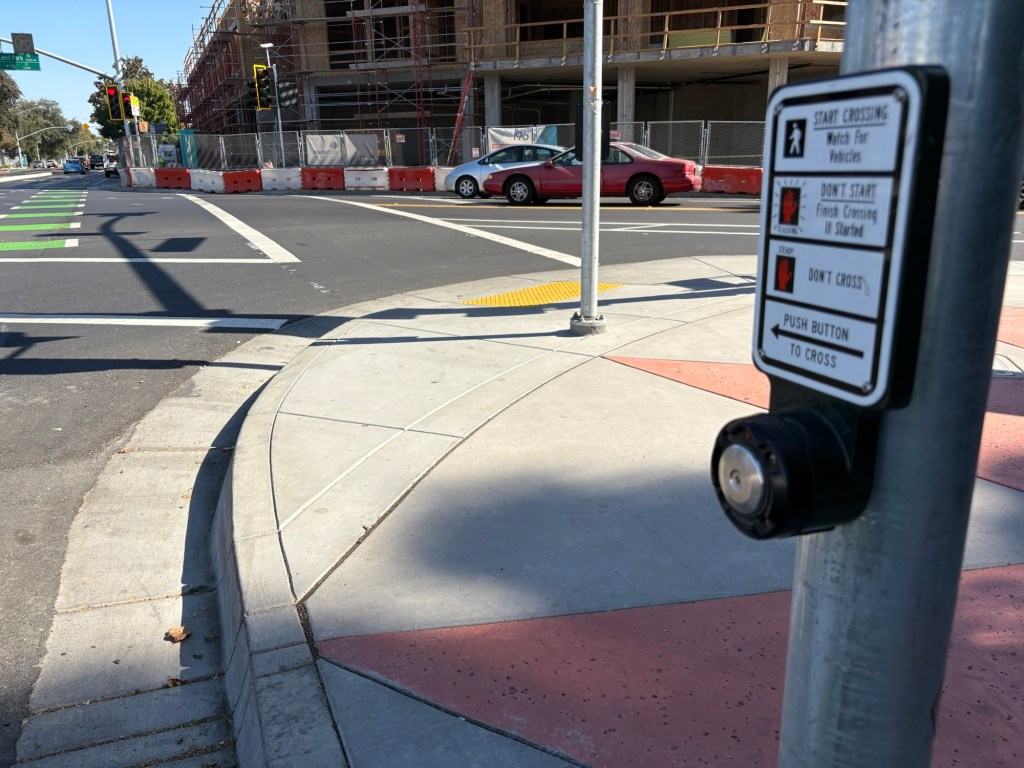
The bicycle signal face for Broadway eastbound at Land Park Drive/16th Street did not work for several weeks after it was turned on. Then it was ‘fixed’ so that it was part of every signal cycle. Now it has been further ‘fixed’ by the installation of a beg button which the bicyclist must press to trigger the bicycle signal. The beg button is the standard pedestrian button, it says nothing about bicyclists.

This signal should detect bicyclists and trigger the bicycle phase, without requiring any action by the bicyclist.

This is yet another example of the incompetence of city traffic engineers, who not only cannot design a signal that works properly, but will actively make things worse for bicyclists. Their concern is foremost, and only, with the free flow of motor vehicle traffic.

Bike signal for Broadway eastbound requires button push

SacCity pedestrian safety emergency: enforcement

The draft City of Sacramento emergency declaration on pedestrian safety: ‘Declaring a state of emergency regarding pedestrian safety in the City of Sacramento and calling for immediate action to address pedestrian injuries and fatalities’ is available (pdf of text, 2 pages, 68KB) (pdf of attachments, 28 pages, 26MB).

This post focuses on the enforcement item.

3. “The City Manager is further directed to work with the Sacramento Police Department to ramp up enforcement of traffic laws that protect pedestrians, including speed limit enforcement, crosswalk violations, and distracted driving. The City shall prioritize enforcement in high-injury corridors and areas with frequent pedestrian activity.”

Three advocacy organizations specifically commented about the draft that it must focus on ‘equity and mobility justice’, as did most of the people who spoke at the city council meeting.

I’ll be blunt. There is a deep and well justified mistrust of Sacramento Police Department (SacPD) among people of color and low-income, particularly among, but not limited to, blacks. SacPD has a history of oppressing black people, and has often used traffic stops as a pretext to harass people. Many of these have escalated into arrest, beatings, and even death. I have seen no real evidence that SacPD has changed their stripes. They are not people that I want interacting with the public about traffic law. And, apparently, they don’t want to either. SacPD has reduced its traffic officer group to almost nothing, and does little traffic enforcement by traffic officers or any officers. It is time to move past the idea that law enforcement has much to contribute to reducing traffic violence.

At the same time, no enforcement of any sort is not the answer. People are dying when drivers violate traffic law, and these deaths are unacceptable. Speed is a contributing factor to all traffic crashes, and is sometimes the primary factor. Driving too fast for conditions, and these conditions include walkers and bicyclists on and close to the roadway, is always wrong, even though road design encourages it.

Automated enforcement is a partial answer. It avoids the pretextual stops, avoids harassment of people of color and low-income by police, at least over traffic law, avoid the escalation that police engage in, and is much less expensive than police officers.

The three main traffic violence issues to be addressed, at least at this time, are:

red light running: Red light cameras and automatic ticket issue to the owner of the vehicle are a partial solution to red light running. Of course some drivers will always run red lights, will always endanger others, and will not be deterred by tickets. But most drivers will notice that tickets are being issued, and will change their behavior. Red light running does have infrastructure solutions, including changing from far-side signals to near-side signals, and raised crosswalks and raised intersections. But there are not easy or inexpensive fixes, so automated enforcement is a good interim solution. When the county ended its red light program, which operated the red light camera in the City of Sacramento, the city made no effort to replace that program, and at least some city staff celebrated it (the red light runners?). The city should create a red light camera program of its own. It should be administered by Public Works, not by SacPD. There are equity issues, since the wide, high speed arterials that most encourage red light running are in low-income communities. Two solutions are to distribute cameras across the city in locations where red light running might occur, and not just those locations with a history. The egregious violators, which are who we really want to target, will be receive tickets eventually. The second is to adjust violation fees (and court costs) to a factor related to income. It would be awkward and perhaps invasive to base it on income, but it could easily be based on vehicle value.

failure to yield to walkers: Drivers have been trained by roadway mis-design to not yield to people in crosswalks. The recent SacPD, OTS funded, sting on J Street demonstrated how common this is. But again, as drivers have been trained to do this, they can be untrained. There are options for automated enforcement of failure to yield, but it requires more complicated and less widely used technology. The city should be experimenting with this technology (they are not), but in the meanwhile, this may be one situation in which in-person enforcement, on a limit basis and with close attention to equity concerns, may be justified. Any in-person enforcement by SacPD raises issues of police violence and over-reaction, including high-speed chases of violators. One solution is to ban high-speed chases. With technology such as helicopters (which the police love) and drones, there is no reason to endanger the lives of violations, bystanders, or officers themselves with high speed chases. Too many cops have watched too many movies with the thrill of high-speed chases. The practice must end.

speeding: There is available and highly reliable technology for automated enforcement of speeding. There is a state-authorized pilot program of speed camera enforcement in six cities and part of Pacific Coast Highway. Sacramento is not among them. To its credit, City of Sacramento asked to be part of this pilot but was not included. The city should strongly lobby the next legislative session for inclusion, and should have a program designed and ready to go when authorized. Speeding is the most common concern of the public, and it is true that speed is a factor in every crash, I’m doubtful that it is the biggest concern. I’d rather see a focus on red light running and failure to yield.

I believe that item 3 should be deleted for its likely failure on equity and mobility justice.

I have not yet written about the other six items, and don’t know when I’ll be able to get to it. However, I will say now, in case you were wondering, that by far the most effective city response is temporary (quick build or tactical urbanism) and permanent changes to roadway design. And what it will take to accomplish those changes is funding, from the city general fund. The seeking of grants, and waiting years or decades for the funding to address traffic violence, is only part of the solution. If this is truly an emergency, and it is, the city must spend significant funding to act on it, and act now.

SacCity pedestrian safety emergency: education

The draft City of Sacramento emergency declaration on pedestrian safety: ‘Declaring a state of emergency regarding pedestrian safety in the City of Sacramento and calling for immediate action to address pedestrian injuries and fatalities’ is available (pdf of text, 2 pages, 68KB) (pdf of attachments, 28 pages, 26MB).

This post focuses on the education item, a public awareness campaign.

2. “The City Manager is directed to identify funds for a public awareness campaign, to educate drivers, cyclists, and pedestrians about traffic safety, with a focus on reducing speeding, improving crosswalk use, and ensuring safer interactions at intersections.”

Public awareness campaigns, or education campaigns, are not an effective response. Despite spending hundreds of millions of dollars on these campaigns, the National Highway Transportation Safety Administration (NHTSA) and the California Office of Traffic Safety (OTS) do not seem to have any research documenting the effectiveness of such programs. But the basic concept of such campaigns is that most crashes are caused by driver, or walker, or bicyclist error, continuing the implication of the rescinded and widely ridiculed ‘94% of all crashes are caused by human error’ (‘It Ain’t 94 Percent’: NTSB Chair Jennifer Homendy Discusses the Role of Human Error in Car Crashes). We just need to educate roadway users, and these crashes won’t happen anymore. Ha!

Many of the public awareness campaigns from NHTSA and OTS are actually victim-blaming campaigns. If only you had been wearing a reflective vest and carrying a light, if only you didn’t cross the street or ride your bike on the street (but don’t ride it on the sidewalk!), if only you hadn’t assumed that our roadways were safe to use, if only you ran faster, if only you weren’t in a wheelchair, if only you’d been willing to walk the half mile to a safe crossing, you’d still be alive. The classic pedestrian safety campaign that shows tire tracks across the face of walkers serves as an example. Do I trust the city to come up with more constructive ‘education’. No, I don’t. I’m afraid that they would just copy and perpetuate existing programs, spending a lot of money and not changing behavior.

Almost drivers know the law, California Vehicle Code, at least the major and not recently changed parts. They know they are supposed to stop at stop signs. They know they are not supposed to run red lights. They know they are supposed to drive the speed limit. They know they are supposed to yield to walkers in the crosswalk (painted or not). They know they are not supposed to enter the intersection unless they can clear it. They know there are clear rules about taking turns at stop sign controlled intersections. So why do they so often do the wrong thing? Why do they kill and severely injure people walking and bicycling, not to mention people in other motor vehicles, their own passengers, and themselves? Because the mis-design of our roadways encourages them to do so. The design says drive fast, consider yourself to be the privileged user of the roadway, and that people walking and bicycling should get out of the way. That kind of education is actually quite effective. It is true that most drivers do not know about recent changes in traffic law, because the state agency responsible for educating them about changes, the Department of Motor Vehicles, does not do so, and is not interested in doing so.

What would be the point of an education program telling people what they already know? None.

I have been involved professionally in walker (pedestrian) and bicyclist education for 22 years. Every program that I have worked in, and designed, included information about the law and how to stay safe, and then, most importantly, practice of that knowledge and those skills. Without practice, education is of very little value. Would the city somehow implement supervised practice for drivers, walkers, bicyclists? I can’t imagine that. The one thing that the city might productively do is educate about traffic laws that have changed during the last legislative session. But I’ve never seen a government agency do that. Walking and bicycling advocacy organizations (CalBike and Walk San Francisco among them) do, but not cities, not counties, not the state.

I believe that item 2 should be deleted as being ineffective.

traffic circles

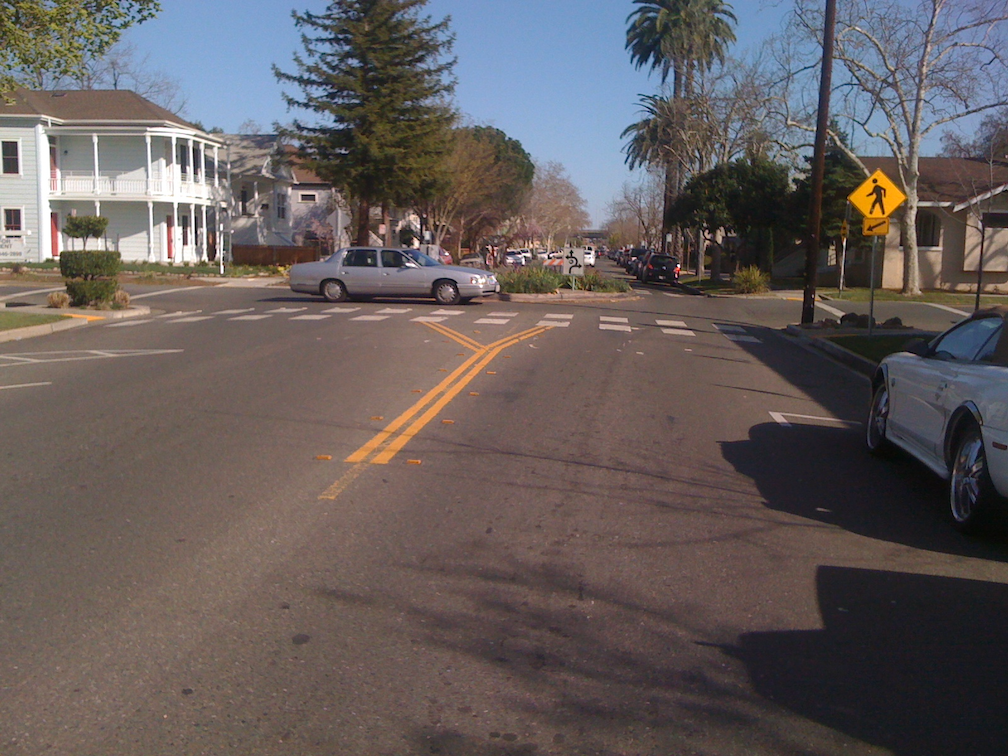
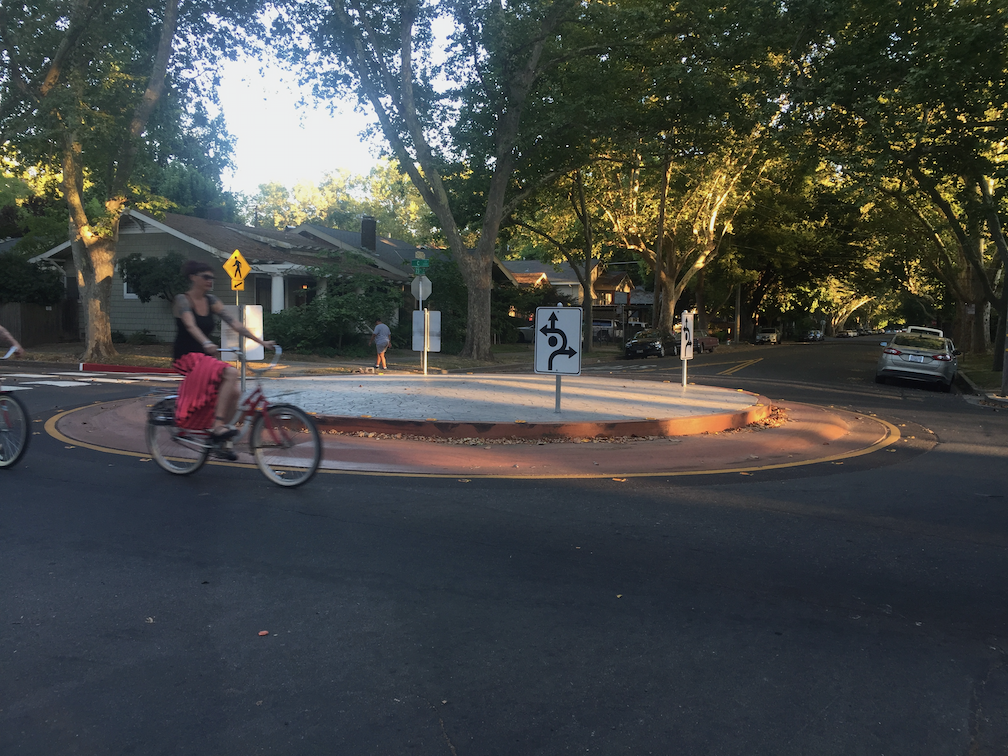
For National Roundabouts Week, here are sample of some traffic circles. True roundabouts have significant horizontal deflection to slow motor vehicles, and do not have any traffic control devices such as stop signs. I do not consider multi-lane roundabout-like structures to be roundabouts, but unfortunately have not come up with a term to distinguish them.

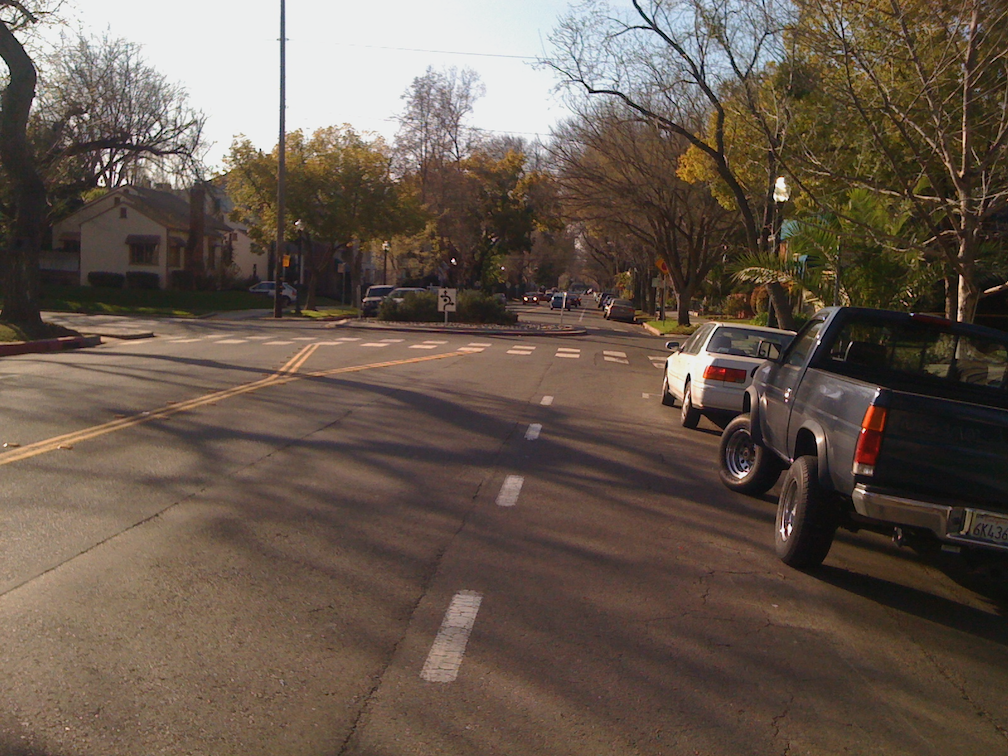
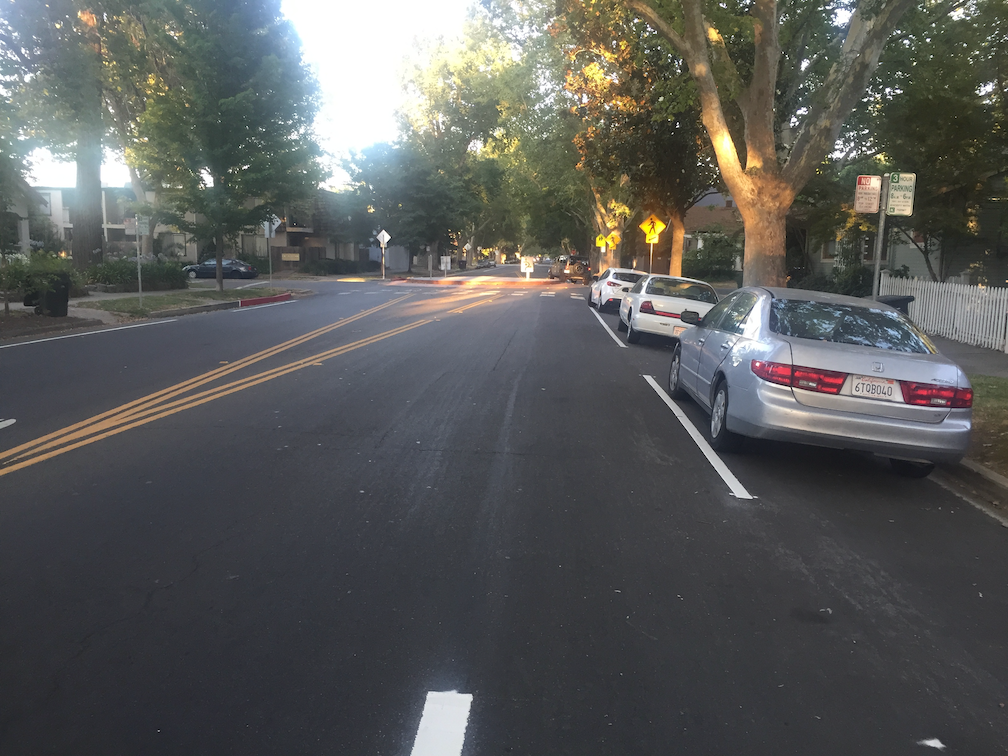
Traffic circles are not roundabouts, at least not as implemented here in the Sacramento region. They are sometimes called mini-roundabouts, which is OK, but they should never be called roundabouts without a modifier. The eight photos below of traffic circles in the Sacramento region, most in the northeast portion of the central city, show some of the settings, and the wide variation in diameter. If the traffic circle is large enough, occupying a significant portion of the intersection, they do cause significant horizontal deflection and therefore slow traffic. Some of the traffic circles are too small, and do not force horizontal deflection and slowing. All of these examples have stop signs on one of the cross streets, so they do not meet the criteria of a true roundabout.

The safety of these structures is somewhere between a true roundabout (high safety) and a regular perpendicular intersection (low safety). Regular intersections are the location of most crashes, whether they are controlled by 2-way stops, 4-way stops, or signals.

See traffic calming measures for additional information on roundabouts and other traffic calming devices.

I have many. fewer photos of true roundabouts, in part because there are many fewer in the region, but I will post on those shortly.

Strong SacTown Street Design: Active Street Typology

Active Street Typology is the seventh post by Strong SacTown to improve and promote the City of Sacramento update to its Street Design Standards. Other posts at tag: street design standards.

“Active Streets are similar to Local Streets, but with additional features to encourage and prioritize active transportation including biking, rolling, and walking. Well-planned Active Streets form a cohesive network of safe, convenient, and direct connections to local destinations and between neighborhoods. Low vehicle volumes and speeds are an essential characteristic of Active Streets, and the typology shares many facets of the bicycle boulevard or neighborhood greenway street types found in other jurisdictions.”

traffic violence emergency at Sac City Council

It is likely that council member Caity Maple, along with Mayor Darryl Steinberg and council member Karina Talamantes, will introduce an emergency declaration on traffic safety at the city council meeting tonight, starting at 5:00 PM. The item is not on the agenda, so I presume it will be introduced during the ‘Council Comments-Ideas, Questions’ part of the agenda, after all the numbered agenda items. Council members get their ‘matters not on the agenda’ time, just like the public does. None of the advocates I have asked have a clear picture of how emergency declarations work. I presume the idea will come back to council one to many times in the near future, but tonight is your first chance to hear what the council has to say and comment on the ideas.

Caity Maple has posted about the recent injury (now fatality) and the emergency response she wants the city to take:


I’m devastated to see yet another person critically injured after being struck by a vehicle on Sacramento’s roads. Even beyond our City’s commitments to eliminate traffic deaths through Vision Zero, we need to take immediate and urgent action. This coming Tuesday, alongside my colleagues Mayor Darrell Steinberg and Mayor Pro Tem Karina Talamantes, I will be introducing a proposal that:

  • Declares a state of emergency for the City of Sacramento regarding the road safety crisis
  • Directs the City Manager to identify funding for a public education campaign focused on driver education, pedestrian/ bicyclist awareness, and traffic safety
  • Directs the City Manager to work with SacPD to ramp up enforcement of traffic laws that protect pedestrians, including speed limit enforcement, crosswalk violations, and distracted driving, especially in high-injury corridors
  • Reaffirms our commitment to Vision Zero and directs staff to expedite safety projects

Read More »