See also Strong SacTown, Tell City Council: Don’t add cars to Truxel Bridge.
Category: City of Sacramento
SacCity planning jobs
The City of Sacramento has three job openings in the planning section. “Join the Transportation Planning Team! Do you have an interest in advancing City goals for safety, mobility, equity and more? Do you want to be part of a dynamic team of professionals who work collaboratively with other agencies, City leadership, and the community to move these goals forward? If so, check out the job links below!”
Principal Planner: https://www.governmentjobs.com/careers/saccity/jobs/4773262-0/principal-planner. This is the position formerly held by Jennifer Donlon Wyant, who has moved up to the Division of Mobility and Sustainability. Deadline 1/28, next Tuesday!
Associate Planners: https://www.governmentjobs.com/careers/saccity/jobs/4772249/associate-planner?department%5B0%5D=Public%20Works&sort=PositionTitle%7CAscending&pagetype=jobOpportunitiesJobs. Deadline 2/2.
The planning section has been understaffed for some while. Do you want to take one of these key positions?
SacATC meeting 2025-01-16 report
SacATC (City of Sacramento Active Transportation Commission) met Thursday, January 16, 2025.
The agenda included:
3. Selection of Chair and Vice Chair for Calendar Year 2025: Arlete Hodel was re-elected as Chair, and Isaac Gonzalez was re-elected as Vice Chair. Juanluis Licea-Cruz joined the commission as seat K youth representative, a high school student at West Campus joined the comission. David Moore was appointed to the Seat J. Ali Doerr-Westbrook has completed her term on the commission.
4. Caltrans American River Bridge Rehabilitation Project: The presentation by Caltrans staff was frustrating. A number of questions about details of the bike path being added as part of the freeway rehabilitation (widening) project went unanswered. Commission concerns were that there are a limited number of connections from the new path to existing bikeways, and that Caltrans has demonstrated an inability to maintain bike paths by the horrible condition of the Causeway path. The Caltrans staff claimed that some other agency would be responsible for maintaining the path, but seemed unclear about what agency. Federal law requires that the host agency is responsible for maintenance of multi-use paths in perpetuity, but Caltrans has rarely complied with that requirement. Completion of the entire project is December 2026, but it is unknown whether the path will be available before then. I hadn’t realized, but this path was part of a lawsuit settlement over widening of the freeway; it was not a project initiated by or desired by Caltrans.
5. Alternative Recommendation: Truxel Bridge Concept and Feasibility Study: See the STAR blog post for this topic, which includes all the agenda document parts. The commission voted for recommendation 3, “reject the Truxel Bridge Concept and Feasibility Study and instead recommend that the City Council direct staff to evaluate and study a Truxel Bridge alternative without personal motor vehicles.’ It was clear from the large number of in-person comments and eComments, as well as commissioner comments, that the city commitment to a multi-modal bridge with private motor vehicles is unacceptable.
My comments added two details: 1) SacRT board has never approved the city concept, though discussions at the staff level indicate that it might. The approved SacRT project is a transit/walking/bicycling only bridge. 2) The light rail to the airport Green Line might never be completed due to very high cost and uncertain ridership. If bus rapid transit (BRT) is implemented instead, the benefits of a direct bridge route are not clear. The current bus Route 11 jogs to the freeway, and is not signficiantly delayed by that. This BRT is not part of the current regional plans because it was assumed that light rail would be implemented, but it is quite possible that it might be added to the high capacity bus network plans.
It is assumed that the city study will proceed until the city council makes a decision on the SacATC recommentation.
6. Streets for People: Neighborhood Connections Draft Final Plan: staff report and Neighborhood Connections Plan: There was strong community and commission support for the plan, and it will be forwarded to council, probably next month. The toolbox part of the plan is outstanding. Nearly all of the 13 treatments in toolbox can be implemented as quick-build projects with low-cost materials, and eventually replaced by hardened infrastructure. Community and commission comments addressed the lack of likely funding for implementation, but it is hoped that the city will allocate some funds to the project, particularly now that the primary resister Howard Chan is no longer city managert.
For ‘not on the agenda’, I commented on the much delayed maintenance (sweeping) of the separated bikeways in the central city. The bikeways became nearly impassible during leaf season, except where they were cleared by landscaping services supplied by adjacent property owners, which is not their responsibility, but is appreciated.
Commissioners requested an update on the staff effort to inform council about what quick-build means. and this topic may also come back to the commission.

SacATC meeting 2025-01-16
SacATC (City of Sacramento Active Transportation Commission) will meet this Thursday, starting 5:30 PM, in city council chambers at 915 I Street, Sacramento. Comments may be made in person or via eComment ahead of time. Note that there are two commission meetings scheduled at the same time, so it is possible that this meeting will be in another location in city hall.
The agenda includes:
3. Selection of Chair and Vice Chair for Calendar Year 2025
4. Caltrans American River Bridge Rehabilitation Project: This project includes the addition of a shared use path (walking and bicycling) to the State Route 51 (Capitol City Freeway) bridge over the American River.
5. Alternative Recommendation: Truxel Bridge Concept and Feasibility Study: See the STAR blog post for this topic, which includes all the agenda document parts.
6. Streets for People: Neighborhood Connections Draft Final Plan: staff report and Neighborhood Connections Plan
The Neighborhood Connections Plan is largely unchanged from the 2024-10 draft. As such, I support it. It is important to remember that this plan only addresses residential and minor collector streets, which are important for encouraging walking and bicycling, but rarely are the location of fatalities and severe injuries. Those occur on major collector and arterial roadways, which are the subject of a separate Streets for People document, coming sometime later this year.
On page 19 the following info from the last round of public outreach is added:
PHASE THREE: PUBLIC DRAFT PLAN
- Project Funding and Prioritization: How the plan will be moved forward into implementation, prioritization, and funding was a common theme. Community members requested clarification on the next steps for project implementation.
- Speeding Implementation: Some workshop participants called for faster implementation of the recommended network via “quick build” projects.
- Equity Considerations: Community members asked how equity would be considered for implementation, particularly where fewer active transportation facilities currently exists.
- Youth Safety: School area improvements and other projects focused on addressing youth transportation needs was a theme in the virtual workshops.
The ‘Funding and Ways to Get the Network Built’ (page 123) is unfortunately unchanged. The city still does not identify even the possibility of using general funds for implementing this plan.
STAR post on Truxel Bridge at SacATC 2025-01-16
SacCity separated bikeway failure?
Are the City of Sacramento separated bikeways on 9th St, 10th St, 19th St, 21st St, J St, P St and Q St a failure?
These separated bikeways are mostly but not entirely parking protected, meaning they are between the curb and the parking lane. The city purchased a bikeway sweeper specifically for use on these bikeways. But that sweeper has not been used this year. As documented in SacCity is not sweeping separated bikeways, the bikeways are filling with fallen leaves, which have now turned to leaf slime. Though I have not seen anyone fall on the leaf slime, I’d not be surprised, and I have slipped but not fallen several times. Some of the bikeways have been cleared, but it has been by adjacent property owners, and by City of Sacramento Youth, Parks, and Community Engagement (YPCE, otherwise called parks) on some but not all park-adjacent blocks. City of Sacramento Public Works, whose responsibility it is to sweep these bikeways which are part of the transportation system, have done nothing. Nothing.
A second issue is that the city has done nothing to solve the bikeway blocking that occurs on a daily basis on P Street approaching 16th Street. The bikeway here is blocked by delivery vehicles, people moving in and out of the adjacent residences, and people picking up food from the restaurants. The city is very aware of this problem, as there are frequent reports to 311 of illegally parked vehicles, by myself and many other bicyclists. But nothing has been done to solve the problem. This location needs, at the least, additional vertical delineators to discourage drivers from using the bikeway, and even better, a hard curb to prevent use.
It is worth noting that there is marked loading zone immediately adjacent to the bikeway, see below. Most drivers choose not to use that, or it is routinely blocked by drivers parked for a long period of time, clearly not loading.
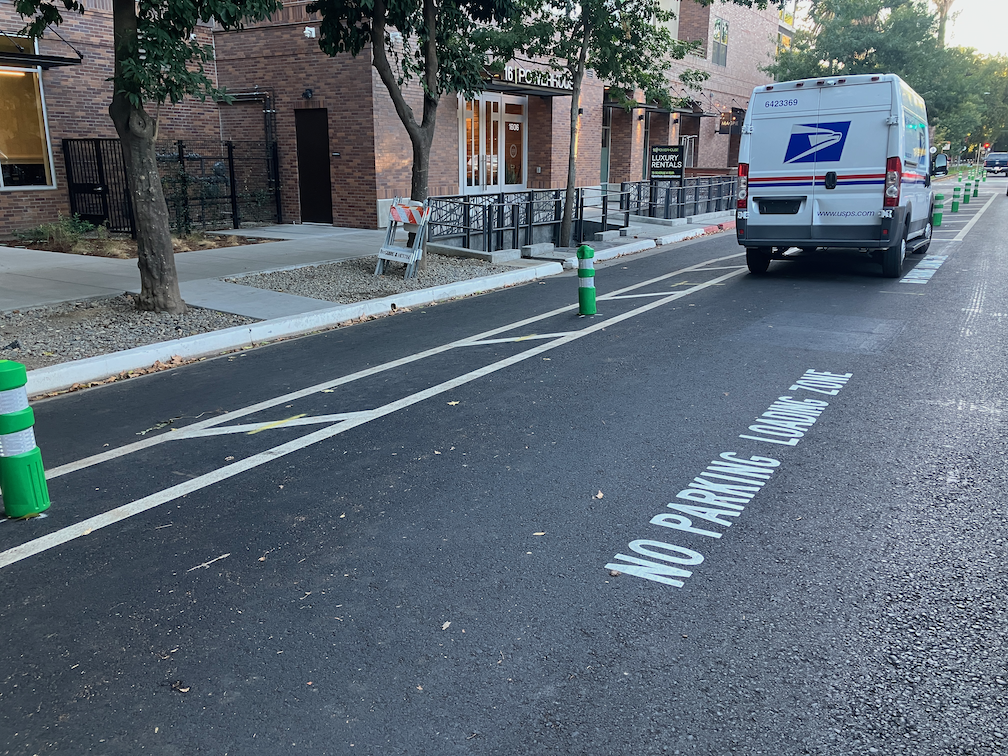
There are other locations where a separated bikeway is blocked by motor vehicles, but nowhere is it as common as the P St approaching 16 St location.
If the city is not willing to maintain the bikeways, and is not willing to solve issues with the bikeways of which it is very aware, then it can’t claim these as separated bikeways. Maybe they should be removed.
On the plus side, the city’s 311 app finally includes a drop down for ‘blocking bike lane’ under the parking violations menu, about five years after the request being made by myself and many others.
Elvas Ave and Hornet Tunnel update
Re-upping the Elvas Ave and Hornet Tunnel post from earlier this year. It has been reported to me by a number of bicyclists, and I have experienced it myself, that this section of Elvas between the Hornet Tunnel and the signal at 62nd Street has become significantly more hazardous due to the motor vehicle traffic generated by The Line (a collection of various food vendors, opened 2022) and Garden at the Line (an outdoor eating and drinking area adjacent to The Line, opened this December). There is a lot more come and go parking on Elvas, and a lot more motor vehicle traffic in and out of the parking lots. Most bicyclists ride on the sidewalk to avoid the fast-moving traffic, otherwise the crash rate would be higher. The M Street to Elvas Avenue to Hornet Tunnel route is probably the busiest in the city.
In addition to the previous post (reblog below) about the hazards for bicyclists, this area is now hazardous for walkers along and crossing Elvas.
I was there last night for the SABA social gathering, and the place was packed. People were parking along the west side of Elvas as well as on 63rd Avenue and 64th Avenue, and then trying to cross Elvas to Garden at the Line. It was nearly impossible to cross, as there are no marked crosswalks over Elvas at either street, drivers are going fast, and Elvas is not well lit. The speed limit in this section is 40 mph, which almost guarantees that walkers hit by cars will die. Sidewalks on both sides of Elvas are in poor condition, and rolled curbs are common, which are less safe for people walking than vertical curbs. There are no sidewalk buffers. While this section of Elvas is not one of the top 5 or top 10 Vision Zero corridors, it will quickly become so. In the last five years, there have been two injury crashes on this stretch, one bicyclist and one walker, both in the vicinity of Hornet Tunnel.
The city has no plans to improve safety for bicyclists or walkers on this stretch of Elvas.
SacBee: update on lack of city investment in street safety
An article today in the Sacramento Bee is about two traffic fatalities on Freeport Blvd, but also does an excellent job of summarizing the city’s lack of general fund investment and action street safety, and over-dependence on long-term grant funded projects. Yay, Ariane Lange for the excellent reporting on roadway safety and solutions, and the real people who are the victims of poorly designed roadways and traffic violence.
SacBee, Ariane Lange: Two grandmothers died blocks apart on a dangerous Sacramento road. Will the city fix it?
https://www.sacbee.com/news/local/article296838739.html
The city’s solution to fatalities and severe injuries on our our streets has been the Vision Zero effort and Vision Zero Action Plan (2018), and related documents. This resulting in a focus of grant applications on corridors with a high level of traffic violence, the high-injury corridors. For more posts on Vision Zero, see tag: Vision Zero. What has not occurred since 2018 is a significant increase of city general funds to address traffic safety. Since that time, Sacramento Police Department has largely ceased traffic enforcement, while their budget has continually increased, though there are strong safety benefits for people of color in that reduction of enforcement which tends to be pretextual and biased.
The city council has repeatedly suggested allocation of some general funds to traffic safety and fixing roadways, but City Manager Howard Chan, and perhaps Public Works, has resisted this. With the departure of Chan, this may change (more to come on that). The city has no program for quick-build projects, though a few have happened. The city’s transportation budget goes to pavement maintenance (which is a good thing, as your roadways are in poor condition for everyone), new capacity expansion, and grant matches. Almost none goes to quick-build solutions.
I am not suggested dropping the approach of grant applications for big projects, as those long-term projects are important. What I am suggesting, and the SacBee supports, is investment in fixing some of the worst roadway designs, now rather than someday.
SacCity Council: last night, the people won!
The Sacramento City Council last night voted to reject the agenda proposal to extend City Manager Howard Chan’s contract for a year. Actually for two years, as the contract had another year extension if Chan wanted it.
There were a long line of big business and labor leaders speaking in support of Chan, and the extension. No wonder. Those have been treated well by Chan during his reign as mayor, whoops, I mean City Manager (he thinks of himself as a strong mayor, but even stronger). Police and fire of course support him because he keeps giving them raises, and increasing their budgets. There is a downtown power structure in Sacramento that wins almost all political battles, or has in the past. Last night, they lost.
There was an even longer line of just plain citizens who spoke against extending Chan’s contract, some quiet with salient points, and some very vocal about ways in which the City Manager has harmed the city, and homeless people, and has refused to reign in the biases of the police against people of color.
Several small business owners also spoke, most opposed to Chan but some in support. It is small businesses that the city should be supporting, but too often they come down on the side of big business. Big business is used to getting its way. Maybe we are moving into a brighter future.
Flo Cofer, who lost the election for Mayor be a very small margin, also spoke. She had previously said that she would move separate Chan if she won.
Council discussion quickly shifted from what many expected to be a done deal when a motion to reject was offered and seconded. Though every council member spoke in praise of Chan’s work, 8 years as City Manager and 22 with the city, there was clearly a lot of discomfort with his arrogant style and refusal to follow council direction on many issues. Though stability had been raised both by the power players and council members, it became clear that the council wanted transition to new leadership, and wanted it now, not a year from now. Roger Dickinson (D2), Karina Talamantes (D3), Caity Maple (D5), Eric Guerra (D6) Mai Vang (D8), and Mayor Kevin McCarty all voted for the motion to reject the extension. Lisa Kaplan (D1), Phil Pluckebaum (D4), and Rick Jennings (D7) voted against the motion. Therefore, 6 to 3.
Several council members indicated that they had been leaning toward supporting the extension until an executive session of three hours. Though council members can’t share what was said in executive session, it was clear that two, maybe three, members changed their mind. I’m guessing that Chan was resistant to any compromise, and some council members were not aware that the one-year extension would like turn into two.
I of course spoke, my comments below.
- The City Manager is not working for the citizens of Sacramento. The council-manager governance model only works if the council holds the City Manager accountable. It has not.
- The City Manager has routinely ignored direction of council, most egregiously on homeless issues. The SacBee has reported a number of dishonest if not illegal actions.
- The City Manager has a false view of public safety, that increases to the police budget solve the public safety challenge.
- Most important to me, as a transportation advocate, the City Manager has refused to allocate significant funding to traffic safety and the reduction of traffic violence. You are going to consider an emergency declaration in part due to the failure of the City Manager to act. If the City Manager had truly been addressing public safety, it is unlikely we would have an emergency.
- Several leaders have expressed that extension would provide stability. Stability of what and for what? For a form of governance and management that does not work for the citizens of Sacramento? I hope not.
SacCity is not sweeping separated bikeways
The City of Sacramento is not sweeping its separated bikeways, as it promised to do when it installed them. The separated bikeways, on I St, P St, Q St, 9th St, 10th St, 19th St, and 21st St have not been swept by the city. The city has a sweeper designed specifically for these bikeways. It may be broken down, or the city may be choosing not to sweep. Some of the bikeways are being swept by landscape maintenance services associated with adjacent properties, a few spots are being swept by individual owners or residents, and even the parks department is cleaning up, but not consistently.
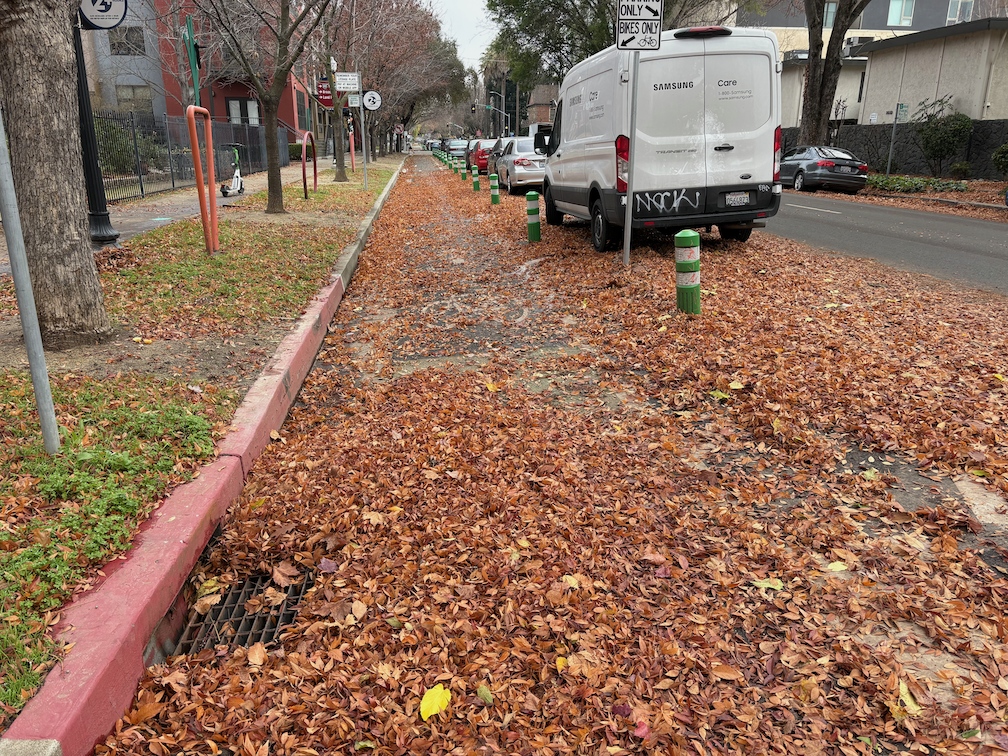
In a few places that have heavier bicycle and scooter traffic, such as P St between 15th and 14th, the leaves have turned into leaf slime, which is extremely hazardous for anyone on two wheels. I’ve seen people almost spin out here, and I have as well.
Most people seem to have realized that the place for piled leaves is NOT in the bikeway, but in the adjacent buffer, and in some locations that buffer is labeled as such. But some people are still piling in the bikeway.
Regular bike lanes are an issue as well. Most are not swept. Dry leaves are sometimes swept away be motor vehicle traffic, but once they are wet, they don’t move. If there is motor vehicle traffic across or along the bike lane, such as approaching an intersection, the leaves are quickly turned into slime. Very slippery! Be cautious anywhere there are leaves.
Palm trees – ack!
And just in case you need to be reminded, palm trees and the fronds they drop are an ongoing hazard to people walking and bicycling. A single frond can block a sidewalk from use by anyone with a mobility device. A single frond can block a bikeway or bike lane, and can throw a bike rider off their bike. With every wind storm or heavy rain storm, palm trees drop huge numbers of fronds. Why do we continue to allow this hazard for walkers and bicyclists? In a few locations where they have historic value, such as Capitol Park, they might be justifiable. But nowhere else. They need to be removed!


