PRN parking lot map for Sacramento

The Parking Reform Network (PRN) website on parking minimums (also called mandates) and minimums has been recently updated and enhanced. Take a look!

I have in the past worked to compile information about parking in the central city, but it turned out to be more complex that I had realized and I never completed it. It is fairly easy to map surface parking lots, that lowest common denominator of land use, but mapping parking garages is more complicated because many of them have commercial at street level, so are not all parking, and many developments have either underground or parking in the middle of the building. All of these are much harder to document and map. So I am glad that PRN, with partner Strong Towns, is mapping.

You can see the primary map at Parking Lot Map. Use the city pulldown if you don’t go directly to Sacramento. Note that this map covers just most of downtown, it does not cover the entire central city, nor any of the rest of the city. Be sure to click on the ‘View More’ button, which provide detail that is difficult to find elsewhere, including on the city’s own website.

PRN parking lot map of 'central city' Sacramento
PRN parking lot map of ‘central city’ Sacramento

The city’s 2021 Housing Element includes policy H-1.4: Facilitate Infill Housing Development. The City shall facilitate infill housing along commercial corridors, near employment centers, near high-frequency transit areas, and in all zones that allow residential development as a way to revitalize commercial corridors, promote walkability and increased transit ridership, and provide increased housing options . (page 23)

The implementation chapter of the housing element includes Program H8. Revisions to Parking Requirements (page 46) that is included in the PRN website. The general plan update for 2040, which would implement this program, has been delayed beyond 2022. The city has not provided a target date, so far as I know.

sidewalks across alleys

Note: Please see post on City of Sacramento Street Design Standards. It turns out that there are at least two different sets of design standards.

The City of Sacramento has Standard Specifications and Drawings that require certain designs for the public right-of-way. There were last revised April 2020, and are available on the Utilities: Development Standards page. It is not clear why these are part of Utilities rather than Public Works or Community Development, but they are. Though I haven’t done an element by element comparison, they seem to be a considerable improvement over the previous standards, which seem to be June 2009.

There are designs which are not being followed, and others that should be eliminated. Today, I’ll address sidewalks crossing alleys. Alleys are only common in the central city, but they do exist other places throughout the city.

The city design standard is below (pdf of entire page). The detail is hard to see, but the alleyway, sidewalk, and alley driveway are all concrete, none are asphalt. The T-11 Standard Alley Entrance Detail page says “Portland Cement Concrete (PCC) is the city standard pavement for alleys.”

SacCity Specification detail alley entrance

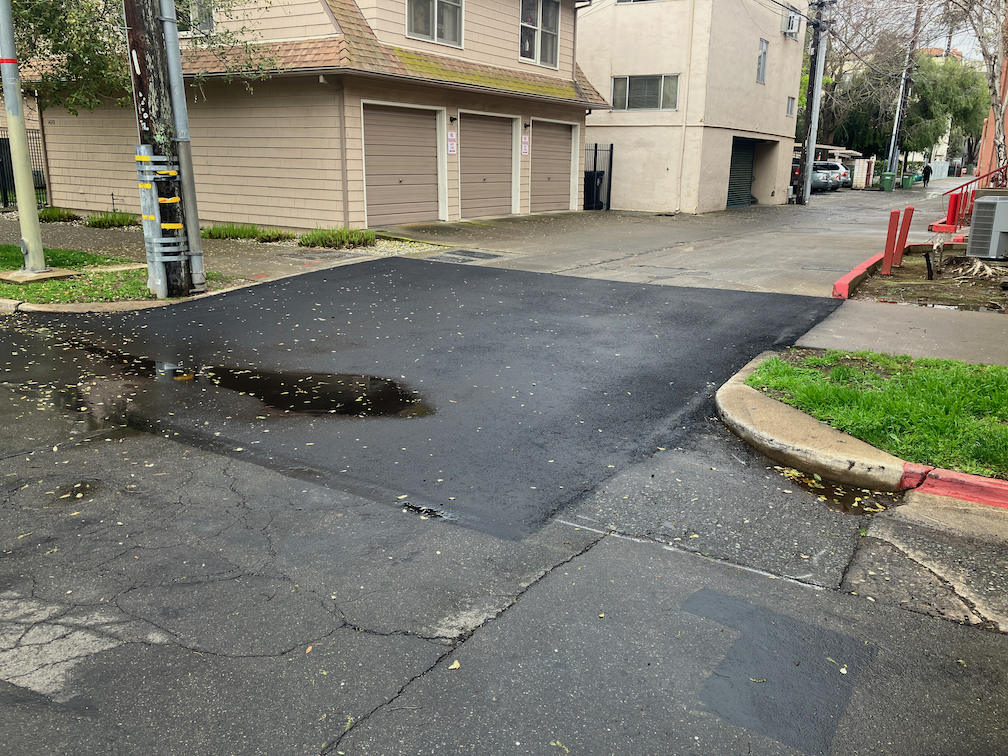
Of course there are many alleyways that are asphalt, and some that are unpaved gravel. I don’t know when the city standards changed to require pavement, or when to require concrete, but those are the current standards. That means that if an alley, or a sidewalk, or the alley driveway is changed, it must meet current standards. Below is a photo of Neighbors Alley at 17th Street, which was just redone within the last two months. It clearly does not meet city standards. Both the driveway and the sidewalk are asphalt, not concrete. Though I noticed this work being done, I failed to notice who was doing it. City? Private? Private utility? Not sure.

photo of Neighbors Alley at 17th Street
Neighbors Alley at 17th Street
Read More »

SacCity red light cameras and crashes

A follow on to red-light-running bullies. I’ve created a map that shows the eleven right light camera (automated enforcement) locations under the City of Sacramento’s Red Light Running Program. The city has 907 signalized intersections. These locations are (listed alphabetically by the intersection entry in the Traffic Signals GIS layer):

  • 16th Street & W Street X
  • 21st Street  & Broadway X
  • 5th Street & I Street X
  • Alhambra Boulevard & J Street
  • Arden Way & Challenge Way X
  • Arden & Exposition Boulevard & Ethan Way X
  • El Camino Avenue & Evergreen Street X
  • Fair Oaks Boulevard & Howe Avenue X
  • Folsom Boulevard & Howe Avenue/Power Inn Road X
  • Mack Road & Center Parkway X
  • Mack Road & La Mancha Way/Valley Hi Drive X

The map (pdf) shows each location, with the red signal icon, and a heat map of the crash severity for crashes occurring at intersections. Yellow means high collision severity, with severity being a weighting of the individual types [1 – Fatal; 2 – Injury (Severe); 3 – Injury (Other Visible); 4 – Injury (Complaint of Pain)]. But it does show the pattern, and you can clearly see the intersections along arterial roadways, where most crashes occur. The crashes are not necessarily red light running crashes. There is a PCF Violation category (VIOLCAT) 12 – Traffic Signals and Signs, and another Intersection (INTERSECT_), but that would not distinguish red light running from stop sign running. It might take looking at individual incident reports, but that is beyond my capacity.

There are certainly high crash severity locations in the city that are beyond the map coverage area, and there are plenty of locations without cameras.

It would be interesting to know if these red light camera locations have a lower rate of red light running crashes that comparable intersections without cameras, but that will require quite a bit more thinking an analysis.

Read More »

red-light-running bullies

If you go stand at any busy intersection in Sacramento, you will see drivers running red lights on almost every single signal cycle. Of course this problem is not unique to Sacramento, but it is where I live and walk and bicycle, and I see it every day, at every signalized intersection. I am not talking about drivers entering the intersection on the yellow light, and not making it through before it turns red. I am talking about drivers entering the intersection when the light is already red. And quite often, they accelerate into the red light, making sure they can get through.

I call this bullying behavior. It says that I (the driver) is more important than anyone else. Me (the driver) making this light is more important than anything else in the world, which translates to my (the driver’s) convenience is more important than anyone else’s life. I (the driver) know that this is dangerous behavior, but I (the driver) don’t care.

My preferred word for this is actually terrorism. Terrorism, however, implies actions by individuals against states, or more often by states against individuals (state-sponsored terrorism). This is not that. But the intent is the same, to change other people’s behavior by the threat of violence, or actual violence. This is traffic violence perpetrated by entitled drivers against everyone else on the road. Terrorism may not be technically correct, but it sure sounds right.

Most drivers have adjusted to this by not starting into the intersection on the green, but waiting until the run light running driver has cleared. Same for people bicycling and walking. Most walkers know it is not safe to enter the crosswalk until all the cars have stopped, because usually they will not stop. But not all drivers, walkers or bicyclists know, and these are the people being killed or seriously injured at intersections.

Red light running has always been a problem, but it has gotten much worse. It accelerated, I think, during the pandemic, when there was less traffic, and drivers started to gamble with running red lights. Now that the traffic is mostly back, they are still doing it. In my observation, it gets worse by the month.

Many people think that the solution to traffic violence is to change road designs so as to prevent dangerous driver behavior. I’m of course in favor of this. But in this instance, re-design does not prevent this bullying behavior.

Having near-side traffic signals, as many advanced countries do, would help a little because a driver who chose not to stop loses information about how late on the red they are and therefore is less likely to run the red light. See Near Side Signals: Thinking Outside the Pedestrian Box for more info on near side signals. But this alone would not solve the problem.

Slowing speeds would help, as the red light running driver would be a little less likely to kill the walker, bicyclist, or other driver and passengers than at higher speeds. But the red light runners are in my observation the same people who are driving well over the speed limit, adjusting their risk tolerance for to the highest possible level that won’t get them killed. Of course, these are not drivers who are much concerned about killing other people.

The City of Sacramento has a Red Light Running Program. The page says there are 11 cameras in the city. Out of 4000 plus intersections. This is not a serious response to a serious problem. It is in fact the typical city response to any transportation issue, to do the absolute minimum possible to avoid being called out for doing nothing.

I believe from extensive observation (I walk a LOT), though I have no data to prove it, that red light running is done by a fraction of drivers, and those drivers do it again and again and again. They’ve gotten away with it, so far, and will continue. At least 3/4 are drivers of expensive cars, high income, entitled people. If that is so, it would not take much to greatly reduce this behavior. Ticket them again and again and again, whether directly by law enforcement officers or by automated cameras, and their behavior would gradually change. Of course if we set ticket fines based on the value of the vehicle rather than flat rates, and impounded and/or confiscated vehicles upon repeated infractions, it would change even quicker.

Law enforcement is complicit in this red light running. I have never seen a driver stopped for running a red light. Ever. And in fact, law enforcement drivers are just as likely to run red lights as any other. Law enforcement doesn’t like automated enforcement, because it reduces the opportunity for them to do pretextual stops. It also is seen as reducing the need for officers, though since they don’t do this enforcement anyway, I can’t see how it actually reduces the need.

Many people have called on the city to install more leading pedestrian interval (LPI) lights in the city, where the pedestrian indicator turns to walk 3 seconds or more before the parallel traffic signal turns green. These of course help, but even where they already exist, the interval is now taken up by the time a walker must wait for the red light running drivers to clear the intersection before proceeding. Much less effective at promoting walking and safety than it could be.

Solutions:

  • The city could recognize that this is a serious traffic violence issue, and respond forcefully, with more enforcement and more automated cameras. The city’s Vision Zero policy obligates them to take traffic violence seriously, but they do not.
  • The CA-MUTCD could be changed to require near side traffic signals instead of far side traffic signals.
  • The state legislature and judicial council could change fines for violation of California Vehicle Code (CVC) to be based on the value of the vehicle. People often talk about basing fines on income, as some first world countries do, but income is not easily available to the law enforcement officer or processor of the red light camera mailed ticket, whereas the value of vehicles is available in the DMV database. If you run a red light in your $1000 clunker, the fine would be $1, and if you run a red light in your $200,000 trophy car, it would be $2000. To start.
  • Along with higher fines for drivers of fancy cars, the vehicles of these drivers should be impounded for the third violation of the same CVC within a year. Impound means you get the vehicle back after a certain period of time, maybe three months. And for those drivers that doesn’t control, then the vehicle should be confiscated, meaning you don’t get it back and the agency sells it. Maybe for more than six violations of the same CVC within a year, or ten within three years.
  • Walkers and bicyclists could equip themselves with paint ball guns so as to mark the vehicles of these bully drivers, so at least other people could see them coming. And perhaps other drivers would them start enforcing social pressure on them. It worked for smoking, when people who smoked in buildings and on transit were publicly shamed.
  • And of course, in the long run, we do need to re-design streets to that red light running is less likely, and less likely fatal due to lower speeds.

Freeport Blvd to council today

The Freeport Blvd Transportation Plan is on the Sacramento City Council Agenda today. I failed to notice this, and submitted my comment late, so will have to attend in person or on Zoom. The item is on the consent calendar, so it is particularly important that people comment on the item so that the city recognizes there is significant opposition. You might also contact your council member to request that they remove the item (#6) from the consent calendar.

You may read my previous blog posts at https://gettingaroundsac.blog/category/city-of-sacramento/freeport-blvd/. You may read other’s comments on the agenda item at https://sacramento.granicusideas.com/meetings/4599-5pm-city-council-closed-session-begins-at-4-00-pm-updated-02-slash-21-slash-2023-at-1-30-p-dot-m/agenda_items/63eeca6df2b670376d010289-6-freeport-boulevard-transportation-plan-final-dr

H St bicycle fixes

H Street is commonly used by bicyclists leaving Sacramento Valley Station, and others as well. It has decent bicycle facilities except for some gaps.

H Street has a bike lane on the south side from 5th Street to 16th St, except one block, 7th Street to 8th Street. There is absolutely no reason for this gap. This is the section between the Sacramento County Administration Building on the south and a decked parking garage on the north. The parking seems to be there for the convenience of people working in the building, as there does not seem to be turnover of the parking spots. There is ample parking in the garage. This parking should be removed and a bike lane painted IMMEDIATELY. No excuses. A common quote in the bicyclist community is “sharrows are bullshit”, and this is the case here, where the city has preferenced motor vehicle drivers over bicyclist safety.

H St parking and sharrows from 7th St to 8th St

There is a bike lane on the north side between 7th Street and 13th Street. Bike lanes on the left side of one-way streets are much less used than right side bike lanes, but are useful.

Read More »

M Street to Hornet Tunnel

I have long been planning to write about the extremely poor bicyclist facilities from M Street to Hornet Tunnel, which is a major access point for Sac State.

M Street is a major east-west bicycle route, with some but not all of it marked as a bicycle route. If the city used the bicycle boulevard designation, it would be designated a bicycle boulevard. M Street forms an uncontrolled T-intersection with 62nd Street, which leads a short way left to a signalized T-intersection with Elvas Ave.

Hornet Tunnel is a major access point to Sac State campus, probably second only to the Guy West bridge access on the north side.

The map below shows M Street, 62nd Street, Elvas Ave, and Hornet Tunnel, as it exists.

The route from M Street to Hornet Tunnel is heavily used by bicyclists, both students and people passing through to the American River Parkway paths. It would be much more heavily used if it were safe, but it is not.

Eastbound to campus, one must cross over four lanes somewhere between 62nd Street and the median along Elvas Ave, and then ride on the wrong side of the street to reach Hornet Tunnel. Westbound, it is not bad, only having to merge over the northbound lanes to a dedicated left turn lane to 62nd Street. The signal here is surprisingly responsive to bicyclists, so the wait is usually short.

At the 62nd Street & Elvas Ave intersection, Elvas is 62 feet wide, 70 feet with sidewalks. There are shoulder stripes setting off unofficial parking, one southbound lane, one center turn lane, and two northbound lanes. At 64th Ave, Elvas is 68 feet wide, 76 feet with sideewalks. At Hornet Tunnel, Elvas is 63 feet wide, 77 feet with sidewalks, with two northbound lanes and three southbound lanes, two of which are dedicated right turn lanes to 65th Street. Elvas was formerly wider at Hornet Tunnel, but some sidewalk was added there to ease crowding at the tunnel entrance/exit. Given the city-preferred, though unnecessarily wide 11 foot travel lanes, there is room for six lanes of traffic here! That means there is ample room for bicycle facilities. But there are none present.

Some bicyclists take the striped shoulders to be bike lanes, but they are not. The city’s 2018 Bikeway Master Plan shows this section of Elvas between 65th Street and Hornet Tunnel as a Class 2 (on-street) bike lane, but this is false. It is not indicated as such with either pavement markings or signage. Though the shoulder stripe southbound has the dashed marking often used to indicate a bike lane approaching an intersection, this is a fake. It is NOT a bike lane. People park along this stretch, so even if it were a bike lane, it would not be safe nor meet minimal standards for a bike lane.

Solutions

What street redesign and reallocation would make is safer for bicyclists?

First, for northbound bicyclists, there should be a separated bikeway on the right side of the street. Along this section, there are four driveways and a stretch of street-oriented perpendicular parking (where vehicles enter directly into parking spaces from the street). There is a section of 270 feet with no existing buildings. Though there could be parking protected bikeway along here, I don’t think the parking is even needed. Instead, this is probably a good location for a curb separated bikeway, with hard curb to prevent encroachment on bicyclists. The curb would be cut only for driveways which are currently in use. The existing parking along this stretch is used mostly by students to avoid paying on-campus parking fees. All the businesses have onsite parking. The one business that might reasonably need short-term parking on Elvas is The Mill coffee shop. Separated bikeways work best with long stretches without driveways, but one here is workable.

Southbound is more complicated. If there were a bike lane or separated bikeway on the southbound side of Elvas, bicyclists would still need to cross to Hornet Tunnel, at a location where there is currently no way to do so. I see three options:

  1. First, have bicyclists ride south to the existing 65th Street & Elvas Ave intersection, and use the crosswalk on the north side to cross over and then go north to the tunnel. This is very awkward, out of the way, and encourages bicyclists to use a crosswalk, which is not illegal but poor practice.
  2. Second is to create a two-way separated bikeway (often called a cycletrack) on the east side of Elvas, from 62nd Street to the tunnel. A separate bicyclist signal phase would need to be created for northbound bicyclists to cross to 62nd Street, and southbound bicyclists to cross to the east side of Elvas Ave. An advantage to this solution is that parking on the west side of Elvas does not need to be changed, though it can be reasonably argued that there should be at least a regular bike lane here for bicyclists who are not going to the tunnel, but continuing south on Elvas or south on 65th Street.
  3. Third, have bicyclists continue southbound on Elvas, but create a clear zone for crossing to the tunnel by signalization. Northbound motor vehicles would be held by the existing signal at the intersection of 65th Street and Elvas Ave, while southbound motor vehicles would be held at a stop line just north of the tunnel by new signal heads. Bicyclists would cross to the tunnel during the red phase. There would need to be queuing area for southbound bicyclists, since they would exceed the stacking capacity of the bike lane during busy times. This option probably slows motor vehicle throughput more than the other options.

No matter which solution, the sidewalks along Elvas Ave should be repaired and widened, and street trees should be planted. And of course the street needs to be repaved.

Below is a Streetsmix diagram showing one possible configuration (looking north) with a two-way separated bikeway (cycletrack) on the east side, along with wider sidewalks and trees in a planing strip, and a southbound regular bike lane. And yes, all this fits in the existing over-wide Elvas Ave right-of-way!

SacCity should remove crossing at alleys prohibition

City of Sacramento code prohibits pedestrians from crossing streets at alleys.

10.20.030 Crossing at alleys.
     No pedestrian shall cross a through street at an intersection with an alley except within a marked crosswalk. (Prior code § 25.03.052)

https://library.qcode.us/lib/sacramento_ca/pub/city_code/item/title_10-chapter_10_20-10_20_030

While this code has always been an attempt to prioritize motor vehicle drivers over people walking, it is becoming increasing problematic as housing and businesses are now located along alleyways in the central city. ADUs and lot split housing are often accessed through alleys and not from the street. This code makes it so that anyone living or doing business in an alley must go out of the way to cross the street, and it prohibits people who just want to walk alleys to avoid busy streets.

The code should be excised.

slip lanes of death

Additional information added below.

Today I wandered around the edges of Sac State, looking at some of the access points. But the worst of the worst is this slip lane from 65th Street northbound to Folsom Blvd eastbound. More on access soon.

slip lane 65th St north to Folsom east

Is there a stop sign? No. Is there a signal to stop motor vehicle drivers when the crosswalk is being used, or the bike lane on Folsom? No. Is there a yield to pedestrians sign? No. Is there paint on the ground? Yes. It is well known, among traffic engineers, if no one else, that the word ‘yield’ painted on the ground slows drivers to a safe speed. This is bullshit.

The city recently did ADA ramp work on this corner. They could have fixed the issue, but did not.

This is the kind of transportation infrastructure the City of Sacramento builds to preference the convenience and time-saving of drivers over the lives of people walking and bicycling. This is criminal negligence. The next time someone is killed or injured here, I would be happy to testify that the city was aware of this hazard and chose not to do anything about it. Criminal negligence, as I said.

Additional Information

Solutions

  1. Install stop signs at every slip lane.
  2. Do NOT install signalization since this is an expensive alternative and would be wasted when the slip lane is removed.
  3. Place a prohibition on slip lanes in city code except under rare and defined circumstances. This would be where the crossing roadway presents an angle less than 75 degrees, a sharper than right angle turn. This skewed intersection does not quite meet that criteria, but even if it did, the slip lane as constructed is hazardous.
  4. Develop a program to close all slip lanes in the city within one year.
  5. Develop a program to replace the closed slip lanes with sidewalks, planting strips, or other useful infrastructure within five years.

reallocate N St to a separated bikeway

Note: Added information on proposed streetcar alignment below.

N Street in downtown Sacramento, from 3rd Street to 15th Street, is a three lane street with parking on both sides. There are no bicycle facilities. For part of the stretch, from 8th Street to 15th St, the sidewalk on the north side is a designated bike route, and is signed as such. Currently, this route alongside Capitol Park is closed due to annex construction, and not alternative has been provided. The city has made the choice to offer nearly unlimited capacity for motor vehicle drivers, but to dump walkers and bicyclists onto the same sidewalk. Some of the time this sharing works, but not when it is at all busy with either walkers or bicyclists.

N Street does not need, and has never needed, three motor vehicle lanes. Since the pandemic, the street is empty most of the day, with very short periods of heavier traffic, but it is never congested. Even before the pandemic, there was only about 20 minutes a weekday when the street could have, perhaps, be considered congested. Frequent construction projects, both before and during the pandemic, have narrowed N Street from three lanes to two, and even to one for shorter periods of time. When there was one lane, traffic was slow (a good thing!) but never really backed up.

The gallery of photos below was taken today, admittedly mid-day when there is almost no traffic at all, but ‘rush hour’ would not look much different. Motor vehicle traffic has come back to pre-pandemic levels on some city streets, but has not on N Street, and it is very unlikely that it ever will.

How should N Street right-of-way be reallocated? By installation of a parking protected separated bikeway on the north (left) side of the street, from 3rd Street to 15th Street. Separated bikeway is the official term, though protected bike lane or cycletrack are common alternative terms. Though in general left side or right side each have advantages and disadvantages, in this case left side (north side) works best because the of long stretch free of driveways on the Capitol Park side, from 10th Street to 15th Street.

Sacramento already has parking protected separated bikeways on P Street, Q Street, 10th Street, and J Street, though J Street in particular is a weak implementation. The NACTO diagram shows a high quality parking protected separated bikeway with a concrete curb, which retains all the benefits and safety even when there are no parked cars. For sections with driveways, protection with vertical delineators may be appropriate.

NACTO diagram one-way cycletrack with curb

The number of driveways in each block between intersections is:

  • 3rd-4th: one, parking garage
  • 4th-5th: zero
  • 5th-7th: two, parking garage, gated driveway
  • 7th-8th: zero
  • 8th-9th: one
  • 9th-10th: two, rarely used
  • 10th-15th: none

The advantages of this reallocation:

  • greatly reduces conflict between walkers and bicyclists on the north sidewalk between 8th St and 15th St
  • provides a safe east-west bicycle route
  • reallocates unneeded roadway width from motor vehicles to bicyclists

The city’s Central City Mobility Project will add 62 blocks of separated bikeways to the downtown area. All of these projects are great. But N Street is not among them. The lane reduction on I St, shown in purple, is particularly great. N Street would benefit from the same. Lane reductions not only slow motor vehicle traffic, but can shorten crossing distances for people walking. Three (or more) lanes in a direction are never safe, and never appropriate in an urban area. All of the three lane roadways in the city should be reallocated to other uses, and reduced to two lanes.

These type of projects are often called road diets, but I don’t like that term. The road is not on a diet, it is just being reallocated from unnecessary or unwanted motor vehicle capacity to more useful purposes such as walking, bicycling, or dining.

Read More »