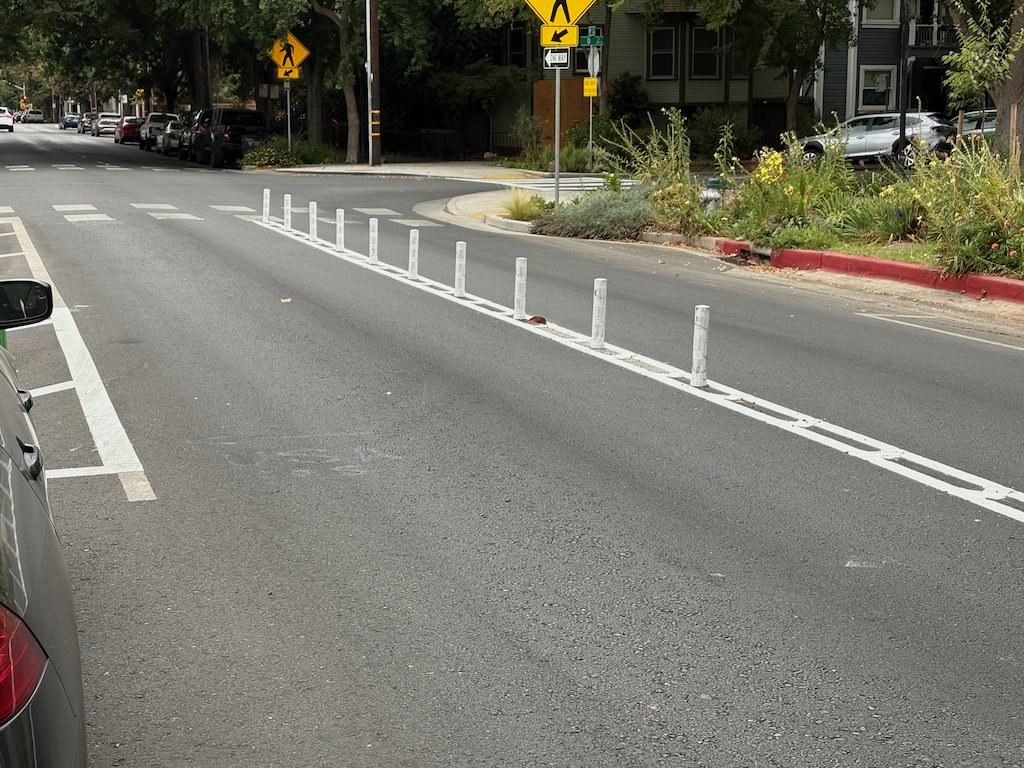
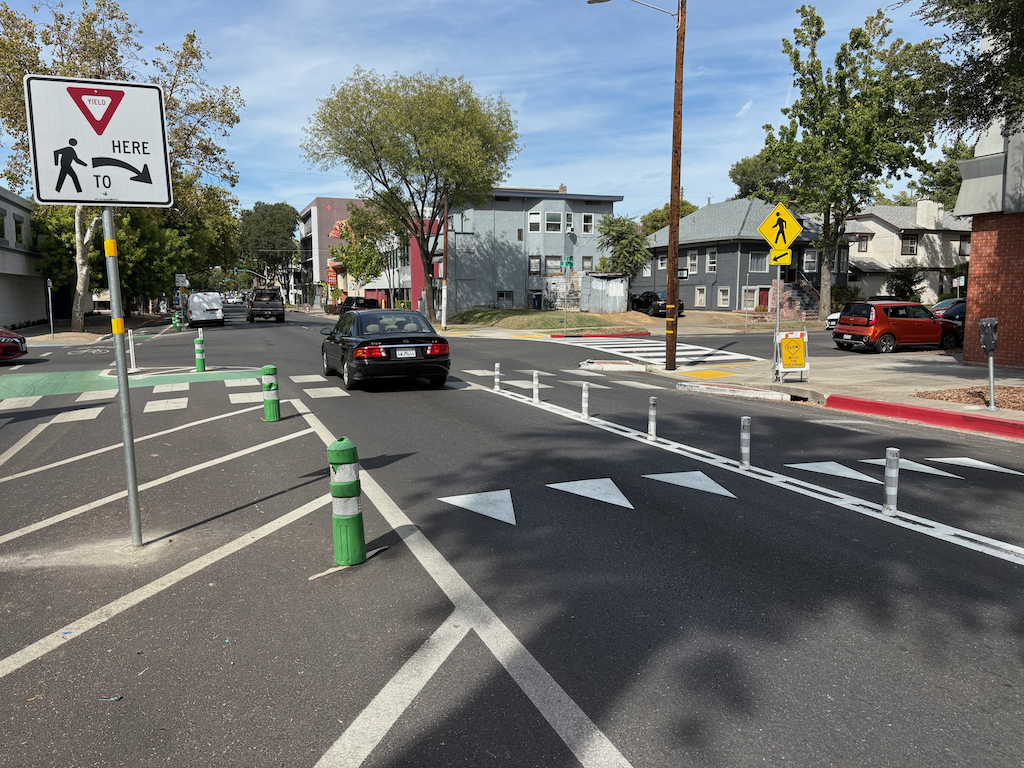
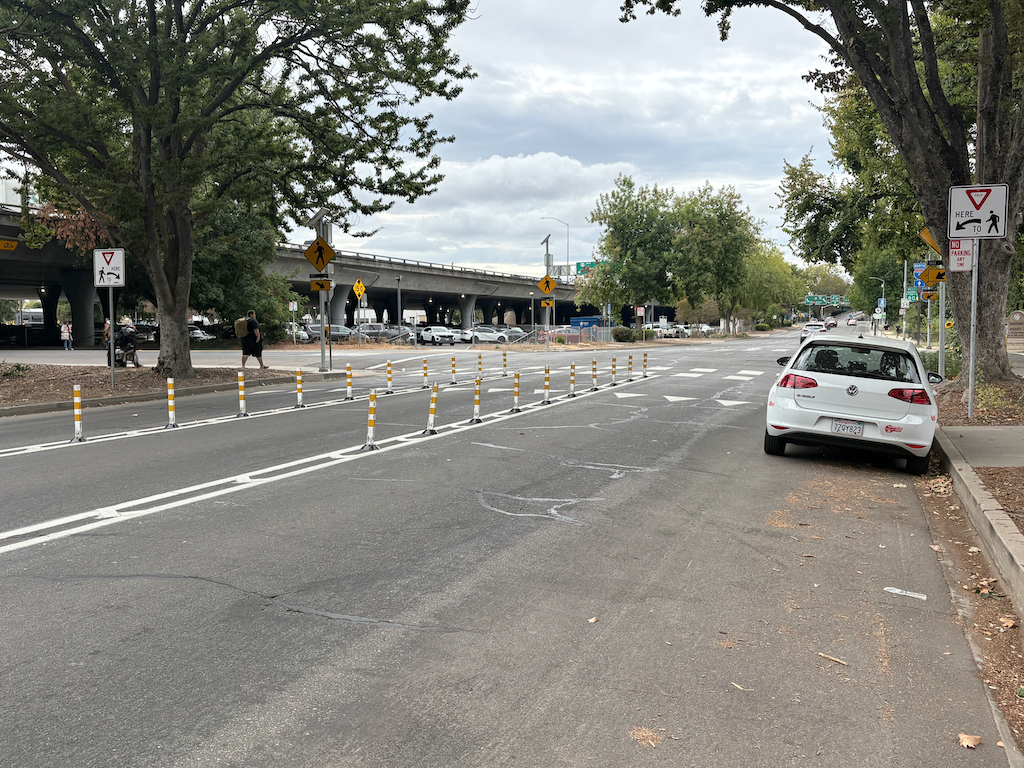
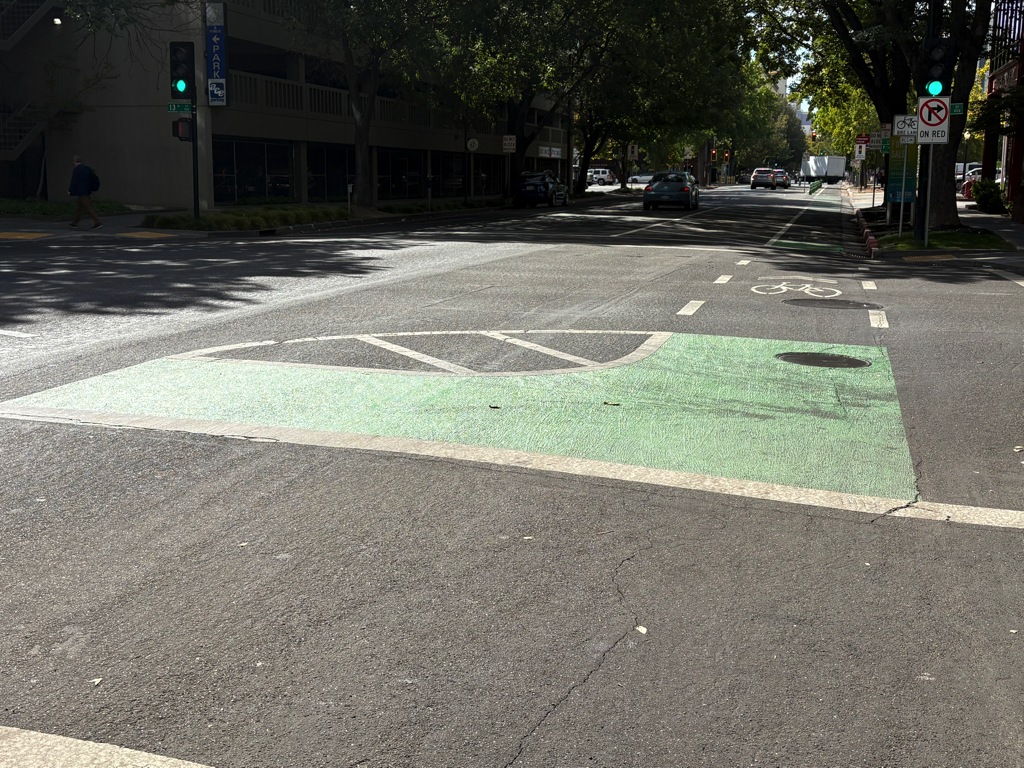
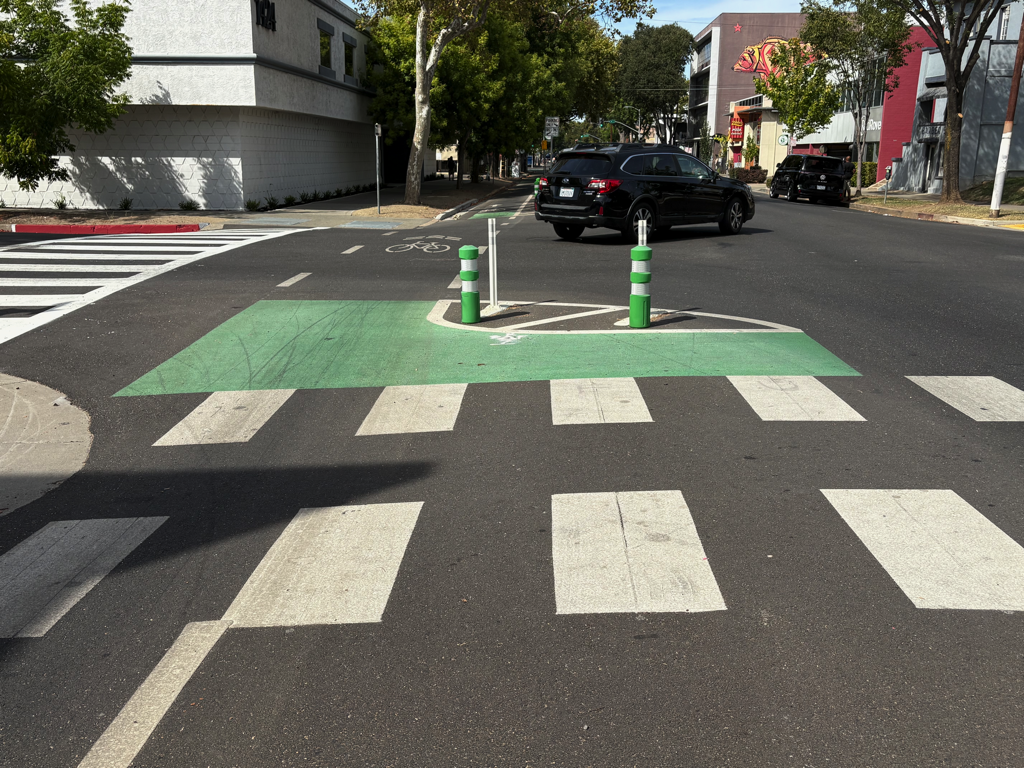
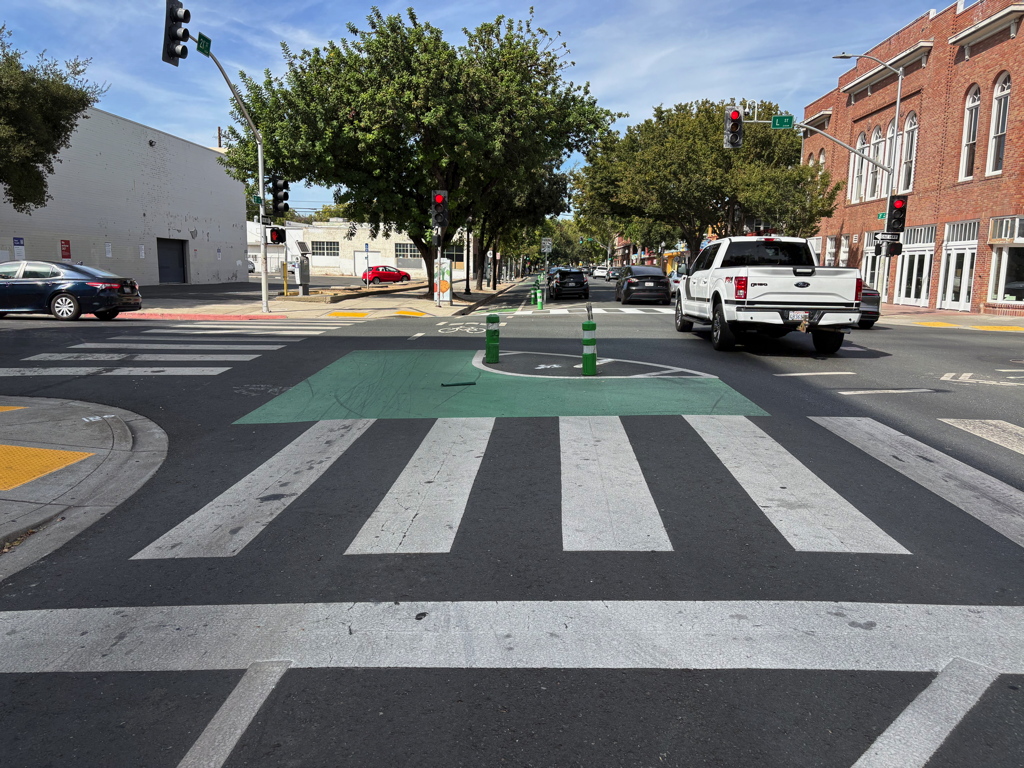
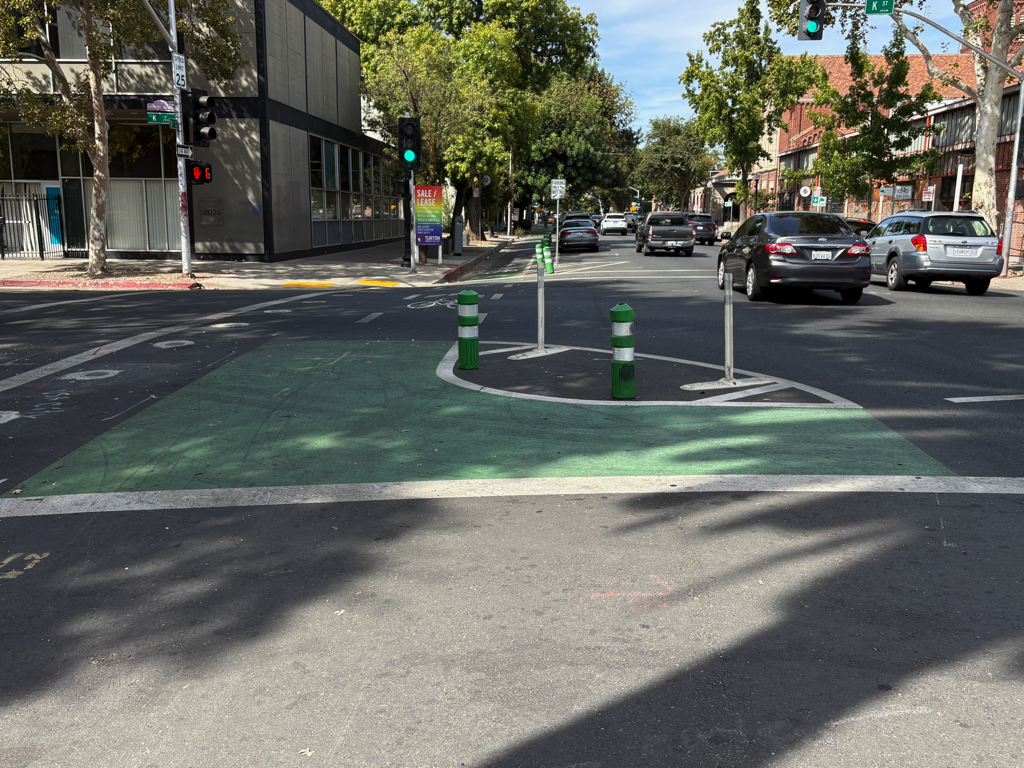
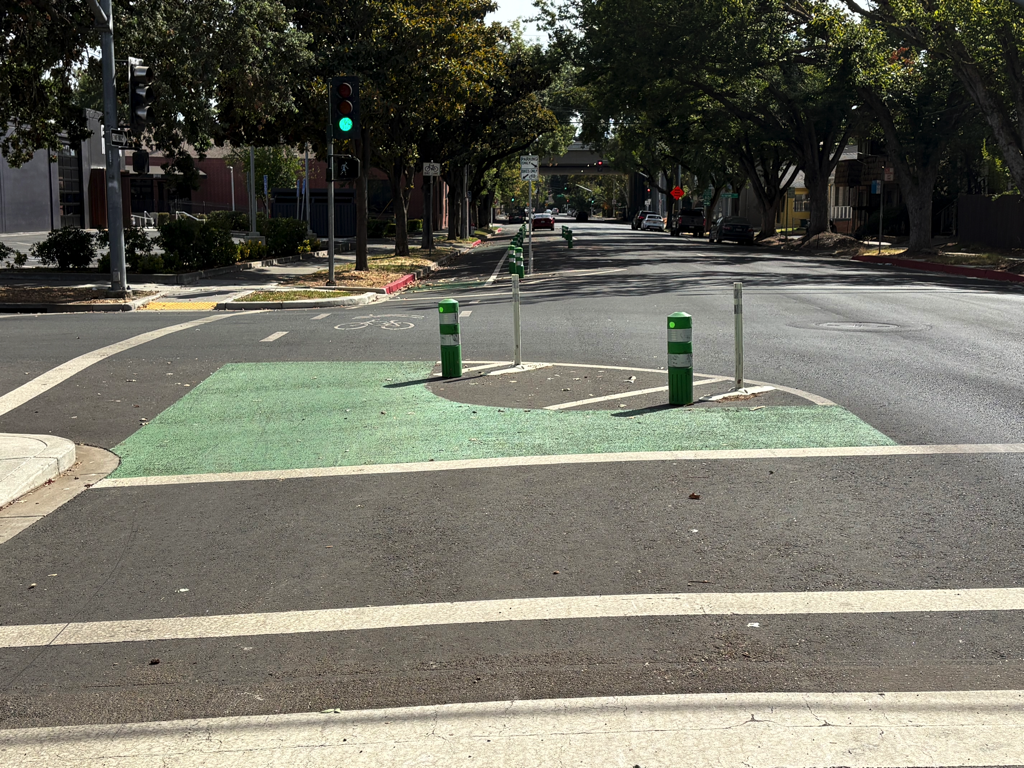
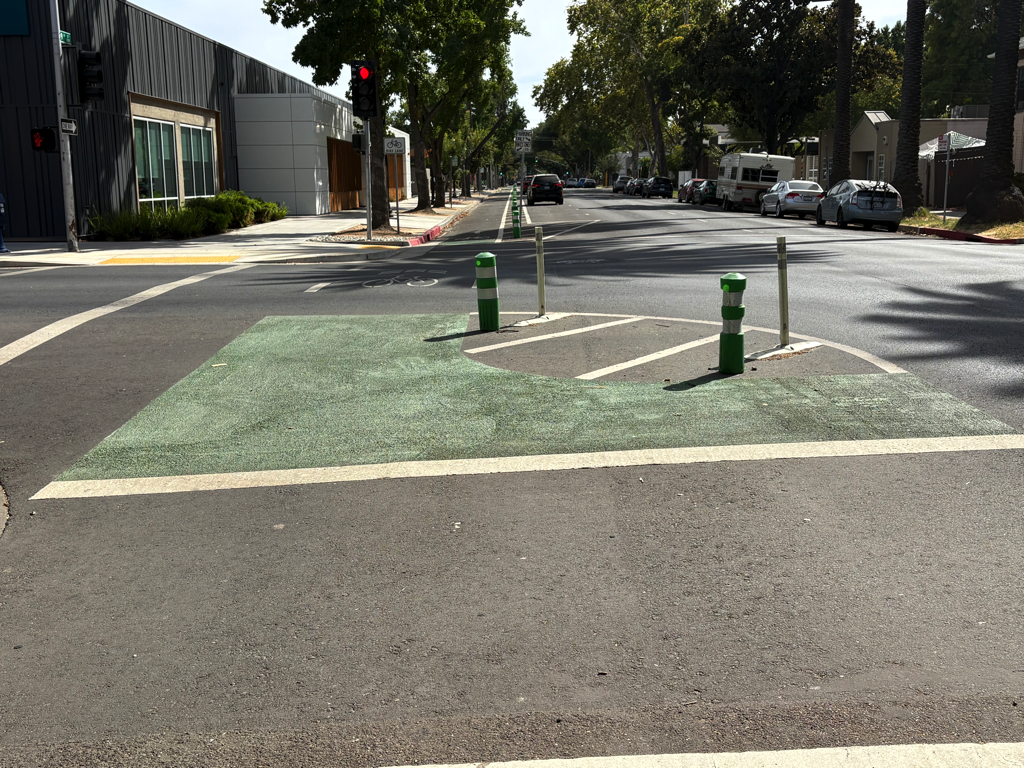
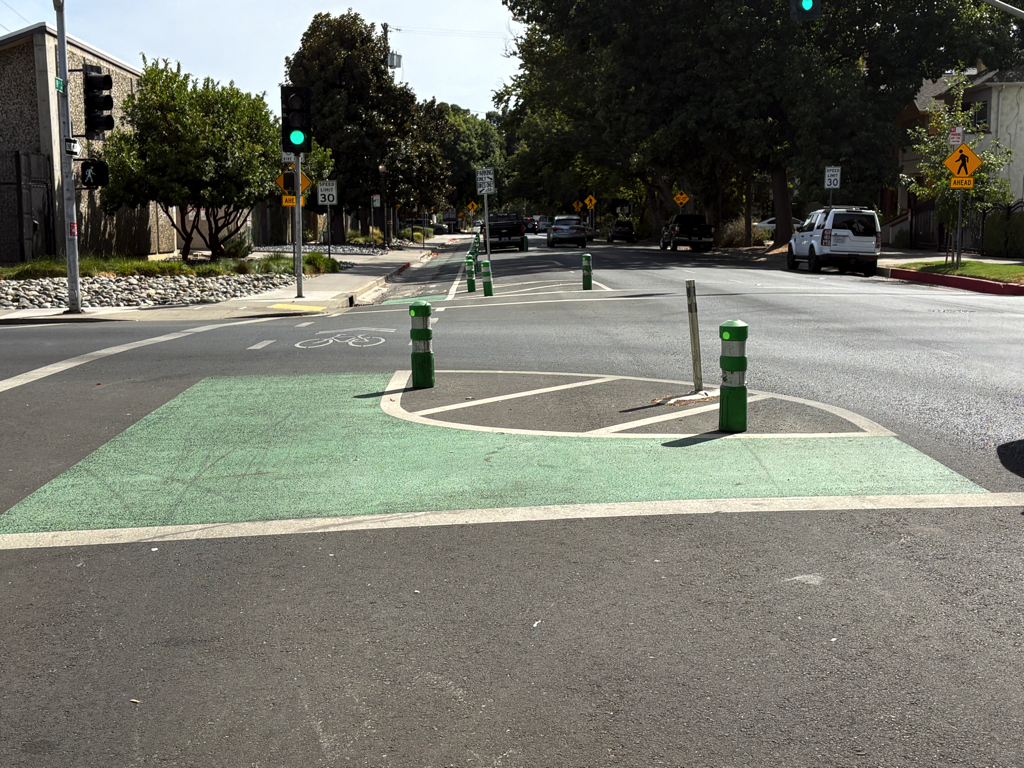
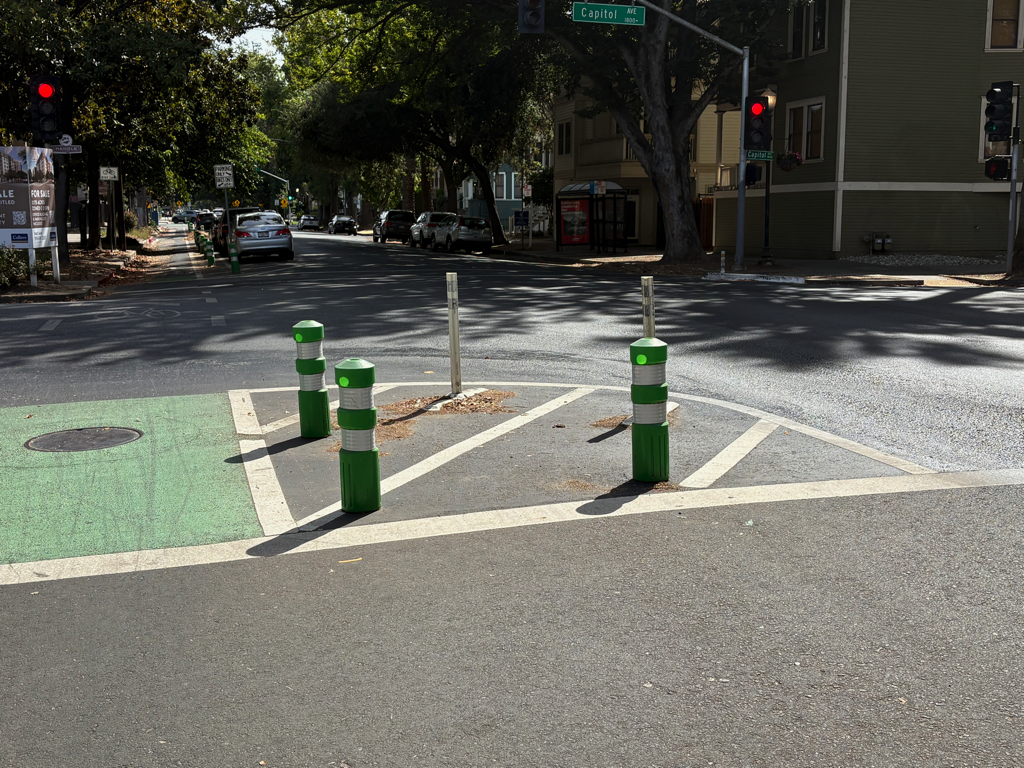
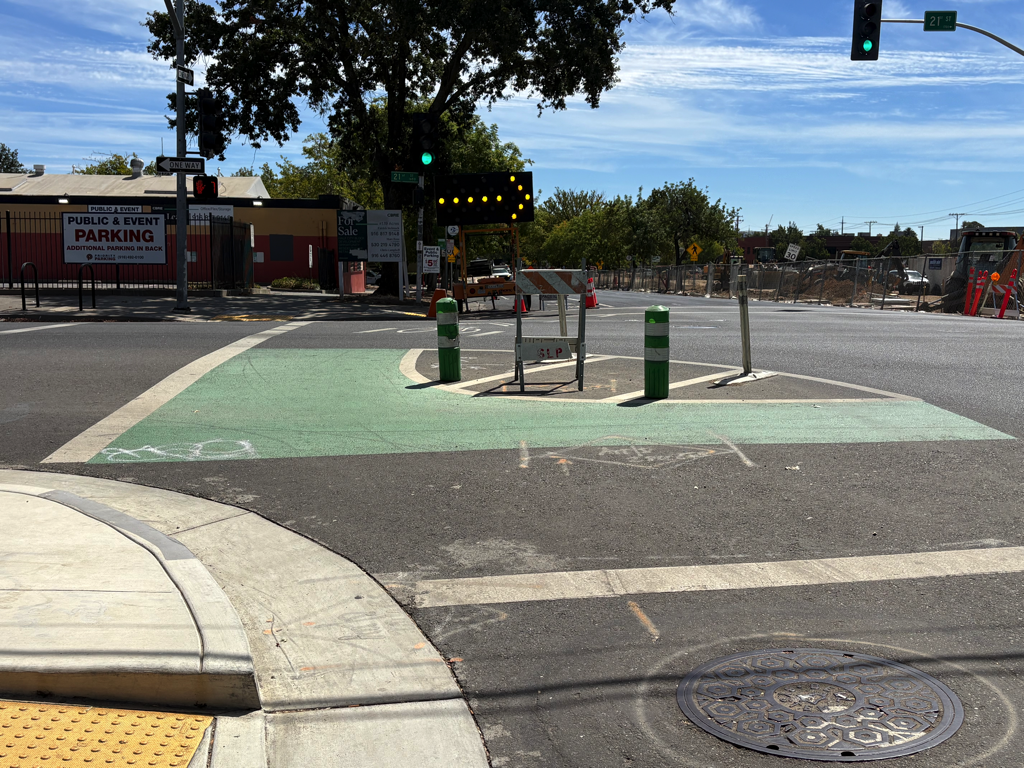
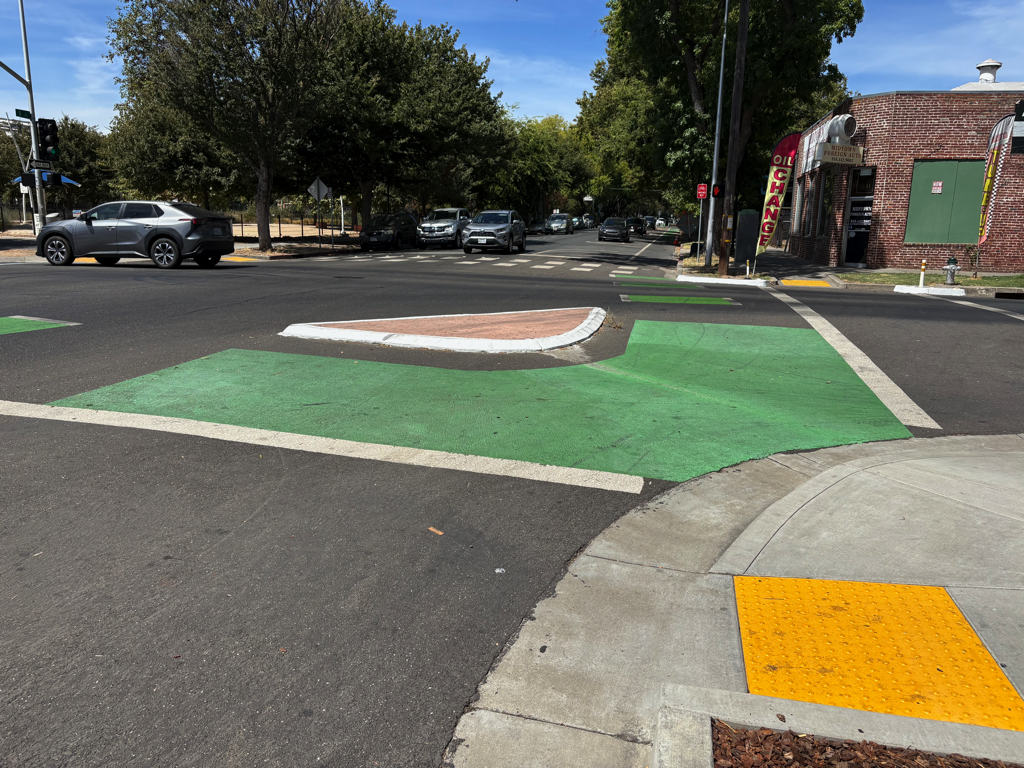
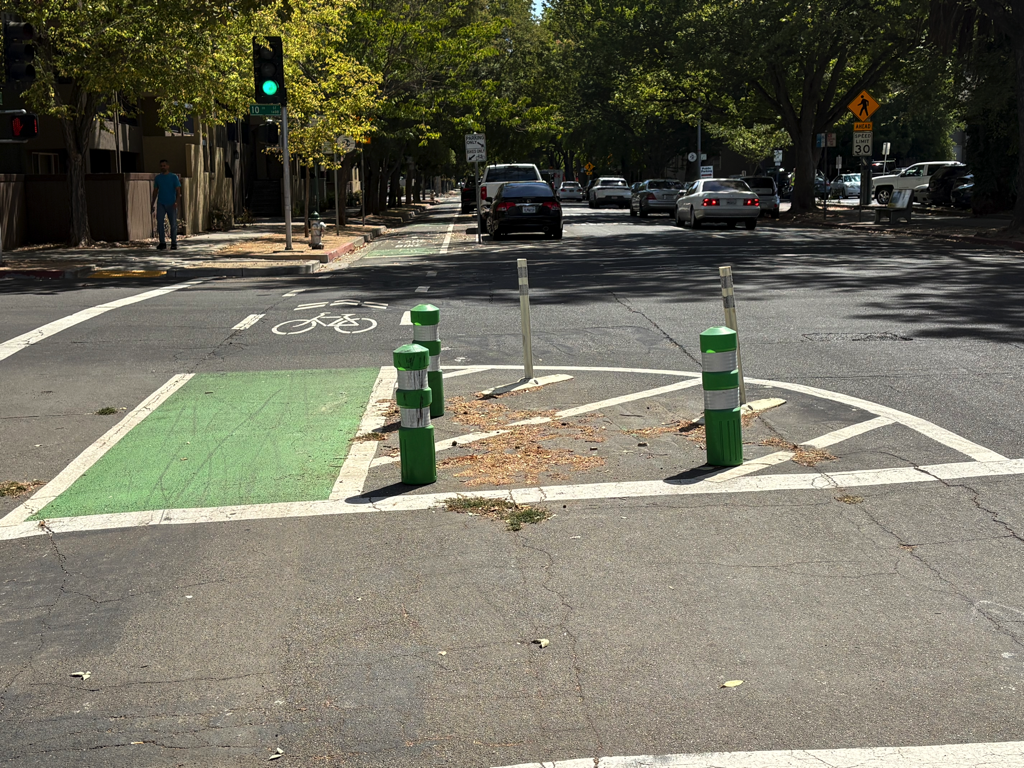
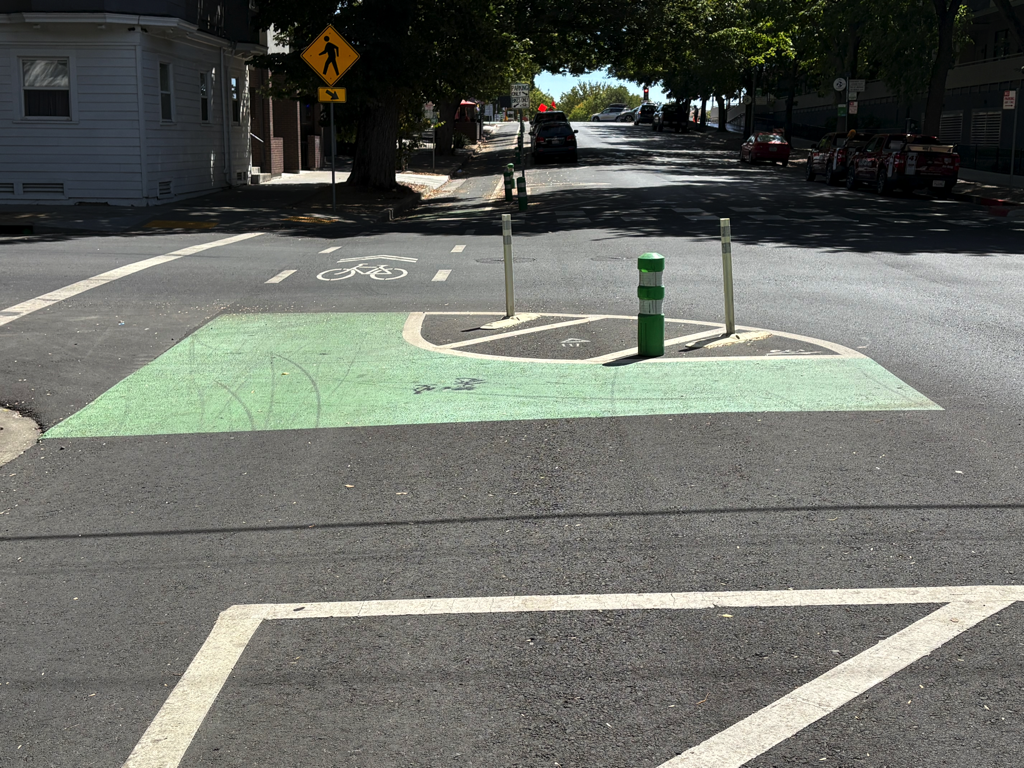
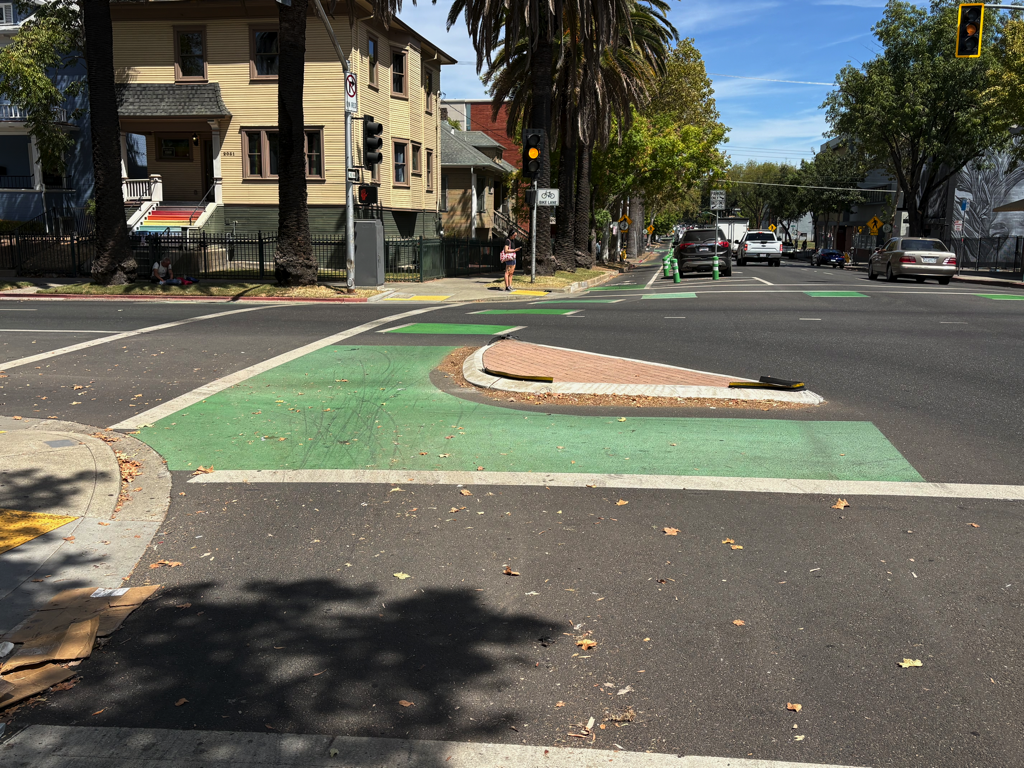
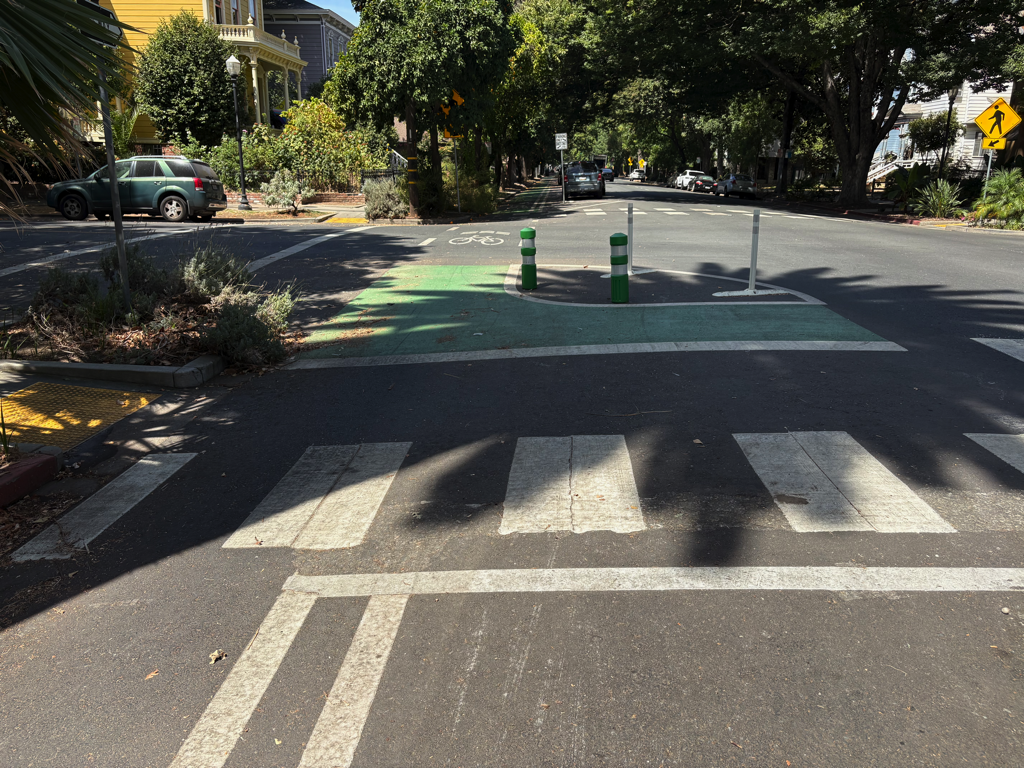
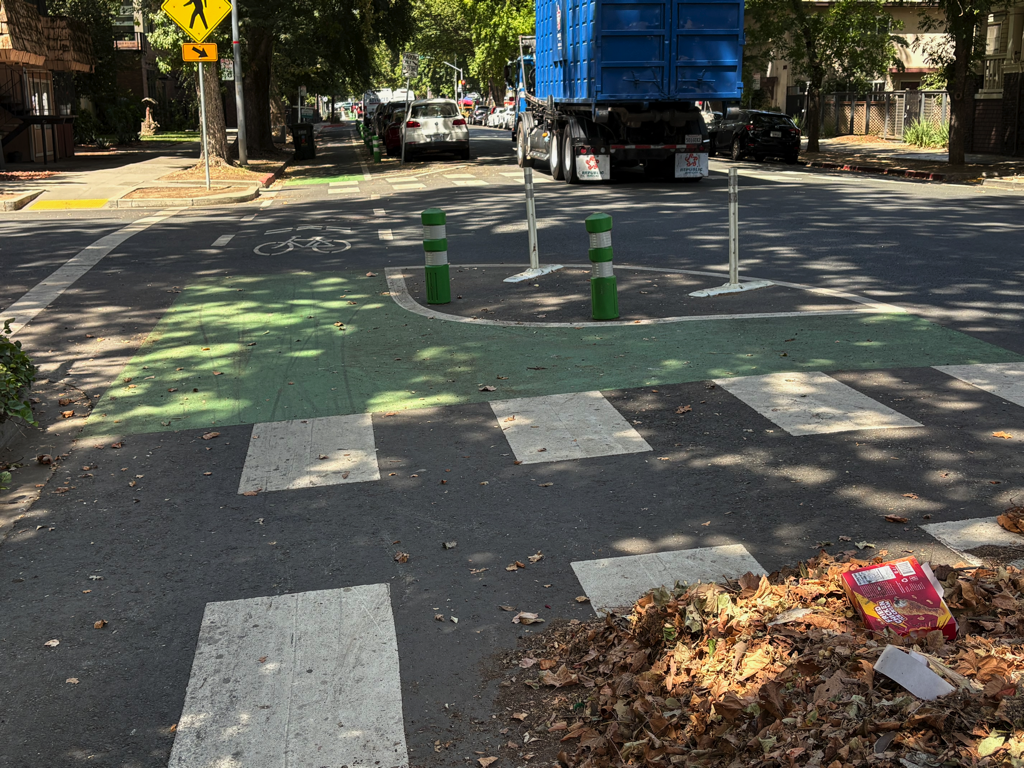
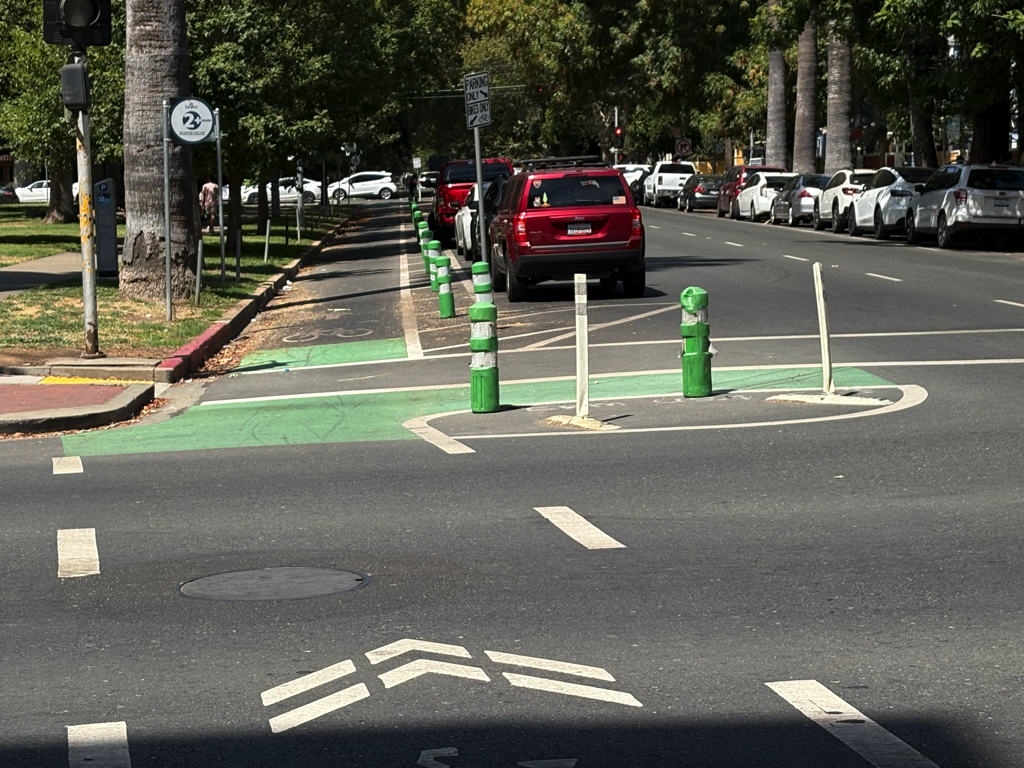
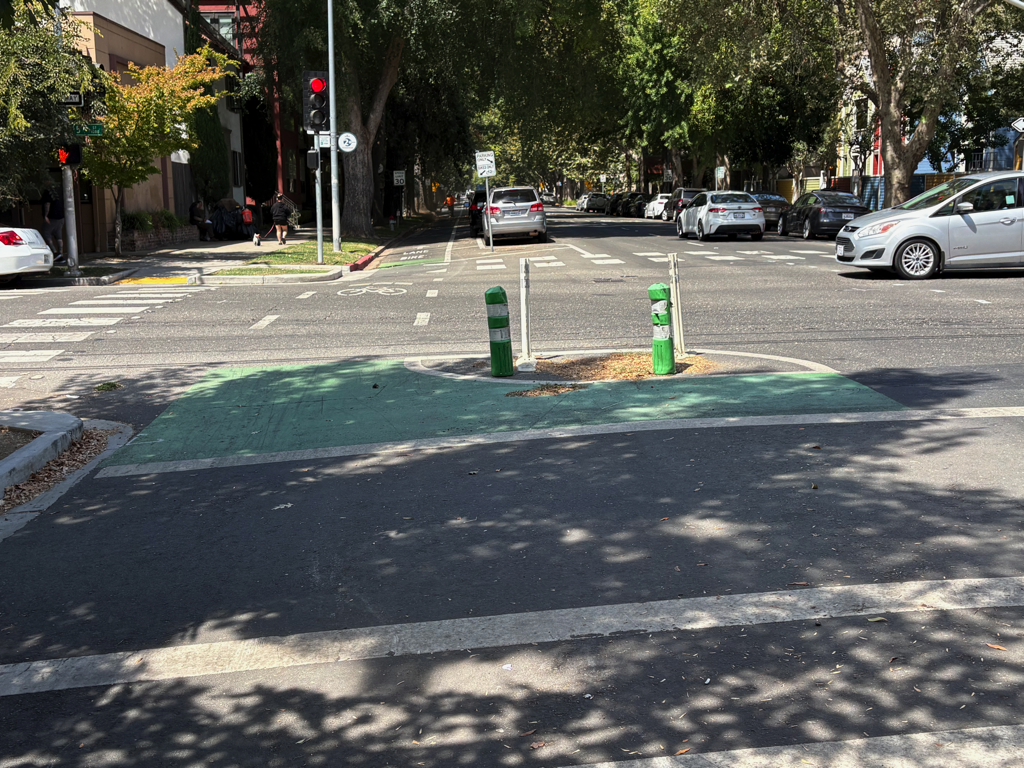
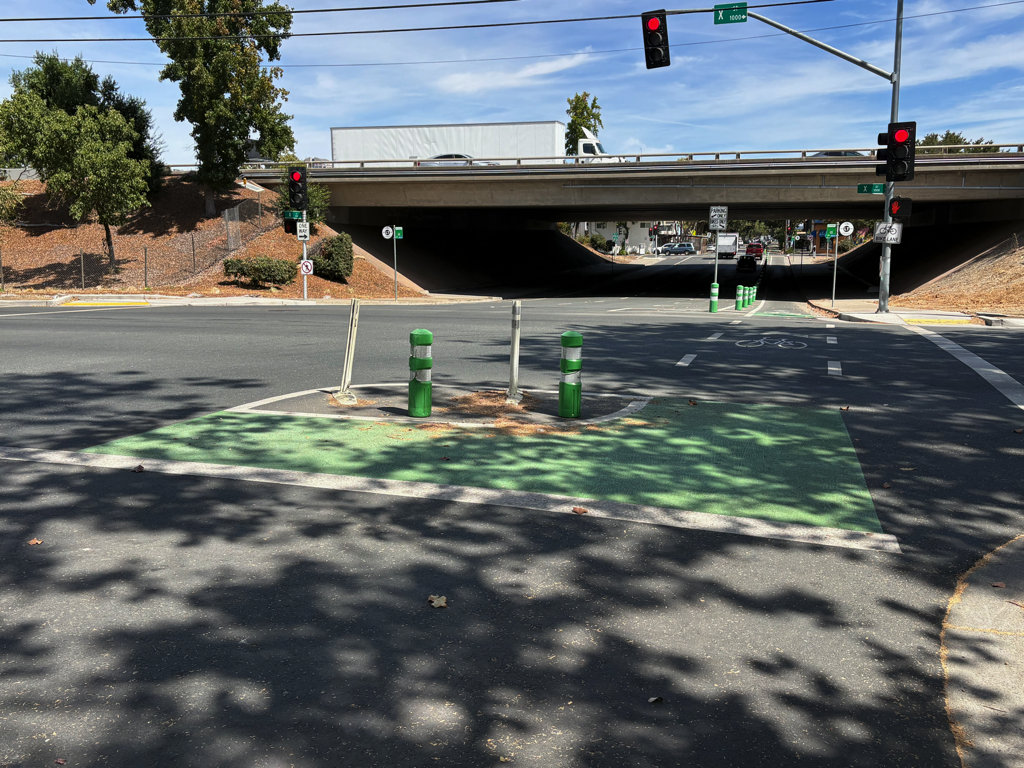
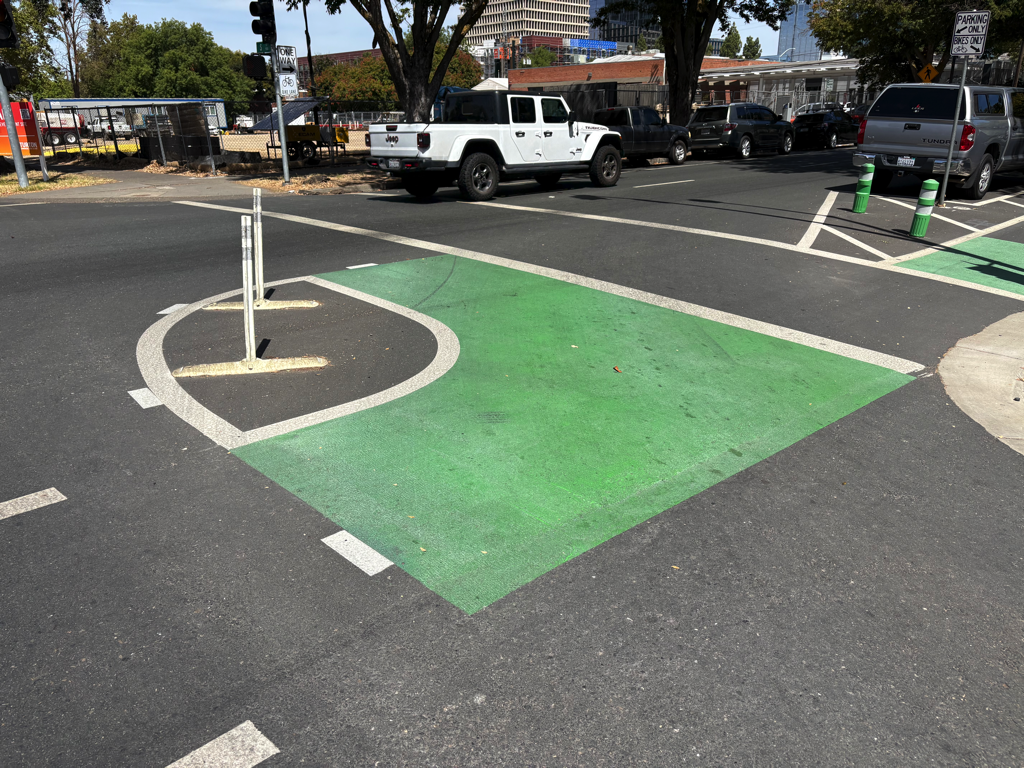
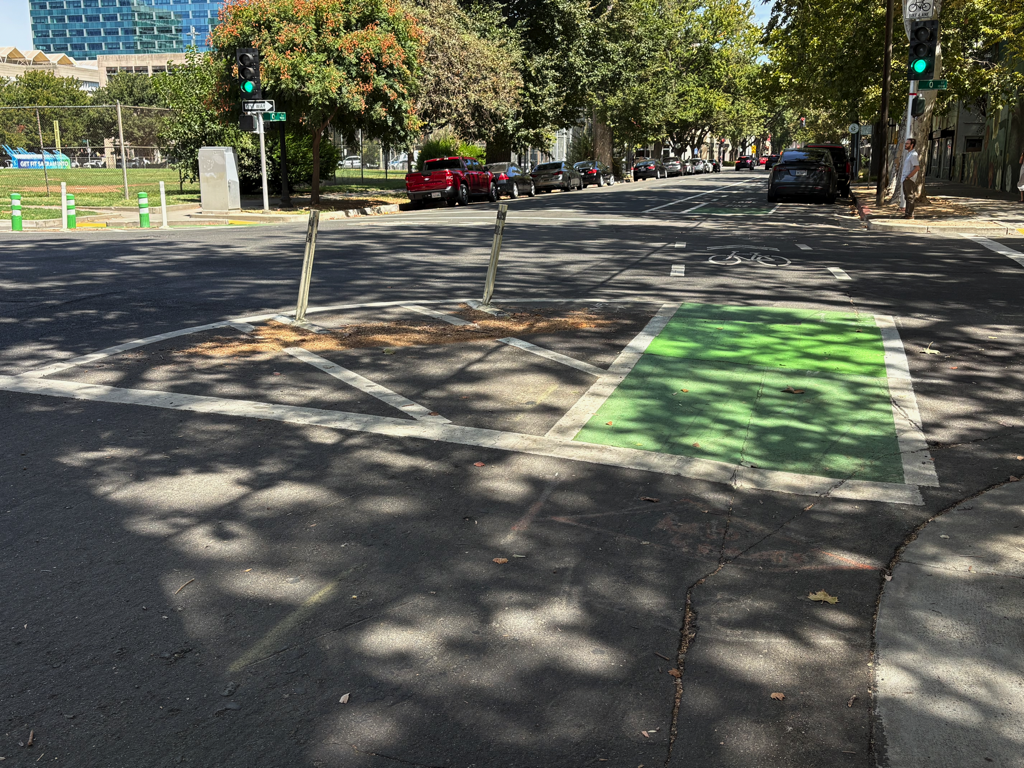
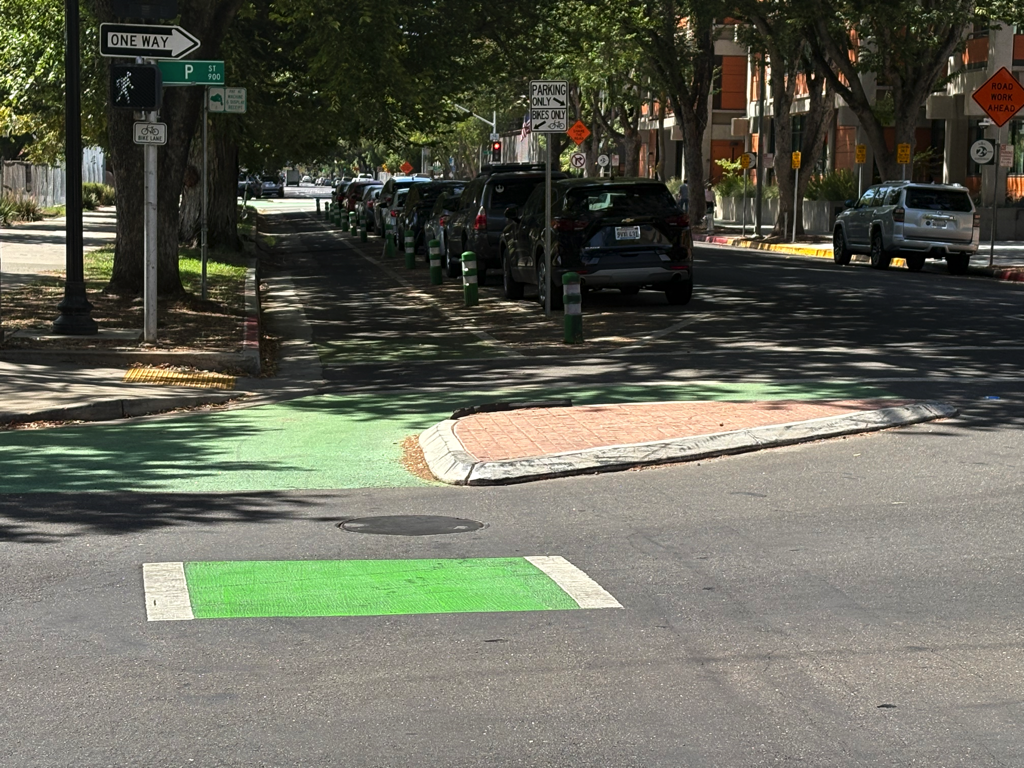
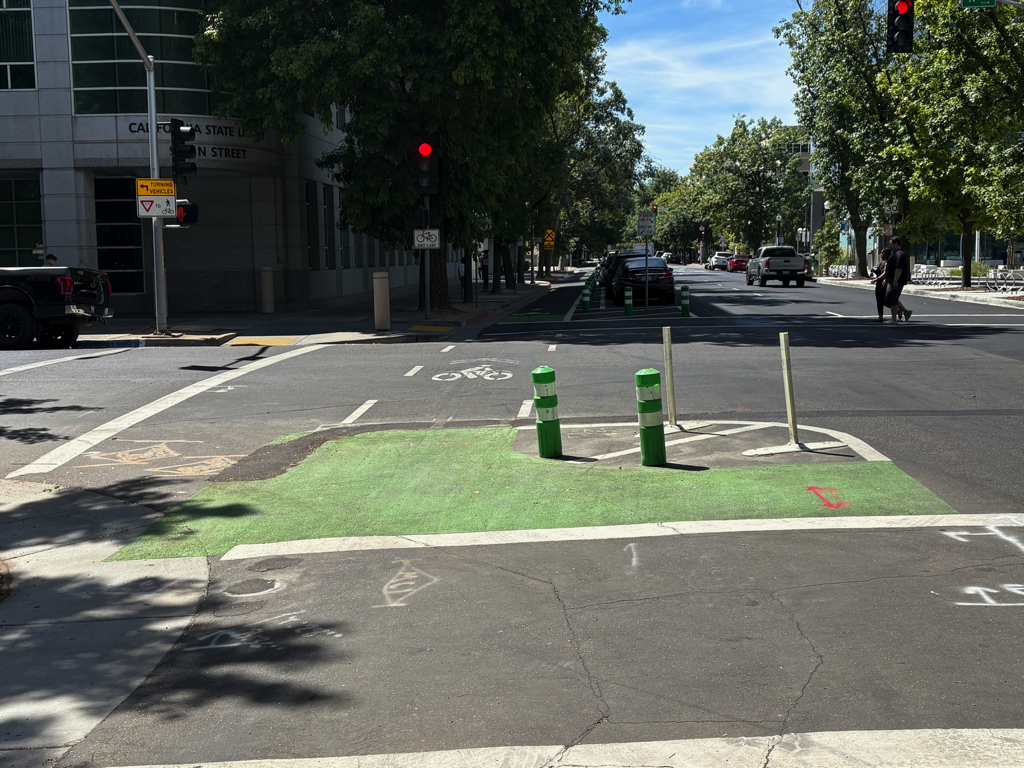
The City of Sacramento has recently installed lane channelizers at new locations in the central city. The three I’ve noticed are shown below. If you are aware of others, please let me know. The four locations that have been in place for several years are 15th Street (southbound) at O Street and at R Street, and 16th Street (northbound) at R Street and O Street. See Strong SacTown: Things that work: traffic posts and traffic calming measures, Lane Channelization, for these older locations. There are other locations where vertical delineators separate opposing lanes of traffic, which I call centerline hardening; for another post.
19th St at O St, channelization with vertical delineators21st St at O St, channelization with vertical delineators, also yield markersW St at 8th St, channelization with vertical delineators, also yield markers
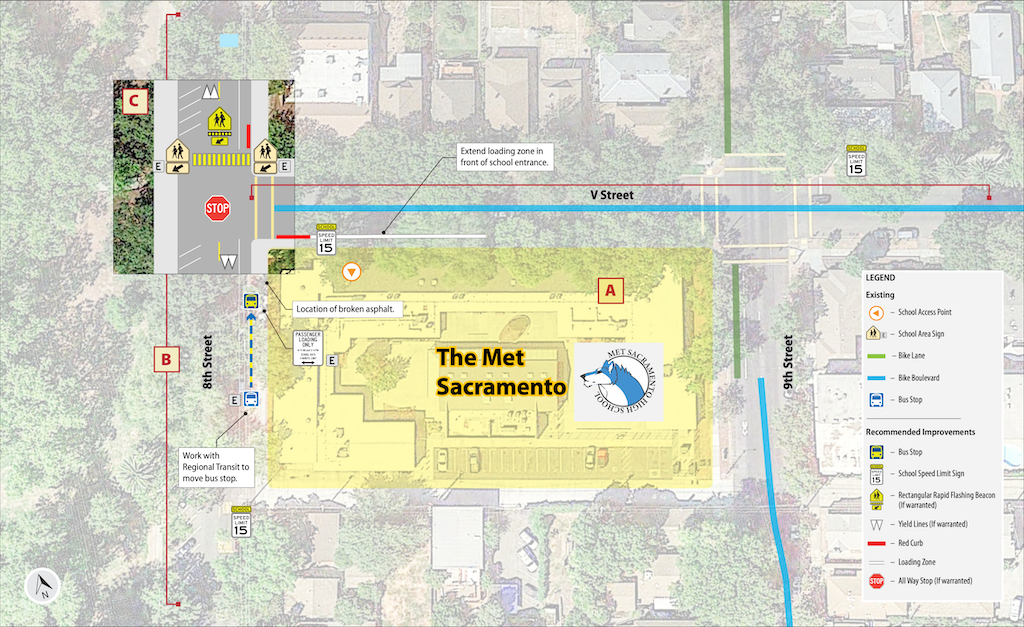
Given that the study was completed and adopted by city council in February 2021, the exact nature of the projects at each school site might now be different, but it is worth looking at what was recommended at that time. I looked at The MET Sacramento High School (pages 33-36), since it is on my morning walk. The diagram is below, followed by my comments.
diagram of improvements for The MET Sacramento, from SacCity VZ School Safety Study 2021
W Street at 8th St: The study missed what I consider to be one of the most significant safety hazards for the school, which is that there was, at that time, no safe crossing of W Street, one-half block south of the school, which would be the source area for probably half the students at the school. As part of an unrelated project (so far as I know), the crosswalks over W Street were made safer by high visibility crosswalk markings, vertical delineator lane channelizers, and RRFBs (Rapid Rectangular Flashing Beacon). I would not recommend installation of RRFBs, since most drivers ignore them, particularly on high speed roadways such as W Street, nevertheless, it is an attempt to make the crossing safer. These improvements may have been done for the heavy walker use during the Sunday farmers market, and Southside Park, but they are a value to the school. Since these crosswalks are only a half block from the school, they should be yellow. If the possible solution to parking is “…consider implementing a parking program at the W/X Parking Lot”, these crosswalks are even more important to student safety.
8th Street & V Street: The intersection of 8th Street and V Street should have school crosswalks (yellow) on both the north side (as shown) and the south side. The south side is constrained by a heritage tree on the west side of 8th Street, but a shifted alignment is possible. All crosswalks should be high visibility zebra pattern, not parallel lines. There is no excuse for excluding a crosswalk on this school corner. As mentioned, RRFBs are not safe, so should not be considered for this intersection. What should be installed are curb extensions on the west, northeast, and southeast corners. Full daylighting must be implemented on V Street westbound and 8th Street northbound (AB 413). V Street has a 15 foot, very faded, red curb, rather than 20 feet.
V Street & 9th Street: Curb extensions should be installed in the northwest and southwest corners. All crosswalks should be high visibility, not parallel lines. Curb extensions on both ends of the section of V Street between 8th Street and 9th Street would further communicate that this is a slow area, not a through route. Full daylighting must be implemented on 9th Street southbound and V Street eastbound.
Sidewalks: In addition to the repair noted for 8th Street east side sidewalk, areas officially designated for drop-off/pick-up should have hard surfaces in the sidewalk buffer (planting strip). Where it is possible to widen sidewalks without reducing the sidewalk buffer, sidewalks on all side of the campus should be eight feet rather than 5-1/2 feet (on V Street) and six feet (on 8th Street). However, the 8th Street width is narrowed to 37 inches for a tree, which is less than the required ADA/PROWAG 48 inches. The damaged sidewalk on 8th Street has been repaired.
Bicycle facilities: The city has a partially funded project to extend a parking protected separated bikeway on 9th Street from its current terminus at Q Street to Broadway (9th Street Separated Bikeway Project). If consistent with the existing facility, this would be on the east side of 9th Street. A two-stage turn box will need to be installed at V Street, and perhaps Victorian Alley, so that southbound bicyclists can wait for a gap in traffic and make a safe turn onto V Street or the alley. The limited bike racks are located off Victorian Alley, which complicates ingress and egress, but can be addressed.
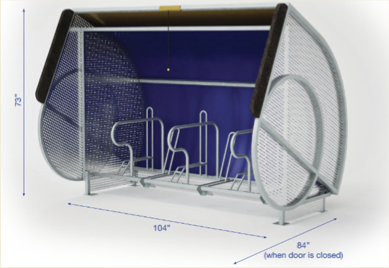
The City of Sacramento is working on a secure bike parking pilot program. This was first presented at the February 2025 SacATC meeting (sacatc_2025-02-20_05-bicycle-parking), and an update was providing at the August 2026 SacATC meeting (SacATC_2026-08-20_agenda-04-bicycle-parking-staff). The presentation provided the following graphic for the secure bike parking solution:
BikeLink mini-station or cage
These secure bike parking facilities from eLock Technologies would use the same BikeLink access, by card or app, that is used for the city’s existing bike lockers located at parking garages. Sacramento Valley Station also has two types of secure bike storage, BikeLink lockers provided by Capitol Corridor, and the BikeHub provided by the city, which uses BikeLink for access but has different rental policies. In the region, Capitol Corridor also provides lockers at Davis, Roseville, Rocklin, and Auburn. City of Folsom has BikeLink lockers at its three light rail stations, and City of Roseville has lockers at transit centers. You can view locations on the BikeLink map. Some but not all locations accept ClipperCards for access, but payment is through BikeLink.
Seeing vandalized and stolen bikes (cut locks, wheels missing, or just wheels remaining, missing seats, etc.) at the outside bike racks in many locations where these lockers are available, leaves me scratching my head about why more people don’t use the lockers. At 5 cents per hour for most locations, this is a tiny price to pay for protecting your bike.
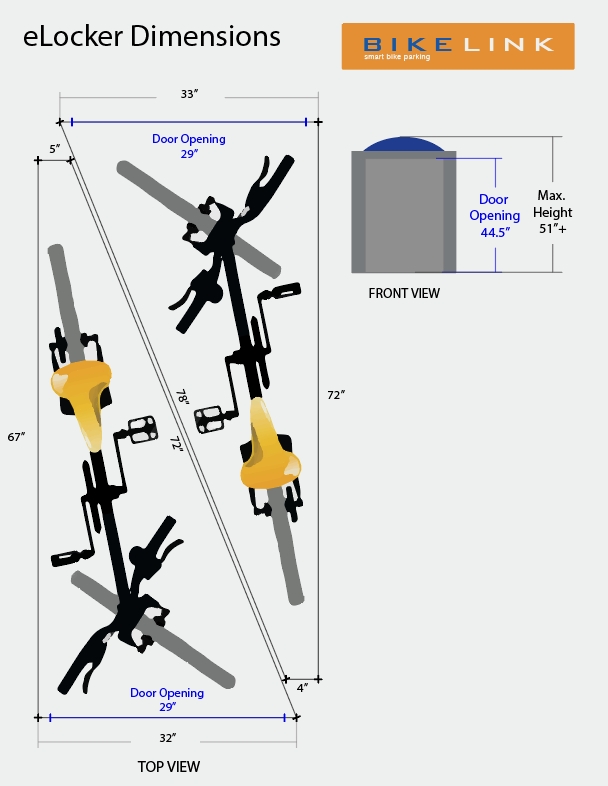
Part of the discussion at the SacATC meeting was about whether this secure parking design would accommodate cargo bikes. It appears not. Though the footprint of this design is 84 inches, it seems that the cage or shell only allows the same traditional bike sizes that standard BikeLink lockers allow, with a depth of 67 or 72 inches.
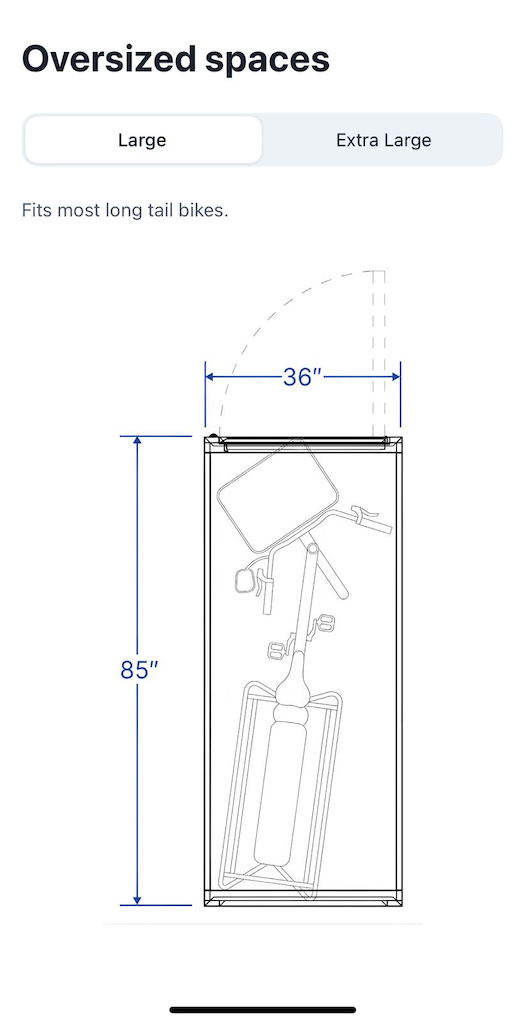
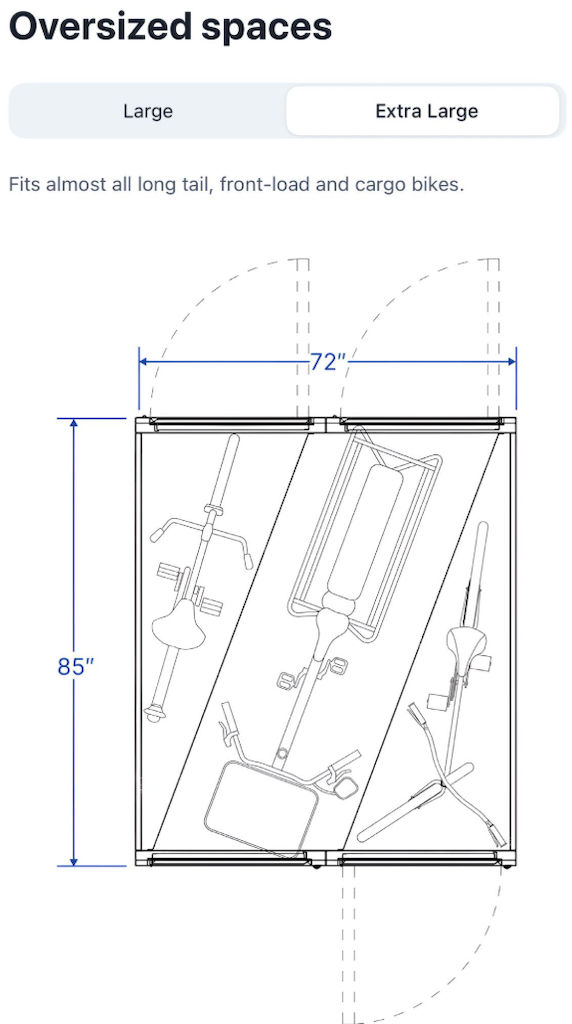
The BikeLink website mentions large and extra large lockers, so I inquired about these and was provided with the following three diagrams. The ‘large’ size has been installed at the Davis Amtrak (Capitol Corridor) station, 12 lockers. I am not aware that this larger size has been installed at any of the other Capitol Corridor stations. As you can see from the diagram, this larger size is designed to accommodate most long-tail bikes and some cargo bike sizes, with a 36 inch width and 85 inch depth. It does not have the wedge design of the standard lockers, so can accommodate bicycles that are wider front and back.
I was told that the mini-station or cage design was a done deal because there was a contract, though the device has not been delivered or even manufactured, so it seems to me that the contract could be modified.
This is a pilot, and as such, it makes sense to explore additional BikeLink options. I recommend that one of the five secure bike parking locations, which have not been identified yet, include at least two BikeLink large size lockers. The city needs to gain experience with these, as do bicyclists.
All of the existing BikeLink lockers in the Sacramento region seem to be underutilized. For the city garage locations, these are not destinations bicyclist think of when planning their trips. Garages are for cars, not for bicyclists. The K Street tunnel locker is accessible from the path, and the city hall parking garage locker was moved to I Street due to the fire, but still, these are not bicyclist destinations. Since Capitol Corridor makes it so easy to take bikes with you on the train, the Capitol Corridor lockers in this region are underutilized, though in the bay area they are much more highly utilized. BART stations have lockers or BikeHubs.
So the key to the pilot program is to identify where bicyclists want to store their bike securely. The best way to determine that is to ask them. City staff could hang out at some existing traditional bike racks, and ask bicyclists how important secure parking is to them, and where they would most want to see it.
For previous posts on BikeLink and secure bicycle parking, see Tag: BikeLink.
As part of the separated bikeways projects in the central city, turn wedges were installed at 30 locations, initially on the P Street and Q Street bikeways, and later on the 19th Street, 21st Street, and I Street bikeways. Though there is a bikeway on J Street, it does not have turn-wedges. My earliest posts on turn wedges, turn wedges of death and Central City Mobility update: turn wedges, I expressed doubt about these features, and added posts about real turn wedges and NACTO protected intersection and Sac semi-protected intersection showing how the designs fell short of best practice designs from NACTO and Alta Design+Planning.
However, after extensive observations of driver behavior around turn wedges, I now believe that these are a positive addition to streets in the central city. These features slow turning drivers, and cause them to face crosswalks more directly. I observe much higher rates of yielding to walkers than at other intersections. Not perfect, by any means, but better. Though these were installed as part of the Central City Mobility Project for bikeways, their greatest benefit is to people walking.
Some turn wedges work better than others, depending on the details of the wedge and the intersecting streets.
Five of the wedges are concrete. Initially, these were being hit by drivers almost constantly. You can see the tire marks on all of the concrete wedges, and even chipping of the concrete. The city added reflective strips to the edges of the wedges, though almost all of the strips have fallen off over time. It would have been good to add delineators or more reflective markings (see the Santa Monica example in real turn wedges). But drivers have adjusted, and I have not seen a driver hit a wedge in quite some time. These concrete wedges are at the intersection of two bikeways, though not all these intersections have concrete.
Two types of vertical delineators were added, initially green K-71 delineators, and later white FG 300 delineators. All of these have been hit by drivers, sometimes repeatedly with significant damage. I don’t see this as necessarily a failure – better a delineator than a walker or bicyclist. There is nothing in the world that can prevent all drivers from hitting objects in or close to the roadway, but good designs reduce the chances of those objects being walkers and bicyclists. This is critically important.
One turn wedge, northeast corner of I Street and 13th Street, is paint only, no delineators. As such, it doesn’t really serve any purpose.
Where buffers, and particularly wide buffers exist, the turn wedges work better because there is a longer approach for the driver before reaching the crosswalk.
Two wedges do not work because the gap between the wedge and the curb is too wide, inducing drivers to cut the corner inside the wedge and negating the benefit of the wedge to walkers and bicyclists. These are at the northeast corner of 9th Street southbound and Q Street eastbound, and the northeast corner of 10th Street northbound and S Street. These locations could be corrected, but they have not been. The 9th Street & Q Street location is particularly problematic because there is a high volume of turning drivers at this location, and speeds are higher due to the design of these two roadways.
There are projects to extend the bikeway on 9th Street south to Broadway, and to extend the P Street and Q Street bikeways to the west. Hopefully these projects will take the lessons of these initial turn wedges to improve the designs. The closer the designs come to the NACTO model, the better. And of course fully protected intersections, all four corners, are the optimal.
Photos of the 30 turn wedges are below. If you are aware of any other locations, please let me know. If you have experiences with any of these, as a walker, bicyclist or driver, please comment.
I-St at 13th-St turn-wedge paint only21st-St at T-St turn-wedge21st-St at O-St turn-wedge21st-St at L-St turn-wedge21st-St at K-St turn-wedge19th-St at V-St turn-wedge19th-St at T-St turn-wedge19th-St at S-St turn-wedge19th-St at N-St turn-wedge19th-St at K-St turn-wedge19th-St at Capitol turn-wedgeQ-St and 21st-St turn-wedgeQ St and 19th-St turn-wedge-concreteQ-St and 10th-St turn-wedgeQ-St at 18th-St turn-wedgeQ-St at 17th-St turn-wedgeQ-St at 16th-St turn-wedgeP-St and 21st-St turn-wedge-concreteP-St and 19th-St turn-wedge-concreteP-St at 18th-St turn-wedgeP-St at 17th-St turn-wedgeP-St at 16th-St turn-wedgeP-St at 15th-St turn-wedge10th-St at X-St turn-wedge10th-St at T-St turn-wedge10th-St at S-St turn-wedge10th-St at Q-St turn-wedge9th-St and Q-St turn-wedge-concrete9th-St and P-St turn-wedge-concrete9th-St at N-St turn-wedge
Automated Red Light Cameras are NOT Automated License Plate Readers (ALPR).
Recently Flock Safety cameras, and similar cameras by other vendors, including the Motorola cameras used in the City of Sacramento, have been much in the news, and there growing public concern and desire to ban or tightly control their use. You can read up on how they have been mis-used by law enforcement agencies. They are a step toward a univeral surveillance state. ALPRs continuously record license plate numbers, and depending on the setup, also other information including vehicle identification and even facial recognition of the driver. Though law enforcement claims that license plates are correctly identified, and that data is shared only with those who need to know, it has been demonstrated that they are very inaccurate, and that the data is being accessed by almost anyone associated with law enforcement or government agencies. Including stalking by law enforcement officers.
Automated Red Light Cameras (and similar Automated Speed Enforcement Cameras) are completely different. They record only incidents of violation, such as running red lights, and capture only license plate numbers. They are not continuous, do not record any other information, and have retention periods only long enough to resolve the civil citations. You can read a good summary of the privacy safeguards on City of Sacramento’s Automated Red Light Camera Enforcement Program page, or more detail on the SB 770 legislation page.
If you get into or overhear a discussion that confuses ALPRs with red light cameras, I hope that you will jump in with the correct information. Being anti-Flock should not means being anti-red light cameras.
Some of this confusion is understandable. To the public, any camera may seem like the camera of concern. At a typical intersection, there may be upwards of ten cameras, all for different purposes, or overlapping purposes. Probably some are ALPRs. Some are for detection, that allow the signal to detect motor vehicles and bicyclists, some are for traffic detection, allowing an agency to adjust for traffic flows. Sadly, most agencies do not actively manage traffic, even though they have spent huge sums on the signals, controller boxes, and central traffic centers that would allow them to do so.
I know that much of the ‘confusion’ is intentional. There is a large subset of motor vehicle drivers who do not want to be held responsible for their driving behavior and the traffic violence they create. Lumping red light cameras (and speed cameras) in with surveillance cameras furthers their attempt to ban all cameras. Don’t fall for it! Help educate your friends, co-workers, agencies, elected officials, and organizations.
I last wrote about this intersection of 21st Street & I Street when the bikeway project was just finished, Central City Mobility: 21st & I bike signals (2024-01-26). A bicyclist signal face had been installed, but the arrangement of the signal phases was dangerous and discriminatory against bicyclists northbound on the 21st Street bikeway. I assumed that the issues would be fixed. They have not.
Drivers continue to turn left from 21st Street to I Street, against the red arrow. If this were a regular round red light, this would be permitted, as it is from a one-way street to a one-way street. However, it is not legal against a red arrow.
If a bicyclist uses the bicyclist actuator button on the southwest corner, they do get an exclusive bicyclist phase to turn left to the bikeway on the north side of I Street, or to go north on 21st Street, or east on I Street (which becomes two-way at this intersection). The pedestrian signal on the west leg of the intersection is ganged with the bicyclist signal, which introduces a small conflict between people bicycling and walking, but this can usually be negotiated without problems. The problem is that criminal drivers still turn left against the red arrow, endangering both bicyclists and walkers.
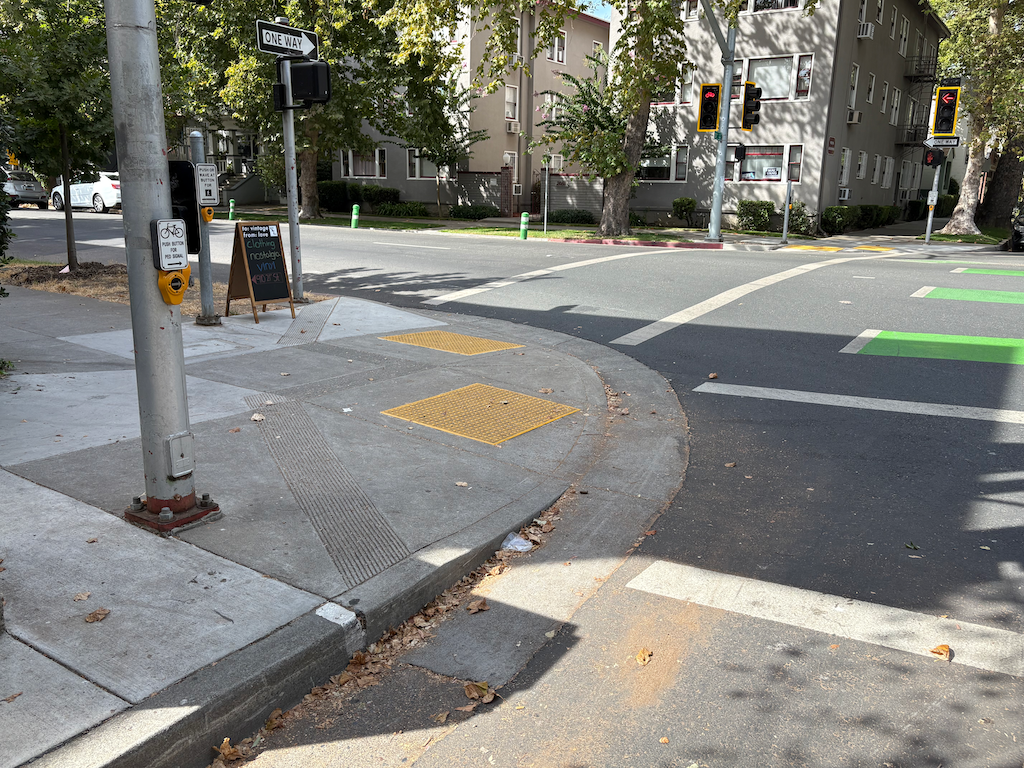
The larger issue is that the bicyclist actuator button is not located in a place usable by bicyclists. As shown in the photo, the button is four feet away from the curb. A bicyclist cannot reach the button without dismounting their bike. This is such an obvious mis-design that I assumed the city would fix it. It was reported as an issue to the city via 311, by myself and other bicyclists. But it was never fixed.
There are two possible solutions. The bicyclist actuator button could be replaced with a ‘push or wave at’ actuator/button. These distance at which these actuators sense a ‘wave’ can be adjusted, and could be adjusted so that bicyclists are detected without additional action. If the location is already a ‘wave’, it fails to function as such. The other option is to use video detection for bicyclists waiting at the intersection. It appears that there is a video detection camera located on the mast arm over 21st Street on the north leg of the intersection, but it is not being used to detect bicyclists.
As is so typical of city projects, a lot was changed, to the good, but the projects always fall short of transformative safety.
bicyclist actuator button at 21st St & I St is inaccessible for bicyclists
The City of Sacramento has been installing temporary curb extensions, with vertical delineators mounted on bases, at intersections. The extension is ‘temporary’ in the sense that it is not a concrete or hardened extension, though in most cases they will not be replaced with ‘permanent’ due to the expense of permanent installations. These curb extensions slow turning drivers, and reduce the crossing distance for people walking, or rolling. These are an effective countermeasure that increases safety, and I am very happy to see them being installed. In the photo below, on the northeast corner of S Street and 27th Street, the crosswalks have also been freshly painted in a high visibility pattern. The marked crosswalk over 27th Street may be new, and seems to be a new pattern for the city to use.
This particular installation also serves as daylighting, by preventing parking in the daylighting area approaching the intersection. I did not measure it, so am not sure if it meets the legal 20 foot requirement, but it does serve the purpose of increasing visibility by precluding parking. However, many of the installations do not set off the daylighting area, for example the northwest corner in the photo. I do not know why the city has decided in some cases to include daylighting in the curb extensions, and in other cases, not.
Though it would increase the materials cost of installations, requiring more delineators, all curb extension installations should also include daylighting, unless the location already has red curbs and/or signing for daylighting. AB 413 (2023), the daylighting law, does not require red curbs, signing, or delineators, however, the city’s intent is to ticket only where there is an indication for drivers of the law.
It appears that these vertical delineators are Pexco FG 300 Turnpike Grade Curb System. The bases discourage but don’t prevent motor vehicle drivers from running over the delineators ‘just for fun’, and provide more visibility than simple vertical delineators. I have so far not seen any curb extension locations where the delineators have been damaged by drivers. Delineators on the bikeway turn wedges have definitely been damaged by motor vehicle drivers.
I wonder if the lane channelizing vertical delineators on 15th Street and 16th Street should be replaced by this type (Hmm. 16th St traffic calming). These installations really do reduce lane changes at the last moment, which endanger walkers using the crosswalks, the ‘multi-lane threat’ that kills people. They are a success story for Sacramento, and should be used in more locations.
temporary curb extension at S St & 27th St, northeast corner
Note: I decided I would map the proposed Automated Red Light Camera and SB 535 areas, and the map is at bottom. Note that SB 535 is not the only criteria for identifying disadvantaged communities, but it is the one most commonly used.
Item 03 on the SacATC agenda for 2026-08-20 is ‘Automated Red Light Camera Program’ (staff report | presentation). This is a new program being established under Senate Bill 720 2025 (SB 720, Ashby. Automated traffic enforcement system programs.). Though this bill did not eliminate earlier programs, the City of Sacramento does not currently have a program because they participated in a county-wide program which the county cancelled. The new program addresses many of the objections that had been raised to the older program.
I support this program, and these locations.
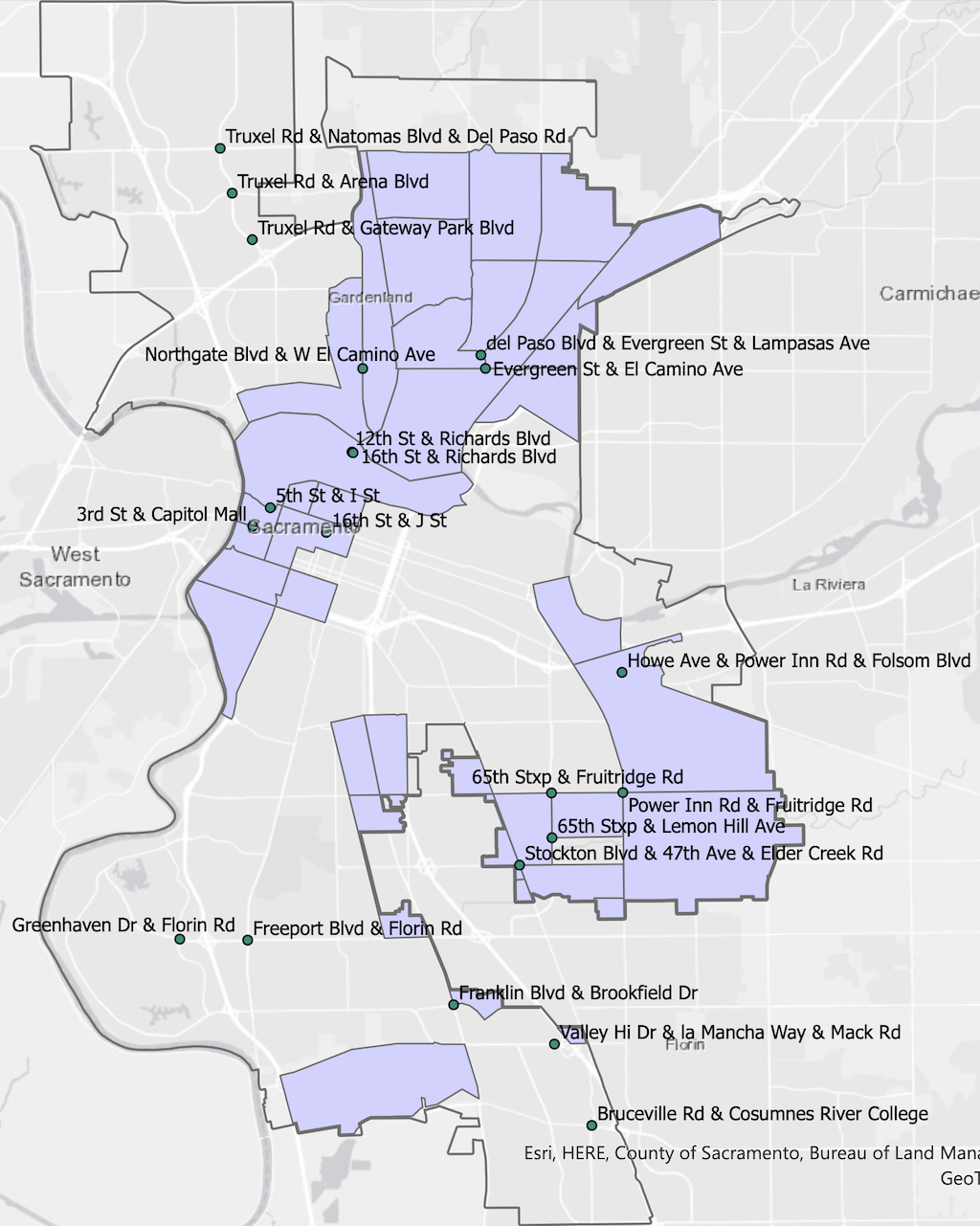
The staff report contains the map below.
map of Automated Red Light Camera Program, from SacATC 2026-08-20
I like the distribution of locations, though would hope for more locations. Maybe in time. The locations demonstrate two things: the equity concerns about concentrating red light cameras, and any type of enforcement, in low-income neighborhoods, does not seem to be a significant issue. Most of the locations are in moderate to high income neighborhoods. This fits with my observations that most red light running is by drivers of high-value motor vehicles, not low-income people. It would be interesting to map the intersections against disadvantaged communities, and probably the city did so, but I don’t have time for that, and the city did not provide it. (see below)
To some degree, I’m not sure how important the distribution of red light camera is. I strongly believe that the majority of red light running is by a minority, but a significant minority, of drivers. Many of these drivers run red lights all over the city. It is also contagious behavior. Yes, it is an epidemic, and the disease spreads though observation of other drivers behavior. It is a visual contagion. Though the enforcement mechanism here is civil and not criminal, it would allow Public Works to identify repeated and egregious red light runners, and pass that information along to law enforcement.
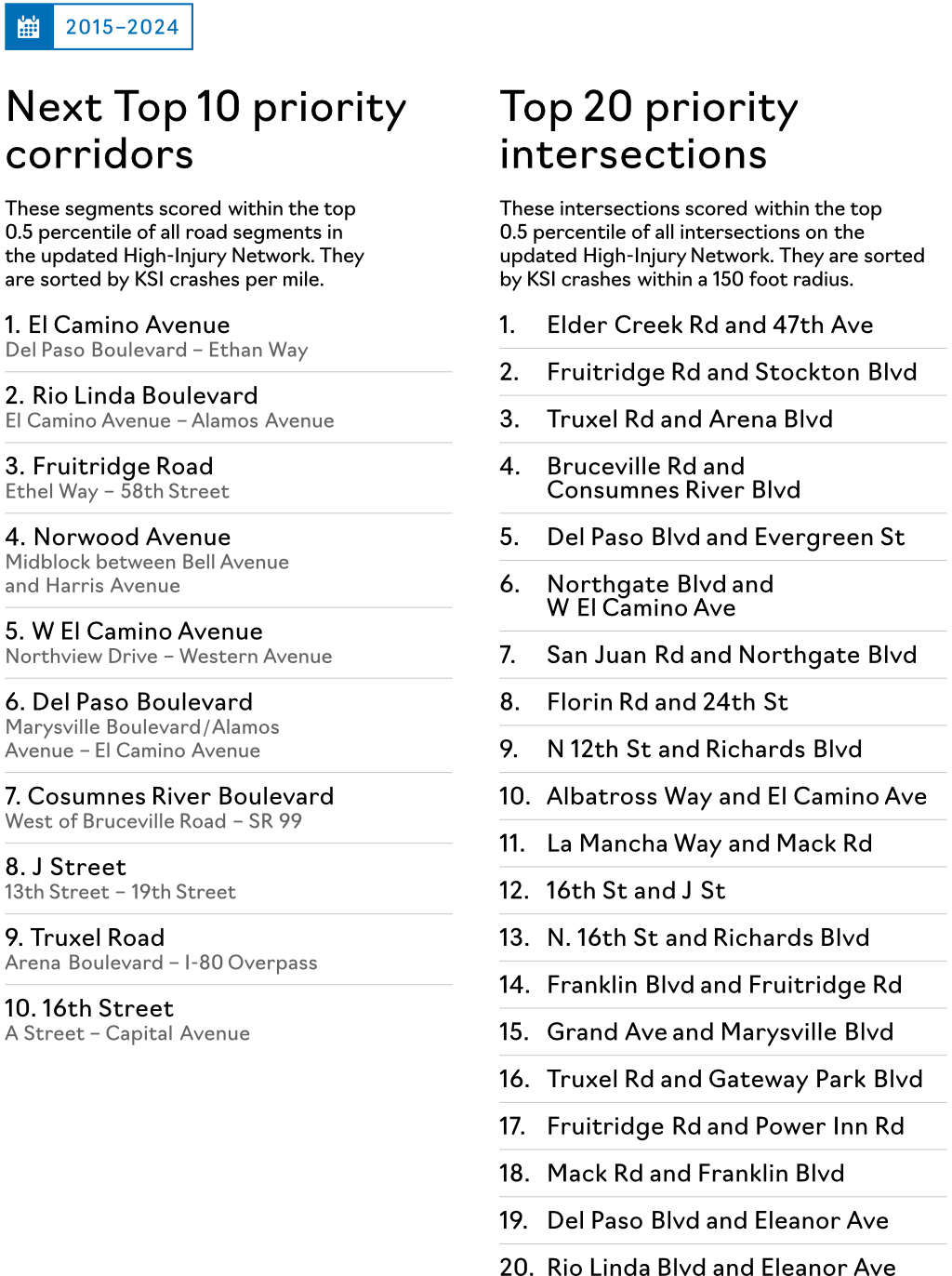
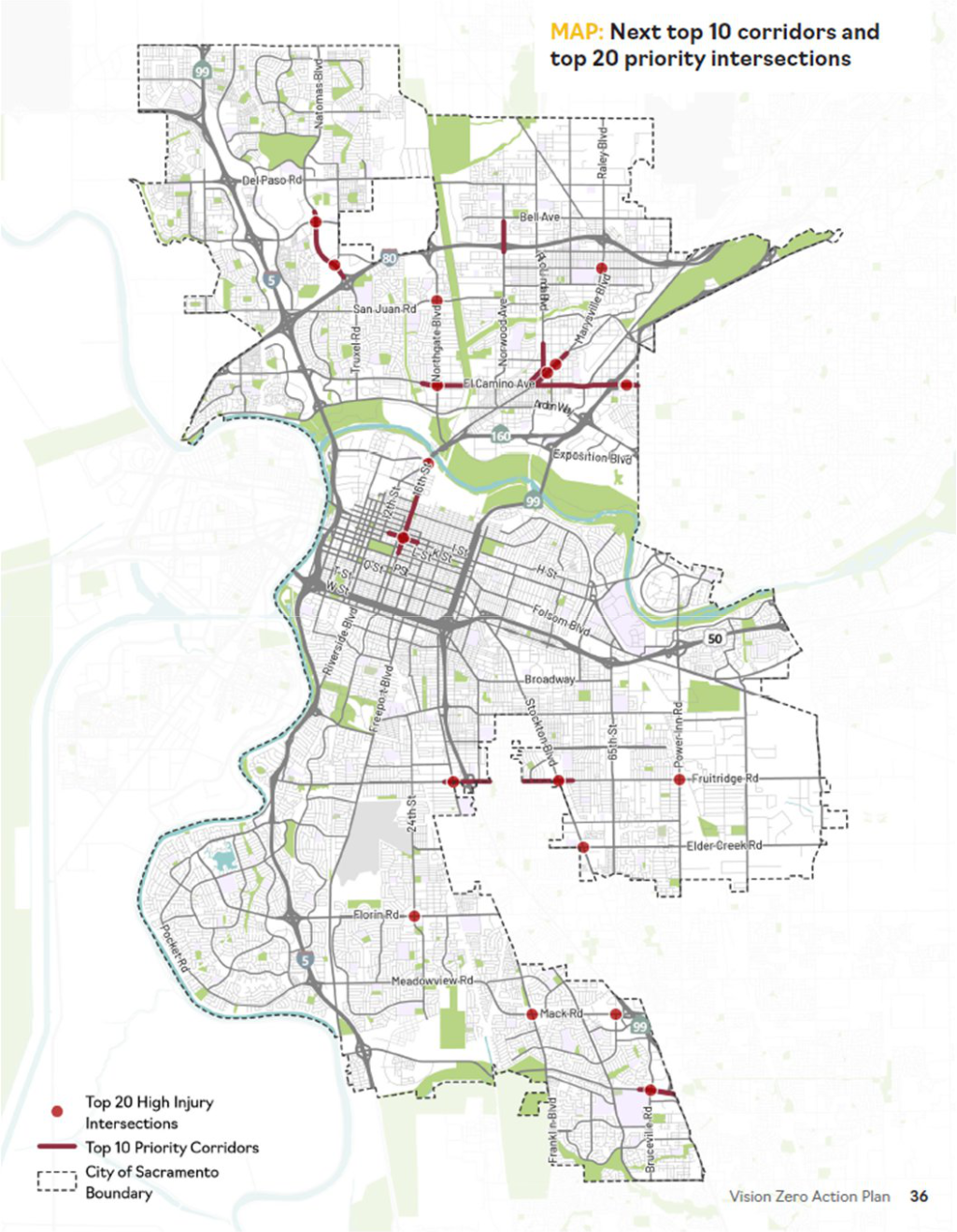
I was curious about how these 20 recommended intersection locations overlapped with the Vision Zero Action Plan Update. The Red Light Camera list is in order of broadside crashes, which are almost always caused by red light running. However, the ordered list in the staff report does not match the ordered list on the map. I don’t know which is correct. The Top 20 intersections in the VZ Action Plan Update are numbered, but not in ranked order. There is an overlap of eight intersections. I also bold-faced the roadways that show up more than once in the list. There is a pattern here – these are the arterial roadways that the city designed to encourage unsafe speeds and unsafe driver behavior. No surprise that these are the locations of red light running crashes.
Rank
Red Light Camera intersections
Vision Zero Top 20 intersections
1
5th Street & I Street
no
2
Truxel Road & Arena Boulevard
yes
3
Del Paso Boulevard & Evergreen Street/Lampasas Avenue
yes
4
65th Street & Lemon Hill Avenue
no
5
Freeport Boulevard & Florin Road
no
6
Folsom Boulevard & Howe Avenue/Power Inn Road
no
7
Truxel Road & Gateway Park Boulevard
yes
8
Stockton & Elder Creek Road/47th Avenue
no
9
Fruitridge Road & Power Inn Road
no
10
65th Street & Fruitridge Road
no
11
Mack Road & Valley Hi Drive/La Mancha Way
yes (as La Mancha Way & Mack Rd)
12
El Camino Avenue & Northgate Boulevard
yes (as Northgate Blvd & W El Camino Ave)
13
16th Street & J Street
yes
14
12th Street & North 16th Street
yes (as North 12th St & Richards Blvd, and North 16th St & Richards Blvd)
15
3rd Street & Capitol Mall
no
16
El Camino Avenue & Evergreen Street
no
17
Florin Road & Greenhaven Drive
no
18
Franklin Boulevard & Brookfield Drive
no
19
Cosumnes River Boulevard & Bruceville Road
yes (as Bruceville Rd & Cosumnes River Blvd)
20
Truxel Road & Del Paso Road/Natomas Boulevard
no
Map of proposed Automated Red Light Camera locations, and SB 535 disadvantaged communities.
map of proposed Automated Red Light Camera locations and SB 535 disadvantaged communities
Of the 20 locations, seven are not in SB 535 areas, four at at the edge of SB 535 areas, and nine are within SB 535 areas. I would not say that the cameras are concentrated in low-income communities, however, many equity organizations have raised concerns about camera locations. My observations of red light running are that most violations are by drivers of high-value vehicles, not low-income drivers. The seven not-in-SB 535 locations are moderate to high-income communities. The three downtown Sacramento locations are not generally low-income, though the SB 535 criteria identifies them as such. SB 535 uses a variety of measures in addition to income.
The Sacramento Active Transportation Commission (SacATC) will meet this Thursday, August 20, 2026, starting at 5:30 PM, at the city council chambers. People can comment on agenda items in person at the meeting, or by making an eComment ahead of time on the city Upcoming Meeting Materials webpage. Though eComments up through the meeting become part of the record, commission members will not see eComments unless they are submitted early the day of the meeting. The format for speaking in person has changed. You can register ahead of time to speak on an agenda item, but apparently you can still fill out a speaker card at the time of the meeting. The comments format has changed a bit, but apparently works the same. Go to the city’s Public Comment page, and then select Sacramento Active Transportation Commission to see registration and comments.
I may post comments on the agenda items. Added a post on Automated Red Light Camera Program. If the bicycle parking program presentation is fixed (it appears to be corrupted), I may post on that item.
City of Sacramento Bicycle Parking Program 2026 Update (staff report | presentation note: the presentation seems to be corrupted, lacking most of the graphic elements)
Marysville Blvd is one the 2018 Vision Zero Action Plan top 5 corridors. The 2026 Vision Zero Action Plan Update (page 33 list and map) draft includes Marysville Blvd south of Arcade Blvd as part of the Del Paso Blvd top 10 corridor, and two intersections. It also includes the intersection of Marysville Blvd and Grand Avenue in the top 20 intersections, which is within and central to the Marysville project. The Marysville Blvd Vision Zero project is the result of the 2018 identification.
The city has a preliminary design for phase 2, but engineering is not complete, nor is funding available. That means that citizen input can improve the project. Phase 2 would extend the project north from Grand Avenue to North Avenue, and south from Nogales Avenue to Arcade Blvd. There is no official public outreach at this time, but you can always email the city with your concerns and ideas: MarysvilleVZ@cityofsacramento.org.
The project page has a list of ‘Project Features’:
Road Diet: A road diet is a reduction of a travel lane to slow down traffic and improve safety.
Bicycle Lanes: Upgrading existing bike lanes to protected bike lanes.
Pedestrian Safety: New pedestrian signals and controlled crossings.
Infrastructure: Pavement repair and sidewalk improvements.
Five maps of the project area were provided in a presentation to SacATC 2025-09-18, and these are shown below, south to north. There are gaps in these maps, but I think they serve to show the kinds of changes proposed. There were preliminary designs, final designs and engineering are now being developed by a consultant.