Crosswalk removal and CVC

At the community meeting, Ryan Moore kept saying “we followed the law” in removing crosswalks. Though he was not specific, the law he may have been referring to is the section of California Vehicle Code (CVC) below. It remains to be seen if this law was followed, but it may have been since the requirements are minimal. Residents in the neighborhood were uniform in saying that they had not seen any notice, but that does not prove it did not occur. There are additional legal requirements on the city that will be addressed in future posts.

CVC 21950.5. (a) An existing marked crosswalk may not be removed unless notice and opportunity to be heard is provided to the public not less than 30 days prior to the scheduled date of removal. In addition to any other public notice requirements, the notice of proposed removal shall be posted at the crosswalk identified for removal.

(b) The notice required by subdivision (a) shall include, but is not limited to, notification to the public of both of the following:

(1) That the public may provide input relating to the scheduled removal.

(2) The form and method of providing the input authorized by paragraph (1).

Leading Pedestrian Interval (LPI) signals

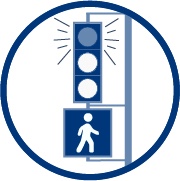
Questions about using Leading Pedestrian Interval (LPI) signals at the community meeting on crosswalks reminded me that I had information on these in the city for some while, but hadn’t shared it. A LPI signal gives the pedestrian a 3-second (or more, but the Sacramento ones are all 3 seconds) head start, with the walk sign coming on before the light turns green, so that pedestrians will already be in the crosswalk and more visible before vehicles start to move. These address the common issue of both right-turning and left-turning vehicles failing to yield to pedestrians in the crosswalk. They are one of the pedestrian safety countermeasures identified by the Federal Highway Administration (FHWA), with a crash reduction factor of 60%. If you search for ‘leading pedestrian interval’ on the Internet, you’ll see a great number of useful links. The NACTO page is especially worthwhile.

My purpose in sharing the specific locations is so you can go out and experience LPI for yourself. How does it work for you?

A LPI does slow traffic very slightly since there is an additional 3 seconds per direction during which most vehicles are not moving.

Lastly, this is not a solution that could have been used at the Freeport-Oregon intersection, which is not a signalized intersection. However, it is a solution for the signalized intersections along Freeport. Ryan Moore claimed that these can’t be used at low pedestrian locations, but the response to all such reactionary claims is: “You can’t judge the need for a bridge by the number of people swimming the river.” If crossings are not safe, then fewer people are walking than otherwise could be. The demand is there, but not the facility. LPIs are one solution.

Lead Pedestrian Interval (LPI) locations in City of Sacramento (as of 2015-08-28):

  • 9th Street and I Street
  • 9th Street and P Street
  • 10th Street and I Street
  • 10th Street and J Street
  • 15th Street and K Street
  • 29th Street and K Street
  • 30th Street and K Street
  • 9th Street and Q Street
  • 13th Street and I Street
  • 8th Street and P Street
  • 8th Street and Q Street

Community meeting on crosswalks – 2

Part one, Community meeting on crosswalks, prior posts:  removal of crosswalksDon’t use the ‘A’ word. Next related post will be about Zegeer.

Question and answer session of the meeting:

  • The city is doing a speed study on Freeport from Sutterville Rd to Meadowview Rd, and will include part of Sutterville (not clear what part)
  • There are no red light cameras on Freeport; the city piggybacks on country red light program
  • There are no lead pedestrian interval signals on Freeport, or even is south Sacramento (all are in the central city); Ryan Moore said these should not be used in low pedestrian areas (which is false)
  • Resident commented on Fruitridge Rd, 24th to Freeport, a lot of red light running and few safe crossings
  • Resident who lives on Oregon suggested changing the speed limit on Freeport
  • Steve Hansen says that the city would like to change Freeport, but to do so, the community (residents, businesses, neighborhood associations) will need to come together to decide how; people will have to give up some time for better safety; he also mentioned narrow sidewalks with obstructions
  • Several people asked about or commented on specific sections and intersections; Matt mentioned catching egregious speeders
  • South Land Park Neighborhood Association (Ryan?) asked what public notice there was before crosswalk removal and said they were not notified; not clear if the other two were notified
  • Ryan Moore said that each removal was analyzed, he says they followed the law of CA MUTCD; said most of the removals were result of complaints; said neighborhood input makes no difference; mentioned FHWA info on crosswalks, referring to Zegeer report though not by name (more info about Zegeer in a future post)
  • Neighbor said that any process that removes crosswalks is flawed; mentioned no still phase on signals (time between red one direction and green the other); going out of the way is not reasonable to ask; can’t have data on people walking because people are scared to walk
  • Steve Hansen and Jay Schenirer want to review pedestrian guidelines, not sure what document this is; said we need to talk about equity because the top corridors of Vision Zero concern are not necessarily located in disadvantaged communities
  • Neighbor said speed display signs don’t seem to have any effect on behavior; asks for immediate action and not years out
  • Ryan Moore continually says “we’d like to but we can’t” but offers no proof; continues to say that crosswalks at this volume and speed are not safe
  • Neighbor said there are bus stops close to Oregon which is true and which might make removal a violation of Title 6
  • Issue of sidewalk maintenance responsibility has come up several times; city continues to insist that it is the responsibility of the property owner (even though most sidewalks are part of the public right-of-way and all are part of the transportation network)
  • Many people pointed out that improvements could have been made at the Freeport-Oregon intesection, such as bulb-outs, refuge median, lighting; there is a median already but it is too narrow to provide refuge
  • Participant asked for a pedestrian commission, Jennifer Donlon Wyant said the the city Active Transportation Commission would be seated in April or May
  • Jay Schenirer wrapped, mentioned that McClatchy students drove the changes to Freeport north of Sutterville Rd

My overall take on the community meeting is that the city council members and the public, both residents of the neighborhood and others, want proactive changes to increase pedestrian safety and walkability. They don’t want excuses. Ryan Moore, the Interim City Traffic Engineer, seem prepared only to offer excuses.

Of all the people on stage, Ryan Moore seemed the least sympathetic to the person killed, or the issues that it raises. He said much the same thing he’d said to the SacBee: “Instead, traffic engineers hope that by removing some crosswalks, pedestrians will instinctively choose to cross at a safer, nearby intersection,” Moore said. He kept referring to federal and state standards that were being followed, though a number of people in the audience who know a great deal about traffic engineering noticed that he was mis-stating and mis-using standards and research to defend his actions and opinions.

Community meeting on crosswalks

I had promised I’d report on the community meeting to address the crosswalk removal over Freeport at Oregon and related issues, but it has taken me a while. Previous posts: removal of crosswalksDon’t use the ‘A’ word. For background, see the SacBee article: Why Sacramento erased 23 crosswalks, including one where a grandmother died after removal.

The meeting was hosted by City of Sacramento council members Jay Schenirer and Steve Hansen, and school board president Jessie Ryan, and held March 8 at Hollywood Park Elementary which is east of the intersection where the fatality occurred.

Steve talked about the concept of a stroad, a street/road hybrid that doesn’t do either well, though he did not use the term. Freeport is a stroad. He introduced vision zero, talked about changing both infrastructure and behavior, mentioned that the traffic motor officers are gradually being built up but are far below what they should be, and said “we should enjoy the public space and not be afraid.”

Ryan Moore, Interim Traffic Safety Engineer, and the person responsible for the removal of crosswalks, repeatedly mentioned a ‘Systematic Safety Analysis Report’ but is was not clear what this is, and the city website has no mention of it. He also said that he was following all the federal and state rules, as well as research, by removing the crosswalks.

Jennifer Donlon-Wyant, the Active Transportation Specialist, gave a Vision Zero presentation similar to what many people have seen before, but highlights are that Sacramento is the second worst in the state for pedestrian fatalities per capita. She went over the ten profiles that are the core of the draft Vision Zero Action Plan, of which three are related to speed, and one related to transit stops, which all play a role in this incident. One that does NOT apply is ‘Pedestrian Crossing Outside of an Intersection or Crosswalk.’ Though the city had erased the marked crosswalk, it was and is still a valid legal crosswalk. Freeport Blvd is not one of the top five fatality and injury corridors in the city.

Matt Armstrong, Sergeant of the Motor Team (officers on motorcycles) said he has 7 officers on at a time, maximum, for the entire city. They respond to complaints, but otherwise focus on schools and high volume corridors. He said top concerns are red light running, distracted driving, and speed. He mentioned something I had not heard before, that this was a multi-lane threat crash. A multi-lane threat crash occurs on streets with more than one lane in the same direction (Freeport has two lanes in each direction), when one driver stops for a pedestrian and other drivers does not. This is a violation of CVC 21951 “Whenever any vehicle has stopped at a marked crosswalk or at any unmarked crosswalk at an intersection to permit a pedestrian to cross the roadway the driver of any other vehicle approaching from the rear shall not overtake and pass the stopped vehicle.”

Jessie Ryan said the district recognized that their policies were insufficient and were going to adopt the California School Boards Assocation Safe Routes to School policy (which is very weak), that they were creating heat maps to prioritize unsafe routes, is committed to using and reviewing data, and welcomes public input. The district, prior to this, has shown little interest in Safe Routes to School and has implemented only some minor projects.

Kirin Kumar of WALKSacramento and Jim Brown of Sacramento Area Bicycle Advocates (SABA) spoke briefly about the need for culture change in the community and in the city bureaucracy.

Next post I’ll discuss some of the public comments and questions, and the answers provided.
Better bike share ordinance

The City of Sacrament is set to adopt a bike share ordinance on Tuesday evening (agenda item 23). This is one more step along the way to bringing JUMP electric bike share to Sacramento, and on the whole the ordinance is good. But I have some suggestions for improving it.

5.18.210 Bicycle parking spaces required. No person shall operate a bicycle‐share business unless they have provided and maintain at least one and one‐half bicycle [designated] parking spaces using bicycle racks for every bicycle‐share bicycle to be operated by the bicycle‐share business, as approved by the city. The installation of bicycle parking spaces and bicycle racks are subject to encroachment permit requirements, as set forth in chapter 12.12.

I completely understand the city’s desire to have an orderly bike share system, where the bikes are in known locations and not scattered randomly. In my experience of dockless bike share in other cities, the concern about bikes left in inappropriate places is exaggerated but real. However, bike racks are not the only possible solution. The photo at right shows a solution from Seattle, still experimental, but with great promise. I would hate to see the city shut the door on other solutions by specifying bike racks when they could specify designated places, of which racks would be one. Bike racks are important, and preferred, but there will be many areas within the system boundaries which do not have racks, or do not have convenient racks.

5.18.220 Retrieval of bicycle‐share bicycles. A bicycle‐share business shall, within two hours of notice, retrieve their bicycle‐share bicycles that are in any of the following conditions.

  1. Bicycle‐share bicycles that are inoperable or not safe to operate, and parked in the public right‐of‐way;
  2. Bicycle‐share bicycles that are not locked to a bicycle rack in an upright position[, or locked within a designated bicycle parking area with the kickstand deployed];
  3. Bicycle‐share bicycles with a battery or motor determined by the city to be unsafe for public use.
  4. Bicycle‐share bicycles parked in violation of section 10.76.050.

This change is consistent with using designated areas, rather than just bike racks.

5.18.230 Electric bicycles. Electric bicycles shall comply with the California Vehicle Code and any other applicable laws and regulations[, and shall be of the Class 1 type (CVC 312.5. (a) (1): A “class 1 electric bicycle,” or “low-speed pedal-assisted electric bicycle,” is a bicycle equipped with a motor that provides assistance only when the rider is pedaling, and that ceases to provide assistance when the bicycle reaches the speed of 20 miles per hour.]. In addition, electric bicycles shall be equipped with software or other mechanisms to prevent the motor from providing assistance when the bicycle’s speed exceeds 15 miles per hour.

I would like to see the 15 mph speed limit removed. There is anecdotal evidence, no research yet that I could find, that e-bikes are somewhat more dangerous that pedal bikes, with a higher crash rate. But many of the anecdotes don’t make clear whether the bikes were pedal assist, Class 1, or throttle, Class 2. Almost none say whether speed was a contributing factor, in fact some seem to be at low speeds, just getting going with a heavy bike. Some bikes with powerful batteries do start suddenly, but my experience with JUMP bikes in San Francisco is that they are pretty smooth as the assist starts and stops. The JUMP bikes are 250 Watt, which is on the low end of power for electric bikes.

The reason speed is important is that a bike at 20 mph is transformative. In moderate to heavy congestion in a urban area, such as most of the area within the system boundary, e-bikes at 20 mph can keep up with traffic. At 15 mph, they are just a regular bike with a little less effort involved. At 20 mph, they could replace many private vehicle trips, and many ride-hailing trips. We already know that private vehicles and ride hailing trips have a negative impact on livability and the environment. Here is a solution! Let’s set them free and see what a difference they can make.

and crossing prohibitions

To complete the story about crosswalks, the locations where crossing is prohibited must also largely be removed. These locations are marked with the ‘no crossing’ sign at right (MUTCD R9-3a). Some of these locations probably never had crosswalks, some had them but were removed when the street was ‘upgraded’. A few of these locations cannot be made safe without complete reconstruction of the street. Freeway on-ramps and off-ramps, of which Sacramento has too many because it has too many freeways and too many freeways designed around commuting instead of interstate commerce, are particularly problematic. However, most locations indicate a clear intent by traffic engineers to prioritize the movement and speed of motor vehicles over all other considerations, including safety. This bias must be ended.
Here are the solutions:

  1. The city should be required to perform a complete traffic study on each and every location with a prohibited crossing. The traffic studies should be completed within two years.
  2. If the traffic study indicates that the prohibition is necessary for safety, then the prohibition can remain, but a new traffic study must be completed every five years. If the traffic study indicates that the prohibition was not made for safety reasons and is not needed for safety reasons, the prohibition must be removed and a marked crosswalk installed.
  3. City staff will analyze each prohibited location that remains to determine what redesign would make the prohibition unnecessary, and bring to the city council a proposal to expend funds to fix the location.
  4. At all prohibited locations, the city would be required to post informational signing with distances to the nearest safe crossing, in both directions.

Though I am picking on the City of Sacramento here, these prohibited crossings are found in every city in the region, and in abundance in unincorporated areas. All should receive the same treatment.

removal of crosswalks

In today’s SacBee, an article on the City of Sacramento’s removal of crosswalks (Why Sacramento erased 23 crosswalks, including one where a grandmother died after removal), which has contributed to at least one fatality, had the following information from Ryan Moore, the City Traffic Engineer.

“To send the message via crosswalk that this is a good place to cross the road is a false message,” Moore said of the Oregon Drive intersection. “Our standards dictated that we remove the crosswalk or build safety enhancements.” The city would have kept the crosswalk marking in place, he said, if it would have been able to install a traffic light there. But the money – in the $500,00 plus range wasn’t available. Instead, traffic engineers hope that by removing some crosswalks, pedestrians will instinctively choose to cross at a safer, nearby intersection, Moore said.

This is definitely the engineer perspective that says lives don’t matter as long as policy was being followed, and the windshield perspective that it is OK to make pedestrians walk out of their way so long as drivers are not inconvenienced.

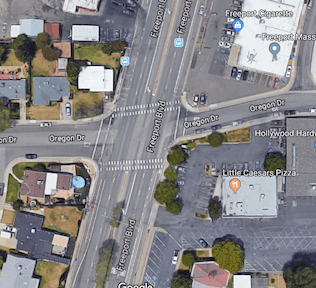
Freeport-Oregon.pngAs you can see to the right, at the intersection of Freeport and Oregon, there are residences to the west and businesses to the right. There are signalized crosswalks about 700 feet to the north and about 700 feet to the south, but walking to either of these adds a one-quarter mile walk. Is this reasonable or not? It could be argued either way, but to discount it as Mr. Moore did demonstrates bias against pedestrians. The Google Map photo is from before the removal of the crosswalk.

The suggestion that nearby intersections are safer is also questionable. At the intersections of arterial roads, which Freeport and Fruitridge to the south are, drivers routinely fail to yield to pedestrians in the crosswalk on right turns. That is in fact why many walkers prefer to cross away from major intersections.

Common estimates of the expense of a HAWK signal (High-intensity Activated crossWalK) are $100,000, not $500,000. $500,000 is the cost of a fully signalized intersection. So Mr. Moore’s $500,000 number is a straw man meant to deflect criticism by saying the solution is more expensive than it really is.

There are solutions to this particular problem, and to the removal of crosswalks in general:

  1. The city should be required to perform a complete traffic study before removing any crosswalk. The city is always saying that they have to do traffic studies before anything can be done to change traffic flow, so I would presume that doing a traffic study in this situation would be a no-brainer.
  2. If the traffic study indicates that the crosswalk is unsafe, then the next step is to design a solution or options, with a funding estimate, and then go to city council with a request for the funding.
  3. The city council would have to hold a hearing, either as part of the regular city council meeting or as a separate meeting, to gather public input on the removal. If the city council then makes a decision not to expend the funds to create a safe crossing, the crosswalk can be removed.
  4. If a crosswalk is removed, the city would be required to post informational signing at that location with distances to the nearest safe crossing in both directions, so that pedestrians can make informed decisions. The signing would have to stay in place for at least two years.

Anything short of these actions makes the city engineers both morally and legally responsible for any fatalities or severe injuries that occur at the site of a removed crosswalk.


bike share racks controversy

I attended the SACOG Transportation Committee meeting yesterday. Item 7 on the agenda, JUMP Bikeshare Contract Amendment, generated the most heat and most discussion of any item. The item would increase the amount allocated to the program by $48K. It was not the amount so much as the implications for bike racks that was controversial. The increase was to cover the difference between the cost of a shift from mostly corral racks, which had previously been specified, to JUMP “wave racks” (this is not the traditional meaning of wave rack) that were now being envisioned. Some of the exist Tower Bridge Bike Share Preview bike racks are of the corral type. The Santa Monica Breeze bike share racks are of the wave rack type. I can’t remember what the other SoBi systems have. Photos of each type are below, corral rack first and wave rack second.

Though the JUMP bike share system bikes will be owned by JUMP and operations are completely private, the rack capacity needed to make the system work are the responsibility of the three cities and the SACOG-led consortium. This is particularly so since Sacramento asked for a dock-optional system rather than the dockless system that JUMP is operating in San Francisco and Washington DC.

The City of Sacramento wants more of the wave racks to ensure that the bike share racks are not taken up by private bikes, making it impossible to park the JUMP bikes at the hubs. This is a reasonable concern in that Sacramento has far too few bike racks in most areas, and the bike share program will not install enough to overcome that deficit. However, many people on the committee questioned why an investment should be made in propriety racks when more racks are needed for everyone. The motion to recommend to the board was not passed, but a recommendation for the SACOG board to consider this issue was agreed to.

There was additional controversy about the JUMP bikes being assist-limited to 15 mph, though they are designed as legal class 1 electric bikes that can assist up to 20 mph. The other two cities apparently do not agree with this limitation.

There was also quite a bit of discussion of how alternative systems being implemented by Rancho Cordova and Folsom, and possibly other cities in the region, the dockless LimeBike, will affect or be affected by the JUMP systems and their bike racks. West Sacramento is permitting LimeBike Lime-E, an electric razor scooter type. I did not catch when that will go live.

Bike share open house

I attended the bike share open house hosted by the City of Sacramento last night. There were as many people representing partners and consultants as members of the public, and I did not see any low income or people of color. SACOG staff were present, as SACOG is the sponsoring agency for the bike share program, staff from Toole Design Group which is managing planning and selection of bike rack locations, and staff from JUMP, the selected bike share vendor.

Some things to report:

  • Rollout date is between the middle of May and the end of June.
  • There will be 900 bikes total, about 600 in the City of Sacramento and the remainder in West Sacramento and Davis.
  • The bikes will be limited to 15 mph, even though they are designed to operate at up to 20 mph. Under state law, Class 1 bikes can operate with pedal assist up to 20 mph, but a decision was made to limit them based on (probably misplaced) safety concerns.
  • The service area is considerably larger than the pilot Tower Bridge Bike Share, a very positive sign. You can see the boundary at http://wikimapping.net/wikimap/SACOG_Bikeshare.html, and add suggestions while you are there. Scroll to the left to see the Davis section. The open house had a large paper map for the same purpose.
  • There will be some sort of discount for low income people using the system, probably the JUMP Boost program, which is a $5 membership the first year, and $5/month thereafter, for 60 minutes of ride per day. In Sacramento, the eligibility might be based on SMUD status. At least initially, the only other option will be the standard $2 for the first 30 minutes and $2/hour after that, prorated. Other types of membership or charge may be implemented later.
  • Nearly the entire service area in Sacramento is moderate and high income, with just a small area in neighborhoods south of Broadway and around Power Inn being included. The city doesn’t have a plan yet for how to reach out to these potential users, and others not included in the boundary.
  • Bike racks will be provided in a quantity of at least two per bike in the system, so 1800 rack spaces. The use of these racks will be discouraged for other bicycles, in order to keep the spaces open for the bike share bikes. Bikes will be required to be parked at these hubs or stations at the termination of the ride, though they can be put on hold (with the meter running) at any other location. Leaving a bike away from a hub incurs a fee of $2, the same as the current SoBi system. Popular and busy locations will have multiple racks, while other have fewer, or one. Many or most of the locations, particularly outside the central city, do not have bike racks yet, so these will be added by JUMP before rollout. The user agreement requires that bikes be locked to a bike rack, not to other objects or left free-standing. It is not a dockless system.
  • JUMP has designed charging racks where a parked bike will charge. Larger locations will have some of these charging racks, though it is not clear if they will be installed at rollout.

There are two additional open houses scheduled, both in Davis. Friday, March 2, 11 to 1 at UC Davis bus terminal, and Saturday, March 3, 9:30 to 1 at the Davis Farmers Market. These will be less formal, and will offer the opportunity to ride the JUMP electric bike.

Complete Streets aren’t

The Complete Streets movement, now 13 years old and with a newly released criteria for evaluating policies, is considered by some to be a success. Not by me.

There are two gaping flaws in the complete streets concept, that after all this time have not been addressed:

  • Who is responsible for sidewalks?
  • How close should safe crossings be?

Sidewalks: On the first issue, responsibility for sidewalks, most cities and counties (not all) have code that makes sidewalk maintenance the responsibility of the adjacent landowner. This includes repair and snow removal. Most cities have some money set aside to repair sidewalks, but only a tiny fraction of what is needed for the huge backlog of deteriorated sidewalks. A very few cities also clear sidewalks after snow. Sidewalks are every bit as much of the transportation network as travel lanes and bike facilities, but most places wash their hands of this reality and this responsibility, pushing it off to others. It has been pointed out that few cities and counties have the funds to also take care of sidewalks, but that is exactly the point. If we allow cities and counties to prioritize cars over walking, they will continue to do so.

How does complete streets play into this? It doesn’t. Complete Streets set no expectation that cities and counties will maintain their sidewalks. In the new policy rating documents, the word sidewalk only shows up twice, neither in this context. Even a search of the Complete Streets website only mentions sidewalks in relation to case studies and model projects. Fortunately, a few places do much better than just have a policy, but the Complete Streets movement does nothing to encourage this.

ElCamino-eb
El Camino complete street, 0.3 miles to the next safe crossing

Crossings: the second great weakness of the complete streets movement and Complete Streets documents is the lack of attention to frequent safe crossings. The new criteria does not mention crosswalks or crossings. The illustrations of a complete street often show an intersection with high visibility crosswalks and sometimes curb extensions to increase visibility and shorten crossing distance. But other illustrations show long distances along a “complete” street, with the next safe crossing often not visible.

In the Sacramento region, every complete street project along arterials has added sidewalks and bike lanes, but none of them have added safe crossings. In fact, several of them have removed crossings. If a busy street is hard for walkers to cross, they won’t cross it. They will either drive, or just avoid the other side of the street. So that fancy complete streets project, with the wonderful looking wide sidewalks, does not serve the very people it is claimed to serve. People need to be able to cross any land all Streets in a safe crossing at an interval of no more than 1/8 mile. The grid in downtown Sacramento is 1/12 of a mile. Few places in the suburbs are less than 1/4 mile, and many are 1/2 mile. To me, this is unacceptable. I would think a complete streets policy would address this distance between safe crossings issue as being key to walkability. Again, the Complete Streets movement ignores this issue.