Sac kill those sharrows on I St

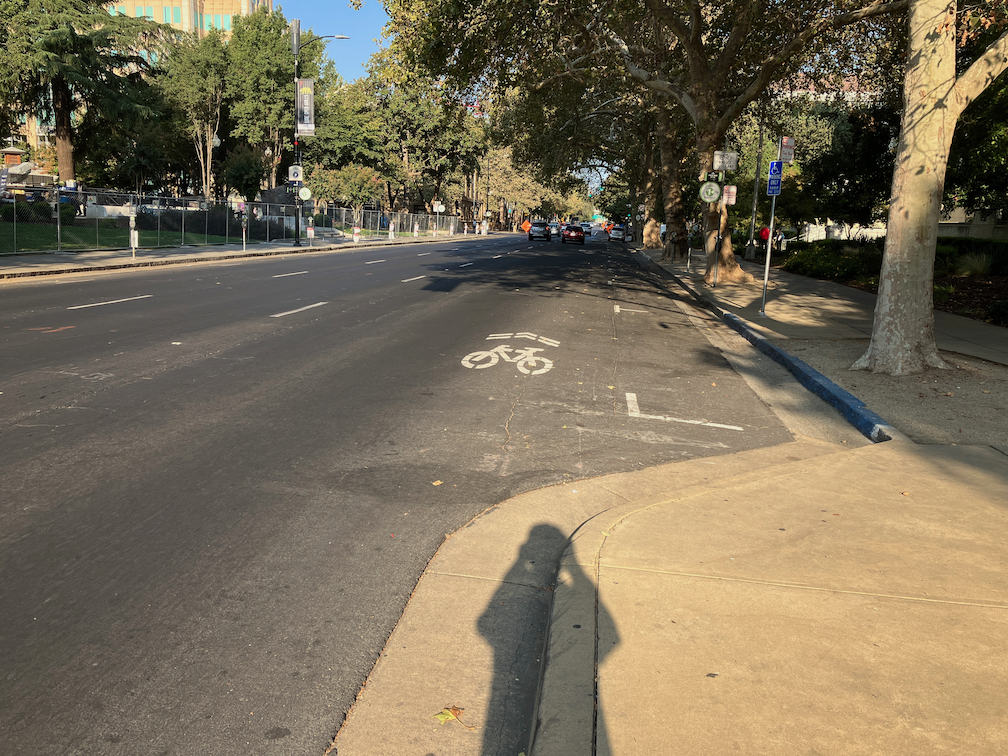
Next sharrows location to address is I Street between 10th Street and 9th Street. The bike lane present to the east disappears in this block, with Cesar Chavez Plaza on the south and Old City Hall on the north, before picking up again west of 9th Street. Not having my tape measure out (and I’d have to measure late night when there is no traffic), it isn’t clear why this one block does not have a bike lane. It may be that the curb extension is too wide, or it may be that the general purpose (car) lanes are not configured correctly. If lanes, then it is an easy problem to fix, just re-stripe the lanes and add a bike lane. If the curb extension, then that would require a bit of infrastructure work. I fully support curb extensions, nearly all intersections should have them, but in some places the city has installed them incorrectly and caused issues for bicycle facilities. This is not, as many places are, a case for removing parking, but for designing the street correctly. Of course ultimately there should be no three-lane one-way traffic sewers in the city, and right of way should be reallocated to a separated (protected) bikeway and wider sidewalks.

I St westbound at 10th St, sharrows, Sacramento
I St westbound at 10th St, Sacramento

Caveat: I post about issues in the central city because I live here, and see the problems every time I am out walking or bicycling. However, I strongly believe that the city should be focused on solving issues in lower income, disinvested neighborhoods, of which there are ample throughout the city. The central city has received more than its share of bike facilities.

Sac kill those sharrows on H St

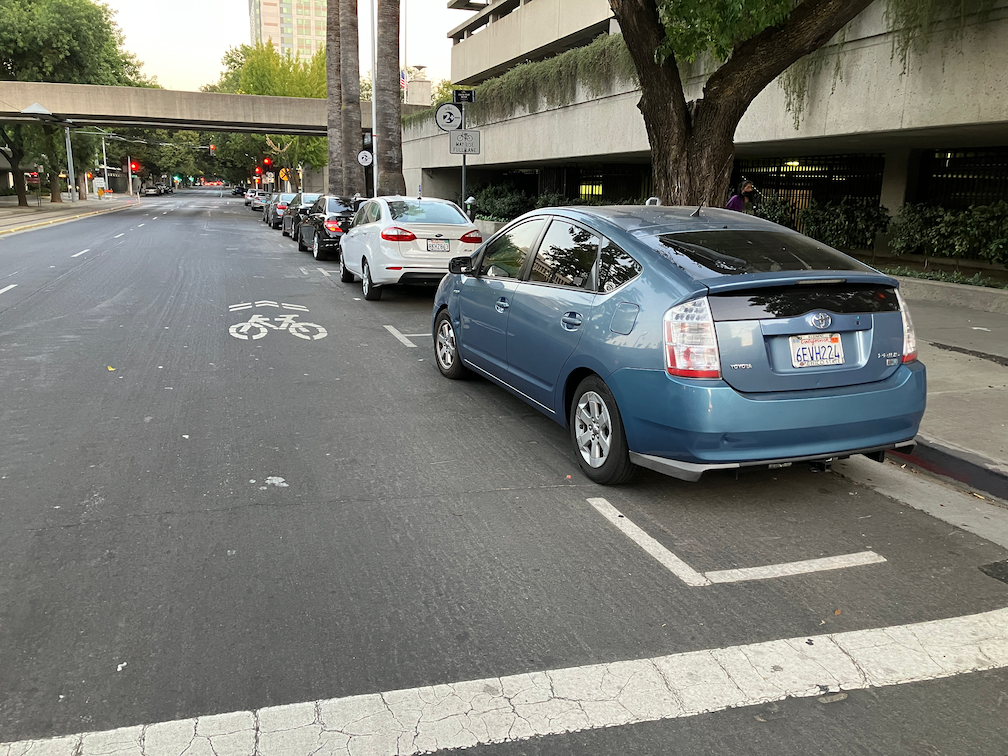
The block of H Street between 7th Street and 8th Street in downtown Sacramento has shadows instead of a bike lane. There is a bike lane in the preceding block, and in the block past, but not this block. Why? Because on-street parking has been preserved on this block in preference to bicycle facilities. The right lane lane is marked with a sharrow. Not a properly placed sharrow, but one in the door zone of the parking lane. When shadows are used, they should be placed in the center of the travel lane. But rare is the situation in which they should be used at all. Research indicates that sharrows are less safe than no markings are all, less safe than marked bike lanes.

So why is this parking here at all? No reason whatsoever. On the north side of this block is a County of Sacramento parking garage. There is even a pedestrian bridge between the parking garage and the Sacramento County administrative building on the south side of H Street, as seen in the photo.

I am certain that all of these cars belong to county employees or contractors. They should be parking in the garage, and this parking should be removed so that at least a marked bike lane can be placed in this block. Of course H Street should have a separated bikeway from 6th Street, Sacramento Valley Station, to 16th Street, where it becomes two-way. But a Continous painted bike lane is at least a first step.

There are a number of locations in the central city where bike lanes are dropped for a block in favor of parking and travel lanes. Every single one of these should be fixed either by the removal of parking or a general purpose lane.

Caveat: I post about issues in the central city because I live here, and see the problems every time I am out walking or bicycling. However, I strongly believe that the city should be focused on solving issues in lower income, disinvested neighborhoods, of which there are ample throughout the city. The central city has received more than its share of bike facilities.

Sacramento bike share update

There are a number of new white and green Lime bikes on the street in Sacramento. There are not the easy-to-steal white and green ones of a few months ago, some of which were promptly stolen and the others quickly pulled from service. Though they still seem to be called Gen 4 bikes, they now have a cable lock very similar to those used on scooters. I have seen more of these bikes downtown/midtown than elsewhere. See photo.

Lime bike cable lock

There continue to be red JUMP/Lime bikes on the street. I had the impression that there were fewer of these bikes than there used to be, but it may be that they are just being distributed differently. I’ve seen racks (the old SoBi/JUMP racks) full of these bikes, which had not had more than one or two bikes since the return of bike share. Lime does not make its GBFS (General Bikeshare Feed Specification) available to the public, nor does it have a map of bike share other than in the app, so it is difficult to say whether the bikes are being appropriately distributed/balanced.

While looking to see if there was a web map, I ran across an interesting ArcGIS Story Map from the City of Sacramento, Shared-Rideables in Sacramento. It was created in January 2022, and has not been updated, but is quite interesting.

Lime still seems to be failing to track and pick up dead bikes. By dead, I mean that the battery has run down to the point that it no longer powers the GPS unit, so Lime loses track of where these bike are. Several months ago there were a number of these bikes, reported to both Lime and the city, but not picked up after three weeks. Lime promised to me and to the city to do better. However, recently there were two bikes parked on the pathway from Sacramento Valley Station to the platforms for more than five days. Bike parked anywhere other than in very visible location on the street network do not get picked up for significant periods of time.

I used a Lime bike (white and green) Saturday without incident, returning from a trip. But on my outbound trip, using Lime/JUMP bikes, when I was on a tight schedule, I had no luck finding a bike that worked properly. The first one was stuck in first gear. The second had no pedal assist. The third had a jammed seat post that could not be adjusted. I managed to make the train on time, but barely. The bikes are simply not being maintained as they should be. I have noticed that if I report a problem, though the app, the bike is still there days later, and still rentable by another victim.

When reporting a bike problem, the app provides a limited number of issues (below), and no longer provides a text field for entering detail. The diagram says pedals, but there is no indication here or anywhere whether than means a problem with the pedals or cranks, or means problem with the pedal assist.

Lime app, problem report screen

One feature that was added to the app a few months ago that I really like is that the user can select scooters only, or bikes only, or both, for map display.

The app seems to show whether the bike in question is one of the new white and green ones or the older red Lime/JUMP bikes with the fabric covered locking cable. I’ve said before and will say again that it was a mistake for JUMP to drop the U-bar lock mechanism used on the SoBi and early JUMP bikes. So far as I know, a properly locked bike with U- bar was never was stolen.

Sacramento and sidewalks

The draft City of Sacramento Climate Action Plan (CAAP) section MEASURE TR-1: Improve Active Transportation Infrastructure to Achieve 6% Active Transportation Mode Share by 2030 and 12% by 2045, includes the performance indicator “Deploy 20,000 feet of new/repaired pedestrian infrastructure by 2030”. The final CAAP will become part of the city’s 2040 General Plan.

This is less than four miles of sidewalk repair. The city has approximately 2300 miles of sidewalk. At this rate, 8 years to repair 4 miles of sidewalk, it would take 4600 years to address the sidewalks in the city. What does the city intend instead? That private property owners repair sidewalks, even though the sidewalks and the land they sit on belong to the city (in most cases, though some wider sidewalks in the central city are a mix of city and private). From the city’s Sidewalks, Curbs & Gutters page:

Q: Isn’t it the City’s responsibility to maintain the sidewalk? Isn’t it public property?

A: The sidewalk is in the City’s right-of-way. However, California Streets and Highways Code sections 5610 through 5618 allow cities throughout California to require property owners to maintain the sidewalks in front of their property. Sacramento City Code section 12.32 sets forth the City’s procedures under these sections.  Sacramento is not the only city to require sidewalk repairs to be the property owner’s responsibility. However, curb and gutter maintenance is the City’s responsibility. As the property owner may bear civil liability for a person suffering personal injury or property damage caused by a defective sidewalk: it is in the property owners best interest to maintain the sidewalk and reduce the risk of a lawsuit.

Note the word ‘allows’. Nothing requires that the city shift the burden of sidewalk maintenance to private property owners. The city has simply decided to do so, so that it may shift responsibility of a critical part of the transportation infrastructure off the city and onto adjacent property owners (so that it may spend more on roadway capacity expansion, in case you were wondering). Though it would make sense to require property owners to repair sidewalk damage from root heaving due to trees on private property, it is ridiculous (and criminal, in my opinion) for the city to demand that private property owners repair sidewalks when the trees are in the city-owned sidewalk buffer area. This is the sort of action one would expect in a dictatorship, forcing citizens to take on individual responsibility for city actions.

See previous posts: Walkable Sacramento #4: sidewalks and whose responsibility are sidewalks?.

public restrooms are a transportation issue

Car drivers can zip between places with restrooms. Bicyclists, to a lesser degree. Transit users and walkers, not at all. This is a transportation issue. If people cannot find restrooms, they can’t make their way through the city. They can’t afford to wait at a transit stop for a transfer. People with urinary issues (count me among them) have to plan carefully around not just their movement, but around restroom access. A city without public restrooms is a city that biases transportation against walkers and transit users, and in favor of vehicle drivers. Access is denied to an entire class of citizens.

In Sacramento, public restrooms are scarce. Cesar Chavez Plaza downtown has a Portland Loo type restroom, but it took years to get it done. So far as I know, there are no plans for additional locations.

Cesar Chavez Plaza restroom Portland Loo model

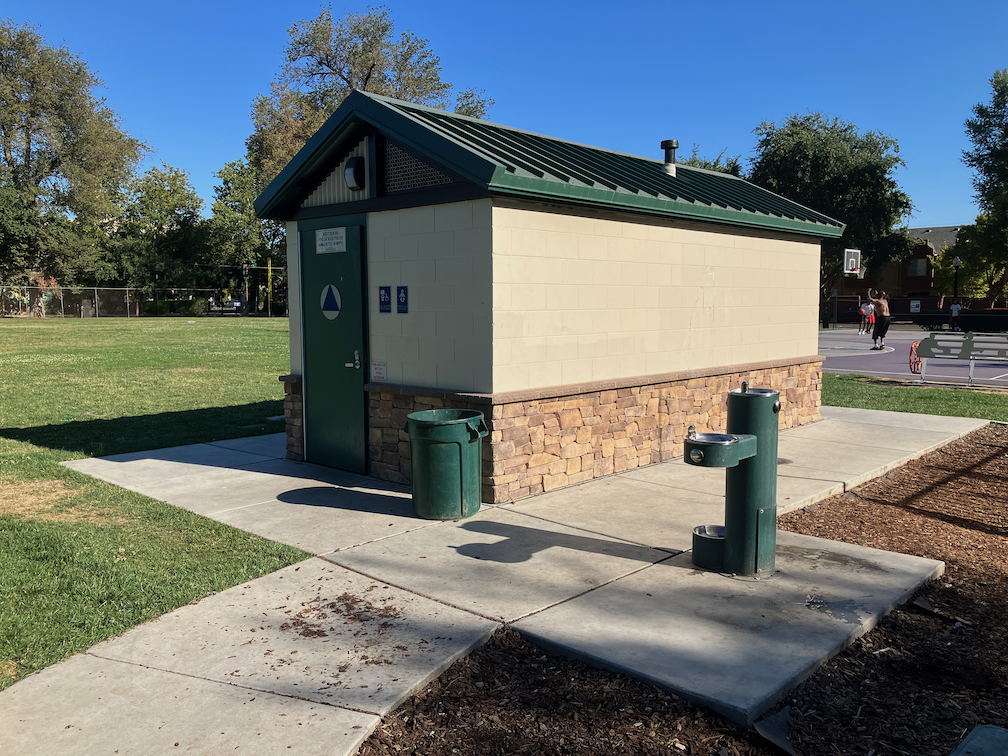
Roosevelt Park downtown has a new restroom, replacing the old one. There are two single-use, all-gender units, which is the current trend and probably much better than the older multi-user, gendered restrooms.

Roosevelt Park new restroom

The restroom in Fremont Park, right across the street as I type, has been closed for years, and despite the sign, is never open during events. Porta-potties are used for events at this park.

Fremont Park restroom closed

I have not traveled to all the city parks to see which restrooms are open, which are open but with limited hours, and which are closed, but my impression is that about half the park restrooms in the city are closed. The city has a GIS map of park restrooms, but no indication of whether the restrooms are actually open or not: https://data.cityofsacramento.org/datasets/b9e7fa6d1d104833b3f04268d7f682dc_0/explore. Park restrooms are valuable for walkers, but very few are located on transit routes.

There are no public restrooms at transit hubs. No restrooms where people are waiting for the next train or next bus. The next bus, at transfer points for low frequency routes, can be quite a long wait, up to 45 minutes assuming the buses are on schedule. Even at Sacramento Valley Station, where a number of modes converge, you can only use the restroom by showing an Amtrak train ticket. Using light rail or bus, or just walking or bicycling, you are out of luck. (Note: Many people assume that Amtrak or Capitol Corridor owns the train station, but it is owned and managed by the city.)

Some light rail stations and a few bus stops have restrooms for the transit operators, but not for the public.

The city should:

  • re-open or replace all park restrooms, within two years
  • install public restrooms at every city park which does not currently have them; this would include Muir Children’s Park, Grant Park, Winn Park, and several others
  • install a public restroom at the bus layover point on L St & 14th St
  • install a public restroom at the 16th St light rail station (where the Gold Line and Blue Line diverge, and the most used transfer point)
  • install a public restroom at 7th St & Capitol Ave light rail station (where the Blue Line, Gold Line and Green Line diverge; the 8th St & Capitol Ave stop is a block away)
  • identify locations throughout the city where walkers and transit users congregate, and install public restrooms there

You might wonder why I’m asking the city to install transit restrooms rather than SacRT. The reason is that I see it as the responsibility of the city to provide restrooms everywhere they are needed, not of the transit agency, though of course the projects could be joint projects.

keep Sacramento N St narrowed

Note: As is not unusual, I had forgotten that I’d written about N St before: N Street bike route to cycle track, 2015. Seven years have passed, the city has taken no action.

The construction for the Capitol annex project has narrowed N St to two lanes eastbound, from 10th St to 14th St, and parking has been removed from the south side to shift the lanes over. Now is the time for the City of Sacramento to implement its long-delayed (if not deep-sixed) plans for re-allocating space on N St. There have been ongoing utility projects over the last few years that have narrowed N St to two or even just one lane. At no time did that create significant congestion, during the pandemic or before the pandemic. I live two blocks from N St, and both travel along it and cross it frequently. I’ve never seen more than momentary congestion, in 11 years. What that means is that N St, in its three-lane configuration, has grossly excess capacity for motor vehicles.

While the street has been narrowed is the time to redesign the street so that it has no more than two general purpose lanes, and has a curb-protected or parking-protected bikeway. Probably on the left. This is in fact the perfect setting for a separated bikeway, five blocks from 10th St to 15th St with no intersecting streets from the north side, which is Capitol Park.

It is true that the sidewalk on the north side of N St is a designated bikeway, so bicyclists may use the sidewalk to avoid riding in the street. But bicyclists on the sidewalk are often in conflict with people walking on the sidewalk. The sidewalk has pretty continuous use by walkers, particularly during the lunch time – walk time for state workers, but a lot of people also include a circuit of the Capitol Park on their runs and walks. This conflict is easy to solve: create a safe, welcoming, protected (separated) bikeway on the street. And do it now!

On N St eastbound, the leftmost lane is a designated left turn lane at 10th St, which is what makes possible the two-lane configuration beyond 10th St. As a temporary measure, this works well, and forcing turns off three lane streets is a good solution for so many overbuilt arterials roads in Sacramento, but here it is only temporary, and would be obviated by the conversion of all of N St from 3rd St to 15th St. N St becomes a two-lane street at 15th St, and then becomes a two-way street at 21st St. N St from 15th St to 21 St would probably be a good candidate for a separated bikeway as well, but with paint bike lanes existing, would be a lower priority.

Below is a StreetMix sketch of what N St might look like. Note that the width of the street and the elements are estimated, not measured. I don’t believe parking is needed on both sides, but the diagram shows it for people who think it is necessary. Left side is north, Capitol Park in this case, and right side is south, mostly state buildings.

N St Sacramento between 3rd St and 15th St

As a reminder, I feel strongly, and it is backed up by evidence:

  1. Three-lane streets are significantly less safe than two-lane streets, primarily for the muli-lane threat (one vehicle stops for walkers and the others do not). They are also a clear sign of poor land use planning, which puts residents and the things they need to reach (jobs, stores, recreation and entertainment, medical, etc.) far away. Narrowing all such roadways in the city from three to two, or less, would increase safety, increase livability, and encourage people to make different choices about where they live and visit. Maps of collisions (vehicle vs. vehicle, vehicle vs. walker, vehicle vs. bicyclist) align almost perfectly with overbuilt arterials.
  2. One-way streets are significantly less safe than two-way streets, for the same multi-lane threat, and because there isn’t any friction to slow drivers. However, I think that the only valid argument for one-way streets is to accommodate separated bikeways, bus lanes, or rail transit. That may be true of N St.

And, sorry, can’t resist, get rid of the worthless palm trees while they are at it. We need shade trees, not poles.

Lime fails on bike share

Below is a photo of a Lime/JUMP bike that has been abandoned for three weeks now, parked on my street, P Street, between 13th St and 12th St. It has been reported to the city, twice, and to Lime, three times. And it is still there. Of course the battery has depleted so that GPS no longer works. But Lime knows the last reported location of the bike, before it died.

Let me be clear and blunt. Lime does not give a shit.

This kind of neglect will continue until: 1) the city (and SACOG) holds Lime accountable for managing the bike share fleet, 2) the city or the region gets a real bike share operator, or 3) the city or the region changes to a publicly owned system. The third option is probably the best, because then the city and/or region can manage the bike share system as part of the transportation network, and SacRT can take on some responsibility for the bike share system as a first mile/last mile solution with transit.

Land Park open (car free) roads?

With the exciting news that the closure of a part of JFK Drive in Golden Gate Park will remain permanently closed to private vehicles. This closure was made to provide safe open space during the pandemic, and is only a small portion of the roads in the park. Most of the people who live in San Francisco support this closure to cars (opening to walkers and bicyclists), and most of the people who visit the park from elsewhere (which includes me) also support.

People have started talking about Land Park in Sacramento. I was certainly not the first. This has been an ongoing conversation among advocates for walking and bicycling for years, but it never turned into a movement. Maybe today is the day.

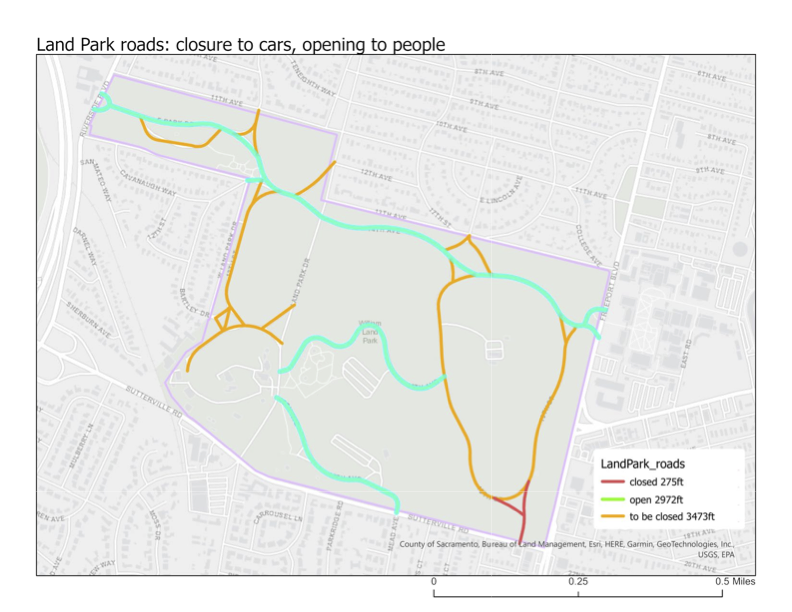
Below is my (modest) proposal for closing some of the roads in Land Park to private vehicles (pdf). There is a small existing closure, of the roadway in from the southeast corner of the park. It has gates that are permeable to bicyclists.

My proposal closes about 53% of the roads in the park, but leaves open roads that access important points such as Fairytale Town and the golf course (if that is important). It also leaves open an east-west route through the park, with ample parking along the roadside, for those who need vehicle access. People who drive are most likely to access the park from Riverside Drive, Land Park Drive, and Freeport Blvd; all those access points remain open.

Of course the use of the term ‘closed to cars’ is really an inversion. Roads that are closed to private vehicles are by nature open to walkers and bicyclists, and so are really ‘open’ to people.

So, what do you think? Constructive comments are always welcome.

a safe and effective transportation system

Many organizations and individuals are deciding to oppose the transportation sales tax measure being proposed for the November 2022 ballot in Sacramento County. The reasons for opposition are many, but previous posts here (Measure 2022) cover significant ones. If the measure does not qualify for the ballot, or does qualify and fails, what then are we to do for transportation? Below are some ideas for a safe and effective transportation system. They are not yet well organized or prioritized.

I acknowledge the contribution of Walkable City Rules by Jeff Speck to this list. If you haven’t read it, please do. I don’t agree with everything he says, but it is the best prescription for correcting our transportation system and healing our cities that I know of. See also Measure 2022: the path not taken.

The realities of climate change and social justice demand a radical redesign of our existing transportation system and radical shift in transportation policies and investments. More of the same, with slight improvements, as the sales tax measure suggests, will not serve our needs now or in the future. See also our racist and classist transportation system.

General

  • all projects must contribute to or be neutral in reaching regional (SACOG) and state goals for reducing VMT and GHG (vehicle miles traveled, greenhouse gas emissions)
  • travel modes will be prioritized as: 1) active transportation (walking and bicycling), 2) transit, and 3) motor vehicles

Equity

  • sales taxes are regressive, and will not be the default mechanism for funding transportation projects
  • travel needs of people who don’t or can’t drive (children, elderly, disabled, choice) will receive at least the same concern and investment as those who do drive
  • at least 60% of transportation investments must serve formerly underinvested communities
  • transportation projects will be selected and designed to meet community needs previously expressed through community engagement; projects will not be selected by transportation agencies or employees
  • anti-displacement measures will be included in all transportation projects
  • no investments will be made in transitioning motor vehicles from fossil fuels to electric or hydrogen, except where formerly underinvested communities need supporting infrastructure; transitioning vehicles away from fossil fuels merely maintains motor vehicle dominance of our transportation system
  • all projects over $10M will require a health impact analysis
  • agencies will educate the public about H+T (housing and transportation) costs as a measure of housing affordability

Policies

  • roadways will be maintained in a state of good repair to serve all travel modes
  • transportation planning will be integrated with land use planning
  • only agencies that acknowledge and plan around induced travel demand will receive transportation funding
  • all transportation agencies must implement a robust complete streets policy which includes frequent, safe crossings of roadways and speed reductions
  • congestion pricing will be considered as a solution in all dense urban areas, to reduce motor vehicle travel and to fund transportation projects; pricing will be based at least in part on vehicle weight, value or emissions
  • cities and counties will not accept responsibility for maintaining local roadways in new developments; therefore, new development must establish reserve accounts to cover ongoing maintenance

Vision Zero

  • all transportation agencies must establish and implement Vision Zero policies in which redesign of roadways is a preferred action
  • at least 25% of transportation funds must be spent on Vision Zero projects
  • all roadway fatalities will be analyzed using a safe systems approach, with required change to the roadway design or use to prevent future fatalities

Roadway Design

  • implement 10-foot or less travel lanes whenever a roadway is repaved; remove striping from local streets
  • all new developments will require a grid street system of one-eighth mile so that the need for arterials and collectors is reduced
  • consider all right-turn-only and left-turn-only lanes for elimination
  • eliminate slip lanes everywhere
  • require signal cycles to be 90 seconds or less
  • eliminate level-of-service (LOS) in transportation planning
  • conversions of one-way streets to two-way streets will be funded; one-way one-lane streets will be considered an acceptable design for local streets and central cities
  • overly wide roadways will be reduced, with unneeded right-of-way returned to adjacent property owners or sold for infill housing
  • rougher pavements such as brick will be considered whenever slower traffic speeds are desired (but crosswalks will be smoother than the pavement)

Traffic Enforcement

  • wherever possible, automated enforcement will be used to enforce vehicle code that protects vulnerable users, rather than direct enforcement by law enforcement officers
  • violations which to do not threaten the safety of other roadway users will be de-prioritized or removed, with reduced fees if maintained
  • temporary or permanent vehicle confiscation will be used for egregious violators of vehicle codes
  • cities and county shall have the authority to do city-wide and county-wide reductions of posted speed limits, with or without corresponding changes to roadway design; redesign is of course preferred

Parking

  • all on-street motor vehicle parking in urban areas will be charged, either through curb metering or though flat fees
  • parking fees will be used to:
    • cover the cost of providing on-street parking construction and maintenance, and parking enforcement
    • improve transportation and economic vitality within the neighborhood that generates them, and therefore will not go into the general fund
  • parking minimums will be eliminated
  • de-couple parking from rent so that car-free renters are not subsidizing renters with cars
  • parking will be managed to maintain a level of availability on every block (similar to the Shoup 85% rule)
  • removal of on-street parking for higher uses such as active transportation, dining, and community spaces will be supported; however, removal of a travel lane rather than removal of parking is preferred
  • remove parking upstream of intersection corners to ensure visibility (daylighting); not needed when curb extensions provide the visibility
  • parking lanes/areas will be maintained to a reduced and less expensive level than roadways

Freeways

  • freeway removal, reduction, or decking will be considered for all freeways
  • new interchanges must be 100% paid for by private development
  • in urban areas, reconnect street networks over or under freeways at no less than one-half mile intervals, and provide pedestrian and bicyclist connections at no less than one-quarter mile intervals
  • managed lanes must be converted from general purpose lanes, not created through capacity expansion

Transit

  • transit performance measures will be developed, with a tentative goal that 80% of the population is served by 15 minute or better frequency bus or rail service, within one-half mile, for at least 15 hours per day on weekdays and 12 hours per day on weekends
  • transit will not be used as a mitigation for roadway expansion or induced motor vehicle travel; transit is a desirable mode in and of itself
  • transit will be funded to at least the equivalent of one-half cent of sales tax
  • dedicated bus lanes or bus rapid transit (BRT) design will be implemented on all high ridership bus routes
  • transit agencies will have flexibility to allocate funds between capital, maintenance, and operations, based on established criteria
  • metered freeway on-ramps serving four or more regular (non-commute) buses per hour will have bus bypass lanes

Sidewalks and Crosswalks

  • sidewalks will be considered an integral part of the transportation network, and therefore maintained by transportation agencies rather than property owners, except where trees or work on private property impacts the sidewalk; buffer strips in which trees are planted will be considered public responsibility
  • sidewalk infill will be considered a primary use of transportation funds, with at least 60% going to formerly underinvested neighborhoods
  • sidewalks with driveway ramps that slope the sidewalk crosswise will be replaced with continuous flat sidewalks, or the driveway eliminated
  • all traffic signals that have a pedestrian signal head will be programmed with a leading pedestrian interval (LPI) of at least 3 seconds
  • required pedestrian-activation will be eliminated (buttons to trigger audible information are acceptable); pedestrian auto-detection will be considered
  • raised crosswalks or raised intersections will be the default design for all reconstructed intersections
  • all crosswalks will be marked, with the possible exception of purely residential areas
  • pedestrian crossing prohibitions will be analyzed and eliminated where not strictly necessary for safety
  • curb extensions, the width of parking lanes and designed to not interfere with bicycling, will be installed whenever intersections are modified or reconstructed

Bicycle Facilities

  • bike facilities on any roadway with a posted speed limit over 30mph must be separated (protected) bikeways
  • bike facilities on any roadway with a posted speed limit over 40 mph must be separated from the roadway
  • roadway design will be used to make bicycle facilities unnecessary on low speed streets
  • design and implement low-stress bicycle networks
  • prioritize filling gaps in the bicycle network
  • re-stripe or re-design roadways so that bike lanes or separated bikeways are not dropped at intersections
  • bike share, and possibly scooter share, will be supported with transportation funds
  • secure, on-demand bicycle parking will be provided at common destinations; bicycle racks will be provided at common destinations and on every block in urbanized areas

Schools

  • school districts will have the authority to close roadways fronting the main entrance to a school, during arrival and dismissal times, in order to increase student safety and protection from air pollutants
  • Safe Routes to School programs or similar will be supported by transportation funds at the local level
  • school districts will be prohibited from building new schools at locations which are not easily accessible via active transportation or transit
  • school districts will prioritize neighborhood schools over magnet schools, in order to reduce travel
  • school districts will develop policies that allow neighborhood schools to remain open under declining enrollment
  • school districts will be responsible for the same transportation demand management requirements placed on any other entity

Thank you if you read all the way through. I realize some of these are radical ideas, but radical ideas make space for more reasonable ideas provided by others. That is part of the purpose of this blog.

and bike lane blockages

Here is one example (of many) of a bike lane blocked by construction, on J Street between 10th Street and 11th Street in Sacramento. There is a major construction project on the south side in the eastern half of the block for a new apartment building. I’ve written about this issue before: J Street needs construction bypass. As construction progresses, the barriers around the site have moved closer to and further from J Street. The last time I was there, only the parking lane (and of course sidewalk) was blocked, but today, the bike lane is blocked again.

J Street bike lane pinches out at construction barrier

There are no signs along J Street warning of the closure ahead, and there is no ‘share the road’ sign. The commonly used, but not official MUTCD or CA-MUTCD, ‘bicycle share the road’ sign is below. This is, at minimum, the sign that should be installed here.

The solution is to either get the construction company to pull the barrier back from the street, returning the bike lane to function, or for a bike lane to replace the right hand travel lane. Since the sidewalk is also blocked, the accommodation can also serve walkers. As you can see from the photo, the left hand general purpose lane is already blocked for a utility work project. That would result in one lane for an unknown period of time, though the utility project seems to be going fairly quickly and might be done within a couple of weeks or less. The city should do a better job of scheduling construction projects so that they aren’t going on both sides of a busy street at the same time!