Rolling the right on red

An article in the Sacramento Bee today by Tony Bizjak (Back-Seat Driver), Lawmaker challenges California’s $500 fine for right-turn violations, talks about the infraction of not stopping on red before turning right, and whether the fine is appropriate. The article invited people to comment. I’ve written several times about what I think about stop signs, so what I’m writing here is just about traffic signals.

My first reaction is that the people favoring lower fines, or no fines at all, for this infraction are the many of the same people who go ballistic when a bicyclist rolls through a stop sign. This is part of a typical attitude that the things I do on the road are OK, but what other people do endangers me and the social order, and they should be treated harshly. This attitude does not recognize that laws are (theoretically) in place to reduce wrong behavior and not solely for the purpose of punishment.

California Vehicle Code (CVC) 21453 says:

(a) A driver facing a steady circular red signal alone shall stop at a marked limit line, but if none, before entering the crosswalk on the near side of the intersection or, if none, then before entering the intersection, and shall remain stopped until an indication to proceed is shown, except as provided in subdivision (b).
(b) Except when a sign is in place prohibiting a turn, a driver, after stopping as required by subdivision (a), facing a steady circular red signal, may turn right, or turn left from a one-way street onto a one-way street. A driver making that turn shall yield the right-of-way to pedestrians lawfully within an adjacent crosswalk and to any vehicle that has approached or is approaching so closely as to constitute an immediate hazard to the driver, and shall continue to yield the right-of-way to that vehicle until the driver can proceed with reasonable safety.

Read More »

Davis protected intersection

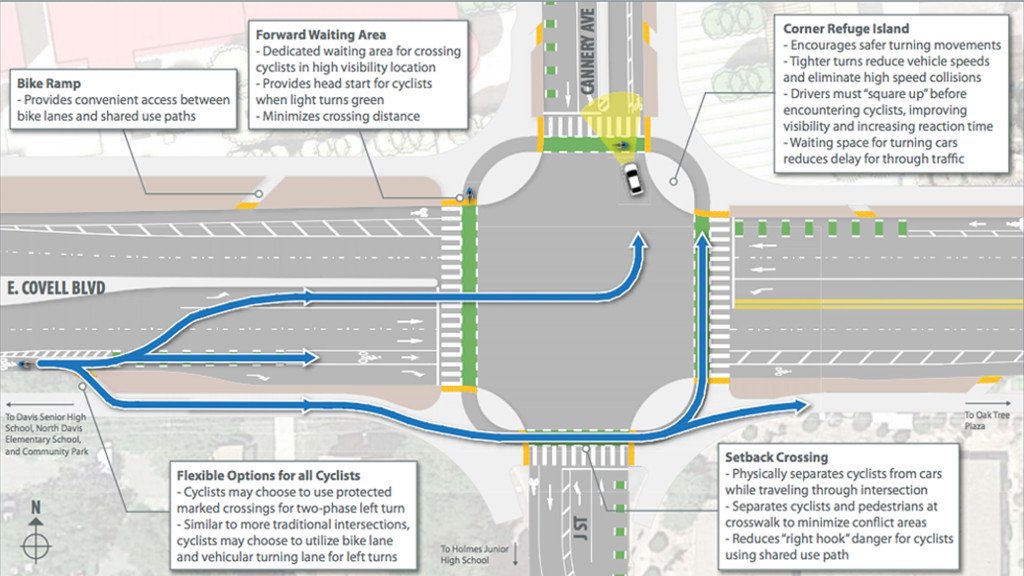
The new protected intersection in Davis, the first in the United States to open, has been in the news recently (#Damien Talks Episode 13 – The Davis Planning Department on the Bike Protected Intersection (Streetsblog), This California city just built the country’s first protected intersection for bikes (Vox), It Just Works: Davis Quietly Debuts America’s First Protected Intersection (Streetsblog), Davis Dutch intersection, first ever in U.S., unveiled with no drama (Davis Enterprise), and others). Though it did not initiate the movement towards protected intersections, which have long existed in some form in Europe, Nick Falbo’s Protected Intersection video has popularized the idea in the United States.

Yesterday I spent about an hour looking at the intersection. It was mid-day, so lightly used by bicyclists, pedestrians and motor vehicles. I might have a different impression at a different time of day. I was on my knee scooter, my current method of getting around, so acting as a pedestrian and not a bicyclist. The design is at the intersection of Covell Blvd and J Street/Cannery Row, on the north side of Davis. The intersection was revised because of the major new development north of Covell, The Cannery, which has recently opened but is still being developed. Some photos are on Flickr.

intersection diagram, from Davis Enterprise

With one exception (below), the intersection worked just fine for all modes. Most bicyclists were on Covell headed east or west, and they used the on-street bike lanes. I saw one person use the ramp up to sidewalk and back down, and one bicyclist use the design to turn left from Covell westbound to J southbound. No issues. I also saw a number of pedestrians crossing in various directions. No issues. The signal cycle is slower than it probably needs to be, but, again, that might be different during commute times.

Read More »

bicyclist collisions in Sacramento

This post complements my recent post on pedestrian collisions in Sacramento. Please see that post for details about data sources (SWITRS GIS Map in TIMS) and mapping.

The collisions mapped are:

  • Date: 01-01-2004 to 12-31-2012
  • Location: City of Sacramento only (no, I can’t explain why some are outside the city)
  • Victim role: Bicyclist
  • Victim degree of injury: Killed or Severe Injury
  • 143 collisions (the pedestrian collisions were 388)

The overall number of bicyclist collisions in the killed or severe injury category over this nine year period is low enough that patterns may not accurately represent hazardous roadways since a small number of collisions can significantly change the pattern.

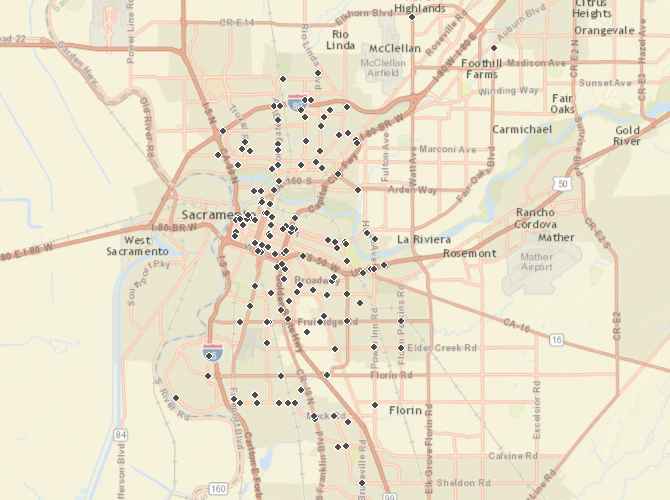
The first map, a point map of the entire city, shows:

  • the greatest density of collisions is in downtown/midtown, but there are certainly plenty in other areas
  • almost all collisions happen at intersections, not mid-block
  • almost all collisions are associated with major streets, called arterials and collectors, which are wide and high speed, intended to move motor vehicle traffic at speed rather than provide for multi-modal transportation
bicyclist collisions, City of Sacramento, killed or severe injury

Read More »

Rancho Cordova achieves bronze Bicycle Friendly

RanchoCordova_wayfinding2The City of Rancho Cordova was awarded bronze level status in the League of American Bicyclist’s Bicycle Friendly Community (BFC) program. Rancho is the first of the communities within the new Bicycle Friendly 50 effort, though Folsom had earlier achieved silver status.

The Bicycle Friendly 50 group, including 50 Corridor TMA and the city hosted two Traffic Skills 101 courses and a League Cycling Instructor (LCI) Seminar in 2014, training two city employees and a number of community members. An education program is one of the requirements for achieving BFC status.

Above is a wayfinding sign in Rancho Cordova, which seems to have installed more than other communities in the Sacramento region.

More Sac county nonsense

MUTCD-2012_Figure9C-7The Bicycle Detector Pavement Marking (CA-MUTCD Figure 9C-7, shown at right) is placed to show a bicyclist where to stop so that they can trigger a traffic signal. When installed properly, they prevent the all-too-common scenario where bicyclists cannot trigger signals and must either cross against the red light when a safe gap is available, or wait until a motor vehicle arrives. They are also a clear signal to motorists that there is a reason why the bicyclist is positioned where they are. Of course “bicycles may use full lane” is true approaching any intersection where right turns are permitted, however, most motorists do not know or remember this law unless there is a sign there to remind them. The sharrow serves a similar purpose. However, these markings are often not installed in properly.

Mission southbound at Marconi, bike detector placement

Here is another fresh Sacramento County mistake, where the marking was not placed properly. On Mission Ave southbound, approaching Marconi Ave, there is a Bicycle Detector Pavement Marking in the bike lane, but not in the regular through/right turn lane. This marking is on new pavement placed in a complete streets project along Marconi from Mission westward to Fulton, and was installed within the last two years. If a bicyclist is to trigger the signal, they have to stay in the right hand edge bicycle lane, where they are at risk of getting right hooked. If they adopt a merge position between the two lanes, where they should be in order to make clear to motor vehicle drivers to either get in front or fall in behind, not beside, then the signal won’t trigger.

The solution is to place a marker in the regular lane, and adjust loop sensitivity if necessary, so that the bicyclist can choose which lane position to use.

Sac County just doesn’t get it

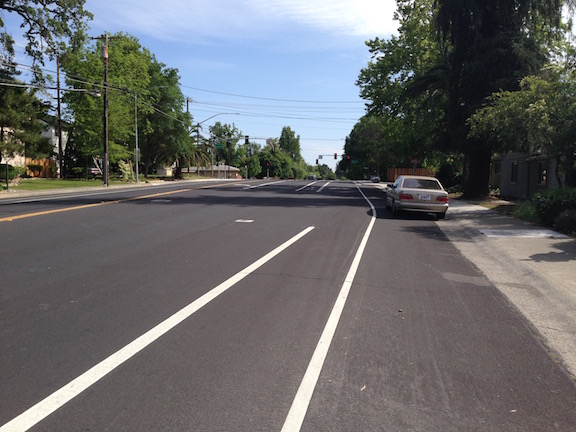
The photo below shows Garfield Ave southbound approaching Marconi Ave, in the Carmichael community of Sacramento County. This roadway was repaved within the last year, and this is the bicycle facility that was painted by the county. The bike lane veers to the right and then ends, running into the dedicated right hand turn lane, and another bike lane continues to the left of the right hand turn lane. These pavement marking clearly give priority to motor vehicles making a right hand turn, and ask bicyclists to yield to those vehicles, as second-class users of the roadways.

Garfield-sb-Marconi_bike-lane-shift

And this is what it could look like.Read More »

11th St bike fix

11th-St_no-bicyclesThe section of 11th Street between L St and Jazz Alley (the alley south of J St) is largely a pedestrian place, but it is also a bike route. For bikes wanting to enter from L St, there are two choices, using the sidewalk area to the right of the fenced seating, or riding the wrong way on the parking garage exit. It is signed against bicycles (see photo at right). And to be honest, it should be signed against bicycles in the sidewalk area because this walkway gets such heavy pedestrian traffic from the Capitol and all the retail and offices in this area.

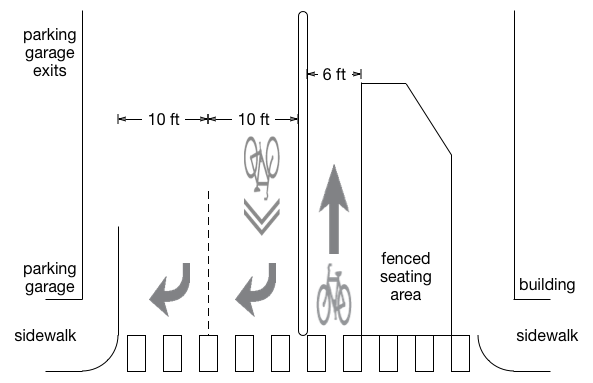
11th-St-L-StSo, I’m proposing that a short protected bike lane be created that would carry bicyclists from L St to the open part of the pedestrian plaza. The roadway here is 27 feet wide, wide enough for two traffic lanes exiting the garage, and one contra-flow bike lane heading north. I’ve watched traffic exiting the parking garage, particularly at the end of the work day, and there is a lot of crazy, erratic driving, and almost continuously an attempt to form three lines of traffic and cut around other cars. A stripe of paint on the ground is not enough. There must be either delineators or a curb (asphalt or concrete) separating motor vehicles from bicyclists. The Google maps at right shows the general setting.

Below is a graphic showing how the traffic lanes and the contraflow bike lane would be installed. Southbound bicycle traffic would use the left hand of the two traffic lanes, which could be marked with a sharrow.

11th-St

N Street bike route to cycle track

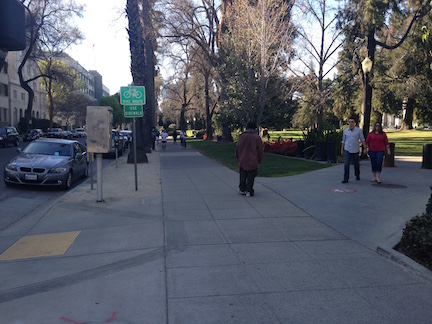
Unknown, or unnoticed, by many people, there is a bike route along N Street on the sidewalks. The route is well-signed from 8th St, where it crosses over from the south side to the north side of N Street, to 12th Street. The route extends east along Capitol Park to 15th Street, and I believe it also extends west to 3rd Street, though it is not well signed at these ends. On the City of Sacramento bikeways map, the route is shown on both sides of N Street, as “Existing Off-street (wide sidewalk).”

The bike route allows bi-directional travel along N Street, which would otherwise not be possible. The city has recognized that N Street is a significant barrier to east-west bicycling.

Read More »

Curtis Village to City College bridge starts

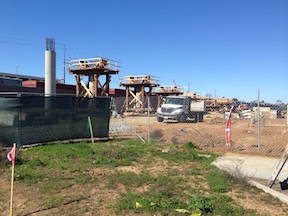
Work has started on the bridge that will connect Curtis Village to Sacramento City College over the Union Pacific railroad right-of-way. The bridge supports on the Curtis Village side have been installed. I did not see any signs of work yet on the section over the tracks nor on the west side at the light rail station and campus. The bridge will be usable by bicyclists, though I am not sure whether the design really addresses bicyclists. The paucity of east-west routes over the rail and light rail corridor means that both bicyclists and walkers have rather unpleasant routes to choose from, so this will be a great improvement. The Sutterville Road bridge, though it has sidewalks and even a narrow bike lane, is a very unpleasant place to be due to the high speed traffic and poor visibility.

update on I Street

"bicycles must turn right" sign, I Street between 6th and 5th
“bicycles must turn right” sign, I Street between 6th and 5th

I wrote previously about the The I Street Mess. A small change has taken place here, with a new sign that says “Bicycles Must Turn Right” on the bike lane midway between 6th and 5th. Basically, this is a warning to bicyclists who missed the “Thru Bikes Merge Left” sign at the beginning of the block that they are truly screwed. By this point, bicyclist will have a very hard time merging across four lanes of high speed traffic to reach the left side bike lane that takes one to Old Sacramento or 3rd Street. At a minimum, the warnings need to occur earlier, in the block between 7th and 6th. Better yet would be slowing the traffic on I Street so that a bicyclist could actually maneuver through the traffic lanes. Best would be an alternate route for bicyclists who don’t wish to ride vehicularly, that avoids the I Street Mess completely.