Central city commute times

Here is the second map generated from American Community Survey data, this one showing average commute times by zip code. Nothing surprising here, the central city still compares well with other areas of the county, but there are some interesting patterns in the Sacramento County map (commute time), such as the northeast county in which I’m guessing people are commuting to Roseville rather than downtown, and therefore have reasonable commute times.

Sacramento-central-commute-time

If I were looking at commute times for surrounding counties, I suspect the average commute times would be significantly longer, since many people are commuting into employment centers such as downtown, Roseville, and Folsom. I have to admit that my own commute is long, 30 minutes to 90 minutes depending on where I’m working in the eastern suburbs. But I’d much rather be on a bike for 90 minutes than in a car for 20 minutes. I use transit at times, but for most trips it is either the same or longer to my work destination, so I use it mostly on horrible weather days and when I need to get work done on the way there or the way home.

Since this map doesn’t require much explanation, I’ll say more about census data. The American Community Survey has some very complex questions, such as whether you departed for work between 6:00AM and 6:30AM, but it can’t seem to find the bandwidth for some simple but very useful questions such as “Is your commute multi-modal? What percentage?” A person can only answer in one category: car/truck/van, bicycling, walking, transit, or other. If a trip is 51% transit and 49% bicycling, it shows up as an entirely transit trip. If a person drives 15 minutes to a parking garage and then walks 10 minutes to work, it shows up as an entirely driving trip. A number of people have suggested that this single mode constraint over-emphasizes the mode share for driving and therefore underemphasizes walking, bicycling and transit.

I will be looking at the National Household Travel Survey, last completed in 2009, to see how it compares to the American Community Survey. There is also a California Household Travel Survey, which looked at things is a much more detailed manner, but did not provide anywhere near the coverage of a census, sampling only typical parts of the state in detail.

How do central city people get to work?

Many central city residents have claimed recently that they can’t get to work if there isn’t parking both at their residence and at their work. I was curious just how central city folks do get to work, so I delved into census data (more about that below the graphic).

Turns out a lot of central city residents don’t drive to work. In 95814 (where I live) and 95811, about 56% use privately owned vehicles (POV = car/truck/van), but the other 44% walk, bicycle, use transit, or work from home. That is remarkable! When you think about how much attention and money we devote to those who drive, it eye-opening. Other areas near the central city have high active and transit use, but it falls off rapidly in most of the suburbs (but not all). The map below zeroes in on the central city. The Sacramento County Privately Owned Vehicles (POV) Commute is also available.

Sacramento-central-commute


So, where does this information come from? The American Community Survey, 2014 version, which has estimated data covering a five year period. The report from which I extracted the data is S0801, Commuting Characteristics by Sex. The field mapped above is HC01_EST_VC03, which is “Total; Estimate; MEANS OF TRANSPORTATION TO WORK – Car, truck, or van.” I think the symbology (colors) I used represent what I’m trying communicate – green is good, red is bad.

It took quite some time to find the fields I was looking for, and the search tool does not make it easy (http://factfinder.census.gov/). Then it took some time to figure out how to extract the data fields I wanted and dispose of those I did not. And then it took a LOT of time to figure out how to get ArcGIS ArcMap to match the zip coded commuting data with the county’s zip code map. Turns out that Excel does not properly label the data type of a field, so either the zip code was a number, which didn’t match the text in the zip code layer, or the rest of the data was text, which could not be symbolized properly. I had to use Apple Numbers to create an export format that retained the correct field type. But now that I know how to do this, I’ll have some more maps to share soon.


Irrational thinking about parking

This week Sacramento News and Review’s Streetalk (not available online as far as I can tell) interviewed five people in midtown about parking meter hours. Facebook also has had a number of posts about parking in the central city. I am amazed that seemingly intelligent people have such fuzzy thinking about parking. Just as with driving, it engenders thoughts that have no grounding in reality, but if anything, parking is a stronger influence. Despite what many people think, free parking is not guaranteed in either the constitution or the bible. (Cheap gas is, though, look it up. – I’m joking.)

First, let me say that I don’t believe the parking changes are solely due to an effort to pay off the city indebtedness for the arena, but I also don’t deny that the arena has driven the pace of the changes and has city officials (elected and staff) drooling over the income. But let’s look rationally at some of the benefits.

People complain that later hours will reduce the amount of parking available. In fact, it is quite likely to have the opposite effect. The reason there is “no parking” in the central city is not because it is priced too high or the hours too long, but because it is priced too low and the hours too short. When people have free parking, whether during the day or the evening, they do several things: 1) they drive when they don’t need to (they often could walk, bicycle or use transit) because that choice is subsidized by free parking; 2) they stay longer in the parking spots because there is no cost of doing so; 3) they don’t carpool when they could; and 4) they don’t plan out trips so that they can maximize efficiency, rather they make trips on the spur of the moment. That drive to get coffee, for example.

The key factor that determines whether parking works for people is turnover. If there aren’t any parking spaces open, it is because metered spots are priced too low and free parking is given away for, well, free. Metered parking, if the pricing is either dynamic or increased to reflect demand, guarantees there will be open spots. Open spots mean that people won’t have to circle the block(s). I live at 16th & O, and I see a lot of drivers circling and circling, just looking for that one close spot. Wouldn’t it be nice if there was an open spot, would you not rather be eating or drinking or listening to music or hanging out with friends, than circling the block? Or even better, if you must drive, park further away and get in some of your daily physical activity.

I can’t resist replying to each of the interviewees:

  • Christina: Why will it be a major inconvenience? Is that something you said because you’d heard other people say it?
  • Beth: “It would inhibit people using this area…” Why? Do people not go to work because they have to pay for parking? Why would they not do the things in the evening they want to do, and pay for parking? Most evening activities are not low budget, no matter what you are doing, and parking fees are not going to be a significant part of that. With a $25 dinner and $20 in drinks (or more), parking fees are just not that big a deal.
  • Vanessa: The reason it is so hard for you to find parking (if it really is) is that parking is underpriced and therefore overused. You can use the new SacPark app to extend your time, if you wish, or just park in a garage and walk to work. What a concept!
  • Kayla: If you can’t be away from your car, then perhaps you should move out. But, how about giving up your car and having a better life? “…my free spaces…”? I always wondered whose free spaces those are, and now I know, they belong to you. Not.
  • Tavares: Midtown is popular because of the culture and opportunity, not because of free parking. People will continue coming, and fortunately they will be able to find parking because there will be some metered spots open and they won’t have to circle the block, wasting time and gas.
  • Montha: “…coins in my pocket…? Are you telling me you don’t have a credit card? Most parking has been converted to single space smart meters that accept credit cards, and the kiosks also accept credit cards. Are you telling me you don’t have a smart phone? The SacPark app allows you to easily pay for your parking without a single coin in your pocket.

Yes, I’m pretty unsympathetic. I live car-free in midtown, and in part I live here because I can have a great life and be car-free. My main complaint about parking is that 10-20% of my rent goes to subsidizing free parking spots for other residents in the apartment complex. I’d have an even greater life if I had that as disposable income to enjoy midtown even more.

This issue has caused me to look into the census characteristic of the central city residents, and I’ll have more posts on that soon.

News summary 2016-03-27

News summary 2016-03-20

Measure BB Sales Tax in Alameda County

In 2014, voters in Alameda county passed a sales tax, Measure BB, by 70%. This measure is seen as a model for progressive use of sales tax in a county, and the Alameda County Transportation Commission simultaneously achieved recognition as a progressive transportation agency. The measure continued an existing half cent sales tax and added another half cent, for a total of one cent. I think a lot can be learned of use in Sacramento county by looking at the measure and the agency.

Measure BB funds the 2014 Transportation Expenditure Plan, which has these goals:

  • Expand BART, bus and commuter rail for reliable, safe and fast services
  • Keep fares affordable for seniors, youth and people with disabilities
  • Provide traffic relief
  • Improve air quality and provide clean transportation
  • Create good jobs within Alameda County

The plan certainly includes some funds for roadways, but shifts the focus to away from traditional roadway expansion to multi-modal transportation, particularly relative to the earlier sales tax which was heavily motor-vehicle oriented. Of the $7.8B (yes, billion) to be invested over 30 years, the allocations are:

  • BART, bus, ferry and commuter rail $2.8B
  • Affordable transit for youth, seniors, and people with disabilities $1B
  • Traffic relief on streets and highways $3B
  • Clean transportation, community development, technology and innovation $1B

The plan allocates 48% of the total to transit, including expansion, operations, and fare subsidies. Of this, 18% of the total goes to operation of AC Transit (Alameda-Contra Costa Transit) which is the equivalent of SacRT. Without knowing the exact nature of the example projects in the document, it is hard to parse out how much of the 39% “traffic relief” category is maintenance and how much expansion, but it looks like about 2/3 maintenance and 1/3 expansion. The 8% clean transportation category includes a remarkable $651M for “Bicycle and Pedestrian Paths and Safety Projects and Educational Programs”.

The Alameda County Transportation Authority has an Independent Watchdog Committee (page 35 of the plan), whereas Sacramento county has nothing of the sort. The committee holds hearings, reviews audits, and issues reports. The Alameda CTC also works with the Alameda county BPAC (Bicycle and Pedestrian Advisory Council), whereas SacTA does not work with SacBAC (Sacramento joint city/county bicycle advisory council), and in fact there is no pedestrian advisory function at the county level at all.

There are a wealth of ideas in the plan, and it is instructive to read it. I’ll be going through it in more detail in the future.

Sacramento Transit Advocates and Riders (STAR)

A new organization is forming here in the Sacramento region specifically to address issues of public transit. This group was seeded and led by 350 Sacramento, and while 350 Sacramento is still one of the coalition members, there is now a core group of active citizens leading the organization. The organization is a combination of individual members (about 50) and a coalition of other organizations (about 25). Though I am pleased to be a member and one of the core leadership, this post does not speak for the organization, but is just a report on it.

The Sacramento region has great organizations for walking advocacy, WALKSacramento, and for bicycle advocacy, SABA (Sacramento Area Bicycle Advocates), but it has never had a strong regional group focused on transit. STAR intends to fill that gap. Given the origin in 350Sac, a focus of the group is on reducing greenhouse gas emissions by getting people out of their cars and on to transit.

The organization has formed three committees to look in detail at issues in public transit in the region. The committees are policy, structure, and outreach. The committees have met about once a month, and there has been a general meeting of the members about once a month. A calendar of public events and STAR meetings is available.

Though the organization will have a regional breadth of the six counties that are part of SACOG (Sacramento Area Council of Governments), the focus to date has been on SacRT (Sacramento Regional Transit) and Sacramento county.

The first major public issue for STAR was the SacRT fare increase proposal, which was presented by SacRT staff in January, modified slightly based on feedback from the board of SacRT, presented again in March, modified further by board action, and adopted at the March 14 board meeting. STAR developed a position paper on the fare increase. Though the STAR proposal was not adopted, this voice for more reasonable fare increases, and the voices from many other people and organizations, particularly the disability community, against any fare increase, did influence the fare increase motion made by Steve Hanson and generated board opposition that resulted in the fare increase passing by only 67%. Most board votes are 100%. Most significantly, the board indicated that it would not consider additional increases until after the November election, and had no stomach for the steep second year increase proposed by staff. The board and staff said that it would be necessary to eliminate or significantly modify up to four bus routes in order to balance the budget in fiscal year 2016-2017, even with the fare increase.

The next major issue up for the organization is a response to the likely half-cent sales tax measure to be offered by SacTA (Sacramento Transportation Authority – better recognized as Sacramento GO) on the November ballot. This measure would increase funding from a half cent under the existing Measure A to a full cent. However, marketing by SacTA indicates that a significant part of the funding will go to the SouthEast Connector and widening of the Capitol City Freeway. These type of sprawl-inducing motor vehicle projects not only take funding from transit, but actually harm transit by subsidizing privately owned vehicles at the expense of public transportation.

STAR does not yet have a web presence on Facebook, the Internet, or Twitter, but it will soon. In the meanwhile, if you’d like to get on the email list, please email Delphine Cathcart.

SacramentoGO completed projects

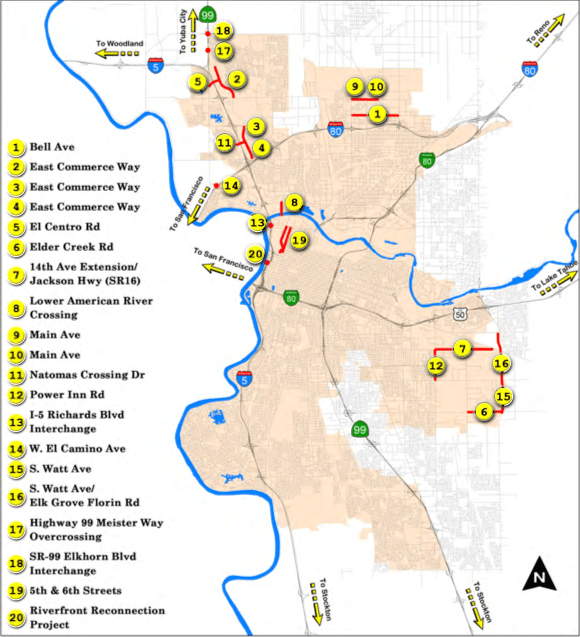
Looking at the projects completed, and highlighted, on the new SacramentoGO website gives a pretty clear indication of the sort of things that would be completed in the future with a new sales tax measure. I’ve made notes, in italic, on each of the items.

Folsom

A. New Folsom Lake Bridge – motor vehicle
B. New Lake Natoma Bridge – motor vehicle
C. Three New Light Rail Stations – transit
D. Light Rail Extended to Folsom – transit
E. Carpool Lanes Added on Hwy 50 – motor vehicle

Highway 50 Communities / Rancho Cordova

A. New Interchange Watt Ave & Hwy 50 – motor vehicle with some active transportation benefit
B. New Light Rail Overhead Crossing – motor vehicle
C. Hwy 50 Bus & Carpool Lanes – motor vehicle
D. Light Rail Extended to Folsom – transit, though again, a parking garage at Old Folsom and large parking lots at another station were part of the expense

Arden-Arcade / Carmichael

A. Howe Ave Widened – motor vehicle
B. Watt Ave Bridge Widened + Bicyclist and Pedestrian Paths – motor vehicle with some active transportation benefit
C. New Interchange Watt Ave & Hwy 50 – motor vehicle
D. Bus and Carpool Lanes Hwy 50 – motor vehicle

Fair Oaks / Orangevale

A. Hazel Ave Widened – motor vehicle
B. Sunrise Blvd and Bridge Widened – motor vehicle
C. Hazel Ave Widened + Road Improvements (in progress) – motor vehicle
D. Carpool & Bus Lanes Added Hwy 50 – motor vehicle

Citrus Heights

A. New Carpool Lanes on I-80 – motor vehicle
B. Safe Routes to School Improvements Mariposa Ave – active transportation
C. Greenback Lane Widened – motor vehicle
D. Antelope Rd – motor vehicle
E. Auburn Blvd – motor vehicle
F. Sunrise Blvd (parts in progress) – motor vehicle

North Sacramento

A. Interchange Upgrade Elverta Rd & Hwy 99 – motor vehicle
B. I-80 Carpool Lanes – motor vehicle
C. Interchange Upgrade Elkhorn Blvd & I-80 – motor vehicle
D. Interchange Upgrade Madison Ave & I-80 – motor vehicle

City of Sacramento

A. Ramp/Connector Improvements – motor vehicle
B. I-80 Bus & Carpool Lane – motor vehicle
C. Arden-Garden Hwy Connector – motor vehicle
D. Arden Way Improvements – motor vehicle
E. Interchange Upgrade – motor vehicle
F. New Intermodal Station – transit
G. New Light Rail Station – transit? unsure what this is, maybe La Valentina
H. Ramp/Connector Improvements – motor vehicle
I. Ramp/Connector Improvements – motor vehicle
J. Hwy 50 Bus & Carpool Lanes – motor vehicle
K. Folsom Blvd Widening – motor vehicle
L. New Interchange – motor vehicle
M. Cosumnes River Blvd Extended – motor vehicle
N. New CRC Light Rail Station – transit
O. Cosumnes River Blvd Extended – motor vehicle

Elk Grove

A. New Interchange – motor vehicle
B. Light Rail Extended to CRC Station – transit, in part, but a large portion of the expense was the parking garage at CRC and huge parking lots at other stations
C. Interchange Upgrade – motor vehicle
D. Interchange Upgraded – motor vehicle
E. Bike & Pedestrian Bridge – active transportation
F. Interchange Upgraded – motor vehicle

Galt

A. Roundabouts and New Gateway to Galt Reduce traffic congestion and improve bike and pedestrian safety – motor vehicle with some active transportation benefit
B. New A Street Bridge – motor vehicle
C. C Street Bridge Rebuilt – motor vehicle