This weekend in South Lake Tahoe I used the LimeBike bike share for the first time. This system is truly rootless, unlike the SoBi system that allows parking outside hubs but is hub focused. As a result, bikes are everywhere, including out of town. I saw a few parking way out the bike trail northeast of town, on Emerald Bay Rd. I’m not sure if there is some sort of outside geofencing beyond which one can’t ride or leave a bike, but the current use is quite expansive. I don’t know anything about what sort of rebalancing occurs.
LimeBike is app centric, you need an iOS or Anroid phone with the app installed, and an account with credit on it. Each bike has a unique QR code,which is scanned with the app to unlock the bike. The bikes have European style wheel locks, which unlock automatically, but are manually locked at the end of the ride.
The cost is $1 for 30 minutes, not prorated, but a very good deal. The Sacramento Tower Bike Preview is $4 per hour, other SoBi systems $7 per hour, and dock systems like Ford GoBike either are membership based or about $3 for 30 minutes.
The bikes are very simple and inexpensive. The weight is less than half of a typical bike share bike, but that means they are also less robust. I saw several bikes with broken or broken off baskets. The bikes have a rear red reflector, meeting legal requirements, but not what the typical rider would want. Front generator lights are provided, the sort older people will remember from childhood, where power is generated by a wheel that rides on the tire. Some bikes are missing their front light, victims of vandals. Most importantly, the bikes are single speed, no gears to maintain, and no gears to use. Though South Lake Tahoe is flat at least close to the lakeshore, it was challenging heading up a slight hill into a headwind. The bikes have standard disc brakes, that work reasonably well. And a twist bell on the left grip.
Apparently the business model for LimeBike is that by using inexpensive bikes they can offer lower rates, and easily replace bikes when necessary. Regular system bike share bikes cost $1000 to $1600, but I would guess these bikes are about $200.
The Breeze Bike Share in Santa Monica uses the same Social Bicycles (SoBi) bikes that the Tower Bridge Preview in Sacramento does. On a recent four day visit to Santa Monica, I used the system quite a bit, both for transportation and to compare systems. Here is my take:
Breeze Bike Share is operated by a separate company, CycleHop, rather than directly by SoBi as is the Sacramento system. The company also operates systems in West Hollywood/Beverly Hills, Long Beach, San Mateo, and other cities outside California. CycleHop has a major maintenance and storage facility, which I stumbled across, shown in the photo above. They tried rebalancing with bikes for a while but have gone to using vans as they are more efficient.
Breeze bikes are green, and the major corporate sponsor is Hulu. As far as I know, Sacramento is still in search of a major corporate sponsor.
The cost per hour for Breeze is $7, whereas Tower Bridge is $4. This makes a difference! Though I only used up $5 of my initial investment (it costs a minimum of $7 to join), this is only because I spent time every day returning bikes to,hubs in order to gain return credits.
Return to hub credit is $1 in the Breeze system, $1.50 in Tower Bridge. It makes a difference!
Outside-hub fees are $2, and outside boundary (geofenced) is $20, the same as Tower Bridge.
I saw people riding Breeze bikes all over town, at all times of day. I often saw the hub racks fill up and empty out over a short period of time, so I know that bikes in the busiest areas were getting many trips per day, though I don’t have any data. It is rare to see Tower Bridge bikes on the road, and though I think they get used one or two times a day, use per bike is much lower.
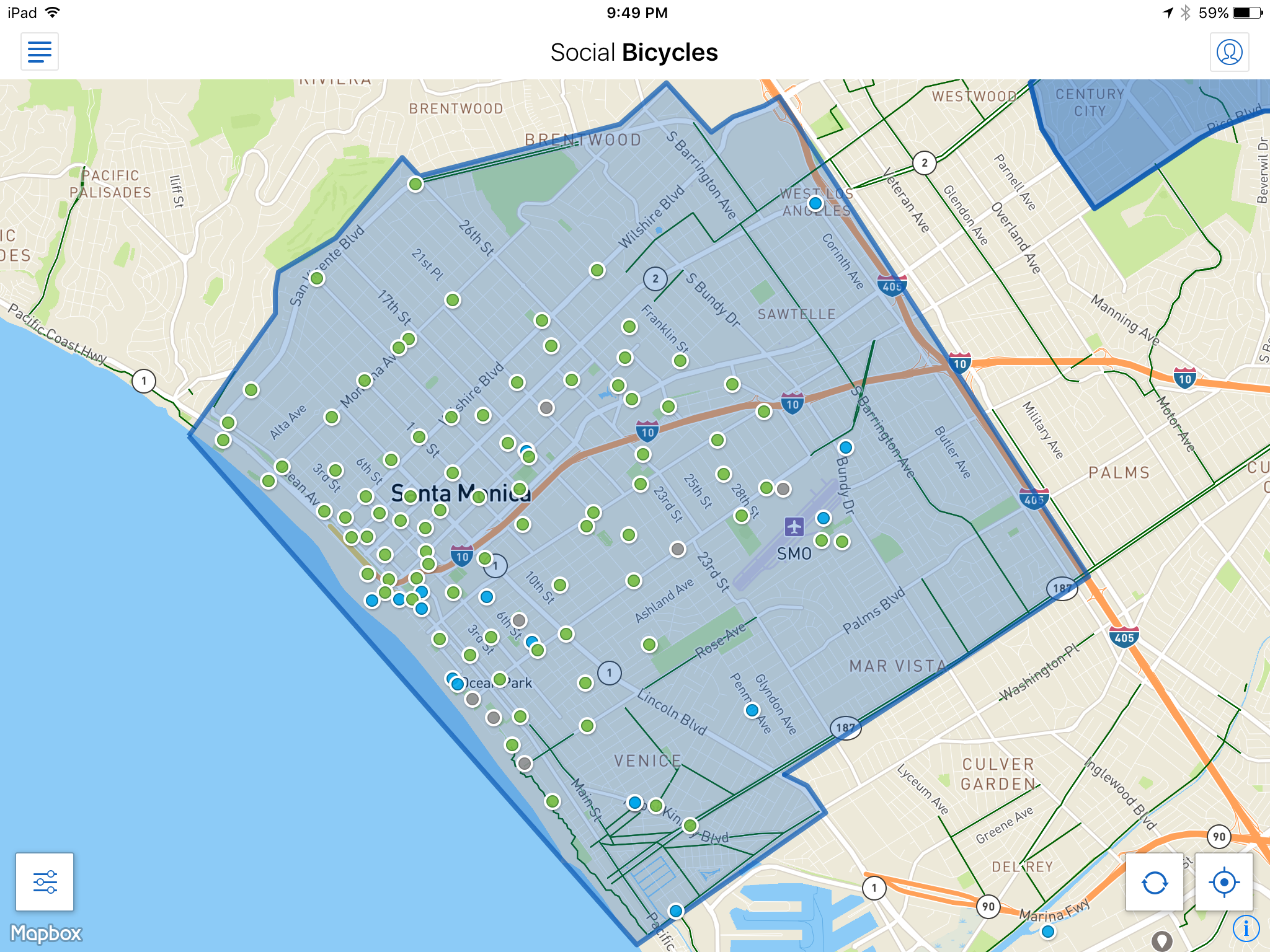
Downtown Santa Monica has a high density of hubs, about every two blocks, but the hubs are much sparser in the more suburban parts of town. The downtown hubs are quite large, up to 16 racks spaces. The advertisement says 500 bikes, 80 stations.
Several of the hubs are sponsored, which is indicated by a different icon for the hub, but I was unable to find out more about these sponsored stations, and it was not obvious who was sponsoring them. Tower Bridge does not have any sponsored stations at this time.
Hubs were located close to each light rail station (Metro Expo Line), and at many major bus stops. Tower Bridge hubs are not.
Breeze has the same problems of geo-location that Tower Bridge has, sometimes bikes shown as in hub were not, sometimes bikes shown as out-of-hub were at a hub, and sometimes the bikes were nowhere to be found at the indicated location. More of an irritant than a major issue, since the next hub or bike is not far away.
Breeze has a low-income program, but details are only available on request, not on the website.
Breeze allows users to unlock bikes with a registered TAP card (similar to Connect Card), but charges are to the Breeze account and not the TAP account. I’m using my Connect Card in Sacramento, and also used it in Santa Monica. Using a card is a slight convenience over entering a six digit number.
Santa Monica has flat areas, and gently inclined areas, similar to Sacramento and West Sacramento, but the rise from beach level to downtown level, and out of the Rustic Creek canyon, is comparable to American River up to Fair Oaks. A lot of bikes get left down by the pier and beach , so I imagine part of the re-balancing effort is getting these bikes back up the hill.
Breeze map below. Green dots are hubs with bikes, grey dots are hubs without bikes, blue dots are bikes parked out-of-hub. You can see the higher density downtown.
The Social Bicycles Tower Bridge Preview is a dockless system. Designated hubs are created both by geofencing (setting up a boundary for hubs and for the system) and designated bike racks, with a $2 penalty for leaving a bike outside a hub, and $20 penalty for leaving a bike outside the system boundary. But it also encourages return of bikes to hubs with a $1.50 credit. These and other issues are discussed in the post, worth a read.
I’m back at work and doing one of my job functions, which is to observe and record driver, bicyclist and pedestrian behavior at intersections. I have noticed, at the same locations and the same time of day, that drivers are much more belligerent this year than previous years. Belligerent toward other drivers, bicyclists, and pedestrians, particularly pedestrians. I observed hundreds of incidents of drivers accelerating towards occupied crosswalks, and then stopping at the last moment. The only explanation that fits what I see is that drivers are trying to intimidate walkers out of using the crosswalks, because it causes a tiny delay in driving time. This behavior is not technically illegal, as the law just requires that a driver not enter the crosswalk while it is occupied, but the behavior is immoral, the kind of thing a scummy driver who sees themselves as the center of the universe would do.
So what has changed since a year ago that has created this belligerent driver behavior? I can think of only one thing. Donald Trump. This is typical of the bullying, self-centered, sociopathic behavior that Donald Trump revels in. The safety and climate of the public realm has declined, and it is showing up in driver behavior as in so many other places in our society.
The Tower Bridge Preview bike share is going to have some expansion in about a month, up to five new hubs on the Sacramento side. I had heard previously that there would be no expansion before full roll-out, which is no sooner than November and quite possibly far beyond that since a major corporate sponsor has still not been identified.
The best news is that one of the hubs will be at Sacramento Valley Station, the train station, and it will be a large hub. This is mentioned in Melanie’s StreetsblogCal post: Eyes on the Street: Sacramento’s First Cycle Track Appears Near Amtrak, and I also heard the same when I ran into Phillipe at the 18th & Capitol hub, doing maintenance and re-balancing. It was a major oversight to not include a hub at the station, but that will be fixed!
I talked with the other person who is regularly parking a bike at the station, for a commute into the Bay Area a few days a week. That person said they love the system, use it for this and other trips, but wished there were a regular hub at the station. The bike has always been there at the end of the day to be used for the return trip. I’m parking a bike at the station for nearly every Amtrak trip I take (to the Bay Area, to Truckee, and to South Lake Tahoe). Since I’m often gone more than one day, other people sometimes check out the bike, which is fine with me since I live close enough to walk.
If you are using the system, you noticed a few days ago that the display screens on each bike changed, with some additional information and tips. The ability to unlock a bike with a RFID card, meaning the Connect Transit Card, is prominent. But not yet implemented. SoBi and the ConnectCard are working out the details. Card use will initially just be for unlocking, in the same manner that the Clipper Card can unlock a Ford GoBike in the Bay Area system, but you will have to have a Social Bicycles account and bike use will be charged to the account rather than the card. The display also mentions unlocking with a phone number, but I’m pretty sure that is not implemented either.
Please share stories here about your use of the bike share. Since that company, SocialBicycles, and the partners, SACOG and the two cities, have said next to nothing about the success and challenges of the bike share, it is even more important that we talk with each other.
Oh, and if you are looking for employment, SocialBicycles is hiring an Operations Manager for Sacramento.
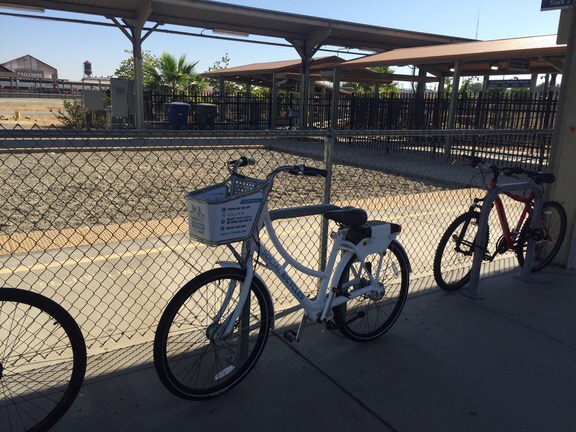
SoBi bike at Sacramento Valley StationThe Tower Bridge Bike Share Preview has been operating in Sacramento central city and part of West Sacramento for two months now. I have been using it from time to time, and have some experiences to share.
These SoBi (Social Bicycles) bikes are a combination of hub bikes and park-anywhere bikes. If you return a bike to a hub, you pay only rental time. If you lock a bike up anywhere within the two geo-fenced boundary areas of Sacramento and West Sacramento, you pay an extra fee of $2. If you Park it outside the geofence, you pay $20. Except for one bike that ended up being stolen, I’ve never noticed a bike being left outside the geo-fence, but bikes are sometimes left outside hubs. This was common in the early days, but seems to have tapered off. It was earning quite a bit of credit on my bike share account returning these bikes to hub, which earns a credit of $1.50, but most days now there are no bikes outside of hubs in the morning, when I look, and return.
One of the cool things about the SoBi system is that temporary geo-fenced areas can be set up at other locations, for special events. The only instance of this that I’ve noticed is when one was set up at the Sunday Street at Broadway open streets event, but the capability is intriguing.
Of the six hub locations in Sacramento, four are located near drinking establishments. Most of the bike share use I observe visually and by watching patterns in the app map is bar-hopping. This is certainly a valid use of the bikes, and I’m glad these people are pedaling instead of driving.
In most bike share cities, a prominent service of bike share is as a transit extender, serving as a “first-mile/last-mile” access to and from transit. None of the hubs in Sacramento were located with that in mind. The greatest shortcoming is that there is no hub at Sacramento Valley Station, the Amtrak station. I have been riding a bike to the station at times, for trips where I’m not taking my own bike with me. Someone else has regularly been leaving a bike at the station on weekdays, presumably commuting on the Capitol Corridor train. The station is at least within the geo-fence, so the charge for doing this is only $2, but I do not understand why the station did not get a hub in the original layout. This is just a pilot, and presumably in the formal rollout in November or beyond, there will be hubs at transit locations. SACOG had said that part of the purpose for the preview was to gather information about patterns of use, but no information is being gathered about transit-related use because none of the hubs were located with that in mind. I asked SACOG about hub locations, and they said these had been determined by the cities, but when I asked Sacramento, they said the locations had been selected by SACOG.
So far as I know, SACOG has not provided any use data for the bike share system, at least it has not showed up on any of the meeting agendas. I look forward to seeing what the system has to say about patterns of use during the preview.
When I’m using the bikes, people often ask me questions about how it works. I tell them how easy it is to download the app and set up an account, and go, but most people seem to think this is too difficult and don’t end up doing it. Even young people who are used to downloading apps don’t seem to want to do it. Once your account is set up, you enter you member number and passcode on the GPS unit located on the bike, in order to unlock. I’m not sure how the system gets over that hump of few members. I have noticed that users of the Bay Area Ford GoBike are mostly using their Clipper Cards (equivalent to the ConnectCard) to unlock bikes, rather than using the application, though the charge is to the GoBike account rather than Clipper. Hopefully the SoBi system can be linked to ConnectCard for unlocking, and maybe even charging.
The Ford GoBike system has created a $5 per year low income membership (regularly $149) in order to encourage use by low income but bike dependent members of the community. It is partnering with the bicycle advocacy groups and low income bicyclist clubs such as the scraper bike folks, in order to sell the benefits of bike share to a wider audience. The locations of the stations (GoBike is a station-based system and the bikes are not designed to leave anywhere other than a station) have also been extended into several low income neighborhoods, though certainly not all of them. I do not know what plans the Sacramento system has for meeting the needs of low income users, but I look forward to finding out.
Now that I’ve had some things to say about individual parks in Parks in the central city and Park positives, some comments about what I think activates parks.
People experiencing homelessness. Yes, I’m serious. There is nothing worse than an empty park, and I’d rather see people using a park than not.
Nearby residential, something more than single family. Parks need people who live close, and parks surrounded by single family and other uses cannot gather enough people to activate them except for special events. Nothing wrong with mixed use, but if no one lives there, there won’t be a good park.
Drinking fountains. In a climate like Sacramento, all public spaces should have drinking fountains.
Something unique that does not exist at nearby parks. Restaurant, senior center, stage, basketball courts, water features, etc.
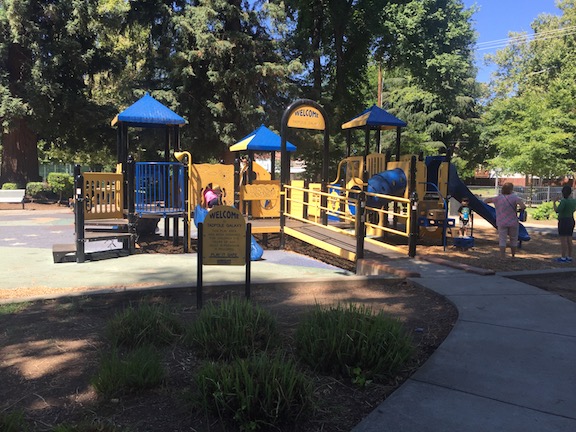
Playground. Parks need kids, and kids need playgrounds. The size can be scaled to use, but the playground needs something unique that appeals to kids and isn’t just like every other playground. Creative ideas.
Restroom. Any Park of a block or larger in size should have a public restroom. Park users will need restrooms, particularly kids, and they should not need to return home or seek out a local business. Of course this is part of a more general issue that Sacramento has almost no public restrooms anywhere.
I am am sure there are official answers to what parks need, and I will look for those when I have the time, but I want to provide my two cents worth.
As promised, some positives to say about parks to follow up on the previous park post.
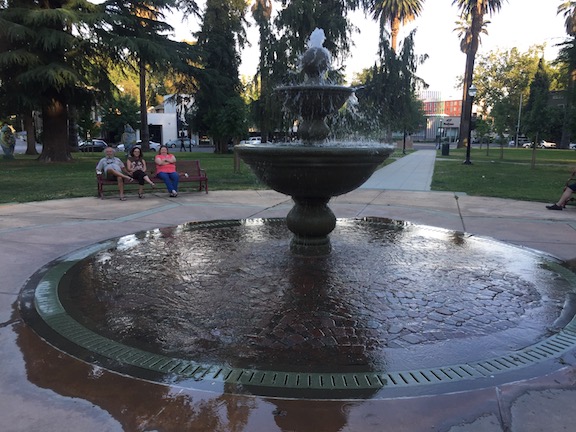
Cesar Chavez Plaza: The park always has people in it. Yes, some complain that it is the wrong (homeless) people, but I think a park full of people is a good park. The park hosts special events such as Concert in the Park, and has a seasonal farmers market. And it finally again has a restaurant. Too high-end for many of the people who use the park, but a positive nevertheless.
Roosevelt Park: The real strength of this park, in my opinion, is the basketball courts. I almost always see people there, playing and socializing. Many are not from this neighborhood, which I see as an indication that there is a much greater demand for high quality community basketball courts than is being met by the city. I'm not a fan of basketball, nor of the Kings who helped upgrade the courts, but I know park activation when I see it.
Fremont Park: This park has a playground used by every kid who lives in the neighborhood. It has a number of special events throughout the year, the biggest of which is Chalk It Up on Labor Day weekend. The park is surrounded by both housing and retail, so it gets a lot of unplanned visits.
Capitol Park: Capitol and Sutter's Fort are of course not primarily parks, but parks surrounding important state buildings. For me, the most interesting thing is the arboretum. It could be better advertised and have an app guide, but nevertheless it is a great resource.
Sutter's Fort and State Indian Museum: Again, a park managed by the state primarily for other purposes, but with some nice park amenities. The ponds and fountains are my favorites.
Grant Park: This would be another big, bland water-wasting grass park, but it is saved by having a great little playground and a drinking fountain.
Zapata Park: Though small, Zapata has a playground, garden, court, grass and trees. The most distinctive thing it has is adjacent multi-family housing, so the park is always full of kids and families.
Southside Park: Southside is of course the gem of the central city, with a large number of amenities. The playgrounds are large enough to have a variety of equipment for different ages, with elements not seen in other parks, and is heavily used by families.
So, given that new HOV lanes do not reduce congestion, and in fact induce demand and increase vehicle miles traveled (VMT), what is the solution? I suggest the following policy:
HOV lanes will not be added to any freeway by the construction of new lanes. If, in the judgement of Caltrans or other agencies, a HOV lane is desirable, an existing general travel lane(s) may be converted to some sort of HOV or tolled status. This only applies to freeways with three or more lanes existing. Existing general purpose lanes may also be converted to transit-only lanes or dedicated to rail use. It is well known that additional lanes of any sort will induce additional traffic, which is directly contrary to state goals to reduce carbon emissions and vehicle miles traveled (VMT).
This could be implemented as a 10-year moritorium rather than a permanent policy, as I think that within 10 years the folly of adding lanes to freeways will be clear to everyone, even Caltrans.
#NoNewLanes
Note: when I wrote the preceding post and this one, I was aware that ECOS (Environmental Council of Sacramento) was working on a lawsuit against Caltrans over the project to add carpool lanes, as additional newly constructed lanes, to Highway 50. That suit has now been been filed.
Winn Park, a block-square park between P & Q, and 27th & 28th, seems dead to me. It doesn’t matter what time of day I see the park, it is almost always empty, sometimes with some homeless folks hanging out, and more rarely, a family with kids on the playground equipment. Other parks seem lively much of the day. Why are the parks so different? I have been visiting all the parks in Sacramento central city to take photos and see if I can make sense of their characteristics.
 This weekend in South Lake Tahoe I used the LimeBike bike share for the first time. This system is truly rootless, unlike the SoBi system that allows parking outside hubs but is hub focused. As a result, bikes are everywhere, including out of town. I saw a few parking way out the bike trail northeast of town, on Emerald Bay Rd. I’m not sure if there is some sort of outside geofencing beyond which one can’t ride or leave a bike, but the current use is quite expansive. I don’t know anything about what sort of rebalancing occurs.






 Getting Around Sacramento