Community meeting on crosswalks – 2

Part one, Community meeting on crosswalks, prior posts:  removal of crosswalksDon’t use the ‘A’ word. Next related post will be about Zegeer.

Question and answer session of the meeting:

  • The city is doing a speed study on Freeport from Sutterville Rd to Meadowview Rd, and will include part of Sutterville (not clear what part)
  • There are no red light cameras on Freeport; the city piggybacks on country red light program
  • There are no lead pedestrian interval signals on Freeport, or even is south Sacramento (all are in the central city); Ryan Moore said these should not be used in low pedestrian areas (which is false)
  • Resident commented on Fruitridge Rd, 24th to Freeport, a lot of red light running and few safe crossings
  • Resident who lives on Oregon suggested changing the speed limit on Freeport
  • Steve Hansen says that the city would like to change Freeport, but to do so, the community (residents, businesses, neighborhood associations) will need to come together to decide how; people will have to give up some time for better safety; he also mentioned narrow sidewalks with obstructions
  • Several people asked about or commented on specific sections and intersections; Matt mentioned catching egregious speeders
  • South Land Park Neighborhood Association (Ryan?) asked what public notice there was before crosswalk removal and said they were not notified; not clear if the other two were notified
  • Ryan Moore said that each removal was analyzed, he says they followed the law of CA MUTCD; said most of the removals were result of complaints; said neighborhood input makes no difference; mentioned FHWA info on crosswalks, referring to Zegeer report though not by name (more info about Zegeer in a future post)
  • Neighbor said that any process that removes crosswalks is flawed; mentioned no still phase on signals (time between red one direction and green the other); going out of the way is not reasonable to ask; can’t have data on people walking because people are scared to walk
  • Steve Hansen and Jay Schenirer want to review pedestrian guidelines, not sure what document this is; said we need to talk about equity because the top corridors of Vision Zero concern are not necessarily located in disadvantaged communities
  • Neighbor said speed display signs don’t seem to have any effect on behavior; asks for immediate action and not years out
  • Ryan Moore continually says “we’d like to but we can’t” but offers no proof; continues to say that crosswalks at this volume and speed are not safe
  • Neighbor said there are bus stops close to Oregon which is true and which might make removal a violation of Title 6
  • Issue of sidewalk maintenance responsibility has come up several times; city continues to insist that it is the responsibility of the property owner (even though most sidewalks are part of the public right-of-way and all are part of the transportation network)
  • Many people pointed out that improvements could have been made at the Freeport-Oregon intesection, such as bulb-outs, refuge median, lighting; there is a median already but it is too narrow to provide refuge
  • Participant asked for a pedestrian commission, Jennifer Donlon Wyant said the the city Active Transportation Commission would be seated in April or May
  • Jay Schenirer wrapped, mentioned that McClatchy students drove the changes to Freeport north of Sutterville Rd

My overall take on the community meeting is that the city council members and the public, both residents of the neighborhood and others, want proactive changes to increase pedestrian safety and walkability. They don’t want excuses. Ryan Moore, the Interim City Traffic Engineer, seem prepared only to offer excuses.

Of all the people on stage, Ryan Moore seemed the least sympathetic to the person killed, or the issues that it raises. He said much the same thing he’d said to the SacBee: “Instead, traffic engineers hope that by removing some crosswalks, pedestrians will instinctively choose to cross at a safer, nearby intersection,” Moore said. He kept referring to federal and state standards that were being followed, though a number of people in the audience who know a great deal about traffic engineering noticed that he was mis-stating and mis-using standards and research to defend his actions and opinions.

Community meeting on crosswalks

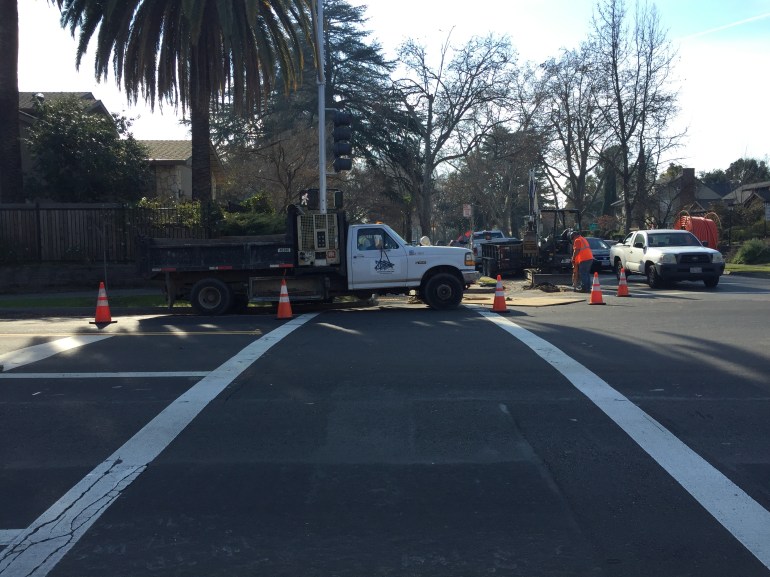
I had promised I’d report on the community meeting to address the crosswalk removal over Freeport at Oregon and related issues, but it has taken me a while. Previous posts: removal of crosswalksDon’t use the ‘A’ word. For background, see the SacBee article: Why Sacramento erased 23 crosswalks, including one where a grandmother died after removal.

The meeting was hosted by City of Sacramento council members Jay Schenirer and Steve Hansen, and school board president Jessie Ryan, and held March 8 at Hollywood Park Elementary which is east of the intersection where the fatality occurred.

Steve talked about the concept of a stroad, a street/road hybrid that doesn’t do either well, though he did not use the term. Freeport is a stroad. He introduced vision zero, talked about changing both infrastructure and behavior, mentioned that the traffic motor officers are gradually being built up but are far below what they should be, and said “we should enjoy the public space and not be afraid.”

Ryan Moore, Interim Traffic Safety Engineer, and the person responsible for the removal of crosswalks, repeatedly mentioned a ‘Systematic Safety Analysis Report’ but is was not clear what this is, and the city website has no mention of it. He also said that he was following all the federal and state rules, as well as research, by removing the crosswalks.

Jennifer Donlon-Wyant, the Active Transportation Specialist, gave a Vision Zero presentation similar to what many people have seen before, but highlights are that Sacramento is the second worst in the state for pedestrian fatalities per capita. She went over the ten profiles that are the core of the draft Vision Zero Action Plan, of which three are related to speed, and one related to transit stops, which all play a role in this incident. One that does NOT apply is ‘Pedestrian Crossing Outside of an Intersection or Crosswalk.’ Though the city had erased the marked crosswalk, it was and is still a valid legal crosswalk. Freeport Blvd is not one of the top five fatality and injury corridors in the city.

Matt Armstrong, Sergeant of the Motor Team (officers on motorcycles) said he has 7 officers on at a time, maximum, for the entire city. They respond to complaints, but otherwise focus on schools and high volume corridors. He said top concerns are red light running, distracted driving, and speed. He mentioned something I had not heard before, that this was a multi-lane threat crash. A multi-lane threat crash occurs on streets with more than one lane in the same direction (Freeport has two lanes in each direction), when one driver stops for a pedestrian and other drivers does not. This is a violation of CVC 21951 “Whenever any vehicle has stopped at a marked crosswalk or at any unmarked crosswalk at an intersection to permit a pedestrian to cross the roadway the driver of any other vehicle approaching from the rear shall not overtake and pass the stopped vehicle.”

Jessie Ryan said the district recognized that their policies were insufficient and were going to adopt the California School Boards Assocation Safe Routes to School policy (which is very weak), that they were creating heat maps to prioritize unsafe routes, is committed to using and reviewing data, and welcomes public input. The district, prior to this, has shown little interest in Safe Routes to School and has implemented only some minor projects.

Kirin Kumar of WALKSacramento and Jim Brown of Sacramento Area Bicycle Advocates (SABA) spoke briefly about the need for culture change in the community and in the city bureaucracy.

Next post I’ll discuss some of the public comments and questions, and the answers provided.

Serve on SacRT board

From our friends SacTRU and also noticed by Ridership for the Masses.

Mayor Steinberg is appointing a member of the private sector to the SacRT Board. This seat will replace one of the Sacramento City Council seats currently filled by Councilman Rick Jennings and will serve until the end of 2018. The member of the private sector would have full voting rights as a board member representing the city of sacramento.

Position: Seat A – A member of the private sector with an understanding of the importance of regional transit and public transportation.

Deadline to Apply: March 30, 2018 at 5:00pm

The requirements and selection process are vague, but all are encouraged to apply. We hope many qualified members of the community will apply and represent the needs of riders, and that this seat is not simply filled by an interested member of the business community.

Apply at: http://www.cityofsacramento.org/Clerk/Legislative-Bodies/Boards-and-Commissions. Scroll down to Sacramento Regional Transit Board; no direct link is available.

It has been suggested that the best candidate is a woman of color. There is only one woman serving on the board currently, Linda Budge. There are two people of color, Rick Jennings and Phil Serna, but it is Rick Jennings seat that is being offered (see board list). STAR believes it is important to have someone who is a regular user of the transit system, since the current members range from low transit use to no transit use. Finding that ideal candidate that increases the diversity of the board and better represents riders will be a challenge. If you know that person or those people, please let them know and ask them to serve.

At the same time, STAR encourages everyone to apply. This can be a transformative moment for SacRT, and a strong interest in the position may encourage the other entities, county and cities, to appoint citizens. The board suffers from having politicians as members who are already very busy with their other boards and commissions, and other interests, and don’t pay enough attention to transit. We need someone whose passion is transit that works for everyone.

Better bike share ordinance

The City of Sacrament is set to adopt a bike share ordinance on Tuesday evening (agenda item 23). This is one more step along the way to bringing JUMP electric bike share to Sacramento, and on the whole the ordinance is good. But I have some suggestions for improving it.

5.18.210 Bicycle parking spaces required. No person shall operate a bicycle‐share business unless they have provided and maintain at least one and one‐half bicycle [designated] parking spaces using bicycle racks for every bicycle‐share bicycle to be operated by the bicycle‐share business, as approved by the city. The installation of bicycle parking spaces and bicycle racks are subject to encroachment permit requirements, as set forth in chapter 12.12.

I completely understand the city’s desire to have an orderly bike share system, where the bikes are in known locations and not scattered randomly. In my experience of dockless bike share in other cities, the concern about bikes left in inappropriate places is exaggerated but real. However, bike racks are not the only possible solution. The photo at right shows a solution from Seattle, still experimental, but with great promise. I would hate to see the city shut the door on other solutions by specifying bike racks when they could specify designated places, of which racks would be one. Bike racks are important, and preferred, but there will be many areas within the system boundaries which do not have racks, or do not have convenient racks.

5.18.220 Retrieval of bicycle‐share bicycles. A bicycle‐share business shall, within two hours of notice, retrieve their bicycle‐share bicycles that are in any of the following conditions.

  1. Bicycle‐share bicycles that are inoperable or not safe to operate, and parked in the public right‐of‐way;
  2. Bicycle‐share bicycles that are not locked to a bicycle rack in an upright position[, or locked within a designated bicycle parking area with the kickstand deployed];
  3. Bicycle‐share bicycles with a battery or motor determined by the city to be unsafe for public use.
  4. Bicycle‐share bicycles parked in violation of section 10.76.050.

This change is consistent with using designated areas, rather than just bike racks.

5.18.230 Electric bicycles. Electric bicycles shall comply with the California Vehicle Code and any other applicable laws and regulations[, and shall be of the Class 1 type (CVC 312.5. (a) (1): A “class 1 electric bicycle,” or “low-speed pedal-assisted electric bicycle,” is a bicycle equipped with a motor that provides assistance only when the rider is pedaling, and that ceases to provide assistance when the bicycle reaches the speed of 20 miles per hour.]. In addition, electric bicycles shall be equipped with software or other mechanisms to prevent the motor from providing assistance when the bicycle’s speed exceeds 15 miles per hour.

I would like to see the 15 mph speed limit removed. There is anecdotal evidence, no research yet that I could find, that e-bikes are somewhat more dangerous that pedal bikes, with a higher crash rate. But many of the anecdotes don’t make clear whether the bikes were pedal assist, Class 1, or throttle, Class 2. Almost none say whether speed was a contributing factor, in fact some seem to be at low speeds, just getting going with a heavy bike. Some bikes with powerful batteries do start suddenly, but my experience with JUMP bikes in San Francisco is that they are pretty smooth as the assist starts and stops. The JUMP bikes are 250 Watt, which is on the low end of power for electric bikes.

The reason speed is important is that a bike at 20 mph is transformative. In moderate to heavy congestion in a urban area, such as most of the area within the system boundary, e-bikes at 20 mph can keep up with traffic. At 15 mph, they are just a regular bike with a little less effort involved. At 20 mph, they could replace many private vehicle trips, and many ride-hailing trips. We already know that private vehicles and ride hailing trips have a negative impact on livability and the environment. Here is a solution! Let’s set them free and see what a difference they can make.

Legislation I’d like to see

In all my spare time, which means while commuting to work on my bike, I think about state legislation I’d like to see. Here is my list of the moment. Feel free to add suggestions.

Bicycling

  • Remove far-to-the-right bike lane provisions, CVC 21202
  • Flip parking in bike lanes from permissible unless posted to prohibited unless posted
  • Require that all signals detect bicycles within two years
  • Be explicit in CVC that placing waste containers in bike lanes is the same violation as leaving any material in a travel lane
  • Require that all waste containers be inscribed with ‘do not place in bike lane’, and have reflective stripes on the sides of the container
  • Implement ‘Idaho stop law’ (yield as stop) for stop sign controlled intersections

Pedestrians

  • Require full traffic studies for the removal or crosswalks or prohibition of crossing, with the default position being that crosswalks will not be removed and prohibitions will not be created or continued
  • Remove the prohibition on pedestrians crossing the street between signalized intersections on all streets 30 mph or less

Speed

  • Change the prima facie speed limit for residential and commercial streets (local) from 25 mph to 20 mph; change to 20 mph or less for posted school zones
  • Set the maximum speed allowable on collector streets to 30 mph; set the maximum allowable speed on arterial streets to 40 mph
  • Allow automated speed enforcement everywhere

Schools

  • Require law enforcement to send incident reports involving children going to or from school to school districts within 24 hours of completion, and investigations within 72 hours of completion
  • Prohibit U-turns within school zones
  • K-12 school districts and colleges/university would be required to have transportation demand management programs, since school-related traffic is a significant portion or overall traffic

Other

  • Shift the burden of proof to the motor vehicle driver for all collisions with pedestrians and bicyclists involving fatality or severe injury
  • Allow any citizen to challenge the professional license of an engineer who is aware of a traffic safety hazard and fails to request funding to mitigate that hazard
  • Decriminalize transit fare evasion
  • Allow conversion of any and all freeway lanes to toll

CEQA hearing

This is a follow-on to my Wednesday post on the CEQA Guidelines update/reform: CEQA VMT reform has a fatal flaw.

Four organizations spoke at the hearing:

  • Climate Resolve (Ella): spoke against exemption, spoke about equity and displacement, mentioned request to Caltrans to use VMT instead of LOS
  • City of San Jose: spoke against transportation exemption, apparently submitted letter signed by other cities but I didn’t catch which ones; San Jose recently adopted VMT as their measure for transportation and development (Streetsblog Cal: San Jose Becomes Fourth California City to Adopt VMT as Metric for Traffic Impacts)
  • Coalition for Clean Air: spoke to reducing VMT as the best path to reducing emissions
  • California Bicycle Coalition (Linda): spoke about equity and displacement issues, on need to monitor and determine consistency, spoke against exemption

And I spoke, the sole citizen speaker:

  • I reject the language in 15064.3, Subdivision (b)(2), which exempts transportation from any requirement to use VMT rather than LOS.
  • Overall, the changes will affect development in a positive way, encouraging infill and discouraging greenfield development, however, transportation drives greenfield development drives rather than greenfield development driving transportation, so the overall benefit will be much lessened by the transportation exemption.
  • Transportation is the largest single contributor to greenhouse gas emissions in California (about 39%), but this language does little to address transportation
  • The draft guidelines specifically say “this provision does not prohibit capacity expansion.” But capacity expansion is the largest single contributor to exist and future emissions. This is exactly the issue that most needs to be solved
  • In the Sacramento region, nearly every county and city will continue to use LOS rather than VMT, with the possible exception of Sacramento city and Davis. Even the discussion of a possible change had most transportation ‘professionals’ and politicians up in arms.
  • Though it did not talk about it, the draft clearly contravenes the intent of the legislature in SB 743, which was to kill LOS.

I hope that there is enough opposition on the transportation issue that the agencies will come back with a better proposal, but if not, the legislature will have to come back to the issue again. If this exemption stands, the state cannot possibly meet its greenhouse gas reduction targets.

CEQA VMT reform has a fatal flaw

If you are not otherwise occupied on Thursday afternoon, you may want to attend the California Natural Resources Agency hearing on CEQA reform. The hearing is Thursday, March 15, 1:30 to 4:30, at California Energy Commission, Rosenfeld Hearing Room, 1516 9th St, Sacramento, CA 95814. One of the great things about living in Sacramento is the opportunity to influence state policy and legislation in a way that people in other parts of the state cannot. We can be their proxies.

As a result of a multi-year planning process, the Office of Planning and Research (OPR) developed recommendations to improve CEQA to address some shortcomings, particularly that it has been used to stop good development, infill and mixed use, while encouraging greenfield development. The recommendations are now being passed along to the California Natural Resources Agency for adoption, since that is the agency that administers CEQA.

While there are great improvements contained in the proposal, there is what I consider to be a fatal flaw. From the OPR document (15064.3, Subdivision (b)(2): Transportation Projects): “Subdivision (b)(2) clarifies that projects that reduce VMT, such as pedestrian, bicycle and transit projects, should be presumed to have a less than significant impact. This subdivision further provides that lead agencies have discretion in which measure to use to evaluate roadway, including highway, capacity projects, provided that any such analysis is consistent with the requirements of CEQA and any other applicable requirements (e.g., local planning rules). Importantly, this provision does not prohibit capacity expansion.”

What this means is that transportation agencies can continue to use outmoded and harmful Level of Service (LOS) instead of using Vehicle Miles Traveled (VMT). To my mind, the main point of CEQA reform was to eliminate LOS, the insidious concept that has led to our unsustainable transportation system. It does so for land use, but does not do so for transportation projects. This is a fatal flaw.

A coalition of environmental and transportation advocacy organizations developed a letter to Resources that addresses the flaw, but seems to give up any hope of making it right, instead hoping that Caltrans will adopt VMT. They might, but I can assure you that many agencies never will unless forced to. Sacramento County, for one, lives in a 1970s mindset that congestion is the great evil that can be met only through roadway expansion, now and forever. [“Apply a VMT-based approach to all projects, including road capacity projects. We are sorely disappointed that the proposed Section 15064.3(b) exempts roadway capacity projects from using a VMT-based measure of transportation-related environmental impacts. With the proposed rulemaking, the State has determined that the best approach to measuring transportationn-related environment impacts is vehicle miles traveled; yet, at the same time, the State has exempted projects with arguably the greatest impact on the environment from using that metric. To close this loophole that threatens California’s environment and public health, we will be recommending that Caltrans commit to applying the VMT metric when they are the responsible agency.”]

If this exemption of transportation projects is not deleted, the exercise will be one of futility because transportation projects have such a huge impact on greenhouse gas emissions, both directly from vehicle emissions, and secondarily by encouraging sprawl which itself has a huge impact on emissions.

To be honest, it took me a while and help from several people to find this flaw, and there may be others I’ve missed, but I do still think that the remainder of the proposal is good.

OPR Current CEQA Guidelines Update page: http://opr.ca.gov/ceqa/updates/guidelines/

NRA CEQA page: http://resources.ca.gov/ceqa/

NRDC: California Gets It Right on Transportation—Almost

Streetsblog California: Update: Last Chance to Comment on Statewide Changes to CEQA

Don’t use the ‘A’ word

I attended the community meeting hosted last evening by Jay Schenirer, Steve Hansen, and the school district, called as the result of the recent fatality and severe life-threatening injury on Freeport Blvd. I’ll write more soon about the meeting itself, but for today, a comment about use of the ‘A’ word, accident. Every public official that evening, with the exception of Jennifer Donlon Wyant, used the word accident. Some of them repeatedly, with Ryan Moore, the Interim City Traffic Engineer, being the worst offender. Many of these uses were made while standing in front of the Vision Zero slide that states “Vision Zero ~ a traffic safety philosophy that rejects the notion that traffic crashes are simply “accidents,” but are preventable incidents that can and must be systematically addressed.” Oh, the irony.

Not the time to go into a detailed explanation of the harm that using this word causes, but you can check out http://droptheaword.blogspot.com, or #CrashNotAccident on Twitter. Basically, the common understanding of the word in traffic violence conversations is to excuse motor vehicle drivers (and engineers) of responsibility for their actions, implying that nothing could have been done, when in fact many things could have been done.

So, a modest proposal. Every time a public official uses the ‘A’ word, they make a contribution of $20 to a local transportation advocacy organization. Eventually, people will cure themselves of using the word, but in the meanwhile it will be an important source of income for nonprofits working to overcome the bias inherent in use of the word, and the underlying windshield perspective that accepts traffic violence as inevitable.

Would it be easier to speed-limit vehicles?

In my previous post, Yes, and lower speed limits, and many others, I’ve written about speed and and need to reduce vehicle speeds. This can be done in a number of ways, most effectively by redesigning streets. But street redesign is a multi-billion dollar undertaking just in our region, and that is a conservative estimate.

Thinking outside the box, what if we speed-limited vehicles instead? What if all vehicles were limited to the posted speed limit? Many newer vehicles already have most of the technology needed: cruise control and location awareness through GPS. They would need some modification to use the cruise control to limit the speed, not to what the driver sets it at, but what the speed limit is. Shouldn’t cost much money for the conversion. Old vehicles, of course, don’t have this technology, and would need a fairly expensive update. How expensive, I don’t know. I’m not a technology person, and can only express surprise that either researchers are not researching this, or that if they are, it isn’t making it into the media.

During the transition period, I can see two actions that would encourage conversion. One is similar to emission inspections, where once your car becomes unable to pass inspection, and it would cost more to fix it that it’s value, it is retired. Of course in California, that means the car is shipped to another state to keep polluting, and that is not a good solution. The other is that there would be a penalty for not installing the conversion. The penalty would gradually increase over time. There are very obvious equity issues about this proposal. Maybe a cash-for-speeders program to buy and retire vehicles without speed-limiters. And it is not as though our current system is without equity implications. People of color and low income are much more likely to be the victims of crashes as are others, and we certainly know that speed enforcement can and is used to oppress people of color and low income.

Speed-limited vehicles would be a huge investment, for the updates required of newer vehicles, and the addition of the technology to older vehicles. I strongly suspect that it would be much less than the investment of fixing all our streets. Of course, we eventually still want to fix our streets in locations that are not triaged out, to make them livable and economically vibrant places, but with speed-limiting, we would have more time to work on that.

I would exempt two-lane rural roads from speed-limiting. Though a lot of crashes do occur on these roads, the valid need to be able to pass slow moving vehicles remains, and the scheme would just not work here. All other roads, yes. It might even be possible to increase speeds on freeways, where variability in speed is as much of a problem as speed itself.

Of course cars-first people would scream that this attacks their god-given and constitutionally-guaranteed right to drive as fast as they can. But these are the car nuts, just like gun nuts, that claim a right to do what they want to do without any consideration of the effect on others. It is time we grow up and recognize that vehicles are deadly weapons that must be limited to reduce mayhem.

Will autonomous vehicles solve this problem? Perhaps. These vehicles will certainly have full awareness of the posted speed limits on every street (part of the reason they are bandwidth intensive). I suspect that most autonomous vehicles will be part of commercial fleets (buses, delivery vehicles, ride hailing). Given the legal liability of allowing these vehicles to exceed the speed limit, I don’t think companies will. Of course there will be private owners who hack their autonomous vehicles to exceed the speed limit, but in a world of speed-limited vehicles these will stand out and be dealt with. The real issue, though, is that there will be a very long period of transition in which most vehicles on the road are not autonomous.

I welcome comments from anyone more technologically savvy than I, who can help me better understand the technological issues and solutions.

and crossing prohibitions

To complete the story about crosswalks, the locations where crossing is prohibited must also largely be removed. These locations are marked with the ‘no crossing’ sign at right (MUTCD R9-3a). Some of these locations probably never had crosswalks, some had them but were removed when the street was ‘upgraded’. A few of these locations cannot be made safe without complete reconstruction of the street. Freeway on-ramps and off-ramps, of which Sacramento has too many because it has too many freeways and too many freeways designed around commuting instead of interstate commerce, are particularly problematic. However, most locations indicate a clear intent by traffic engineers to prioritize the movement and speed of motor vehicles over all other considerations, including safety. This bias must be ended.

Here are the solutions:

  1. The city should be required to perform a complete traffic study on each and every location with a prohibited crossing. The traffic studies should be completed within two years.
  2. If the traffic study indicates that the prohibition is necessary for safety, then the prohibition can remain, but a new traffic study must be completed every five years. If the traffic study indicates that the prohibition was not made for safety reasons and is not needed for safety reasons, the prohibition must be removed and a marked crosswalk installed.
  3. City staff will analyze each prohibited location that remains to determine what redesign would make the prohibition unnecessary, and bring to the city council a proposal to expend funds to fix the location.
  4. At all prohibited locations, the city would be required to post informational signing with distances to the nearest safe crossing, in both directions.

Though I am picking on the City of Sacramento here, these prohibited crossings are found in every city in the region, and in abundance in unincorporated areas. All should receive the same treatment.