JUMP drop zones for Sacramento

New in the JUMP app within the last few days (thanks Matt for noticing) are drop zones, marked with a green lightning bolt icon. I thought these might be charging hubs, promised for ‘some day’, but they are drop zones, just regular JUMP system racks (exclusive JUMP racks and other racks that were part of the SoBi system). I checked three of the 12 racks on the Sacramento side, and none are charging racks. This makes me question the assumption I made that the green hubs in San Francisco are charging hubs; they may also be just drop zones. I’ll be in SF tomorrow and will report.

The purpose of the drop zone hubs is to accumulate bikes that need charging so that it is easier for JUMP staff to locate them and return them to the West Sacramento warehouse for charging. The city hall hub had five ‘in repair’ (very low battery) bikes parked there this afternoon, so the idea is working to at least some degree.

in repair (very low battery) bikes at city hall hub

JUMP is offering an incentive of 50 cents for returning a low battery bike (shown as a $ icon) to a drop zone hub. I did this twice this afternoon, and got the promised 50 cent credit on my account. If you tap on the drop zone hub, it says “Bring a bike with a ‘$’ icon to this drop-off zone. The trip will be free and you will get up to $6.00 in credit.” If you tap on a $ bike, it only offers $0.50, so I assume that is the default and only value for the JUMP Sacramento region, at least at this time.

I finally got a clarification of why I was seeing $ icons in my app, and other people were not. I am a member of both the San Francisco and Sacramento systems, so my membership in the SF system causes these $ to show up. Of course now everyone should be seeing the $ icons and drop zone icons in their app, even if they only have a Sacramento membership.


JUMP count

July 19, 11:30PM (picked as a time when most bikes are parked, not traveling):

  • Sacramento, 68 bikes out of hub, 18 bikes in hubs, 5 bikes out of service area, total 91 bikes in service.
  • Davis, 37 bikes out of hub, 7 bikes in hubs (2 hubs), 1 bike out of service area, total 45 bikes
  • West Sacramento, 19 bikes out of hub, 2 bikes in hub, 0 bikes out of service area, total 21 bikes
  • total 157 bikes

July 20, 7:30AM (picked as a time when recharged bikes may have been distributed, though bikes will be traveling)

  • Sacramento, 63 bikes out of hub, 22 bikes in hubs, 5 bikes out of service area, total 90 bikes
  • Davis, 33 bikes out of hub, 7 bikes in hub, 1 bike out of service area, total 41 bikes
  • West Sacramento, 18 bikes out of hub, 2 bikes in hub, 1 bike out of service area
  • total 152 bikes

July 20, 11:00AM (picked as after the commute rush and before the lunch rush, though there are certainly bikes traveling)

  • Sacramento, 61 bikes out of hub, 10 bikes in hubs, 5 bikes out of service area, total 76 bikes
  • Davis, 36 bikes out of hub, 7 bikes in hub, 1 bike our of service area, total 41 bikes
  • West Sacramento, 5 bikes out of hub, 5 bikes in hubs, zero bikes out of service area, total 10 bikes
  • total 130 bikes

I am not able to compile these kind of statistics on a regular basis, but perhaps we (the users) could pick a few times of day and crowd-source the data.

Charging hubs in San Francisco

The JUMP San Francisco system now has nine charging hubs scattered around the service area, as shown on the map below, with the green lightning bolt icons being the charging hubs. I had previously written about the original charging hub at the Bluxome St warehouse, and wondered when there would be more. I have not been following closely, so don’t know when these showed up. Nothing in Sacramento, yet.

Rent control?

A group of citizens is trying to qualify a rent control measure for the November ballot in the City of Sacramento (Sacramento Community Stabilization and Fair Rent Charter Amendment). I have mixed feelings. First, some background, then my support, and then my concern.

We absolutely have a crisis of affordable housing in the City of Sacramento. People are becoming homeless due to eviction and a shortage of housing. This is unacceptable in a ‘world class city’ and in any city. We must change things to end this, and in short order.

But understanding the root of the crisis is important. It is really a transportation, housing and land use crisis. The city allowed and encouraged unsustainable suburban development, which it cannot now afford to maintain because the property and sales tax income from suburban development is not and never will be sufficient to maintain the infrastructure there. So the older suburbs have deteriorated as city, individuals, and companies disinvested. The same thing will happen to the newer suburbs, it will just take some time. This would not be as big a problem if we had a transportation system that allowed people to get from their deteriorating neighborhoods to well-paying jobs. But we don’t, and the city and county have refused over the years to fund a high quality transit system, so ours is marginally functional. Why? Because we spent all the money on freeways and arterials, instead of transportation. Our bicycling network and walking network (sidewalks) is sadly lacking outside of the central city.

Single family residences will never be affordable for many people. In fact they can never be affordable to the city or county, but that is a separate issue. We need multi-family housing in order to meet the needs of moderate and low income people. But very little of that is being built.

In the face of these problems, housing of only two types in being built: high to very high cost infill housing in the central city, and moderate to very high cost greenfield sprawl at the far edges, which has even poorer transportation than the suburbs. There is almost no development or redevelopment in the suburbs. In many cases, zoning and NIMBYism prevents redevelopment, but even if it did not, it is not clear that much would be going on there. The people who want to live in the older suburbs are people who largely don’t have other choices. So we don’t have enough housing of the right type and in the right place, and prices go up and up, while availability does not change significantly. I am not a housing expert, and people who are may contradict me on this, but I think the core issue is lack of a range of housing types and costs, and not so much specifically eviction and displacement (I don’t use the G word, as it does not explain anything and does not lead to any solutions). Can we build our way out of the housing crisis? No, but it would be a good start. Will it solve eviction and displacement issues? Only partially.

The Sacramento measure has three components:

  1. Rent regulation: limits the rate of rent increase
  2. Just cause for eviction: Limits the ability of landlords to evict except under certain conditions, and requires relocation assistance if not one of those
  3. Rental housing board: administers the rent control program

I have absolutely no problem with #2. This should be the law no matter what the circumstances, whether we are in a housing crisis or not. Though the apartment association presents a picture of the small landlord renting out a few units, this is the exception. Most rental units, as well as rental houses, are owned by huge out-of-state real estate conglomerates, in fact, in many cases, out-of-country investors. The small landlord picture plays well to people who like to think of themselves as supporting the little guy, and small landlords do deserve some support, but the huge corporations do not. Just cause for eviction is absolutely necessary to balance the power of renters against huge corporations.

I support #1 as a temporary solution, however, the measure does not make it temporary.

Let me be more specific. I think rent control is absolutely necessary to meet the housing crisis that we are in. I don’t buy the arguments of the developers (note that these are largely greenfield developers in Regional Business, not infill developers), the apartment association, or the mayor, that rent control will make things worse. It will not, in fact it can’t get much worse than it already is. There will be problems, but it is not as though we don’t already have problems. There will need to be other solutions, and they should be explored. But we need rent control, and we need it now. It is interesting that the developers and apartment owners have suddenly developed a concern for housing affordability and availability, when they were absent from the conversation before. Bogus! I don’t think the mayor really has a commitment to housing either, he is just trying to stall things as a favor to his contributors. I do not respect these people.

HOWEVER. I think the rent control section should sunset after some period of time, or when some objective is reached. That objective could be a declining rate of increase, below the consumer price index. It could be a vacancy rate above a certain level that is typical of cities outside of California. It could be average rents compared to the median household income. It could be affordable housing as a certain percentage of total housing stock. I’m not sure what the best criteria is, but I am sure there must be a criteria used to sunset. It is worth remembering that Costa Hawkins, the state legislation that severely restricts the ability of cities to manage housing supply and pricing was intended to solve a perceived problem, but here we are 23 years later still suffering from the effects of the legislation. (Some argue that it was never really intended to solve a problem but as payment to contributors, but I don’t know enough to argue one side or the other.) Costa Hawkins should be repealed (by Proposition 10) whether there is rent control in Sacramento or not.

So, I support the efforts of organizations and advocates under the Housing 4 Sacramento coalition to qualify the ballot measure. I think the arguments against it are weak. However, I’m not sure that I will vote for it if it qualifies, because it does not have a sunset. But I’m still learning, and still thinking.

Is policing part of a Strong Town?

This is a response to the post on Strong Towns, titled “What’s the Role of the Police Department in Building Strong Towns?

I’m going to argue that a Strong Town does not depend upon or even much need policing. This strong statement comes from my experience in observing the interactions between law enforcement and citizens of color, citizens of low income. I’m a white male middle class person, so I have not directly experienced these issues, but I see them every day. Every day. In the city where I live (Sacramento), in the county where I live (Sacramento) to an even greater degree, and in most of the places I visit in the western US. There is data driven enforcement where I live, as follows: if they are black, they are guilty. If they are other people of color or poor, they are likely guilty. If they are black and poor and young and male, god help them, they will probably be dead no matter the nature of their perceived infraction. The district attorneys are part and parcel of the problem, as they will not prosecute law enforcement officers for violations of the law and of civil rights. The police unions are part and parcel, as they defend all officers, no matter how much of a bad apple they are.

I am not saying that all law enforcement profiles, in fact most probably do not. Not all officers are prone to excessive use of force, in fact most are probably not. However, the person of color has no way of knowing which kind of officer is approaching them. They have to assume they are going to be harassed, arrested for imaginary violations, and possibly murdered. Because that is what happens all too often. In fact, any instance is too often.

You might think I’m exaggerating. Let me refer to two cases in my area, both of which received national attention.

Nandi Cain was a young black male crossing the street legally. He was confronted by and severely beaten by a Sacramento City police officer for the imagined ‘crime’ of jaywalking. The officer did not lose his job and was not disciplined beyond administrative leave. https://www.sacbee.com/news/local/crime/article146114669.html

Joseph Mann was a middle aged black male killed by two Sacramento City police officers who first tried to run him over with their patrol car, and when they couldn’t hit him, pumped large number of bullets into him. What did he do? He was holding a pocket knife and behaving strangely. He had mental health issues. Neither officer was fired, neither was prosecuted, and it is not clear whether either were disciplined. Both eventually left the department. One later admitted in print that what they had done was probably murder, but the district attorney did not follow up. The interesting thing about this case is that other earlier arriving officers had largely defused the situation, the good officers, but the two later arriving ones assumed that the person was guilty of whatever and had to be killed, the bad officers. Data-driven enforcement, for sure. https://www.sacbee.com/news/local/crime/article180804391.html

This list could go on for pages, just in my region, and it could be a book nationally. I’m sure you have all heard of such incidents. The reason I picked these two is that they also relate to safety on the streets, which is a major component of a Strong Town. Nandi, the pedestrian, is the most obvious one. He could not safety cross the street in his own neighborhood, not because of traffic (though there are certainly issues with that as well), but because the police profiled and convicted him in the field. Joseph was killed while standing in the street. The officers used a deadly weapon, their patrol vehicle, to try to kill him, and only went to their other deadly weapons, their service revolvers, when that did not work.

The fact is, under our current policing paradigm, people of color, and particularly the young, black, poor male, cannot be safe. If any citizen is not safe, all citizens are not safe, and you cannot have a Strong Town.

The second major issue is the propensity of law enforcement to take the windshield perspective on all traffic collisions, and assume that the pedestrian or bicyclist was fully responsible for their injury or death. This shows up in the news media all the time. The officer on the scene will report that the bicyclist was not wearing a helmet, or that the pedestrian was wearing dark clothing. This is at the scene, before any investigation has even started. And that is the only thing the public ever hears. There is never a follow-up. And no one can get a copy of the investigation except the immediate family, if any, because friends and other family, and the public, is not considered an interested party.

Again, a specific example. I arrived on scene just moments after a student riding to school had been hit by a driver. His pack was thrown a considerable distance, and I made sure that it was not moved by anyone, as it gives an indication of the speed of impact. When I pointed it out to the officer, he went and picked it up and said it had no bearing on the crash. A neighbor who did not see the crash but had seen the student bicycling to school dozens of times, stated to me that she had never seen the student veer or do anything but ride in a completely safe and predicable manner. The officer would not take her statement since she did not witness the collision. How can anyone feel safe using the roadways if law enforcement sees only what it wants to see, not the facts? The student was transported to the hospital but did not have life-threatening injuries.

Traffic crash statistics, on which we base many of our decisions about traffic safety, investments in transportation systems, and how we value people who use the roadways and sidewalks, is suspect. Officers report that the pedestrian or bicyclist was at fault in most crashes, because that is what they want to believe. To believe otherwise would bring into question the built environment and the organizing principles of the city, and that is something most law enforcement personnel are not willing to consider.

Chuck Marohn has expressed concern about traffic enforcement, in More Thoughts on Ending Traffic StopsIt’s Time to End the Routine Traffic Stop, and many other posts and episodes. The Internet is full of posts questioning whether law enforcement can be a constructive partner in Vision Zero.

Robert Severance III of Cleburne TX is probably an honorable person. But I’d speculate that one or more persons on his force are not. As BWTrainer commented in response to the Strong Towns post, there is no mention of what the citizens think. A Strong Towns approach values all voices but emphasizes the voices of those who are not usually heard. That’s what I think.


JUMP hub count

JUMP is gradually adding hubs to the system. As of today, the counts I see are:

  • Davis: 3
  • West Sacramento: 7
  • Sacramento: 60

In Sacramento, the number of hubs exceeds the number of bikes available. at least at certain times of day. The city requirement was two rack spaces, not the JUMP ‘wave’ racks only, but also regular racks, per bike. The hubs have between four and twelve bike spaces, at least the ones I’ve visited. The number of available bikes as of this moment (8:30PM, 2018-07-02) is 51, but I’m sure there are bikes in motion. I saw five bikes being ridden while out on my evening walk.

People have been asking me questions about the bike share system, and pointing out that I have mixed feelings. Yes, that is true. I think it has the power to transform transportation in Sacramento, but is falling short at the moment. I am traveling and backpacking this summer, only occasionally in town, so it probably will not be until mid-August that I’ll have much to say about the system.

Remember, you can always comment on my posts (if you have commented before and been accepted, you comment will automatically get added, if not, I approve, or very rarely disapprove, as soon as I can). If you have written something, you can submit a link to that. Of, if you have more ambition, you can write your own posts for consideration for Getting Around Sacramento. I don’t want my voice to the the only voice.


when the battery runs out

Several people have asked me what happens with a JUMP bike if the battery runs out before you get to your destination. Now I know. It isn’t too bad. I have been picking up low battery bikes and returning them to hubs where they are more easily picked up by the field crew for charging, and if the battery goes completely dead and they disappear from the system, they are in a known spot where they can be found. Last night I picked up a bike that showed in the app as having a low battery (one red bar on the battery indicator, see the screen capture at right for an example), and it was so low that it did not provide any detectable pedal assist. It did have enough battery to power the headlights and taillights, but the pedaling was all mine.

The bikes are heavy, and so getting started from a stop requires some muscle. But once moving, the bikes are not hard to pedal, and the electric motor does not cause any significant drag. I would not want to go up a hill, but there aren’t any real hills in the current service area, and pedaling into a strong headwind would probably not be pleasant. People with handicaps or less strong muscles should probably avoid low battery bikes, just to make sure.

The bikes that show up in the app with a $ bike icon (not fixed yet), I call ‘low battery’, These still have considerably life in them, as long as you aren’t doing a long ride. The ones that show with a single red bar, I call ‘low-low battery’. These may get you to a nearly location, but you wouldn’t pick one for a longer trip.

Most of the time when I take a low-low battery bike to a hub, it puts itself into ‘repair’ mode a minute or so after I lock it up, which is what it should do.

Bike share is booming

I had a mindset for the last three weeks that the problem with the JUMP system was that bikes were not being used because they were not being charged and re-balanced. But my observations this weekend show that I had things flipped. The system is getting used so much that the bikes are running out of battery. Everywhere I went in the central city, I saw people riding them. I’d see a bike parked, and ten minutes later it was gone, in use by someone else. I don’t know when JUMP will provide rides-per-bike data to the partners, but I think it will indicate that, at least on weekends, each bike is getting many trips per day.

The app map this morning showed almost no bikes in the central city, and what there were were in low-battery status. On my walk, I saw five bikes in very low battery ‘in repair’ status, all within a few blocks of my home. Another had a dead GPS battery, which I think happens when they stay in ‘in repair’ mode for a long time. The bikes are still in the central city, but they are out of juice because they have been used so many times.

Two things users could do to help:

  • If you find a dead GPS battery bike, with the display blank and the keypad unresponsive, email JUMP at support@jumpbikes.com to let them know the location, street and cross-street. Include that it is in Sacramento, or West Sacramento, or Davis, as the bike numbers alone don’t pin down which city the bike is in.
  • If your destination is within a block, or perhaps two, of a hub, park at the hub. That not only makes it easier for the next person to find it, but makes it easier for the JUMP field crew to find it, particularly if it eventually goes to dead battery and drops off the system.

No hub or rack near your destination? You can submit location requests to JUMP at the same support@jumpbikes.com email address. There are a number of locations which have been identified for hubs but not yet installed. Some of them in repurposed parking spaces, marked with thick white lines and two delineators. But it doesn’t hurt to submit an already planned location, so go ahead. SACOG has promised a map of future hub locations, but I’ve not seen it. Presumably it will show up on the SACOG Bike Share page: https://www.sacog.org/bike-share.

a day in the life… of bike share

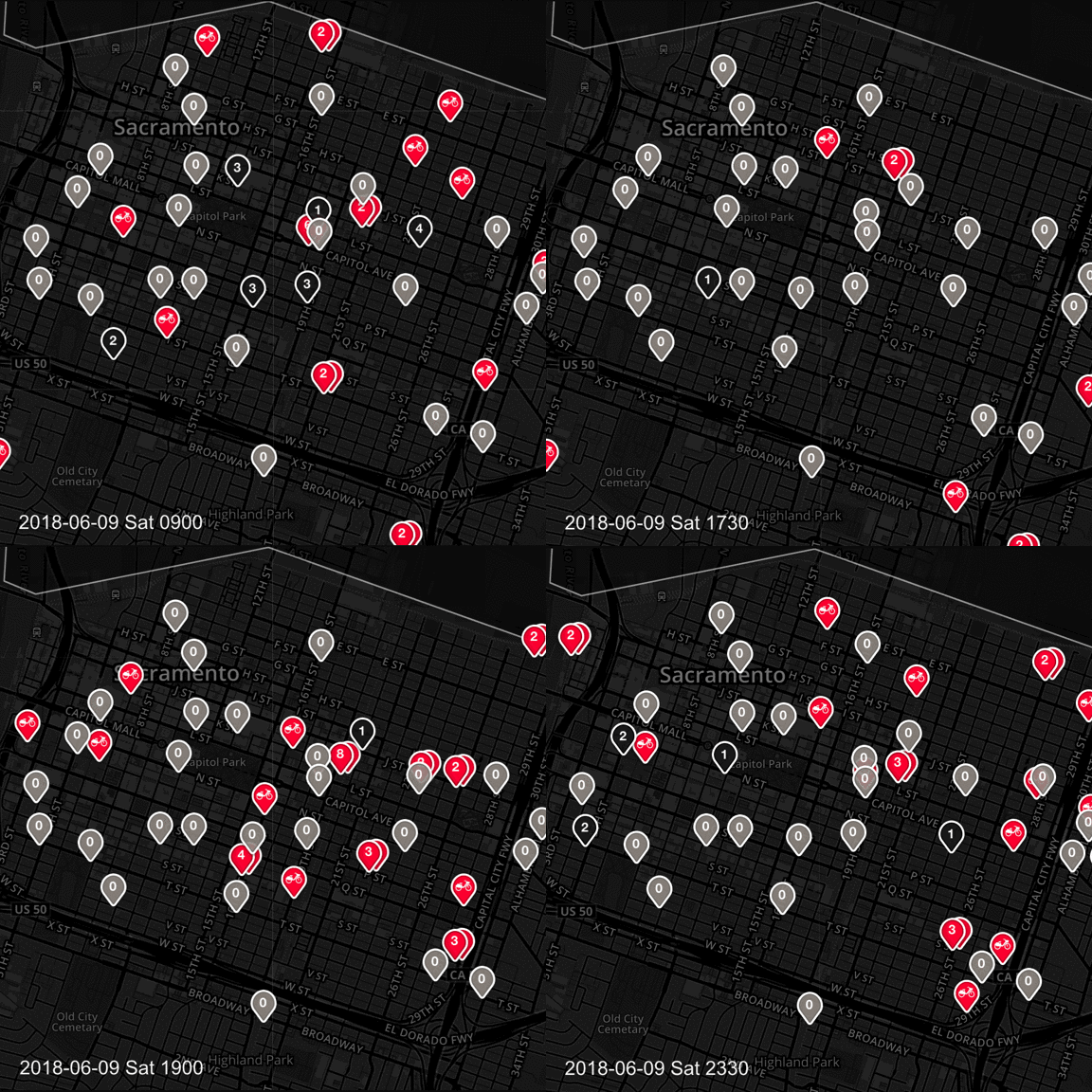
I saw a cool graphic of the flow of JUMP bike share bikes in San Francisco, and thought is would be interesting to do the same for Sacramento. The effect is not so dramatic, but it is interesting. I have zeroed in on the central city, which of course only tells part of the story, but this is the level at which bike and hub icons show, whereas the next zoom out only shows them as dots. I’d like to do this for a weekday as well, but probably won’t have the chance for several weeks, as I’m out of town.

The first one is Saturday, at a few points in time, the second one is Sunday, at three hour intervals. Maybe like watching paint dry, maybe better.

JUMP_Sac-map_2018-06-09

JUMP SF and Sac bikes

There are at least two San Francisco bikes in Sacramento, and I’ve come across them and ridden them. The most obvious, though subtle, difference is that the SF bikes have eight gears and the Sacramento bikes three, as befits the terrain. The shifting direction is reversed.

Since I rode these bikes on the same day that I rode Sacramento bikes, I could compare them directly, and the feeling I’d had when I’d ridden them several days apart turned out to be accurate. The bikes accelerate the same, but once reaching top speed of 15 mph for Sacramento bikes and 20 mph for San Francisco, the Sacramento bikes drop out of assist roughly, and continue to go in and out of it, surging and bogging down. The San Francisco bikes have a smooth transition, noticeable, but much smoother, going from assist to not in a comfortable manner.

The Sacramento bikes make a lot more noise than the San Francisco bikes. Sometimes people turn their head to look. Though I don’t know for sure, I suspect this is the result of whatever was implemented to limit the Sacramento bikes to 15 mph, which is not their design speed but a limitation imposed by the City of Sacramento. I’m concerned that the bikes may actually be damaged by this. I do know that when mechanical devices make a lot of noise, it is not a good sign.

I continue to believe that the 15 mph limitation was unnecessary and inappropriate.