The meeting recording is on YouTube at https://www.youtube.com/watch?v=TWun1r4Na3A.
Comments were not available for posting or viewing leading up to this meeting. I note that there are comments in the meeting archive, but I don’t know where they came from, they were not there at the time of the meeting. The livestream was also not available to me, but I have viewed it after the fact.
Item 4: Franklin Boulevard Complete Street Phase 3 Project (T15255600)
Four commission members questioned why there are RRFBs (rapid rectangular flashing beacons) included in this project since they are known to be ineffective in slowing or stopping drivers, and are especially inappropriate for a higher speed and higher volume roadway. Chair Gonzalez pointed out that Public Works staff had promised in an earlier meeting that there would be no new RRFBs in projects, but they have since backpedaled on that promise and are including them in new projects. He stated that RRFBs might work on a seriously constrained street like Folsom at One Speed Pizza, but that is not the situation on Franklin. He stated that RRFBs are not a traffic calming measure, and a HAWK/PHB or regular signal should be used.
One commission member questioned the design of a green painted but unprotected bike lane at the intersection of Franklin and Fruitridge, saying it was not comfortable for less confident bicyclists.
The city engineer presenting admitted that no study was being done on Franklin Phase 1 and 2 to determine if traffic had been slowed or yielding behavior increased. This is typical for city projects, that they project safety improvements, but don’t gather data to see what the actual improvements are.
Item 5: Active Transportation Commission 2026 Annual Report Draft Recommendations (this item was by far the bulk of the meeting)
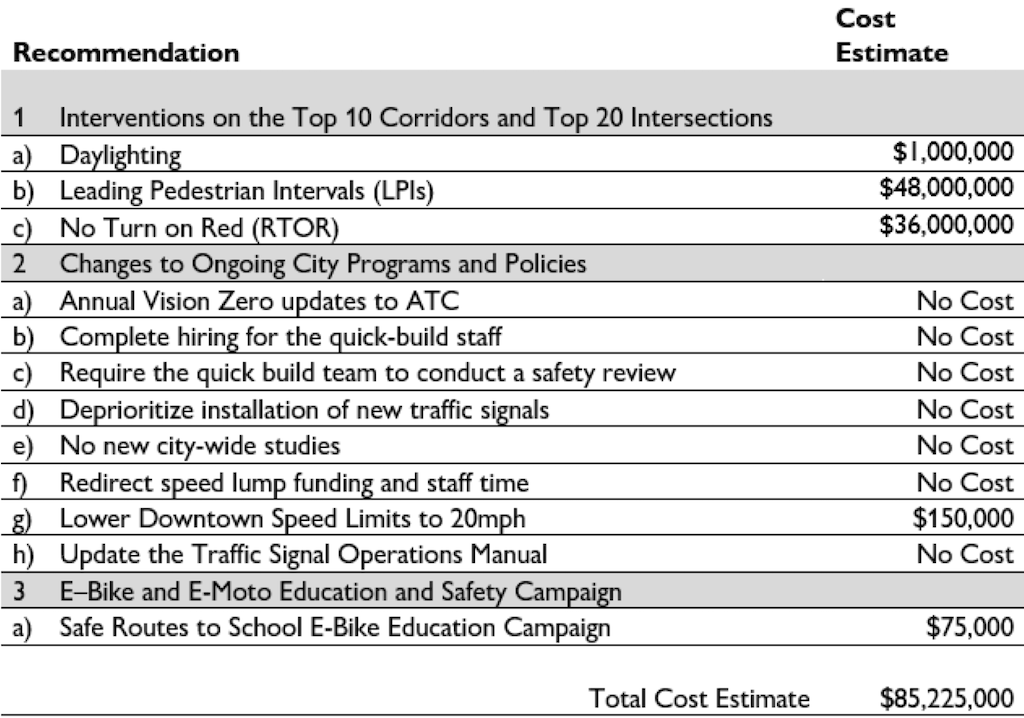
Staff (JDW) said that the reason for the high cost of LPIs (leading pedestrian intervals) is due to the need to add Audible Pedestrian Signals (APS) as required by PROWAG, and many of the locations have such old signal controllers and signals that there are significant costs to modify them. (slide 9)
The cost of ‘no turn on red’ is high because the use of blank-out no turn signs are more expensive than regular signs (MUTCD R10-11), and also require new cabling and sometimes controllers. If only regular signs were used, the cost would be $1.2M rather than $36M. I can state that the blank out signs are far more effective than regular signs, but am not sure that it is worth delaying installation over cost. One commissioner questioned the effectiveness of the blank-out signs. So far as I know, there is no research on this.
Item 2 g) lower downtown speed limits to 20 mph, was removed from the list as not being a critical safety measure, and likely to happen as part of other city initiatives.
There was considerable discussion about the most expensive projects, LPIs and ‘no turn on red’. There was also discussion on the timing of projects, that the commission recognized that major projects take ten years or more, while the city is estimating less (though they have previously recognized the very long time lines).
The commission realized that the funding table showed cost for all Top 10 Corridor intersections and Top 20 intersections, not a per-year expenditure, which would be considerably less as action on LPIs, no turn on red, and daylighting would take place over several years, with a significantly lower per-year cost.
During my viewing of the meeting, YouTube had an outage, so I will add important information to this post when it becomes available again.
The Commission
A commissioner, I’ve forgotten who, commented that these details of policy and expenditure were exactly what the commission should be focused on and spending time to come up with consensus. My next post on SacATC will address the question, what is SacATC for?

