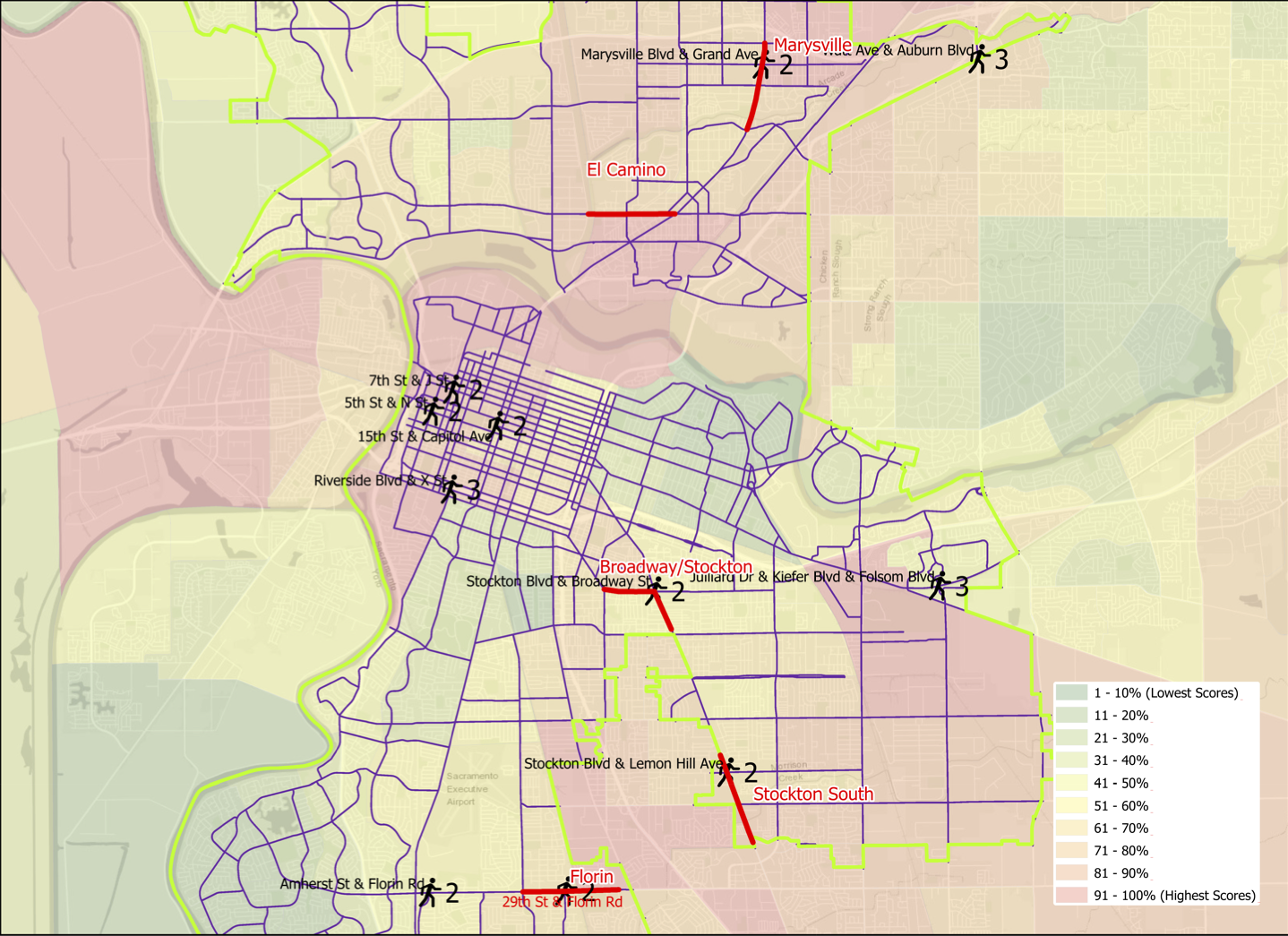
Another reminder from Enzo. He commented on how dangerous the Watt Ave & Auburn Blvd intersection is, which led to a discussion about the entire section of Watt Ave between the Watt/I-80 light rail station and Auburn Blvd. He pointed out the absolutely ridiculous crosswalk and sidewalk at the westbound onramp to I-80 Business.

As you can see, the sidewalk leading down to, or up from, the crosswalk on the left hand side is quite steep. It would not be navigable by anyone in a wheelchair, or with any mobility limitations, and Enzo said that even an able bodied person would have difficulty with it. I only walked this sidewalk on the west side of Watt Ave once, and it was such an unpleasant experience that I never did it again. This particular issue did not stand out in my mind because the entire section was so uniformly unpleasant and dangerous.

As you can see in the Google overhead view, this onramp has a long approach, so most drivers are already going 65 mph when they hit the crosswalk (the speed limit on Watt Ave is 45 mph). So anyone using this crosswalk would be likely to die. For drivers, there is no warning of the crosswalk ahead, and so no reason to take the onramp more slowly. The crosswalk is not even a high visibility crosswalk, but the outmoded two stripe version which can’t even be seen when the pavement is wet.
And very few people do use this sidewalk and this crosswalk. When I worked in the eastern suburbs, I initially took light rail and then bicycled south to Auburn Blvd, but with no bicycle facilities and high speed traffic, that got old very quickly. So then I started taking the SacRT bus Route 1. Currently, this bus route starts and ends at light rail, though it used to go further north. I wondered why so many people got on the bus westbound at the last stop on Auburn, and got off the bus eastbound at the first stop on Auburn. So I asked them, and every person said it was to avoid this section of Watt Avenue between light rail and Auburn Blvd. They said the onramps and off-ramps made it just too dangerous to walk. I wasn’t able to talk to any bicyclists, but I’m sure they would have said the same.
This is Caltrans design, and it was designed to not be usable by people walking. This was the entire design philosophy of Caltrans, to discourage walkers and bicyclists from being anywhere near a highway.
Caltrans has reformed somewhat. For example, when the Watt Ave & Hwy 50 interchange was improved in 2015, a separated walking path and bikeway was created that when under the eastbound onramp, westbound onramp, and westbound off-ramp on the east side of Watt, then along the Watt Ave overpass. In the aerial below, you can see the pathway which loops to gain the elevation from the under tunnel to the bridge height. Note, however, that there is no matching facility on the west side of Watt Ave, so a walker or bicyclist must cross to the east side at the nearest intersection, which is Folsom Blvd to the south and La Riviera Drive to the north. Though not great, it is a considerable improvement over what was there before. It did, however, solidify the status of Watt Avenue as an expressway rather than an arterial street.

As you can see from the photo at the beginning, and the Watt/Hwy 50 example, the only way to solve this issue is with some sort of flyover for the sidewalk, so that there is an ADA compatible gradient and no crosswalk over the ramp. I’m expecting that Caltrans will start that project in about 2121. There was a proposal by SacRT to improve the section of Watt Ave between light rail and Auburn because they recognized that the walker and bicyclist hostile nature of the corridor was reducing use of light rail. But the city and Caltrans did not seem interested.
Though Caltrans created these hazards, and the hazard is clearly on Caltrans property, the agency has shown little interest in solving the problems they created. They have washed their hands of the roadway part of interchanges by handing these over to the cities or counties. Their preference remains building new stuff rather than maintaining and correcting existing freeways and highways, and I’m not at all sure that will ever change.

 Getting Around Sacramento