Stockton Boulevard Safety and Transit Enhancement Project (STEP)

And yet another City of Sacramento planning effort, the Stockton Boulevard Safety and Transit Enhancement Project. This is a Vision Zero project. Two segments are on the Vision Zero High Injury Network Top 5, Broadway and Stockton (Broadway between Martin Luther King Blvd and Stockton Blvd, and Stockton Blvd between Broadway and 13th Street), and Stockton Blvd South (Stockton between 65th Street and 37th Avenue). However, the project includes the entire route of SacRT 51, from downtown, along 8th and 9th Streets, Broadway, and Stockton as far as Florin Road. It is also a transit project, to enhance bus service along the Stockton part of Route 51, in particular.

Stockton has long been a focus for the city, and county, with many plans developed but none implemented. The current effort is a revision of those efforts to emphasize a potential Bus Rapid Transit (BRT) service along Stockton Blvd, and perhaps some enhancements to the other sections.

A community workshop was held this week at the Southgate Library, with city staff, consultants, and county staff present. Some issues that came up during the workshop include:

  • ridership on bus 51 drops off sharply south of Fruitridge Road, so investment should be focused on the section of Stockton between Broadway and Fruitridge; the nature of the neighborhoods north and south of Fruitridge are quite different, with south being significantly more car-dominated, and so less likely to generate ridership
  • sloped driveway ramps, common along Stockton, must be repaired so that they are compliant with PROWAG; provision of sidewalk buffers which contain the sloped driveways are the optimal solution
  • earlier outreach for Stockton, and every project the city has planned, surfaced a strong community desire for more street trees; healthy street trees need wide sidewalk buffers (the city calls them planting strips) of 8 feet; tiny sidewalk buffers lead to unhealthy trees and root heaves of the sidewalks
  • additional housing going in right now on Stockton, particularly around 8th to 10th Avenues, will generate a lot of walking, and the sidewalks there need to be improved and widened, not in the future, but now
  • several of the design concepts show a center turn lane throughout the project; in most sections, these are a waste of valuable roadway right-of-way; instead, left turn pockets should be provided where clearly needed
  • businesses have concerns about unhoused people using bus shelters and shelter, and crossing Stockton at random places

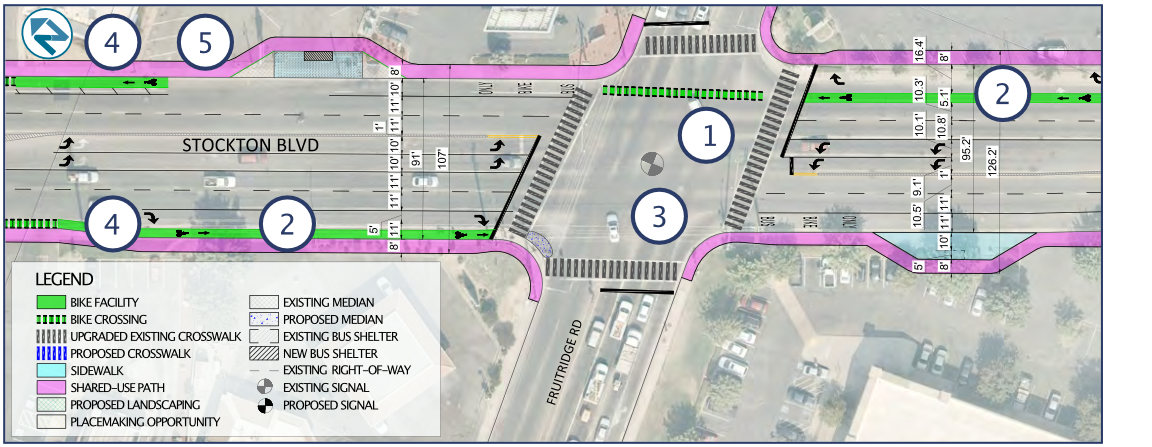
The project is also considering changing SacRT Route 51 so that it runs on Stockton from Broadway to Alhambra, and thence on surface streets to downtown. This section of Stockton has a narrower right-of-way, but it also hosts UC Davis Medical Center which could be a major generator of ridership for the bus. The existing Broadway Complete Streets project, and the additional segments from 24th Street to Stockton, have designs with a single general purpose lane in each direction and a center turn lane, which is not a good setting for BRT. The map below shows this option. If SacRT Route 51 was re-routed, there would need to be additional bus service along Broadway, since it is a high transit use corridor.

City and county staff, and consultants, seem to be supportive of a transformed Stockton Blvd, which will effectively serve transit riders, bicyclists, and walkers (and rollers). But there is likely to be pushback from the car-centric people who drive through on their way somewhere else, and who feel that time saving is more important than safety. It will take concerted effort to ensure a strong project.
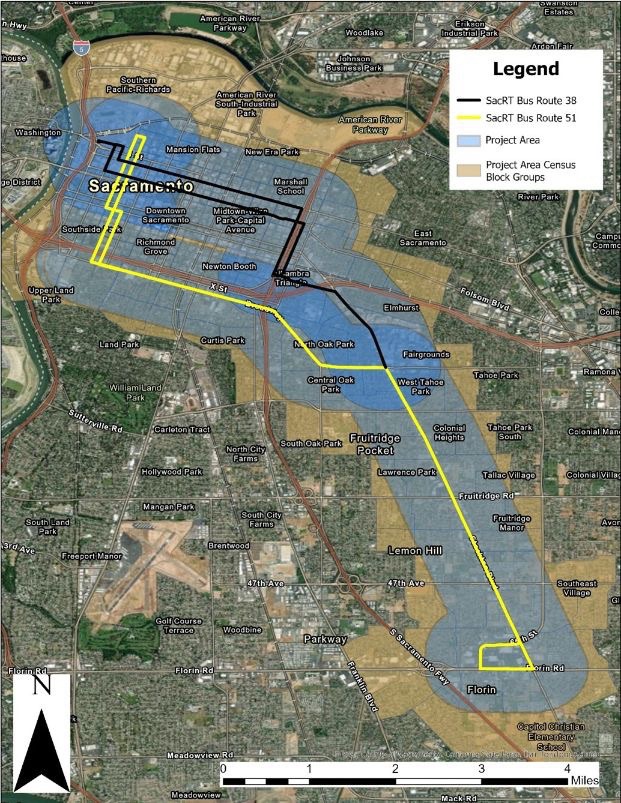
map of Stockton Blvd Safety and Transit Enhancement Project (STEP)

we are still doing it wrong

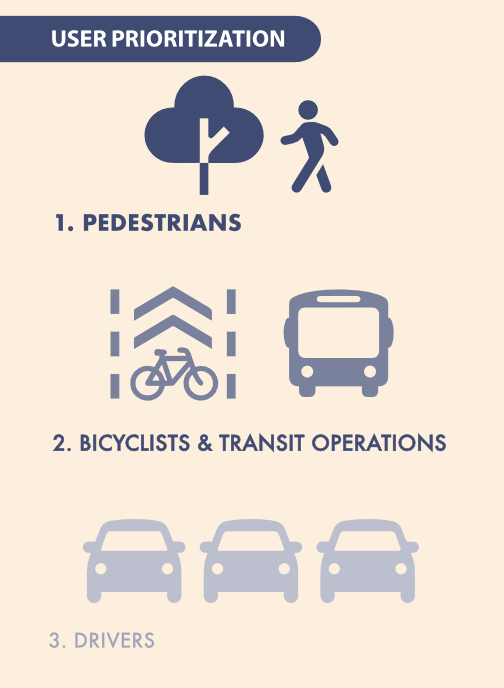
Below is a graphic from the City of Sacramento 2040 General Plan (Chapter 8 Mobility Element, page 8-9). As a transportation advocate, I obviously have a bias, but I think this is the most important graphic, and the most important message in the entire general plan.

graphic of User Prioritization from City of Sacramento 2040 General Plan
User Prioritization from City of Sacramento 2040 General Plan

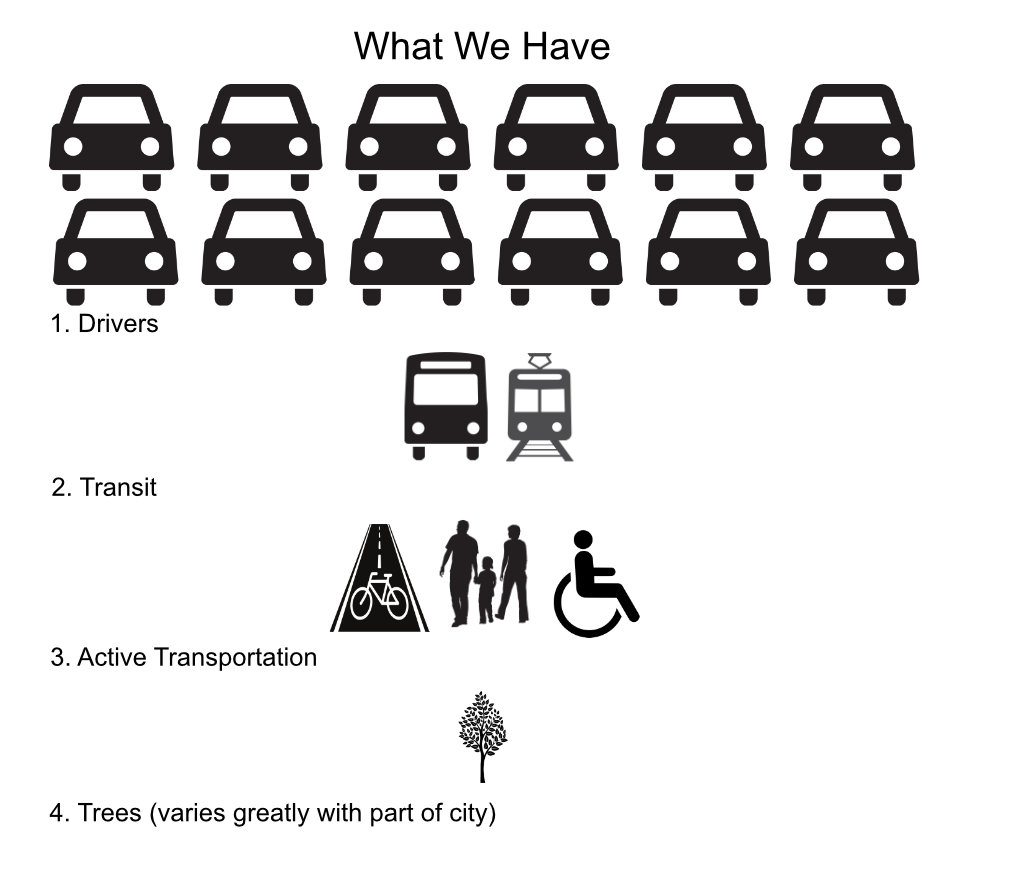
This is in complete contrast to the transportation system we have built. Below is the transportation system we have. One could argue endlessly about how this varies with parts of the city, and whether active transportation should be lumped together, but the graphic communicates the problem.

graphic of What We Have

I follow the city’s transportation projects, some in great detail, others only superficially. There are far too many for one person to cover, or even a group of people.

What I see in these projects is a very gradual shift from what we have to what we want. We might reduce general purpose (car) lanes, in number or width, but not always. We might add bicycle facilities. We might, occasionally, improve sidewalks for people walking and rolling (but not if we can get away with making property owners do it). We might make it easier for transit. Though the central city, and some neighborhoods outside the central city, have a reasonable tree canopy, north and south Sacramento are largely lacking a tree canopy, and every transportation project neglects solving this issue. We don’t plan in trees from the beginning, saying we’ll get to them later in the process, but at the end, they are usually missing.

We have invested hundreds of millions of dollars in making things better for drivers and motor vehicles, and very, very little on anything else. It is time to almost completely reverse that, so spend nothing on drivers and motor vehicles, and almost everything on transit, active transportation, and trees.

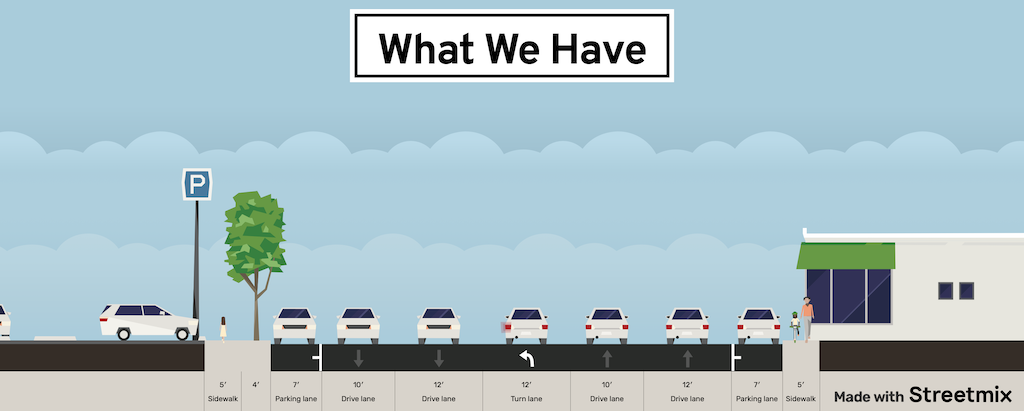
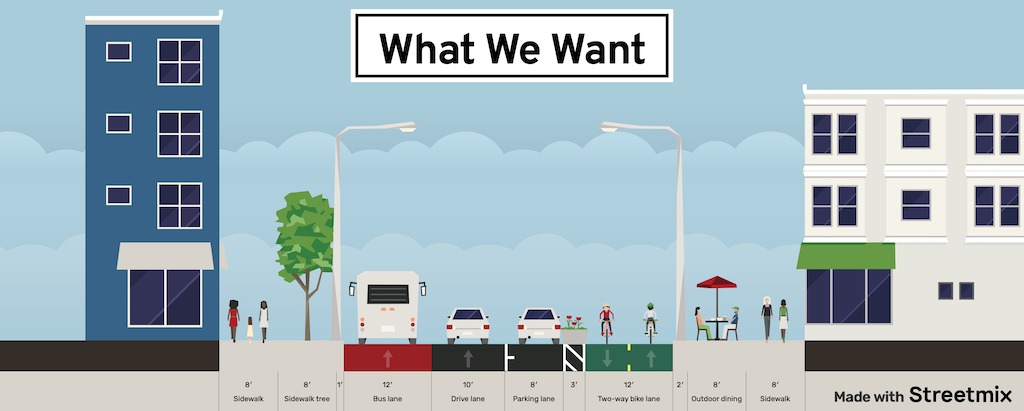
Another way of exhibiting this is street cross-sections. These are from StreetMix (https://streetmix.net/), for an 80 foot right-of-way. Certainly not every street would be the same, context and surrounding land use are important, but it does show the necessary shift from a car-dominated place to a people-dominated place. The city is not proposing ‘what we want’ anywhere.

graphic of a street cross-section with narrow sidewalks, narrow sidewalk buffers, ample parking, ample lanes for motor vehicles
graphic of street cross-section with bus lane, two-way bikeway, and wide sidewalks and sidewalk buffers

Of note in ‘what we want’ is a one-lane, one-way street. They are far, far safer than multi-lane streets, and by reducing the amount of space devoted to motor vehicle through traffic, space is freed up for people, people walking, people bicycling, people eating and socializing, and people just hanging out. It is quiet. It is friendly. It not only feels safe, but feels welcoming. This reflects my axiom that we should design streets from the outside in, not from the inside out (street design from the outside in). Outside in preferences walkers and trees, inside out preference drivers and motor vehicles.

Freeport Blvd grant is a loser

It pains me to oppose a grant application that the city is making for transportation improvements, in this case, an application to Active Transportation Program Cycle 7 (ATP7), for Freeport Blvd, to implement the Freeport Blvd Transportation Plan.

When the plan came out, many, many people pointed out the flaws in the plan. To simplify:

  • the plan did not reflect the desires of the community, both the adjacent community and the larger Sacramento community, for safety and trees
  • the plan neglected to include space for and planting of trees, a top priority of the community
  • the plan maintained a roadway of four lanes, two each way, throughout the project, even though only a short stretch, from Sutterville Road to the east to Sutterville Road to the west, has enough traffic to even come close to justifying four lanes

If Freeport were a major bus route, it might make sense to reserve a lane for buses, but it is not a major route and is not a roadway being studied for Bus Rapid Transit (BRT).

The plan was recommended by SacATC to the council, which was a mistake, and then approved by the council. I wasn’t too worried, because I figured the city would take the criticism by myself and many, many others to heart and improve the plan before seeking grant funding for it. I was wrong. There was almost no one outside the city staff who supported the plan. The city now wants to submit a grant application for engineering design and environmental clearance, based on the flawed transportation plan.

The city’s priorities for transportation modes, under the new General Plan 2040, are below. The plan does not meet that criteria.

I have written many times about the plan:

These posts are included under the category Freeport Blvd. If you have time on your hands, you can read one or more of the posts, but what they do is build a case, and I feel clear about the case. No grant applications until the plan itself is significantly improved.

I hope that you will attend the SacATC meeting this Thursday, March 21, starting at 5:00 PM, in city council chambers, and will speak in opposition to the inclusion of Freeport Blvd in agenda item 6, part (b), for the Freeport Blvd grant application.

healing over-wide streets

I participated in a Strong Towns Crash Analysis Studio on Thursday. I highly recommend these sessions, and will have much more to say about them in the future. One of the presenters shared the diagram below to illustrate what could be done with an over-wide street in Carlsbad, California, the scene of a bicyclist fatality.

diagram of Residential Neighborhood Collector Parallel Parking One Side
Residential Neighborhood Collector Parallel Parking One Side

The diagram is from Better Town Toolkit, and I am quite pleased to find this website. It has design guidance for a variety of places, best practices, and case studies. “Our goal is to help you improve the prosperity, sustainability and quality of life in your community by providing you with the best practices for design and development in your area.” It is sponsored by Regional Plan Association in New York. I am unable to find this exact diagram on their website, but a similar one is L56.

Sacramento is full of over-wide streets. Of course pulling in the curb line and permanently narrowing the vehicle portion of the roadway is the best solution, but very expensive for moving drain inlets an re-pouring curbs. I’ve suggested using diagonal parking to narrow the travel way on slow, low-traffic streets: diagonal parking. The diagram shows another good solution for streets with attached sidewalks, no sidewalk buffer or planting strip. Plant trees in the parking lanes to narrow the roadway, retain parking on one side only, and make a two-way street with narrow lanes (9 foot?). The curb line does not necessarily need to be moved at all, and drain inlets may not need to be moved, so the project would be much less expensive than a street redesign.

There are many streets on which parking utilization is low, in fact, streets empty of parking have none of the traffic calming effect that parking can have. One lane of parking would be sufficient on many streets, and would disourage excess car ownership and long-term storage of cars on the street. Parking has benefits, but only if there is high utilization and turnover. Streets are not a place for long-term storage of private property.

Take a look at the website and let me know what your favorite diagram or page is.

sidewalk buffer widths

One of the elements of street design is the width of sidewalk buffers, and how these are presented in design standards. The sidewalk buffer is the area between the curb and the sidewalk. The city calls sidewalk buffers ‘planting strips’, and this is often how they are used, but it is not the only use, and in more urban areas, there are often multiple uses of the sidewalk buffer.

I did a sampling of sidewalk buffer widths in the central city, and a few other parts of Sacramento. I am not claiming any insight into the overall pattern. The city does not have a publicly available database or GIS layer of sidewalk locations and widths, let alone locations and widths of the buffers. I have heard rumors that they are developing one, but I have been hearing that rumor for the last ten years, so I’ve become doubtful.

Typical buffer widths in the central city range from six feet to nine feet, with seven feet being the most common. With huge mature trees, the narrower buffers are too narrow of the trees, and the sidewalks have had to be modified. The photo below shows an example, and these situations are everywhere.

sidewalk narrowed for tree roots, Q St near 14th St
Read More »

Freeport trees and sidewalk buffers

Another post on the Freeport Blvd Transportation Plan. See the category Freeport Blvd for others.

So, given the need for trees to shade sidewalks along Freeport, where do they go? The answer is in the sidewalk buffer or planting strip. At one existing location along Freeport, there is an example of street trees in a sidewalk buffer, where the new Raley’s shopping center is. The photo below is from the photo essay. I don’t know whether the city required the developer to put in sidewalk buffers and wider sidewalks, or whether the developer knew this was the right thing to do and did it on their own. In any case, this is the only part of Freeport that has them, other than a short section along the airport north of Blair Ave.

The one situation in which sidewalk buffers may not be appropriate is where buildings come to the curb in dense retail areas. But there are virtually no instances of this along Freeport. Almost all buildings are set back from the sidewalk a little, or a lot. In several cases there are massive parking lots adjacent to the sidewalk, creating the kind of place where no one wants to be. So buffers and trees at least mitigate the blandness to some degree.

Freeport Blvd sidewalk buffer and trees
sidewalk buffer and trees along Freeport Blvd at Raley’s

As with any post, I look for example photos and diagrams. So I searched Google for ‘sidewalk buffer’. Lo and behold, the second item is my own post about this! It is experiences like this that make me realize the value of this blog, when other people are using my advocacy work in their advocacy work.

So, so rather than re-write the post, I’ll link to it here: sidewalk buffers. I encourage you to take a read. Trees, and the sidewalk buffers that would allow them, are probably the most important aspect of Freeport Blvd, and the most important topic that the city has neglected.

Where are the trees on Freeport?

Another post on the Freeport Blvd Transportation Plan. See the category Freeport Blvd for others.

If you take a look at the Freeport Blvd Transportation Plan, including Appendix F Design Layout, you will see that most of the existing trees are preserved. But there is no information about new trees, not in the diagrams, not in the text. In fact, the only text mention of trees, other than existing trees, is in the Community Vision (page 20, 23 in the pdf), where it says “4 IMPROVE SHADE AND COMFORT: Enhance the walking and bicycling experience along the corridor by integrating street trees to provide shade and comfort from the sun and rain”. Certainly, that is the community’s vision, but it does not seem to be the city’s vision. If it were, the plan would have addressed trees.

Given that a major objective of the plan is to make Freeport Blvd more walkable, the lack of trees and mention of trees is concerning, to say the least. When questioned about trees at the January 18 Active Transportation Commission meeting, city staff said two things: 1) we aren’t the experts in trees, so we didn’t include them, and 2) tree information will come later in the design process.

This is a classic case of planning and engineering gaslighting. The story beforehand is always, well, it’s too early in the planning process to consider that. The story later is that it is too late to consider that element of the plan, we’re already past that, the decisions have been made. Every plan goes that way. It is true that this plan is only the first step in design, and there will be more detailed design to come, but when you don’t plan for trees from the beginning, you get a roadway with too few trees. Or no trees.

Almost all the existing trees are in median strips at a few locations along the roadway. Trees in medians have some value. They make the road look prettier, they slow traffic to a slight degree, they shade pavement and slightly reduce the heat island effect. But they are not even as remotely useful as trees along sidewalks. What Freeport Blvd needs is trees adjacent to sidewalks, not median trees. But the city has nowhere reserved space for them. So they won’t be there.

Next post is about where to put the trees, adjacent to sidewalks.

Freeport Blvd Transportation Plan

The City of Sacramento has released the final draft Freeport Blvd Transportation Plan. Appendix F Design Layouts is a key part of the document. This post reflects my original comments (Freeport Boulevard Emerging Design Concepts) and the new plan. The city’s plan page is at http://www.cityofsacramento.org/Public-Works/Transportation/Planning-Projects/Freeport-Blvd-Corridor. The plan is on the Active Transportation Commission agenda for January 20, 2023, and will go to the city council within the next two months.

The ten common design elements on page 21 (24 of the pdf) include: “10. Maintained necessary travel lanes, turn lanes, and parking: Maintaining travel lanes and turn lanes ensures that drivers traveling along the corridor will not be compromised, and preserving parking spaces where 5 the utilization is higher so it serves better adjoining businesses.” This is statement is contrary to all walkability, bikeability and vision zero goals. It should be removed from the document, and removed from planning goals. It is offensive. It means that no matter what other improvements to the corridor will be made, cars and motor vehicle drivers will be preferenced over all others.

The ten common design elements do not mention trees. Trees are an integral part of the walking experience, as well as providing climate and heat island benefits. They should be prominently recognized throughout the document, but they are not. The phrase ‘existing trees’ occurs many time in the document, but nowhere are ‘proposed trees’ identified.

Frequent driveways along much of this section present hazards to walkers and bicyclists, and handicap the design of safe streets. It is clear that the city did not consider reduction or narrowing of driveways to address this hazard. If you look at the design layouts (Appendix F), the number of gaps in the bikeway, shown as dashed green, is remarkable. Each of these is a driveway. Again, this is a clear indication that the city intended to maintain the car-dominated character of this street.

All crosswalks at intersections should contain all three or four legs (three for T-intersections). The design leaves many intersections with only one crosswalk over Freeport Blvd, meaning pedestrians must cross three streets in order to reach some destinations, rather than just one. Though not mentioned in the plan, this often means installing pedestrian crossing prohibition signs and barriers. These should be outlawed, not encouraged.

North Section

pages 25-26 (28-29 in the pdf)

The intersection of Sutterville Road to the east with Freeport Blvd is shown with a two-lane roundabout. Two lane roundabouts have almost none of the traffic calming and safety benefits of one lane roundabouts, in fact they should not even be called roundabouts, with the implication that they have safety benefits. This roundabout should be redesigned to a single-lane. Traffic levels on Freeport to the north certainly do not justify two lanes, in fact Freeport become single lane each direction a short distance to the north at 13th Avenue.

The dedicated right turn lane on Freeport Blvd southbound at Sutterville Road to the west is not needed and presents an unnecessary hazard to bicyclists. Dedicated right turn lanes should be eliminated from this plan, and from all city roadways. They are rarely justified by traffic volume, create conflicts for bicyclists, and widen roadways and therefore crossing distances for walkers. They also encourage drivers to make right hand turns without looking for people walking.

There should be a crosswalk on the north side of the Freeport-Sutterville intersection. There is no justification for leaving it out, unless an attempt to discourage walkers from accessing the park.

South Section

pages 27-31 (30-34 in the pdf)

The offset crosswalks with median refuge at Oregon Drive and Potrero Way/Virginia Way are a good design, but there is no reason to not provide crosswalks on the other leg of the intersection.

The median gap at Arica Way, with dedicated left turn lanes, is not needed. Arica Way is a low volume street that is a good candidate for right in/right out treatment. The shopping center access can be provided for northbound traffic.

At the intersection of Fruitridge Blvd and Freeport, there should be no dedicated right turn lanes. They create a hazard for bicyclists, that cannot be mitigated by pavement marking, and they lengthen the crossing distance for walkers. In this location, where center refuge medians are not proposed, this is particularly egregious. The dual left turn lanes southbound on Freeport are a hazard to bicyclists and motor vehicles, and should be reduced to a single left turn lane. This intersection, due to long crossing distances, should provide center refuge medians on both the north and south crosswalks.

Northgate Blvd Transportation Plan

The City of Sacramento has released the final draft Northgate Blvd Transportation Plan. Appendix F Layout Designs is a key part of the plan. This post reflects my original comments (Northgate Boulevard Emerging Design Concepts) and the new plan. The city’s plan page is at http://www.cityofsacramento.org/Public-Works/Transportation/Planning-Projects/NorthgateMobility. The plan is on the Active Transportation Commission agenda for January 20, 2023, and will go to the city council within the next two months.

Travel Lanes

The most important aspect to the plan is that travel lanes (general purpose lanes) have been reduced from two each direction to one each direction. A reduction of lanes and narrowing of lanes (from 12 feet or more to 11 feet) is probably the single most effective action for calming traffic. When there is a single lane, the prudent driver who is traveling at or near the speed limit controls the behavior of other drivers, many of which would be traveling at excessive and incredibly dangerous speeds.

Trees?

Of the 10 common design elements on page 20 (23 of the pdf), none are about trees. Yet the lack of trees and shade for walking was a major issue in community input. The city has a tendency to minimize trees in transportation planning, because they are a detail beneath the interest of traffic engineers, and the city doesn’t want responsibility for maintaining street trees. Trees are often treated on the standard timeline of it is either a) too soon to address that (which was the response to early plans lack of attention to trees), or b) decisions already made so it is too late to address that (which will be the answer on trees now). Yet trees are a critical element of walkability, and walkability is a critical element of economic vitality. No trees, no walkers, no economic vitality.

On page 26 (29 of the pdf), the proposed cross-section does not show any trees within the public right-of-way, only on private property. Sidewalks are shown as eight feet, which is great, but without trees, many fewer people will walk there than if there were trees for shade. The wide-open viewshed also encourages higher speed driving, counteracting efforts to reduce speed.

Driveways?

One of the unfortunate aspects of the corridor is the prevalence of driveways. In most cases, each and every business has its own driveway or driveways, and its own parking. That is a characteristic of how the area developed, and in some ways it is a strength, because many small businesses make for a more vibrant economy (not to mention higher property tax and sales tax income). But crossing driveways are also the biggest impediment to a safe and welcoming walk, and to bicycling.

The city seems to have decided that it is not worthwhile addressing the number of curb cuts for driveways. The plan acknowledges wide and number driveways, but offers no solution.

Page 28 (31 of the pdf) shows a diagram for Wilson Avenue intersection. In just this short section, three properties are shown as having double in-out driveways for a single business. Not only is this unnecessary interruption of the sidewalk, but an interruption of the bikeway (green color in the diagram).

I believe the city should proactively reduce driveways by eliminating all double in-out driveways. It could be left to the property owner or business to decide if they want to have one in driveway and one out driveway, or a wider in-out driveway, though clearly one in-out is better for walkers and bicyclists.

Stockton Blvd Corridor Plan review

I have finally gotten to reviewing the Stockton Blvd Corridor Plan, following my post noticing the draft plan: Stockton Blvd draft available.

Overall, the plan is great, and when someday implemented, will result in a much safer and livable Stockton Blvd. The plan addresses major concerns raised by the community, including safer and more frequent crossings, better lighting, more trees, more effective transit service, and others. However…

  • The plan is still too oriented to the throughput of motor vehicle traffic. Better, but not as good as it could be. Maintaining the five lane configuration for significant parts of the corridor is unnecessary.
  • The plan does not even mention speed limits. When any street is reconfigured/reallocated, it removes any obligation to the unsafe and outmoded 85% rule, so the city should have considered speed limit changes for the corridor.
  • The plan recommends two-way cycle tracks in some locations. These are great for traveling along, but the problem comes in transitioning into and out of them at the beginning and end. Unless very clear guidance and priority is provided, these transitions can be very unsafe, particularly for less experienced bicyclists. In most cases, a bicycle signal head with exclusive bicyclist phase is required at beginning and end.
  • The plan acknowledges the challenging intersection of Stockton Blvd/34th Street/R Street as a “unique challenge” (page 13), but doesn’t even suggest solutions. I believe that the only way to make this intersection safe is to either restrict R Street or 34th Street, or to construct a flyover for light rail, similar to that for 19th Street, Watt Ave, and Sunrise Blvd. Yes, the expense of any of these might be beyond the scope of this plan, but eliminating this issue from the plan makes it difficult to compare the relative cost and benefit of other solutions.
  • On page 36, a diagram shows a bike lane eastbound on T Street to the right of a dedicated right hand turn lane. Bike lanes should never be to the right of dedicated turn lanes unless there is a bicycle signal head to create an exclusive bicyclist phase, which the plan does not propose. This must be fixed.
  • Shared bus and bike lanes will be a new concept for the city, and region. I support the implementation of these, and have used them in several other cities where transit frequency is not high. But they should be considered a pilot. If they don’t work out for bicyclists, and bus drivers, in this region, how do we fix it?
  • The flared intersection at Stockton Blvd and Fruitridge Road is preserved in the plan, but this is completely inappropriate. Flared intersections are always more dangerous for people crossing the street. The roadway width at the intersection, shown on page 41, is 90 feet. Crossings of this length cannot be safe, no matter what the length of the pedestrian cycle, without a pedestrian refuge median (with push buttons unless the pedestrian crossing is already on auto-recall). Double left hand turn lanes are dangerous for drivers and everyone else, as driver attention is focused on the vehicle beside, and not the roadway ahead, so these should be reduced to single left turn lanes. The right hand turns lanes should probably be eliminated, unless a traffic study shows conclusively that traffic would not clear during a signal cycle without them. The upshot is that this intersection should be completely reconfigured, not just tinkered with.
  • The plan does not indicate which intersection signals and signalized pedestrian crossings will be on auto-recall, or not. There is probably no justification for pedestrians activation buttons at any location on the corridor (pedestrian crossings should have auto-detection), but if there is, these should be called out clearly in the plan.
  • The plan shows most intersections as having skipped (dotted) green bike lanes striped through the intersection, but a few do not. They should be used everywhere. For the protected legs of partially protected intersections, the striping should be continuous rather than skipped (dotted). MUTCD frowns on this, but it has been installed many places with positive safety outcomes.
  • Added item: No right turn on red prohibitions should never be used without leading pedestrian intervals (LPI). Otherwise, drivers turning will immediately come into conflict with walkers in the crosswalk. I don’t think this is being proposed in this plan, but just want to make sure.

The City of Sacramento Active Transportation Commission will consider the plan this evening (2021-03-18). I apologize for not posting this in time for you to consider my suggestions, and relay them to the commission, if you agree.

Stockton Blvd & Fruitridge Road intersection

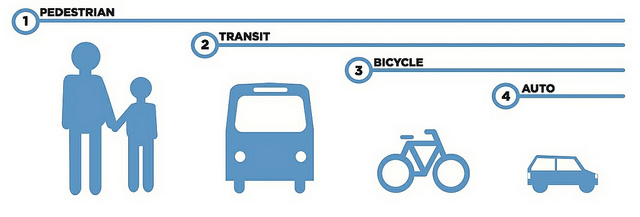
Added info: There was a discussion about the prioritization of different travel modes during the SacATC meeting this evening. It reminded me of one of my favorite graphics about transportation modes, from Chicago Department of Transportation. I think this is the right answer for Stockton Blvd, and for nearly every other roadway.