SacRT routes & population density

SacRT with density and income

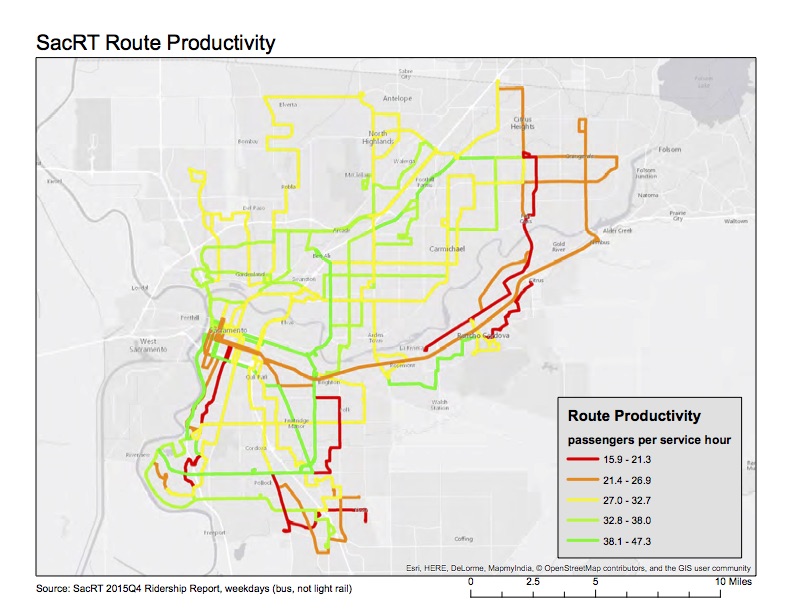
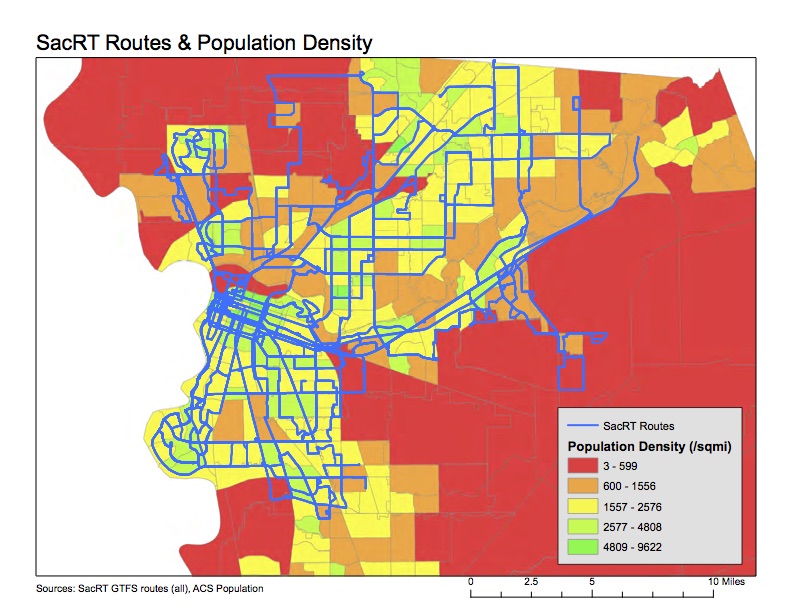
Investigating the proposed SacRT service changes (cuts), I identified that routes serving low density areas are a problem. I developed the map below (pdf SacRT_pop-density) showing routes and population density, with low density areas shown in red. Two routes stand out as servicing primarily low density areas, which are unlikely to ever be productive in a ridership sense. In fact, one of the reasons SacRT struggles to provide efficient transit service is the low-density nature of the county. Though of course agricultural areas north and south of the urbanized area will be low density, there are also large areas of low-density suburb and exurb (sprawl) which will never be successful. Every greenfield development allowed by the county and cities just exacerbates this problem

The population data is from the American Community Survey (ACS) 2014 5-year estimate (S1903), selected by census tract and matched to census tract outlines provided by SACOG, showing residents per square mile. The routes are from the Google Transit Feed Specification (GTFS) provided by SacRT. All routes are shown, including commute hours, low frequency, moderate frequency, and high frequency routes, as well as routes operated by SacRT under contract with others. It would be more useful to identify and/or separate out different kinds of routes, but it takes a while to compile that data, and I’m not quite there yet.

Read More »

Measure BB Sales Tax in Alameda County

In 2014, voters in Alameda county passed a sales tax, Measure BB, by 70%. This measure is seen as a model for progressive use of sales tax in a county, and the Alameda County Transportation Commission simultaneously achieved recognition as a progressive transportation agency. The measure continued an existing half cent sales tax and added another half cent, for a total of one cent. I think a lot can be learned of use in Sacramento county by looking at the measure and the agency.

Measure BB funds the 2014 Transportation Expenditure Plan, which has these goals:

  • Expand BART, bus and commuter rail for reliable, safe and fast services
  • Keep fares affordable for seniors, youth and people with disabilities
  • Provide traffic relief
  • Improve air quality and provide clean transportation
  • Create good jobs within Alameda County

The plan certainly includes some funds for roadways, but shifts the focus to away from traditional roadway expansion to multi-modal transportation, particularly relative to the earlier sales tax which was heavily motor-vehicle oriented. Of the $7.8B (yes, billion) to be invested over 30 years, the allocations are:

  • BART, bus, ferry and commuter rail $2.8B
  • Affordable transit for youth, seniors, and people with disabilities $1B
  • Traffic relief on streets and highways $3B
  • Clean transportation, community development, technology and innovation $1B

The plan allocates 48% of the total to transit, including expansion, operations, and fare subsidies. Of this, 18% of the total goes to operation of AC Transit (Alameda-Contra Costa Transit) which is the equivalent of SacRT. Without knowing the exact nature of the example projects in the document, it is hard to parse out how much of the 39% “traffic relief” category is maintenance and how much expansion, but it looks like about 2/3 maintenance and 1/3 expansion. The 8% clean transportation category includes a remarkable $651M for “Bicycle and Pedestrian Paths and Safety Projects and Educational Programs”.

The Alameda County Transportation Authority has an Independent Watchdog Committee (page 35 of the plan), whereas Sacramento county has nothing of the sort. The committee holds hearings, reviews audits, and issues reports. The Alameda CTC also works with the Alameda county BPAC (Bicycle and Pedestrian Advisory Council), whereas SacTA does not work with SacBAC (Sacramento joint city/county bicycle advisory council), and in fact there is no pedestrian advisory function at the county level at all.

There are a wealth of ideas in the plan, and it is instructive to read it. I’ll be going through it in more detail in the future.

Sacramento Transit Advocates and Riders (STAR)

A new organization is forming here in the Sacramento region specifically to address issues of public transit. This group was seeded and led by 350 Sacramento, and while 350 Sacramento is still one of the coalition members, there is now a core group of active citizens leading the organization. The organization is a combination of individual members (about 50) and a coalition of other organizations (about 25). Though I am pleased to be a member and one of the core leadership, this post does not speak for the organization, but is just a report on it.

The Sacramento region has great organizations for walking advocacy, WALKSacramento, and for bicycle advocacy, SABA (Sacramento Area Bicycle Advocates), but it has never had a strong regional group focused on transit. STAR intends to fill that gap. Given the origin in 350Sac, a focus of the group is on reducing greenhouse gas emissions by getting people out of their cars and on to transit.

The organization has formed three committees to look in detail at issues in public transit in the region. The committees are policy, structure, and outreach. The committees have met about once a month, and there has been a general meeting of the members about once a month. A calendar of public events and STAR meetings is available.

Though the organization will have a regional breadth of the six counties that are part of SACOG (Sacramento Area Council of Governments), the focus to date has been on SacRT (Sacramento Regional Transit) and Sacramento county.

The first major public issue for STAR was the SacRT fare increase proposal, which was presented by SacRT staff in January, modified slightly based on feedback from the board of SacRT, presented again in March, modified further by board action, and adopted at the March 14 board meeting. STAR developed a position paper on the fare increase. Though the STAR proposal was not adopted, this voice for more reasonable fare increases, and the voices from many other people and organizations, particularly the disability community, against any fare increase, did influence the fare increase motion made by Steve Hanson and generated board opposition that resulted in the fare increase passing by only 67%. Most board votes are 100%. Most significantly, the board indicated that it would not consider additional increases until after the November election, and had no stomach for the steep second year increase proposed by staff. The board and staff said that it would be necessary to eliminate or significantly modify up to four bus routes in order to balance the budget in fiscal year 2016-2017, even with the fare increase.

The next major issue up for the organization is a response to the likely half-cent sales tax measure to be offered by SacTA (Sacramento Transportation Authority – better recognized as Sacramento GO) on the November ballot. This measure would increase funding from a half cent under the existing Measure A to a full cent. However, marketing by SacTA indicates that a significant part of the funding will go to the SouthEast Connector and widening of the Capitol City Freeway. These type of sprawl-inducing motor vehicle projects not only take funding from transit, but actually harm transit by subsidizing privately owned vehicles at the expense of public transportation.

STAR does not yet have a web presence on Facebook, the Internet, or Twitter, but it will soon. In the meanwhile, if you’d like to get on the email list, please email Delphine Cathcart.

Green Line to the airport?

SacRT, and many local politicians, want the Green Line to the Airport to be the next big transit project in the region. I have doubts, and have written about them before (Green Line to the AirportOpen houses on Green Line to the Airportlinking the colleges?SacRT light rail extensions). Jarrett Walker, my favorite writer on transit, has posted Keys to Great Airport Transit, a great analysis of rail and bus transit to airports.

  1. Total travel time matters, not just in-vehicle time: Not sure how the Green Line measures up, but it is indicative that the Green Line to Township 9 (the current destination) runs on an infrequent schedule (60 minutes) during a small part of the day, because it is beyond the area where most people travel. The airport would also be beyond where most people travel, so is likely to have infrequent and short hours service.
  2. Combine air travelers and airport employees on the same train/bus: The Green Line might do OK on this, though light rail already suffers from the perception of higher income people (which is mostly who flies rather than takes the bus or train) that light rail is only for poor people.
  3. Connect the airport to lots of places, not just downtown, by providing a total network: Since the SacRT network fails pretty badly on connectivity already, it is likely that the Green Line will suffer from the same issue.
  4. Don’t interfere with the growth of other services: The Green Line is definitely a negative on this issue. The Green Line to the Airport would gobble up all the construction funds for years, as well as a large slice of operating funds. Fare recovery on the network is 23%, somewhat below average, but the extension would likely reduce this significantly. If distance-based fares (which SacRT has talked about but done no real planning towards) are implemented on the light rail system, the operating subsidy might be less, but it will still compare poorly with the rest of the system.
  5. If you can afford it, go via the airport instead of terminating there: Not applicable to the Green Line because there is nothing beyond the airport except agricultural fields, and a bit further out, sprawling suburbs that would never generate ridership.

I think the right solution for airport access is frequent bus service (15 minute frequency) from downtown to the airport, from 5:00AM to 12:00 midnight, for travelers and airport employees, and less frequent service from midnight to 5:00AM, for employees. The current Yolobus 42A/42B provides infrequent (60 minute) service from 5:30AM (6:30AM on weekends) to 10:00PM. In addition, there would need to be service from eastern Sacramento/Roseville, but I’ve thought less about how that would work.

Save our infrastructure funds for more productive routes!

RideSacRT app

RideSacRTI have been using the RideSacRT app for a bit of time, and have some initial impressions.

When I started, I could not get the app to accept credit cards, which is the only way to pay for tickets. It rejected three different cards (two credit and one debit). I asked about that via Twitter, and SacRT responded that they were aware of problems with some credit cards. After a couple of days, I tried again, and my main card was accepted.

It is fairly easy to purchase tickets. Tap on the the “buy tickets” icon on the lower left, select the length (single or daily pass) and type (basic or discount), and the quantity, and then “add to cart.” Then select select your card, or enter your card if you have not used it before, and then “pay now” and “purchase.” You can then use your ticket immediately, or later by selecting “ticket manager” from the pull-up menu in the lower right corner.

RideSacRT-TicketWalletThe ticket, once selected for use, lasts for 90 minutes and is good on buses and light rail.

William Burg and others have been discussing whether this 90 minute window offered to smart phone users is fair to people who pay cash, and only get one ride. If there were ticket machines available everywhere, it might be reasonable to require that someone pre-purchase a ticket of some sort, but there are not machines everywhere. People paying cash do slow down boarding of buses, often fumbling for the right change and search for money in various places. This is significant because dwell time, the amount of time a bus spends stopped, the largest determinant of how efficient the route is. This is why transit agencies are experimenting with smart phone apps and transit cards like the Connected Card, coming to SacRT some time this century. I’m not sure how I feel about the equity issue.

The app cannot purchase or store passes. The app is a six month pilot, so it is possible that other capabilities will be added during or at the end of the pilot.

The app also offers routing. It opens with a display of a Google Maps centered on the current location, and start/end fields at the top. But the search routine is seriously flawed. It cannot find street intersections. For example, a search for Folsom and 65th St came up with a location far south on 65th St. It cannot find transit stops unless you know and can enter the exact name of the stop. For example, a search for 65th St Station produces nothing, since the actual name of that station University/65th St. If you type a partial match, a list of suggestions is provided, but that list cannot be scrolled, it pops back to the first two on the list and anything further down (which is likely since the matching is so poor) cannot be selected. For example, type “65th” and see what happens. The app is perfectly happy to match partial names to places completely outside the SacRT service area. For example, Berkeley.

So, my first take is that the ticket purchase is worthwhile, but the routing function is worthless.

Note: I’ve not offered a screenshot of an active ticket because I’m not in Sacramento at the moment, and it would waste a ticket to use one.


MTP-SCS comments

mtpscsSACOG is working on the 2016 update of the MTP-SCS (Metropolitan Transportation Plan / Sustainable Communities Strategy) or Greenprint, with the draft having been out for a month and the deadline for comments on November 16. The last of the public meetings will be held tomorrow, Tuesday, November 10, 6:30-7:30PM, at SACOG Offices, 1415 L Street, 3rd Floor, Sacramento. I hope you can attend.

I have been part of a 350Sac Transportation Committee effort to review the document. I’ve reviewed parts of it, Chapters 1, 4, and 5C, and Appendix A, but have not had the time to review the whole thing – it is massive. The comments below are my own, not the committees. Your comments on the plan are welcome and important. If you can’t tackle the whole plan, pick a small part of interest to you, and comment on that part.

Read More »

Sac Grid 2.0

Tomorrow (Monday) an open house / community meeting will be held on the Sacramento Grid 2.0 project which aims to improve transportation in the downtown/midtown area of Sacramento.

I attended the stakeholder meeting October 20, and had input leading up and as a result of that meeting, but then forgot to post. Thank you, Ken Petruzzelli for reminding me to post.

The stakeholder meeting was all about the maps of each component (pedestrian, bicycling, transit, and others), gathering feedback about what works and what doesn’t. Of course with physical maps you can’t overlay different layers to see what the correlation is, but the facilitator at my table did a good job of relating the layers. The maps have not been made available to the public yet, and what you see on Monday could differ from those shown at the stakeholder meeting.

Significant issues in my group (there were six groups) were: whether bike lanes on both sides of one-way streets made sense, with the consensus being that they were not needed except in special circumstances of heavy bicyclist traffic turning left; whether the two-way cycle-track (separated bikeway) on N Street between 3rd and 15th would work well at intersections in the western part; and that nothing in the plan seemed to address a reduction of signals and stop signs throughout the grid that would improve transportation flow and actually reduce speeding.

The map approach at the stakeholder meeting left out that which isn’t spatial – policy. I think policy to support the transformation is at least as important as which streets are changed. What follows is a list of policy issues that I think must be addressed in the plan.

Read More »

transit frequency in Houston and Sacramento

Houston has been in the news recently, and will certainly be today, opening day, for their revised transit system which created a network of high frequency (service every 15 minutes or better, 15 hours a day, 7 days a week) transit lines. The map below left shows this new system, only, and clicking goes to the high resolution image on the Houston METRO website. The map below right shows the entire system, with lines that don’t meet the high frequency definition. The system was redesigned with the help of Jarrett Walker, transit consultant and author of Human Transit, which I posted on yesterday and will be posting a lot more in the near future.

Houston METRO Frequent Network

Houston METRO System

So, what’s the story in Sacramento?

Read More »

SacRT issues and posts

A summary of SacRT issues and my blog posts (even more):

And issues on my list to blog about:

  • failure of the streetcar
  • more about light rail extensions
  • much more about bus rapid transit
  • funding (other options)
  • system map and frequency
  • equity
  • serving density
  • more about station amenities (signing, lighting, cleanliness, Watt elevator)
  • delay in ConnectCard implementation
  • need for a SacRT blog
  • transparency in the ad-hoc System Improvement process

improving SacRT

The condition and future of Sacramento Regional Transit (SacRT), particularly the light rail system, has been much in the news recently:

Everyone these days seems to want a better transit system. The problem is that no one wants to pay for a better transit system. The business leaders who suddenly want a modern, appealing, well-maintained light rail are the same ones that have worked over the years to suppress efforts at increasing the tax base for operation of the system.

Read More »