no turn on red for Sacramento?

Update: I was incorrect that a ban citywide would not require signing. See below for more information. Thank you, Matt, for the heads up.

Many places throughout the United States are considering banning turns on red signals. Permitting turns on red was a fuel-saving practice implemented in the 1970s, though there is little evidence it actually saved fuel. There is considerable evidence that it decreases safety for walkers and bicyclists, and perhaps motor vehicle drivers and passengers. Though turns on red signals are not the greatest danger walkers and bicyclists face, banning the practice would have safety benefits. It is a partial protection against oversized SUVs and trucks, which have large blind zones that contribute to striking walkers and bicyclists. Though people think of this as no-right-turn-on-red, in Sacramento central city with its overabundance of one-way streets, it may also be no-left-turn-on red.

San Francisco is considering an expansion of its no-turn-on red zones from the Tenderloin, where it has increased safety and calming traffic, to more of the downtown area. Washington DC has banned turn-on-red, though it doesn’t take effect until next year. Chicago and Seattle have considered bans.

The signs used to indicate no turn on red are:
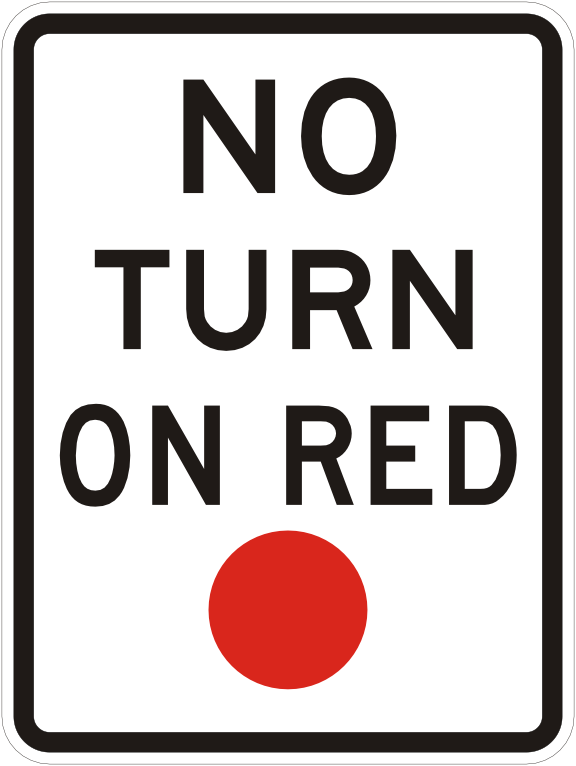
How should the City of Sacramento, and the rest of the counties and cities in the region respond? The options are:

  • ban citywide: Turns on red would be illegal throughout the city (or county). The advantage is that no signing would be needed since it would apply to all signalized intersections. However, this may not have as great a safety benefit as a more targeted approach.
  • ban at locations of crashes involving turning vehicles: This is a no-brainer. Turn on red should be banned at any intersection where there is a history of crashes caused by vehicles turning on red. This should be city policy, to install signs at any location where SWITRS indicates there is an issue, or immediately after any crash.
  • ban at intersections with a high walker count: This is probably the most beneficial for safety. The problem is that the city does not collect data on the number of walkers using crosswalks (marked or unmarked), so it would not know where to start. The lack of data collection is a failure on the part of the city, but it is nevertheless a fact.
  • ban at separated bikeway locations: A ban at the intersections with separated bikeways (also called protected bike lanes, parking-protected bikeways, or cycletracks) would protect bicyclists and give them a head start over motor vehicles. Leading pedestrian intervals (LPIs), which bicyclists can also use, can offer even better protection.

I have resisted turn-on-red bans in the past because I thought they had a lower safety benefit than many other measures that could be taken, but traffic violence has become such an issue that any action to reduce death and injury for walkers and bicyclists may be worth taking, and taking now.

As an alternative to bans, yield-to-pedestrians (and bicyclists) signs can also be installed. Two versions are shown below, on the left, the approved MUTCD R10-15R sign, and on the right, the bicyclist and pedestrian version with interim approval in California, and in use in many locations. My observation is that these signs are widely ignored by drivers, but of course, they do help those drivers who are willing to follow the law.


California Vehicle Code (CVC) 21453

CVC 21453: 
(a) A driver facing a steady circular red signal alone shall stop at a marked limit line, but if none, before entering the crosswalk on the near side of the intersection or, if none, then before entering the intersection, and shall remain stopped until an indication to proceed is shown, except as provided in subdivision (b).
(b) Except when a sign is in place prohibiting a turn, a driver, after stopping as required by subdivision (a), facing a steady circular red signal, may turn right, or turn left from a one-way street onto a one-way street. A driver making that turn shall yield the right-of-way to pedestrians lawfully within an adjacent crosswalk and to any vehicle that has approached or is approaching so closely as to constitute an immediate hazard to the driver, and shall continue to yield the right-of-way to that vehicle until the driver can proceed with reasonable safety.
(c) A driver facing a steady red arrow signal shall not enter the intersection to make the movement indicated by the arrow and, unless entering the intersection to make a movement permitted by another signal, shall stop at a clearly marked limit line, but if none, before entering the crosswalk on the near side of the intersection, or if none, then before entering the intersection, and shall remain stopped until an indication permitting movement is shown.

https://leginfo.legislature.ca.gov/faces/codes_displaySection.xhtml?lawCode=VEH&sectionNum=21453.

Under section (b), signs are required, even if the ban is citywide. Section (c) does allow use of red arrows, but the red arrow signal would be more expensive than a sign, so only used in a few situations. The blank-out sign, shown above in the set of three, is probably the most effective, but again, more expensive that a regular sign.

Central City Mobility update: 19th St

This is Central City Mobility Project update #24.

For quite some while, the project on 19th Street had stopped at Q Street, but it is now continuing south to W St. White striping is done, there is some green paint but incomplete, curb and line colors for special parking is not started, and there are no vertical delineators. The block from Q Street to the light rail tracks is a buffered bike lane, due to a street dining area at Midtown Spirits. At the tracks, there are some swooping lines, that I think are intended to encourage bicyclists to cross the tracks at a closer to perpendicular angle, but it is not finished so I can’t tell if it being properly marked. The remaining blocks to W Street are parking protection separated bikeway.

photo, 19th St at Q St, buffered bike lane
19th St at Q St, buffered bike lane

The section from W Street to Broadway has not been worked on. As is true of most of the separated bikeways, it is on the left side. South of Broadway, 19th Street becomes Freeport Blvd and is two way, with the southbound bike lane on the right side. At the moment, there is nothing to indicate how and where a bicyclist would transition from right side to left side. The two blocks are devoted to general purpose (motor vehicle) lanes, and is not a comfortable place for a bicyclist to be.

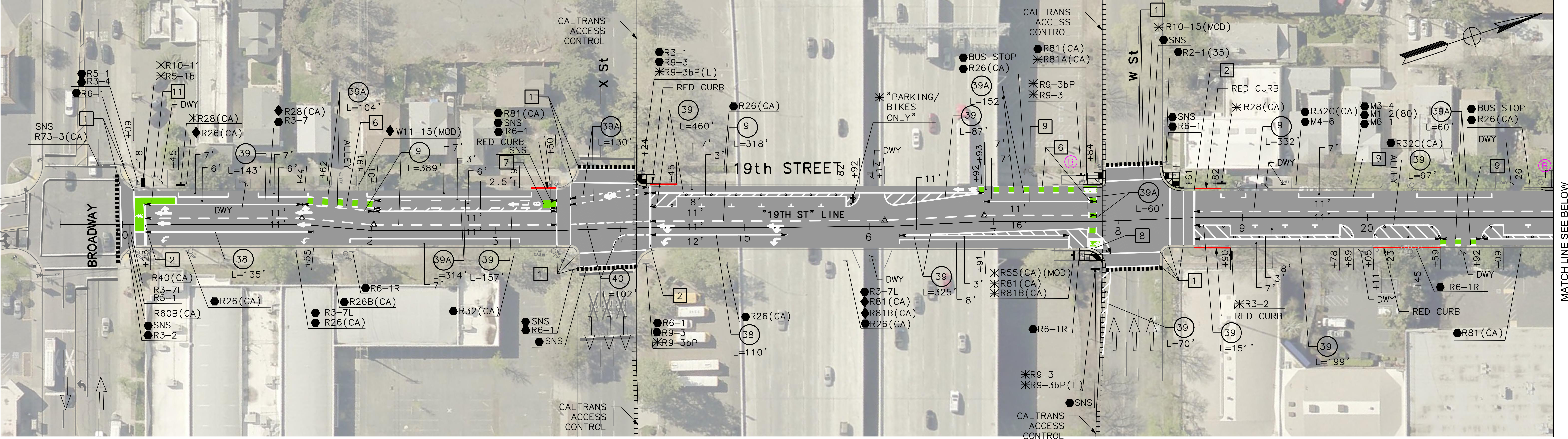
In the design diagrams, the transition appears to be at W Street, with no particular accommodation for bicyclists. Though the design diagrams do not indicate operations, just striping and signing, it looks as though bicyclists will cross W Street on the east side, with the regular signal, and then 19th Street on the south side, with the regular signal. There is no indication that the bicyclist crossing 19th Street will be protected from left turning motor vehicle traffic by an exclusive phase. Green paint is not sufficient communication for most drivers, hard physical control is required, such as no left turn during the bicyclist movement. I suspect, based on city implementation in other locations, that it was decided that an exclusive bicyclist phase was ‘not practical’ because it would slow motor vehicle drivers a bit.

design diagram, 19th Street from W Street to Broadway
19th Street from W Street to Broadway

I believe that the city should develop and install signing specifically for bicyclists on the transition points, where a bikeway either ends or transitions to the other side. There is no indication that the city has done or intends to do this. The diagram indicates a R55(CA) (MOD) sign on the southeast corner, which is a mystery, since the standard R55 sign is ‘yield to uphill traffic’. Of course neither the federal MUTCD nor the California CA-MUTCD, which is similar, has much in the way of guidance or signage for bicycle facilities, since in the mind of FHWA and Caltrans, bicyclists are an afterthought. There are several note references around this intersection, several of which I have been unable to locate in the design document, but they must exist somewhere. Be aware that the city has ‘invented’ a number of traffic control signs that are not compliant with CA-MUTCD, so the excuse that there isn’t an official sign is just stonewalling on the part of the city.

I Street

There has been no work on I Street in quite a while, since the resurfacing, but there are new ‘no parking’ signs posted with control starting today, 2023-09-19, so perhaps work is about to start again.

J Street needs construction bypass

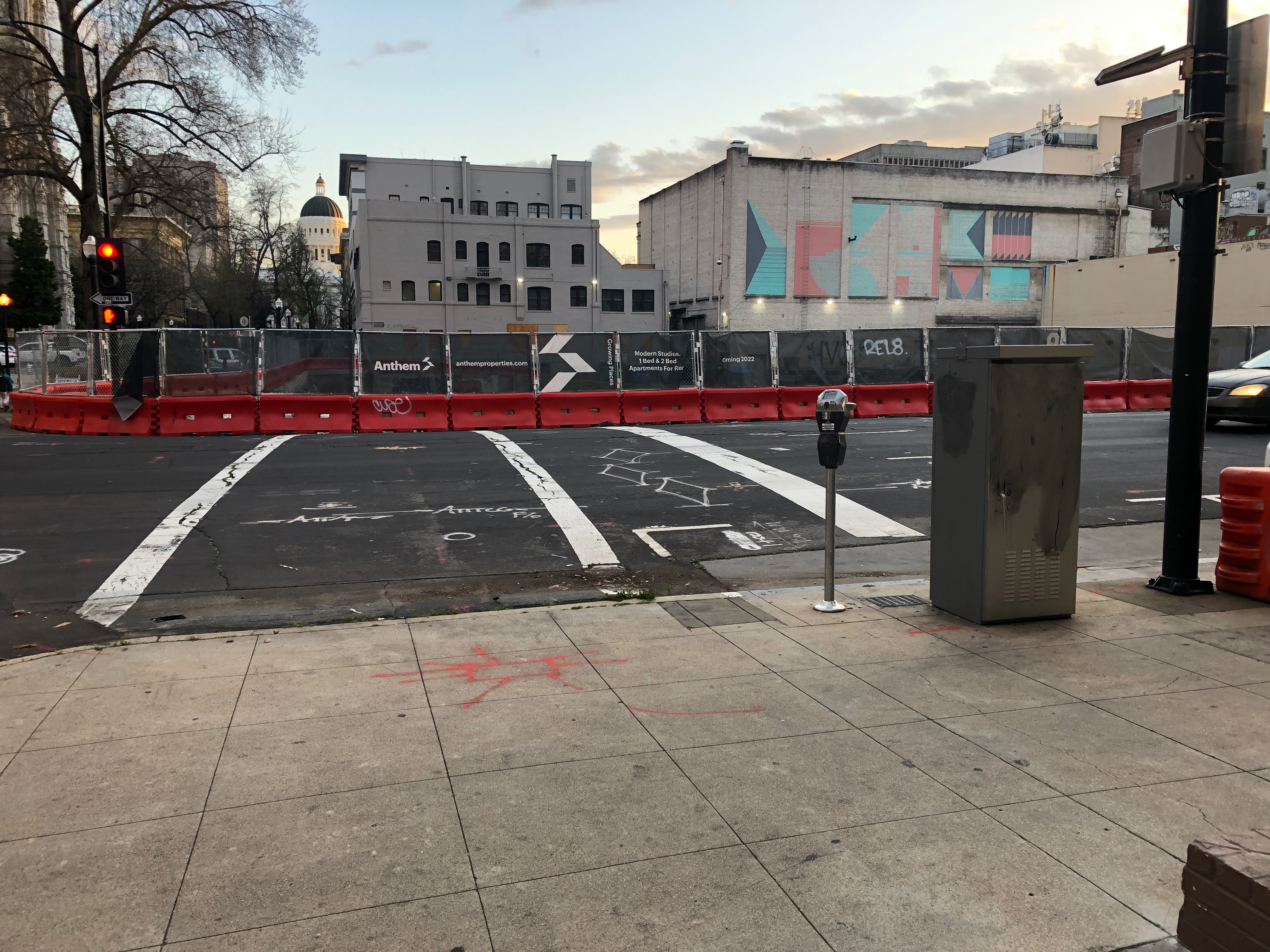
The future development, possibly to be called Anthem Cathedral Square, at J Street & 11th Street is currently a hole in the ground. The old buildings have been razed, and debris hauled away, but new construction has not started, so it will be some while before J Street on the north side of the site (south side of the street) returns to normal.

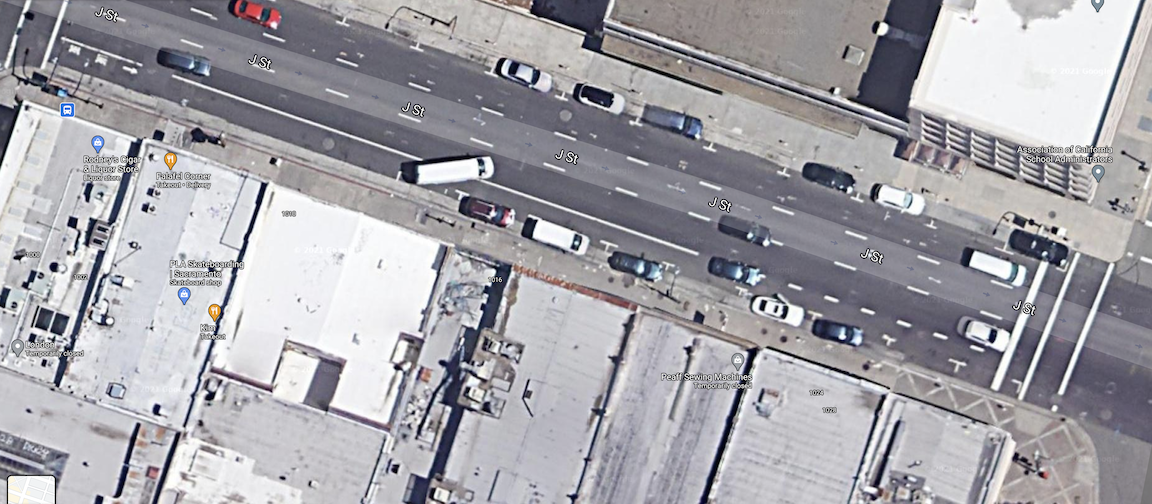
A channelized bypass should be created to carry the sidewalk for walkers and the bike lane for bicyclists past this construction site, between 10th St and 11th St, by removing a general purpose travel lane from J Street. The aerial below (before removal of the buildings) shows a sidewalk, a parking lane, a bicycle lane, three general purpose travel lanes, and a parking lane. The channelized bypass would include a shared pathway for walkers and bicyclists, in place of the right hand general purpose lane. The bypass can be created with use of orange construction barrier, as was done on 9th Street. This bypass would remain in place until construction is complete.

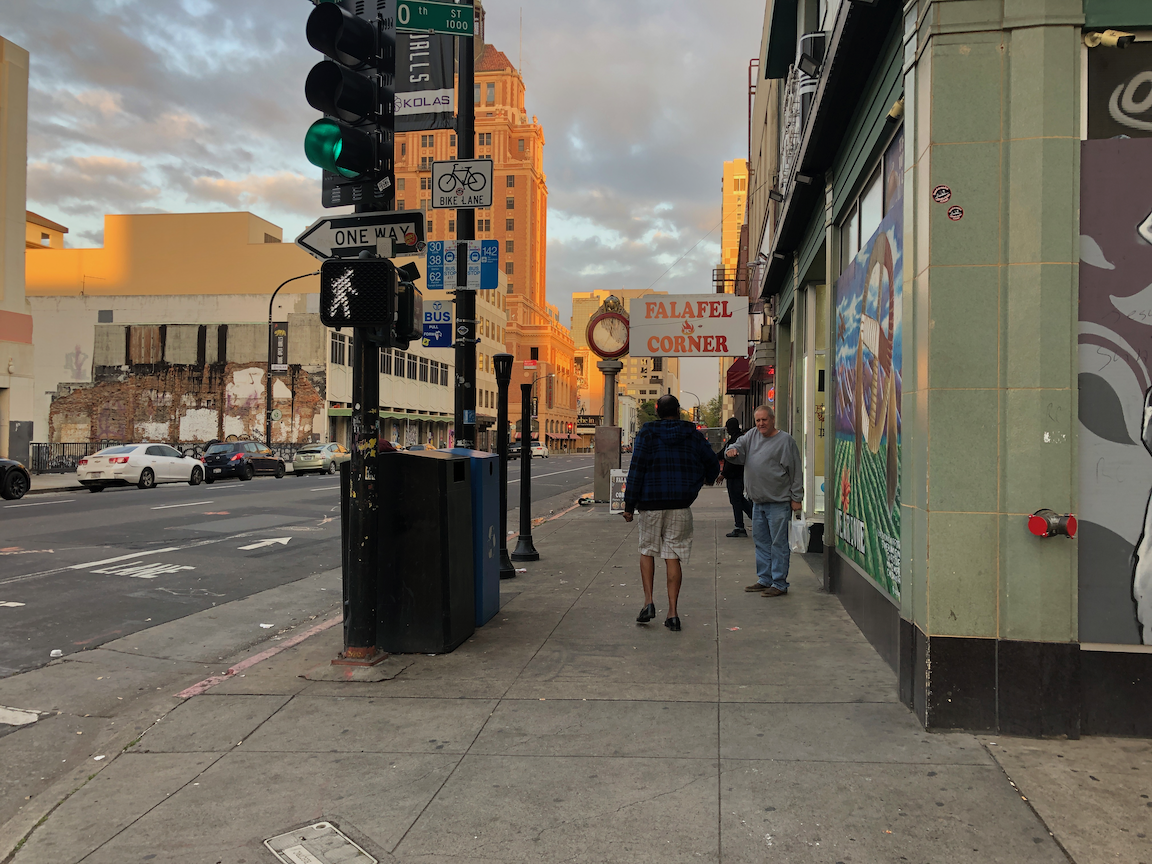
While the razing and cleanup was going on, there was decent signing, but it has disappeared or been moved to the side. The first set is the former signage at J St & 1oth St, and then today without an signage. There should be a sign here, the MUTCD R9-11; a barrier is not appropriate at this location since the closure is ahead and there are businesses open.

J St at 10th St se, signage
J St at 10th St se, no signage

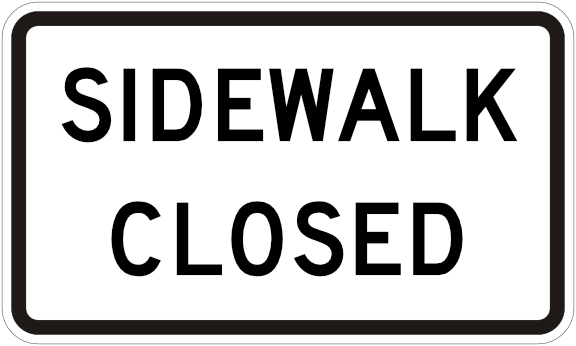
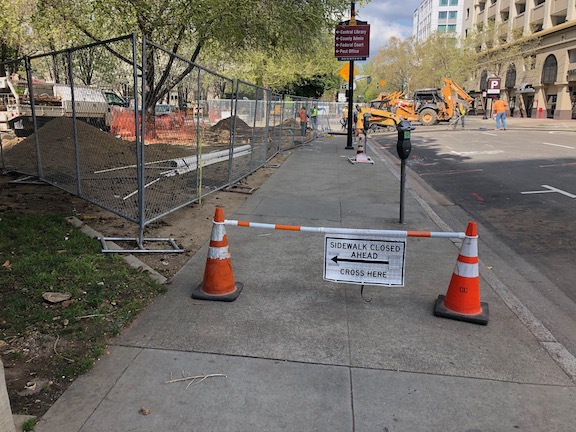
At the sidewalk closure point, there is an acceptable barrier but no signage. At this point, it looks like there could be a bypass, but it is fenced off. The appropriate sign here is MUTCD R9-9.

J St past 10th St, sidewalk barrier

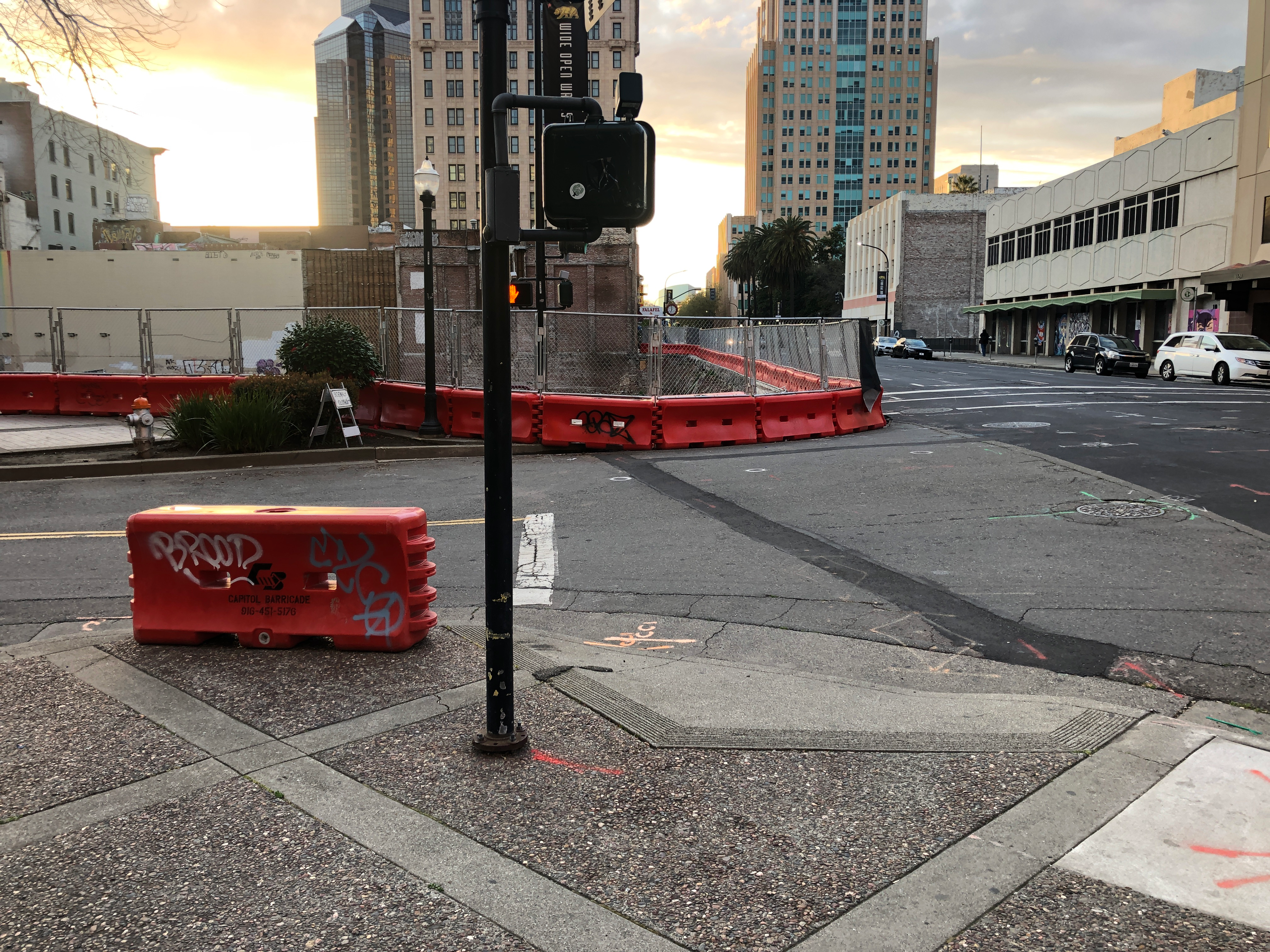
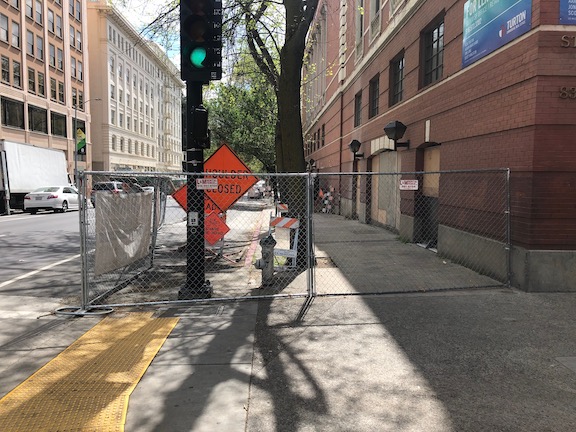
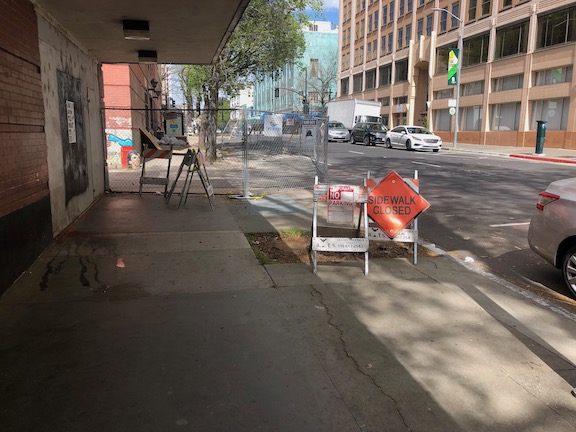
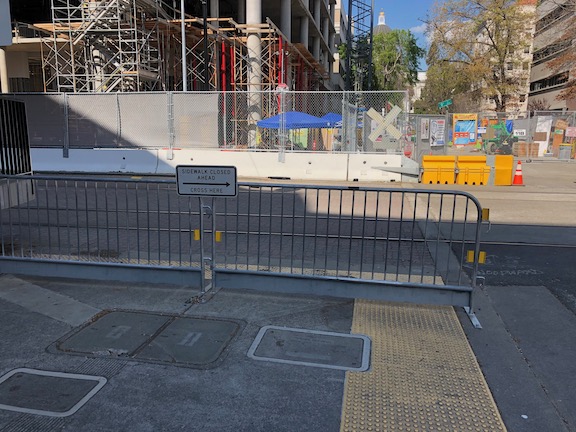
At J St & 11th St southeast corner, there was a barrier and signage, but the barrier has been moved to the side and the signage is gone. There should be a barrier and sign here to indicate that the crosswalk is closed. The third photo is an example of a correct barrier and signage.

11th St at J St se, signage
11th St at J St se, no signage
crosswalk closure barrier
correct barrier and signage

At J St & 11th St northwest corner, there should be a barrier and signing to indicate the crosswalk is closed, but neither is present.

J St & 11th St nw, no barrier or signage

This construction zone failure is one among many in Sacramento. The city is not creating traffic control plans that accommodate walkers and bicyclists, and the construction companies are not appropriately placing signs and barriers. This is a violation of the ADA (Americans with Disabilities Act). Responsibility for encroachment permits (when the construction project goes into the public right of way, which includes sidewalks), and traffic control plans to mitigate the situation, rests with the City of Sacramento Department of Public Works.

I have created a new category, construction zone, which will make is easier to find other posts on the construction zone topic. Photos of many construction zone locations are on Flicker in Sac construction-zone album.

miscellaneous construction woes

I recognize that all the examples of construction zone problems (and a few done right) have been central city Sacramento. This is for two reasons, one is that I live downtown, and when I’m out on my physical distancing walks, these are the places I’m seeing. The second is that a lot of the construction happening in the entire city is happening in downtown, particularly the projects which require extensive closure of sidewalks, and bike lanes. If you have examples from other places, please let me know (allisondan52@gmail.com) and I will try to get there to take photos and analyze the situation. For those of you in the county, well, that is too much to tackle, and in a relative sense the county is economically moribund, so much less construction is going on.

Please don’t take my criticism of construction zones at being a criticism of construction. I love that there is a lot of construction going on. In midtown, most of the construction is housing, and nothing could make me happier. In downtown, there is more office construction than housing construction, and that is not a good thing, as it further exacerbates the jobs/housing imbalance in downtown. Except right around the arena, and in old town, there are few businesses and almost none are open on weekends because there is so little housing as compared to offices.

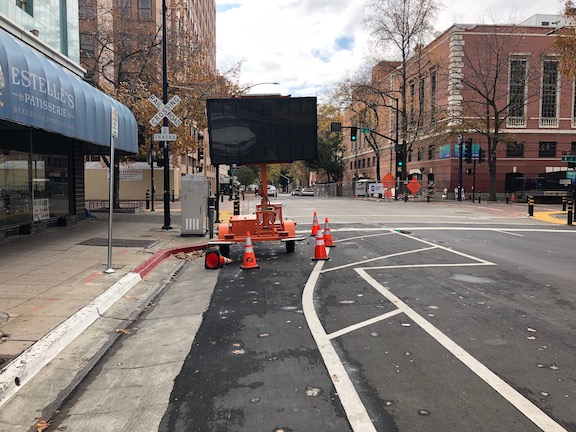
Below, a few last examples, before I move on to solutions. The first was a temporary issue, but it is illustrative of the problems. A mobile message board was placed in the center of the separated bikeway on 9th Street, even though there was a cross-hatched area immediately adjacent where is could have been placed, without constraining the bikeway or the general purpose lanes. I am not sure whose mistake this was, but anyone with a brain would know that this was the wrong place to put it. The sign was moved within a day of my reporting it to the city, but these are things that should be done right, not relying on citizens to correct mistakes.

9th Street separated bikeway, mobile message board

There is currently a utility project along the north side of L Street between 13th St and 10th Street. The photo belows shows the situation at L Street & 11th Street. The signing is acceptable, though the use of plastic barricade poles is not, but the issue is that the detour doesn’t tell you how far. A block? Several? Where is the nearest safe crossing? As referred to in the What? Cross Where? post, the west side of this intersection has a pedestrian prohibition, but you can see someone crossing here. And why not? What else could they do?

L Street at 11th Street, signing but no information, improper barricade

This next one was a temporary closure on 10th Street. There is signing, but rather than being placed at the point where a walker could either choose to cross to the east side of the street, or to walk through Cesar Chavez Plaza and back to the sidewalk, it was placed where the closure starts. Again, the plastic barricade poles do not meet ADA requirements because they are not detectable for person with vision limitations. While some would say, well this is just temporary, for a day, and standards should be lower, I disagree. It may be perfectly acceptable to not provide an alternative route for a temporary closure, but the signing and sign locations should be the same for all closures, whether they last an hour, a day, a week, a month, a year.

10th Street, west side, temporary closure

And one last example, though I have dozens more. The 3rd Street Sewer project has closed off 3rd Street from S Street to U Street. An attempt has been made to keep the sidewalks open, and I seriously appreciate this effort, as many construction projects would simply close off the sidewalks along with the street, and not think twice. However, construction tape does not a safe route make. The detour signs are clear, but no attempt is made to provide a detectable barrier. And construction tape…

3rd Street & T Street closure, signing, tape

830K construction zone

Yet another. There is a construction project, or at least a fencing off for future construction, at 830K, a long abandoned building. Along 9th Street, a fence has been put up where there used to be a bus stop, extending from K Street to and including Kayak Alley.

Southbound at K Street, there is no signing on the fence at all. This is not a major flaw, as it is obvious the sidewalk is closed, but there is no information about how far the closure extends.

9th Street southbound at K Street, west side (830 K)

From the south end, things are much worse. There is no signing at L Street to indicate there is a closure ahead. When you get to the closure, there is a random assortment of barricades, each of which is non-ADA compliant, and not indication which way to go. If Kayak Alley were open, it would at least offer an alternative, but the alley is closed.

9th Street, northbound at Kayak Alley, west side (830 K)

The worst part of this is that, so far as I can tell, nothing is going on here. The sidewalk, and bus stop, was closed off by fencing, but since then, nothing is happening. The point here is that there should be requirements placed on construction projects that if they stall out, the sidewalks must be returned to their previous open condition until such time as construction resumes.

crosswalk barriers done right

And now, before going on to all the examples of failure to accommodate walkers and bicyclists, some examples of crosswalk/sidewalk barriers that are done right. These barriers are for the state office building being constructed on the north side of O Street between 11th Street and 10th Street. It is also the light rail alignment, and one of the busier light rail borderings is across the street at Archives Plaza.

These barriers are some of the few ADA compliant barriers in the entire city. These are hard barriers, not construction tape or plastic barricade poles that can be walked through without notice be a vision impaired person. They have a base plate which is detectable by canes. They are anchored to the sidewalk, so that they can’t be knocked over intentionally or accidentally. The signing is clear, that the sidewalk/crosswalk is closed, and that the route goes left, crossing O Street.

11th Street at O Street, northeast corner

At the opposite corner of the project, on 10th Street southbound, there is clear signing, even wayfinding signing for the State Museum. Though the sidewalk is open for half the block, the barriers and signing make clear that a crossing of 10th Street is the appropriate action. Again, these are ADA compliant barriers.

10th Street east side, southbound from N Street

On 11th Street northbound, there is ‘share the lane’ signing, which is not ideal but serves acceptably in this situation with narrow street width. On 10th Street northbound, the bicycle lane has been carried through by shifting travel lanes to the left (west) and removing parking (no photo, but I will add one later). This is a good solution to accommodating bicyclists.

11th Street northbound

The remaining photos below show the other barriers and signing for this construction project. I don’t know why this one was done correctly, when most of the others are not. Was it the construction company that insisted on doing it right? Was it the state? Was it the city?

10th Street at O Street, northwest corner, crosswalk barricade
O Street at 10th Street, southeast corner, barricade and signing
O Street at 11th Street, southwest corner, barricade and signing

What? Cross where?

Now onto a construction signing instance that would be laughable if it weren’t dangerous and offensive.

11th Street & J Street, northwest corner

Take a look at the signing, and think about what it means….

The orange detour sign is telling you the detour goes left, to cross J Street, while the permanent pedestrian prohibition signing tells you not to cross J Street here. Leaving along the issue of a stupid place to put a pedestrian prohibition (it is here simply to favor the drivers whipping out of the garage exit on 11th Street and wanting to take the right without stopping), this is nonsensical. This is one of the few issues that I do blame the construction company for. It was eventually corrected, the orange detour sign was turned around to face eastbound walkers, where it should have been, but it was this way for more than 24 hours. Does the construction company care so little about safety that it just puts up signs without thinking about them? Well, yes.

Parkway trail flood signing

Part two of posts on the parkway trail; Parkway trail low points.

When the parkway trail has been flooded this year, all the way back into December but increasingly this spring, Sacramento Regional Parks has closed various segments, and even the entire parkway at times. This is understandable. The trail is, after all, in a riparian area, and what defines riparian areas is an abundance of water.

Regional Parks has posted some information about the trail on their website, particularly as more and more of the trail has been closed, and is up-to-date with a complete closure now. In December and early January the website information was frequently out-of-date. Their Twitter account has had somewhat better information about the parkway, but it focuses mostly on motor vehicle access and not on trail access and usability.

Parts of the trail are quite usable right now, but rather than addressing those parts, all of the trail is closed.

Read More »