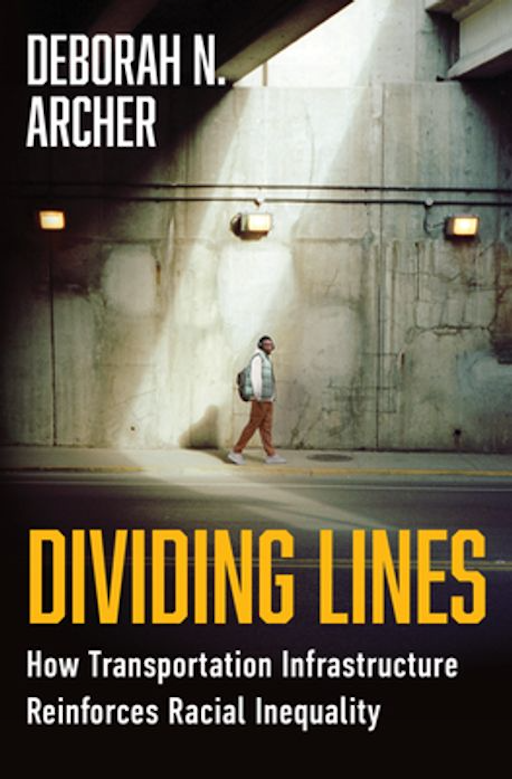
In the 2025 book Dividing Lines: How Transportation Infrastructure Reinforces Racial Inequity (2025; ISBN 978-1-324-13056-7), Deborah N Archer lays out the issues that have long plagued the Black community as their neighborhoods were underinvested, and broken up by transportation infrastructure built for the convenience of white people. She also covers the past legal frameworks that encouraged this, as well as the laws which can be used to fight it and correct it. I am part way though reading the book, but it has deepened my understanding of the racial bias built into our transportation system.
This is not just a problem of other cities. The alignment of Interstate 5 was designed to both erase low income housing and the people of color that lived there, as well as related businesses, and to isolate what remained from the rest of the city. The alignment of Highway 50 was designed to remove low income housing and the people of color that lived there, to isolate the higher income Land Park neighborhood from the city, and erased part of Southside Park. Highway 99 cut directly through south Sacramento and isolated the Black neighborhoods on both sides. And this is just the freeways. Arterial roadways were placed, and widened, and widened again, to separate people of color, and to cater to higher income while people. Many of these were not directed just at Black neighborhoods, but at all immigrant and low income people.
In Chapter 6, ‘The White Man’s Right of Way’, Archer delves more deeply into the issue of sidewalks:
“Even in cities that were not segregated by law, sidewalks in predominantly Black neighborhoods are less common and of poorer quality, often as the result of a legal regime that places greater reliance on private property owners. More than perhaps any other means of transportation, pedestrian infrastructure is highly localized in its construction, funding, and maintenance; the federal government does little to oversee or force accountability on sidewalk quality or even whether sidewalks are required on a particular road. Sidewalks are in some ways “public,” but are also closely associated with adjacent properties or lots. The result is that neighborhood socioeconomic disparities map directly onto pedestrian infrastructure quality, as poorer neighborhoods that are disproportionately Black and Brown are less able to invest private capital into maintaining their sidewalks.”
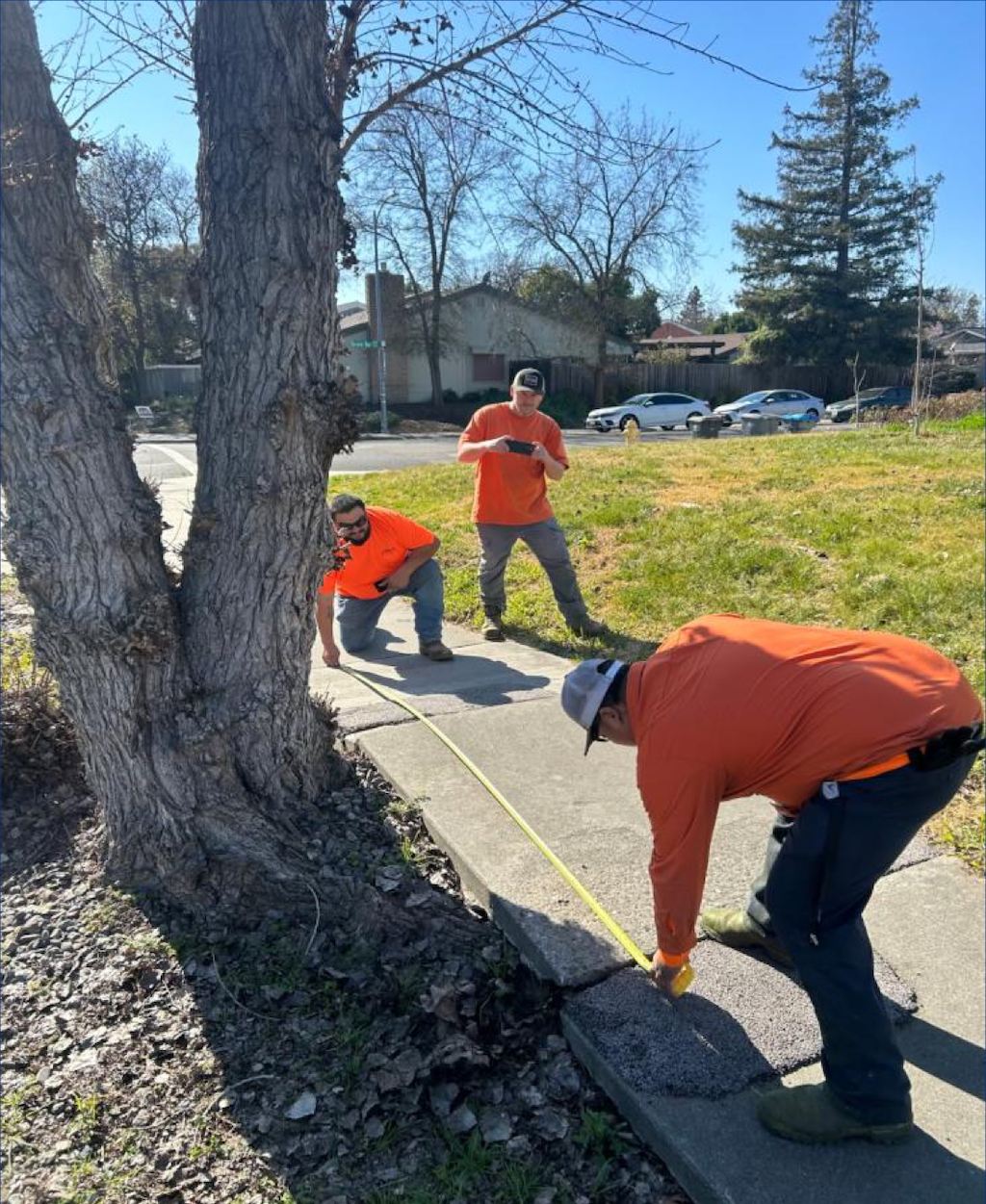
The City of Sacramento responds to complaints about sidewalk condition such as root heaves by making the adjacent property owner repair the sidewalk, or if the property owner does not do so, doing the repair through a contractor and billing the property owner. This is the city’s policy. State law allows the city to impose this, though it does not require the city to impose it. And just because something is in state law does not make it constitutional. As I have said before, requiring a private property owner to maintain city property is prima facie unconstitutional.
The city could take on responsibility, if it so chose. It is worth noting that some of the most poorly maintained sidewalks in the city are adjacent to property the city itself owns. The city often does not apply the requirement to itself.
The cost of a sidewalk repair does not fall equitably. A commercial property owner or a high income property owner may be able to handle the cost of repair, which can be quite expensive. A low income or even moderate income property owner cannot. So where are low income and moderate income property owners located? In those parts of the city where sidewalks were narrow or nonexistent, where the standards of construction were lower or overlooked, where sidewalk buffers, if they were present at all, were too narrow to allow for healthy trees. In other words, north Sacramento and south Sacramento.
Archer says: “Municipalities that require private property owners to maintain sidewalks can worsen disparities when they enforce those rules in inequitable or unreasonable ways. For example, when cities pay for the cost of repairs themselves, they often will bill the adjacent property owner. This debt can be enforced through a lien that may ultimately result in foreclosure on the property. It should not be a surprise that Black communities bear the brunt of this practice.”
I used to file 311 reports on sidewalks, before I understood that the financial burden fell on property owns, and not on the city. Once I realized this, I stopped reporting. Archer says:
“A related problem comes when cities rely on private complaints to determine where and when the city should repair damaged sidewalks. Several cities use voluntary complaint systems like “311” phone calls to assess which sidewalks need work. Low-income communities of color are far less likely to call to request help. Seattle, Washington, switched from a 311 system to a fixed repair schedule after officials realized that relying on 311 led the city to make a disproportionate number of repairs in high-income, white neighborhoods. Those residents were more comfortable filing complaints and likely had higher expectations that those complaints would be addressed. When Boston embarked on a citywide campaign to address sidewalk inequities in 2017, it opted not to use a 311 system. Instead, city officials went block by block over Boston’s 1,600 miles of sidewalk to set repair priorities. But not all cities have the interest or the resources to follow Seattle’s and Boston’s leads.”
One can argue about whether these disparities were intentional on the part of the city, or inattention by the city, or the result of private developers, or any number of other excuses. The fact remains that Black, Latinx, and immigrant communities have lower quality walking environments, and lower quality sidewalks, and many of the property owners there cannot afford to maintain these sidewalks.
Placing the burden of sidewalk repair on adjacent property owners is racist, if not in intent, then in practice. It is time to change this. It is time for the city to take on responsibility for maintaining sidewalks. I am not talking about situations where damage to a sidewalk is clearly the result of trees planted on private property too close to the sidewalk, or where driving over sidewalks by private property owners (or their tenants) caused damage. But I am most certainly talking about sidewalks where trees in the city right-of-way, which includes sidewalk buffers (planting strips), have caused the damage, and deterioration due to natural causes or substandard construction led to damage. I have looked at miles of sidewalks in the city, and can say with certainty that the city often accepted substandard sidewalk construction because it did not care about the neighborhoods where this shoddy construction was the pattern.
I have written about Denver’s solution (Denver’s approach to sidewalk maintenance, 2024-11-05), and will have more (much more) to say about sidewalks. They are the neglected part of our transportation system.
Talking Headways/Jeff Wood just had an interview (Episode 578, Sidewalk Nation) with Michael Pollack, author of Sidewalk Nation: The Life and Law of America’s Most Overlooked Resource (ISBN 9780674305366), to be published in June. I will take a look at that book when it becomes available, and it should be even more to the point.

 Getting Around Sacramento