alternatives to transportation sales tax

Sales taxes are regressive, in that lower income people pay a higher percentage of their income in sales tax than do higher income people. In Sacramento area, a new transportation sales tax measure is being talked about, whether for transportation in general, or for transit specifically. No proposals have been made, but there are certainly many discussions in many arenas.

The San Francisco Bay Area is also having the same discussions. There is legislation to authorize a transportation sales tax measure in up to five Bay Area counties. A recent KQED article (Proposed Transit Tax Should Be Paid by Businesses, Not People, Progressive Group Says) talks about discussions, and an alternative proposal to use a business gross receipts tax instead of sales tax. It is true that any tax ultimately comes out of the pockets of citizens, but a gross receipts tax is better distributed and not as regressive.

I have a concern that politicians again and again go to the default of sales taxes because it seems easier to sell. But sales tax rates are already very high, and there is increasing evidence that voters will not go for a higher sales tax rate, no matter what the topic or the benefit.

I’ll write more about funding options in the future. Past posts include Is sales tax for transportation the wrong approach?, transportation funding ideas, and many, many others under the category: transportation funding. I was amazed, looking back, at how many times I’ve posted about transportation funding and tax measures.

Is sales tax for transportation the wrong approach?

There are three ideas for transportation funding floating around, for the 2026 ballot, though none have been formalized. All rely on sales tax.

  • Sacramento Transportation Authority (SacTA) may create a ballot measure to fund transportation. It would be in addition to the existing Measure A, and might fund transportation infrastructure for infill housing, which has not been done before. As an agency-sponsored measure, it would require 2/3 vote to pass.
  • Sacramento Metro Rail and Transit Advocates (SMART) and Mayor Darrell Steinberg have drafted measure that would fund active transportation, transit, and housing. It would probably be for the county, but could be just for the City of Sacramento. As a citizen initiative, it would require only 50% + 1 to pass, a much more achievable vote.
  • SacRT it considering a measure for transit and related active transportation that might cover only a part of Sacramento County, the more transit-supportive part, probably the cities of Sacramento and Elk Grove. As an agency-sponsored measure, it would require 2/3 vote to pass.

Sales taxes are regressive, meaning that low-income people pay a much larger percentage of their income to sales tax versus high-income people. Most organizations which lead with equity are opposed to further sales tax increases, feeling that enough is enough.

In Sacramento County, with a strong anti-tax voice in the low density unincorporated county, it is difficult though not impossible to reach the 2/3 threshold. The 2016 transportation sales tax fell short of 2/3. Measures to fund schools districts are more likely to pass. A complicating issue is that Elk Grove recently passed a sales tax measure to fund many purposes, one of which is transportation. Folsom and Rancho Cordova have sales taxes for which it isn’t clear to me whether any goes to transportation.

General purpose sales tax measures, which may list uses but are not required to follow those lists, only require 50% + 1 to pass. That flexibility is both a feature and a danger, since a government may shift sales tax income from what they said it would be spent on to other purposes.

Though I have not heard parcel taxes being discussed, they are another source of funding, though they are also regressive because they are a flat rate per parcel, not based on the value of the parcel.

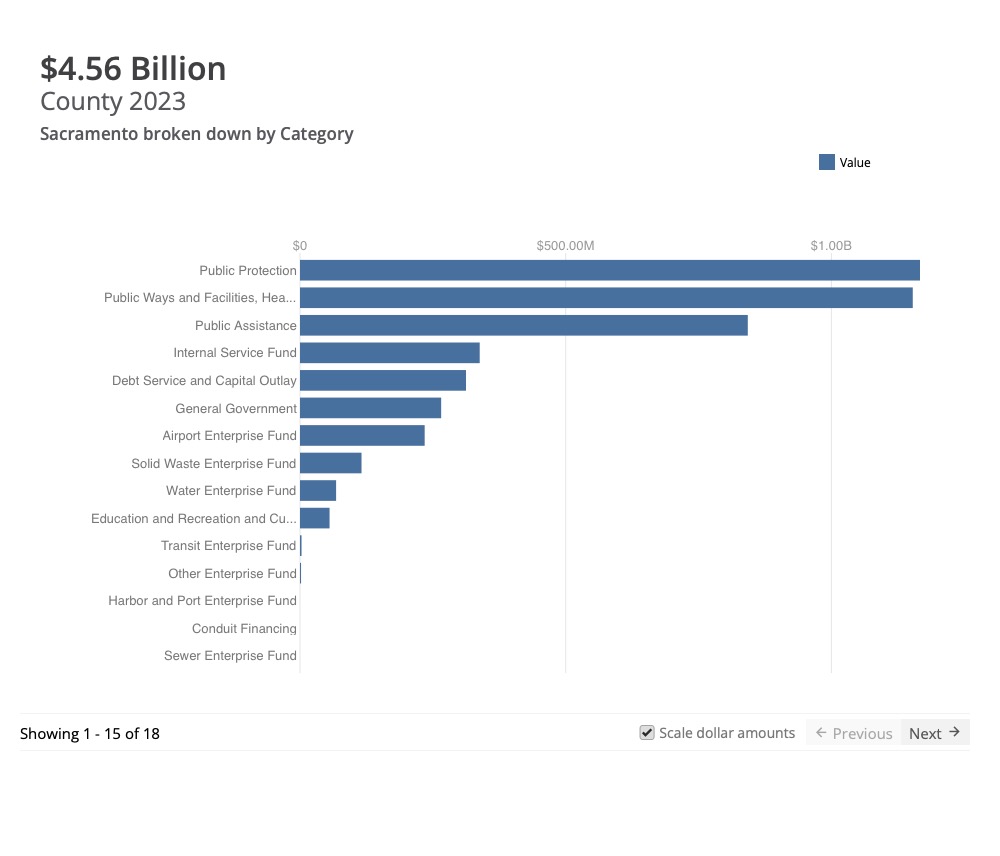
Two other types of tax which are progressive, meaning that high-income people pay a higher percentage of income than low-income people, are income tax and property tax. Income tax does fund transportation at the state level, but income taxes are not available to cities, counties, and special districts. Property tax can fund transportation, though due to Prop 13 which limits property tax, it mostly goes to schools and public safety. For Sacramento County in 2023, the chart below shows allocations. The ‘Public Ways and Facilities, Health, and Sanitation’ category goes mostly to Health, with Public Ways and Facilities being less than 20% of that category. This chart does not include school districts within the county, which also rely on property tax.

Transfer taxes, which are based on the value of a property when it is sold, are progressive. These have been discussed in a number of places in California, though not locally so far as I have heard. I am not aware of any existing transfer taxes that fund transportation, though they do fund a number of other government functions. The state levies a transfer tax throughout the state, and that income goes into the general fund.

Any county, city or special district can bond against property tax, meaning that they can expend money now and pay it back over time from future property tax income. Again, Prop 13 limits the usefulness of this by suppressing property tax income, but does not preclude it. If Prop 5 on the 2024 ballot passes, cities, counties, and special districts will be able pass bond measures with a 55% vote rather than 2/3 vote, though the proposition raises the bar on transparency and types of expenditures. Though Prop 5 is intended primarily to fund housing, it could fund transportation, and there is a logical nexus with transportation that supports housing.

For other posts on transportation funding, see category Transportation Funding.

Prop 5 bonding for transportation?

Proposition 5

A Yes on 5 website offers details in support of the proposition. The arguments against, on the voter information guide, are just the standard anti-tax voice, so isn’t useful to this post, but you can read your guide if you are interested. Prop 5 was placed on the ballot by the legislature, as a result of two legislative resolutions. The proposition is entitled “Proposition 5: Allows Local Bonds for Affordable Housing and Public Infrastructure with 55% Voter Approval.

The proposition would change the voting threshold from two-thirds, 67%, to 55%, for ballot measures by cities, counties and special districts (does this include SacRT?) that bond against property taxes for the purposes of affordable housing and public infrastructure. The proposition does not directly raise property taxes, nor would local bonding measures directly raise taxes, though since the bonds have to be repaid with interest, property taxes could eventually go up within the limits sets by other legislation. This has nothing to do with sales tax, which remains at two-thirds for govenment proposed sales taxes, and 50%+1 for citizen proposed measures.

The history of the proposal development indicates that it is more about affordable housing than public infrastructure, but infrastructure is definitely allowed, and could easily be justified when that infrastructure supports affordable housing. It can also apply to transportation infrastructure. The specific language in the ballot measure related to infrastructure is “construction, reconstruction, rehabilitation, or replacement of public infrastructure”, which is pretty open-ended. More specifically, the proposition lists the following infrastructure uses:

(I) Facilities or infrastructure for the delivery of public services, including education, police, fire protection, parks, recreation, open space, emergency medical, public health, libraries, flood protection, streets or highways, seaports, public transit, railroad, airports, and
(II) Utility, common carrier or other similar projects, including energy-related, communication-related, water-related, and wastewater-related facilities or infrastructure.
(III) Projects identified by the State or local government for recovery from natural disasters.
(IV) Equipment related to fire suppression, emergency response equipment, or interoperable communications equipment for direct and exclusive use by fire, emergency response, police, or sheriff personnel.
(V) Projects that provide protection of property from sea level rise.
(VI) Projects that provide public broadband internet access service expansion in underserved areas.
(VII) Private uses incidental to, or necessary for, the public infrastructure.
(VIII) Grants to homeowners for the purposes of structure hardening of homes and structures, as defined in state law.

The reason for raising this issue is that taxes based on property are progressive, meaning that people with higher incomes and therefore higher value property, pay more in taxes. Sales taxes are regressive, meaning that low-income people pay a higher percentage of their income on taxes than do higher income people. Proposals to increase the sales tax in Sacramento County have been resisted by many who think we have runs out that option and need to turn to options that are not regressive, like property tax.

I prefer pay-as-you go expenditures from most transportation projects, except for a few which are very expensive and of clear benefit to everyone. There are few transportation projects that would or should quality for this. The transportation projects we most need going forward are many small fixes, not the mega-projects done in the past which tend to be motor vehicle projects. But some transit projects could be or should be bonded. The problem with bonding is that interest payments raise the cost to about 1-1/2 times the project cost, depending on the bond length and bone rates, and that money goes to wall street investors, not to the project.

I am in favor of the proposition. It gives local governments, and therefore citizens, control over how they spend their property tax, rather than being constrained by statewide controls that were implemented by anti-tax interests.

If the proposition passes, would it be the solution, or a solution, to funding affordable housing and transportation infrastructure instead of or in addition to sales tax or other taxes and fees? I don’t know, but I do think it is worth exploring. Though the proposition applies to local measures on the same ballot, there are no transportation measures of any sort on the 2024 ballot in Sacramento Couny. There may be in 2026, as a Sacramento Transportation Authority new Measure A transportation sales tax, or a SacRT sales tax for transit with a limited geography, a citizen measure sales tax for housing, transportation, and active transportation (the SMART/Steinberg proposal), or other ideas that have not yet come forward. A property transfer tax has been discussed, which is another progressive tax. The state has a property transfer tax, as do other entities. It isn’t clear to me whether Sacramento County or any of the cities within the county have transfer taxes.

Yuba City sales tax for transportation+

SacBee: Yuba City voters will decide on an unorthodox sales tax. How will it work, what does it pay for?

Yuba City will be placing on the November ballot Measure D sales tax that includes ‘Roads – tackling the $150 million in deferred maintenance on our local roads’. It is a general purpose sales tax measure, so the city can change how funds are allocated after it passes (as happened with some of the City of Sacramento Measure U funds), but it is interesting that a small city in the Sacramento region is taking the initiative to fix its roads, when others are not.

Elk Grove passed Measure E, a one-cent sales tax measure, also a general measure, which includes ‘Maintaining Streets and Improving Traffic’. Rancho Cordova passed Measures R and H to ‘to improve city streets’ among other general purposes. There may be others. Sacramento County has been unable to pass a sales tax measure for transportation since 2009’s Measure A, which is in effect through 2039, though there may be a ballot measure in 2026. The City of Sacramento has not passed a sales tax measure for transportation. Measure U did not include a call-out for transportation, though as a general measure, funds could be used for transportation.

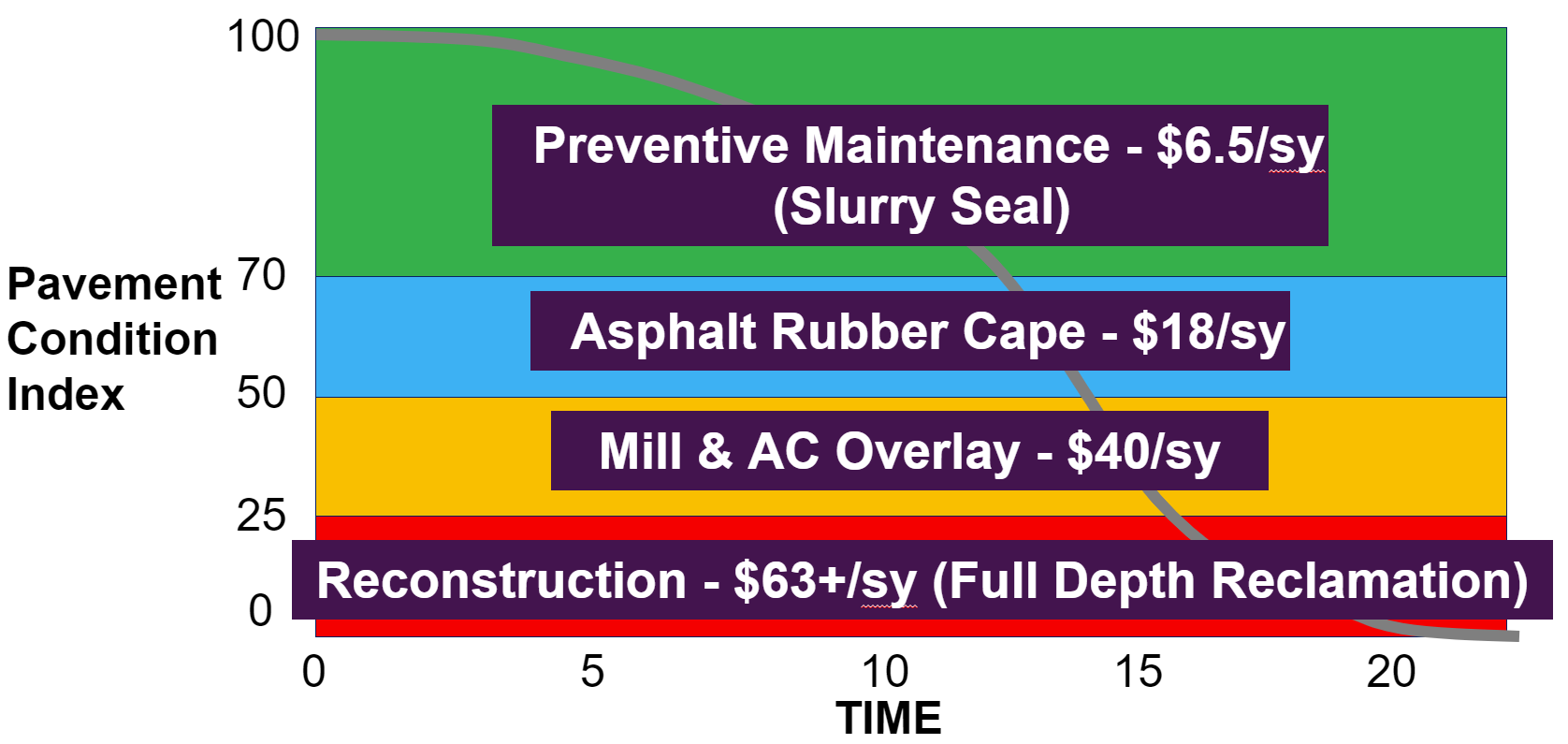
Yuba City chart on the increasing cots of deferred roadway maintenance
Yuba City chart on the increasing costs of deferred roadway maintenance

no Measure A in 2020

The Sacramento Transportation Authority decided today in a special meeting to “Repeal Ordinance No. STA 20-001 And Withdraw Request To The Board of Supervisors To Place The Measure On The November Ballot”. So Measure A is dead for the 2020 election. I celebrate this decision, but not for the reasons that most of the commenters online and by email gave.

A lot of the people opposed to the measure are simply opposed to any taxes, of any sort. The claim was made by a number of commenters that no roads had been fixed in the county. This is simply not true. Several roads have been paved, and a few reconstructed. The reason it looks like not much has been done is that there is so much need, so much deferred maintenance, that available funds can make only a small dent in the backlog. This is a significant point, as there is no amount of money, even if every cent went to fixing roads, to maintain the sprawling road and freeway infrastructure that the county and the cities have created. The economic value of these road investments is too small to maintain them. Economic productivity lies in places where there are a lot of jobs and a lot of small businesses, and that takes at least moderate density. The suburbs and exurbs of Sacramento county can’t provide that economic value, their value is just too low. Most of the commenters are under the illusion that someone guaranteed that their roads would be maintained even if their property taxes and sales taxes and other taxes were not sufficient to cover the cost. This is delusional. A lot of commenters suggested that the politicians are lying to them, and that the money is going somewhere else. Well, what the politicians are doing is not telling the truth that the infrastructure cannot be maintained on any conceivable tax. There are too many miles of roads, running through low density development, that can’t pay its own way. There are too many miles of freeway and expressway, serving to get commuters from their low-tax haven in the suburbs to their high value job in the job centers such as downtown Sacramento, and parts of Rancho Cordova and Folsom.

I know that a number of SacTA board members want to bring the same measure back in two years, when they hope (and I hope) that we are out of the current health and economic crises, and voters are more willing to vote for a transportation sales tax measure. I sincerely hope that is not what happens. I hope that instead people see that sales taxes are a dead-end road, and that the projects proposed were not the ones needed. I’ll have at least two more posts over the next two days about what I would like to see happen.

Against Measure A

The Sacramento Transportation Authority (SacTA) has developed an ordinance and transportation expenditure plan for a new half cent transportation sales tax, intended for the November ballot. All of the cities and the county have supported the measure (some overwhelmingly, some closer), and SacTA has voted to forward the measure to the Sacramento County Board of Supervisors for placement on the ballot. There are reluctance to put a tax measure on the ballot when so many other tax increases have happened over the last few years, and in such a time of uncertainty. But it is also being sold by boosters as a jobs creation program. I can’t predict what the supervisors will do. Nonetheless, it is my time to speak out against the measure.

Here is what I believe to be wrong, first as a tax measure:

  • The proposed Measure A is in large part an attempt to bail out the existing Measure A, which is nearly out of money because almost all projects were bonded (a gift to wall street), rather than being pay-as-you-go with a few exceptions for large or very high priority projects. There is no reason to think that financial mis-management won’t continue under the new measure, and there is nothing in the ordinance language to prevent it.
  • Sales taxes are inherently regressive, and we must stop funding government with sales tax. It is time to move to property tax and other taxing mechanisms. Sales tax places the greatest burden on those least able to afford it, as low income people pay a much larger percentage of their income to sales tax than do higher income people. This is not an argument against all sales taxes, but I think we have gone far enough down that road and it is time to STOP.
  • The anti-tax arguments against the measure, however, are a red herring. The anti-tax suburbs and exurbs exist because of subsidies of their infrastructure and transportation system by the rest of the county. For these people to now object to the measure because it doesn’t continue to provide them the high level of subsidy they demand is disingenuous, to say the least.

Second, as a transportation measure:

  • Measure A perpetuates, for 40 years, the cars-first model of transportation, continuing to expand lane miles and interchanges. The fact that there is money for transit and to fix roads does not change the climate-killing expansion agenda of the measure. Transportation expenditures should now be 100% for mitigating the effects of our past misallocation of transportation funds, not reinforcing them. Anyone who is paying any attention knows that the global climate change is going to slam our existing habits and infrastructure, and to me, the idea of continuing down the road of capacity expansion is criminal.
  • No amount of transit expenditure will bring us to a balanced system so long as we continue to fund (subsidize) the competition to transit, personal motor vehicles.
  • Freeways are inherently racist, since they were created and continue to serve to allow suburban and exurban whites to access central city jobs while not have to fund or support central city infrastructure. We have seventy years of catering to the desires of suburban whites, and it is time to shift to supporting those who were disinvested.
  • Though the transportation agencies continue to give lip service to maintenance, or ‘fix-it-first’, no sooner does the tax start then they are trying to undermine maintenance. It has always been this way and will continue until there are absolute and irrevocable commitments to maintenance. Measure A contains no such commitments.
  • Substantial portions of the Measure A TEP are for highway interchanges. These projects exist solely to benefit private development, often the sprawl development of greenfields (agricultural and open space lands). Citizens are forced to subsidize private development, and that development is always large developers and large corporations, never small developers and small businesses.
  • The Capital Southeast Connector is probably the worst transportation project this region has ever seen. Its purpose is to fuel long distance commutes between El Dorado Hills (which is not even in the county) and Elk Grove, and to develop the agricultural land along the alignment. The amount of money going to the project from Measure A has been scaled back a bit, but a stake needs to be driven through the heart of this zombie project, which has been built little by little under the nose of taxpayers, without the required evaluation of the entire project.

And lastly, SacTA ignored most of the input from the SacMoves coalition that could have improved the measure. The input, based on Los Angeles County (Metro)’s successful Measure M and the perspectives of the Mayors’ Commission on Climate Change, was developed over a long period of time by a large variety of community advocacy organizations. Of the model proposals, only a small part was adopted. This despite the board members saying that they wanted to see a Measure M-like effort. When push came to shove, the board fell back on reliance on the the highway building lobby and its city and county minions.

What will happen if the sales tax measure does not go on the ballot, or if it does but fails in November? Well, I know SacRT is so concerned about this that they have placed their effort behind the measure. But the failure, either way, actually opens the window for a transit-only ballot measure, maybe with a source of income other than sales tax, and covering the parts of the county (and maybe part of Yolo County) where people actually want a successful transit system. The very recent court ruling that citizen-origination measures only need 50% plus to pass providing an intriguing possibility for a citizen-led effort to support transit.

I realized I’ve said some very radical things there. Comments that help illuminate the issues or give different perspectives on progressive change are welcome. Comments from suburban NIMBYs and people who believe the right to drive was written into the constitution and bible will be deleted, so don’t waste your time.

Though I have been or am a member of the SacMoves coalition, and several organizations which are members of the coalition, I do not speak for any of them. The words are my own.

transportation sales tax decision tomorrow

A critical decision on whether to place a new sales tax measure for transportation on the November ballot will be made tomorrow, Thursday, April 28, by the Sacramento Transportation Authority. I ask that you attend and let the SacTA know what you think, and why. The meeting starts at 2:30PM in the Sacramento County Board of Supervisors Chambers at 700 H Street in Sacramento. The agenda and agenda packet are available at: http://www.sacta.org/c_calendar.html.

I’ve written in the past about transportation funding, and will provide you some more background information between now and tomorrow that may help you form a position on Measure B, but for right now, let me summarize what I see as the negatives.

  1. The 30-year measure is far too long. To say the we know today what the county will need in 30 years is simple hubris. Just today a different vision for the streetcar was released than one year ago. How can we know 30 years from now what we will need? Yet the Transportation Expenditure Plan associated with the ballot measure would lock in projects for 30 years.
  2. There is a claim that this measure is balanced, because it includes some projects for all the entities in the county, and provides some for fix-it-first, transit capital and operations, and walking and bicycling via complete streets projects. What is not mentioned by the measure supporters is that the majority of other transportation funding goes to building new roads, not to these things, so our funding pattern is already severely out of balance. Our taxes and fees have long gone to building new roads, and almost none to creating a transportation system that works for all. If this were the sole funding for transportation, the mix might make some sense, but given the overall funding picture, this measure would just continue the imbalance.
  3. The measure devotes significant funds to two new road projects, the Capital Southeast Connector and widening of the Capital City Freeway, as well as a number of smaller but expensive freeway interchanges. All of these have unacceptable impacts on greenhouse gas reduction because they will in fact increase vehicle miles driven (VMT) rather than reducing it. It is called induced demand, and it is a well known effect.
  4. Our roadways are in such horrible condition because transportation planners and engineers, and the politicians that support them, have continued to devote our transportation funds to building new roads rather than keeping the ones we have in repair. It is time now to spend every tax dollar that we spend on roads on fixing what we have, and not building yet more than we will fail to maintain.

More to come!

Measure BB Sales Tax in Alameda County

In 2014, voters in Alameda county passed a sales tax, Measure BB, by 70%. This measure is seen as a model for progressive use of sales tax in a county, and the Alameda County Transportation Commission simultaneously achieved recognition as a progressive transportation agency. The measure continued an existing half cent sales tax and added another half cent, for a total of one cent. I think a lot can be learned of use in Sacramento county by looking at the measure and the agency.

Measure BB funds the 2014 Transportation Expenditure Plan, which has these goals:

  • Expand BART, bus and commuter rail for reliable, safe and fast services
  • Keep fares affordable for seniors, youth and people with disabilities
  • Provide traffic relief
  • Improve air quality and provide clean transportation
  • Create good jobs within Alameda County

The plan certainly includes some funds for roadways, but shifts the focus to away from traditional roadway expansion to multi-modal transportation, particularly relative to the earlier sales tax which was heavily motor-vehicle oriented. Of the $7.8B (yes, billion) to be invested over 30 years, the allocations are:

  • BART, bus, ferry and commuter rail $2.8B
  • Affordable transit for youth, seniors, and people with disabilities $1B
  • Traffic relief on streets and highways $3B
  • Clean transportation, community development, technology and innovation $1B

The plan allocates 48% of the total to transit, including expansion, operations, and fare subsidies. Of this, 18% of the total goes to operation of AC Transit (Alameda-Contra Costa Transit) which is the equivalent of SacRT. Without knowing the exact nature of the example projects in the document, it is hard to parse out how much of the 39% “traffic relief” category is maintenance and how much expansion, but it looks like about 2/3 maintenance and 1/3 expansion. The 8% clean transportation category includes a remarkable $651M for “Bicycle and Pedestrian Paths and Safety Projects and Educational Programs”.

The Alameda County Transportation Authority has an Independent Watchdog Committee (page 35 of the plan), whereas Sacramento county has nothing of the sort. The committee holds hearings, reviews audits, and issues reports. The Alameda CTC also works with the Alameda county BPAC (Bicycle and Pedestrian Advisory Council), whereas SacTA does not work with SacBAC (Sacramento joint city/county bicycle advisory council), and in fact there is no pedestrian advisory function at the county level at all.

There are a wealth of ideas in the plan, and it is instructive to read it. I’ll be going through it in more detail in the future.

SacramentoGO completed projects

Looking at the projects completed, and highlighted, on the new SacramentoGO website gives a pretty clear indication of the sort of things that would be completed in the future with a new sales tax measure. I’ve made notes, in italic, on each of the items.

Folsom

A. New Folsom Lake Bridge – motor vehicle
B. New Lake Natoma Bridge – motor vehicle
C. Three New Light Rail Stations – transit
D. Light Rail Extended to Folsom – transit
E. Carpool Lanes Added on Hwy 50 – motor vehicle

Highway 50 Communities / Rancho Cordova

A. New Interchange Watt Ave & Hwy 50 – motor vehicle with some active transportation benefit
B. New Light Rail Overhead Crossing – motor vehicle
C. Hwy 50 Bus & Carpool Lanes – motor vehicle
D. Light Rail Extended to Folsom – transit, though again, a parking garage at Old Folsom and large parking lots at another station were part of the expense

Arden-Arcade / Carmichael

A. Howe Ave Widened – motor vehicle
B. Watt Ave Bridge Widened + Bicyclist and Pedestrian Paths – motor vehicle with some active transportation benefit
C. New Interchange Watt Ave & Hwy 50 – motor vehicle
D. Bus and Carpool Lanes Hwy 50 – motor vehicle

Fair Oaks / Orangevale

A. Hazel Ave Widened – motor vehicle
B. Sunrise Blvd and Bridge Widened – motor vehicle
C. Hazel Ave Widened + Road Improvements (in progress) – motor vehicle
D. Carpool & Bus Lanes Added Hwy 50 – motor vehicle

Citrus Heights

A. New Carpool Lanes on I-80 – motor vehicle
B. Safe Routes to School Improvements Mariposa Ave – active transportation
C. Greenback Lane Widened – motor vehicle
D. Antelope Rd – motor vehicle
E. Auburn Blvd – motor vehicle
F. Sunrise Blvd (parts in progress) – motor vehicle

North Sacramento

A. Interchange Upgrade Elverta Rd & Hwy 99 – motor vehicle
B. I-80 Carpool Lanes – motor vehicle
C. Interchange Upgrade Elkhorn Blvd & I-80 – motor vehicle
D. Interchange Upgrade Madison Ave & I-80 – motor vehicle

City of Sacramento

A. Ramp/Connector Improvements – motor vehicle
B. I-80 Bus & Carpool Lane – motor vehicle
C. Arden-Garden Hwy Connector – motor vehicle
D. Arden Way Improvements – motor vehicle
E. Interchange Upgrade – motor vehicle
F. New Intermodal Station – transit
G. New Light Rail Station – transit? unsure what this is, maybe La Valentina
H. Ramp/Connector Improvements – motor vehicle
I. Ramp/Connector Improvements – motor vehicle
J. Hwy 50 Bus & Carpool Lanes – motor vehicle
K. Folsom Blvd Widening – motor vehicle
L. New Interchange – motor vehicle
M. Cosumnes River Blvd Extended – motor vehicle
N. New CRC Light Rail Station – transit
O. Cosumnes River Blvd Extended – motor vehicle

Elk Grove

A. New Interchange – motor vehicle
B. Light Rail Extended to CRC Station – transit, in part, but a large portion of the expense was the parking garage at CRC and huge parking lots at other stations
C. Interchange Upgrade – motor vehicle
D. Interchange Upgraded – motor vehicle
E. Bike & Pedestrian Bridge – active transportation
F. Interchange Upgraded – motor vehicle

Galt

A. Roundabouts and New Gateway to Galt Reduce traffic congestion and improve bike and pedestrian safety – motor vehicle with some active transportation benefit
B. New A Street Bridge – motor vehicle
C. C Street Bridge Rebuilt – motor vehicle

SacramentoGO survey

If you are a resident of Sacramento county, you have probably received two glossy mailers from SacramentoGO, otherwise known as the Sacramento Transportation Authority. The agency is building up towards putting a measure on the November ballot that will add another half cent of sale tax to fund transportation in the county. This half cent would be added to the existing half cent of Measure A. I will have plenty to say about the tax measure in the future, but tonight I’ll focus on the authority’s “Tell Us What You Think” survey.

I took the online survey, and was pretty dissatisfied with the wording of the questions. By putting unrelated items into one choice, the survey tries to gain support for pro-motor-vehicle projects by conflating them with pro-active-transportation and pro-transit options. My notes from the survey are below.

If Sacramento County had additional funding for transportation, which would be a higher priority for you:
[note: I was not able to capture the two options here because trying to copy the text selects that item, but you’ll get the idea with the next few questions about the tricks they are trying to play; if someone manages to capture these for me, I’ll add them here]

Smoothing traffic flow on local streets
(Street maintenance, pothole fixes, synchronized traffic signals, street widening)
Low Priority, Medium Priority, High Priority
Conflates street maintenance with street widening, which should be unrelated to each other, and should have been asked separately.

Reducing congestion on Sacramento highways
(Fixing or upgrading major roadways and interchanges, adding carpool lanes)
Low Priority, Medium Priority, High Priority
Again, conflates fixing with upgrading, which should be unrelated to each other.

Investing in bridges and overcrossings
(Building or upgrading bridges over the rivers, improving or adding light rail)
Low Priority, Medium Priority, High Priority
Though there is one river crossing which might carry both motor vehicle and light rail (though it shouldn’t), the Green Line extension, this is not true of any other bridge, and this is an attempt to conflate car bridges with light rail bridges.

Adding bike paths
(American River Parkway improvements and adding bike paths to local streets)
Low Priority, Medium Priority, High Priority
A reasonable option. The parkway receives $1M per year from Measure A, but all entities in the county have a backlog of desirable bike lanes of at least $1B.

Extending light rail service to additional locations
(Adding new rail lines and stations to expand the light rail network)
Low Priority, Medium Priority, High Priority
Seems reasonable at first glance, but what is not asked is which extensions. The Green Line to the Airport is a trophy project that will not serve local or regional needs, and current planning is largely ignoring the valuable extension to the northeast at least to American River College, and perhaps beyond.

Improving service on existing light rail routes
(Upgrading trains, improving cleanliness and security, increasing frequency of service)
Low Priority, Medium Priority, High Priority
Yes!

Improving sidewalks, trails, paths
(Pedestrian improvements to sidewalks and lighting, neighborhood traffic calming and safety upgrades near schools)
Low Priority, Medium Priority, High Priority
Yes! There is probably a backlog of $20B in the county for sidewalks.

Reducing pollution from traffic
(Key infrastructure investments to improve air quality
Low Priority, Medium Priority, High Priority
Another wolf in sheep’s clothing. I am almost certain that SacTA will claim that roadway and highway widening will reduce air pollution, when in fact it will induce demand that will increase air pollution, including but not limited to greenhouse gas emissions.

Providing more transit programs/options for seniors and people with disabilities
(Expanded and affordable paratransit services)
Low Priority, Medium Priority, High Priority
Yes, but we need to be careful not to continue or establish low-productivity routes in an effort to serve seniors and disabled. There are other, more efficient ways of meeting this need.

Investing in reliable and convenient bus routes
(Bus service improvements, new routes or increased frequency)
Low Priority, Medium Priority, High Priority
Yes. But reliable and convenient means high frequency, which SacRT has not really provided or investigated.