Intersection control means the devices used at intersections to control the actions and behavior of motor vehicle drivers and others including walkers. The types of controls are:
- none
- 2-way yield
- 2-way stop (or minor approach stop, MAS)
- 4-way stop (or all-way stop, AWS)
- roundabouts without signals
- partial traffic control signals, such as flashing red or flashing yellow, and HAWK or RRFB
- complete traffic control signals, with a cycle of green-yellow-red
It is often assumed, by traffic engineers and by the public, that safety increases moving down the list of intersection controls. However, there is research both supporting and contradicting this assumption.
Intersections may have features designed for people crossing, such as pedestrian crossing signals, with or without a countdown, and accessible pedestrian signals, compliant with PROWAG (Public Right-of-Way Accessibility Guidelines). Pedestrian signals may require user activation (the beg button) or may use automated pedestrian detection. Exclusive pedestrian phases allow people to cross when no motor vehicles are moving, thereby reducing the chance for crashes to near zero.
Other features may increase or decrease safety. Examples that may increase safety if properly designed and implemented, are curb extensions, refuge islands, automated red light cameras, near-side traffic signal placement, raised crosswalks or raised intersections, and roadway design that slows vehicles approaching the intersection. Examples that may decrease safety, particularly for walkers and bicyclists, are dedicated turn lanes, faded or non-existent crosswalks, pedestrian crossing prohibitions, and roadway designs that encourage speeding approaching the intersection.
Traffic Signals
Traffic engineers often try to solve known safety issues by adding new traffic signals. Little attention is paid to alternative solutions such as adding traffic calming features, or removing hazardous features. New or enhanced traffic signals are VERY expensive, ranging up to $1,000,000 per intersection. The addition of new signals ensures that money will not be available for traffic calming solutions that would be less expensive and more effective.
Traffic signals do not decrease the speed of motor vehicles in between intersections. Drivers immediately accelerate to the speed they had before stopping at the signal (if in fact they do stop). But signals do delay drivers, leading to frustration and increased violation of motor vehicle codes, particularly in yielding to walkers in the crosswalk. Red light running has become epidemic in the Sacramento region, perhaps worse than other regions, so it is not safe for anyone to proceed on a green signal or a pedestrian walk signal. This indicates a failure of traffic signals to control driver behavior, and that they may no longer be effective for safety.
The fact is, traffic signals are largely intended to smooth and ease traffic flow, and are often not safety features at all. Safety is used to justify new or upgraded signals, often without evidence.
Traffic signals are a classic example of ‘orderly but dumb’. Intersections should be ‘chaotic but smart’. (Strong Towns concept and Carlson’s Law)
Traffic engineers often claim that existing traffic signals were installed based on meeting warrants defined in the Manual for Uniform Traffic Control Devices (MUTCD, and the California version CA-MUTCD), but generally can’t produce those warrant documents. Many signals were installed based on politician requests and were not and are not justified by intersection characteristics. The warrant process emphasizes traffic flow and de-emphasizes safety for walkers and bicyclists.
All existing traffic signal locations should be analyzed every ten years, and signals which did not meet, or no longer meet, warrants, shall be removed. As roadways are modified or rebuilt with traffic calming features, far fewer traffic signals will be necessary.
When are traffic signals justified?
- At the intersection of two major roadways.
- Where the flow of traffic on one roadway does not provide gaps in traffic for crossing that roadway.
- At offset or skewed intersections where visibility or understanding may be difficult.
Most existing and proposed traffic signals do not meet any of these criteria. Major roadways, almost always designed as stroads, which are roadways designed for higher speed but with land use or design features that require slower speed, including driveways and turning movements, should be uncommon in urban areas.
Signals should never be installed to serve driveways, including shopping centers.
For any new traffic signal installed, it must include:
- Signal cycles no longer than 90 seconds. Longer cycles are biased against walkers, and encourage walkers to cross against the signal.
- Leading pedestrian interval (LPI) which provides the walk sign three or more seconds before the green light for drivers. Leading pedestrian interval (LPI) should be installed at ALL traffic signals in the city within five years. Bicyclists may proceed on the walk signal.
- Elimination of slip lanes, dedicated right-hand turn lanes, and dedicated left-hand turn lanes more than one. Turning movements constitute the greatest danger to all roadway users.
- No right (or left, for one-way roads) turn on red. No right on red should be installed at ALL traffic signals in the city within ten years.
- Automated pedestrian detection to eliminate the need for beg buttons while achieving compliance with PROWAG. No person walking or rolling shall be required to manually actuate a pedestrian signal.
- Implementation of exclusive pedestrian phases at any intersection with significant pedestrian flow. This phase may be achieved with turn prohibitions during pedestrian movement, or by all-way pedestrian crossing, called pedestrian scrambles.
- Demand-responsive operation so that the signal cycle responds to demand by drivers, walkers and bicyclists, rather than set to an unchanging cycle.
Existing signals should meet the same criteria when upgraded.
HAWK and RRFB signals
HAWK (High intensity Activated crossWalK) and RRFB (Rectangular Rapid Flashing Beacon) are partial signals installed to allow walkers to cross roadways which would be difficult or unsafe to cross. However, HAWK signals are violated by some drivers, and RRFB signals are violated by many drivers. These signals are often justified by traffic engineers as ‘safer than nothing’, but it only takes one violating driver to kill a walker. RRFBs should not be used on roadways with a posted speed limit over 30 mph, and HAWKs over 35 mph.
Other Intersection Control
Intersections without signals can have stop signs, yield signs, or no signs at all.
The intersection of two low-speed (20 mph or less), low volume streets do not need any sign. They can be left uncontrolled, with drivers and bicyclists negotiating right of way at intersections, based on the universal first-come/first-served principal.
Intersections of moderate-speed (up to 30 mph), moderate volume streets may justify some signing. In order of increasing regulation, these are:
- Two-way yield
- Two-way stop
- Four-way stop
The lowest level of signing that can provide safety for the intersection is the right level of signing. Stop signs should not be installed based on neighborhood or politician request, but rather based on observation of user behavior and the intersection, and crash history. The objective should not be to eliminate all possibility of crashes but to eliminate any possibility of fatal crashes.
With roadways designed for safety and placemaking rather than motor vehicle speed and throughput, intersection control can be the minimum necessary rather than the maximum control and expense.
Roundabouts
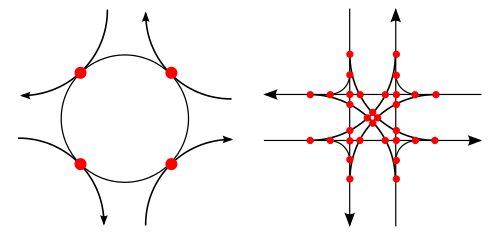
A roundabout is a circulatory intersection in which motor vehicles and bicyclists yield to others already in the roundabout, but otherwise do not need to stop. By eliminating traffic signals and stop signs, they ease traffic flow (and therefore driver frustration) and reduce crashes, particularly fatal and severe injury crashes. Other than low speed, low volume local streets that require no traffic control but do require user negotiation, roundabouts are the safest sort of intersection. Multi-lane roundabouts should really not be called roundabouts at all, and are generally no safer than signalized intersections.
References
Previous Getting Around Sacramento posts

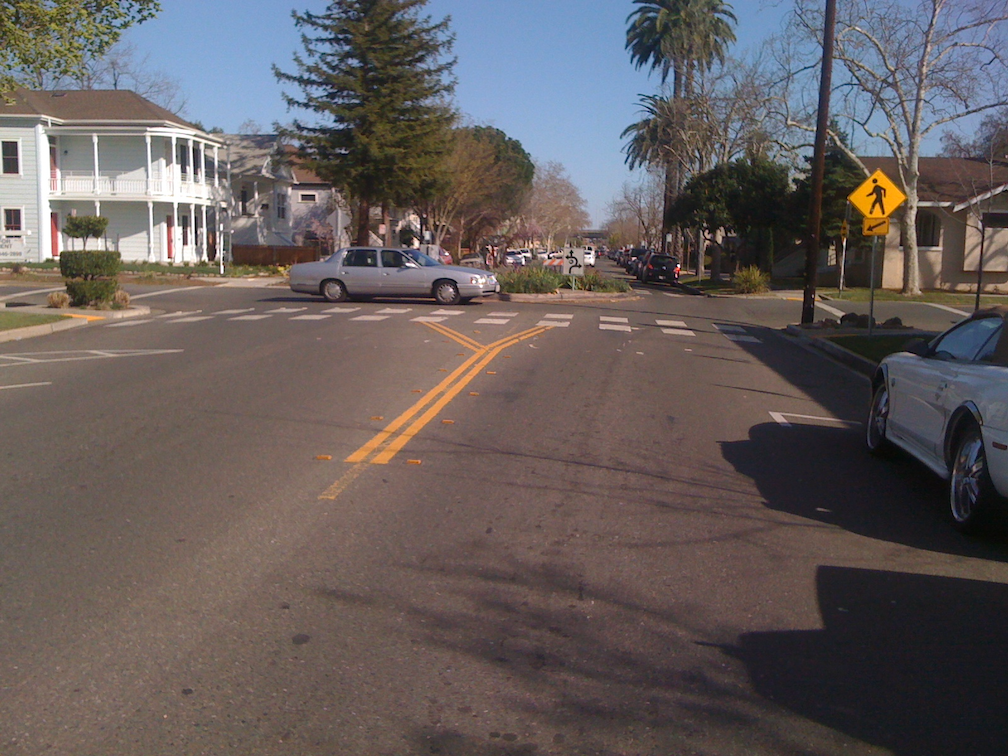


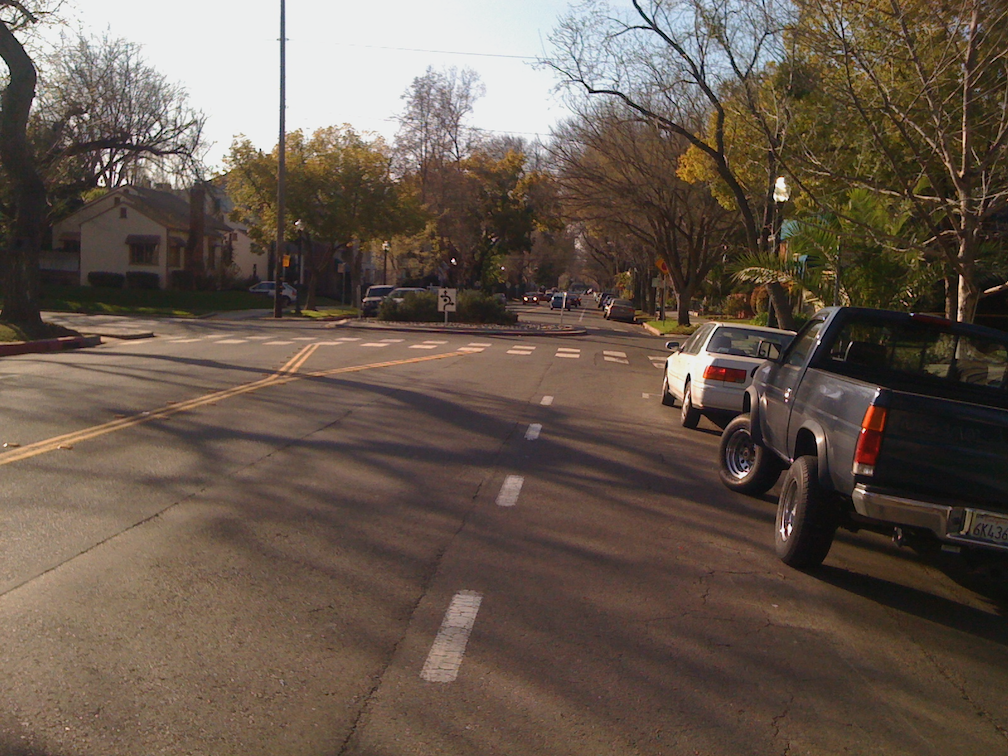
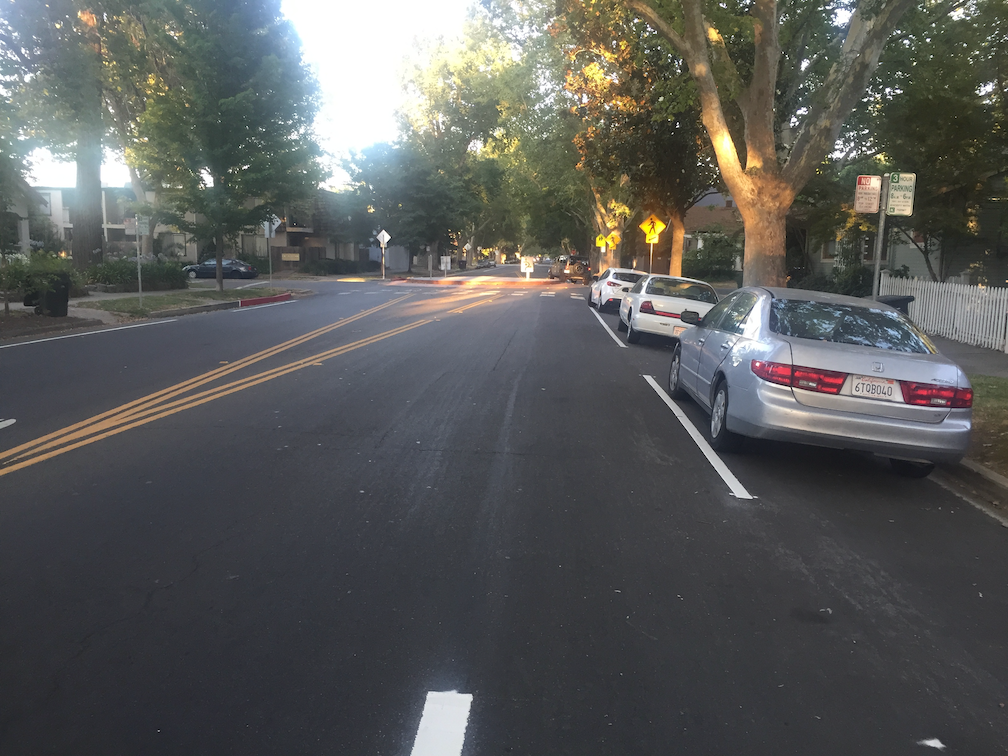
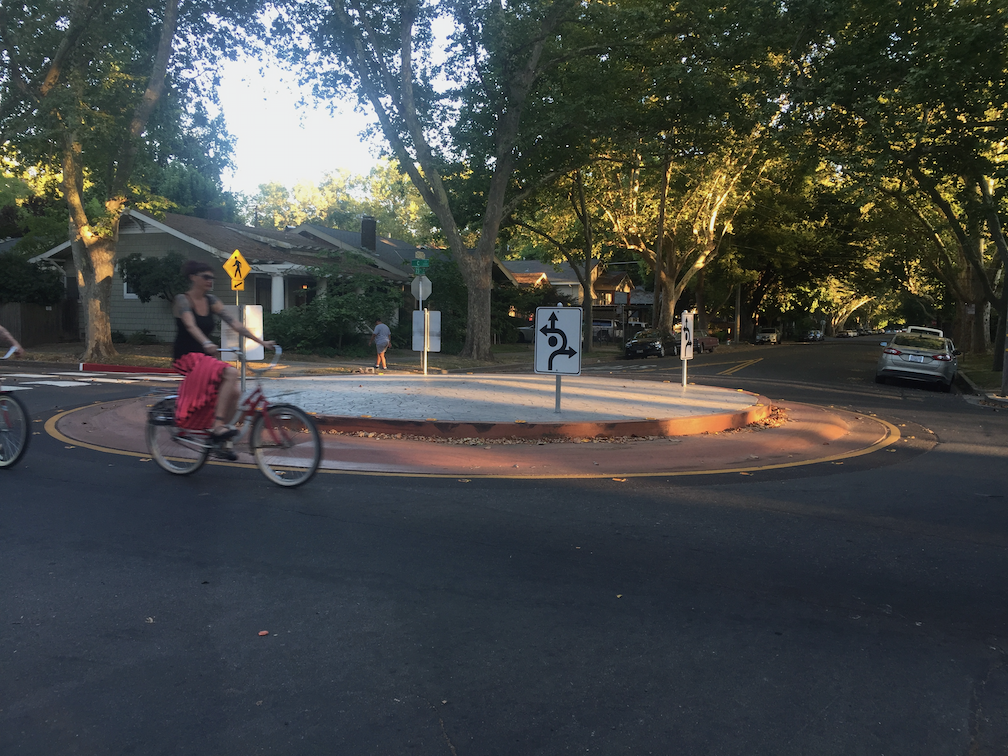


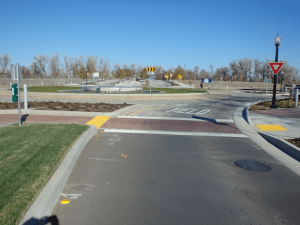
 Yield signs on all approaches means that vehicles only have to stop for other vehicles already in the roundabout. Otherwise, they proceed at their reduced speed and never have to stop. This yield approach benefits motor vehicles and bicyclists who ride in the travel lane. It does not, and is not really intended to, benefit bicyclists in bike lanes or pedestrians, but at the same time, if does not hurt them. There is one standard MUTCD sign used at roundabouts, shown at right, but you will also see many other signs at both roundabouts and traffic circles.
 Lastly, the type of traffic circle that engendered the discussion in San Francisco is at right. It has several non-standard features, even given the variability of traffic circles.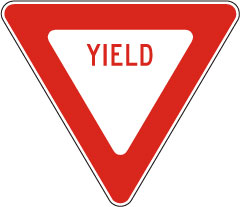
 Getting Around Sacramento