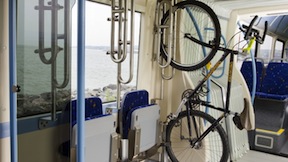
Level boarding with low floor light rail cars

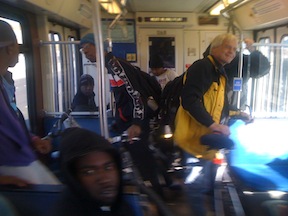
SacRT light rail steep steps for bicyclist

Today in Sacramento will be the last of SACOG’s Unmet Transit Needs meetings. It will start at 9:30AM in the SACOG board room at 1415 L St, Ste 300, in downtown Sacramento, near the northeast corner of Capitol Park. In preparation for that meeting, I’m thinking about the things I’d like to talk about, particularly issues that I’m not sure that others will bring up. Those two are bicycles on light rail, and level boarding for light rail. I’ve said a bit about level boarding in my Portland post, but there is plenty more to say.

The SacRT light rail system has high floor cars. Both the older 100 series cars by Siemens Transportation Systems and the newer 200 series cars by Construcciones y Auxiliar de Ferrocarriles (CAF) have high floors. People must navigate steep stairs from the ground to the car. Disabled people are accommodated by a high boarding platform, but with only one platform at each station (and none for southbound blue line at 12th & I station), those needing level boarding are restricted to one end of the lead car, and all other doors and cars exclude them. Many people who use the train don’t consider themselves disabled enough to use the high boarding platforms, yet struggle with getting up and down the steps. Many bicyclists also struggle with these steps. The handrails which are provided in the middle of the stairs to assist people with the steep steps are themselves part of the problem, as they block people who are carrying items such as strollers, groceries, luggage and bicycles.Read More »

Transit Score

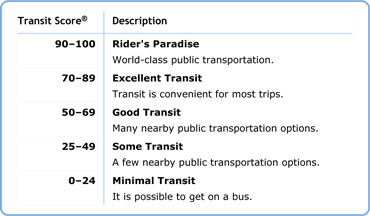
Walk Score/Transit Score offers an assessment of the transit access of any location. It is available in any browser at https://www.redfin.com/how-walk-score-works. The Redfin app shows walk score, bike score and transit score for each listing (scroll way down). Walk Score is based on the distance to the places people want to go, such as grocery stores, restaurants, coffee shops, bars, movie theaters, schools, parks, libraries, bookstores, fitness locations, drug stores, hardware stores, and clothing & music.

I previously wrote about Walk Score and its use in Sacramento, and now the Walk Score company has released Transit Score. Sacramento ranks 22 out of 25 cities, with a Transit Score of 32 (of 100), in the category of “some transit.” The categories are rider’s paradise, excellent transit, good transit, some transit, and minimal transit. It is worth noting that if all the major cities had provided their transit information, Sacramento would probably have not been on the list at all, because with a population of just under a half million, it is not in the usual top 25 but would show up in a top 50.

Walk Score notes “The Transit Score algorithm calculates a score for a specific point by summing the relative ‘usefulness’ of nearby routes. We define usefulness as the distance to the nearest stop on the route, the frequency of the route, and type of route.” As pointed out in the recent Streetsblog post, it does not including information about where you can go once you’ve gotten onto the transit, which also of course affects the usefulness of the transit.

Read More »

Co-op relocation

The Sacramento Natural Foods Coop is considering relocation to 28th and R streets. As a coop member, I’m interested in how the new location addresses transportation. Though plans are preliminary and vague, here is my reaction to what is available so far on the website at http://www.sacfoodcoop.com/index.php?option=com_content&view=article&id=1726:store-relocation-update. Given the stated mission of the co-op, “…consumer-owned […]

Bikes on RT Light Rail

Bikes and light rail are a natural complement to each other. Light rail covers the longer distances quickly, while bikes get you from your origin and to your destination, directly or via connecting bus service. I’ll post about buses later.

Bikes can be taken on all Sacramento RT Light Rail trains, without time restrictions. However, there is insufficient capacity on light rail for bicyclists, for two reasons:
1. The restriction on the number of bicycles per car of four does not reflect the current demand for bicycle space. This is a relict of a time when few bicyclists used light rail, and must be modified.
2. Passengers without bicycles occupy the end spots of the cars, seemingly in preference, precluding use by bicyclists. These bicyclists then cram their bikes into other spaces and inconvenience other passengers.

Read More »