traffic violence emergency at Sac City Council

It is likely that council member Caity Maple, along with Mayor Darryl Steinberg and council member Karina Talamantes, will introduce an emergency declaration on traffic safety at the city council meeting tonight, starting at 5:00 PM. The item is not on the agenda, so I presume it will be introduced during the ‘Council Comments-Ideas, Questions’ part of the agenda, after all the numbered agenda items. Council members get their ‘matters not on the agenda’ time, just like the public does. None of the advocates I have asked have a clear picture of how emergency declarations work. I presume the idea will come back to council one to many times in the near future, but tonight is your first chance to hear what the council has to say and comment on the ideas.

Caity Maple has posted about the recent injury (now fatality) and the emergency response she wants the city to take:


I’m devastated to see yet another person critically injured after being struck by a vehicle on Sacramento’s roads. Even beyond our City’s commitments to eliminate traffic deaths through Vision Zero, we need to take immediate and urgent action. This coming Tuesday, alongside my colleagues Mayor Darrell Steinberg and Mayor Pro Tem Karina Talamantes, I will be introducing a proposal that:

  • Declares a state of emergency for the City of Sacramento regarding the road safety crisis
  • Directs the City Manager to identify funding for a public education campaign focused on driver education, pedestrian/ bicyclist awareness, and traffic safety
  • Directs the City Manager to work with SacPD to ramp up enforcement of traffic laws that protect pedestrians, including speed limit enforcement, crosswalk violations, and distracted driving, especially in high-injury corridors
  • Reaffirms our commitment to Vision Zero and directs staff to expedite safety projects

Read More »

SacCity fails to act on traffic violence

At the June 11 city council meeting at which the 2024-2025 budget was adopted, seven of the council members spoke strongly about the need to address safety on the city’s streets, acknowledging that the city leads California as the most deadly for roadway users. But no modification was made to the budget to reflect that priority, and the city manager refused to make any changes to the budget to fund street safety.

In the two months since that council meeting, nothing has shown up on the council agenda to move forward on street safety, nothing has shown up to allocate funds, except some minor grant applications.

The city has long had a policy that it does not fund street safety projects, except for the required grant matches. Other than grant matches, no city general funds are expended to make our streets safer. The city certainly has been successful in getting some grants, but also has not been competitive on many others.

The Sacramento Active Transportation Commission (SacATC) made a recommendation in their annual report to allocate $10M to safety projects. Council members spoke in support of the idea, but no action was taken to fund those ideas.

We have an epidemic of traffic violence in the city. Yet the city is doing almost nothing to address that. Walkers, bicyclists, drivers and passengers are all dying in horrible numbers. What is the city doing in response? Submitting grant applications and hoping for the best. This is unacceptable.

The council must take this public health crisis seriously, and allocate funds to start solving it. It must also stand up to the city manager, who does not believe in spending money on street safety. The city manager runs the city according to his own whims, and rarely follows the direction of council on anything. The council must either stand up to, or fire, the city manager. So long as he is in the position, the city will not move forward on saving the lives of vulnerable roadway users.

pavement condition in Sacramento County

A report on pavement condition in Sacramento County was presented today to the Sacramento Transportation Authority (SacTA): 2023 Regional Pavement Analysis, written by consultant NCE, agenda item 12.

The report has two main sections:

  • What are the existing pavement conditions, countywide, and by each agency (city or county).
  • What are funding scenarios and how would the allow, or not allow, substandard conditions to be improved.

Existing conditions are summarized in the chart below. The countywide PCI (pavement condition index) is 53, out of a possible 100, with a target of at least 70 for ‘good condition’. Only Elk Grove has the target 70 or better, in large part because their roadways are newer than most of the county.

The second section presents five possible funding scenarios, and how pavement condition would vary over time. In each of the scenarios except the first, ‘improve PCI to 70’, pavement condition declines, sometimes slowly and sometimes quickly. SacTA already recognized that there is no likely funding source that would allow scenario one. Scenario four includes new sales tax income, but still does not keep pavement conditions from declining.

Many people question where SB 1 Road Repair and Accountability Act of 2017 funding (mostly gas tax) is going and why it hasn’t fixed our roads. SB 1’s main intent was to allow Caltrans to maintain freeways and other state-owned roads. It had only minor funding, a fraction of what would be needed, to maintain local roadways.

Why are we in this crisis of pavement condition? Because we have built roadways (and bridges and freeways) that we will never be able to maintain. It would take a tax rate many times higher than it is today to actually maintain all we have. That isn’t happening. We’ve built ourselves into a corner. But that doesn’t mean we can’t address the problem. We can shift funding from road building to road repair. This is called ‘fix my pothole’ or ‘fix-it-first’ or ‘state of good repair’.

I made these comments today about the issue:

  • I’m a active transportation and transit advocate, but what everyone in the county wants is to have good streets.
  • Under no reasonable funding scenario does pavement quality improve
  • There will be less money coming through the state, as demonstrated by the LAO presentation (the previous agenda item, 11)
  • $8.3B roadway ‘asset’ is really a $8.3B ‘liability’, requiring a significant investment to maintain
  • Every new pavement mile is an additional liability
  • Authority funding should shift from creating new pavement to maintaining and rehabilitating existing pavement
  • This shift is even more important for the member agencies, cities and county
  • Each potential infrastructure project should be evaluated on the question “Does this project add enough economic activity to pay for maintenance?” If the answer is not, they should not be built.
  • If the authority is going to voters for increased sales tax in the future, it will be necessary ahead of time to show that the authority and agencies are already working to solve this issue, not just waiting for more money

Two bicycle advocates spoke after me, pointing out that safety for bicyclists is actually a very high priority. I agree, even above economic productivity. But economic productivity must be considered. I roadway projects don’t create enough income to pay for them, and maintenance and rehabilitation of them, we are sliding further down the slope of pavement deterioration.

Board comments were mostly in recognition that we must invest differently than in the past, we must keep our existing roads in better condition, and that includes consideration not doing projects which increase future liability.

Four boards meeting

On November 9, 2023, the boards of four agencies met together for the first time: SACOG (Sacramento Area Council of Governments), SacRT (Sacramento Regional Transit District), SMAQMD (Sacramento Metropolitan Air Quality Management District), and SMUD (Sacramento Municipal Utilities District). This is probably the largest gathering of elected officials in one room in Sacramento history. Of course the number was not as great as you might think, because many officials serve on multiple boards. The SMUD board is independently elected, while the other three boards are composed of elected officials appointed to the boards by their own boards or councils.

The agenda for this meeting and the resolution that was passed are available here. The reason for the meeting was to advance collaboration among the boards to further mutual objectives, and to pass a resolution stating that. The staff of these agencies already collaborate to some degree, but also don’t on some important issues.

There was a long discussion period before passing of the resolution. No surprise, many of the smaller cities dominated the discussion, as is the case with SACOG board meetings. Several electeds used the time to promote commercial concerns that they benefit from, which is a really sad statement on the quality of our elected officials. Probably 90% of the discussion was devoted to electric vehicles, and in fact it looks as though seeking grant funding for more electric vehicle infrastructure was the real reason for the meeting. Grant applications with multiple agencies on board are more likely to receive funding. There was also discussion of managing forest lands for carbon sequestration and need to manage forests to reduce severe wildfire carbon release. And a few other topics. Active transportation was not one of them.

The boards tried to cut off public comment, but this caused an uproar and several citizens were allowed to speak (if they had been prevented, it would have invalidated the whole meeting under the Brown Act). Of course I spoke, and made the following points:

  • Where is Sacramento Transportation Authority? SacTA probably has more effect on carbon emissions that any other agency in the region, but was not represented. I later learned they were not invited.
  • The discussion and collaboration is about money, money, money, but should be about policy, policy, policy. What are the policies that the agencies can agree on? Money should follow policy, not control it.
  • The strong focus on motor vehicle electrification is techno-glitter, and results in deemphasizing:
    • safe walking: no mention was made of the needs of walkers for safety from motor vehicles
    • bike share: no mention was made of bike share, or scooter share for that matter
    • electric bikes: no mention was made of electric bikes during the discussion; bikes are the most important solution to the climate crisis, but one that the agencies seem particularly disinterested in
    • reducing VMT: the discussion was mostly about electrification, with very little about reducing VMT (vehicle miles traveled), though all reputable sources indicate that it will be necessary to reduce VMT along with electrification
    • land use: no mention was made of land use; though none of these agencies have direct control over land use, their expenditures affect land use and are affected by land use; the climate crisis cannot be solved without changing our land use patterns, but all of the smaller cities, and the counties, want and hope to ignore this fact

I finished up by talking about my experience with bike parking at the venue, which was the Sacramento State Alumni Center. When I rode up, there was no bike rack on the north side of the building, so I locked up to a parking sign. Exploring around I noticed a wave rack on the south side of the building. Wave racks received a ‘not recommended’ status from the Association for Pedestrian and Bicycling Professionals, which is the national standard, about ten years ago. Yet that is all the university provides. There are acres of car parking north of the building, and acres of parking south of the building. The university does have two dedicated bike parking compounds, but neither are close to the alumni center. The pathway along the south side of College Town Drive is nice, though substandard, but it ends at the intersection with Stadium Drive, where the alumni center is located. This is what we get when we focus on the needs of motor vehicle drivers, and place them above other users of the public space. This is what got us into the climate crisis, and we will not get out of it until we change that focus.

SacATC recommendations supported by city council

Agenda item 11 on the Sacramento City Council agenda last night (2023-08-29) was ‘Active Transportation Commission 2022 Annual Report Regarding the Status of Walking and Bicycling in the City of Sacramento and Activities of the Commission‘. Twenty members of the public and organizations spoke in support of the recommendations, no one against, and all council members spoke in support. Comments of both the public and council focused on the need for more funding to make infrastructure changes to our roadways, in order to fix the unsafe roadway network we have.

I have written twice before about the SacATC recommendations: support SacATC status on walking/biking (now!) and SacATC meeting Jan 19 with report, Northgate, Freeport. I recommend you read the full set of recommendations. Do they go far enough? No. Do they miss some important issues? Yes. But these recommendations are beyond anything that the city has considered before, and deserve the support of everyone in the city (and county and region).

Several representative from Land Park talked about how much they loved the slow streets in the park, and how disappointed they were when the city nixed them. They want them back! So do a number of other speakers. Grace Bartley talked about how she was hit by a driver while riding her bike to McClatchy High on Freeport, probably the most impactful speaker of the evening. Several speakers mentioned the imperative to control motor vehicle speeds, by whatever means necessary. (The ultimate solution to this issue is not any action of the city, but speed-limited motor vehicles.)

Eric Guerra mentioned again, as he has other times, that many parents seem to care about only their own children, once their children are safely dropped off at school, they speed away, endangering other people’s children. And some not ever their own children, encouraging their kids to run across the street at drop-off and pick-up. There was general agreement that there needs to be more money in next year’s budget for active transportation, though no one said what would be cut to accomplish that. SacATC had wanted their recommendations to go to the council for consideration in adopting this year’s budget, but a roadblock (intentional?) was thrown up by requiring that the report go first to the Personnel and Public Employees Committee, which meant that it did not come to the council until August. Katie Valenzuela suggested that Public Works come up with guidelines for citizen-initiated ‘tactical urbanism’ projects so that quick-builds can happen now, when the city does not have the funds or materials or personnel to complete in a timely manner. Jennifer Donlon Wyant was open to the idea, but I’m sure it would get nixed in Public Works. Darrell Steinberg talked about his proposal for a housing and transportation measure in 2024, that would provide some of the additional funding needed. This will be the topic of my next post.

I spoke along with the other 19 people, and my comments are below:

I strongly support all of the recommendations included in the 2022 report from the ATC to the city council. In particularly, I would like to address two of those, 3. Develop a Citywide Safe Routes to School Program, and 4. Finalize the Construction Detour Policy. 

I was the Safe Routes to School Coordinator for San Juan Unified for 10 years. Having that position funded through federal and ATC grants, and district funding, allowed the completion of many infrastructure project though collaboration with the City of Citrus Heights and Sacramento County. Most of these would not have occurred without the position. We also offered an extensive program of walking and bicycling education to students, and to the community. Civil Thread/WALKSacramento was a key partner in these efforts. I recommend that Sac City schools and the city create and fund a Safe Routes position to head an ongoing program in the support of students and their families.

It is long past time for a policy to accommodate walkers and bicyclists during construction projects. Nearly every construction project that has occurred in the central city has violated ADA guidelines, which require accommodation. City staff is on record as saying that walkers and bicyclists would be accommodated when it does not remove capacity from motor vehicles. So every project presents dangers to walkers and bicyclists. The are poorly signed and do not provide detectable barriers. I spend a lot of time reporting these violations, and over time many though not all of them are corrected. However, it should not be the responsibility of citizens to hold the city to ADA requirements. A progressive city would develop traffic plans that accommodate all travel modes, and would then inspect and enforce those plans.

Sac CAAP: more carbon-intense transportation and land use

The City of Sacramento (and the county, and the region, and the state) have created a very carbon-intensive transportation system, focusing on moving motor vehicles (more and faster) over all other uses of the public right-of-way. It has also created a carbon-intensive land use pattern, by allowing and encouraging sprawling development that places everything further away, and makes motor vehicle travel the only reasonable option for many people to get from one place to another. Sprawl not only makes transportation less efficient, but uses more water and more electricity, reduces agricultural lands, and isolates people. Freeways and the arterial street network that supports them are far more expensive than other roadways, so most of our transportation budget goes to those two types. There is little left over for streets, and little left over for maintenance. But you know all that.

If the city is serious about reducing greenhouse gas emissions (GHGs), it would focus most of the Climate Action and Adaptation Plan on these issues. Transportation and land use, and housing in particular, cannot be separated from each other. They should not be separated in the plan. If we change our transportation system without changing land use and housing, we fail. If we change land use and housing without changing the transportation system, we fail. They must both be changed, healed from the harms of past city action or neglect, together. What the draft plan proposes to do is make minor changes to housing and minor changes to transportation, but sets low goals for both. And it uses enough vague language that it is not even clear that those low goals will be achieved. Most importantly, it does not commit the city to spending any money to fix problems and do better. What it is basically doing is kicking the can down the road, in case future versions of the city government happen to be more committed to change and innovation.

I encourage you to take a look at the plan (yes, it is long and hard to read), and then contact your city council member to express your concerns. I’ll likely be gone by 2045, so won’t see the outcome, but for many of you and your children, the meek action and underfunding that the plan proposes will make your world unlivable. Time for leadership is now!

How to fund transit in Sac county

This post is a follow-on to three previous posts, in particular:

and many other posts on this blog (category Measure B) and on Sacramento Transit Advocates and Riders (categories Measure B 2016 and Measure A 2020).

It is quite possible that Sacramento Transportation Authority (SacTA) will decide to float a new transportation sales tax measure in 2022 or 2024. The transit, walking and bicycling advocacy community, which worked hard but largely unsuccessfully to improve the 2020 Measure A, which never made it to the ballot, will have to decide what to do between now and then. I argue that efforts to improve the newest measure will not significantly improve it because: 1) the SacTA board is resistant to including policy and performance goals in the measure; 2) the list of projects is and probably will always be a wish list of the engineers in each of the government transportation agencies in the county, which will always be weighted towards cars-first and ribbon cutting projects; and 3) SacTA gave strong lip service to the idea of maintenance (fix-it-first) in the measure, but there was nothing to guarantee that the expenditures would actually reflect that. One has only to look at the condition of our surface streets, sidewalks and bike lanes, and bus stops and light rail vehicles, to know that has never been the priority.

I would like to suggest three major alternatives to a new transportation sales tax measure put forward by SacTRA:

  • a citizen-initiated measure that reflects the values of the residents and businesses of Sacramento County, and not the preferences of engineers
  • a transit-only measure (with first/last mile walking and bicycling improvements), either for the county, or the actual service area of the transit agencies where residents support transit
  • other sources of income rather than a regressive sales tax

Citizen-initiated Measure

A citizen-initiated funding measure only needs to pass by 50%+1, whereas agency-initiated measures need to pass by 2/3. The 2/3 level is hard though not impossible to achieve – several transportation and transit measures in California have achieved that level, but certainly 50% is easier. This 50% is not based on a specific state law, but on a court ruling about San Francisco’s tax measures which passed with more than 50%. It will probably be subject to further court cases as anti-tax organizations try to overturn the ruling, but for now, it stands. The 2016 Measure B had a yes vote of 64%+, but needed 2/3, and therefore failed. The polling done for the 2020 Measure A was also less than 2/3, which is why Sacramento County and SacTA declined to put it on the ballot.

I have no illusions about how difficult it would be to engage the community, write a ballot measure, and then promote it strongly enough to receive a 50% plus vote. The recent experience the community organizations that supported a measure for stronger rent stabilization and eviction protection in the City of Sacramento, that failed to pass, gives pause. The SacMoves coalition spent thousands of hours of individual and organization time, basically writing a good measure for SacTA to use, but very little of that effort was included in the measure proposed by SacTA. A successful citizen-initiated measure would require more than double the amount of work, and a broader coalition. Nevertheless, it is an option that I think should receive serious consideration.

I doubt that the structure of SacTA, which is board members that are elected in each of the jurisdictions, without formal citizen or organization representation on the board, combined with a Transportation Expenditure Plan that is and will alway be a wish list for roadway engineers, can ever lead to a good measure. We could of course wait to see what SacTA comes up with, or again try the largely unsuccessful attempt to improve the measure, or just oppose any measure from SacTA.

Transit-Only Measure

The percentage of 2020 Measure A allocated to transit was actually lower than in the 2016 Measure B, and lower than in the existing Measure A. Some of the difference in 2020 was due to the regional rail allocation being subtracted from the transit allocation, but there was more to it than just that. Sadly, SacRT accepted this reduction as ‘the best they could get’. To citizen advocates, though, it was unacceptable. Since the 2020 measure was not placed on the ballot, it was not necessary for advocates to formally oppose passage of the measure, but I believe most of them would have.

A transit-only measure would avoid this competition between maintenance, roadway capacity expansion, and transit (notice that walking and bicycling are not really in the competition at all), by allocating all funds to transit and related needs. The amount of course would not be the half-cent sales tax of the 2020 Measure A, but more likely a quarter-cent sales tax (or equivalent in other incomes sources, see the next section). Certainly the advocacy community would support first/last mile walking and bicycling improvements in the measure, though I’m not sure exactly how it would be defined or whether the percentage would be specified ahead of time.

A transit-only measure would more easily allow the SacRT to determine how much to allocate to capital (bus and light rail vehicles and rail, and related items such as bus stops and sidewalks) versus operations, and to change that allocation over time as needs changed. The three counties that are members of Caltrain passed 2020 Measure RR for a eighth-cent sales tax to fund operations, with 69% of the vote, and at least 2/3 in each county, precedence in California for transit-only measures.

For a transit-only measure, a decision would have to be made about the geographical area it covers. Sacramento County, only and exactly, or Sacramento County plus the YoloBus service area, or just the transit-using areas. It was clear that the strongest support for 2016 Measure B was in the transit-using parts of Sacramento County, and if these areas were the only ones, it would have passed easily. There has also been a lot of opposition to transit expenditures on the part of the county supervisors who say they represent the rural and semi-rural areas of the county (it is statistically impossible that three of the five supervisors represent rural, given that the population of the county is mostly urban and denser suburban). A lot of advocates then said, well, if they don’t want transit, then let’s exclude voters and their tax income in the future. Of course the projects defined in the measure, mostly capacity expansion, could not be funded off sales tax from only the rural and semi-rural areas, so most of these would never happen. And I think that is a good thing.

Other Sources

The sales tax rate in Sacramento County is 7.75%, and ranges up to 8.75% in the City of Sacramento and some other locations. I am not opposed to sales tax, but I think we are at or close to the point of diminishing returns on sales tax income versus impact on people and businesses. Sales taxes are regressive, in that lower income people pay a much higher percentage of their income for sales tax than do higher income people. It is not the most regressive of taxes, that award probably goes to flat rate parcel taxes where people with a lot of land and expensive buildings pay the same as anyone else. For more detail on possible funding sources, please see my earlier post: transportation funding ideas.

California under Prop 13 has an intentionally biased tax base, where property tax depends more on when you purchased than on the value of the property. I really hoped that 2020 Prop 15 would pass, undoing part of the tremendous damage that Prop 13 has done to California, but it did not. So while small and gradual increases in property tax income can occur, it is probably not enough to finance our transportation system. This saddens me, because I believe property tax would be the best, most equitable source of funding.

If property tax can serve only part of the need, and further sales tax increases are not my preference, what then? First, I think that both federal and state funding of transportation should move away from any and all roadway capacity expansion. Overall federal and state transportation funding should be greatly reduced so that it only funds needs that are more than county or regional level. And yes, federal and state taxes should be commensurately reduced, so that the money does not simply go elsewhere. State prohibitions on the type of taxes and fees that can be levied at the city and county level should be mostly or entirely removed, so that cities and counties can then recover the foregone state and federal taxes for whatever transportation uses they deem.

Local transportation needs would still exist, and should be locally funded. Yes, I want Sacramento County to provide most of the transportation funding for Sacramento County. It is necessary that local people pay for transportation, and see the benefit of what they pay for, so that they can make rational decisions about what they want and how to pay for it. Getting state and federal grants to meet local transportation needs is just a game that agencies play, hoping that they will somehow get more than they give. We know that states with strong economies, such as California, subsidize transportation in other places, and that regions with strong economies such as Los Angeles area, Bay Area, and maybe Sacramento, subsidize transportation in other regions. No reason for that to be happening, unless the need being addressed is regional or greater. If you don’t agree on this, I’d ask that you read Strong Towns Rational Response #1: Stop and Rational Response #1: What it means to STOP. And everything else by Strong Towns, for that matter.

We have spent trillions of dollars on a motor vehicle transportation system, with the biggest accomplishment being destruction of communities of color, impoverished economies and communities, pollution-caused health problems, climate change, and death, injury, and intimidation of walkers and bicyclists. It is time to stop. All future funding should go to maintenance, transit, intercity trains, walking, and bicycling. Those who want to bring ‘balance’ by making a small shift are asking that we continue the madness. We should not.

Examples of projects or maintenance that should come from the state or federal level? The Interstate highways that are actually dedicated to national defense and interstate commerce. In Sacramento region, that means Interstate 5 and Interstate 80. No, not the current freeways that have been bloated to serve local and regional commuters, but the highways. Two lanes in each direction would be sufficient to meet the legitimate needs of these highways. All additional lanes, if any, should be completely funded at the local level because they serve local needs. Long distance and regional rail should also be funded. In the case of Sacramento, that means the Amtrak Coast Starlight and California Zephyr, and the Capitol Corridor and San Joaquins regional rail. That’s pretty much it. There might be some argument for funding freight rail infrastructure and maintenance, not sure. No, I don’t think airports should be funded at the any level, they are a transportation mode that benefits primarily high income travelers and shipping corporations. If they want that infrastructure, they should pay for it.

So, how to fund transportation in the county?

First, charge for parking everywhere, even in residential areas. A residential parking permit should reflect the part cost of maintaining all streets. Quite possibly, people would reduce their use of the public street to store their personal vehicle, and might reduce their ownership of vehicles so that they don’t need to park on the street, and those would be good side effects, but would also limit the income from those permits. When there are fewer vehicles parked, there is less resistance to re-allocating space to sidewalks, sidewalk buffers, and bike lanes. Metered parking should be raised to ‘market rates’ which means what it would cost to park in a private garage or lot, AND achieves the Shoupian ideal of at least one open parking space on every block. Of course all parking revenue should go to transportation, not to other uses (such as paying off the Golden 1 Center). The Pasadena model of using some parking income to improve the street and surrounding areas is compatible.

Second, charge for entry into congested areas. In Sacramento County, that would primarily mean the central city. The purpose of this fee is not to reduce congestion, though the fees are often called congestion fees, but to obtain the income necessary to build and maintain our transportation network. The fee would be for each entry, so that people who live in the central city but don’t use their car much would not be paying a lot, while people who commute into the central city for their own convenience would be paying a lot.

These two sources alone might well not meet the need for transportation funding in the county, and I don’t have a ready solution to that. I don’t want development impact fees to go to transportation because I think they should be used to upgrade utilities and fund affordable housing. Same with title transfer taxes.

So, those are my thoughts of the moment. Comments and other or additional ideas are welcome.

SB1 Local Partnership Program applications

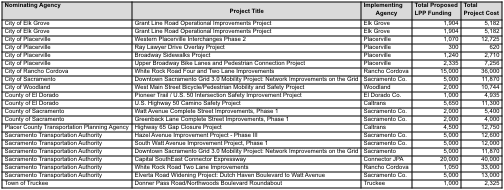
The California Transportation Commission (CTC) yesterday released the list of applications for the Local Partnership Program (LPP) which is one of many programs in SB 1, the transportation bill. The SACOG projects have been selected and are below (with pdf link).

Though these are just applications, and the process of selecting and awarding projects will take many months, it is instructive to take a look at what has been submitted by the transportation agencies in the region.

The list has zero transit projects. Though there are separate programs fo transit, nothings prohibits transit projects, but the agencies were not interested.

Four of the projects are Capital Southeast Connector related (Grant Line Road Operational Improvements Project, White Rock Road Four and Two Lane Improvements, White Rock Road Two Lane Improvements, and of course Capital SouthEast Connector Expressway), which total $40M out of the list total of $88M. This sprawl-inducing gift to greenfield developers has been criticized here and many other places, cannot comply with the air quality and VMT reduction goals of the regional sustainable communities strategy (if was grandfathered in), yet accounts for 45% of all applications.

Of the remaining projects, $27M, 31%, are mostly road widening projects. 24% of the projects have at least a minor component of bicyclist or pedestrian benefit, such as complete streets projects, and a few are primarily for active transportation.

roads in California and Sacramento County

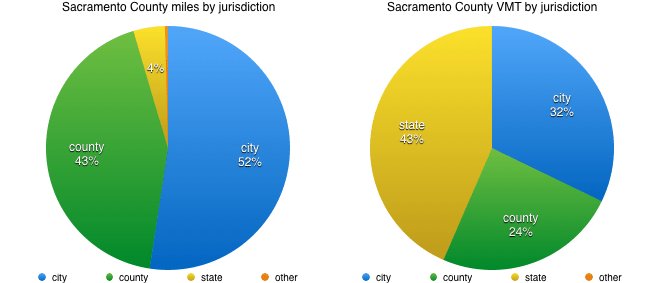
In preparation for some exploration of funding sources for roads, it helps to see what the situation is with the jurisdictions and types of roads, for mileage and VMT.

Jurisdiction means the level of government responsible for the road. This is not always clear from simply looking at a road. If there is a federal or state highway sign, it is pretty clear, but there are roads that are part of the state highway system that are not signed as such.

The types of roads, here, means functional classification, which is a federal designation of Interstate, Principal Arterial – Other Freeways and Expressways, Principal Arterial – Other, Minor Arterial, Major Collector, Minor Collector, and Local. Again, it is not always easy to distinguish classification, but as a generality, freeways fall into the first two, major roads such as Folsom Blvd and Watt Ave fall into the third, busy wide streets are the next three, and residential streets are the last. Another useful classification is that the first six categories are roads, meant to move motor vehicle traffic, and the last is a street, meant to provide access to residences and small businesses. Unfortunately, we build far too many of the road variety and then put business on them so they no longer function well to move cars. See Strong Towns for a more detailed explanation of roads, streets, and stroads.

Read More »

Measure BB Sales Tax in Alameda County

In 2014, voters in Alameda county passed a sales tax, Measure BB, by 70%. This measure is seen as a model for progressive use of sales tax in a county, and the Alameda County Transportation Commission simultaneously achieved recognition as a progressive transportation agency. The measure continued an existing half cent sales tax and added another half cent, for a total of one cent. I think a lot can be learned of use in Sacramento county by looking at the measure and the agency.

Measure BB funds the 2014 Transportation Expenditure Plan, which has these goals:

  • Expand BART, bus and commuter rail for reliable, safe and fast services
  • Keep fares affordable for seniors, youth and people with disabilities
  • Provide traffic relief
  • Improve air quality and provide clean transportation
  • Create good jobs within Alameda County

The plan certainly includes some funds for roadways, but shifts the focus to away from traditional roadway expansion to multi-modal transportation, particularly relative to the earlier sales tax which was heavily motor-vehicle oriented. Of the $7.8B (yes, billion) to be invested over 30 years, the allocations are:

  • BART, bus, ferry and commuter rail $2.8B
  • Affordable transit for youth, seniors, and people with disabilities $1B
  • Traffic relief on streets and highways $3B
  • Clean transportation, community development, technology and innovation $1B

The plan allocates 48% of the total to transit, including expansion, operations, and fare subsidies. Of this, 18% of the total goes to operation of AC Transit (Alameda-Contra Costa Transit) which is the equivalent of SacRT. Without knowing the exact nature of the example projects in the document, it is hard to parse out how much of the 39% “traffic relief” category is maintenance and how much expansion, but it looks like about 2/3 maintenance and 1/3 expansion. The 8% clean transportation category includes a remarkable $651M for “Bicycle and Pedestrian Paths and Safety Projects and Educational Programs”.

The Alameda County Transportation Authority has an Independent Watchdog Committee (page 35 of the plan), whereas Sacramento county has nothing of the sort. The committee holds hearings, reviews audits, and issues reports. The Alameda CTC also works with the Alameda county BPAC (Bicycle and Pedestrian Advisory Council), whereas SacTA does not work with SacBAC (Sacramento joint city/county bicycle advisory council), and in fact there is no pedestrian advisory function at the county level at all.

There are a wealth of ideas in the plan, and it is instructive to read it. I’ll be going through it in more detail in the future.