Rapid Response Program for SacCity

Note: This is a major revision of a post from 2024-01-31. The OakDOT Rapid Response Program is now in a separate post.

When a fatality or severe injury occurs for walkers and bicyclists, people often ask, what can we do right now to prevent or reduce the severity of the next crash? This topic has come up a number of times at the Sacramento Active Transportation Commission (SacATC), and communication from Slow Down Sacramento and the Safety ForumCivic ThreadSABA, Strong SacTown and other organizations.

Based on the successful program from Oakland, I am proposing that the City of Sacramento develop a similar rapid response program.

The City of Sacramento would establish a pilot Rapid Response Program with an initial budget of $100K. The pilot program would address only fatal crashes. The budget will likely be insufficient, as Sacramento has a state-leading level of fatal crashes, but the pilot would allow the city to develop expertise and program structure, and formulate a future budget. The city might respond only to fatal crashes on the high injury network, in order to extend the budget.

A Rapid Response Team will include a city planner and city traffic engineer, and may include responding law enforcement officer and walking or bicycling advocate (Civic Thread for walking and SABA for bicycling, paid for their time). I intentionally say the law enforcement officer who responded to the crash. Other law enforcement officers would likely offer only uninformed opinions and victim blaming, though the experience could be useful for educating officers about street design.

The team will review existing documents and data, and then visit the fatal crash site within two work days of the crash, or the death of a person resulting from an earlier crash.

The team will make a report within five working days which identifies and proposes quick-build features (countermeasures) to reduce or eliminate infrastructure hazards, with prioritization based on effectiveness.

The quick-build features (countermeasures) may include:

  • Refreshed crosswalk
  • Refreshed pavement markings
  • Temporary curb extension with flex posts
  • Temporary modal filter (traffic diverter) with flex posts
  • Temporary traffic circle with flex posts
  • New marked crosswalk
  • Changed or added signing
  • Temporary new stop sign; permanent stop sign would require additional analysis
  • Changed signal timing

At least one quick-build feature (countermeasure) will be installed within 10 work days of the site visit. Additional temporary features will be designed and scheduled.

I had previously mentioned mapping of crashes and related data by the city, because the state SWITRS system is always too far behind. I had previously mentioned a dashboard on crashes. However, these would probably best be implemented after the pilot year.

Pedestrian safety countermeasures

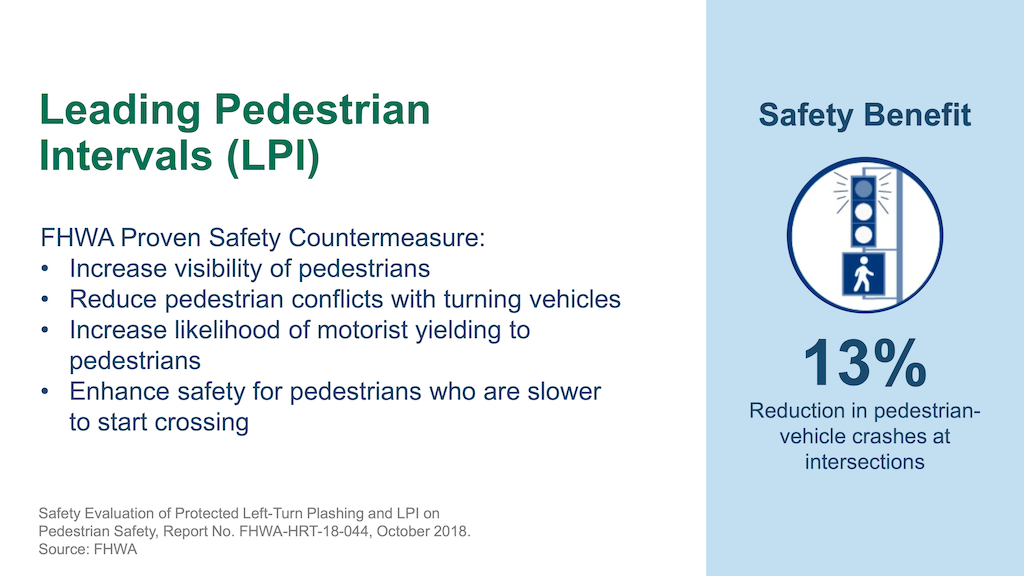
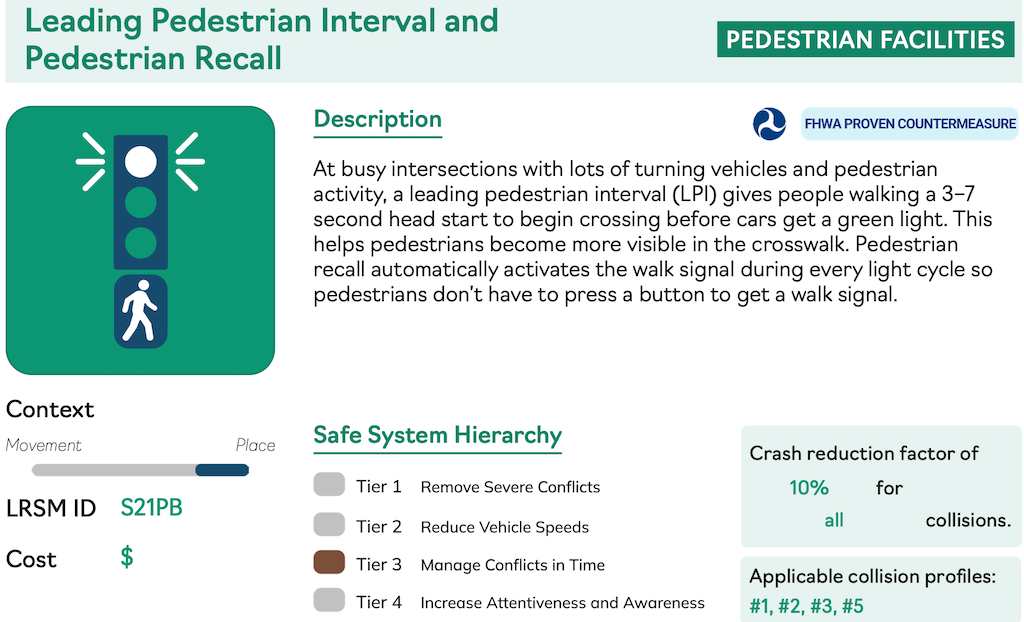
In addition to the leading pedestrian interval recently covered, three other pedestrian safety countermeasures are given prominence (among a long list of potential measures with smaller but not insignificant benefit):

Medians and Pedestrian Crossing Islands in Urban and Suburban Areas: These medians provide a safe space for pedestrians to wait while part way across the intersection, and simplify the crossing by making so the walker only has to look at one traffic direction at a time. They are used both in mid-block and intersection settings. The photo is of a pedestrian island at Folsom and 48th in Sacramento. This is a location with frequent crossings, with popular businesses on the north and south side of Folsom. And with a popular bar on the north side, the importance of safe crossing is increased.

Pedestrian Hybrid Beacon: This is a specialized signal for mid-block pedestrian crossings that grabs the attention of drivers with a sequence of changing signal patterns that eventually goes to full stop. These are also known as HAWK signals (High intensity Activated crossWalK), invented in Arizona. I often hear complaints that these signals are confusing to drivers, but to me, that is exactly the point, it grabs their attention. Though I’ve seen these installed at intersections, this is a mis-application; they are designed for mid-block crossings. These signals are expensive, about 20% of the cost of a fully signalized intersection. The Rectangular Rapid Flashing Beacon (RRFB) is a much simpler and much less expensive alternative, but limited to lower traffic volume and lower speeds than the hybrid beacon.

Road Diet: A road diet reallocates roadway width from regular motor vehicles lanes (called general purpose lanes) to more constructive use such as wider sidewalks, bike lanes or separated bikeways, transit lanes, and sometimes parking – where it is really needed and calms traffic). The simplest to implement is the conversion of parallel parking to diagonal parking on overly wide streets, such as has been done a number of places in Sacramento central city. More complicated reallocations are often called ‘Complete Streets,’ though complete streets are not well defined, and adding sidewalks and bike lanes to 45 mph posted (55 mph actual) arterials with infrequent safe crossings does not encourage anyone to walk or bike and may be a waste of money. But in urban areas where the capacity of multi-lane streets is not needed, or needed for only a very small part of the day, a road diet may create a safer and walkable environment.

For a full list of pedestrian safety countermeasures, see Countermeasures.

Zegeer and crosswalks

In 2005, the Federal Highway Administration (FHWA) published Safety Effects of Marked Versus Unmarked Crosswalks at Uncontrolled Locations. The authors were Charles V. Zegeer, J. Richard Stewart, Herman H. Huang, Peter A. Lagerwey, John Feaganes, and B.J. Campbell, but the research paper is usually referred to as ‘the Zegeer report.’

This is the research that Ryan Moore was referring to in the crosswalk removal meeting when he said that the city was following federal guidelines that required them to remove the crosswalk at Freeport and Oregon, though he did not call out Zegeer by name. Twenty-three crosswalks were removed in total, though we still don’t know where all of them are, and the city won’t provide that information.

As you would imagine, research reports contain a lot of text and figures and tables, but a key finding is that on multi-lane roads (more than one lane in a direction), with traffic volumes over 12K ADT, marked crosswalks had a somewhat higher crash rate than unmarked crosswalks. There is always an unmarked crosswalk at intersections unless there is specific signing to prohibiting crossing. It is this finding that traffic engineers have used to not install, or to remove, crosswalks on arterial roads all over the US. They don’t read beyond that.

The report says several things relevant to the crosswalk removal issue:

  • “In most cases, marked crosswalks are best used in combination with other treatments (e.g., curb extensions, raised crossing islands, traffic signals, roadway narrowing, enhanced overhead lighting, traffic calming measures). Marked crosswalks should be one option in a progression of design treatments. If one treatment does not accomplish the task adequately, then move on to the next one. Failure of one particular treatment is not a license to give up and do nothing. In all cases, the final design must accomplish the goal of getting pedestrians across the road safely.”
  • “Raised medians provided significantly lower pedestrian crash rates on multilane roads, compared to roads with no raised median.” (There is a raised median on both north and south sides of the intersection, and though they are narrower than would be required if built today, they do indeed provide pedestrian refuge.)
  • “Regardless of whether marked crosswalks are used, there remains the fundamental obligation to get pedestrians safely across the street.”
  • “Pedestrians have a right to cross roads safely, and planners and engineers have a professional responsibility to plan, design, and install safe and convenient crossing facilities. Pedestrians should be included as design users for all streets.”

Most importantly, Charles Zegeer, the lead author, said this about the key table in the report:

“This table should never be used to remove crosswalks. That will not solve the safety problem. Use this table to make crosswalks safe.” – Charlie Zegeer

I was on a webinar in which he said that he was horrified by the tendency of traffic engineers to use his research to justify crosswalk removal, and he strongly implied that this was professional malfeasance.

I believe that the city removed the crosswalk because they looked at the intersection and decided that removal was preferable to all other options. This is the ‘cars first’ attitude that contributes to the death of almost 6000 pedestrians a year. It preferences the convenience of people driving though a neighborhood over the safety of people in the neighborhood. This is not acceptable to me, and I doubt it is acceptable to the neighborhood around the removed crosswalk. The city needs to rethink its entire approach to pedestrian safety. Having a Vision Zero Action Plan will do no good if traffic engineers continue to make the wrong choices.