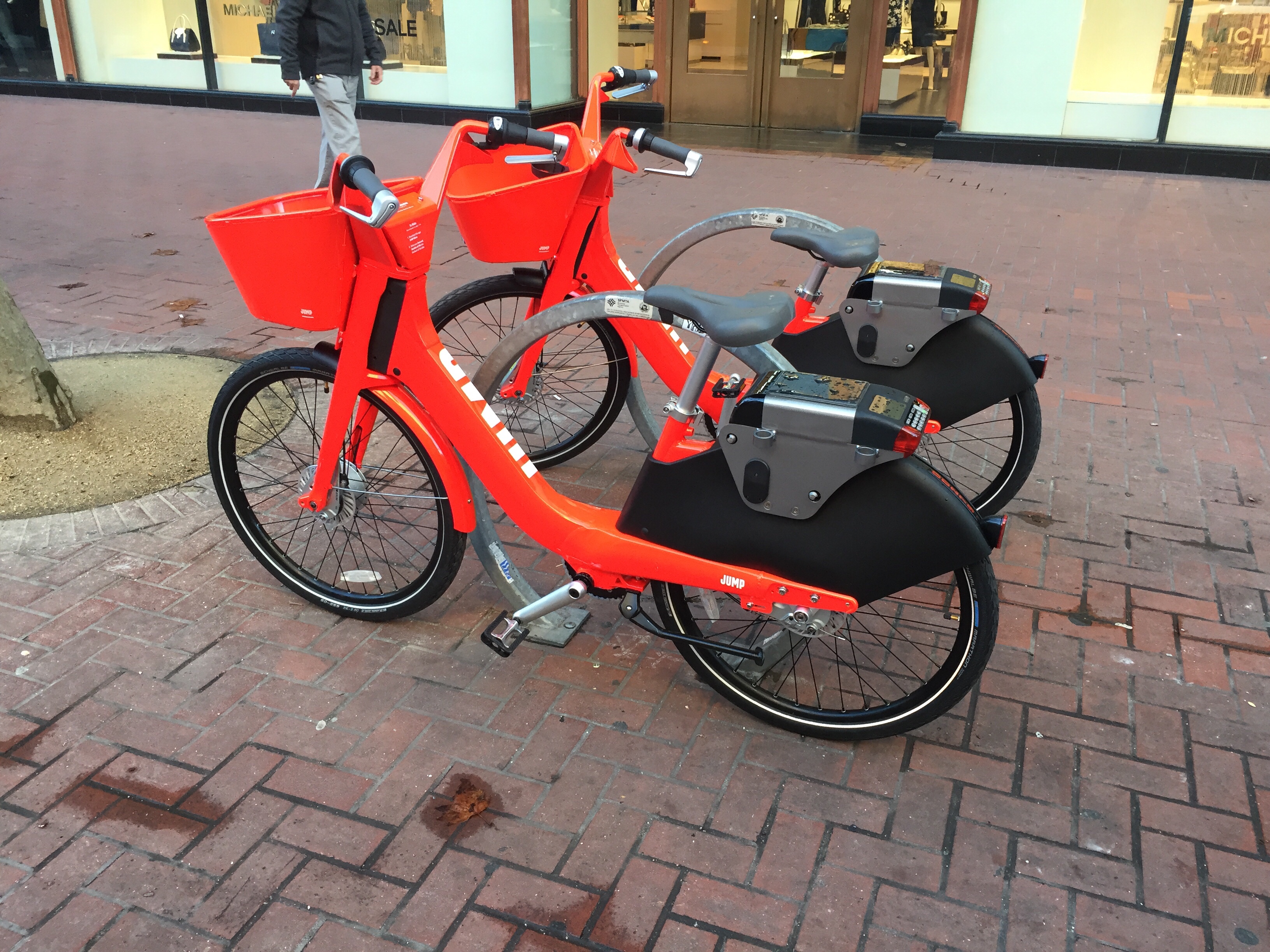
Bike share open house

I attended the bike share open house hosted by the City of Sacramento last night. There were as many people representing partners and consultants as members of the public, and I did not see any low income or people of color. SACOG staff were present, as SACOG is the sponsoring agency for the bike share program, staff from Toole Design Group which is managing planning and selection of bike rack locations, and staff from JUMP, the selected bike share vendor.

Some things to report:

  • Rollout date is between the middle of May and the end of June.
  • There will be 900 bikes total, about 600 in the City of Sacramento and the remainder in West Sacramento and Davis.
  • The bikes will be limited to 15 mph, even though they are designed to operate at up to 20 mph. Under state law, Class 1 bikes can operate with pedal assist up to 20 mph, but a decision was made to limit them based on (probably misplaced) safety concerns.
  • The service area is considerably larger than the pilot Tower Bridge Bike Share, a very positive sign. You can see the boundary at http://wikimapping.net/wikimap/SACOG_Bikeshare.html, and add suggestions while you are there. Scroll to the left to see the Davis section. The open house had a large paper map for the same purpose.
  • There will be some sort of discount for low income people using the system, probably the JUMP Boost program, which is a $5 membership the first year, and $5/month thereafter, for 60 minutes of ride per day. In Sacramento, the eligibility might be based on SMUD status. At least initially, the only other option will be the standard $2 for the first 30 minutes and $2/hour after that, prorated. Other types of membership or charge may be implemented later.
  • Nearly the entire service area in Sacramento is moderate and high income, with just a small area in neighborhoods south of Broadway and around Power Inn being included. The city doesn’t have a plan yet for how to reach out to these potential users, and others not included in the boundary.
  • Bike racks will be provided in a quantity of at least two per bike in the system, so 1800 rack spaces. The use of these racks will be discouraged for other bicycles, in order to keep the spaces open for the bike share bikes. Bikes will be required to be parked at these hubs or stations at the termination of the ride, though they can be put on hold (with the meter running) at any other location. Leaving a bike away from a hub incurs a fee of $2, the same as the current SoBi system. Popular and busy locations will have multiple racks, while other have fewer, or one. Many or most of the locations, particularly outside the central city, do not have bike racks yet, so these will be added by JUMP before rollout. The user agreement requires that bikes be locked to a bike rack, not to other objects or left free-standing. It is not a dockless system.
  • JUMP has designed charging racks where a parked bike will charge. Larger locations will have some of these charging racks, though it is not clear if they will be installed at rollout.

There are two additional open houses scheduled, both in Davis. Friday, March 2, 11 to 1 at UC Davis bus terminal, and Saturday, March 3, 9:30 to 1 at the Davis Farmers Market. These will be less formal, and will offer the opportunity to ride the JUMP electric bike.

Bike share for Rancho Cordova & Folsom?

From the 50 Corridor TMA Communter Connections newsletter:

Bike Share recommendation advances to City Councils

This month, both the Rancho Cordova and Folsom City Councils will hear the 50 Corridor Bike Share Task Force recommendations in for launching a new bikeshare program using LimeBike as the program provider.

The Rancho Cordova City Council is expected to vote on the recommendation at its February 20 meeting which starts at 6 p.m.  The Folsom City Council will consider the recommendation on February 27 during its meeting which starts at 6:30 p.m.

A representative of LimeBike will make a presentation to the Folsom City Council.

Should both councils approve the recommendation, bike share should be available on the 50 Corridor by early April.

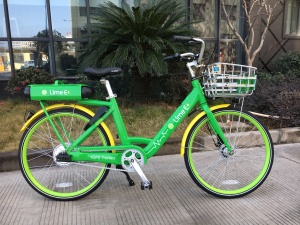
LimeBike-e
LimeBike e-bike

LimeBike features a dockless system – allowing users to park bikes at whatever destination is convenient.  The cost is expected to be $1 for 30 minutes, although a variety of pricing options will be available, including monthly subscription rates.  Electric assist bikes will also be available for $1 to unlock the bike and $1 per every 10 minutes.

The main goal of employing bike share along the 50 Corridor is to address first mile/last mile connections for Regional Transit’s Gold Light Rail Line.  However, bikes can be used for any kind of trip. And because the bikes are not linked to a particular rack (or dock), they can operate anywhere along the corridor where a need exists. 

Read More »

Bike Share Open House Feb 21

from a City of Sacramento email:


Join the City and SACOG for a Bike Share Open House!

What is bike share?

Bike Share provides short-term bike rentals that you can pick up and drop off at various locations around Sacramento, West Sacramento, and Davis. Jump will soon be rolling out 900 bikes for anyone to use, and we want to hear from you!

You can find more information about our regional bike share program here.

When and Where?
Wednesday, February 21st, 5:30-7:00pm

City Hall, 915 I St, Room 1119 (off of H Street)

Can’t attend the meeting?

Share your thoughts on the online map!

Questions?

Email: bikeshare@sacog.org

More information can be found here.

Bike share and bike racks

The announced JUMP bike share coming to Sacramento (Sacramento, West Sacramento and Davis) is fuzzy on details. The announcement says “SACOG and the cities of Davis, Sacramento, and West Sacramento are currently permitting the bike share hub locations and are beginning public engagement.” The implication is that the system will be dock-optional, with hubs located in common areas and a small fee for not parking the bike at a hub, just like the existing SoBi Tower Bridge Bike Share Preview. However, the two existing JUMP systems, in Washington DC and San Francisco, are truly dockless, not dock-optional. There are no hubs, at least so far, though SF is considering some hubs to encourage people to leave the bikes at charging stations.

The JUMP bikes are of the same basic design as the SoBi bikes, they have a GPS unit and a locking U-bar that is meant to lock to bike racks or other fixed objects. Many other bike share systems such as LimeBike have a self-locking wheel lock (like European bikes), and cannot be locked to a rack. The Zagster system I used in Ashland is a hybrid: there is a cable for locking to a hub, which the bike must eventually be returned to, and another cable for locking to racks or other objects when stopping off as part of an errand trip.

When I used JUMP bikes in SF last weekend, one end of my trips had ample bike racks, but the other end did not. At the far northern edge of the geofenced system area, in a residential neighborhood, I searched four blocks without finding a bike rack, and finally used a post that was not a good location as it may have partially blocked access to a building and to parking spots. It was only there for about 20 minutes, so I felt OK, but it really brought home that a dockless system that requires bike rack use, as does the JUMP system, needs ample bike racks to work.

In the Sacramento central city, some areas have ample bike racks, but many areas, particularly neighborhoods to the east, and state building and office building areas, do not. So if the Sacramento system is to be dockless, and if it is to be successful, the city will have to install many more bike racks, in a hurry. West Sacramento and Davis probably have a similar need, but I’m less familiar with them.

My suggested criteria for bike racks is that one or more be visible when standing on a corner at any intersection, anywhere within the service area. I think electric bikes can be a great substitute for ride hailing (Lyft and the company that shall not be named), and a great complement to transit, but only if a person can find a bike close to their origin, and leave it close to their destination.

Jumping ahead (bike share update)

I rode a Jump e-bike in San Francisco yesterday. This was the first day that the program was open to the public, though there had been a low-income pilot going on for several months previously. The bright red (vermillion) bikes are pedal-assist. If you don’t pedal, they don’t go anywhere. But if you do, they really jump out. Though I haven’t ridden any really steep SF hills yet, the bike handled moderate hills with ease. I did ride most of the way across SF and back, and a chose a somewhat more hilly route than I normally would have.

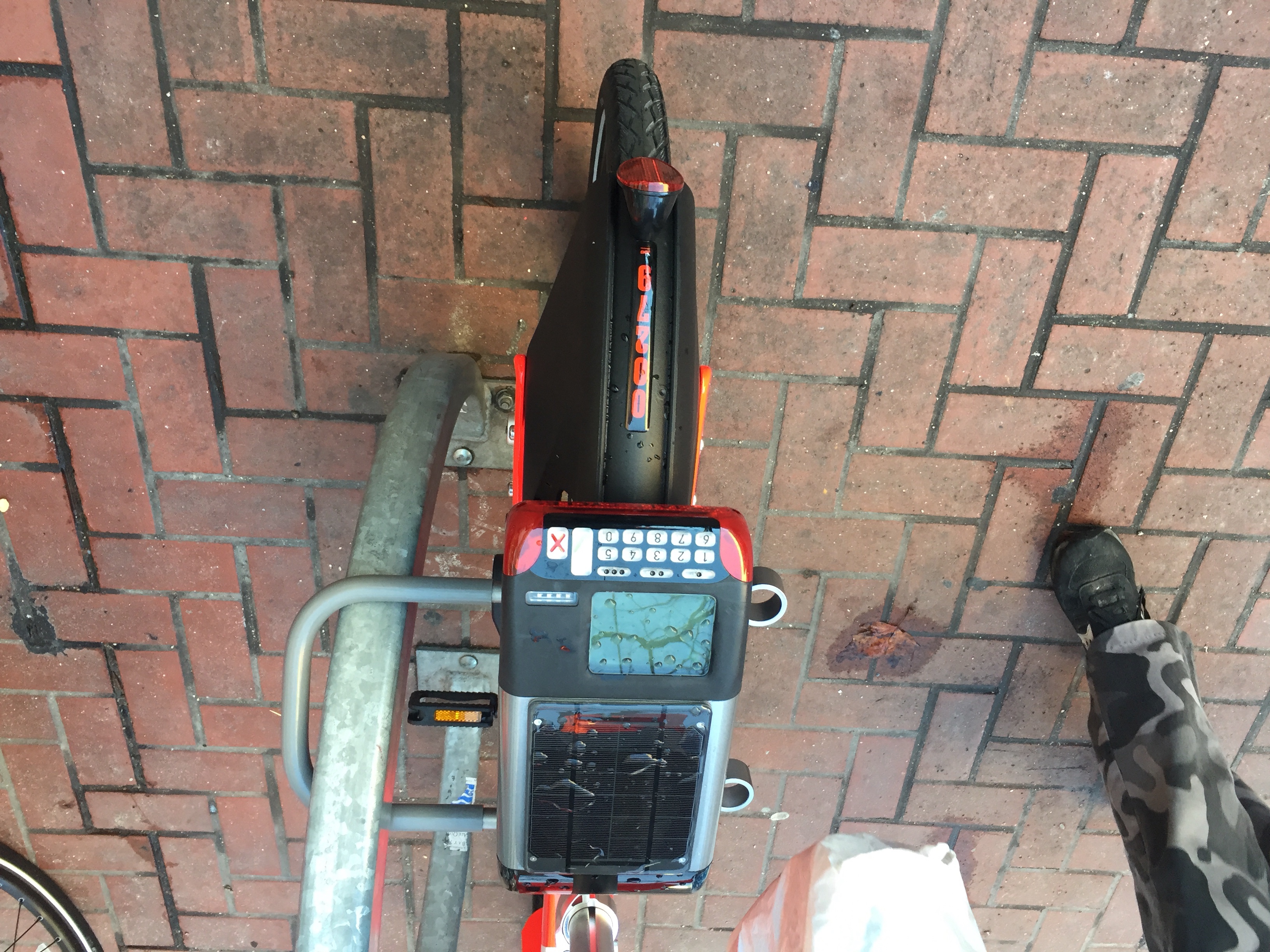
Jump is operated by the company formerly known as Social Bicycles, so the GPS units and locking bar will be familiar to anyone that has used the Tower Bridge Preview bikes in Sacramento. The brakes are different, much stronger, as they should be for a bike that will go 25 mph. There are “gears,” but theses feel different with the pedal assist. The Jump system in SF is truly dockless, unlike the existing Sacramento system which is dock optional. There are no hubs or stations, the bikes can be locked at any bike rack within the system area. On the first day, the bikes were in clusters, with large areas uncovered, but they may become more dispersed over time. The coverage includes two of the lower income neighborhoods in SF, Bayview and Mission, so the user profile may be different than in Sacramento and for the existing Ford GoBike dock system in SF. There is a good article about Jump on SFgate: Jump rolls out San Francisco’s first stationless e-bike system.

The bikes must be recharged every few days, depending on use, and there are no charging stations at least so far, so rebalancing will probably be done as part of recharging. The company reported to me that they are considering hubs, but haven’t located any yet, pending data about use patterns. There seems to be a charging port on the right side of the bike below the handlebars, but it doesn’t look to me as though it was designed for docking/charging stations.

So, back to Sacramento. SACOG and partners have announced that the expanded system in the Sacramento region will use Jump e-bikes rather than the pedal bikes in the Tower Bridge pilot. It is not clear in the announcement whether the Sacramento system will be dockless or dock-optional. I think I prefer dock optional as more of the bikes will be in known locations, but with active rebalancing and recharging, dockless probably works.

The additional hubs (racks with geofences) that we were promised back in September are still not online yet, though most or all of the locations are installed. The most prominent lack is that there is still no hub at Sacramento Valley Station, even though that is the most common non-hub location where bikes get parked. With a May 15 promised opening of the different Jump system, I’m wondering if these other hubs will ever be online.

The 50 additional bikes arrived, though. They have black fenders and baskets. Unfortunately, the practical effect of the additional bikes has not been large. Before the new bikes, the Sacramento side had 20-25 bikes, and it now has 25-30 bikes, though it should have about 50. The bikes are often out of service, mostly due to gearing problems. If you have ridden the bikes, you’ve noticed that the gears slip on many of them. Sometimes this is just irritating, but sometimes it makes the bike unridable. Though this might be a maintenance issue, I suspect it is a design flaw.


The email I got when I joined Jump SF is below:

Hi Dan,

Thanks for joining JUMP SF!

Your account is now active!

Your account number is XXXXXX. Please store this number in a safe place as you will use it to access our e-bikes.

IMPORTANT SAFETY INFORMATION

JUMP is bike share–electrified. When riding the e-bike, start slowly to get familiar with its boost. You’ll feel motor assistance as you pedal. The harder you pedal the more boost you’ll feel. Be sure to try out the brakes to get a feel for stopping.

• JUMP brakes are powerful! Brake early – brake gradually.

• Ride slowly down steep hills.

• Use both brakes together at all times.

• Do not bike one-handed! Do not text while biking!

• Braking hard while riding one-handed is dangerous.

• If you are a heavier rider, ride cautiously down steep or long hills and keep your speed low. Weight limit: 210lbs.

STARTING YOUR RIDE

When you’re ready to take your first ride, enter your account number and PIN using the keypad on the back of the bike. Remove the gray U-bar and place it in the holster loops on the back left of the bike. Adjust the seat height and test your brakes.

PAYING FOR YOUR RIDE

JUMP bike rides cost $2 for the first 30 minutes and just $0.07/minute after that (plus applicable taxes). Your ride begins when you book a bike and ends when you lock a bike.

ENDING YOUR RIDE

At the end of your ride, lock the bike to a public bicycle rack within the designated system area. Bikes should always be visible from the street, and never parked on private property, in parking garages, or in parks. Improper bike locking fees may apply. If you’re ever unsure, check the system area map. Locking the bike outside of the SF system area will result in a $25 fee.

OUR BOOST

On a full charge our bikes can travel around 30 miles with pedal assist. While we do have teams regularly servicing our fleet, please understand that the bike you rent might not be at full charge. If you are riding a bike and the pedal assist runs out, please press the repair button on the bike’s keypad when ending your rental, and lock the bike to a bicycle rack. We will take care of it from there.

Please do not travel outside of the system area unless you are comfortable pedaling without the electric assist should the battery run out. Fees for retrieval of bikes due to low battery outside the system area may still apply.

RESERVING YOUR RIDE

You can walk up to a bike and check it out, or reserve one through the app. The clock starts ticking once the reservation is made. Bikes reserved in advance can be held for up to 10 minutes. Reservations will be canceled automatically if the bike is not unlocked within that time.

HOLD FEATURE

Need to make a short stop on your trip? The HOLD function guarantees that the e-bike is yours for up to 60 minutes. Press the “HOLD” button and lock the bike to a rack. Please note that reservation and hold time count toward your total minutes of riding time.

LINK CLIPPER CARD

You can link your Clipper card after unlocking the bike for the first time. Once unlocked, click Menu > Link Card > Start. Now hold the card directly up against the keypad buttons and wait for the screen to say “Success.” Next time you want to rent the bike, hold the card to the keypad to reserve.

For riding tips and safety information, please see our FAQ. We encourage all JUMP members to wear a helmet while riding. Don’t have one? Visit one of San Francisco’s many bike shops to pick one up, and if you’re a San Francisco Bicycle Coalition member, you can get 10-15% off!

You can learn more about our system and policies by reading our Rental Policy

Thank you again for joining. We think you will enjoy JUMP!

The JUMP SF Team

support@jumpbikes.com

LimeBike in South Lake Tahoe

This weekend in South Lake Tahoe I used the LimeBike bike share for the first time. This system is truly rootless, unlike the SoBi system that allows parking outside hubs but is hub focused. As a result, bikes are everywhere, including out of town. I saw a few parking way out the bike trail northeast of town, on Emerald Bay Rd. I’m not sure if there is some sort of outside geofencing beyond which one can’t ride or leave a bike, but the current use is quite expansive. I don’t know anything about what sort of rebalancing occurs. 

LimeBike is app centric, you need an iOS or Anroid phone with the app installed, and an account with credit on it. Each bike has a unique QR code,which is scanned with the app to unlock the bike. The bikes have European style wheel locks, which unlock automatically, but are manually locked at the end of the ride. 

The cost is $1 for 30 minutes, not prorated, but a very good deal. The Sacramento Tower Bike Preview is $4 per hour, other SoBi systems $7 per hour, and dock systems like Ford GoBike either are membership based or about $3 for 30 minutes. 

The bikes are very simple and inexpensive. The weight is less than half of a typical bike share bike, but that means they are also less robust. I saw several bikes with broken or broken off baskets. The bikes have a rear red reflector, meeting legal requirements, but not what the typical rider would want. Front generator lights are provided, the sort older people will remember from childhood, where power is generated by a wheel that rides on the tire. Some bikes are missing their front light, victims of vandals. Most importantly, the bikes are single speed, no gears to maintain, and no gears to use. Though South Lake Tahoe is flat at least close to the lakeshore, it was challenging heading up a slight hill into a headwind. The bikes have standard disc brakes, that work reasonably well. And a twist bell on the left grip. 

Apparently the business model for LimeBike is that by using inexpensive bikes they can offer lower rates, and easily replace bikes when necessary. Regular system bike share bikes cost $1000 to $1600, but I would guess these bikes are about $200. 

Bike share in Santa Monica

Breeze maintenance shed

The Breeze Bike Share in Santa Monica uses the same Social Bicycles (SoBi) bikes that the Tower Bridge Preview in Sacramento does. On a recent four day visit to Santa Monica, I used the system quite a bit, both for transportation and to compare systems. Here is my take:

  • Breeze Bike Share is operated by a separate company, CycleHop, rather than directly by SoBi as is the Sacramento system. The company also operates systems in West Hollywood/Beverly Hills, Long Beach, San Mateo, and other cities outside California. CycleHop has a major maintenance and storage facility, which I stumbled across, shown in the photo above. They tried rebalancing with bikes for a while but have gone to using vans as they are more efficient. 
  • Breeze bikes are green, and the major corporate sponsor is Hulu. As far as I know, Sacramento is still in search of a major corporate sponsor. 
  • The cost per hour for Breeze is $7, whereas Tower Bridge is $4. This makes a difference! Though I only used up $5 of my initial investment (it costs a minimum of $7 to join), this is only because I spent time every day returning bikes to,hubs in order to gain return credits. 
  • Return to hub credit is $1 in the Breeze system, $1.50 in Tower Bridge. It makes a difference!
  • Outside-hub fees are $2, and outside boundary (geofenced) is $20, the same as Tower Bridge. 
  • I saw people riding Breeze bikes all over town, at all times of day. I often saw the hub racks fill up and empty out over a short period of time, so I know that bikes in the busiest areas were getting many trips per day, though I don’t have any data. It is rare to see Tower Bridge bikes on the road, and though I think they get used one or two times a day, use per bike is much lower.
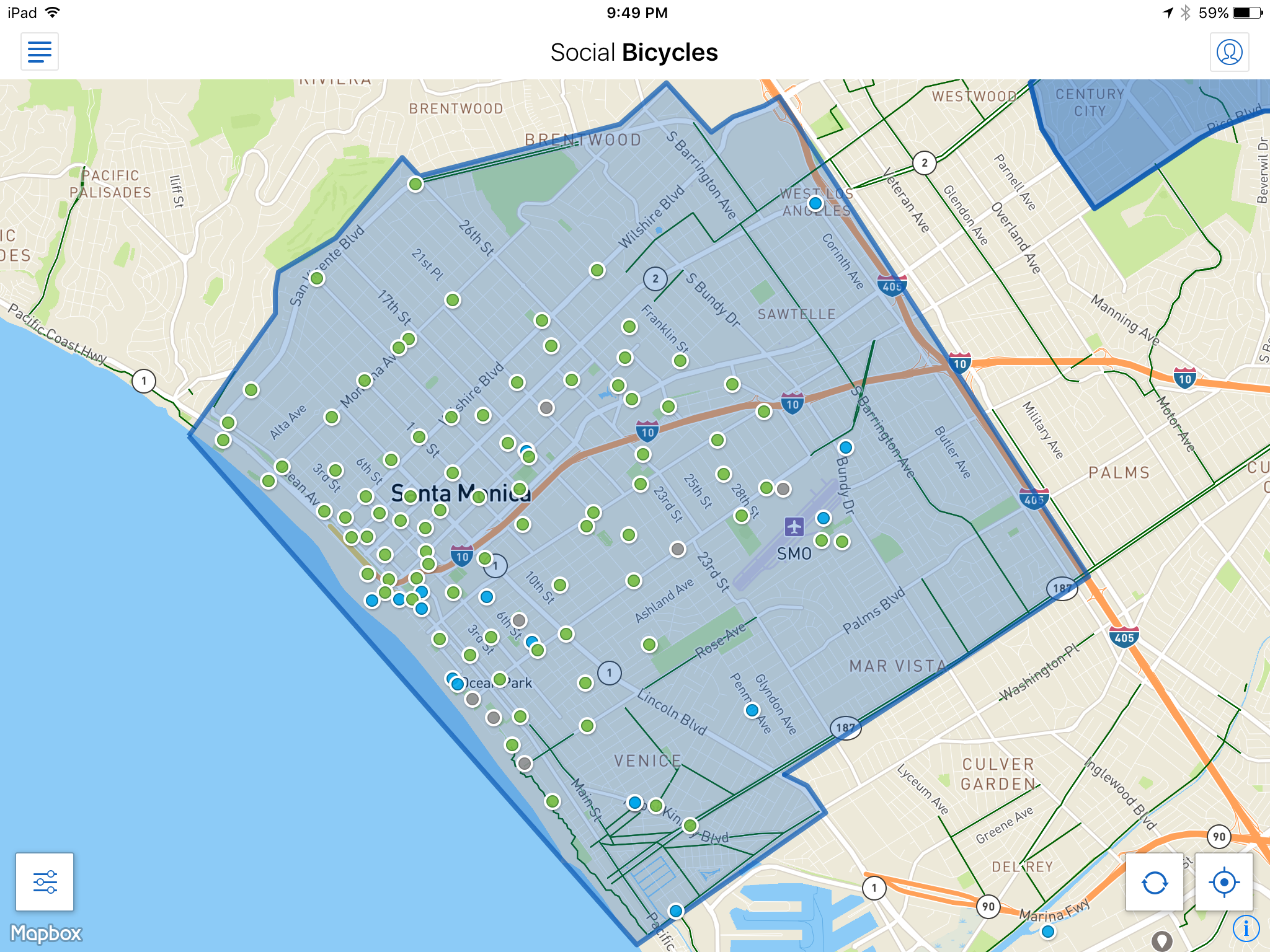
  • Downtown Santa Monica has a high density of hubs, about every two blocks, but the hubs are much sparser in the more suburban parts of town. The downtown hubs are quite large, up to 16 racks spaces. The advertisement says 500 bikes, 80 stations. 
  • Several of the hubs are sponsored, which is indicated by a different icon for the hub, but I was unable to find out more about these sponsored stations, and it was not obvious who was sponsoring them. Tower Bridge does not have any sponsored stations at this time. 
  • Hubs were located close to each light rail station (Metro Expo Line), and at many major bus stops. Tower Bridge hubs are not. 
  • Breeze has the same problems of geo-location that Tower Bridge has, sometimes bikes shown as in hub were not, sometimes bikes shown as out-of-hub were at a hub, and sometimes the bikes were nowhere to be found at the indicated location. More of an irritant than a major issue, since the next hub or bike is not far away. 
  • Breeze has a low-income program, but details are only available on request, not on the website. 
  • Breeze allows users to unlock bikes with a registered TAP card (similar to Connect Card), but charges are to the Breeze account and not the TAP account. I’m using my Connect Card in Sacramento, and also used it in Santa Monica. Using a card is a slight convenience over entering a six digit number. 
  • Santa Monica has flat areas, and gently inclined areas, similar to Sacramento and West Sacramento, but the rise from beach level to downtown level, and out of the Rustic Creek canyon, is comparable to American River up to Fair Oaks. A lot of bikes get left down by the pier and beach , so I imagine part of the re-balancing effort is getting these bikes back up the hill. 

Breeze map below. Green dots are hubs with bikes, grey dots are hubs without bikes, blue dots are bikes parked out-of-hub. You can see the higher density downtown. 

Alta on dockless bike share

Alta Planning + Design has an interesting post on dockless bike share: The Dockless Bike Share Revolution; Is Dockless Bike Share Right for Your Community?

The Social Bicycles Tower Bridge Preview is a dockless system. Designated hubs are created both by geofencing (setting up a boundary for hubs and for the system) and designated bike racks, with a $2 penalty for leaving a bike outside a hub, and $20 penalty for leaving a bike outside the system boundary. But it also encourages return of bikes to hubs with a $1.50 credit. These and other issues are discussed in the post, worth a read. 

More bike share

The Tower Bridge Preview bike share is going to have some expansion in about a month, up to five new hubs on the Sacramento side. I had heard previously that there would be no expansion before full roll-out, which is no sooner than November and quite possibly far beyond that since a major corporate sponsor has still not been identified. 

The best news is that one of the hubs will be at Sacramento Valley Station, the train station, and it will be a large hub. This is mentioned in Melanie’s StreetsblogCal post: Eyes on the Street: Sacramento’s First Cycle Track Appears Near Amtrak, and I also heard the same when I ran into Phillipe at the 18th & Capitol hub, doing maintenance and re-balancing. It was a major oversight to not include a hub at the station, but that will be fixed!

I talked with the other person who is regularly parking a bike at the station, for a commute into the Bay Area a few days a week. That person said they love the system, use it for this and other trips, but wished there were a regular hub at the station. The bike has always been there at the end of the day to be used for the return trip. I’m parking a bike at the station for nearly every Amtrak trip I take (to the Bay Area, to Truckee, and to South Lake Tahoe). Since I’m often gone more than one day, other people sometimes check out the bike, which is fine with me since I live close enough to walk. 

If you are using the system, you noticed a few days ago that the display screens on each bike changed, with some additional information and tips. The ability to unlock a bike with a RFID card, meaning the Connect Transit Card, is prominent. But not yet implemented. SoBi and the ConnectCard are working out the details. Card use will initially just be for unlocking, in the same manner that the Clipper Card can unlock a Ford GoBike in the Bay Area system, but you will have to have a Social Bicycles account and bike use will be charged to the account rather than the card. The display also mentions unlocking with a phone number, but I’m pretty sure that is not implemented either. 

Please share stories here about your use of the bike share. Since that company, SocialBicycles, and the partners, SACOG and the two cities, have said next to nothing about the success and challenges of the bike share, it is even more important that we talk with each other. 

 Oh, and if you are looking for employment, SocialBicycles is hiring an Operations Manager for Sacramento. 

bike share so far

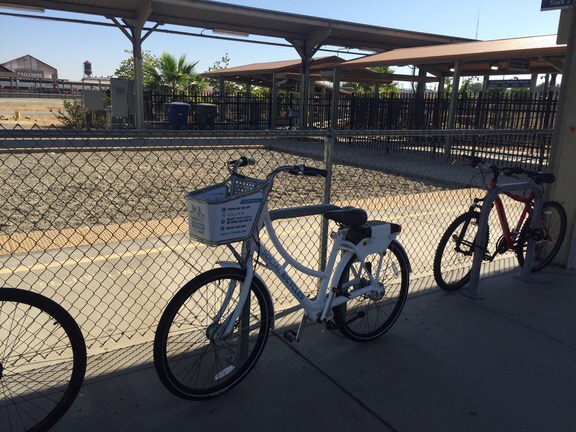
SoBi bike at Sacramento Valley Station
The Tower Bridge Bike Share Preview has been operating in Sacramento central city and part of West Sacramento for two months now. I have been using it from time to time, and have some experiences to share. 

These SoBi (Social Bicycles) bikes are a combination of hub bikes and park-anywhere bikes. If you return a bike to a hub, you pay only rental time. If you lock a bike up anywhere within the two geo-fenced boundary areas of Sacramento and West Sacramento, you pay an extra fee of $2. If you Park it outside the geofence, you pay $20. Except for one bike that ended up being stolen, I’ve never noticed a bike being left outside the geo-fence, but bikes are sometimes left outside hubs. This was common in the early days, but seems to have tapered off. It was earning quite a bit of credit on my bike share account returning these bikes to hub, which earns a credit of $1.50, but most days now there are no bikes outside of hubs in the morning, when I look, and return. 

One of the cool things about the SoBi system is that temporary geo-fenced areas can be set up at other locations, for special events. The only instance of this that I’ve noticed is when one was set up at the Sunday Street at Broadway open streets event, but the capability is intriguing. 

Of the six hub locations in Sacramento, four are located near drinking establishments. Most of the bike share use I observe visually and by watching patterns in the app map is bar-hopping. This is certainly a valid use of the bikes, and I’m glad these people are pedaling instead of driving. 

In most bike share cities, a prominent service of bike share is as a transit extender, serving as a “first-mile/last-mile” access to and from transit. None of the hubs in Sacramento were located with that in mind. The greatest shortcoming is that there is no hub at Sacramento Valley Station, the Amtrak station. I have been riding a bike to the station at times, for trips where I’m not taking my own bike with me. Someone else has regularly been leaving a bike at the station on weekdays, presumably commuting on the Capitol Corridor train. The station is at least within the geo-fence, so the charge for doing this is only $2, but I do not understand why the station did not get a hub in the original layout. This is just a pilot, and presumably in the formal rollout in November or beyond, there will be hubs at transit locations. SACOG had said that part of the purpose for the preview was to gather information about patterns of use, but no information is being gathered about transit-related use because none of the hubs were located with that in mind. I asked SACOG about hub locations, and they said these had been determined by the cities, but when I asked Sacramento, they said the locations had been selected by SACOG. 

So far as I know, SACOG has not provided any use data for the bike share system, at least it has not showed up on any of the meeting agendas. I look forward to seeing what the system has to say about patterns of use during the preview. 

When I’m using the bikes, people often ask me questions about how it works. I tell them how easy it is to download the app and set up an account, and go, but most people seem to think this is too difficult and don’t end up doing it. Even young people who are used to downloading apps don’t seem to want to do it. Once your account is set up, you enter you member number and passcode on the GPS unit located on the bike, in order to unlock. I’m not sure how the system gets over that hump of few members. I have noticed that users of the Bay Area Ford GoBike are mostly using their Clipper Cards (equivalent to the ConnectCard) to unlock bikes, rather than using the application, though the charge is to the GoBike account rather than Clipper. Hopefully the SoBi system can be linked to ConnectCard for unlocking, and maybe even charging. 

The Ford GoBike system has created a $5 per year low income membership (regularly $149) in order to encourage use by low income but bike dependent members of the community. It is partnering with the bicycle advocacy groups and low income bicyclist clubs such as the scraper bike folks, in order to sell the benefits of bike share to a wider audience. The locations of the stations (GoBike is a station-based system and the bikes are not designed to leave anywhere other than a station) have also been extended into several low income neighborhoods, though certainly not all of them. I do not know what plans the Sacramento system has for meeting the needs of low income users, but I look forward to finding out. 

Previous posts: riding the bike share, almost bike share