bike share model for Sacramento

I was recently asked what model for bike share could work in the Sacramento region, given the recent pull-out of Lime, and the small fleet offered by Bird.

The current situation is:

  • SACOG no longer wants to be involved in bike share
  • it is not clear whether Sacramento Metropolitan Air Quality Management District wants to be involved
  • private bike share companies have pulled out of Sacramento twice now, without notice to the permitting agencies nor users
  • privately owned and operated bike share systems are struggling in many cities, and they have either ended or cut back
  • City of Sacramento does not want to be involved in managing bike share beyond issuing permits; it isn’t clear whether West Sacramento wants to
  • Davis, under a partnership between UC Davis and the City of Davis, has a bike share system operated by Spin, and was not part of the SACOG program before it ended
  • when the system was in operation, it covered only parts of Sacramento and West Sacramento, excluding many lower income neighborhoods
  • discount programs offered by Lime, and still by Bird, are important, but are meaningless if bikes are not available in low income neighborhoods

It is clear that the privately owned and operated model is not working, and will not work, for Sacramento and West Sacramento. I believe that bike share is an integral part of our transportation system, and it is the responsibility of the transportation agencies to ensure that there is viable bike share in urban areas. So what model might work? Please understand that I do not have special expertise in bike share programs, beyond having used the local ones extensively, used systems in several other cities, and in fact was a primary enabler of the SoBi and initial JUMP systems by rebalancing bikes when the companies were understaffed to do so. I encourage you to look at NACTO’s Bike Share and Shared Micromobility Initiative and Shared Micromobility in 2022 to educate yourself about bike share.

Note: I am not addressing scooter share. My observation of scooter share is that it mostly replaces walking trips, and therefore has no VMT reduction value. Bike share seems to be used mostly to replace motor vehicle trips. Therefore bike share is the important issue to be solved.

My model

  1. Bike share would be publicly owned, including bikes, bike parking areas and racks, and docks or charging infrastructure if that turns out to be the system model.
  2. Bike share would be privately operated under contract with a public agency. The private company would be required to give a minimum of 60 days notice to terminate the operation.
  3. The best public entity to own and contract the system in the Sacramento region is SacRT. I don’t say this because SacRT has any expertise or competence in bike share, but because they are the one regional entity that covers nearly all of Sacramento County, and might be interested, and through MOU, could cover West Sacramento as well (Yolobus is likely to eventually be annexed by SacRT, but the two agencies already cooperate). There is a nexus between transit and bike share, because bike share fulfills the first mile/last mile needs of many riders. Bike share locations would not be limited to transit stops, but that would be one of the criteria for system design and bike locations.
  4. SacRT, or other entity, would contract with a private company with experience in bike share management to operate the system. It is also possible that a nonprofit might be created to operate the system, as this has been a successful model in several cities, particularly as private systems failed.
  5. The system would be operated in areas with enough residential or commercial activity to justify productive and profitable (for the private operator) operation. Since there are such areas outside of the cities in the county, and since there are also areas within the cities that are too low density to justify bike share, it does not make sense for operations to be contracted by the cities. Criteria for successful areas would have to be developed, and adjusted as appropriate.
  6. There is a role for the cities, and the counties, to fund bike share infrastructure. Though grants are a possibility, there are no existing and reliable sources of funding for the publicly owned system. Either the cities and counties fund it, or it doesn’t happen. Once the system is in operation, there may be enough ‘profit’ to maintain and upgrade the system, so that the cities and counties might not have to supply ongoing funding. Or it may require ongoing subsidy.
  7. The private operator would be subsidized by an amount subject to negotiation, for perhaps two years, but the system should not need ongoing subsidy. The initial subsidy would cover the start up period during which the system would rebuild knowledge and support among the users. The withdrawal of LIme, and JUMP/Uber before that, has certainly damaged the reputation of bike share, and the new system will have to rebuild trust.

There are three types of bike share systems:

  • Docked: Bike must be returned to a dock after use. Docks are provided in areas of higher use.
  • Undocked: Bikes can be parked anywhere, though them must be locked to a rack or within a designation parking area.
  • Hybrid: Bike may be returned to a dock or hub, or parked elsewhere. JUMP had a highly successful hybrid system, where users were rewarded for returning bikes to a charging hub, but could park elsewhere. The bay area Bay Wheels is hybrid for pedal assist e-bikes (not regular bikes) in that they can be parked away from docks for a small fee.

There are plenty of other issues to resolve before we get to which type of system, but I provided that for people who will ask. Each system has its advantages and disadvantages, and its proponents and detractors.

Your thoughts? Have at it.
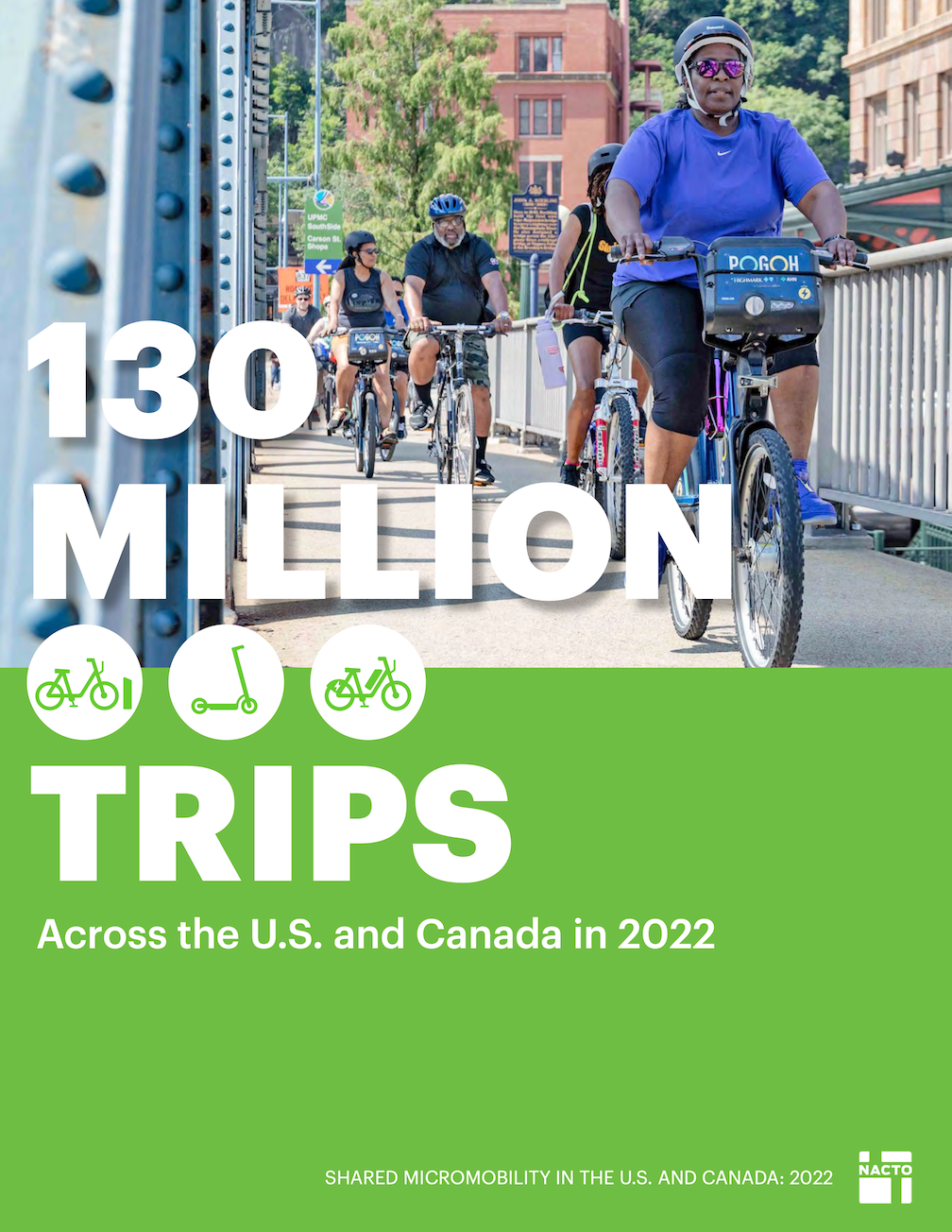
NACTO shared micromobility report

NACTO released it’s Shared Micromobility in the U.S. and Canada 2022 ‘130 Million Trips’ report in September 2023, and the report has a summary webpage at https://nacto.org/publication/shared-micromobility-in-2022/. The report is interesting throughout, but one paragraph in particular is important for the Sacramento situation in which Lime has removed its bikes from the region, and Bird is offering few bikes. Bike share in Sacramento is more or less dead. It is clear that the model of privately owned and managed bike share does not work here. If we are to have bike share, we need a new model. I’ll have one or more posts on that shortly.

From the report (page 10):

“Shared micromobility systems that see consistent growth and equitable outcomes are typically municipally-owned or closely managed through long-term partnerships with private operators. Long-term contracts have resulted in more sustainable results for ridership and the durability of systems. The enduring viability of private sector operators remains uncertain, especially as companies with short-term permits respond to financial troubles by pulling out of cities–often abruptly–altogether. Shared bikes and e-scooters can and should be integral parts of a city’s transportation network, but that is only possible if they are consistently available and resistant to the volatility of market conditions. Partnership models where local governments have greater involvement in their shared micromobility programs generally lead to better outcomes, like more equitable pricing structures, greater investment in historically underserved communities, and ultimately, a greater likelihood of long-term viability.”

Another issue for the Sacramento area was that rental prices for bikes saw several increases during the JUMP and Uber times, and a huge jump when Lime took over. The system had become unaffordable for many former users. Lime originally offered a free for a low monthly fee rental program for people in CalFresh or similar programs, but this year changed to a half-off discount, helpful but hardly affordable. Bird has a similar half-off program. Again, from the NACTO report (page 14):

“The cost to ride a shared bike or scooter continues to rise in numerous cities, posing a threat to affordability. In a year of widespread consumer price increases–including public and private transportation modes–shared micromobility was no exception. Annual membership hikes, alongside rising e-bike surcharges, led to a 70% increase in average per-trip costs for members of station-based bike share systems from the previous year. Pay-as-you-go trips on e-bikes or e-scooters were the most expensive, with average per-trip costs more than double the typical fare of a one-way trip on public transit in the U.S. and Canada.”

I have not yet used the Spin bike share in Davis yet. I’m always in Davis with my own bike, so haven’t been motivated, but I should test it out.

where did the bikes go?

I noticed on the evening of Friday, November 10, that there were no bike-share bikes available on the Lime app, anywhere in the Sacramento region. This is still true on the morning of Thursday, November 16. The red-orange Lime/JUMP bikes had been available throughout the center of Sacramento and West Sacramento. Where have they gone? I don’t know. I’ve received no communication from Lime about the issue, and no one has shared any information with me.

Since there were no Lime/JUMP bikes on the 10th, I looked at the Bird app for their blue bike-share bikes. There were none. As of this morning, there are a few Bird bikes available in the app, but far fewer than there used to be.

I don’t know if the disappearance of bikes from these two vendors was related, or just happenstance.

Bike-share from Lime and Bird are privately owned and operated, under permit from the City of Sacramento and City of West Sacramento. But the permits apparently do not require notification to the cities of major service interruptions or issues. JUMP pulled its bikes from the entire region, without notice to any of the agencies, or the users, at the beginning of the pandemic. Users were left in the lurch, with fewer transportation options that before. The withdrawal, which was not necessitated by the pandemic, was probably a business decision. It killed off the most successful bike-share system in the United States (in terms of rides per bike per day). Sacramento continues to be a second class bike-share market to this day.

I believe that bike-share must be controlled in some way by the transportation or transit agencies. The systems might be contracted out to vendors such as Lime and Bird, but control would be with the agencies. Again, we see the flaws in the privately owned and operated model.

SACOG bike share policy

The SACOG Regional Bike Share Policy Steering Committee met this week on Monday (agenda). This was the first meeting of the committee in quite some while, long enough that the staff member did not remember when the last one was. The committee is almost entirely new people since the last meeting. Members are: Alberto Ayala (Sac Metro Air Quality District), James Corless (SACOG), Dawnté Early (City of West Sacramento), Caity Maple (City of Sacramento council member D5), Katie Valenzuela (City of Sacramento council member D4), and Chair Josh Chapman (City of Davis).

There was a presentation by SACOG staff Nicole Zhi Ling Porter on the status of bike share/scooter share (or micromobility) in the region, as well as questions that the policy committee will help answer. The main question is the ownership and operations model, with three options”

  • privately owned and operated (the current model)
  • publicly owned and operated
  • publicly owned and privately operated (under contract)

These are not exclusive categories. Several existing bike share programs have detail models for operations, using some sort of public/private partnership.

The City of Davis and UC Davis are undertaking a study to determine the model they want to use and the operators. They did not rejoin the regional program after the pandemic shutdown. It has apparently not been decided that they will not rejoin the program, but they wanted to consider other options. There may be an announcement about this in the near future.

The current bike share fleet is about one-third the number of bikes that were available before the pandemic, which was about 900. Sacramento was in fact the most successful bike share system in the country, as measured by number of rides per bike per day. The system is now an also-ran.

Several committee members mentioned that rental costs were now much higher, and that was probably depressing use. I have to admit that I am a Lime Access member, meaning that I don’t pay for individual rides of up to 30 minutes, so I have not noticed the per-minute fees.

I was the only public person in attendance in the room. One person spoke on Zoom, but I have not way of knowing if there were more people observing on Zoom. Note that I am a user of the bike share, not of the scooter share, and don’t have much perspective on scooters, I expressed these concerns, which I hope committee will address:

  • Instability: The unannounced shutdown of the system at the beginning of the pandemic was not the desire of the public, which wanted to continue using the bikes. This type of issue, determined solely on the whims of the operator/owner, is not acceptable to the users, and any new policy must address this issue.
  • Maintenance: The bikes are not being maintained to an acceptable level of good repair. About 1/4 of the bikes I try to rent are unrideable for various reasons, about 1/4 are rideable but have significant issues, and about 1/2 are more of less OK.
  • Distribution: The agreement between the operator/owner requires that some bikes be distributed/rebalanced into low income neighborhoods within the service area (many are not in the service area, but some are). My observation, both from being on the streets and checking the app, indicate that this is not being done.
  • Transit integration: The JUMP bike share system was for a time somewhat integrated with transit. Bike charging stations were located at a number of light rail stations. But when Uber took over the system, these charging stations were removed. So there is no integration at this time. Bike share and transit can complement each other in critical ways, but the current system is operating without that insight. There are a few systems in the country where the transportation/transit agency also operates the bike share system, Los Angeles Metro for example. Though this system is not perfect, the integration is noticeable, and the rental rates are significantly below that of private systems.

fixed bike/scooter corral

A bike/scooter corral was installed on R Street in a parking space, next to the Sacramento Natural Foods Co-op. Though for a while drivers respected the set-aside, marked for bikes and scooters, drivers came to use the space as regular parking, with a car parked there almost all day long, preventing the intended use as a bike and scooter parking area. I reported this illegal parking to the city a number of times, but to my knowledge, no one was ever ticketed. It should be noted that parking is not short on the streets around the co-op, and there is a parking garage adjacent to the co-op, which I have never seen full. So drivers were using the spot for personal convenience.

The city recently installed vertical delineators (flex posts) in the spot and repainted the while line that signifies are bike parking area. So far it is working, I’ve not seen anyone run over the posts in order to park there.

The majority of the bike/scooter corrals in the city have been placed on wide sidewalks, where they don’t interfere with walking. The in-street corrals are mostly being respected; this is the only one I am aware of that was routinely violated.

These corrals are designed to solve two issues: 1) provide parking where traditional bike racks are not present or insufficient; and 2) to keep scooters (mostly rental scooters from the scooter-share companies) from filling up the regular bike racks and preventing their use by the public.

photo: R St micromobility corral with posts
Sac_R-St-corral-with-posts

Sacramento bike share update

There are a number of new white and green Lime bikes on the street in Sacramento. There are not the easy-to-steal white and green ones of a few months ago, some of which were promptly stolen and the others quickly pulled from service. Though they still seem to be called Gen 4 bikes, they now have a cable lock very similar to those used on scooters. I have seen more of these bikes downtown/midtown than elsewhere. See photo.

Lime bike cable lock

There continue to be red JUMP/Lime bikes on the street. I had the impression that there were fewer of these bikes than there used to be, but it may be that they are just being distributed differently. I’ve seen racks (the old SoBi/JUMP racks) full of these bikes, which had not had more than one or two bikes since the return of bike share. Lime does not make its GBFS (General Bikeshare Feed Specification) available to the public, nor does it have a map of bike share other than in the app, so it is difficult to say whether the bikes are being appropriately distributed/balanced.

While looking to see if there was a web map, I ran across an interesting ArcGIS Story Map from the City of Sacramento, Shared-Rideables in Sacramento. It was created in January 2022, and has not been updated, but is quite interesting.

Lime still seems to be failing to track and pick up dead bikes. By dead, I mean that the battery has run down to the point that it no longer powers the GPS unit, so Lime loses track of where these bike are. Several months ago there were a number of these bikes, reported to both Lime and the city, but not picked up after three weeks. Lime promised to me and to the city to do better. However, recently there were two bikes parked on the pathway from Sacramento Valley Station to the platforms for more than five days. Bike parked anywhere other than in very visible location on the street network do not get picked up for significant periods of time.

I used a Lime bike (white and green) Saturday without incident, returning from a trip. But on my outbound trip, using Lime/JUMP bikes, when I was on a tight schedule, I had no luck finding a bike that worked properly. The first one was stuck in first gear. The second had no pedal assist. The third had a jammed seat post that could not be adjusted. I managed to make the train on time, but barely. The bikes are simply not being maintained as they should be. I have noticed that if I report a problem, though the app, the bike is still there days later, and still rentable by another victim.

When reporting a bike problem, the app provides a limited number of issues (below), and no longer provides a text field for entering detail. The diagram says pedals, but there is no indication here or anywhere whether than means a problem with the pedals or cranks, or means problem with the pedal assist.

Lime app, problem report screen

One feature that was added to the app a few months ago that I really like is that the user can select scooters only, or bikes only, or both, for map display.

The app seems to show whether the bike in question is one of the new white and green ones or the older red Lime/JUMP bikes with the fabric covered locking cable. I’ve said before and will say again that it was a mistake for JUMP to drop the U-bar lock mechanism used on the SoBi and early JUMP bikes. So far as I know, a properly locked bike with U- bar was never was stolen.

Lime fails on bike share

Below is a photo of a Lime/JUMP bike that has been abandoned for three weeks now, parked on my street, P Street, between 13th St and 12th St. It has been reported to the city, twice, and to Lime, three times. And it is still there. Of course the battery has depleted so that GPS no longer works. But Lime knows the last reported location of the bike, before it died.

Let me be clear and blunt. Lime does not give a shit.

This kind of neglect will continue until: 1) the city (and SACOG) holds Lime accountable for managing the bike share fleet, 2) the city or the region gets a real bike share operator, or 3) the city or the region changes to a publicly owned system. The third option is probably the best, because then the city and/or region can manage the bike share system as part of the transportation network, and SacRT can take on some responsibility for the bike share system as a first mile/last mile solution with transit.

JUMP/Lime bikeshare update

The JUMP/Lime bikeshare bikes in Sacramento and West Sacramento say “Available on Lime and Uber” on the bikes. They are not available on Uber. After many months of the Uber app offering only ride-hail car services, they finally added back shared devices under the ‘2 Wheels’ option. The app offers to rent bikes, showing them on the map for selection, or allowing the user to scan the QR code on the bike. It goes to ‘starting ride’ and then… nothing. The bike is not unlocked, and the ride terminates after a few moments, without any message.

I have of course reported this issue to Lime. The support people insist that it works correctly, referring me to or reading from the support article “How does renting a scooter through Uber work?”. When I insist that this is incorrect, their response is, well, just use the Lime app. The reason I want to use the Uber app rather than the Lime app is that I have a large credit in Uber Cash, accumulated from rebalancing bikes in the past, that I want to use.

I’m not a scooter user, so I can’t report whether scooter rental works or not. I’m also not an Android user, so can only report on the iOS app.

The size of the bike fleet continues to be smaller than it was under JUMP. Friends who live outside the central city tell me there are rarely bikes available close to them. even in the central city it may be some distance to a bike. Under JUMP, the system did not work well until the number of bikes deployed reached a critical density of about 900 bikes, and then it worked great, being the most successful location in the country. Lime doesn’t seem interested in achieving this critical density.

I see a lot of dead bikes around, ‘dead’ meaning that the batteries are too low to rent, or the battery has completely run out. For a few of these bikes in my neighborhood, I’ve reported them to both Lime and to the city, but Lime was very slow to pick the bikes up. One dead bike was there for a week before it was picked up; others have been there for several days after being reported.

JUMP charging hubs

Someone asked me recently about the locations of JUMP bike charging hubs in Sacramento. There are 18 on the map below, and one new on on 19th Street just north of Q Street, at the Q19 Apartments development. I captured this map from the JUMP bikes website, which took a little doing.

JUMP bike charging hubs in Sacramento

I recently took photos of all the hubs I could find, and they are part of the Sac bike-share album at https://www.flickr.com/photos/allisondan/albums/72157713653167982. I was able to locate only one of the three hubs shown for Sacramento City College. It may be: 1) I just couldn’t find the other two (they are much harder to see at this time since they don’t have any bright red bikes in them), or 2) they are not charging hubs but regular bike racks, or 3) they are located where construction is going on and are inaccessible or removed. All the rest of them have at least one photo in the album.

So far as I know, there are no charging hubs in Davis, nor in West Sacramento (which shown on the map as part of Sacramento).

When you actually rent a bike, the app shows the location of these hubs, but with no bikes to rent (the system is currently shut down, in case you had not heard), I can’t see what the live map shows. But other than the one new one, I think this map is accurate. Let me know if you know otherwise.

JUMP on Monday, August 6

We counted throughout the day of Monday, August 6, and generated the following data table and gif animation. Monday was not necessarily a typical weekday, as the middle days of the week may be more typical, and it was not a typical use day because the air quality was unhealthy for a portion of the day. The gif animation focuses on Sacramento central city. It is not possible to present much larger areas without losing icon and count detail.

JUMP_2018-08-06