- Bike trail mostly reopens after water recedes along American River (SacBee 2017-03-02)
- Sacramento transit agency wants to shake up its bus routes (SacBee 2017-02-28)
- 30-day walking challenge: Readers share how they’ve kept walking (SacBee 2017-02-27)
- Taxes are on the table as push for California road funding intensifies (SacBee 2017-02-27)
- Back-Seat Driver: This winter has bashed the heck out of California roads (SacBee 2017-02-27)
News summary 2017-02-26
- Walk This Way (SacTown Magazine 2017-Feb/Mar)
- Here’s how to see Northern California while keeping your carbon footprint minimal (SacBee 2017-02-24)
- Repairs to damaged light-rail equipment in Folsom nearly complete (SacBee 2017-02-23)
- Restored Sacramento train depot offers glimpse of past and future (SacBee 2017-02-23)
- Tahoe officials tackle congestion, say wider roads not part of the solution (SacBee 2017-02-22)
principles for transportation investment
As part of my work with transportation advocates, and my personal passions toward a transformed transportation system, here is my Principles for Transportation Investment. It applies to all government levels, but in particularly was developed as an alternative paradigm for Measure B and “Son of Measure B.” Text below, and also a pdf (Principles for Transportation Investment). This is long, but I hope you will take the time to read and reflect. And comment.
Principles for Transportation Investment
The overarching goals for investments in transportation are:
- creation and support of livable, walkable communities that are economically vibrant for all citizens
- reduction of distance between housing, jobs and amenities
- reduction of vehicle miles traveled (VMT) per capita in order to reduce greenhouse gas emissions
- reduction and eventual elimination of crash fatalities and severe injuries
- maintenance of our transportation system in a state of good repair
Our transportation system is out of balance, emphasizing private motor vehicles over transit, walking and bicycling. A ten-year moratorium on new roadways and roadway widening, through 2028, will jump-start the process of bringing modes back into balance.
In the past and present, communities of low-income and color have been under-invested, and often dis-invested through lack of maintenance. Future investments must therefore work to return these communities to parity. Specifically,
- communities of low-income and color must be present at the table for all major transportation decisions, and funding will be allocated to support that inclusion in all planning processes
- 50% of transportation investments will be in or directly benefiting communities that meet the established ATP/GGRF grant criteria for disadvantaged communities, for at least 15 years or until significant parity is achieved
Transportation investments must meet the goal of reduction and eventual elimination of fatalities and severe injuries. Specifically,
- the top intersections and corridors with fatalities and severe injuries will be identified and will be used as the primary though not sole criteria for project selection
- projects which may increase crash rates for minor injuries and property damage while reducing or eliminating fatalities and severe injury, such as roundabouts and mid-block crossings, will be considered for funding without prejudice
- sidewalks will be considered an integral part of the transportation system, therefore sidewalk installation and maintenance will be completed as a normal part of transportation investment
- bicyclist and pedestrian fatality and severe injury rates are high and increasing; therefore 25% of transportation investments will be devoted to bringing fatality and injury rates back to parity with mode share
Transportation investment must depend upon a variety of income sources including user fees, property taxes, income taxes, and sales taxes. User fees should be the primary source, while sales taxes should be used in moderation because they are inherently regressive. Specifically,
- at a state, regional, county and city level, sales tax measures must be complemented by actions to implement user fees, property taxes and income taxes to support transportation
Housing and transportation cannot be addressed in isolation and must be integrated through planning and investment. The economic impact on housing affordability and individual mobility is not just housing costs or transportation costs, but housing + transportation costs. Specifically,
- no investment in rail transit should be made in areas where there are not existing plans or reasonable expectation of affordable housing development, and no new bus routes created where there are not existing plans or reasonable expectation of affordable housing development
- governments must invest in affordable and “missing-middle” housing at a rate comparable to or exceeding investments in transportation
A successful transportation system must be integrated with wise land use. Specifically,
- no transportation investments should be made which promote rapid densification and displacement
- and conversely, no transportation investments should be made in communities or areas which are unwilling to allow a natural increment of density
- greenfield development must pay the entire cost of transportation, including long-term maintenance, related increases in transportation capacity for roads, transit, walking and bicycling throughout the region which are engendered by the development, and transportation demand management
Transportation investments at all government levels will support the SACOG Sustainable Communities Strategy. Specifically,
- since achievement of greenhouse gas reduction targets can only be achieved through a strong investment in transit, walking and bicycling, transportation investments will reflect those goals
- no project will be funded which would induce increased VMT
Congestion relief in the absence of other measures has and will induce more traffic and therefore additional congestion. Therefore, all projects which are intended to relieve roadway congestion will implement controls to prevent induced demand, including congestion pricing, or will mitigate induced demand through corresponding investments in transit, walking and bicycling.
All transportation projects must address maintenance of the infrastructure in a state of good repair for all time, including eventual replacement cost. Specifically,
- user fees must support a significant portion of ongoing roadway maintenance
- fix-it-first must be a continuing commitment at all levels of government until the entire transportation system is in a state of good repair (SOGR), and then state of good repair must be continued
- all agencies will have and implement a complete streets policy before receiving funding; all roadway repaving projects must consider re-allocation of roadway width to sidewalks, bike lanes, and transit lanes
- governments will no longer take on responsibility for the cost of maintaining transportation infrastructure which serves greenfield development; therefore the development must allocate a long-term reserve to the maintenance of internal transportation facilities and any highway interchange which primarily serves greenfield development
Fiscal solvency at all government levels must be a guaranteed outcome of major transportation investments. Therefore, all major projects will include a transparent and accountable analysis of the ways in which the project will increase user fees, property taxes, income taxes, and sales taxes which meet or exceed the cost of construction and maintenance.
All transportation investments must support improvement and maintenance of public health. Specifically,
- investment must reduce air pollution, however, the traditional assumption that congestion relief reduces air pollution must be justified by actual data
- investment must encourage daily physical activity in all parts of society
- transportation modes which generate air pollution (roadways and diesel rail) will not be located or expanded near schools and parks
- transportation planning must consider the removal or reduction of existing roadway capacity such as freeways and/or conversion of diesel rail to electric rail
Education of youth in transit, walking and bicycling will reduce future demand for private motor vehicle travel, and increase demand for livable, walkable communities. Specifically,
- elementary students will receive pedestrian and bicyclist education
- middle and high school students will receive transit education
- 1% of all transportation funds will be devoted to youth education
- transportation agencies will work with California Department of Education, school districts, private schools and law enforcement to develop and fund model education programs
time to get off the infrastructure treadmill
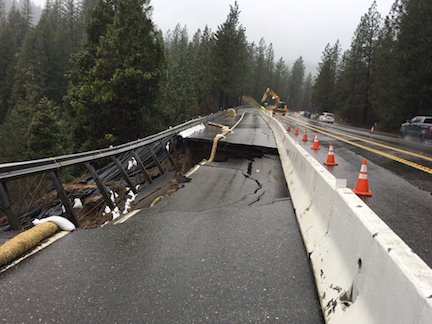
With the recent storm damage to roadways, as well as some transit and rail lines, the governor has proposed about $600M in quick fixes. This adds on to $59B deferred maintenance on state highways, and $78B on local roads (the actual local roads number is likely much, much higher). Pretty soon, we’re talking real money.
I am not opposed to fixing storm damage, or to keeping roads in a state of good repair, abbreviated SOGR and often called “fix-it-first.” However, if it isn’t obvious by now, let me clearly state that we already have more infrastructure than we can ever afford to maintain. Even without climate change, we probably could not keep up, and with climate change, we don’t have a chance.
We have a transportation system built on the idea that someday there will be enough money, our kids will be richer, the economy will be better, the federal government will offer an infrastructure windfall, a fairy godmother will wave her wand. It’s not going to happen. The bills are already coming due, and there will be far greater bills coming due in the near future. Politicians, and the voters who support them, have been running a growth ponzi scheme (see https://www.strongtowns.org/journal/2009/2/3/the-small-town-ponzi-scheme.html and other Strong Towns references), gathering the political and economic benefits today while putting the costs off to the future.
So, what to do? Well, first, stop digging the hole. We don’t need any new roads or highways, or additional lane miles. We do need to make the ones we have more efficient (defined as the number of people moved per hour per dollar, NOT the number of vehicles moved per hour per dollar), and on the whole, we do need to keep them repaired.
But we also need to realize that we have already overbuilt, and we are going to need to let go of some of it. Return rural roads and residential-only streets to gravel (bicyclists, get your mountain bikes). Stop paving parking lanes to the same high standards we use for the travel lanes, and in many cases, let them return to gravel as well. Or just remove some of them – we don’t need as many cars, either. Where sidewalks are needed and don’t exist, don’t take them out of people’s property, but out of the existing roadway. Where roads have been built wider than will ever be needed, take the extra width out and sell it off, with adjacent property owners getting first right of refusal. If there is no market, then give it away to the adjacent property owner. In suburban Sacramento county, there are streets that go from narrow two lane to four lane to extra-wide four lane and then back down again. These are safety hazards and maintenance nightmares. Let’s put this wasted road space back to productive use.

Freeways are the next big thing to reduce. The major Interstates are economically critical for freight movement and to a lesser degree people movement (though quality rail can take much of the pressure off). But they’ve gone from two lanes per direction to four to six to eight to ten, with Texas holding the record, I believe, at thirteen lanes per direction (in the U.S. at least). What are all the extra lanes for? Mostly commuters, and for about two hours a day. People who have been allowed and encouraged to live a long way from where they work, just to save on housing costs. But the bill has been paid by all of us, private car commuters or not, and we have only just begun to pay this bill. It may be larger than our entire economy. So, let’s shrink the Interstates back down, in most cases to two lanes per direction. The other freeways? Most of them are not needed at all and can be removed in favor of surface streets with a restored street grid. People will adjust over time, make different decisions, and it will take long enough to accomplish that it won’t be a sudden shock.
There is no better time than a crisis to re-think our transportation system. If we don’t think now, we will go back to sleep and assume that it is all going to work out, somehow, someday, some fairy godmother.
Each of these ideas deserves exploration, and I will do that as I can.

on-demand bike lockers at Sacramento Valley Station
 Forty on-demand bike lockers have been installed at Sacramento Valley Station by Capitol Corridor. They are located between the station exit to the platforms and the thruway bus area. These lockers use the BikeLink chip-card system, which I wrote about in 2013 (BikeLink). These join long-term lockers and the Pedal Stop bike station, and new lockers at the Amtrak/Capitol Corridor station in Davis.
Unfortunately, you can’t purchase a BikeLink card in the station, at least not yet. You can purchase them in the Cafe Car onboard all Capitol Corridor trains, but of course if you arrive at the lockers without a card, that doesn’t help you for this trip. You can also order cards via BikeLink. I am not sure how long it takes to get cards through the mail, but I think I remember about a week. The BikeLink map shows three vendor locations in Roseville, since Roseville now has BikeLink locker locations, though I have not used these. The cards cost $20, and that full value is available for locker rentals, though if you use a bike station location with multiple bike racks, such as the Folsom station and several in the bay area, you do have to pay a one-time $5 fee.
The lockers cost 5 cents per hour. That’s a pretty incredible deal given how much car parking costs, and the peace of mind knowing your bike is very unlikely to be stolen or vandalized. Even your seat will be dry!
Hopefully this will be the beginning of more installations showing up around Sacramento and the region, as business and agencies realize what a convenience and encouragement for bicycling the lockers are.
Thank you, Capitol Corridor!
Parkway trail management
Part three of posts on the parkway trail; part 2 Parkway trail flood signing; part 1 Parkway trail low points. This is it for now.
The Jedediah Smith Memorial Trail through the American River Parkway is a major commuting route for bicyclists from the suburbs to downtown, with some reverse commuting as well. It is also a recreational trail, getting a lot of use from recreational bicyclists, walkers, and families on weekends. It is great that one trail can serve so many purposes. However, the trail is being managed by Sacramento Regional Parks as though it were just a recreational trail. The trail is part of the transportation network in the county, and it should be managed as such, of course in a way that is compatible with its purposes of recreation and natural area conservation.
To be specific:
- Directional signage to indicate entry and exit points and junctions with connecting trails is almost nonexistent. Mileage/time to destinations signage is non-existent.
- Park ranger and maintenance vehicles regularly drive on the trail, compressing the decomposed granite walking/running shoulders that have been constructed. These then erode and become muddy, and the vehicles track mud out onto the paved trail. Much of the maintenance work could be done by cargo bike, and much of the ranger patrol could be done by bicycle, which after all works just fine for the Sacramento PD and CHP bike officers. I have never seen a regional parks employee on a bike.
- When the trail is closed by flooding or fire, no information is provided about alternate routes. (see Parkway trail flood signing)
- Low spots on the trail are regularly flooded under moderate rain and flooding events, resulting a broken network. (see Parkway trail low points)
- The entire parkway has remained closed after the recent severe flooding episode, but regional parks has made no effort to inform the public about the sections where easy bypasses are available, such as levee top paths (which are sometimes paved and sometimes gravel, but usually passable). For example, it has been easy to ride from Guy West bridge along the levee, duck under the overpass at Howe Avenue by using paths down to and up from University Ave, and continue on to Watt Avenue, and beyond, but instead regional parks has said the parkway is closed and has not informed anyone of these alternate route. Parts of the trail were never flooded at all, yet remain closed.
- Sacramento Regional Parks receives $1 million annually from the Measure A transportation sales tax in order to maintain the trail. The Sacramento Bicycle Advisory Committee (SacBAC) has questioned how the money is being spent over the years, but has never received a satisfactory answer. It is possible the money is being well spent, and I’m sure the trail is expensive to maintain, but regional parks is not being transparent.
- There are almost no user facilities on the western end of the trail between Watt Avenue and Discovery Park. A drinking fountain at Howe Avenue was removed three years ago and never replaced. There are no bathrooms in this section, other than the smelly pit toilet at Watt Avenue and the almost unusable pit toilet near the Expo Parkway access point (which leaks waste into the waterway, no less). There are some benches or tables, but few and far between.
- Root humps regularly develop in the trail, which is natural given the riparian zone and large trees. So far as I can tell, the paint markings to flag these hazards are all made by trail users, not by regional parks. When things get really bad, they are repaired, but long after the point at which they become dangerous. The same issue exists with beaver burrow slumps, common in the section between Expo Parkway access and Sac Northern trail.
If Sacramento Regional Parks cannot manage the trail as part of the transportation network in the county, then perhaps it is time to pass along management of the trail (not the parkway) to another agency.
Please check the “Storm-Related Parks Update” on the Sacramento Regional Parks homepage.

Parkway trail flood signing
Part two of posts on the parkway trail; Parkway trail low points.
When the parkway trail has been flooded this year, all the way back into December but increasingly this spring, Sacramento Regional Parks has closed various segments, and even the entire parkway at times. This is understandable. The trail is, after all, in a riparian area, and what defines riparian areas is an abundance of water.
Regional Parks has posted some information about the trail on their website, particularly as more and more of the trail has been closed, and is up-to-date with a complete closure now. In December and early January the website information was frequently out-of-date. Their Twitter account has had somewhat better information about the parkway, but it focuses mostly on motor vehicle access and not on trail access and usability.
Parts of the trail are quite usable right now, but rather than addressing those parts, all of the trail is closed.
News summary 2017-02-19
The news this week has been full of Oroville Dam and road closures due to flooding and mudslides. Despite all our spending on infrastructure, nature is still in charge.
- Democrats should find room in the car for Republicans (SacBee 2017-02-16)
- Rough weather puts rails at risk in Northern California (SacBee 2017-02-15)
- Think you didn’t deserve that parking ticket? Here’s why you may be right. (SacBee 2017-02-13); and other topics

Parkway trail low points
There are two low spots on the American River Parkway trail (officially called the Jedediah Smith Memorial Trail) that flood even under moderate rainfall or flood conditions. It may seem strange to bring these low spots up when just last week perhaps 90% of the trail was underwater. The trail is in a riparian area, and so will and should flood during major flood events. But the trail is also a major commuter route for hundreds people who work downtown and live to the east, as well as a few reverse commuters like myself. After the jump, details and solutions for these two problem spots.
55% threshold for transportation maintenance
State Senator Scott Wiener has introduced SCA 6, a constitutional amendment that would change the threshold for transportation measures from 2/3 (67%) to 55%. While I understand the desire to make funding of transportation easier, I am also scared by possible outcomes. The Sacramento County Measure B would have passed under this new threshold, but it failed with 65% when 67% was required. Measure B was chock full of bad projects, including Capital Southeast Connector (a new freeway), widening of Capital City Freeway, new interchanges throughout the county (mostly to serve new and planned greenfield developments), and additional road widening and extension. It also had some good things, such as fix-it-first and light rail car replacement with low-floor/level boarding cars.
I am concerned that if this amendment were adopted, there would just be more and more investment in the same old infrastructure solutions that got us into this mess in the first place, and still less dedicated to what we really need for the time being, which is maintenance.

