JUMP credit, in repair, count

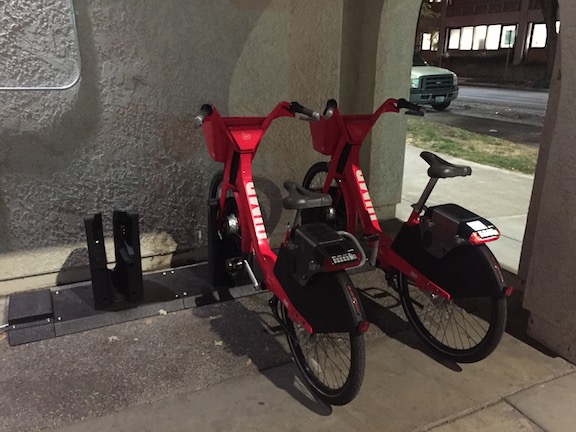
If you pick up one of the $ icon bonus bikes in Sacramento and return it to one of the drop zone hubs, you actually have 15 minutes to park to receive the full credit. After 15 minutes, you are charged the regular minute rate. For example, if you took a $ bike and rode it for 30 minutes, you would get the credit of 50 cents, but subtracted from that would be 15 minutes times 7 cents (the per minute charge is not exactly 7 cents, but close enough), so $1.00 would be deducted, for a total of minus 50 cents. It is still a good deal, as compared to the $2.00 you would have paid otherwise, but returning low battery bikes to drop zone hubs is a good bike share community act, valuable regardless of the credit.

The threshold for bikes going into repair mode from low battery changed about a week ago. A $ icon bike no longer goes into repair mode all the time, but rather it depends on the battery level. I have not exactly pinned down at what battery level this is, but it is below the 35% level at which a bike gets the $ icon. I think it is about 25%, which I also think is the level at which the app shows ‘low’ instead of a percentage, but I need more observations to pin this down. At any rate, you still get the drop zone credit whether or not the bike goes into repair.

Since bikes will be available at lower battery levels than before, it becomes more important for the user to look at the battery level and determine whether there is enough to reach the destination. The GPS unit display shows battery level, but it is a little hard to determine exactly what it is, and the battery level may change as the GPS unit corresponds with the network. The app gives an exact level.

I heard from a JUMP staff that there are now 600 bikes in the region. Of course some are in the warehouse being charged and some are in repair mode, so there are always fewer available, but this is a significant increase over time from the initial 300.

No more pure office buildings downtown

The state is building several new office buildings downtown. Close to where I live, the former building at O St and 12th is gone, and will be replaced with a modern office building, and the block between O and P and 7th and 8th is seeing a new building. There are others planned, and there is a plethora of state-owned surface parking lots (a travesty of land use if ever there was one) that could be developed.

It is good, in a sense, to see the state aggregating scattered offices into more centralized locations. But what is not good is that the state is not building any housing to go with the offices. So most employees will still be driving in from the suburbs, creating air pollution and rush hour congestion in the process, while contributing nothing to life in the central city. Almost every new building, whether public or private, has some retail, at least a corner and sometimes the whole ground floor. But integrated housing and office is rare.

So, my modest proposal (in the Swiftian sense) is that every office building of one-quarter block or larger include housing for at least one-quarter of the employees of the building. Not just the daytime office drones, but the maintenance staff as well. Some percentage should be required affordable, probably 20% to cover the lower income maintenance and clerical staff. I am not saying the the residences should be limited to employees of the building, I’d leave it up to each building manager how they wanted to allocate housing.

I have mixed feelings about whether this should be required of private developments. Certainly there should be codes and city support for accomplishing the same objective in private development, but requirements, not so sure. But state owned buildings, yes, absolutely, every one of them.

I lived in midtown, close to the downtown boarder, for seven years, and have now lived in downtown, near the midtown border, for just under a year. I moved all of five blocks. These two places might as well be in different cities. Downtown is dead, dead, dead at night and on weekends, whereas midtown is alive weekdays, evenings, and weekends. The difference? I think it is primarily the lack of housing in downtown. Office towers do not make for a livable, walkable place.

JUMP on Monday, August 6

We counted throughout the day of Monday, August 6, and generated the following data table and gif animation. Monday was not necessarily a typical weekday, as the middle days of the week may be more typical, and it was not a typical use day because the air quality was unhealthy for a portion of the day. The gif animation focuses on Sacramento central city. It is not possible to present much larger areas without losing icon and count detail.

JUMP_2018-08-06

JUMP count update 2018-08-04

There are clearly more bikes on the street now than at last count posting, but I’m not sure how many. The rumor was 100 more bikes in this last week, and 100 more in the week before, but so far I’ve not been able to get anyone to confirm or deny those numbers. If true, that would make a total of 500 bikes in the region. Since the total possible is not known, we can’t say what the availability percentage is. When there were 300 bikes possible, the percentage available ranged up to 56%, but I think that staffing is now catching up with demand and the percentage available may be ranging up to 74%.

I am curious about whether there is an industry standard for the availability of bikes. Since I am pretty sure that JUMP has the vast majority of electric assist bikes in service, and none of the electric bike share systems are very old, I have not been able to find any information. It is worth remembering that electric assist bike share did not even exist in 2016, and the NACTO 2017 bike share report does not mention electric assist bikes at all. This report was released May 2018, so the next report is months away. Of the bike share systems, the only ones with electric assist, so far as I know, are JUMP (dock-optional), Motivate (which operates most of the dock systems in the US), and LimeBike (dockless). I have seen a few Ford GoBike (a Motivate system) electrics in SF, but have not had the opportunity yet to ride one.

There are a number of people returning bikes to the drop zone (green) hubs, either for the 50 cent credit or out of the goodness of their hearts, and I think that is helping keep more bikes out on the streets because it makes it easier for JUMP staff to find and load these for West Sacramento to be charged. It is more likely now that hubs will actually have bikes available because charged bikes are being returned to hubs more frequently.

I was out last night returning low battery bikes to hubs (in between beers), and I saw about 80 bikes in use in various parts of the central city. I also saw ‘in repair’ (low battery) bikes being picked up by JUMP staff at the 17th & R drop zone, at about 10:00 at night, so there is real effort now to keep up with charging.

A caveat about all counts: These counts are done by hand by Dan, and Matt who is now helping, and of course they will not be 100% accurate. In fact, in the time it takes to count the bikes in the app, the numbers have changed, particularly at those times of day when a lot of bikes are in motion, commute hours and going out in the evening hours.

2018-08-04 10:00AM

  • Sacramento: 207 bikes, 94 in hub and 113 out of hub
  • West Sacramento: 57 bikes, 35 in hub and 22 out of hub
  • Davis: 50 bikes, 21 in hub and 29 out of hub
  • Total: 316 bikes

2018-08-02 6:46AM

  • Sacramento: 248 bikes, 125 in hub and 123 out of hub
  • West Sacramento: 59 bikes, 29 in hub, 30 out of hub
  • Davis: 58 bikes, 20 in hub, 38 out of hub
  • Total: 369 bikes (this is the largest number available that we have seen to date)

2018-07-31 6:22AM

  • Sacramento: 187 bikes, 94 in hub and 93 out of hub
  • West Sacramento: 50 bikes, 33 in hub and 17 out of hub
  • Davis: 67 bikes, 26 in hub and 41 out of hub
  • Total: 304 bikes

2018-07-30 1:41PM

  • Sacramento: 108 bikes, 46 in hub and 62 out of hub
  • West Sacramento: 33 bikes, 23 in hub and 10 out of hub
  • Davis: 52 bikes, 17 in hub and 35 out of hub
  • Total: 193 bikes (this afternoon low probably indicates both bikes in motion and ones that are ‘in repair’ low battery)

2018-07-30 6:17AM

  • Sacramento: 127 bikes, 76 in hub and 51 out of hub
  • West Sacramento: 32 bikes, 15 in hub and 17 out of hub
  • Davis: 55 bikes, 21 in hub and 34 out of hub
  • Total: 215 bikes

2018-07-28 6:30AM

  • Sacramento: 162 bikes, 62 in hub and 100 out of hub
  • West Sacramento: 37 bikes, 19 in hub and 18 out of hub
  • Davis: 30 bikes, 17 in hub and 13 out of hub
  • Total: 229 bikes

2018-07-27 6:30AM

  • Sacramento: 155 bikes, 75 in hub and 80 out of hub
  • West Sacramento: 35 bikes, 16 in hub and 19 out of hub
  • Davis: 45 bikes, 11 in hub and 34 out of hub
  • Total: 240 bikes (this is the first count that I think indicates the total bikes are now above 300)

JUMP drop zones in San Francisco

I was in San Francisco the last two days, and used the JUMP system to familiarize myself with the drop zones there, the ones marked as a green lightning bolt. First, the only drop zone with charging racks is at the Bluxome Street warehouse location, as it was before. The other eight drop zones are just regular bike racks, meant to accumulate bikes that have low batteries and are about to go into repair mode, so that they can be picked up more easily for recharging. A person at the Bluxome warehouse confirmed that the other drop zone hubs were not charging hubs, said they were planned to be eventually, but didn’t know when.

The credit for returning a low battery bike (with $ icon) to a drop zone is offered as ‘up to’ $6, and the two bikes I returned both earned that $6 credit. I’m rich! Well, rich in bike share credits.

And, to repeat what I’ve already said, the difference between 20 mph (SF) and 15 mph (Sacramento) is significant. At 20 mph, I can keep up with traffic on most streets. Of course having bike lanes and separated bikeways that are present on more and more streets in downtown, and lane splitting when necessary to avoid congestion, makes a huge difference as well. In afternoon rush hour traffic yesterday, I rode to two destinations that would have taken me about five times as long in a car, because the traffic was crawling, and sometimes not even that, and I was zooming. Bikes, and bike share!

I also did a single bike count, 3:00PM on Tuesday, and there were 162 bikes out of a possible 250 bikes available in San Francisco, an availability rate of 65%. It would be interesting to do more counts, but I don’t have the time.

It is hard to come back to Sacramento heat after two days in San Francisco cool.

JUMP drop zones for Sacramento

New in the JUMP app within the last few days (thanks Matt for noticing) are drop zones, marked with a green lightning bolt icon. I thought these might be charging hubs, promised for ‘some day’, but they are drop zones, just regular JUMP system racks (exclusive JUMP racks and other racks that were part of the SoBi system). I checked three of the 12 racks on the Sacramento side, and none are charging racks. This makes me question the assumption I made that the green hubs in San Francisco are charging hubs; they may also be just drop zones. I’ll be in SF tomorrow and will report.

The purpose of the drop zone hubs is to accumulate bikes that need charging so that it is easier for JUMP staff to locate them and return them to the West Sacramento warehouse for charging. The city hall hub had five ‘in repair’ (very low battery) bikes parked there this afternoon, so the idea is working to at least some degree.

in repair (very low battery) bikes at city hall hub

JUMP is offering an incentive of 50 cents for returning a low battery bike (shown as a $ icon) to a drop zone hub. I did this twice this afternoon, and got the promised 50 cent credit on my account. If you tap on the drop zone hub, it says “Bring a bike with a ‘$’ icon to this drop-off zone. The trip will be free and you will get up to $6.00 in credit.” If you tap on a $ bike, it only offers $0.50, so I assume that is the default and only value for the JUMP Sacramento region, at least at this time.

I finally got a clarification of why I was seeing $ icons in my app, and other people were not. I am a member of both the San Francisco and Sacramento systems, so my membership in the SF system causes these $ to show up. Of course now everyone should be seeing the $ icons and drop zone icons in their app, even if they only have a Sacramento membership.


JUMP count

July 19, 11:30PM (picked as a time when most bikes are parked, not traveling):

  • Sacramento, 68 bikes out of hub, 18 bikes in hubs, 5 bikes out of service area, total 91 bikes in service.
  • Davis, 37 bikes out of hub, 7 bikes in hubs (2 hubs), 1 bike out of service area, total 45 bikes
  • West Sacramento, 19 bikes out of hub, 2 bikes in hub, 0 bikes out of service area, total 21 bikes
  • total 157 bikes

July 20, 7:30AM (picked as a time when recharged bikes may have been distributed, though bikes will be traveling)

  • Sacramento, 63 bikes out of hub, 22 bikes in hubs, 5 bikes out of service area, total 90 bikes
  • Davis, 33 bikes out of hub, 7 bikes in hub, 1 bike out of service area, total 41 bikes
  • West Sacramento, 18 bikes out of hub, 2 bikes in hub, 1 bike out of service area
  • total 152 bikes

July 20, 11:00AM (picked as after the commute rush and before the lunch rush, though there are certainly bikes traveling)

  • Sacramento, 61 bikes out of hub, 10 bikes in hubs, 5 bikes out of service area, total 76 bikes
  • Davis, 36 bikes out of hub, 7 bikes in hub, 1 bike our of service area, total 41 bikes
  • West Sacramento, 5 bikes out of hub, 5 bikes in hubs, zero bikes out of service area, total 10 bikes
  • total 130 bikes

I am not able to compile these kind of statistics on a regular basis, but perhaps we (the users) could pick a few times of day and crowd-source the data.

Charging hubs in San Francisco

The JUMP San Francisco system now has nine charging hubs scattered around the service area, as shown on the map below, with the green lightning bolt icons being the charging hubs. I had previously written about the original charging hub at the Bluxome St warehouse, and wondered when there would be more. I have not been following closely, so don’t know when these showed up. Nothing in Sacramento, yet.

Rent control?

A group of citizens is trying to qualify a rent control measure for the November ballot in the City of Sacramento (Sacramento Community Stabilization and Fair Rent Charter Amendment). I have mixed feelings. First, some background, then my support, and then my concern.

We absolutely have a crisis of affordable housing in the City of Sacramento. People are becoming homeless due to eviction and a shortage of housing. This is unacceptable in a ‘world class city’ and in any city. We must change things to end this, and in short order.

But understanding the root of the crisis is important. It is really a transportation, housing and land use crisis. The city allowed and encouraged unsustainable suburban development, which it cannot now afford to maintain because the property and sales tax income from suburban development is not and never will be sufficient to maintain the infrastructure there. So the older suburbs have deteriorated as city, individuals, and companies disinvested. The same thing will happen to the newer suburbs, it will just take some time. This would not be as big a problem if we had a transportation system that allowed people to get from their deteriorating neighborhoods to well-paying jobs. But we don’t, and the city and county have refused over the years to fund a high quality transit system, so ours is marginally functional. Why? Because we spent all the money on freeways and arterials, instead of transportation. Our bicycling network and walking network (sidewalks) is sadly lacking outside of the central city.

Single family residences will never be affordable for many people. In fact they can never be affordable to the city or county, but that is a separate issue. We need multi-family housing in order to meet the needs of moderate and low income people. But very little of that is being built.

In the face of these problems, housing of only two types in being built: high to very high cost infill housing in the central city, and moderate to very high cost greenfield sprawl at the far edges, which has even poorer transportation than the suburbs. There is almost no development or redevelopment in the suburbs. In many cases, zoning and NIMBYism prevents redevelopment, but even if it did not, it is not clear that much would be going on there. The people who want to live in the older suburbs are people who largely don’t have other choices. So we don’t have enough housing of the right type and in the right place, and prices go up and up, while availability does not change significantly. I am not a housing expert, and people who are may contradict me on this, but I think the core issue is lack of a range of housing types and costs, and not so much specifically eviction and displacement (I don’t use the G word, as it does not explain anything and does not lead to any solutions). Can we build our way out of the housing crisis? No, but it would be a good start. Will it solve eviction and displacement issues? Only partially.

The Sacramento measure has three components:

  1. Rent regulation: limits the rate of rent increase
  2. Just cause for eviction: Limits the ability of landlords to evict except under certain conditions, and requires relocation assistance if not one of those
  3. Rental housing board: administers the rent control program

I have absolutely no problem with #2. This should be the law no matter what the circumstances, whether we are in a housing crisis or not. Though the apartment association presents a picture of the small landlord renting out a few units, this is the exception. Most rental units, as well as rental houses, are owned by huge out-of-state real estate conglomerates, in fact, in many cases, out-of-country investors. The small landlord picture plays well to people who like to think of themselves as supporting the little guy, and small landlords do deserve some support, but the huge corporations do not. Just cause for eviction is absolutely necessary to balance the power of renters against huge corporations.

I support #1 as a temporary solution, however, the measure does not make it temporary.

Let me be more specific. I think rent control is absolutely necessary to meet the housing crisis that we are in. I don’t buy the arguments of the developers (note that these are largely greenfield developers in Regional Business, not infill developers), the apartment association, or the mayor, that rent control will make things worse. It will not, in fact it can’t get much worse than it already is. There will be problems, but it is not as though we don’t already have problems. There will need to be other solutions, and they should be explored. But we need rent control, and we need it now. It is interesting that the developers and apartment owners have suddenly developed a concern for housing affordability and availability, when they were absent from the conversation before. Bogus! I don’t think the mayor really has a commitment to housing either, he is just trying to stall things as a favor to his contributors. I do not respect these people.

HOWEVER. I think the rent control section should sunset after some period of time, or when some objective is reached. That objective could be a declining rate of increase, below the consumer price index. It could be a vacancy rate above a certain level that is typical of cities outside of California. It could be average rents compared to the median household income. It could be affordable housing as a certain percentage of total housing stock. I’m not sure what the best criteria is, but I am sure there must be a criteria used to sunset. It is worth remembering that Costa Hawkins, the state legislation that severely restricts the ability of cities to manage housing supply and pricing was intended to solve a perceived problem, but here we are 23 years later still suffering from the effects of the legislation. (Some argue that it was never really intended to solve a problem but as payment to contributors, but I don’t know enough to argue one side or the other.) Costa Hawkins should be repealed (by Proposition 10) whether there is rent control in Sacramento or not.

So, I support the efforts of organizations and advocates under the Housing 4 Sacramento coalition to qualify the ballot measure. I think the arguments against it are weak. However, I’m not sure that I will vote for it if it qualifies, because it does not have a sunset. But I’m still learning, and still thinking.

Is policing part of a Strong Town?

This is a response to the post on Strong Towns, titled “What’s the Role of the Police Department in Building Strong Towns?”

I’m going to argue that a Strong Town does not depend upon or even much need policing. This strong statement comes from my experience in observing the interactions between law enforcement and citizens of color, citizens of low income. I’m a white male middle class person, so I have not directly experienced these issues, but I see them every day. Every day. In the city where I live (Sacramento), in the county where I live (Sacramento) to an even greater degree, and in most of the places I visit in the western US. There is data driven enforcement where I live, as follows: if they are black, they are guilty. If they are other people of color or poor, they are likely guilty. If they are black and poor and young and male, god help them, they will probably be dead no matter the nature of their perceived infraction. The district attorneys are part and parcel of the problem, as they will not prosecute law enforcement officers for violations of the law and of civil rights. The police unions are part and parcel, as they defend all officers, no matter how much of a bad apple they are.

I am not saying that all law enforcement profiles, in fact most probably do not. Not all officers are prone to excessive use of force, in fact most are probably not. However, the person of color has no way of knowing which kind of officer is approaching them. They have to assume they are going to be harassed, arrested for imaginary violations, and possibly murdered. Because that is what happens all too often. In fact, any instance is too often.

You might think I’m exaggerating. Let me refer to two cases in my area, both of which received national attention.

Nandi Cain was a young black male crossing the street legally. He was confronted by and severely beaten by a Sacramento City police officer for the imagined ‘crime’ of jaywalking. The officer did not lose his job and was not disciplined beyond administrative leave. https://www.sacbee.com/news/local/crime/article146114669.html

Joseph Mann was a middle aged black male killed by two Sacramento City police officers who first tried to run him over with their patrol car, and when they couldn’t hit him, pumped large number of bullets into him. What did he do? He was holding a pocket knife and behaving strangely. He had mental health issues. Neither officer was fired, neither was prosecuted, and it is not clear whether either were disciplined. Both eventually left the department. One later admitted in print that what they had done was probably murder, but the district attorney did not follow up. The interesting thing about this case is that other earlier arriving officers had largely defused the situation, the good officers, but the two later arriving ones assumed that the person was guilty of whatever and had to be killed, the bad officers. Data-driven enforcement, for sure. https://www.sacbee.com/news/local/crime/article180804391.html

This list could go on for pages, just in my region, and it could be a book nationally. I’m sure you have all heard of such incidents. The reason I picked these two is that they also relate to safety on the streets, which is a major component of a Strong Town. Nandi, the pedestrian, is the most obvious one. He could not safety cross the street in his own neighborhood, not because of traffic (though there are certainly issues with that as well), but because the police profiled and convicted him in the field. Joseph was killed while standing in the street. The officers used a deadly weapon, their patrol vehicle, to try to kill him, and only went to their other deadly weapons, their service revolvers, when that did not work.

The fact is, under our current policing paradigm, people of color, and particularly the young, black, poor male, cannot be safe. If any citizen is not safe, all citizens are not safe, and you cannot have a Strong Town.

The second major issue is the propensity of law enforcement to take the windshield perspective on all traffic collisions, and assume that the pedestrian or bicyclist was fully responsible for their injury or death. This shows up in the news media all the time. The officer on the scene will report that the bicyclist was not wearing a helmet, or that the pedestrian was wearing dark clothing. This is at the scene, before any investigation has even started. And that is the only thing the public ever hears. There is never a follow-up. And no one can get a copy of the investigation except the immediate family, if any, because friends and other family, and the public, is not considered an interested party.

Again, a specific example. I arrived on scene just moments after a student riding to school had been hit by a driver. His pack was thrown a considerable distance, and I made sure that it was not moved by anyone, as it gives an indication of the speed of impact. When I pointed it out to the officer, he went and picked it up and said it had no bearing on the crash. A neighbor who did not see the crash but had seen the student bicycling to school dozens of times, stated to me that she had never seen the student veer or do anything but ride in a completely safe and predicable manner. The officer would not take her statement since she did not witness the collision. How can anyone feel safe using the roadways if law enforcement sees only what it wants to see, not the facts? The student was transported to the hospital but did not have life-threatening injuries.

Traffic crash statistics, on which we base many of our decisions about traffic safety, investments in transportation systems, and how we value people who use the roadways and sidewalks, is suspect. Officers report that the pedestrian or bicyclist was at fault in most crashes, because that is what they want to believe. To believe otherwise would bring into question the built environment and the organizing principles of the city, and that is something most law enforcement personnel are not willing to consider.

Chuck Marohn has expressed concern about traffic enforcement, in More Thoughts on Ending Traffic Stops, It’s Time to End the Routine Traffic Stop, and many other posts and episodes. The Internet is full of posts questioning whether law enforcement can be a constructive partner in Vision Zero.

Robert Severance III of Cleburne TX is probably an honorable person. But I’d speculate that one or more persons on his force are not. As BWTrainer commented in response to the Strong Towns post, there is no mention of what the citizens think. A Strong Towns approach values all voices but emphasizes the voices of those who are not usually heard. That’s what I think.