TIRCP grants for Sac region

TIRCP (Transit and Intercity Rail Capital Program) grants for 2022 have been announced, with two in the Sacramento region. One is a joint application from Capitol Corridor JPA, City of Sacramento, SACOG, SacRT, and Downtown Railyard Ventures, for work related to Sacramento Valley Station realignment of light rail and buses. The second is for SacRT to purchase eight more modern low floor rail cars.


4. Capitol Corridor Joint Powers Authority (CCJPA), with the City of Sacramento, Sacramento Area Council of Governments (SACOG), Sacramento Regional Transit District (SacRT), and Downtown Railyards Venture, LLC (DRV)

Project: Sacramento Valley Station (SVS) Transit Center: Priority Projects
Award: $49,865,000
Total Budget: $95,050,000
Estimated TIRCP GHG Reductions: 156,000 MTCO2 e

This project delivers a set of interrelated projects to introduce better connectivity between modes at the Sacramento Valley Station, as well as redesigned commuter and intercity bus service to the SVS and Downtown Sacramento, that will increase ridership on both trains and buses. Project elements include design of a new bus mobility center to facilitate convenient transfers between modes, realignment of existing light rail tracks and construction of a new platform, construction of a new cycle track on H Street to improve access to the station, and construction of a new pick-up and drop-off loop.

The light rail tracks will be realigned into a loop with a new north-south oriented platform just south of the Steve Cohn Passageway entrance (about 450 feet closer to the rail tracks than currently, and only 100 feet from the future Bus Mobility Center), as well as a new double track alignment from the new platform to the intersection of F Street and 6 th Street. The construction of the new pick up and drop off loop at the station will allow more efficient transfers. The project includes installation of a new storm drain trunk line which will enable new transit-oriented development on key parcels next to SVS.

A new regional bus layover facility will be built in a 2-block portion of X Street between 6th and 8 th Street. The proposed facility will allow buses to layover in Sacramento between runs, improving bus efficiency and reducing vehicle miles traveled, as well as fossil fuel consumption. Initial users of the facility are expected to include El Dorado Transit, Galt-Sacramento SCT Link, Placer Transit, Roseville Transit, San Joaquin RTD, and Yuba-Sutter Transit.

The project will also support the consolidation of downtown regional bus routes, building on the study SACOG completed with 2020 TIRCP funding. Construction of shared stops between SVS and the future Midtown Amtrak San Joaquin and Altamont Corridor Express station will be completed, including the reuse of seventeen bus shelters from the Temporary Transbay Terminal in San Francisco. This component will also complete an unfinished portion of 5 th Street between Railyards Boulevard and North B Street as the most efficient connector for all north area buses to access the freeway to SVS and serve the new state office complex on Richards Blvd. That will provide the connectivity to implement 10 additional bus stops (5 northbound and 5 southbound) north of H Street. Commuter buses operated by Amador Transit, Butte Regional Transit, El Dorado Transit, Soltrans, Galt-Sacramento SCT Link, Placer Transit, Roseville Transit, San Joaquin RTD, Yolobus and Yuba-Sutter Transit will be routed along new shared northbound and southbound routes. This work will complement SacRT’s TIRCP-funded network integration to better integrate its service with intercity rail at both SVS and the future Midtown station.

The project will also purchase and install contactless EMV readers coordinated with the California Integrated Travel Project on rail and bus vehicles to allow fares to be collected through contactless bank cards and mobile wallets.

Ridership at Sacramento Valley Station is also expected to be positively impacted by the city’s housing policies, confirmed with a Pro-Housing designation by HCD, the first city to receive such a designation in the state. A significant amount of housing is expected to be added in the Railyards District, adjacent to the station area.

These plans will be developed in cooperation with many transit partners and agencies throughout the Sacramento region, and with additional technical assistance provided by the California Department of Transportation, in order to ensure integration of regional and interregional capital improvements and service.

Project is expected to be completed by 2025.

Key Project Ratings: Medium-High
Cost per GHG Ton Reduced: Medium-High
Increased Ridership: High
Service Integration: Medium-High
Improves Safety: Medium
Project Readiness: Medium
Funding Leverage:High
Multi-Agency Coordination/Integration: Priority Population Benefits: Medium-High
Housing Co-Benefits: High


15. Sacramento Regional Transit District (SacRT)

Project: Fleet Modernization
Project Award: $23,600,000
Total Budget: $47,200,000
Estimated TIRCP GHG Reductions: 44,000 MTCO2 e

Purchases 8 new low-floor light rail vehicles (LRVs) to further expand low-floor fleet operations on the light rail system. Over one-third of SacRT’s light rail fleet has reached the end of its useful life, and this investment leverages past TIRCP grants, as well strong local match, to help modernize the fleet.

Low-floor LRVs will produce operational efficiencies by speeding up train times and optimizing boarding convenience and safety along with increased capacity. They also will increase fleet reliability and reduce the number of shorter than planned trains need to be operated on the system. These are significant benefits to persons with disabilities, seniors, parents with strollers, and bicyclists, who will have more boarding options and increased boarding and alighting safety. These improvements are expected to support retaining and attracting new light rail riders, including residents of disadvantaged communities, who make up 30% of the population within SacRT’s service boundary.

The project also supports sustainable housing and land use development while providing meaningful benefits to priority populations by improving mobility and access to transit options. The project complements several TOD/joint development projects underway along the light rail corridors, including a surplus SacRT property near a station that was sold to an affordable housing developer who has entitlements and plans to begin construction on 128 units.

Ridership on SacRT is also expected to be positively impacted by further rollout of integrated contactless payment throughout the light rail and bus system, as well as by the city’s housing policies, confirmed with a Pro-Housing designation by HCD, the first city to receive such a designation in the state.

19 Project completion is expected by 2027.

Key Project Ratings: Medium-High
Cost per GHG Ton Reduced: Medium
Increased Ridership: Medium-High
Service Integration: Medium-High
Improves Safety: High
Project Readiness: High
Funding Leverage: Medium-High
Multi-Agency Coordination/Integration: Priority Population Benefits: High
Housing Co-Benefits: High

ATP6 applications in SACOG region

Applications made for Active Transportation Program cycle 6 from counties and cities within the SACOG Region. So far as I know, no other details about these projects are available yet. The application period for the state-level program just closed. pdf version

See also Streetsblog California: Active Transportation Plan Update: $3.2 Billion in Requests

NoCountyApplication NumberImplementing Agency NameProject Name
260El Dorado3-El Dorado County-1El Dorado CountyPonderosa Road Bicycle and Pedestrian Improvements
294El Dorado3-El Dorado County-2El Dorado CountyEl Dorado Trail / Missouri Flat Road Bicycle/Pedestrian Overcrossing
254El Dorado3-El Dorado County-3El Dorado CountySouth Tahoe Greenway-Upper Truckee River Bridge at Johnson Meadow
253El Dorado3-El Dorado County-4El Dorado CountyMeyers Bikeway Connector – Pioneer Trail to Elks Club Project
303El Dorado3-El Dorado County-5El Dorado CountyFallen Leaf Road Recreational Access Project
290El Dorado3-Placerville, City of-1Placerville, City ofPlacerville Drive Bicycle and Pedestrian Facilities Phase 1
226Placer3-Placer County Nonurbanized Area-3Placer County Nonurbanized AreaNorth Tahoe Regional Multi-Use Trail – Segment 1
38Placer3-Placer County-1Placer CountySR 89 / Fanny Bridge Community Revitalization Project Complete Streets
56Placer3-Placer County-2Placer CountyKings Beach Western Approach Project
98Placer3-Rocklin, City of-1Rocklin, City ofRocklin Road Sierra College Corridor Multimodal Enhancements
40Placer3-Roseville, City of-1Roseville, City ofDry Creek Greenway East Multi-Use Trail, Phase 2
139Sacramento3-Sacramento County-1Sacramento CountyElkhorn Boulevard Complete Streets Project
265Sacramento3-Sacramento County-2Sacramento CountyBell Street Safe Routes to School
208Sacramento3-Sacramento County-3Sacramento CountyStockton Blvd Complete Streets Project
417Sacramento3-Sacramento, City of-1Sacramento, City ofFranklin Boulevard Complete Street – Phase 3
221Sacramento3-Sacramento, City of-2Sacramento, City ofEnvision Broadway in Oak Park
218Sacramento3-Citrus Heights, City of-1Citrus Heights, City ofOld Auburn Road Complete Streets – Phase 1
93Sacramento3-Citrus Heights, City of-2Citrus Heights, City ofCarriage/Lauppe Safe Routes to School Project
319Sacramento3-Elk Grove, City of-1Elk Grove, City ofLaguna Creek Inter-Regional Trail SR 99 Overcrossing and Gap Closure
295Sacramento3-Folsom, City of-3Folsom, City ofHistoric District Connectivity Project
413Sacramento3-Folsom, City of-1Folsom, City ofFolsom-Placerville Rail Trail Gap Closure Project
204Sacramento3-Rancho Cordova, City of-1Rancho Cordova, City ofZinfandel Drive Bicycle and Pedestrian Overcrossing
249Yolo3-Yolo County-1Yolo CountyCounty Road 98 Bike & Safety Improvement Project Phase II
219Yolo3-West Sacramento, City of-1West Sacramento, City ofI Street Bridge Deck Conversion for Active Transportation Project
26.Yolo3-Winters, City of-1Winters, City ofWinters/El Rio Villas Active Transportation Connection: SR-128/I-505 Over-cross
42.Yolo3-Woodland, City of-1Woodland, City ofWoodland Safe Routes to School & ATP Connectivity Project
195Yuba3-Yuba County-1Yuba CountyWest Linda Comprehensive Safe Routes to School Project
202Yuba3-Yuba County-2Yuba CountyOlivehurst Comprehensive Safe Routes to School Project
231Yuba3-Yuba County-3Yuba CountyEast Linda Comprehensive Safe Routes to School Project
150Yuba3-Yuba City, City of-1Yuba City, City ofYuba City Bicycle and Pedestrian Safety Improvements
272Yuba3-Yuba City, City of-2Yuba City, City ofYuba City Abandoned Railroad Corridor Conversion Project

car sickness on Capitol Ave

I walked by the section of Capitol Ave in Sacramento, east of 18th St, as I have done many times, but today it struck me how dead this street is, now. It was alive for a while:

Capitol Ave, Sacramento, pandemic street closure, August 2020

But now it is sick again. To extend the analogy, it has always suffered from car sickness (a street dominated by motor vehicles), but had a relatively brief recovery when the street was closed to cars and opened to people walking and bicycling, and now a relapse into car sickness:

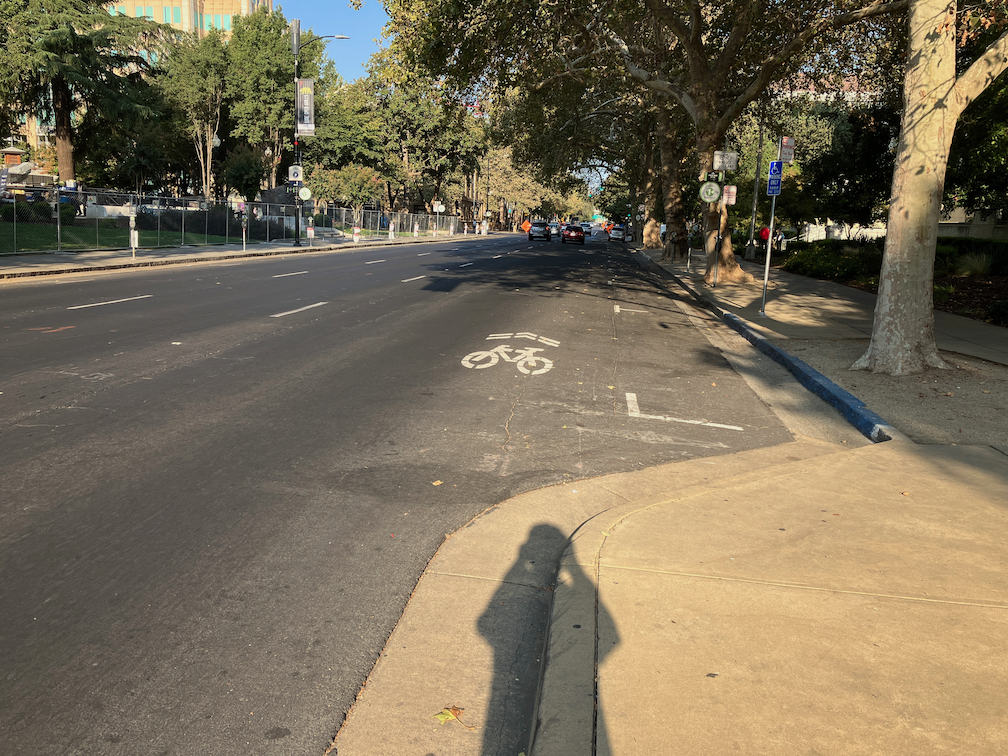
Capitol Avenue, Sacramento, opened to cars but not people, June 2022

The street feels abandoned. There are no people walking or bicycling. There are a very few people at the restaurants. It is hot, hot, hot, with insufficient street trees and an overly wide pavement. Note that if the street were closed (to cars) again, the street could be significantly narrowed, just space for bicyclists. Parking, unnecessary. Bike lane, unnecessary. Travel lanes, just enough width for emergency vehicles. Leaving plenty of space for outdoor dining, and street trees, and even a little nature.

During the closure (to cars), the street felt alive, even when there were few people there, even in the morning before most of the restaurants opened. People were walking and bicycling, and hanging out.

I don’t know why the closure was ended, and all the street canopies and seating removed. I’ve heard a lot of different stories: it was the city, it was the Midtown Association, it was the business owners. So I can’t point any fingers. But what I can say is that what was once clearly alive is now barely hanging on. Will it die? Probably not, but it won’t ever be healthy again, until the cars are again removed.

Cars kill business, cars kill cities. Why do we allow our city to be dominated by cars?

SACOG Board outcome

At the SACOG Board meeting this morning, the board passed the staff-recommended agreement that authorizes Executive Director James Corless to negotiate an MOU (memorandum of understanding) with the transportation sales tax measure proponents and SacTA (Sacramento Transportation Authority) to include elements of the agreement in the MOU and in the ballot measure statement of support.

There was a lot of controversy over this issue, more than I have seen at any board meeting. Representatives of the other five counties (Yolo, Yuba, Sutter, Placer, El Dorado) and the cities within expressed great concerns about the agreement. Some voted no, some voted reluctantly yes, but there was no enthusiasm. The only really enthusiastic voice at all was from David Sander, representative of Rancho Cordova, who is also conveniently the board chair of the Capital Southeast Connector JPA. Even James Corless who supports the compromise expressed considerable discomfort that the agreement was even necessary to keep SACOG in the discussion.

The agreement implies that each new project (not in the current MTP/SCS) will have to completely mitigate all greenhouse gas (GHG) emissions from the reduction. Left unanswered is how that can be accomplished. How can a project like the sprawl and VMT inducing Capital Southeast Connector be mitigated? Will the project fund all mitigation, or will the project proponents come back to SACOG or SacTA begging for funds for mitigation? Are all the other projects expected to pick up the slack in order to meet the required reduction in GHG? Will projects in the other five counties be expected to pick up the slack? Nothing in the agreement says the proponents of these capacity expansion projects will help to meet the regional target of 19% GHG reduction.

Don Saylor of Yolo County asked some very pointed and relevant questions of Corless and SACOG Counsel Kirk Trost. Trost confirmed that it is unlikely that any signatories to the MOU could be held legally accountable, that the MOU would be worthless if it continued the same vague language in the agreement, and that the whole thing was dependent on the good will of all the players. All players includes Sacramento County and each city in the county, and by implication, the Sacramento Metropolitan Air Quality Management District. It is not at all clear whether they will all sign on, or that they will fulfill their agreement. The commitment to the 1970s model of transportation (the dark side), which the measure proposes to continue for 40 years, is very strong among many of the entities in the county, and it would not be surprising if some decided to back out on or just ignore the commitment to mitigating ALL GHG impacts of each project.

The original motion to adopt the agreement and delegate to Corless was modified to include a review (not approval) by the board chair and the chairs of the SACOG committees. A second motion to include formal representation on the review by the other five counties failed, but Corless promised to reach out to them.

Most board members just held their nose and voted yes.

My comments were directed at the mis-information that was being provided by signature gatherers, talking about fixing streets, support for bicycling, and “it’s all for transit”. There was never mention of freeways, interchanges, or capacity expansion, which is largely what the measure is really about. The measure proponents clearly intended to fool the public into signing by not telling the truth about the TEP (Transportation Expenditure Plan). Of course many ballot measures have the same dishonesty, but it is significant in this case because these are the people that Mayor Steinberg and Corless were negotiating with ‘in good faith’. There is no good faith with the proponents.

I think the transportation advocacy community can see a small victory here in that many people are now coming to understand how bad the proposed measure is and specifically how it will harm the region. And they saw today how the proponents intended to bully SACOG, in the measure language, and in this agreement. We lost on this particular vote, but board members can’t really deny anymore that the transportation future of the county and the region has been hijacked.

For more on the measure, see Measure 2022 posts. The use of this category is not meant to confuse. A lot of people are referring to this as Measure A, but the measure letters are assigned by county elections after they have qualified, so this is in no sense Measure A at this time.

small business, not homeownership

Many organizations and governments are again touting homeownership as the path to economic security and wealth creation. I have my doubts. The wealth generated for people who own homes is not wealth out of thin air, nor is it wealth out of moral superiority. It is wealth out of exclusion and externalized costs. Every day, the gap among homeowners, and renters, and unhoused people grows, and the structure of wealth accumulation depends upon this gap.

As we, as a society, come to realize that we cannot continue to subsidize single family homes and their development pattern that requires large amounts of infrastructure, huge amounts of driving, and an impoverishment of cities, the single family home will lose value. This is hard to believe, given the exponential increase in home prices, but it will happen. As has been said by many others, the suburbs will largely collapse of their own weight, of their permanent debt burden. See growth ponzi scheme. Some will survive by changing their form and becoming small towns within the bigger city, but most will not. Detroit is the fate of most suburbs.

So, when the reckoning comes, and the American dream of homeownership comes to an ignominious end, what then is the alternative?

I’d like to propose small business ownership as a better model. No, I have no illusions that small business ownership is easy, or that it is any quick path to wealth. The business owners I talk to would find this laughable. But the wealth that is gradually accumulated is real wealth for the owner and real wealth for the community. It does not need subsidized infrastructure. It does not need an expensive transportation system and associated harms. It may need a small boost from the government, at times, but largely it survives and thrives by being part of an ecosystem of a healthy (and wealthy) community.

Some people claim that homeownership is the way to erase the disparity in wealth between white people and people of color. I’ll let the people of color speak for themselves, but for me, nothing about the current system or the proposed system of widespread homeownership looks likely to erase the gap. In fact, though it may bring a few people from the renter category into the homeowner category, it will very likely cast the rest downward into struggling renters and unhoused. If the government spends money to increase homeownership, as seems the politically preferable action these days, what then of the unhoused? What then of renters? What then of people who live in substandard and deteriorating housing, whether they own it or rent it?

I believe that government should stop subsidizing, and stop promoting large developments and large businesses. Large developments and large businesses seek government support in order to make what they do more profitable, but it is at the expense of the rest of us. This is nowhere more clear than in our transportation system, which was designed, and continues to be designed, to support large corporations and large shopping areas (malls), to make possible long distance commuting which is necessary when we separate single homes from work, shopping and recreation, and which destroys both the general environment on which we depend and the local communities that suffer from this system.

All efforts should instead be focused on small businesses. What do they need to succeed? What small government actions would support them? In this, I am completely aligned with the Strong Towns message:

Strong Towns Chuck Marohn in Citrus Heights on Thursday

Chuck Marohn, President of the Strong Towns organization, will be in the Sacramento area this Thursday (June 16). He is speaking in Citrus Heights, 6:00PM to 7:30PM, and it appears he is also presenting to the SACOG Board at a workshop, item 14 (immediately following consideration of the proposed transportation sales tax measure side agreement).

This conjunction seems appropriate, since Strong Towns has just released its five campaigns that are the core of its new strategic plan:

  1. We’re Advocating for Safe and Productive Streets
  2. America *Must* End Highway Expansions
  3. Your City’s Accounting Is Unnecessarily Obscure. It’s Time To Pull Back the Veil
  4. Legalizing Incremental Change—Everywhere—To Meet America’s Housing Needs
  5. End the Parking Mandates and Subsidies That Are Hurting Our Cities

So, how does the transportation sales tax measure measure up?

  1. It does almost nothing for safe and productive streets. It at least give lip service to complete streets, but since it does not define what that means, the transportation agencies will create arterials that look a little nicer, but do little to slow traffic or increase the number of safe crossings. In fact, it is the unwritten policy of each of the agencies that speed limits will NOT be reduced when a roadway is reconstructed.
  2. It is all about highway expansions. More freeways, more interchanges! More construction jobs dedicated to making our cities worse rather than better.
  3. Accounting. The Existing Measure A has an Independent Taxpayer Oversight Committee (ITOC), which ensures that no one is absconding with funds, but does not address whether the projects actually contribute to economic stability, nor whether bonding almost all projects was a good idea. Measure A income is going largely to pay off bond debt, which is why SacTA and other advocates are so wanting to pass another measure, so Measure A can be bailed out.
  4. The measure says nothing about the connection between land use and transportation. It just makes the assumption that more transportation infrastructure is good, and more sprawl (technically, low density exurban development) is also good.
  5. Parking is hardly mentioned. Yes, this is primarily the purview of local agencies (cities and the county), but it is interesting that none of the projects in the Transportation Expenditure Plan address management of parking. Isleton wants to rehabilitate a parking lot, and the City of Sacramento wants parking facilities (not defined).

I am a founding member of Strong Towns, and the organization has influenced my thinking about transportation and housing more than any other source. I don’t agree with everything, but I do agree with most, and it is these goals that I work to implement in the city, county, and region.

So – go see Chuck!

backroom deals on sales tax

Imagine, if you will, a backroom filled with cigar smoke, burley guys with prominent gun bulges around the edges, the sounds of illegal gambling games coming from the adjacent room, and the clink of bootleg whiskey bottles. Around the table sit power players, working out deals. Someone asks about the public, and one of the burley guys says “We took care of them”.

This is the picture I have of the just-released proposed agreement on the transportation sales tax measure being developed. Read the agreement: Mitigation Agreement, and the SACOG 2022-06-16 Agenda Item 13 Staff Report that introduces it. It is important to realize that this agreement was developed by Sacramento Mayor Darrell Steinberg, SACOG Executive Director James Corless, and the proponents of the measure (called ‘The Campaign’ in the agreement). The proponents are named A Committee for a Better Sacramento, but their website tell the story: two mega-developers of greenfield (agricultural) lands, Cordova Hills Development Corporation and Angelo T. Tsakopoulos and Affiliated Entities, and the California Alliance for Jobs, an organization that supports large infrastructure projects on behalf of construction contractors (it is the contractors, not the workers who are represented). The proponents want the taxpayers to build them a freeway and interchanges to increase the value of their greenfield developments. The public was not involved. Actually, the SACOG Board of Directors was not really involved.

Before going into what is wrong with the agreement, a review of what happened at the last SACOG Board Meeting on May 19. Almost every representative from Sacramento county and cities badmouthed the SACOG study that revealed that the Capital Southeast Connector would likely cause the region to not meet its 19% greenhouse gas (GHG) reduction target, and therefore likely lose a significant amount of state and federal funding for transportation and housing. Several of them even questioned the honesty of the staff that wrote the study. It was a pretty horrible display of politicians saying they know more than professional staff. On the other hand, almost every representative of counties and cities in the region that are not in Sacramento County expressed concern about losing transportation and housing funding if the measure passes. James Corless listened to this, and decided an agreement that helps some select developers and some select projects, while harming the region, is the way to go.

So, the agreement. What is wrong with it?

  1. The agreement accepts that project proponents (cities and the counties, not measure proponents) can make a determination about whether their project meets air quality requirements. It encourages both projects and the overall program to meet SACOG requirements and inclusion in the MTP/SCS, but accepts that they may not. This will establish a precedent that will be used by project hosts and tax measure proponents from now on, to claim they don’t need to follow SACOG.
  2. The agreement proposes that SACOG undertake a study of the proposed measure to determine GHG/VMT impacts. This will be expensive, and the funds will come out of the Sacramento Transportation Authority (SacTA) Measure A funds, meaning less money for other projects. This study would probably be a good idea, but it should have been done before the measure was written, not after. If this measure fails, as it should, advocates should demand that climate impact studies be done before the Transportation Expenditure Plan is completed, not after.
  3. The agreement also proposes a third party study, because, basically, the measure proponents don’t trust SACOG to kowtow to the party line. Who will this third party be? The agreement doesn’t say. Handpicked by the proponents? Handpicked by SacTA (current SacTA Executive Director Kevin Bewsey was formerly the Principal Civil Engineer for Sacramento County, hardly an unbiased role)? The agreement says, if the two studies don’t agree, we’ll talk about it. Hmm. More smokey back rooms.
  4. The agreement depends upon an ‘extra’ $510M in additional sales tax revenue for mitigation. What if sales tax remains flat, or decreases? What if construction and management cost go up at the same rate as the sales tax receipts, thereby eating up the excess? No mitigation, then? That is the implication.
  5. The agreement relies on the good will of the transportation agencies in the county (pretty please) to spend their extra sales tax revenue on mitigation: “…recipient agencies can pledge that the use of these additional funds be used first for GHG Mitigation.” Notice it doesn’t say must or will, just can. Citrus Heights, for example, which is much more likely to propose multi-modal transportation projects than other entities, will be asked to sacrifice sales tax revenue to mitigate the Connector and other capacity expansion projects, even though they won’t benefit from those. The same for the City of Sacramento, which makes it doubly disappointing to me that Mayor Steinberg is a party to this agreement.
  6. The agreement implies that the GHG/VMT generating projects can be mitigated sometime later: “Therein, there should be no net increase to regional GHG emissions after mitigation measures are complete.” It doesn’t say the mitigation needs to happen first, or at the same time as the project, just sometime within the 40 years. Ouch!
  7. An MOU is just a statement of intent, laying out what each party intends to do. It is not a contract, and is not legally binding. If one of the parties is unhappy with what the other parties have done, or not done, they can bring a civil suit, but they may not allege breach of contract, because it is not a contract.
  8. The agenda staff report says it is likely that the SACOG Blueprint will have to be delayed in order for staff to be shifted to the study. This is SACOG’s flagship product. Why in the world would it be delayed just to meet the needs of the transportation sales tax measure proponents? This is crazy.
  9. $100M out of City of Sacramento’s share of sales tax revenues would be added for the Mobility Center. Why? What does this have to do with the Capital Southeast Connector and other roadway capacity expansion projects? Are we going to mitigate all the bad things in the measure with a small investment in electric vehicles?

    The measure proponents are bullying SACOG. This was their intention, else why would they have removed the GHG/VMT climate protection language that was in the deferred 2020 measure? It is as though the school bully said “hand over your lunch money” and the victim counter-proposes an agreement to only give half of the lunch money, and agrees not to report the bully to the Principal (the Principal, in this case, being the public).

Please take a look at the SACOG Board page to see who your representatives are, and contact them about this agreement.

The SACOG Board Meeting is this Thursday, June 16, starting at 9:30AM, and this is agenda item 13. You can view the meeting at https://us06web.zoom.us/j/82132538239. You can comment via Zoom, or by email or online or phone, or even in person. This is apparently the first in-person meeting of the board. See the agenda for details.

For more on the measure, see Measure 2022 posts. The use of this category is not meant to confuse. A lot of people are referring to this as Measure A, but the measure letters are assigned by county elections after they have qualified, so this is in no sense Measure A at this time.

CARB 2022 Scoping Plan

CARB has released for public review the Draft 2022 Scoping Plan Update. The June 23/25 CARB Board Meeting will have public comment (and board decision?) on this document. The document is 255 pages, not even including many appendices. I have only just begun to review the document, but what I see so far is pretty disappointing. For a brief introduction, see the four page Executive Summary. Also see Air Board Seeks Comments on Climate Scoping Plan; Shoup Urges a Look at Parking.

From the Executive Summary: “… rapidly moving to zero-emission transportation, electrifying the cars, buses, trains, and trucks that now constitute California’s single largest source of planet-warming pollution”. Notice that bicycles are not mentioned. Even more worrisome is that one third of the carbon reduction is from actions that capture carbon, including natural environments and as-yet unavailable carbon capture technology.

From the Ensure Equity and Affordability section: “… effective actions to move with all possible speed to clean energy, zero-emission cars and trucks, energy efficient homes, sustainable agriculture, and resilient forests…”. No mention of electric bikes or transit. Unless CARB intends to buy every low income person in the state an electric car, its plan will not meet with needs of low income and disinvested communities. What would meet those needs is a transit-first policy and funding, with significant state investment in making walking and bicycling more welcoming and safer.

In the entire document, there are two instances of ‘bike’ and three of ‘bicycling’ (and none of bicycle or e-bike or electric bicycle). There is one instance of ‘transit’. Six instances of ‘walking’. Ten instances of ‘active transportation’, but 163 instances of ‘transportation’, many of them referring to other documents and programs. In contrast, 157 instances of ‘vehicle’. Not hard to see where the focus is.

Here is a wordcloud of just the Executive Summary section. See if it speaks to your concerns. A wordcloud of the entire document would show vehicle prominently.

CARB seems incapable of imagining a future that is not dominated by cars. They simply intend to replace existing cars with electric cars. Put simply, this is climate arson, by the very agency that is supposed to be working on climate change in a serious way.

Sadly, many of the climate change and environmental organizations seem aligned with this focus on vehicle electrification.

I’ve said it before and will repeat (again and again): electric cars, or any electric vehicles other than bikes, are only a partial solution to the climate crisis. Serious solutions will include and prioritize walking, bicycling and transit. If you are an electric car booster and not working to reduce the dominance of motor vehicles in our cities and lives, you are not serious about climate change. And you are certainly not serious about livable cities.

Lime fails on bike share

Below is a photo of a Lime/JUMP bike that has been abandoned for three weeks now, parked on my street, P Street, between 13th St and 12th St. It has been reported to the city, twice, and to Lime, three times. And it is still there. Of course the battery has depleted so that GPS no longer works. But Lime knows the last reported location of the bike, before it died.

Let me be clear and blunt. Lime does not give a shit.

This kind of neglect will continue until: 1) the city (and SACOG) holds Lime accountable for managing the bike share fleet, 2) the city or the region gets a real bike share operator, or 3) the city or the region changes to a publicly owned system. The third option is probably the best, because then the city and/or region can manage the bike share system as part of the transportation network, and SacRT can take on some responsibility for the bike share system as a first mile/last mile solution with transit.

SACOG Board on sales tax analysis

The SACOG Board met today, and agenda item 12 was on the SACOG Review & Analysis of Proposed Citizens’ Transportation Tax Initiative in Sacramento County. This was an information item, for discussion, not for action. This post is a brief summary of the discussion, to follow on to the earlier post on the analysis: SACOG analysis of Measure 2022. The analysis identifies 26 (or more) capacity expansion projects proposed in the measure’s Transportation Expenditure Plan, all of which would increase GHG/VMT, and most of which would also increase sprawl.

Nearly every representative of the cities and counties in Sacramento County rejected the analysis as being flawed, some even said it was unprofessional. They claimed that the analysis made so many assumptions that it could not be trusted, and that SACOG should not be in the business of producing documents like this. Despite that fact that planning for transportation and land use is specifically the purview of the MPOs, and that they instead support a measure that speculates about transportation needs for 40 years into the future. If you don’t like the message, blame the messenger.

I can’t resist pointing out that this has become a pattern for supporters of more of the same (more capacity expansion, more sprawl, more GHG/VMT):

Supporters of sprawl and the measure proponents: Show us the data!

SACOG: Here is the data.

Supporters of sprawl and the measure proponents: No, not that data. We don’t believe you.

On the other hand, every representative from the other five counties in the SACOG region expressed great concern that allowing the measure to go through would threaten their own transportation projects and funding due to the region not meeting GHG reduction goal of 19%. Don Saylor of Yolo County was the most succinct, saying that SACOG must consider the impact on the region as a whole, and that it is time to move past the limited vision of the past.

The out-of-left-field part of the discussion was that Darrell Steinberg talked about an ongoing negotiation with the measure proponents that would mitigate for the worst aspects of the measure. This apparently has been going on for six weeks, and is the reason the release of the analysis was delayed, even though it was completed a month ago.

Darrell talked about five elements of the negotiation (this is captured from his verbal report, and may not be accurate, no printed information was offered):

  • $300M in the measure for the connector would be contingent upon SACOG defining mitigation measures, and that the Capital Southeast Connector JPA accepted the mitigation.
  • SACOG would develop a scenario in the currently developing MTP/SCS that includes the connector.
  • SACOG would commit to putting the connector in the MTP if these other conditions where met.
  • An additional $300M would be provided for connector mitigation in the measure.
  • $100M will be added to the California Mobility Center, diverted from other projects.

It looks as though Steinberg is putting the onus on SACOG, not on the proponents. It is true that none of the government entities have any control over the measure, but if negotiations are going on, it should be from a position of strength, not weakness. If the City of Sacramento opposed the measure, it is very unlikely that it would pass.

The proponents intended to bully the agencies into supporting it, and to make sure that they got their message across, removed the climate protection language from the measure. They want the agencies to make their own decisions about whether and how to mitigate climate impacts, regardless of regional interests or the intent of the state legislature, or even the interests of the counties that would be impacted.

To my knowledge, no opponents of the measure, of which there are many, the majority of the transit, transportation, and environmental advocacy organizations, were asked to participate in the negotiations. Yet another example of excluding public engagement, just as the people who wrote the measure excluded public engagement.

SACOG said that the analysis would be presented to the various SACOG committees, and would come back to the board in June. It isn’t clear to me what, if anything will happen at that point. I assume the negotiations will have completed by then, successfully or unsuccessfully. It isn’t clear what kind of agreement could be reached that would actually be binding on Sacramento Transportation Authority and the other governments, since a measure, if passed and not found unconstitutional, has the force of law. Maybe there is a way.

For more on the measure, see Measure 2022 posts. The use of this category is not meant to confuse. A lot of people are referring to this as Measure A, but the measure letters are assigned by county elections after they have qualified, so this is in no sense Measure A at this time.